
Mechanical Watch Market Size and Share
Market Overview
| Study Period | 2022 - 2032 |
|---|---|
| Market Size (2027) | USD 94.75 Billion |
| Market Size (2032) | USD 127.12 Billion |
| Growth Rate (2027 - 2032) | 6.05 % |
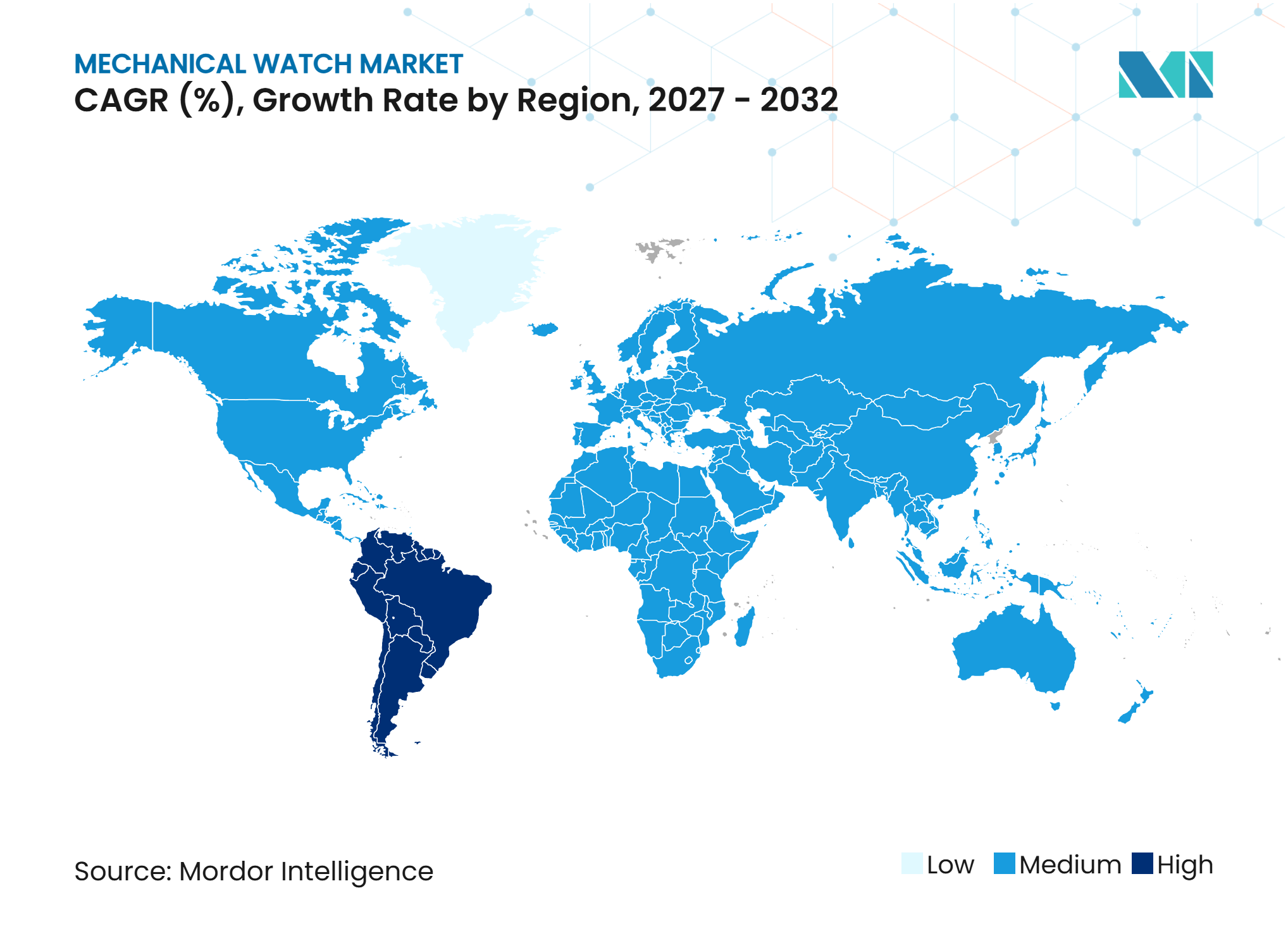
| Fastest Growing Market | South America |
| Largest Market | Asia-Pacific |
| Market Concentration | Low |
Major Players *Disclaimer: Major Players sorted in no particular order Image © Mordor Intelligence. Reuse requires attribution under CC BY 4.0. | |
Mechanical Watch Market Analysis by Mordor Intelligence
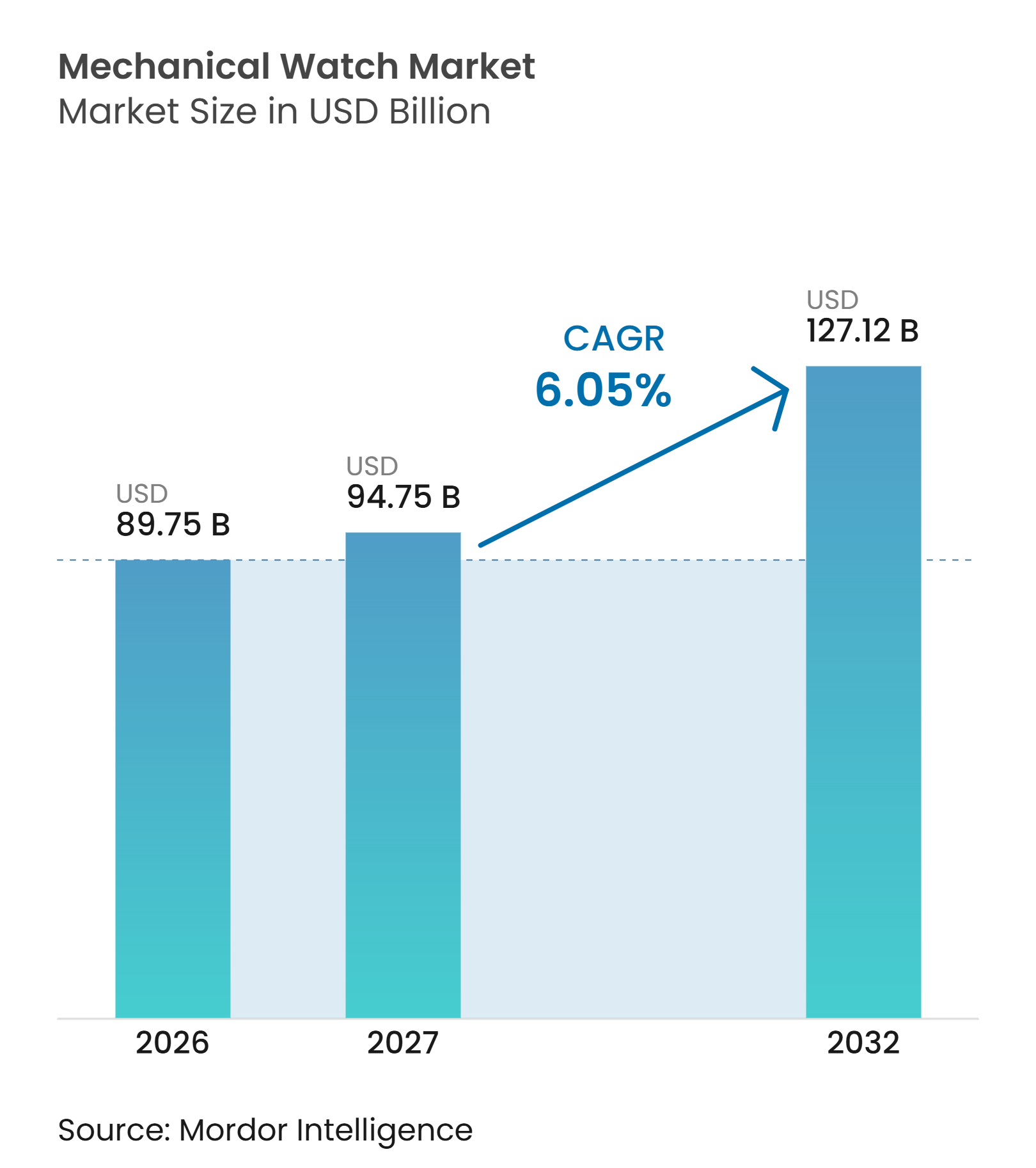
Mechanical Watch Market size was valued at USD 89.75 billion in 2026 and is projected to reach USD 94.75 billion in 2027, further expanding to USD 127.12 billion by 2032, registering a CAGR of 6.05% between 2027 and 2032. The market's growth is primarily driven by increasing consumer appreciation for traditional watchmaking craftsmanship, luxury appeal, and the enduring value of mechanically engineered timepieces. Growing interest in horological heritage, intricate movement mechanisms, and handcrafted components is encouraging consumers to invest in mechanical watches as symbols of sophistication, personal achievement, and timeless style. Furthermore, continuous advancements in movement precision, power reserves, magnetic resistance, and materials are enhancing product performance and strengthening consumer interest in mechanical timepieces.
Key Report Takeaways
-
By product type, Classic Dress Watches held a 38.12% share in 2026, while Sports Watches are projected to grow at a CAGR of 7.35% through 2032.
-
By category, the Mass segment accounted for a 70.12% share in 2026, while the Premium segment is forecast to expand at a CAGR of 7.53% through 2032.
-
By end user, Men represented a 44.34% share in 2026, while the Unisex segment is expected to advance at a CAGR of 7.02% through 2032.
-
By distribution channel, Specialty Stores captured a 54.29% share in 2026, while Online Retail Stores are projected to grow at a CAGR of 7.84% through 2032.
-
By geography, Asia-Pacific held a 34.23% share in 2026, while South America is forecast to grow at a CAGR of 7.41% through 2032.
Note: Market numbers in this report are based on Mordor Intelligence's proprietary estimation framework, which combines nine months of actuals with Q4 projections for base year 2026.
Market Trends and Insights
Drivers Impact Analysis of Mechanical Watch Market*
| Driver | (~) % Impact on CAGR Forecast | Geographic Relevance | Impact Timeline |
|---|---|---|---|
| Growing appreciation for traditional craftsmanship and watchmaking heritage | +1.3% | Global; strongest in Japan, Switzerland, and Western Europe | Long term (≥ 4 years) |
| Increasing popularity of mechanical watches among younger consumers | +1.4% | North America, Asia-Pacific; emerging in South America | Medium term (2–4 years) |
| Technological advancements in mechanical watch movements | +0.9% | Global; innovation centered in Switzerland and Japan | Long term (≥ 4 years) |
| Increasing influence of celebrity endorsements and luxury brand collaborations | +0.7% | North America, Asia-Pacific, Middle East | Short term (≤ 2 years) |
| Expansion of the pre-owned and certified pre-owned watch market | +1.0% | Global; strongest in North America, Europe, and Asia-Pacific | Medium term (2–4 years) |
| Growing consumer preference for timeless and durable accessories | +0.5% | Global; most pronounced in Europe and North America | Long term (≥ 4 years) |
| Source: Mordor Intelligence | |||
Growing Appreciation for Traditional Craftsmanship and Watchmaking Heritage
Growing appreciation for traditional craftsmanship and watchmaking heritage is driving demand for mechanical watches. Consumers increasingly value artisanal techniques, historical design elements, and the specialized expertise associated with traditional watchmaking. The use of hand-finished components, intricate dial decoration, traditional enamel work, and precision-engineered mechanical movements is strengthening the appeal of heritage-inspired timepieces. For instance, in January 2026, Credor, a Seiko Group brand, introduced a limited-edition Goldfeather featuring a traditional Imari Nabeshima porcelain dial, powered by an ultra-thin 1.98 mm manual-winding Calibre 6890, with production restricted to 60 pieces. This launch illustrates how manufacturers are preserving traditional Japanese craftsmanship while integrating it with mechanical movement engineering.
Increasing Popularity of Mechanical Watches Among Younger Consumers
The growing popularity of mechanical watches among younger consumers is supporting market growth. Millennials and Gen Z increasingly view traditional timepieces as expressions of personal style, individuality, and an appreciation for mechanical engineering. Growing exposure to watch-related content through social media, digital collector communities, and influencer-led product reviews is improving awareness of mechanical movements, established watchmaking brands, and collectible models. Rising interest in vintage-inspired designs, limited-edition releases, independent watchmakers, and distinctive mechanical complications is encouraging younger consumers to explore traditional watch ownership. The appeal of understanding movement mechanisms, observing intricate components through exhibition casebacks, and participating in online watch-collecting communities is further strengthening engagement with mechanical timepieces.
Technological Advancements in Mechanical Watch Movements
Technological advancements in mechanical watch movements are driving market growth as manufacturers increasingly focus on improving timekeeping accuracy, power reserve, durability, and overall movement efficiency. The integration of advanced materials, innovative escapement mechanisms, and precision-engineered components is enhancing the performance and reliability of mechanical watches while addressing traditional limitations such as magnetic interference, friction, and sensitivity to external shocks. For instance, in September 2025, TAG Heuer unveiled its TH-Carbonspring technology, developed in-house at the TAG Heuer LAB following nine years of research and development. The carbon-composite hairspring is designed to improve resistance to magnetic fields and external shocks while enhancing the precision and stability of mechanical watch movements.
Increasing Influence of Celebrity Endorsements and Luxury Brand Collaborations
Celebrity endorsements and luxury brand collaborations are emerging as growth drivers in the mechanical watch market, as manufacturers increasingly partner with actors, athletes, musicians, fashion designers, and other influential personalities to strengthen brand visibility and consumer engagement. These partnerships help watchmakers connect with younger and aspirational consumers, enhance brand prestige, and communicate their heritage and craftsmanship through prominent public figures. For instance, in September 2026, Audemars Piguet collaborated with its long-standing brand ambassador and tennis champion Serena Williams to introduce a 38 mm Royal Oak Selfwinding Chronograph. This collaboration reflects the brand's strategy of working with influential personalities to reach new consumer audiences and strengthen its cultural relevance.
Restraints Impact Analysis of Mechanical Watch Market*
| Intense competition from smartwatches and connected wearable devices | -1.3% | Global; highest in mass-market segments; strongest in Asia-Pacific and North America | Medium term (2–4 years) |
|---|---|---|---|
| Vulnerability to counterfeit and imitation products | -0.8% | Global; transit hubs: Hong Kong, Netherlands; end markets: North America, Europe | Long term (≥ 4 years) |
| Dependence on specialized components and raw materials | -0.5% | Switzerland, Japan; broader supply chain in Germany and France | Long term (≥ 4 years) |
| Long production lead times and limited manufacturing scalability | -0.4% | Switzerland; boutique mechanical manufacturers globally | Medium term (2–4 years) |
| Source: Mordor Intelligence | |||
Intense Competition from Smartwatches and Connected Wearable Devices
The growing adoption of smartwatches and connected wearable devices is diverting consumer spending toward multifunctional timekeeping alternatives, posing a significant restraint on the mechanical watch market. Unlike traditional mechanical watches, smartwatches offer features such as fitness tracking, health monitoring, GPS navigation, smartphone notifications, contactless payments, and real-time connectivity, providing greater functional convenience for everyday use. Their ability to integrate with smartphones and other digital ecosystems makes them particularly attractive to technology-oriented consumers and younger demographics seeking multifunctional accessories. Additionally, continuous advancements in wearable technology, improved battery performance, and expanding product affordability are intensifying competition across different price segments.
Vulnerability to Counterfeit and Imitation Products
The increasing prevalence of counterfeit and imitation products poses a significant restraint to the mechanical watch market by undermining brand reputation, exclusivity, and consumer trust associated with established watchmakers. Counterfeit manufacturers replicate the designs, logos, and visual characteristics of premium mechanical watches and distribute them through unauthorized retailers, online marketplaces, and informal sales channels, often at substantially lower prices than authentic products. For instance, according to the German General Directorate of Customs, German customs authorities seized approximately 4.6 million counterfeit products in 2025[1]. German authorities also identify branded watches among the commonly counterfeited luxury products, highlighting the watch industry's exposure to product imitation and intellectual property violations. This widespread counterfeiting activity increases challenges for authentic watch manufacturers in protecting their brand identity and maintaining consumer confidence.
*Our forecasts treat driver/restraint impacts as directional, not additive. The impact forecasts reflect baseline growth, mix effects, and variable interactions.
Mechanical Watch Market Segment Analysis
By Product Type:
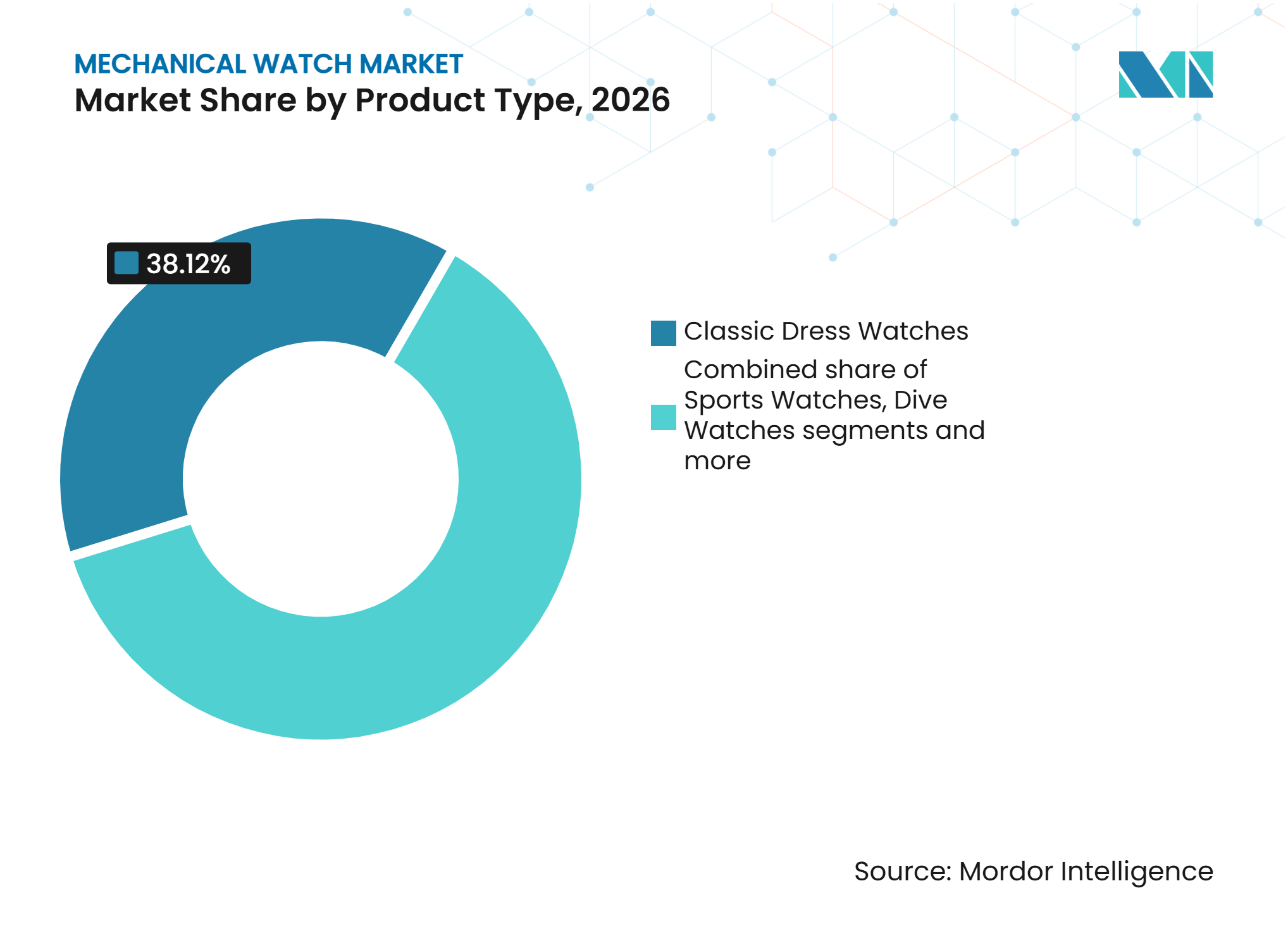
Classic Heritage Sustains Category DominanceClassic Dress Watches hold the largest share in the global mechanical watches market at 38.12% in 2026, sustained by enduring consumer preference for formal aesthetics, grande complication movements, and the investment-grade secondary market performance of limited-production heritage pieces. The segment's growth is further supported by rising demand for high-complication calibres, including perpetual calendars, minute repeaters, and tourbillons, which enhance these timepieces' technical exclusivity and horological value. Additionally, the adoption of advanced movement-finishing techniques, such as Côtes de Genève, perlage, and hand-bevelled bridges, is strengthening product differentiation and attracting collectors interested in mechanical intricacy.
Sports Watches are the fastest-growing product segment, projected at a CAGR of 7.35% from 2027 to 2032, driven by increasing demand for mechanically engineered timepieces offering enhanced durability, shock resistance, and reliable performance under demanding conditions. Advanced movement protection systems, including shock-absorbing mechanisms and improved balance-wheel stabilization, are strengthening their suitability for active use. Furthermore, the integration of anti-magnetic technologies, reinforced case construction, scratch-resistant crystals, and enhanced sealing mechanisms is improving product resilience and operational reliability. Manufacturers are also investing in high-performance mechanical calibres featuring extended power reserves, improved winding efficiency, and greater resistance to external disturbances.



By Category:
Mass Scale Coexists with Premium MomentumThe Mass category holds a 70.12% market share in 2026, supported by the growing availability of standardized mechanical movements, cost-optimized manufacturing processes, and efficient component sourcing. Manufacturers are focusing on simplified calibre architectures, automated component production, and streamlined assembly procedures to improve production efficiency and maintain consistent product quality. The development of reliable entry-level automatic and manual-winding mechanisms is supporting wider product availability across mass-market mechanical watch portfolios. The use of standardized movement components, stainless-steel construction, and mineral crystal glass further supports efficient manufacturing and product consistency.
The Premium category is the fastest-growing segment, projected at a CAGR of 7.53% from 2027 to 2032, driven by increasing demand for high-value timepieces, sophisticated mechanical engineering, and exclusive product offerings. According to the Federation of the Swiss Watch Industry (FH), watches priced above CHF 3,000 accounted for approximately 80.1% of the value of Swiss wristwatch exports in 2025, reflecting the strong contribution of higher-priced timepieces to industry value generation[2]. This demand is supported by growing interest in manufacture-developed movements, intricate complications, premium-grade materials, and specialized finishing techniques. The increasing emphasis on exclusive collections featuring proprietary calibres, hand-finished components, and limited-production designs is further strengthening the segment's growth.
By End User:
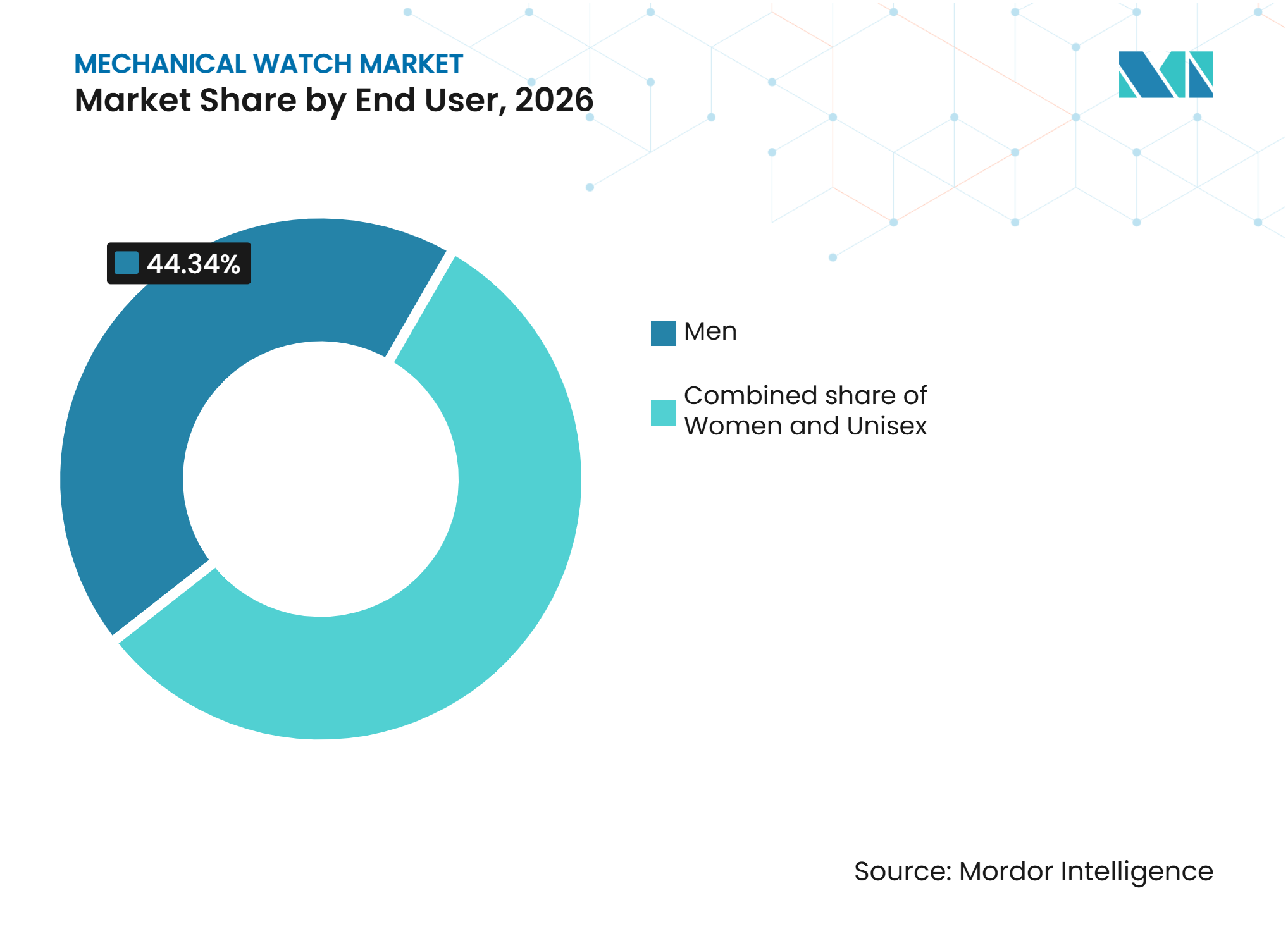
Established Demand Meets Emerging DemographicsMen represent the largest end-user segment in the mechanical watches market, accounting for 44.34% of the market share in 2026. This is supported by sustained demand for mechanically engineered timepieces, established watch-collecting preferences, and a strong presence of men-oriented product portfolios. The segment is driven by continued interest in mechanical chronographs, precision-engineered calibres, and watches featuring specialized complications such as GMT functions, power-reserve indicators, and annual calendars. The availability of diverse movement configurations, case materials, dial finishes, and bracelet options is expanding product choices across different consumer preferences.
The unisex segment is the fastest-growing end-user category, projected at a CAGR of 7.02% from 2027 to 2032. Growth is driven by the increasing adoption of gender-neutral product positioning and changing preferences toward inclusive watch designs. Manufacturers are increasingly developing collections with adaptable styling, neutral dial aesthetics, and versatile design elements that appeal across gender categories. The availability of interchangeable straps, adjustable bracelet systems, and customizable watch configurations is supporting broader product appeal. A shift toward individual style expression, where purchasing decisions are increasingly influenced by personal design preferences rather than conventional gender-based classifications, is further supporting segment expansion.

By Distribution Channel:
Specialty Retail Leads but Digital DisruptsSpecialty stores accounted for a 54.29% market share in 2026, supported by their established retail presence, specialized product knowledge, and personalized customer engagement. The availability of trained sales professionals enables consumers to evaluate movement specifications, mechanical complications, material quality, and product authenticity before making purchasing decisions. Access to authorized collections, exclusive product releases, physical product demonstrations, and professional after-sales servicing further strengthens the channel's market position. Established relationships with watch manufacturers and access to brand-certified repair facilities also reinforce consumer confidence in specialty retail outlets.
Online retail stores represent the fastest-growing distribution channel, projected to register a CAGR of 7.84% from 2027 to 2032. This growth is driven by the increasing adoption of brand-owned e-commerce platforms, digital product discovery, and cross-border online purchasing. Manufacturers and retailers are strengthening their digital presence through detailed product specifications, high-resolution product displays, virtual consultations, and personalized shopping experiences. The integration of secure payment systems, authenticity verification, warranty registration, and convenient delivery services is improving consumer confidence in purchasing mechanical watches online. Omnichannel capabilities, including online reservations, digital customer support, and in-store collection, are further supporting the expansion of online retail distribution.
Geography Analysis
Asia-Pacific
Asia-Pacific accounts for the largest share of the global mechanical watches market, representing 34.23% in 2026, supported by the region's established watch manufacturing ecosystem, strong horological heritage, and expanding consumer interest in premium timepieces. Demand is reinforced by the presence of major watch-producing markets, including Japan, China, and other established Asian markets. According to the Japan Clock & Watch Association (JCWA), exports of finished watches by Japanese manufacturers, including mechanical watches, reached 49.3 million units in 2025, highlighting the region's strong manufacturing and export capabilities[3]. Japan's established expertise in movement engineering, precision component manufacturing, and automatic watch technologies continues to support the regional industry's development.
South America
South America is projected to expand at a CAGR of 7.41% from 2027 to 2032, supported by increasing interest in premium accessories, expanding luxury retail infrastructure, and improving access to international mechanical watch brands. Brazil, Argentina, Chile, and Colombia represent important regional markets, with Brazil serving as a major center for luxury retail distribution. The expansion of authorized dealerships, specialist watch boutiques, and multi-brand retail outlets is improving the availability of internationally recognized mechanical watch collections. Growing interest in automatic movements, collectible timepieces, and premium watch designs is creating additional market opportunities.
Mature Markets Navigate Structural Headwinds
North America, Europe, and the Middle East and Africa are gaining traction in the global mechanical watches market, supported by established luxury retail networks, active collector communities, and sustained interest in specialized horological products. In North America, particularly the United States, demand is supported by specialist watch retailers, luxury boutiques, and growing interest in limited-production and pre-owned mechanical timepieces. Europe benefits from its longstanding watchmaking heritage, established manufacturing capabilities, and concentration of specialized expertise across Switzerland, Germany, France, and the United Kingdom. Meanwhile, the Middle East and Africa market is supported by demand for premium accessories, established luxury shopping destinations, and the presence of international watch brands across the United Arab Emirates, Saudi Arabia, and South Africa.
Competitive Landscape
Market Concentration
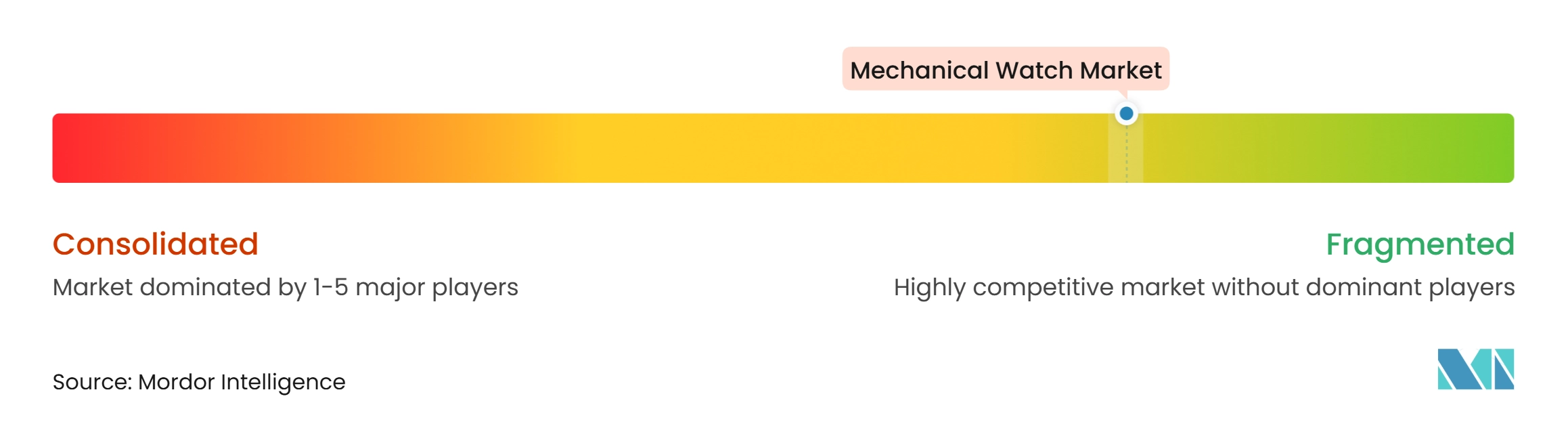
The global mechanical watches market is fragmented, with established luxury watchmakers, diversified watch manufacturing groups, and independent premium brands competing through product innovation, movement engineering, brand positioning, and exclusive collections. Major players such as Rolex SA, Patek Philippe SA, Audemars Piguet Holding SA, Swatch Group Ltd., and Richard Mille SA maintain strong market positions through proprietary mechanical movements, specialized complications, precision manufacturing, and differentiated product portfolios. Competition is particularly influenced by manufacturers' ability to develop in-house calibres, introduce technically advanced timepieces, maintain product exclusivity, and strengthen direct customer relationships.
Product innovation and in-house movement development remain important competitive strategies among leading manufacturers. In February 2026, Audemars Piguet unveiled its new in-house self-winding perpetual calendar openworked movement, Calibre 7139, offering a modern interpretation of the traditional perpetual calendar complication through openworking techniques. This highlights the emphasis on advanced movement architecture, mechanical complexity, and specialized finishing as manufacturers seek to differentiate their collections. Continued investment in proprietary calibres, innovative complications, advanced materials, and limited-production timepieces is strengthening the technical positioning of established watchmakers and supporting competition in the premium mechanical watch segment.
Competitive positioning is further shaped by product exclusivity, brand heritage, distribution control, and customer engagement strategies. Leading manufacturers are strengthening their authorized retail networks, expanding brand-owned boutiques, and maintaining selective distribution to reinforce product positioning and purchasing experiences. Investments in after-sales servicing, certified maintenance networks, authentication systems, and digital ownership records are also becoming important competitive considerations. Manufacturers are increasingly focusing on supply chain control, skilled watchmaking capabilities, proprietary component production, and long-term collector relationships to strengthen brand loyalty and maintain their market positions.
Mechanical Watch Industry Leaders
-
Rolex SA
-
Patek Philippe SA
-
Audemars Piguet Holding SA
-
Swatch Group Ltd
-
Richard Mille SA
- *Disclaimer: Major Players sorted in no particular order
Mechanical Watch Market Companies Covered in this Report
- Rolex SA
- Patek Philippe SA
- Audemars Piguet Holding SA
- Swatch Group Ltd
- Cartier International SNC
- Richard Mille SA
- Richemont International SA
- Omega SA
- LVMH Moet Hennessy Louis Vuitton SE
- Seiko Group Corporation
- Citizen Watch Co., Ltd.
- TAG Heuer SA
- Breitling SA
- Vacheron Constantin SA
- Jaeger-LeCoultre SA
- IWC International Watch Co. AG
- Hublot SA
- Tissot SA
- Grand Seiko
- A. Lange & Söhne
Recent Industry Developments in Mechanical Watch Market
- September 2026: Titan launched Vetra, its first branded in-house mechanical movement, marking a significant milestone in Indian watchmaking. Vetra forms the foundation of the new Titan Automatics collection, powered by the 7A series movement architecture.
- September 2026: Seiko Group Corporation expanded its Prospex Speedtimer collection with four new mechanical watches, comprising two automatic chronographs and two three-hand models.
- June 2026: Casio Computer Co., Ltd. launched the latest addition to its EDIFICE line of timepieces. The new EFK-200 features an automatic mechanical movement and a case polished with separate mirror and hairline finishes, creating a look that changes depending on the viewing angle.
- June 2026: Porsche Design marked the official opening of its new Timepieces Manufactory in Grenchen, Switzerland, reaffirming its commitment as an independent watch manufacturer.
Global Mechanical Watch Market Report Scope
A mechanical watch is a timepiece that uses a complex system of gears, springs, and mechanical parts to measure time rather than relying on a battery or electronic circuitry. The Mechanical Watch Market is segmented by product type, category, end user, distribution channel, and geography. Based on product type, the market is segmented into classic dress watches, sports watches, dive watches, skeleton watches, and others. Based on category, the market is segmented into mass and premium. Based on end user, the market is segmented into men, women, and unisex. Based on distribution channel, the market is segmented into supermarkets/hypermarkets, specialty stores, online retail stores, and other distribution channels. Based on geography, the market is segmented into North America, Europe, Asia-Pacific, South America, and the Middle East and Africa. For each segment, the market sizing and forecast have been done based on the value (in USD).
Segmentation Overview
| Classic Dress Watches |
| Sports Watches |
| Dive Watches |
| Skeleton Watches |
| Others |
| Mass |
| Premium |
| Men |
| Women |
| Unisex |
| Supermarkets/Hypermarkets |
| Specialty Stores |
| Online Retail Stores |
| Other Distribution Channels |
| North America | United States |
| Canada | |
| Mexico | |
| Rest of North America | |
| Europe | United Kingdom |
| Germany | |
| France | |
| Italy | |
| Spain | |
| Netherlands | |
| Poland | |
| Belgium | |
| Sweden | |
| Rest of Europe | |
| Asia-Pacific | China |
| Japan | |
| India | |
| Australia | |
| Indonesia | |
| South Korea | |
| Thailand | |
| Singapore | |
| Rest of Asia-Pacific | |
| South America | Brazil |
| Argentina | |
| Colombia | |
| Chile | |
| Peru | |
| Rest of South America | |
| Middle East and Africa | South Africa |
| Saudi Arabia | |
| United Arab Emirates | |
| Nigeria | |
| Egypt | |
| Morocco | |
| Turkey | |
| Rest of Middle East and Africa |
| By Product Type | Classic Dress Watches | |
| Sports Watches | ||
| Dive Watches | ||
| Skeleton Watches | ||
| Others | ||
| By Category | Mass | |
| Premium | ||
| By End User | Men | |
| Women | ||
| Unisex | ||
| By Distribution Channel | Supermarkets/Hypermarkets | |
| Specialty Stores | ||
| Online Retail Stores | ||
| Other Distribution Channels | ||
| By Geography | North America | United States |
| Canada | ||
| Mexico | ||
| Rest of North America | ||
| Europe | United Kingdom | |
| Germany | ||
| France | ||
| Italy | ||
| Spain | ||
| Netherlands | ||
| Poland | ||
| Belgium | ||
| Sweden | ||
| Rest of Europe | ||
| Asia-Pacific | China | |
| Japan | ||
| India | ||
| Australia | ||
| Indonesia | ||
| South Korea | ||
| Thailand | ||
| Singapore | ||
| Rest of Asia-Pacific | ||
| South America | Brazil | |
| Argentina | ||
| Colombia | ||
| Chile | ||
| Peru | ||
| Rest of South America | ||
| Middle East and Africa | South Africa | |
| Saudi Arabia | ||
| United Arab Emirates | ||
| Nigeria | ||
| Egypt | ||
| Morocco | ||
| Turkey | ||
| Rest of Middle East and Africa | ||
Key Questions Answered in the Report
What is the projected value of the mechanical watches sector by 2032?
The mechanical watches sector is projected to grow from USD 89.75 billion in 2026 to USD 127.12 billion by 2032, at a CAGR of 6.05% from 2027 to 2032.
Which mechanical watch product category has the largest share?
Classic Dress Watches lead the product mix with a 38.12% share in 2026. Sports Watches are the fastest-growing product type, with a projected CAGR of 7.35% through 2032.
Which mechanical watch category is expected to grow the fastest?
The Premium category is projected to expand at a CAGR of 7.53% through 2032.
Which sales channel is growing fastest for mechanical watches?
Online Retail Stores are forecast to grow at a CAGR of 7.84% through 2032.