
Matter Management Software Market Size and Share
Market Overview
| Study Period | 2020 - 2031 |
|---|---|
| Market Size (2026) | USD 2.58 Billion |
| Market Size (2031) | USD 4.48 Billion |
| Growth Rate (2026 - 2031) | 11.67 % |
| Fastest Growing Market | Asia-Pacific |
| Largest Market | North America |
| Market Concentration | Medium |
Major Players *Disclaimer: Major Players sorted in no particular order Image © Mordor Intelligence. Reuse requires attribution under CC BY 4.0. | |
Matter Management Software Market Analysis by Mordor Intelligence
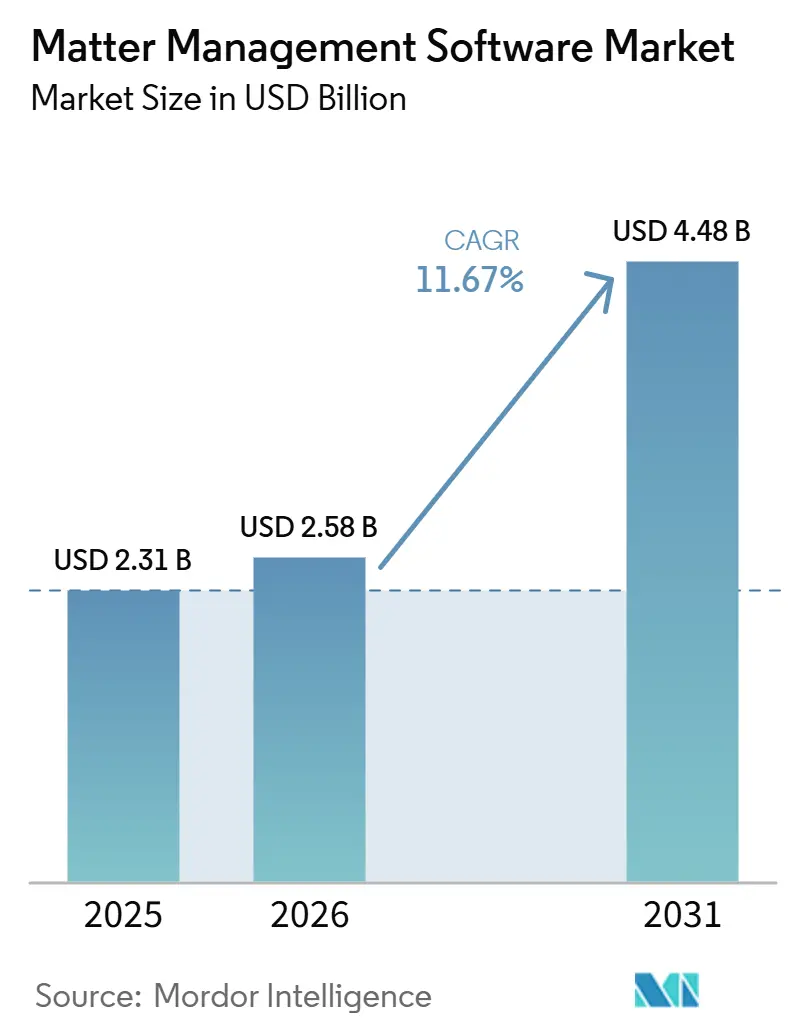
The matter management software market size is projected to expand from USD 2.31 billion in 2025 and USD 2.58 billion in 2026 to USD 4.48 billion by 2031, registering a CAGR of 11.67% between 2026 and 2031. Growth reflects a shift from reactive case handling toward connected systems for matter intake, outside counsel oversight, compliance tracking, and spend analysis. Cloud delivery has become central to this shift because it supports distributed teams, continuous updates, and governed access to legal records. Demand is also strengthened by regulatory work around artificial intelligence, privacy, and environmental reporting, which creates more matters that require deadlines, owners, and reporting trails. Competition centers on secure artificial intelligence functions, workflow automation, and easier integration with existing legal and business systems. Vendors that can address confidentiality concerns and reduce implementation effort have a clearer route to organizations that still rely on legacy processes.
Key Report Takeaways
- By deployment, cloud-based systems held 76.23% share of the matter management software market size in 2025, while hybrid deployment is projected to expand at a 14.96% CAGR through 2031.
- By organization size, large enterprises held 68.54% of revenue in 2025, while small and medium-sized enterprises are projected to grow at a 13.38% CAGR through 2031.
- By matter type, litigation and disputes accounted for 24.82% of revenue in 2025, while compliance and regulatory matters are projected to grow at a 15.84% CAGR through 2031.
- By end user, corporate legal departments accounted for 46.21% of the matter management software market's revenue in 2025, while alternative legal service providers are projected to grow at a 15.31% CAGR through 2031.
- By geography, North America held 38.67% share in 2025, while Asia-Pacific is projected to grow at an 16.54% CAGR through 2031.
Note: Market size and forecast figures in this report are generated using Mordor Intelligence’s proprietary estimation framework, updated with the latest available data and insights as of January 2026.
Market Trends and Insights
Drivers Impact Analysis of Matter Management Software Market*
| DRIVER | (~) % IMPACT ON CAGR FORECAST | GEOGRAPHIC RELEVANCE | IMPACT TIMELINE |
|---|---|---|---|
| Accelerating Cloud Migration in Legal Operations | +3.5% | Global, strongest in North America and Asia-Pacific | Short term (≤ 2 years) |
| AI-Ready Matter Data for Legal Operations Modernization | +3.0% | Global, led by North America and Europe | Long term (≥ 4 years) |
| Growing Demand for Legal Workflow Automation | +2.5% | North America and Europe | Medium term (2-4 years) |
| Rising Regulatory and Privacy Compliance Requirements | +1.5% | Europe, with spillover to North America and Asia-Pacific | Short term (≤ 2 years) |
| Increasing Focus on Outside Counsel Spend Control | +1.0% | North America and Europe | Short term (≤ 2 years) |
| Embedded Legal Operations Across Finance and Procurement Workflows | +0.7% | North America and Europe | Medium term (2-4 years) |
| Source: Mordor Intelligence | |||
Accelerating Cloud Migration in Legal Operations
Cloud-based deployment represented 76.23% of the matter management software market in 2025, and organizations continued moving away from on-premises systems in 2026. The Wolters Kluwer Benchmark Study 2025 found that the use of general file-sharing tools for legal work fell from 46% to 33% in 1 year among surveyed legal professionals in Europe and the United States.[1]Wolters Kluwer, “Benchmarkstudie 2025: Digitalisierung der Rechtsabteilung,” Wolters Kluwer, presseportal.de This change indicates a move toward platforms that organize legal records and permissions in a more consistent way. Cloud repositories also give vendors a practical route to deliver generated summaries, spend analysis, and deadline extraction features. Organizations that retain scattered files or isolated on-premises data may face a slower path to these functions. The result is stronger pressure to treat cloud migration as part of legal operations modernization rather than a simple technology replacement.
AI-Ready Matter Data as a Prerequisite for Legal Operations Modernization
Many legal departments adopted artificial intelligence tools before establishing consistent data structures for their legal work. The 2025 Association of Corporate Counsel benchmark found that 52% of departments used artificial intelligence tools, while 32% used matter management software and 26% used workflow tools. This gap leaves many teams working with data that is incomplete, inconsistently labeled, or separated across systems. It supports demand for the matter management software market because structured matter records provide a controlled base for reliable automation. This need is becoming a more important reason to replace incomplete legal record systems. Mitratech expanded its TeamConnect ARIES capabilities with Advanced Docket Management in March 2026, applying artificial intelligence to governed data within the enterprise system without retaining matter data in the model.[2]Mitratech, “Mitratech Launches ARIES AI for Advanced Docket Management in TeamConnect,” Mitratech, globenewswire.com Legal teams that improve taxonomy and record quality can create a more useful foundation for future artificial intelligence applications.
Growing Demand for Legal Workflow Automation
Legal workflow automation has become a practical solution to administrative tasks that limit attorney capacity. The 2026 Bloomberg Law Attorney Workload and Hours Survey found that attorneys averaged 49 working hours per week and billed 37 hours. A separate Dashboard Legal survey of 2,500 attorneys found that email processing used 66.2% of their working days. The same Bloomberg Law research found that 42% of firms investing in legal technology prioritized automating manual tasks, while 41% cited consistent work quality and reduced non-billable time. These pressures favor matter management software market platforms that automate intake, deadline synchronization, approval routing, and reporting. As teams manage more compliance work with constrained staffing, passive matter tracking is less likely to meet buyer expectations.
Rising Regulatory and Privacy Compliance Requirements
Regulatory obligations are creating recurring work that legal teams need to record and manage. The European Union Artificial Intelligence Act entered into force in August 2024, and its requirements have continued to shape legal and compliance planning in 2026. General Data Protection Regulation obligations apply when artificial intelligence systems process personal data, requiring organizations to assess data flows and controls before deployment. This work can generate separate matters related to vendors, risk assessments, contracts, and internal approvals. The matter management software market benefits when legal departments need to assign accountability, track deadlines, and retain evidence across these related obligations. Demand in the matter management software market is strongest where data protection and artificial intelligence rules require detailed documentation and reliable reporting.
Restraints Impact Analysis of Matter Management Software Market*
| RESTRAINT | (~) % IMPACT ON CAGR FORECAST | GEOGRAPHIC RELEVANCE | IMPACT TIMELINE |
|---|---|---|---|
| Data Security and Client Confidentiality Concerns | -0.8% | Global | Long term (≥ 4 years) |
| Implementation Complexity and Legacy-System Integration Costs | -0.5% | North America and Europe | Medium term (2-4 years) |
| Fragmented Matter Taxonomies Limiting AI Accuracy | -0.3% | Global | Long term (≥ 4 years) |
| Country-Specific Data Residency Requirements | -0.2% | Europe, Asia-Pacific, Middle East and Africa | Medium term (2-4 years) |
| Source: Mordor Intelligence | |||
Data Security and Client Confidentiality Concerns
Artificial intelligence-assisted workflows raise concerns about privileged communications and sensitive case records. Legal buyers increasingly ask whether sensitive information is used to train models, where it is stored, and how access is restricted. Procurement teams also expect contractual commitments on data isolation, configurable residency, and breach notification processes. These requirements can slow selection cycles, especially for mid-sized organizations without dedicated legal technology specialists. They can also favor platforms that document security controls and offer in-region deployment choices. Data security remains a restraint for the matter management software market because confidence in the handling of client information is essential before legal teams will expand automation.
Implementation Complexity and Legacy-System Integration Costs
Replacing an established matter platform involves more than purchasing a new license. Legal teams often need to connect timekeeping, billing, document management, and reporting systems before they can move operational workflows. The Association of Corporate Counsel reported median legal technology spending of USD 123,000 per department annually in its 2025 benchmark. The Wolters Kluwer study also found that only 16% of European legal departments allocated more than EUR 50,000 (USD 57,024) to digital transformation in a given year. Migration, workflow redesign, training, and audit requirements can extend implementation cycles to 12-18 months. Open application programming interfaces and ready-made connectors can lower this burden, but integration remains a barrier for organizations with customized legacy processes.
*Our forecasts treat driver/restraint impacts as directional, not additive. The impact forecasts reflect baseline growth, mix effects, and variable interactions.
Matter Management Software Market Segment Analysis
By Deployment:
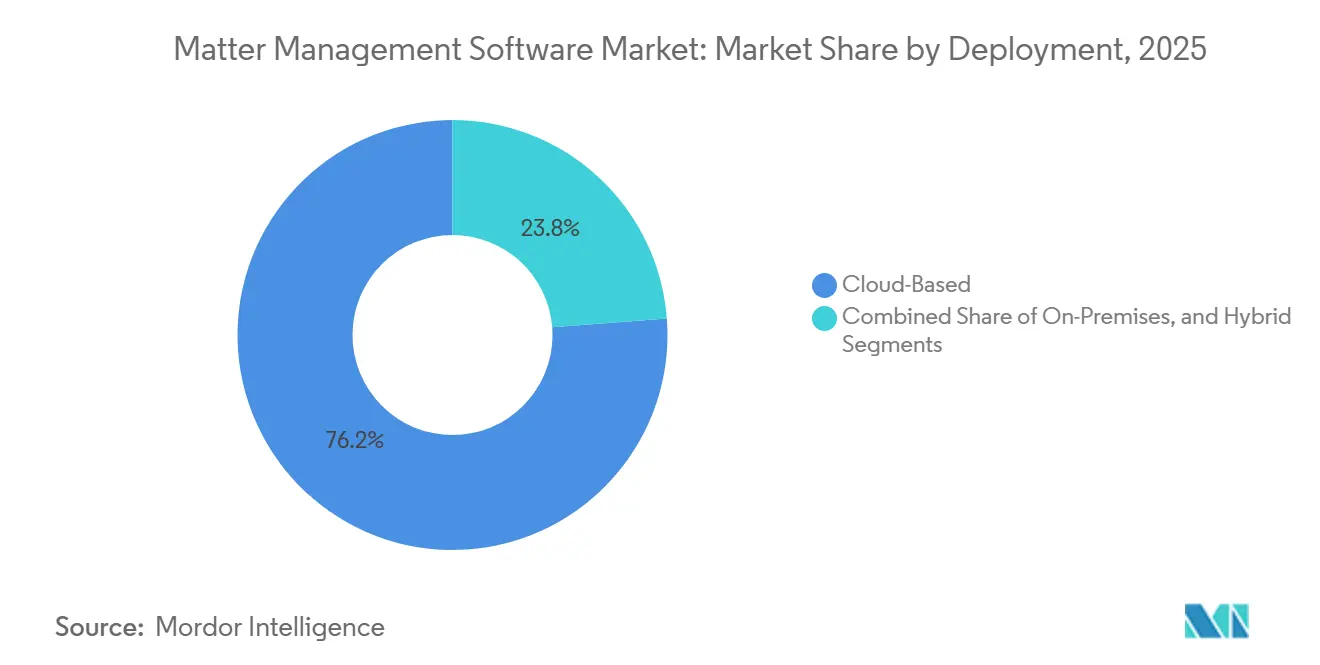
Cloud Platforms Support Connected Legal OperationsCloud-based systems held 76.23% of the matter management software market share in 2025. Their position reflects lower ownership costs, automatic updates, and support for legal teams that work across locations. Cloud systems can also provide controlled access to records for internal users and outside counsel. These capabilities are important as legal departments bring matter intake, documents, invoices, and reporting into a single operating environment. This installed base gives the matter management software market a broad foundation for continued platform upgrades.
Hybrid deployment is projected to record the highest growth rate at a 14.96% CAGR through 2031. This pattern reflects the need to keep highly sensitive records and privileged communications in controlled local environments while using cloud services for analytics and collaboration. The Wolters Kluwer study recorded a decline in the use of unstructured tools such as Google Drive and SharePoint from 46% to 33% in 1 year among surveyed European and U.S. legal departments. iManage introduced its Model Context Protocol Server in May 2026 to allow artificial intelligence systems to access governed matter content without bulk exports or changes to existing security controls. The Matter management software industry therefore has room for both cloud-native and hybrid platforms within the matter management software market.



By Organization Size:
Small and Medium-Sized Enterprises Broaden AdoptionLarge enterprises held 68.54% of revenue in 2025, reflecting their larger legal teams, longer use of enterprise legal management systems, and greater budgets for broad deployments. These organizations often need consistent processes across many business units and jurisdictions. They also have substantial requirements for outside counsel oversight, spend management, and audit-ready reporting. The 2025 Association of Corporate Counsel benchmark found workflow tool use in 59% of organizations with USD 20 billion or more in revenue, compared with 16% of organizations below USD 1 billion in revenue. This use pattern supports continued replacement and expansion opportunities in the matter management software market.
Small and medium-sized enterprises are projected to grow at a 13.38% CAGR through 2031, the fastest rate within this segmentation. Subscription pricing and prebuilt templates reduce the capital and customization burden that once limited software adoption among smaller legal teams. Compliance obligations are also affecting organizations that previously relied on spreadsheets, email, and external counsel for routine coordination.[3]LawVu, “LawVu Acquires ClauseBase,” LawVu, lawvu.com LawVu acquired ClauseBase in December 2025, adding contract drafting automation to its legal operations platform for in-house teams. Vendors that limit information technology dependence and shorten deployment periods can address this open area of the matter management software market.
By Matter Type:
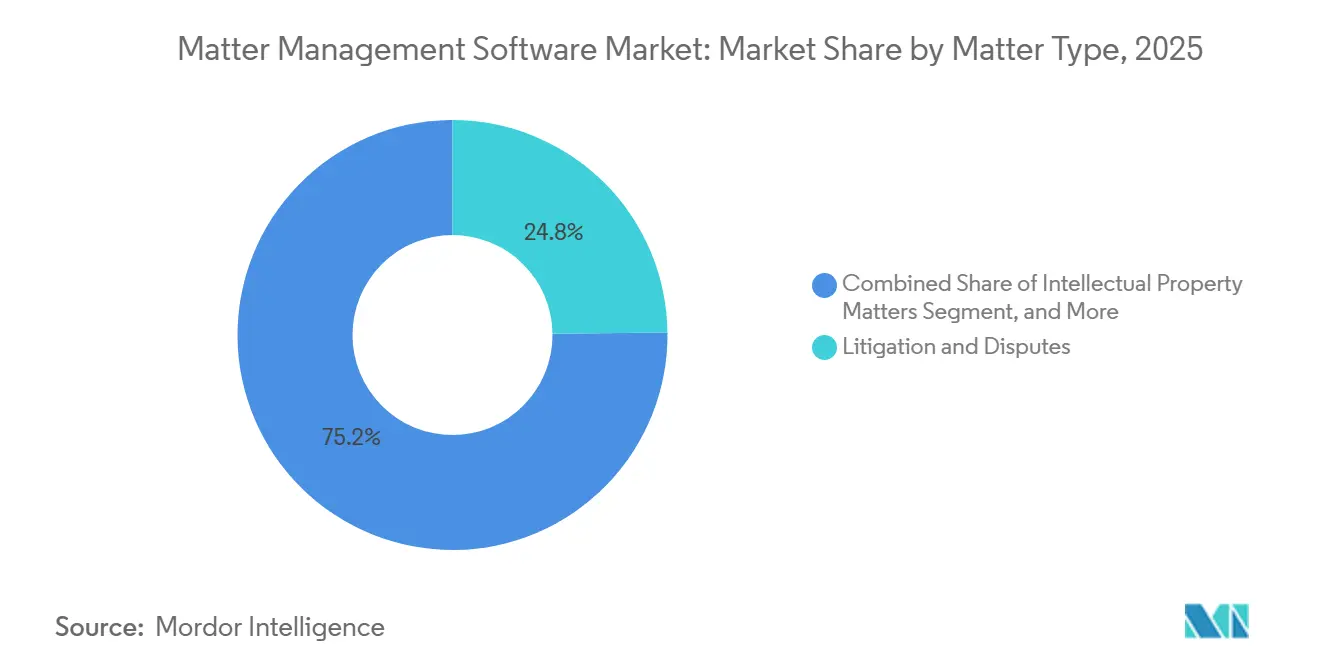
Compliance Work Expands the Legal Workload MixLitigation and disputes accounted for 24.82% of revenue in 2025, making it the largest matter type. Corporate legal departments and law firms require established processes for cases, outside counsel activity, documents, and deadlines. The remaining workload mix comprises commercial and corporate matters, intellectual property matters, employment and labor matters, and claims and investigations. Each category needs different fields, workflows, and reporting rules. Configurable templates remain important for organizations that manage multiple legal functions within a single Matter management software platform.
Compliance and regulatory matters are projected to grow at a 15.84% CAGR through 2031. This activity has become increasingly important as legal teams handle privacy requirements, artificial intelligence governance, cybersecurity oversight, and environmental reporting. Broader matter taxonomies help departments move beyond litigation-focused records and support obligation tracking, categorization, and periodic reporting. Intellectual property management is also receiving attention as technology companies manage filings, brand protection, and enforcement across Asia-Pacific and European jurisdictions. These needs broaden the range of workflows addressed by the matter management software market.
By End User:
Alternative Legal Service Providers Build Operating CapacityCorporate legal departments accounted for 46.21% of revenue in 2025. They remain the main purchasers because they manage external counsel, internal workflows, legal spend, and business reporting. Law firms form the second major buyer group, while government and regulatory agencies, educational institutions, and other users represent smaller but stable groups. Corporate departments also need a central record of matters to support internal governance and business decisions. This established user base continues to support the matter management software market across major regions.
Alternative legal service providers are projected to grow at a 15.31% CAGR through 2031, the fastest end-user rate. These providers use matter platforms as operating systems for repeatable, high-volume legal work and client reporting. The Thomson Reuters Alternative Legal Services Providers 2025 Report estimated the alternative legal service provider sector at USD 28.5 billion in 2023. It also found that 57% of corporate law departments relied on alternative legal service providers for some legal work and that 40% of law firms planned to increase independent provider use in the following year.[4]Thomson Reuters Institute, “Alternative Legal Services Providers 2025 Report,” Thomson Reuters, thomsonreuters.com As these providers take on more compliance monitoring and legal operations work, they require billing links, audit trails, and configurable reports.
Geography Analysis
North America Matter Management Software Market
North America held 38.67% of revenue in 2025. The region benefits from a high concentration of corporate legal departments, established adoption of enterprise legal management, and the presence of vendors such as Thomson Reuters, Mitratech, and Wolters Kluwer. LexisNexis CounselLink tracked nearly 1.8 million matters and more than USD 67 billion in legal spend in its 2025 trends report. It reported that some partner billing rates exceeded USD 1,000 per hour in selected practice areas.[5]LexisNexis, “CounselLink 2025 Trends Report: Benchmark Metrics to Empower Legal Cost Management,” LexisNexis, ln-counsellink.lexisnexis.com Rising legal costs encourage corporate departments to use the matter management software market to oversee outside counsel and make spending decisions.
Europe Matter Management Software Market
Europe is the second-largest region and relies on compliance-related platform investment. The Wolters Kluwer Benchmark Study 2025 found that 41% of European legal departments used contract lifecycle management software, compared with 33% in 2024. It also found that 7% continued to manage contracts through paper archives. This leaves a meaningful opportunity for digitization across legal teams that still use fragmented processes in the matter management software market. Privacy rules and the European Union artificial intelligence framework influence procurement toward vendors that provide regional hosting and contractual data separation.
APAC, South America and MEA Matter Management Software Market
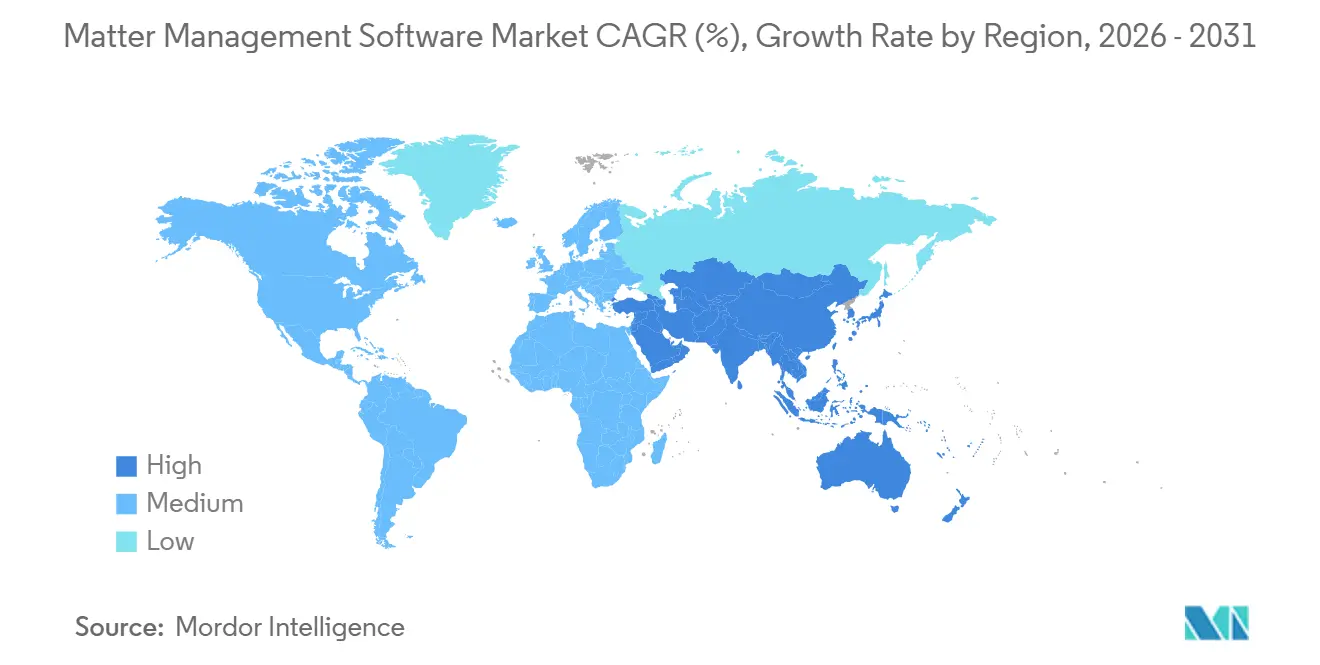
Asia-Pacific is projected to grow at a 16.54% CAGR through 2031, the fastest regional rate in the matter management software market. Judicial digitization in Japan and expansion of corporate legal functions in India are creating new users in both corporate departments and law firms. Huayu Yodex reported that its platform supported more than 40 legal document types and achieved more than 90% automatic case-data extraction accuracy in 2025. South America and Middle East and Africa remain smaller but growing areas, where uneven infrastructure favors cloud-based systems that require limited configuration.

Competitive Landscape
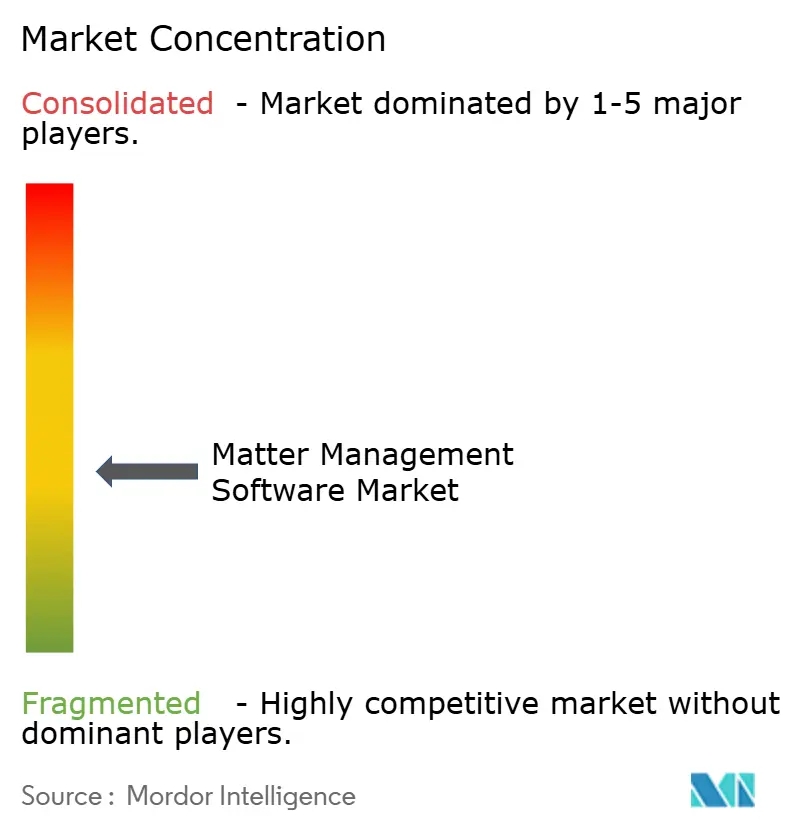
The matter management software market is moderately fragmented beyond the leading enterprise legal management vendors. Thomson Reuters Corporation, Wolters Kluwer N.V., and Mitratech Holdings compete with specialized providers focused on litigation, intellectual property, compliance, or specific buyer groups. Competition is shaped by the ability to combine matter records, documents, invoices, and workflow controls in a single environment. The market structure supports selective consolidation where acquisitions add capabilities or access to a new customer group.
Wolters Kluwer completed its acquisition of Brightflag for EUR 425 million (USD 483.32 million) in June 2025. The transaction added artificial intelligence-enabled legal spend and matter management capabilities and extended the company’s reach in the U.S. and European mid-market. Relativity acquired Gavel in June 2026 to extend legal data intelligence into Microsoft Word-based document automation and contract review. iManage launched its Model Context Protocol Server in May 2026, creating a governed connection between matter knowledge and external artificial intelligence systems. These actions show how the market for matter management software is expanding through acquisitions and strategic partnerships with artificial intelligence.
Artificial intelligence is a major basis of competition in 2026, particularly for deadline extraction, matter summaries, classification, and spend analysis. Buyers need those functions to operate within controlled systems rather than through uncontrolled transfers of privileged data. Vendors are therefore emphasizing security architecture, citations to underlying records, and compatibility with existing legal tools. Opportunities remain for suppliers that place matter management within enterprise resource planning and procurement workflows, where legal and finance teams share responsibility for outside counsel spend. The matter management software market will continue to reward platforms that combine usable automation with clear data governance.
Matter Management Software Industry Leaders
Thomson Reuters Corporation
Wolters Kluwer N.V.
Mitratech Holdings, Inc.
RELX PLC
Themis Solutions Inc.
- *Disclaimer: Major Players sorted in no particular order
Matter Management Software Market Companies Covered in this Report
- Thomson Reuters Corporation
- Wolters Kluwer N.V.
- Mitratech Holdings, Inc.
- RELX PLC
- Themis Solutions Inc.
- Onit, Inc.
- Relativity ODA LLC
- Litera Corp.
- iManage, LLC
- Aderant Holdings, Inc.
- Filevine, Inc.
- Anaqua, Inc.
- Everlaw, Inc.
- Rocket Matter, LLC
- Smokeball, Inc.
- Paradigm Corporation
- App4Legal, Inc.
- Legal Files Software, Inc.
- NetDocuments Software, Inc.
- Lexzur
- Xakia Technologies
- Brightflag, Inc.
- SimpleLegal, Inc.
- LawVu Limited

Recent Industry Developments in Matter Management Software Market
- June 2026: Relativity acquired Gavel, an AI-native document automation and contract review company, to extend its AI platform for legal data intelligence into Microsoft Word. Gavel's solutions were used by thousands of legal professionals to draft, review, and automate work product. The acquisition marked Relativity's 4th publicly announced transaction since 2021 and its 2nd in the contract review space.
- May 2026: iManage unveiled the next evolution of its platform at ConnectLive 2026, introducing the iManage MCP Server, a standardized, open-protocol connection enabling any AI system to access governed matter knowledge without custom integrations or bulk data exports. The update also included expanded AI ecosystem access through Anthropic's Claude partner store, positioning iManage as a trust infrastructure for third-party AI deployments.
- May 2026: NetDocuments unveiled an industry-first Legal Context Graph, a continuously updated map of how every matter, document, and communication within a firm connects across hundreds of millions of records, alongside a fundamentally reimagined platform experience. Private preview opened to Enterprise AI tier customers.
- March 2026: NetDocuments launched Smart Answers and expanded direct connectivity to leading AI models including ChatGPT and Claude, establishing the platform as an active intelligence layer that surfaces matter context to AI tools without file downloads or manual transfers.


Global Matter Management Software Market Report Scope
The matter management software market is defined as the market for digital platforms that help corporate legal departments, law firms, and regulatory agencies centralize, track, and manage legal matters throughout their lifecycle, from intake and triage to litigation, compliance, intellectual property, and spend management. These solutions combine workflow management, document tracking, collaboration tools, and analytics to improve operational efficiency, support regulatory compliance, and enhance visibility across legal operations. By incorporating automation, AI-driven summarization, and predictive analytics, matter management software converts fragmented legal processes into structured, data-driven workflows and serves as a core system of record for modern legal operations.
The Matter Management Software Market Report is Segmented by Deployment (Cloud-Based, On-Premises, and Hybrid), Organization Size (Large Enterprises, and Small and Medium Enterprises), Matter Type (Litigation and Disputes, Commercial and Corporate Legal Matters, Compliance and Regulatory Matters, Intellectual Property Matters, Employment and Labor Matters, and Claims and Investigations), End User Industry (Corporate Legal Departments, Law Firms, Government and Regulatory Agencies, Alternative Legal Service Providers, Educational Institutions, and Other End User Industries), and Geography (North America, South America, Europe, Asia-Pacific, and Middle East and Africa). The Market Forecasts are Provided in Terms of Value (USD).
| Cloud-Based |
| On-Premises |
| Hybrid |
| Large Enterprises |
| Small and Medium-Sized Enterprises |
| Litigation and Disputes |
| Commercial and Corporate Legal Matters |
| Compliance and Regulatory Matters |
| Intellectual Property Matters |
| Employment and Labor Matters |
| Claims and Investigations |
| Corporate Legal Departments |
| Law Firms |
| Government and Regulatory Agencies |
| Alternative Legal Service Providers |
| Educational Institutions |
| Other End User Industries |
| North America | United States | |
| Canada | ||
| Rest of North America | ||
| South America | Brazil | |
| Argentina | ||
| Rest of South America | ||
| Europe | United Kingdom | |
| Germany | ||
| France | ||
| Italy | ||
| Spain | ||
| Russia | ||
| Rest of Europe | ||
| Asia-Pacific | China | |
| Japan | ||
| India | ||
| Australia | ||
| South Korea | ||
| Singapore | ||
| Rest of Asia-Pacific | ||
| Middle East and Africa | Middle East | United Arab Emirates |
| Saudi Arabia | ||
| Israel | ||
| Turkey | ||
| Rest of Middle East | ||
| Africa | South Africa | |
| Nigeria | ||
| Egypt | ||
| Rest of Africa | ||
| By Deployment | Cloud-Based | ||
| On-Premises | |||
| Hybrid | |||
| By Organization Size | Large Enterprises | ||
| Small and Medium-Sized Enterprises | |||
| By Matter Type | Litigation and Disputes | ||
| Commercial and Corporate Legal Matters | |||
| Compliance and Regulatory Matters | |||
| Intellectual Property Matters | |||
| Employment and Labor Matters | |||
| Claims and Investigations | |||
| By End User Industry | Corporate Legal Departments | ||
| Law Firms | |||
| Government and Regulatory Agencies | |||
| Alternative Legal Service Providers | |||
| Educational Institutions | |||
| Other End User Industries | |||
| By Geography | North America | United States | |
| Canada | |||
| Rest of North America | |||
| South America | Brazil | ||
| Argentina | |||
| Rest of South America | |||
| Europe | United Kingdom | ||
| Germany | |||
| France | |||
| Italy | |||
| Spain | |||
| Russia | |||
| Rest of Europe | |||
| Asia-Pacific | China | ||
| Japan | |||
| India | |||
| Australia | |||
| South Korea | |||
| Singapore | |||
| Rest of Asia-Pacific | |||
| Middle East and Africa | Middle East | United Arab Emirates | |
| Saudi Arabia | |||
| Israel | |||
| Turkey | |||
| Rest of Middle East | |||
| Africa | South Africa | ||
| Nigeria | |||
| Egypt | |||
| Rest of Africa | |||


Key Questions Answered in the Report
What is the matter management software market size?
The matter management software market size is projected to expand from USD 2.31 billion in 2025 and USD 2.58 billion in 2026 to USD 4.48 billion by 2031, registering a CAGR of 11.67% between 2026 and 2031.
Which deployment model leads adoption?
Cloud-based deployment held 76.23% of revenue in 2025. Hybrid deployment is projected to be the fastest-growing model at a 14.96% CAGR through 2031.
Why are legal teams adopting matter management platforms?
Legal teams use these platforms to manage intake, records, outside counsel activity, compliance tasks, legal spend, and reporting in a controlled system.
Which matter type is growing fastest?
Compliance and regulatory matters are projected to grow at a 15.84% CAGR through 2031, supported by privacy, artificial intelligence, cybersecurity, and reporting obligations.
Which users are expected to grow fastest?
Alternative legal service providers are projected to grow at a 15.31% CAGR through 2031 as they scale repeatable legal work and client reporting.
Which region is expanding fastest?
Asia-Pacific is projected to grow at a 16.54% CAGR through 2031, supported by judicial digitization and expansion of corporate legal functions.
Page last updated on:





