
Marketing Procurement Services Market Size and Share
Market Overview
| Study Period | 2020 - 2031 |
|---|---|
| Market Size (2026) | USD 3.85 Billion |
| Market Size (2031) | USD 6.09 Billion |
| Growth Rate (2026 - 2031) | 9.61 % |
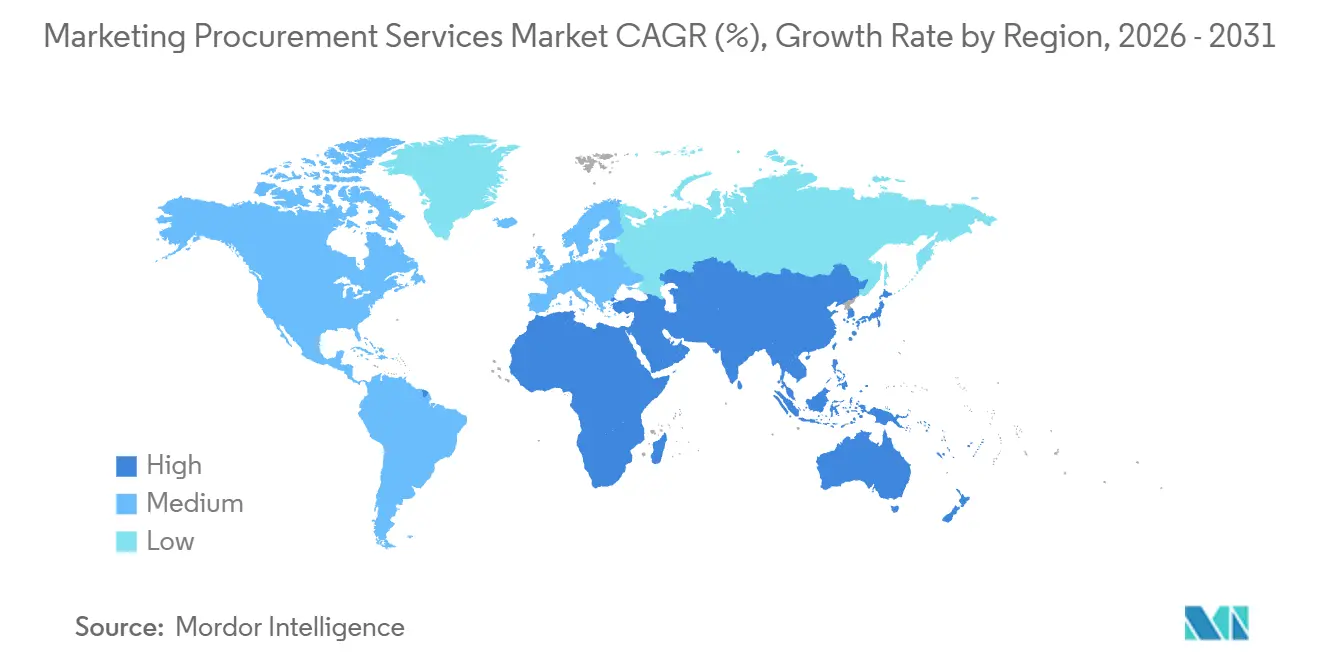
| Fastest Growing Market | Asia-Pacific |
| Largest Market | North America |
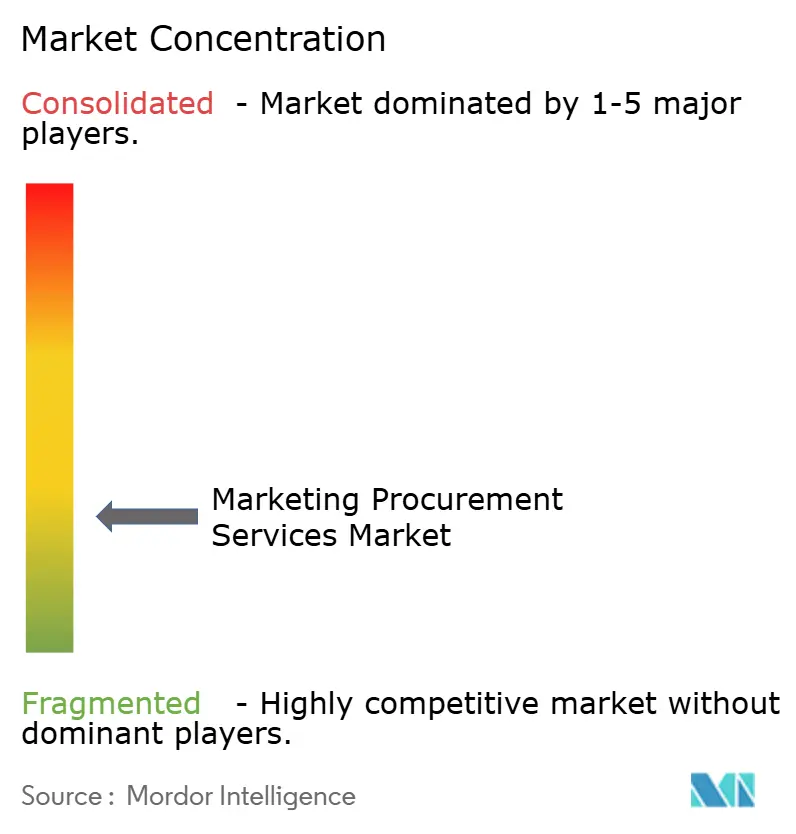
| Market Concentration | Low |
Major Players *Disclaimer: Major Players sorted in no particular order Image © Mordor Intelligence. Reuse requires attribution under CC BY 4.0. | |
Marketing Procurement Services Market Analysis by Mordor Intelligence
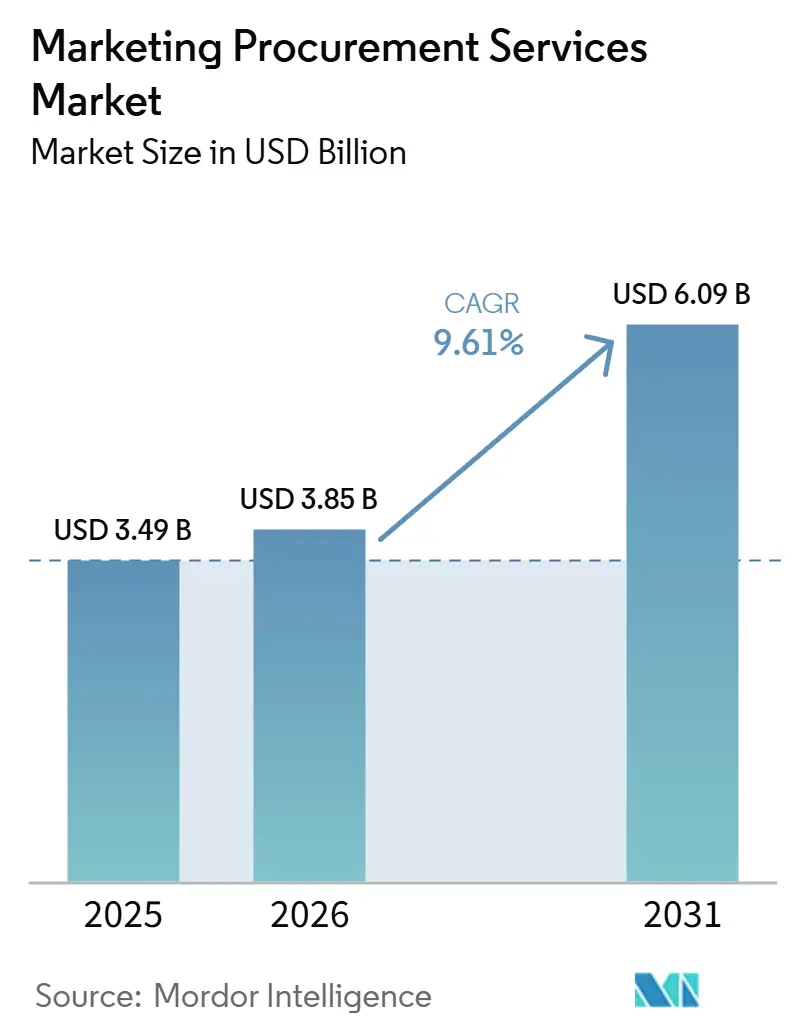
The marketing procurement services market size is projected to expand from USD 3.49 billion in 2025 to USD 3.85 billion in 2026, and to USD 6.09 billion by 2031, registering a CAGR of 9.61% between 2026 and 2031. Growth reflects a move away from informal agency oversight toward structured sourcing and clearer controls over marketing spending. Budget scrutiny, a wider mix of digital channels, and more complex agency contracts are increasing demand for services that connect commercial discipline with campaign performance. Programmatic media, artificial intelligence contract terms, and closer review of data access within agency relationships are also shaping the marketing procurement services market. Providers are responding with media audits, supplier management, contract review, and technology-supported spend analysis. The opportunity is strongest where procurement teams can support marketing decisions without slowing campaign execution or reducing creative flexibility.
Key Report Takeaways
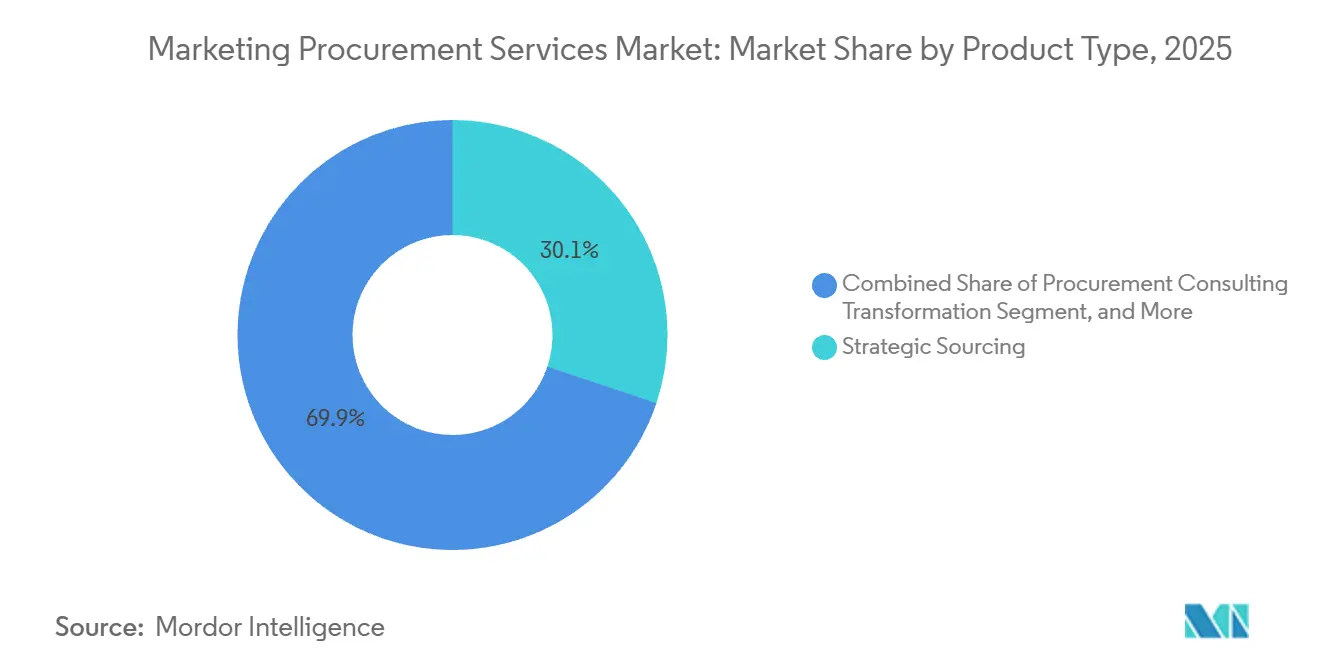
- By product type, Strategic Sourcing held 30.12% of the Marketing Procurement Services Market share in 2025, while Procurement Consulting and Transformation is projected to expand at a 10.67% CAGR through 2031.
- By marketing spend category, Media Procurement accounted for 32.13% of the marketing procurement services market in 2025, while Digital Marketing Procurement is projected to grow at a 9.89% CAGR through 2031.
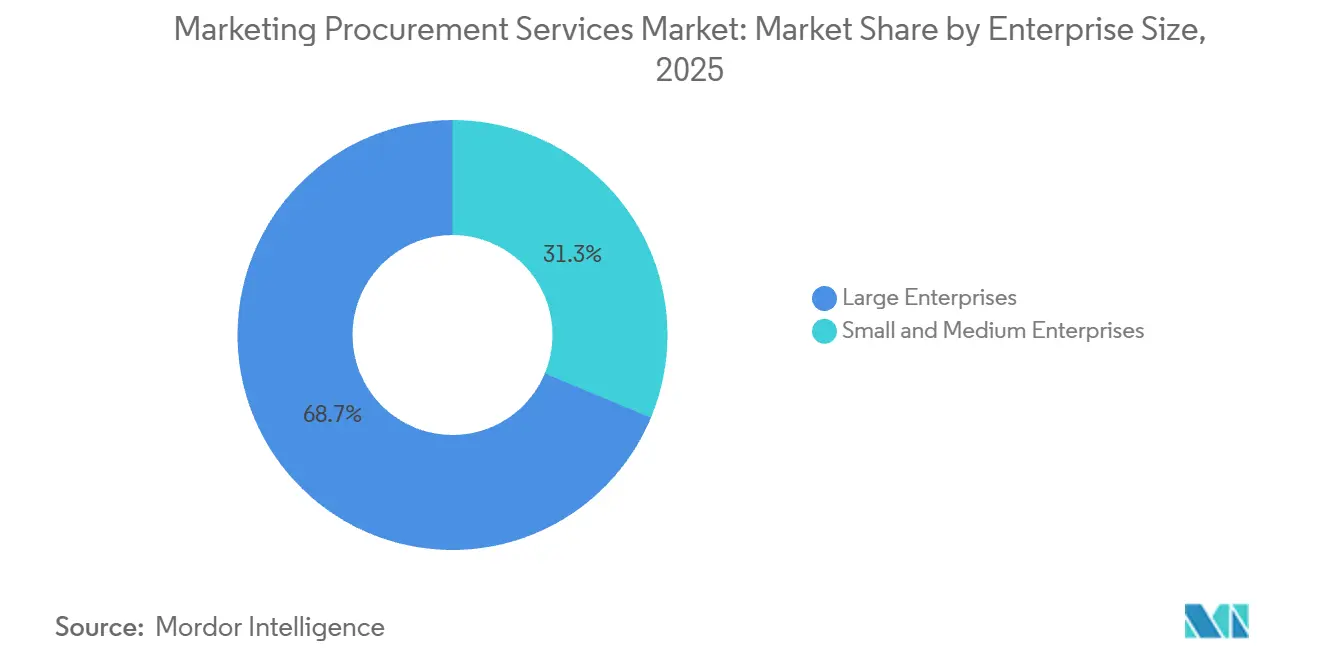
- By enterprise size, Large Enterprises held 68.72% of the marketing procurement services market in 2025, while Small and Medium Enterprises are projected to advance at a 10.11% CAGR through 2031.
- By end-user industry, Retail and E-commerce accounted for 24.18% of the marketing procurement services market in 2025, while Healthcare and Life Sciences are projected to expand at an 11.12% CAGR through 2031.
- By geography, North America held 37.18% of the marketing procurement services market in 2025, while Asia-Pacific is projected to grow at an 11.21% CAGR through 2031.
Note: Market size and forecast figures in this report are generated using Mordor Intelligence’s proprietary estimation framework, updated with the latest available data and insights as of January 2026.
Market Trends and Insights
Drivers Impact Analysis of Marketing Procurement Services Market*
| Driver | (~) % Impact on CAGR Forecast | Geographic Relevance | Impact Timeline |
|---|---|---|---|
| Need for Measurable Marketing Returns and Spend Optimization | +1.8% | Global, with highest urgency in North America and Europe | Short term (≤ 2 years) |
| Expansion of Multi-Channel Digital Advertising Campaigns | +1.6% | Global, concentrated in North America and Asia-Pacific | Medium term (2-4 years) |
| Growth of Programmatic and Real-Time Bidding Sourcing Technologies | +1.5% | Global, strongest in North America and Western Europe | Medium term (2-4 years) |
| Generative AI Contract Valuation and Fee Structure Auditing | +1.3% | Global, with early adoption in North America and Western Europe | Medium term (2-4 years) |
| Corporate ESG and Sustainable Sourcing Mandates | +0.8% | Europe and North America, with growing spillover to Asia-Pacific | Long term (≥ 4 years) |
| Agency Relationship Capital as a Sourcing Metric | +0.7% | Global, with advanced adoption in North America and Australia | Long term (≥ 4 years) |
| Source: Mordor Intelligence | |||
Growing Need for Measurable Marketing ROI and Spend Optimization
Budget pressure is encouraging companies to review marketing spend with greater discipline. The marketing procurement services market benefits when organizations need savings without weakening campaign delivery. Procurement teams are therefore being asked to consider measures such as return on ad spend and marketing efficiency alongside price and supplier terms. This changes the role of procurement from rate negotiation toward decisions that affect marketing performance. It also increases the value of teams that can interpret media data and apply it to commercial decisions. The Marketing Procurement Services Market has room to expand, particularly as this work improves both financial oversight and allocation decisions.
Expansion of Multi-Channel Digital Advertising Campaigns
Digital advertising has created a broader supplier base across programmatic media, connected television, retail media, social commerce, and creator platforms. This makes it harder to use one commercial model across all campaign types. Germany's online advertising volume reached EUR 35.6 billion (USD 38.8 billion) in 2026, exceeding EUR 27.5 billion (USD 31.69 billion) in traditional media investment. Marketing teams often understand channel performance, while procurement teams bring contract and supplier expertise. The marketing procurement services market grows as organizations seek advisers who can apply both perspectives to a single governance process. This need supports consulting and transformation work as companies update their sourcing practices to accommodate a broader digital media mix.[1]Association of National Advertisers, “Q1 2026 Programmatic Transparency Benchmark,” Association of National Advertisers, ana.net
Rapid Proliferation of Programmatic and Real-Time Bidding Sourcing Technologies
Programmatic buying requires commercial oversight that keeps pace with automated media delivery. The ANA found that higher-performing advertisers converted 54.0% of programmatic spending into qualified impressions in the first quarter of 2026, compared with 32.1% for lower-performing advertisers.[2]Association of National Advertisers, “Programmatic Transparency Benchmark,” Association of National Advertisers, ana.net The difference points to media productivity issues rather than to transaction costs alone. The ANA also estimated that inefficiencies destroyed USD 26.8 billion in global media value during 2025. Advertisers need access to log-level data, audit rights, and clear contractual terms to assess the value they receive. The marketing procurement services market is supported by demand for supply-path review and independent media auditing.
Rise of Generative AI Contract Valuation and Fee Structure Auditing
Generative AI is changing how agencies produce content and how clients assess agency fees. Agency contracts need to clarify AI use, ownership of generated work, data access, and audit rights. The ANA released a standardized AI contract rider in 2025 to address these matters for advertisers and agencies. The Marketing Procurement Services Market can benefit as clients replace labor-based fee assumptions with measures of content reuse, delivery speed, and error control. European contract requirements are becoming more demanding as disclosure and compliance obligations take effect in 2026. Procurement specialists can help marketing and legal teams translate these expectations into agency master service agreements.[3]Bundesverband Digitale Wirtschaft, “Marketing Trend Ranking,” absatzwirtschaft, bvdw.de
Restraints Impact Analysis of Marketing Procurement Services Market*
| Restraint | (~) % Impact on CAGR Forecast | Geographic Relevance | Impact Timeline |
|---|---|---|---|
| Cultural Friction Between Marketing Teams and Sourcing Professionals | -0.8% | Global, most pronounced in North America and Europe | Short term (≤ 2 years) |
| Data Asymmetry and Hidden Markups in Programmatic Media Networks | -0.7% | Global, particularly North America and Europe | Medium term (2-4 years) |
| Lack of Standardized Measures for Intangible Creative Deliverables | -0.5% | Global | Medium term (2-4 years) |
| Inertia From Legacy Agency-of-Record Agreements | -0.4% | Global, with greater impact in large-budget markets | Long term (≥ 4 years) |
| Source: Mordor Intelligence | |||
Heavy Resistance and Cultural Friction Between Marketing Teams and Sourcing Professionals
The most persistent constraint is often organizational rather than financial. In April 2026, the APS Group reported that 84% of marketing teams faced collaboration challenges that affected execution speed and clarity.[4]The APS Group, “4 Shifts Shaping Marketing and Procurement in 2026,” The APS Group, theapsgroup.com Marketing teams can view procurement involvement as a barrier to quick decisions and trusted agency relationships. Procurement teams may struggle to show value beyond savings when creative work is difficult to compare. A 2025 survey from Setup found that strong client-agency relationships depend on shared performance expectations and commercial transparency. The marketing procurement services market may grow more slowly when organizations do not give marketing and procurement equal roles in planning and supplier governance.
Severe Data Asymmetry and Hidden Markup Costs in Opaque Programmatic Media Sourcing Networks
Programmatic media supply chains can limit visibility into fees, inventory quality, and intermediary margins. The ANA's 2026 benchmark showed that qualified-impression performance differed materially across advertisers, reinforcing the need for transparent media data. Principal buying arrangements can further restrict client visibility when agencies purchase inventory and resell it through undisclosed margins. Procurement teams cannot address this issue without access to data, specialized audit skills, and enforceable contract clauses. Direct supply-side contracts and recurring independent reviews can improve the information available to advertisers. The marketing procurement services market faces a restraint whereby advertisers continue to adopt commercial models that limit the assessment of media value.
*Our forecasts treat driver/restraint impacts as directional, not additive. The impact forecasts reflect baseline growth, mix effects, and variable interactions.
Marketing Procurement Services Market Segment Analysis
By Product Type:
Strategic Sourcing Supports the Core Base While Consulting Leads ChangeStrategic Sourcing held 30.12% of the Marketing Procurement Services Market share in 2025. It is commonly the first formal capability that organizations establish for marketing spend governance. Companies use it to consolidate agency rosters, standardize request-for-proposal processes, and classify suppliers. These activities create a base for stronger control over fees, terms, and delivery expectations. The category remains important because global advertisers need a consistent way to manage agency relationships across markets. It also gives procurement teams a clearer view of where marketing funds are being committed.
Procurement Consulting and Transformation is projected to grow at a 10.67% CAGR from 2026 to 2031. Demand reflects changes in artificial intelligence, outcome-based compensation, data ownership, and marketing technology licensing. Organizations increasingly need support to redesign their procurement operating models rather than simply negotiate contracts. Supplier Management is gaining attention as agency ecosystems expand beyond a single agency of record to include specialized partners. Contract Management, Spend Analysis, and Analytics are also advancing through tools that identify clauses and irregularities in agency fee statements. The Marketing Procurement Services Market includes platform-based services that offer managed sourcing portals, automated workflow tools, and focused advisory for companies without dedicated procurement teams.



By Marketing Spend Category:
Media Procurement Leads as Digital Media BroadensMedia Procurement accounted for 32.13% of the marketing procurement services market in 2025. The category leads because paid media accounts for a substantial share of advertising budgets. Retail media spending is expanding in the United States, increasing the need for commercial control of media relationships. Major retail media platforms concentrate a significant share of this spending. This concentration raises the stakes for retail brands that need to manage terms, measurement, and media performance. Media procurement is also central to the review of agency trading practices and programmatic supply paths.
Digital Marketing Procurement is projected to grow at a 9.89% CAGR from 2026 to 2031. Organizations need more specialized sourcing methods for search, social commerce, retail media, connected television, and programmatic display. Traditional advertising procurement remains important for creative production, broadcast media, and integrated campaigns. However, AI content tools are changing how buyers value human-created and AI-assisted work. Market Research Procurement now covers synthetic data, AI-generated consumer insights, panel studies, and conventional research agencies. Events Procurement is focused on sustainability requirements and coordination of multiple suppliers across global event calendars.
By Enterprise Size:
Large Enterprises Drive Revenue While Smaller Firms Gain AccessLarge Enterprises held 68.72% of the marketing procurement services market in 2025. Their marketing budgets can support dedicated procurement teams, agency roster management, and spend analytics platforms. These firms often use master service agreements with agency holding companies across several markets. They also have the data systems needed to benchmark spending by channel and geography. This capability makes structured procurement a practical part of their marketing governance. Large enterprises, therefore, continue to provide the main revenue base for service providers.
Small and Medium Enterprises are projected to expand at a 10.11% CAGR from 2026 to 2031. Software-based platforms are reducing the cost and effort required to implement agency benchmarking, improve spend visibility, and evaluate suppliers. This makes formal procurement more accessible to advertisers who previously relied on agency recommendations. The ANA found a 21.9-percentage-point gap in qualified-impression conversion between higher- and lower-performing programmatic advertisers in 2026. Growing firms that manage several active media channels face a greater risk of duplicated buying and inconsistent measurement. The marketing procurement services industry can reach these buyers through lower-cost, self-service services and advisory support.
By End-User Industry:
Retail Leads While Healthcare and Life Sciences Grows FastestRetail and E-commerce accounted for 24.18% of the marketing procurement services market in 2025. The segment has high advertising intensity and a complex mix of online and offline customer touchpoints. Retail brands must manage media, search, social commerce, retail media, and creator activity simultaneously. Rising retail media costs are strengthening the commercial case for disciplined spend allocation. Retail procurement teams also need better visibility into platform fees, data use, and performance outcomes. These demands make the segment an important source of recurring work for providers.
Healthcare and Life Sciences are projected to grow at an 11.12% CAGR from 2026 to 2031. The sector needs structured procurement because agency and media relationships must comply with promotional requirements. Procurement teams must account for those requirements alongside commercial terms. Media and Entertainment buyers focus on content production, streaming partnerships, and creator contracts. Consumer Goods companies are also integrating sustainability requirements into agency selection and contract governance.
Geography Analysis
North America Marketing Procurement Services Market
North America held 37.18% of the regional Marketing Procurement Services Market in 2025. The region benefits from a large concentration of global advertisers, agency holding companies, and procurement technology providers in the United States. The ANA, 4As, and IAB formed an AI Leadership Council in 2026 to develop shared approaches for retail media, measurement, and talent. This signals a more organized approach to AI-enabled marketing sourcing. The depth of the region's advertising ecosystem creates a large addressable base for commercial oversight services. Canada and Mexico are extending established North American procurement practices into regional operations.
Europe Marketing Procurement Services Market
Europe has a distinct landscape because regulatory and media-auditing experience play a larger role in agency governance. Germany's online advertising volume reached EUR 35.6 billion (USD 38.8 billion) in 2026, exceeding EUR 27.5 billion (USD 31.65 billion) in traditional media investment. A February 2026 Bitkom study found that 84% of 180 German companies identified AI as the most influential marketing trend through 2027. The EU AI Act, Digital Services Act, and GDPR increase the contractual requirements around AI disclosure, data security, and consumer protection. This supports demand for specialist advisory services in the United Kingdom, France, and the Benelux region.
APAC, South America and MEA Marketing Procurement Services Market
Asia-Pacific is projected to grow at an 11.21% CAGR from 2026 to 2031. Digital advertising and retail media are expanding across the region. These conditions encourage organizations to establish formal governance for digital marketing spending. China’s data localization rules add a compliance issue to commercial sourcing decisions. South America is expanding through early adoption by large FMCG and retail advertisers. The UAE and Saudi Arabia lead the Middle East and Africa.

Competitive Landscape
The Marketing Procurement Services Market is fragmented, with no provider leading every service category. Specialist firms such as Ebiquity, TrinityP3, MediaSense, ID Comms, Flock Associates, RightSpend, Agency Mania Solutions, and SpotSource compete through marketing procurement expertise, media auditing, and agency relationship governance. Large firms such as Accenture, Capgemini, Genpact, Infosys BPM, WNS, and Cognizant compete on scale, technology integration, and broader transformation services. GEP Worldwide and Corcentric combine procurement software with advisory capabilities. Genpact reported 17% year-over-year growth in Advanced Technology Solutions revenue in its 2025 full-year results. The result indicates that AI-enabled procurement services have become a more important growth area for established providers.
Providers are expanding capabilities through acquisitions, data infrastructure, and AI-supported service delivery. In May 2026, Publicis Groupe agreed to acquire LiveRamp for USD 2.167 billion to strengthen its first-party data and identity capabilities. In June 2026, Accenture agreed to acquire the creator and social agency Whalar to expand its creator and influencer marketing capabilities through Accenture Song. These moves show that providers are addressing creator economics, data management, and AI-supported campaign services alongside conventional media procurement. The Marketing Procurement Services Market also has openings in benchmarking AI-generated content, managing influencer contracts, and providing integrated support for mid-sized advertisers. Platform providers can compete by offering lower-cost, self-service tools.
Agency holding company consolidation is changing agency-of-record relationships and contract negotiations. The 2025 combination of Omnicom and The Interpublic Group of Companies, Inc. has increased the need for advertisers to review consolidated rosters and revised commercial terms. WPP introduced its WPP '28' plan in February 2026, with 4 operating units that bring together media, creative, production, and enterprise services. WPP also positioned WPP Open Intelligence as a unified AI and data layer after its April 2025 acquisition of InfoSum. These changes increase the importance of procurement support during agency selection, contract renewal, and data governance reviews. Competitive outcomes will depend on whether providers can combine marketing knowledge with credible commercial and technical capabilities.
Marketing Procurement Services Industry Leaders
HH Global Group Limited
Accenture plc
Ebiquity plc
GEP Worldwide, LLC
Genpact Limited
- *Disclaimer: Major Players sorted in no particular order
Marketing Procurement Services Market Companies Covered in this Report
- HH Global Group Limited
- Accenture plc
- WPP plc
- Publicis Groupe S.A.
- Omnicom Group Inc.
- The Interpublic Group of Companies, Inc.
- Dentsu Group Inc.
- Genpact Limited
- Infosys BPM Limited
- WNS (Holdings) Limited
- Capgemini SE
- Cognizant Technology Solutions Corporation
- GEP Worldwide, LLC
- Corcentric, Inc.
- Ebiquity plc
- MediaSense Limited
- ID Comms Group Limited
- Flock Associates Limited
- TrinityP3 Pty Ltd
- Agency Mania Solutions, LLC
- RightSpend Limited
- SpotSource, Inc.

Recent Industry Developments in Marketing Procurement Services Market
- July 2026: Genpact announced a strategic partnership with Nestlé Business Solutions to establish a new Global Capability Center in Hyderabad, India. The center combines Genpact's domain expertise and agentic AI capabilities with Nestlé's global shared-services network. It supports AI-driven process transformation across procurement, supply chain, and business services, reinforcing India as a delivery hub for marketing procurement outsourcing in Asia-Pacific.
- June 2026: Accenture agreed to acquire Whalar, a creator and social agency, from Whalar Group. The business will be integrated into Accenture Song to scale creator and influencer marketing capabilities alongside AI-driven social commerce. The acquisition followed Accenture Song's purchase of Superdigital in August 2025.
- May 2026: Publicis Groupe entered an agreement to acquire LiveRamp for a total enterprise value of USD 2.167 billion. The all-cash transaction was expected to close before the end of 2026, subject to regulatory approvals. It combines LiveRamp’s identity capabilities with Publicis’ Epsilon infrastructure to enable clients to train AI agents on proprietary first-party data.
- May 2026: Infosys BPM was positioned as a global Leader in the 2026 ISG Provider Lens Procurement Services study across 3 areas, AI Hub, generative AI-based spend and contract intelligence, and agentic AI for procurement execution.


Global Marketing Procurement Services Market Report Scope
The marketing procurement services market refers to professional advisory and operational services that help organizations optimize the sourcing, contracting, and management of their marketing suppliers and external spend. This encompasses strategic sourcing, supplier and contract management, spend analytics, and procurement transformation across specific marketing categories, including media, digital, advertising, market research, and events. Catering to both large enterprises and SMEs across diverse industries, these services enable businesses to drive cost savings, improve supply chain transparency, mitigate agency risks, and maximize the overall return on investment of their marketing budgets.
The Marketing Procurement Services Market Report is Segmented by Service Type (Strategic Sourcing, Supplier Management, Contract Management, Spend Analysis and Analytics, Procurement Consulting and Transformation, and Other Services), Marketing Spend Category (Advertising Procurement, Media Procurement, Digital Marketing Procurement, Market Research Procurement, Events Procurement, and Other Spend Category), Enterprise Size (Large Enterprises, and Small and Medium Enterprises), End User Industry (Retail and E-commerce, Media and Entertainment, Healthcare and Life Sciences, Travel and Hospitality, Consumer Goods, and Other End User Industries (BFSI, Education, Automotive, and IT and Telecom amongst Others)), and Geography (North America, South America, Europe, Asia-Pacific, Middle East, and Africa). The Market Forecasts are Provided in Terms of Value (USD).
| Strategic Sourcing |
| Supplier Management |
| Contract Management |
| Spend Analysis and Analytics |
| Procurement Consulting and Transformation |
| Other Service Types |
| Advertising Procurement |
| Media Procurement |
| Digital Marketing Procurement |
| Market Research Procurement |
| Events Procurement |
| Other Marketing Spend Categories |
| Large Enterprises |
| Small and Medium Enterprises |
| Retail and E-commerce |
| Media and Entertainment |
| Healthcare and Life Sciences |
| Travel and Hospitality |
| Consumer Goods |
| Other End User Industries (BFSI, Education, Automotive, and IT and Telecom amongst Others) |
| North America | United States |
| Canada | |
| Mexico | |
| South America | Brazil |
| Argentina | |
| Chile | |
| Rest of South America | |
| Europe | Germany |
| United Kingdom | |
| France | |
| Italy | |
| Spain | |
| Rest of Europe | |
| Asia-Pacific | China |
| Japan | |
| India | |
| South Korea | |
| Australia | |
| Rest of Asia-Pacific | |
| Middle East | United Arab Emirates |
| Saudi Arabia | |
| Qatar | |
| Rest of Middle East | |
| Africa | South Africa |
| Egypt | |
| Nigeria | |
| Rest of Africa |
| By Service Type | Strategic Sourcing | |
| Supplier Management | ||
| Contract Management | ||
| Spend Analysis and Analytics | ||
| Procurement Consulting and Transformation | ||
| Other Service Types | ||
| By Marketing Spend Category | Advertising Procurement | |
| Media Procurement | ||
| Digital Marketing Procurement | ||
| Market Research Procurement | ||
| Events Procurement | ||
| Other Marketing Spend Categories | ||
| By Enterprise Size | Large Enterprises | |
| Small and Medium Enterprises | ||
| By End User Industry | Retail and E-commerce | |
| Media and Entertainment | ||
| Healthcare and Life Sciences | ||
| Travel and Hospitality | ||
| Consumer Goods | ||
| Other End User Industries (BFSI, Education, Automotive, and IT and Telecom amongst Others) | ||
| By Geography | North America | United States |
| Canada | ||
| Mexico | ||
| South America | Brazil | |
| Argentina | ||
| Chile | ||
| Rest of South America | ||
| Europe | Germany | |
| United Kingdom | ||
| France | ||
| Italy | ||
| Spain | ||
| Rest of Europe | ||
| Asia-Pacific | China | |
| Japan | ||
| India | ||
| South Korea | ||
| Australia | ||
| Rest of Asia-Pacific | ||
| Middle East | United Arab Emirates | |
| Saudi Arabia | ||
| Qatar | ||
| Rest of Middle East | ||
| Africa | South Africa | |
| Egypt | ||
| Nigeria | ||
| Rest of Africa | ||


Key Questions Answered in the Report
What is the size of the Marketing Procurement Services Market?
The Marketing Procurement Services Market was valued at USD 3.85 billion in 2026 and is projected to reach USD 6.09 billion by 2031 at a 9.61% CAGR.
What services are included in marketing procurement?
Services include strategic sourcing, supplier management, contract management, spend analysis, procurement consulting, and platform-based sourcing support.
Which marketing spend category has the largest share?
Media Procurement held the largest share at 32.13% in 2025 because paid media represents a substantial part of advertising budgets.
Why are companies using procurement for programmatic media?
Programmatic media needs audit rights, log-level data, and transparent contracts to address media productivity and visibility concerns.
Which organizations are increasing their use of these services fastest?
Small and Medium Enterprises are projected to grow at a 10.11% CAGR through 2031 as software-based tools lower adoption barriers.
Which region is growing fastest?
Asia-Pacific is projected to grow at an 11.21% CAGR from 2026 to 2031 as digital advertising spending and formal procurement practices expand.
Page last updated on:


 Your data is secure and never sold or shared.


