
Vendor Scouting Services Market Size and Share
Market Overview
| Study Period | 2020 - 2031 |
|---|---|
| Market Size (2026) | USD 1.33 Billion |
| Market Size (2031) | USD 2.03 Billion |
| Growth Rate (2026 - 2031) | 8.76 % |
| Fastest Growing Market | Asia-Pacific |
| Largest Market | North America |
| Market Concentration | Low |
Major Players *Disclaimer: Major Players sorted in no particular order Image © Mordor Intelligence. Reuse requires attribution under CC BY 4.0. | |
Vendor Scouting Services Market Analysis by Mordor Intelligence
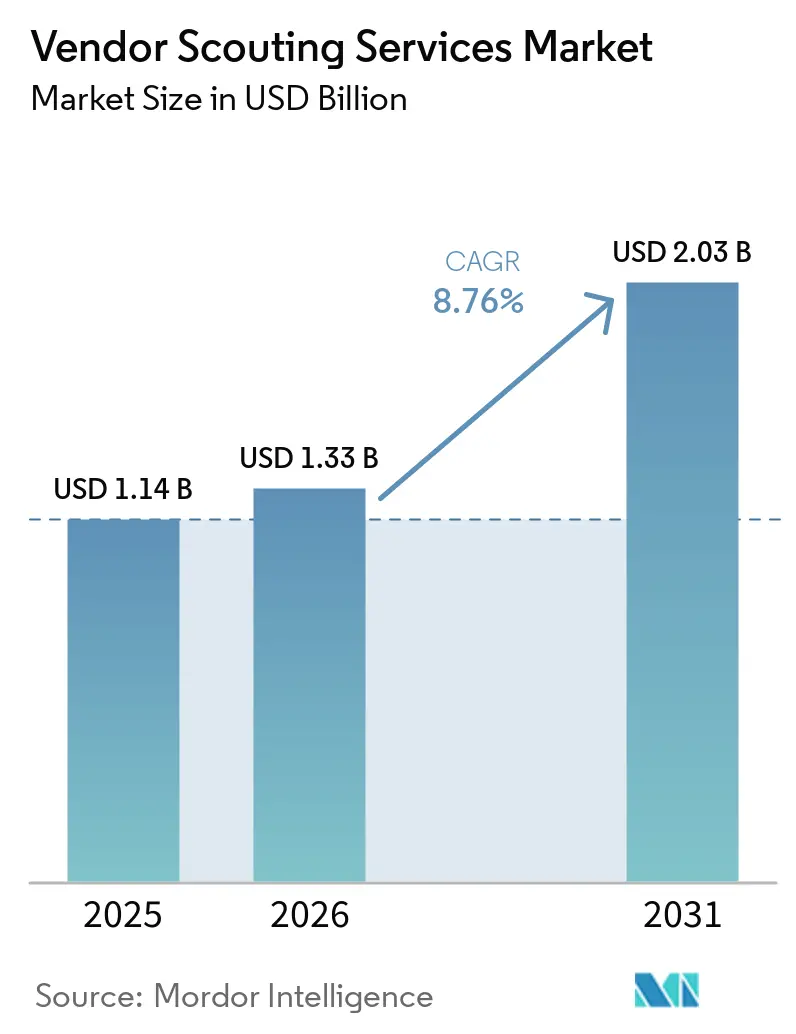
The Vendor Scouting Services Market size was valued at USD 1.14 billion in 2025 and estimated to grow from USD 1.33 billion in 2026 to reach USD 2.03 billion by 2031, at a CAGR of 8.76% during the forecast period 2026-2031. Enterprises are making external vendor discovery a regular part of procurement and R&D work because new technologies and supply risks require faster access to specialized capabilities. The Vendor Scouting Services Market benefits when buyers need to identify, compare, and qualify companies beyond established supplier lists. AI-enabled search tools and cloud delivery are reducing the time needed to build an initial supplier list, while detailed assessment work remains necessary for high-value decisions. The Vendor Scouting Services Market also faces a higher standard for information security because a search brief can reveal product plans, technical needs, or intended market entry. Providers that combine reliable data, specialist knowledge, and controlled handling of customer information can address this need more effectively.
Key Report Takeaways
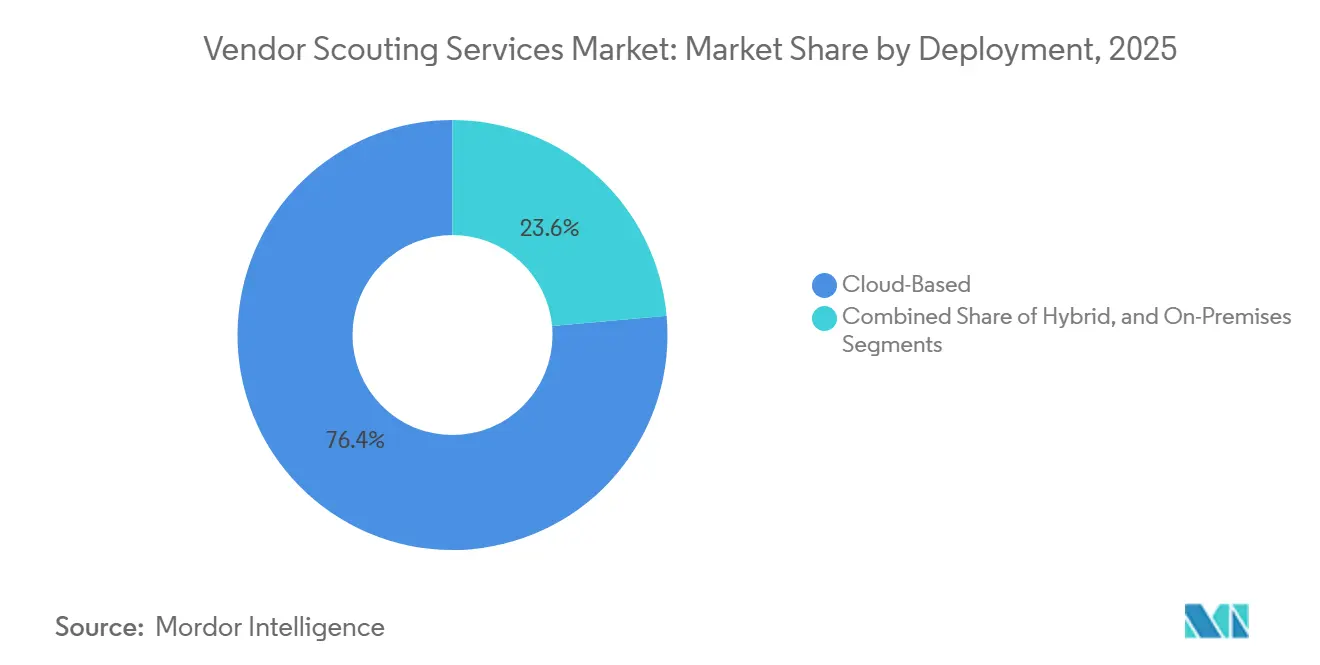
- By deployment, cloud-based solutions held 76.42% of the Vendor Scouting Services Market share in 2025, while hybrid deployment is forecast to grow at a CAGR of 9.61% through 2031.
- By service type, Innovation and Technology Services held 38.24% of the Vendor Scouting Services Market share in 2025, while Search Services is forecast to grow at a CAGR of 10.64% through 2031.
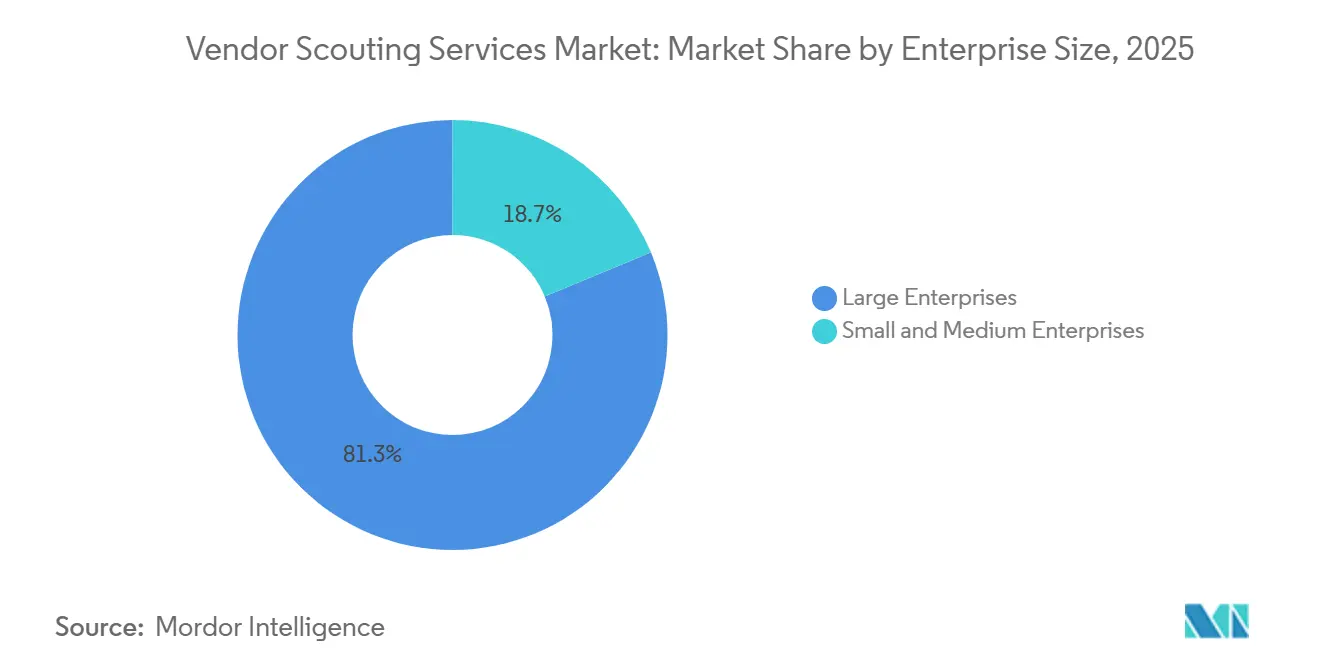
- By enterprise size, large enterprises held 81.28% of revenue in 2025, while small and medium enterprises are forecast to grow at a CAGR of 11.71% through 2031.
- By end user, corporates held 61.33% of the Vendor Scouting Services Market revenue in 2025, while government and public-sector organizations are forecast to grow at a CAGR of 9.76% through 2031.
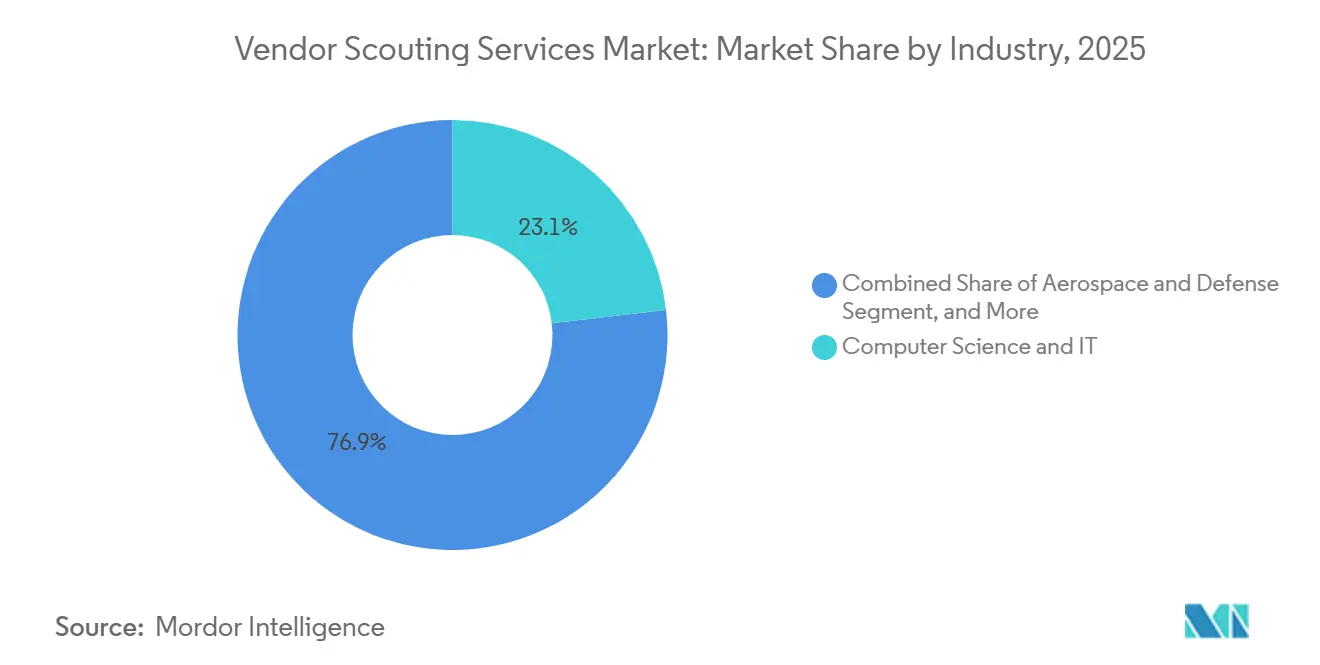
- By industry, Computer Science and Information Technology held 23.14% of revenue in 2025, while Aerospace and Defense is forecast to grow at a CAGR of 8.98% through 2031.
- By technology and architecture, 4G and LTE held 41.18% of the Vendor Scouting Services Market revenue in 2025, while 5G Standalone is forecast to grow at a CAGR of 9.12% through 2031.
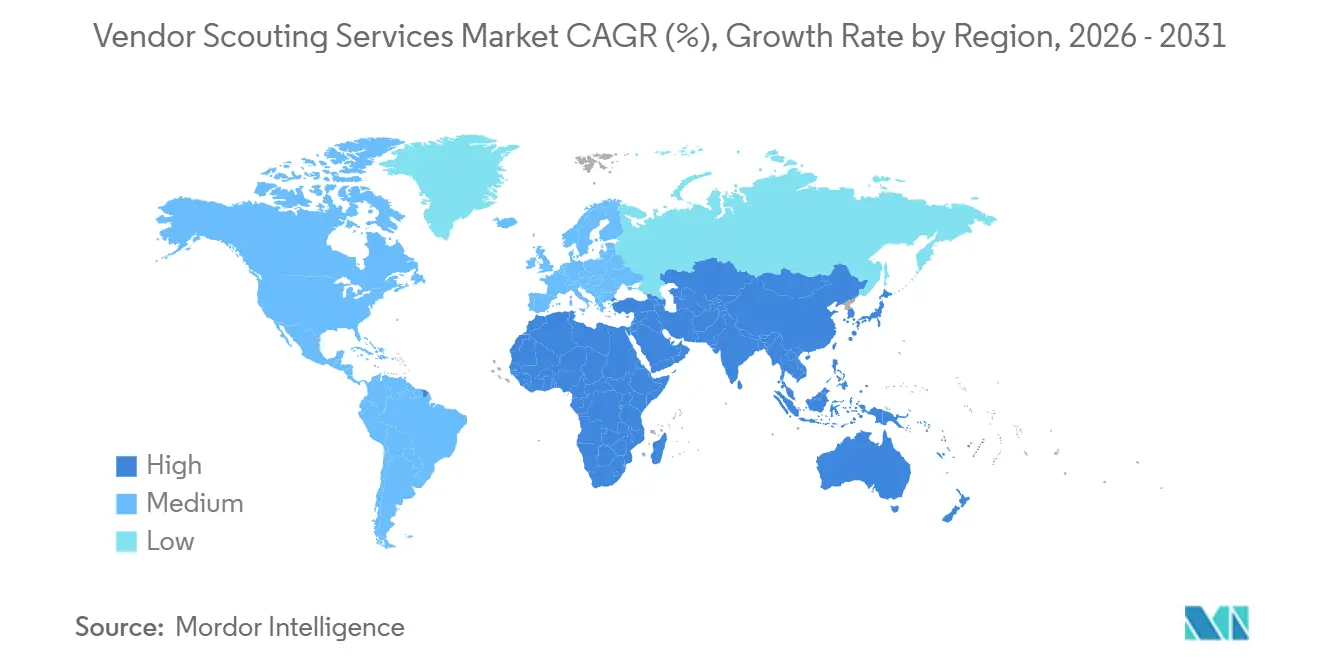
- By geography, North America held 38.42% of revenue in 2025, while Asia-Pacific is forecast to grow at a CAGR of 11.89% through 2031.
Note: Market size and forecast figures in this report are generated using Mordor Intelligence’s proprietary estimation framework, updated with the latest available data and insights as of January 2026.
Market Trends and Insights
Drivers Impact Analysis of Vendor Scouting Services Market*
| Driver | (~) % Impact on CAGR Forecast | Geographic Relevance | Impact Timeline |
|---|---|---|---|
| Enterprise Innovation Outsourcing | +2.5% | Global | Medium term (2-4 years) |
| AI-Assisted Discovery of Niche Suppliers | +2.0% | Global, concentrated in North America and Europe | Short term (≤ 2 years) |
| Cloud-Based Scouting Accessibility | +1.5% | Global, Asia-Pacific core | Short term (≤ 2 years) |
| Supply-Chain Resilience and Dual-Sourcing Requirements | +1.2% | North America and Europe, with spillover to Asia-Pacific | Medium term (2-4 years) |
| Patent and Research Commercialization Pressure | +0.8% | North America and Europe | Long term (≥ 4 years) |
| Procurement Integration With Innovation Workflows | +0.6% | Global, led by North America | Medium term (2-4 years) |
| Source: Mordor Intelligence | |||
Enterprise Innovation Outsourcing
External innovation sourcing has moved from an occasional activity to a recurring operational need for procurement and R&D teams that need to evaluate technologies, suppliers, and commercialization options beyond their established networks. The Vendor Scouting Services Market therefore receives demand from buyers that need specialist capabilities without building every research, supplier-discovery, outreach, and early-screening function internally. A scouting engagement can give a buyer a structured view of emerging technologies, potential partners, alternative suppliers, university-originated intellectual property, and relevant companies in adjacent sectors for a defined requirement. This arrangement makes external expertise accessible when internal teams lack the time, local coverage, technical knowledge, or broad data access needed to complete an assignment to a consistent standard. The Vendor Scouting Services Market must still protect the buyer's confidential brief because the requested search can signal product priorities, technical gaps, future sourcing plans, and intended areas of market entry. Providers with controlled workflows, anonymized outreach, clear information barriers, and a documented process for managing client materials are better placed to serve these sensitive assignments.
AI-Assisted Discovery of Niche Suppliers
AI tools are shortening the initial discovery stage by searching patent, publication, supplier, and company datasets through a single interface, rather than requiring analysts to review each source separately. It was stated that its Slate platform indexed more than 160 million patents and 264 million research papers, providing R&D teams with a wider starting point for external technology discovery.[1] The Vendor Scouting Services Market benefits from these tools, which quickly identify relevant candidates, allowing analysts to spend more time assessing technical fit, commercial readiness, and available evidence. Access to innovation intelligence data was expanded, and its infrastructure was connected to Microsoft Copilot via Model Context Protocol integration in June 2026.[2] These integrations allow procurement, IP, and R&D personnel to review patent, technology, and supplier landscapes from enterprise AI environments they already use in their daily work. Larger platforms can improve their models as they collect structured assessments, but final qualification still depends on the completeness of supporting evidence, the quality of the supplier response, and human review.
Cloud-Based Scouting Accessibility
Cloud delivery allows users to access supplier databases, patent information, research records, and program workflows without maintaining dedicated infrastructure for an activity that may be project-based or intermittent. This model has made formal scouting more practical for organizations that cannot justify a large internal research system, specialist software team, and permanent data-maintenance budget for occasional assignments. Cloud-based delivery also supports faster onboarding and enables distributed procurement, innovation, and technical teams to work from the same supplier records, project requirements, and candidate shortlists. The Vendor Scouting Services Market uses this accessibility to reach mid-sized buyers that want project-based searches, subscription access, or a gradual approach to formalized vendor discovery. Public cloud deployment is less suitable for some aerospace, defense, pharmaceutical, and other regulated assignments because buyers may need strict control over where data is stored, processed, accessed, and retained. Hybrid and private-cloud options address this issue by separating cloud-based discovery from confidential assessment material, strategic briefs, bid intelligence, and internal qualification records.
Supply-Chain Resilience and Dual-Sourcing Requirements
Supply-chain disruption has made the search for qualified alternative suppliers more important in critical product categories where a single source, region, or tier can create a material operational risk. It was reported that significant import concentration increased by 50% globally in the early 2020s compared with the late 1990s. This condition makes supplier visibility important for manufacturers, technology companies, and chemical producers that depend on concentrated supply sources yet need to maintain production continuity and commercial flexibility. The Vendor Scouting Services Market supports dual-, tri-, or quad-sourcing by identifying candidates across regions, countries, and supply chain tiers and by organizing early evidence for a buyer's review. A targeted search for viable suppliers in nearby or allied countries can be more practical than relocating an entire supply chain, particularly when production capability and technical qualification must be retained. Broad supply-chain relocalization was also modeled as reducing global real GDP by more than 5%, reinforcing the value of targeted supplier diversification.[3]
Restraints Impact Analysis of Vendor Scouting Services Market*
| Restraint | (~) % Impact on CAGR Forecast | Geographic Relevance | Impact Timeline |
|---|---|---|---|
| Confidentiality and Strategic-Intent Leakage Risk | -1.1% | Global | Short term (≤ 2 years) |
| Sparse and Inconsistent Supplier Evidence | -0.7% | Asia-Pacific, South America, and Africa | Medium term (2-4 years) |
| Long Validation Cycles for Regulated Categories | -0.4% | North America and Europe | Long term (≥ 4 years) |
| Buyer Preference for Internal Procurement Databases | -0.3% | Global, concentrated in large enterprises | Medium term (2-4 years) |
| Source: Mordor Intelligence | |||
Confidentiality and Strategic-Intent Leakage Risk
A vendor scouting brief can disclose meaningful information even when it does not name a new product, program, or internal project directly. A request for a specific battery chemistry, defense subsystem, specialized component, or bioprocess capability can indicate which technical direction a buyer is considering and where it may invest. This risk is important when the provider conducts outreach that could reveal the buyer's interest to potential suppliers, competitors, or other parties that can interpret the pattern of inquiries. The Vendor Scouting Services Market must respond with defined confidentiality controls, limited-access workspaces, clear data segregation, and careful use of AI systems that process customer queries or supporting documents. Buyers may also require proof that their search queries, candidate lists, and supporting materials will not be used to train models available to other customers or be transferred across restricted jurisdictions. These requirements can favor providers that can document their data-handling practices, apply information barriers in daily work, and operate securely across relevant jurisdictions.
Sparse and Inconsistent Supplier Evidence
Supplier discovery is difficult where smaller companies have limited public records, technical documents, quality certifications, product specifications, or financial disclosures that allow a buyer to compare them consistently. The evidence problem is most acute when buyers seek niche suppliers in emerging economies or specialized technical fields, because the most relevant candidate may have the least visible digital presence. Automated tools can identify possible matches, but incomplete information requires analysts to conduct technical outreach, compliance checks, financial reviews, capability assessments, and follow-up with the supplier. Supplier and partner vetting is described as a process that includes technical review, financial stability assessment, compliance checks, and evaluation of manufacturing capability.[4] This work can lengthen the assignment, require more specialist effort, and reduce the cost advantage of a purely automated discovery process for the buyer and the provider. It can also favor regional specialists with local networks when global platforms cannot verify candidates through available data or obtain credible responses through remote outreach alone.
*Our forecasts treat driver/restraint impacts as directional, not additive. The impact forecasts reflect baseline growth, mix effects, and variable interactions.
Vendor Scouting Services Market Segment Analysis
By Deployment:
Cloud-First Posture Persists as Hybrid Models AccelerateCloud-based deployment accounted for 76.42% of the Vendor Scouting Services Market in 2025. The leading position reflected recurring access to supplier databases, patent indexes, startup registries, and shared project workflows that supported both initial discovery and ongoing supplier monitoring. Large enterprises adopted these systems to avoid the cost and time required to create similarly broad internal data resources across technology, company, and research sources. Mid-sized firms followed as subscription and per-user models reduced the need for dedicated capital budgets. The model also enabled procurement and R&D teams across different locations to work from a common project record rather than maintaining separate files and disconnected search results.
On-premises deployment remained important in aerospace, defense, and pharmaceutical settings where data residency, restricted information, and legal exposure limit public-cloud routing. These users often need to keep supplier assessments, bid information, technical records, and strategic briefs in controlled environments. Hybrid deployment is projected to grow at a CAGR of 9.61% through 2031 because it can combine cloud search tools with private handling of sensitive material. The Vendor Scouting Services Market can serve regulated buyers more effectively when its architecture separates discovery work from confidential records. This approach allows users to retain the speed of broad external search while applying their own controls to the evidence used for internal qualification decisions.

By Service Type:
Search Services Gain Share as AI Shortens Discovery CyclesInnovation and Technology Services accounted for 38.24% of revenue in 2025, making it the largest service category. Corporate R&D and strategy teams use these services to review emerging technologies, adjacent-sector innovators, university-originated intellectual property, and possible commercialization partners. The work requires sector understanding as well as broad discovery capabilities because an identified company must be relevant to a defined technical or commercial need. Professional Services cover briefing, candidate shortlisting, supplier engagement, and validation work following an initial search. This work remains important when a buyer needs a documented view of a candidate's capabilities rather than a broad list of possible names.
Platform Services provide the software layer that manages assignments and connects scouting activity to procurement and innovation workflows. Research Services remain important in life sciences, chemicals, and materials, where publications, patents, and technical literature are essential parts of supplier identification. Search Services is projected to experience the highest growth, with a CAGR of 10.64% through 2031, as AI engines handle larger datasets and more complex queries. Early users of a structured research module achieved a 30% reduction in decision-making time for constraint-based R&D work. This changes the Vendor Scouting Services Market by shifting part of the value proposition from time spent searching to the quality, relevance, and usability of the resulting decision.
By Enterprise Size:
Large Enterprises Dominate, Small and Medium Enterprises ExpandLarge enterprises accounted for 81.28% of revenue in 2025. Their position comes from formal procurement programs, dedicated innovation teams, and supplier searches across several countries and business units. These organizations may simultaneously pursue patent landscape projects, technology scouting programs, and alternative supplier assessments. The volume of work can support continuous platform subscriptions and professional-service retainers. Their scale also makes it easier to justify consistent governance over how research findings are reviewed, stored, and shared across procurement and R&D functions.
Small and medium enterprises are projected to grow at a CAGR of 11.71% through 2031. Cloud-native platforms and project-based engagements reduce the financial and operational barriers that once limited structured scouting to large companies. Buyers in food technology, packaging, and electronics can use external services to identify specialized materials or technology partners without creating a full internal intelligence team. This expansion broadens the Vendor Scouting Services Market beyond its traditional large-enterprise customer base and brings more varied assignment sizes to providers. Small buyers can focus external support on a defined problem, such as finding a material supplier or a technical partner, rather than committing to a permanent platform program.
By End User:
Government and Public-Sector Organizations Grow FastestCorporates accounted for 61.33% of revenue in 2025 and remained the core end-user group. Corporate innovation, procurement, and strategy teams need information on sustainable packaging, semiconductor suppliers, technologies, and potential partners across many verticals. Innovative startups act both as users of scouting intelligence and as targets of corporate-commissioned searches when larger organizations look for specialized capabilities. Technology companies also have high scouting needs because vendor landscapes in open-source software, AI, cloud systems, and startups change quickly. Corporate users commonly need a structured process that connects an initial external search with their existing evaluation and supplier-management practices.
Government and public-sector organizations are projected to grow at a CAGR of 9.76% through 2031. A 2026 cohort process reviewed more than 2,600 applications across 10 challenge areas and selected 150 innovators. This example shows how defense-linked public bodies use structured open-innovation processes to identify possible technology providers. Public-sector programs may require compatibility with security clearance requirements and appropriate handling of classified or restricted information. These requirements can concentrate certain assignments among specialist providers with the necessary controls in place. They can also extend the review period because public buyers need evidence that a potential supplier meets technical, security, and administrative requirements.
By Industry:
Computer Science and IT Leads, Aerospace and Defense OutpacesComputer Science and Information Technology accounted for 23.14% of revenue in 2025. The segment needs continuous tracking of cloud infrastructure, cybersecurity tools, AI models, and developer platforms because supplier lists can become outdated quickly. Electronics and Communication also needs regular qualification of component vendors as technology requirements and component availability change. Packaging, Chemicals and Materials, and Food and Beverages use scouting to locate material suppliers, ingredient innovators, and process technology partners. In these areas, a search often needs to combine evidence from commercial suppliers with technical information about products, processes, and intellectual property.
Healthcare and Life Sciences, Energy and Utilities, and Automotive and Mobility maintain scouting activity related to digital therapeutics, grid decarbonization, and electrification. Agriculture is also increasing its use of scouting as precision agriculture, soil science, and controlled-environment growing attract investment. Aerospace and Defense is projected to grow at a CAGR of 8.98% through 2031 as prime contractors seek dual-use technology suppliers and governments use open-innovation channels. Work supporting the US Irregular Warfare Technical Support Directorate and the UK national security community through defense challenges illustrates the role of structured challenges in identifying candidates for security-sensitive technology programs.
By Technology and Architecture:
4G and LTE Leads, 5G Standalone Gains Momentum4G and LTE accounted for 41.18% of revenue in 2025. These networks provided the established connectivity foundation for cloud platform access, mobile supplier audits, and fieldwork at manufacturing locations and supplier sites. 5G Non-Standalone improved speed on existing 4G infrastructure and supported real-time synchronization where coverage reached industrial sites. Other connectivity options served remote and network-restricted scouting settings where the standard mobile network model was not suitable. The established 4G and LTE base continued to support routine access to scouting platforms for most enterprise users.
5G Standalone is projected to grow at a CAGR of 9.12% through 2031. Its network-slicing capability can support low-latency access to AI-based patent and supplier data during site visits, production audits, and technology events. The Vendor Scouting Services Market may benefit when field personnel can access current data while reviewing a supplier and recording findings. Faster access can improve the link between a site observation and the relevant technical or supplier record. However, the usefulness of faster connectivity still depends on the quality and completeness of supplier information in the underlying systems.
Geography Analysis
North America Vendor Scouting Services Market
North America accounted for 38.42% of revenue in 2025 and remained the largest regional area. The United States supported demand through corporate innovation programs, procurement technology providers, and defense-linked technology searches. Federal agencies and prime contractors increasingly use structured processes to identify dual-use technology candidates. Canada contributed through university technology transfer networks that connected research activity with corporate buyers in life sciences, clean energy, and advanced materials. Mexico was more often a target for supplier searches as North American buyers qualified manufacturing alternatives closer to home.
Europe Vendor Scouting Services Market
Europe had a regulatory environment that increased the importance of data governance and supplier evidence. Due diligence requirements and sustainability reporting obligations broadened demand beyond R&D and procurement teams to include legal and ESG functions. Germany, the United Kingdom, and France were important markets because of their industrial R&D bases, established corporate innovation programs, and, in France, national policies and public funding that supported technology discovery. German mid-sized industrial companies generated recurring demand across the automotive, chemicals, and industrial automation sectors. Spain, Italy, and other European markets added demand as firms sought suppliers in Eastern Europe and North Africa.
APAC, South America and MEA Vendor Scouting Services Market
Asia-Pacific is projected to record the fastest regional growth at a CAGR of 11.89% through 2031. China created demand for services that can navigate local intellectual property and government-backed innovation programs. India combined the demand from IT services companies with a network of research institutions that produced university-originated IP. Japan and South Korea provided recurring demand from electronics, automotive, and defense groups with long evaluation cycles and high data-quality expectations, while South America, the Middle East, and Africa remained emerging areas for agribusiness, mining, industrial diversification, fintech, and agricultural technology scouting activity.
Competitive Landscape
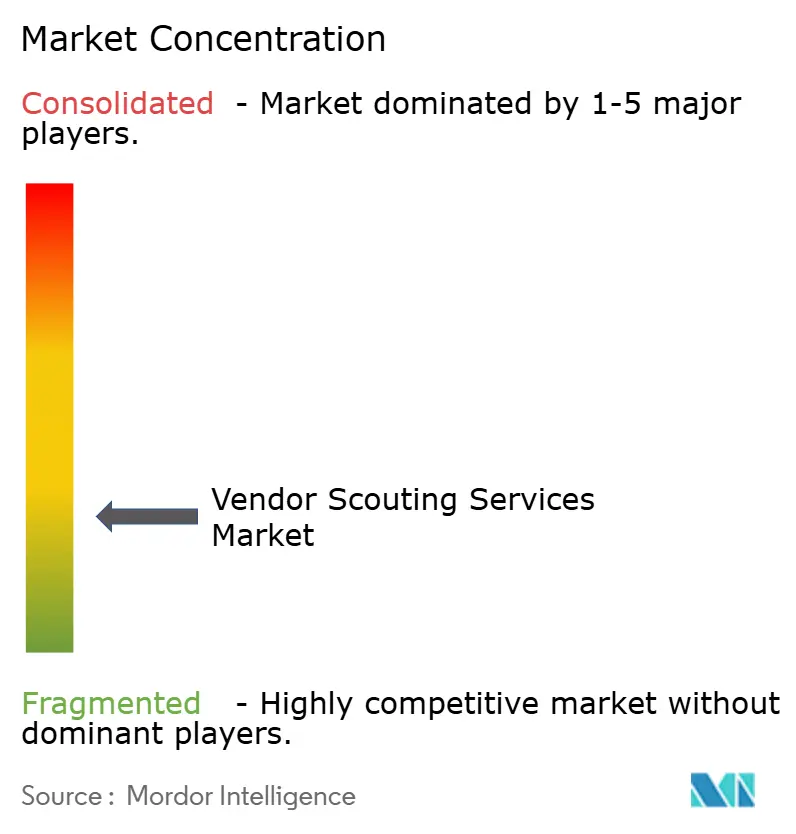
The Vendor Scouting Services Market remained fragmented, with specialist providers and platform-scale companies serving different needs. Boutique firms competed by leveraging domain expertise, expert networks, and validated research for buyers who valued detailed, curated assessments. Larger platforms competed through proprietary data, AI-assisted discovery, and integration with enterprise software. A June 2026 integration with Microsoft Copilot demonstrated how a platform can embed innovation intelligence into an established enterprise AI workflow. Regulated-sector assignments created room for providers that can combine subject expertise with documented evidence and secure workflows.
Providers are investing in AI tools, broader platforms, and vertical specialization to improve their position. An AI-powered supplier discovery platform and network was acquired in October 2025, adding AI-based supplier discovery capabilities to a procurement network and transaction data. The transaction showed the value of combining supplier intelligence with a live procurement platform rather than operating a standalone research service. A strategic partnership for AI-powered patent-to-product mapping was announced in June 2026. The partnership connected patent intelligence with commercial product information, narrowing the gap between IP scouting and vendor qualification.
AI-native entrants can generate supplier and technology assessments with less research effort than conventional models, putting pressure on firms that rely primarily on manual research without differentiated data or specialized expertise. At the same time, automated outputs do not remove the need for verified technical, compliance, financial, and manufacturing evidence. Buyers still need to understand why a candidate was selected, what evidence supports the assessment, and which information requires further validation. The Vendor Scouting Services Market is therefore likely to reward providers that link rapid discovery to accountable validation and clear control of sensitive customer information.
Vendor Scouting Services Industry Leaders
-
Planbox Inc.
-
Tekcapital plc
-
Advanced Technology Innovations, Inc.
-
Amritt Ventures, Inc.
-
Darcy Partners
- *Disclaimer: Major Players sorted in no particular order
Vendor Scouting Services Market Companies Covered in this Report
- Planbox Inc.
- Tekcapital plc
- DAF Technologies
- Advanced Technology Innovations, Inc.
- Darcy Partners
- Erdyn Consultants SARL
- FuelUp Innovation
- ICEBERG IP Group
- INNOSPOT GmbH
- Innovosource LLC
- Amritt Ventures, Inc.
- Via Group Partners
- Skyquest Technology Consulting Private Limited
- Idyl Consulting Limited
- Grey B Research Private Limited
- PreScouter, Inc.
- IN-PART Publishing Ltd.
- Wazoku Limited
- Ninesigma Europe B.V.
- TechScout Holding B.V.
- Ezassi, Inc.
- Lux Research, Inc.
- Questel SAS
- Patsnap Pte. Ltd.
Recent Industry Developments in Vendor Scouting Services Market
- July 2026: A partnership embedding AI-native patent intelligence directly into the technology transfer workflow for licensing managers and R&D teams was announced. The integration connects a 165 million-patent semantic search index to a technology transfer management environment, enabling on-demand novelty assessments for invention disclosures without leaving the technology transfer management environment.
- July 2026: A strategic partnership to bring AI-powered patent-to-product mapping to IP professionals was announced. The joint solution combines patent data infrastructure with AI capabilities to support licensing, enforcement, and portfolio strategy, extending the scope of patent-based technology and vendor scouting into commercial product landscapes.
- March 2026: A major update to an AI Agent was launched, introducing an enhanced "Ask" capability with pre-research analysis and visualized outputs, and a new "Pulse" trend-monitoring feature enabling continuous filtering of high-value technical intelligence across patent and research landscapes.
- October 2025: The acquisition of an AI-powered supplier discovery platform and network was announced. The deal integrated AI-driven search, supplier data, and collaboration tools with a platform of over 10 million buyers and suppliers and an USD 8 trillion transaction dataset, significantly expanding AI-native supplier discovery within a spend-management platform.
Global Vendor Scouting Services Market Report Scope
The vendor scouting services market refers to the ecosystem of professional, research, and platform services designed to help organizations identify, evaluate, and select optimal third-party vendors, suppliers, and technology partners. This market encompasses innovation and technology scouting, professional services, and search solutions deployed via cloud, on-premises, or hybrid models. Catering to corporates, startups, and government entities across diverse industries such as IT, healthcare, and automotive, these services are crucial for navigating complex technology architectures like 4G/LTE and 5G. By leveraging vendor scouting services, organizations can reduce procurement risks, accelerate innovation cycles, and ensure strategic alignment with specialized supply chain and technology partners.
The Vendor Scouting Services Market Report is Segmented by Deployment (Cloud-Based, On-Premises, and Hybrid), Service Type (Innovation and Technology Services, Professional Services, Platform Services, Research Services, and Search Services), Enterprise Size (Large Enterprises, and Small and Medium Enterprises), End User (Corporates, Innovative Startups, Technology Companies, and Government and Public-Sector Organizations), Industry (Computer Science and Information Technology, Electronics and Communication, Packaging, Chemicals and Materials, Food and Beverages, Healthcare and Life Sciences, Energy and Utilities, Automotive and Mobility, Aerospace and Defense, and Agriculture), Technology and Architecture (4G and LTE, 5G Non-Standalone, and 5G Standalone), and Geography (North America, South America, Europe, Asia-Pacific, Middle East, and Africa). The Market Forecasts are Provided in Terms of Value (USD).
Segmentation Overview
| Cloud-Based |
| On-Premises |
| Hybrid |
| Innovation and Technology Services |
| Professional Services |
| Platform Services |
| Research Services |
| Search Services |
| Large Enterprises |
| Small and Medium Enterprises |
| Corporates |
| Innovative Startups |
| Technology Companies |
| Government and Public-Sector Organizations |
| Computer Science and Information Technology |
| Electronics and Communication |
| Packaging |
| Chemicals and Materials |
| Food and Beverages |
| Healthcare and Life Sciences |
| Energy and Utilities |
| Automotive and Mobility |
| Aerospace and Defense |
| Agriculture |
| 4G and LTE |
| 5G Non-Standalone |
| 5G Standalone |
| North America | United States |
| Canada | |
| Mexico | |
| South America | Brazil |
| Argentina | |
| Chile | |
| Rest of South America | |
| Europe | Germany |
| United Kingdom | |
| France | |
| Italy | |
| Spain | |
| Rest of Europe | |
| Asia-Pacific | China |
| Japan | |
| India | |
| South Korea | |
| Australia | |
| Rest of Asia-Pacific | |
| Middle East | United Arab Emirates |
| Saudi Arabia | |
| Qatar | |
| Rest of Middle East | |
| Africa | South Africa |
| Egypt | |
| Nigeria | |
| Rest of Africa |
| By Deployment | Cloud-Based | |
| On-Premises | ||
| Hybrid | ||
| By Service Type | Innovation and Technology Services | |
| Professional Services | ||
| Platform Services | ||
| Research Services | ||
| Search Services | ||
| By Enterprise Size | Large Enterprises | |
| Small and Medium Enterprises | ||
| By End User | Corporates | |
| Innovative Startups | ||
| Technology Companies | ||
| Government and Public-Sector Organizations | ||
| By Industry | Computer Science and Information Technology | |
| Electronics and Communication | ||
| Packaging | ||
| Chemicals and Materials | ||
| Food and Beverages | ||
| Healthcare and Life Sciences | ||
| Energy and Utilities | ||
| Automotive and Mobility | ||
| Aerospace and Defense | ||
| Agriculture | ||
| By Technology and Architecture | 4G and LTE | |
| 5G Non-Standalone | ||
| 5G Standalone | ||
| By Geography | North America | United States |
| Canada | ||
| Mexico | ||
| South America | Brazil | |
| Argentina | ||
| Chile | ||
| Rest of South America | ||
| Europe | Germany | |
| United Kingdom | ||
| France | ||
| Italy | ||
| Spain | ||
| Rest of Europe | ||
| Asia-Pacific | China | |
| Japan | ||
| India | ||
| South Korea | ||
| Australia | ||
| Rest of Asia-Pacific | ||
| Middle East | United Arab Emirates | |
| Saudi Arabia | ||
| Qatar | ||
| Rest of Middle East | ||
| Africa | South Africa | |
| Egypt | ||
| Nigeria | ||
| Rest of Africa | ||
Key Questions Answered in the Report
What is the forecast for vendor scouting services through 2031?
The Vendor Scouting Services Market is projected to increase from USD 1.33 billion in 2026 to USD 2.03 billion by 2031, at a CAGR of 8.76%.
Which deployment model has the largest share?
Cloud-based deployment held 76.42% of revenue in 2025, supported by subscription access to supplier and technology data.
Which service type is growing fastest?
Search Services is forecast to grow at a CAGR of 10.64% through 2031 as AI tools shorten initial discovery work.
Why are small and medium enterprises adopting scouting services?
Cloud-native tools and project-based engagements reduce the cost and operating burden of formal supplier and technology searches.
Which region is expanding fastest?
Asia-Pacific is forecast to grow at a CAGR of 11.89% through 2031, supported by innovation activity in China, India, Japan, and South Korea.
What risk should buyers address before outsourcing a scouting assignment?
Buyers should require clear confidentiality controls because the search brief may disclose technical priorities, sourcing needs, or plans for market entry.