
Marketing Performance Management (MPM) Software Market Size and Share
Market Overview
| Study Period | 2020 - 2031 |
|---|---|
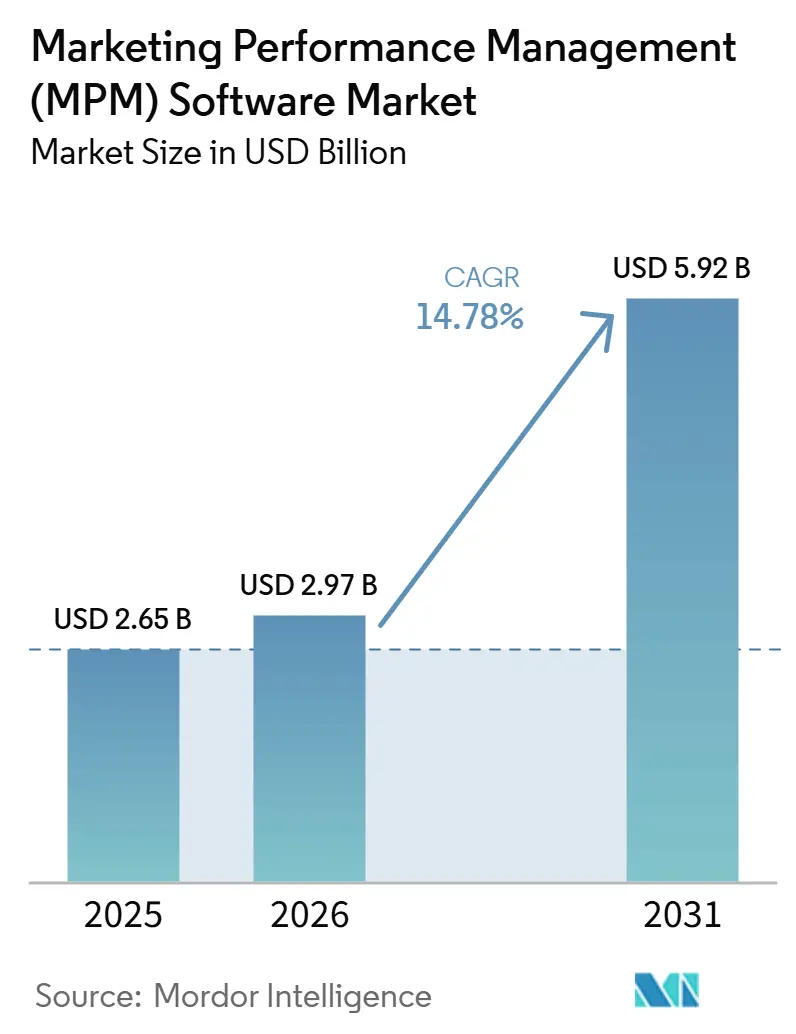
| Market Size (2026) | USD 2.97 Billion |
| Market Size (2031) | USD 5.92 Billion |
| Growth Rate (2026 - 2031) | 14.78% CAGR |
| Fastest Growing Market | Asia-Pacific |
| Largest Market | North America |
| Market Concentration | Medium |
Major Players *Disclaimer: Major Players sorted in no particular order Image © Mordor Intelligence. Reuse requires attribution under CC BY 4.0. | |
Marketing Performance Management (MPM) Software Market Analysis by Mordor Intelligence
The Marketing Performance Management (MPM) Software Market size is projected to expand from USD 2.65 billion in 2025 and USD 2.97 billion in 2026 to USD 5.92 billion by 2031, registering a CAGR of 14.78% between 2026 and 2031. Growth is being shaped by the move away from third-party cookie-based attribution, wider use of AI in budget decisions, and stronger finance oversight of marketing spend. These shifts are reinforcing each other because marketers now need tools that connect planning, execution, and outcomes in one place. Buyers who cannot prove closed-loop returns face greater pressure to reallocate budgets to channels and platforms with clearer measurement. That pressure is also pushing vendors to compete on privacy-safe measurement, stronger governance, and easier links with finance and operating systems. The clearest opportunity in the Marketing Performance Management (MPM) Software Market is for platforms that reduce data engineering effort while enabling teams to make faster, more credible performance decisions.
Key Report Takeaways
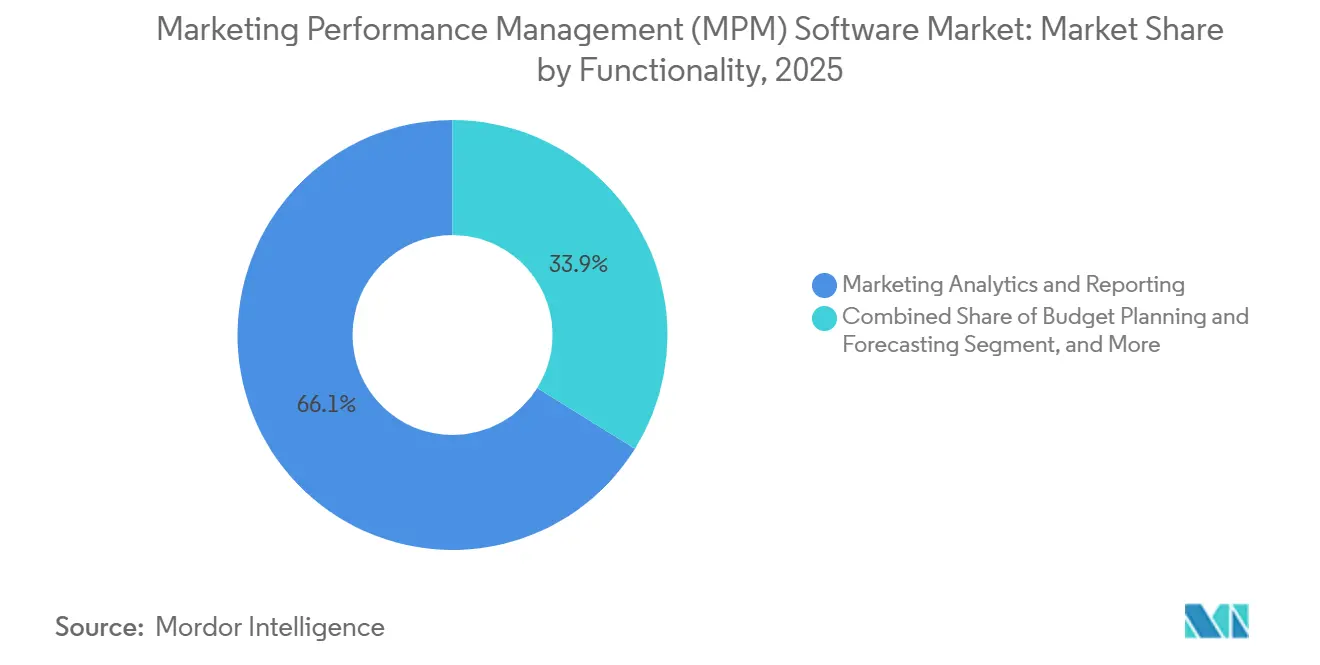
- By functionality, marketing analytics and reporting held 66.12% of the Marketing Performance Management (MPM) Software Market share in 2025, while performance measurement and optimization is projected to expand at a 16.71% CAGR through 2031.
- By deployment type, cloud-based deployments captured 70.29% of the Marketing Performance Management (MPM) Software Market share in 2025, while hybrid deployments are projected to grow at a 17.05% CAGR through 2031.
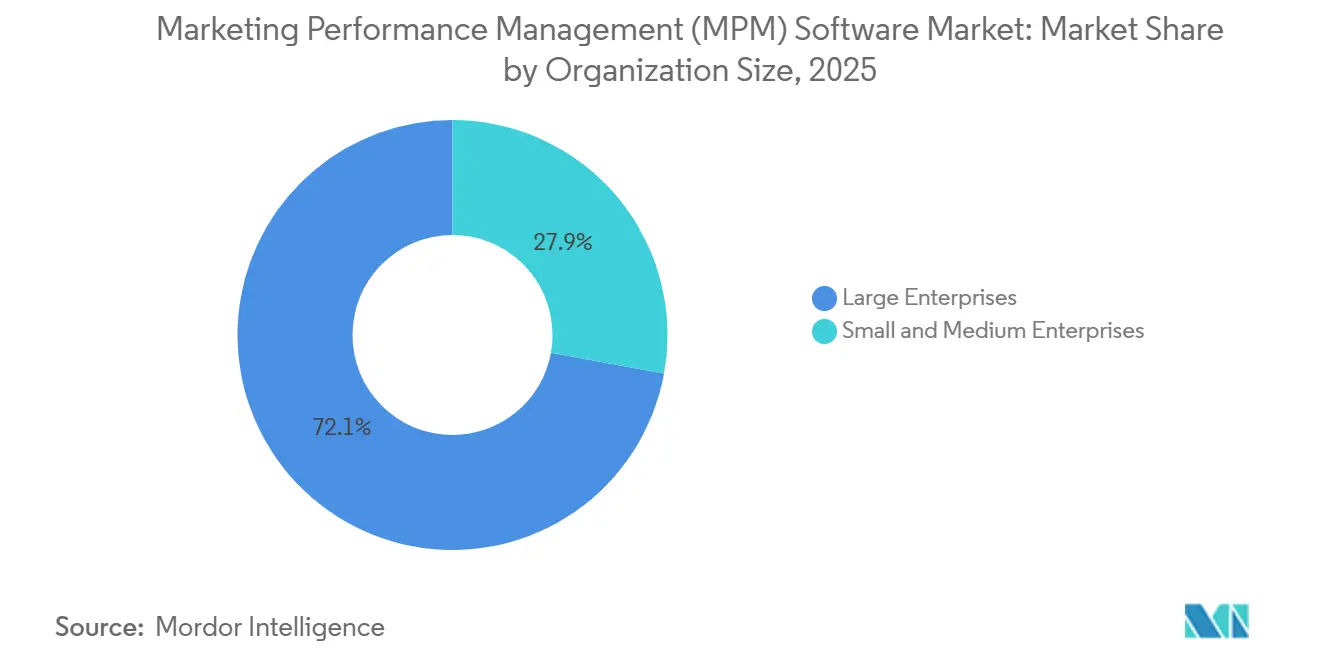
- By organization size, large enterprises held 72.14% of the Marketing Performance Management (MPM) Software Market share in 2025, while SMEs are projected to expand at a 17.30% CAGR through 2031.
- By end user industry, retail and e-commerce accounted for 22.45% of the Marketing Performance Management (MPM) Software Market share in 2025, while healthcare and life sciences are projected to advance at a 16.04% CAGR through 2031.
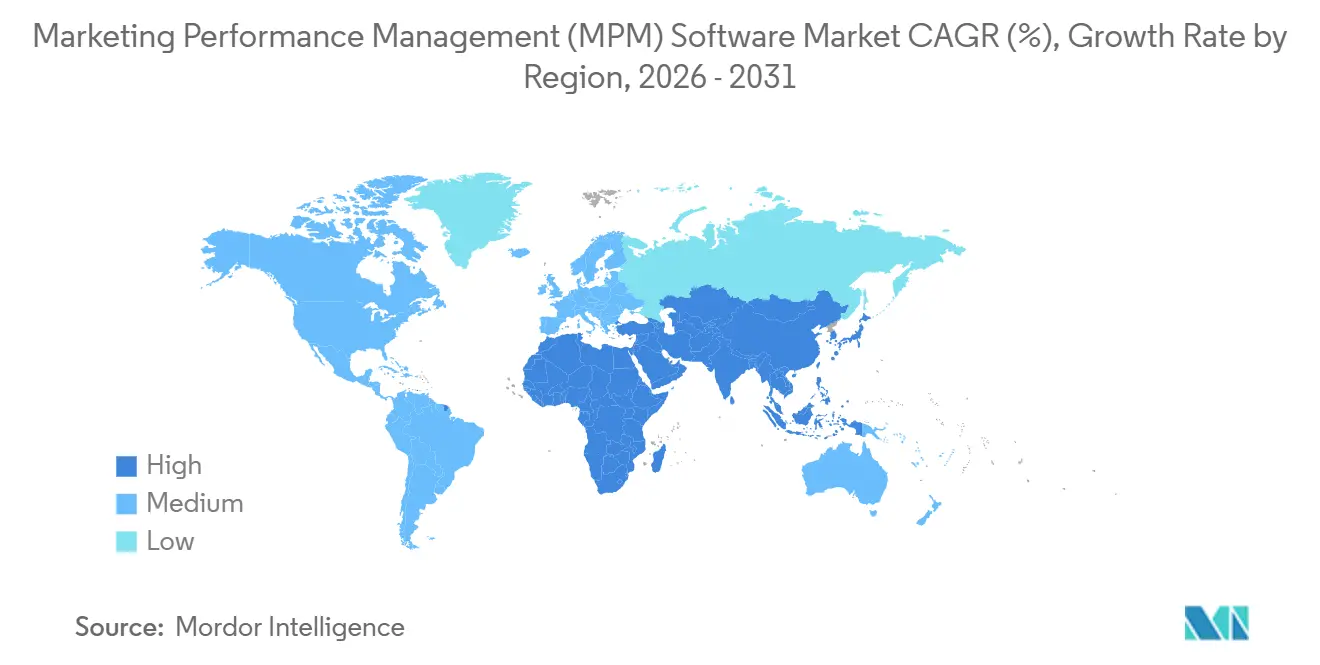
- By geography, North America held 37.23% of the Marketing Performance Management Software Market share in 2025, while Asia-Pacific is projected to expand at a 16.37% CAGR through 2031.
Note: Market size and forecast figures in this report are generated using Mordor Intelligence’s proprietary estimation framework, updated with the latest available data and insights as of January 2026.
Global Marketing Performance Management (MPM) Software Market Trends and Insights
Drivers Impact Analysis*
| Driver | (~) % Impact on CAGR Forecast | Geographic Relevance | Impact Timeline |
|---|---|---|---|
| Rising Need for Closed-Loop Marketing ROI Accountability | +3.8% | Global | Medium term (2-4 years) |
| Expansion of Privacy-Safe Measurement and Attribution Workflows | +2.9% | North America and EU | Medium term (2-4 years) |
| Convergence of Marketing, Finance, and Operations Planning | +2.4% | North America, Europe | Medium term (2-4 years) |
| AI-Enabled Forecasting for Budget Reallocation and Scenario Planning | +2.1% | Global | Short term (≤ 2 years) |
| Rising Demand for Enterprise-Wide Marketing Governance | +1.6% | North America, Europe, Asia-Pacific | Long term (≥ 4 years) |
| Growth of Multi-Channel and Retail Media Measurement Complexity | +1.3% | North America, Asia-Pacific | Short term (≤ 2 years) |
| Source: Mordor Intelligence | |||
Rising Need for Closed-Loop Marketing ROI Accountability
Marketing teams still using last-click attribution and siloed dashboards struggle to defend spend when finance asks how campaigns connect to revenue. In the Marketing Performance Management (MPM) Software Market, this gap turns measurement from a reporting issue into a budget governance issue. The problem is sharper as advertisers spread activity across more channels and more retail media networks, each with its own attribution logic. Buyers therefore favor platforms that connect plans, spend, and outcomes in one operating view, so monthly reviews can focus on what to reallocate next. This need keeps the Marketing Performance Management (MPM) Software Market tied closely to proof of return rather than to dashboard volume alone.
Expansion of Privacy-Safe Measurement and Attribution Workflows
The shift to privacy-safe measurement is changing how the Marketing Performance Management (MPM) Software Market is designed and bought. The W3C published its Privacy-Preserving Attribution specification in June 2025, providing the ecosystem with a browser-level model for conversion measurement that does not expose individual user identities across sites. At the same time, the IAB said commerce media spend is expected to grow 12.1% in 2026, which raises the need for consistent cross-network measurement under tougher privacy rules. Enterprises that rebuild around first-party data, hashed identity, and server-side conversion workflows are better positioned to maintain stable signal quality as policies tighten. Vendors that can harmonize consent-managed and aggregated data flows are likely to capture more demand in the Marketing Performance Management (MPM) Software Market.
Convergence of Marketing, Finance, and Operations Planning
Marketing, finance, and operations planning are converging, changing what buyers expect from software. The Marketing Performance Management (MPM) Software Market is benefiting because teams want plans and spend controls that can be reviewed in the same cycle as broader business budgets. Enterprise case examples published by Uptempo show that IBM used the platform to keep budget variance at 0.01% across 6 quarters and reallocated USD 240 million, while IKEA demonstrated USD 25 million in promotion ROI and removed 125,000 hours of spreadsheet work.[1]Uptempo, “Uptempo 2.0 Empowers CMOs to Slash Waste and Maximize ROI,” Uptempo, uptempo.io These results matter because they show why finance-grade visibility is becoming part of the buying process instead of an optional add-on. As this alignment deepens, the Marketing Performance Management (MPM) Software Market should continue to reward vendors that make spend governance easier across functions.
AI-Enabled Forecasting for Budget Reallocation and Scenario Planning
AI-enabled forecasting is moving the Marketing Performance Management (MPM) Software Market beyond static reporting and toward active budget reallocation. Salesforce introduced its Agentforce Marketing Goals Agent in June 2026, showing how campaign creation, execution, and optimization can run against live signals inside set budget guardrails. This changes buyer expectations because software is now judged on how well it can recommend the next move, rather than just how well it explains the last one. The same shift makes scenario planning more useful for mid-sized teams that previously lacked the staff to run constant measurement reviews. Over time, the Marketing Performance Management (MPM) Software Market should see more value shift toward vendors with credible optimization models and usable AI workflows.
Restraints Impact Analysis*
| Restraint | (~) % Impact on CAGR Forecast | Geographic Relevance | Impact Timeline |
|---|---|---|---|
| High Integration Effort With CRM, ERP, and Data Warehouses | -2.4% | Global | Medium term (2-4 years) |
| Data Quality Gaps that Undermine Attribution Confidence | -1.8% | Global | Medium term (2-4 years) |
| Long Change-Management Cycles in Legacy Marketing Organizations | -1.2% | North America, Europe | Long term (≥ 4 years) |
| Budget Scrutiny from CFOs During Slowdown Cycles | -0.9% | Global | Short term (≤ 2 years) |
| Source: Mordor Intelligence | |||
High Integration Effort With CRM, ERP, and Data Warehouses
High integration effort remains the largest brake on adoption in the Marketing Performance Management (MPM) Software Market. Buyers often need to connect campaign systems, CRM data, ERP records, and warehouse tables before they can trust a single performance view. Uptempo positioned its 2025 platform update around integrations with Salesforce, Adobe, and Oracle ERP, which shows how central this plumbing work is to enterprise deployments. When field definitions, transaction granularity, and governance rules do not align, go-live timelines stretch, and early ROI becomes harder to prove. This keeps some prospective customers in pilot mode longer than planned, even when demand for better measurement is clear.
Data Quality Gaps that Undermine Attribution Confidence
Data quality gaps still weaken confidence in attribution and hold back wider use of the Marketing Performance Management (MPM) Software Market. Skai reported in 2026 that only 15% of retail media advertisers rated their organizations as very or extremely effective at measuring overall marketing performance. The same study found that 75% saw incrementality measurement as their biggest challenge, suggesting fragmented definitions and operating models rather than missing software alone. Aprimo's March 2026 Agentic DAM launch also highlighted continuous runtime compliance and governance, underscoring the need to ensure data quality before insights reach decision-makers. Until data validation and reconciliation become routine, some buyers will continue to question the outputs generated by MPM tools.
*Our forecasts treat driver/restraint impacts as directional, not additive. The impact forecasts reflect baseline growth, mix effects, and variable interactions.
Segment Analysis
By Functionality: Analytics Keeps the Largest Base While Optimization Gains Speed
Marketing analytics and reporting held 66.12% of the Marketing Performance Management (MPM) Software Market share in 2025. That lead serves as the base layer for dashboards, attribution, and standardized KPI tracking across campaigns. Most buyers still need a stable reporting spine before they can automate optimization or formalize budget governance. This is why analytics remains the first purchase in many expansion cycles across the Marketing Performance Management Software Market.
Performance measurement and optimization are projected to grow at a 16.71% CAGR through 2031, which shows where spending momentum is shifting. The next phase of the Marketing Performance Management (MPM) Software Market is less about collecting data and more about acting on it faster. Salesforce's June 2026 rollout of Agentforce Marketing pointed to this change by embedding campaign creation and optimization into AI-driven workflows.[2]Salesforce, “Salesforce Puts an AI Marketing Team in Every Marketer's Hands,” Salesforce News, salesforce.com Vendors that report only results may find it harder to protect pricing as buyers seek systems that guide budget decisions in real time. The balance of demand still favors analytics today, but growth is clearly moving toward tools that turn performance signals into action.



By Deployment Type: Cloud Leads Current Adoption While Hybrid Expands in Regulated Settings
Cloud-based deployment captured 70.29% share of the Marketing Performance Management (MPM) Software Market size in 2025. Its lead reflects the subscription model, faster updates, and easier rollout across distributed teams. Cloud delivery also suits vendors that want to release AI features and connector changes across the installed base with less delay. That keeps Cloud as the default entry point for much of the Marketing Performance Management Software Market.
Hybrid deployment is projected to expand at a 17.05% CAGR through 2031, led by buyers that want cloud scale without full data externalization. This pattern is strongest in regulated settings, such as healthcare, BFSI, and government-linked operations, where retention and control rules shape architectural choices. The W3C privacy-preserving attribution work has reinforced the broader shift toward privacy-safe measurement models that reduce dependence on older tracking methods. On-premises systems still matter where internal control remains the priority, but they are now part of a more selective procurement case. Vendors with credible hybrid options are better placed as the Marketing Performance Management (MPM) Software Market expands across sectors with stricter governance needs.
By Organization Size: Large Enterprises Anchor Revenue While SMEs Open the Next Growth Layer
Large enterprises held 72.14% of the Marketing Performance Management (MPM) Software Market in 2025. Their lead reflects larger contract values, longer implementation programs, and more complex data environments, all of which justify dedicated performance platforms. Enterprise buyers also have a stronger need to align marketing planning with finance controls and cross-region governance. That scale keeps large accounts central to current revenue across the Marketing Performance Management Software Market.
SMEs are projected to expand at a 17.30% CAGR through 2031, indicating that adoption is entering a new phase. AI-assisted modeling and lighter workflow tools are lowering the cost and skill barrier that once limited smaller teams. The shift is visible in how vendors package usability and automation rather than solely enterprise depth. Uptempo's published enterprise outcomes for IBM and IKEA still show where the largest savings can be found, but they also highlight the demand for clearer spend visibility that smaller firms increasingly want to replicate. The Marketing Performance Management (MPM) Software Market should therefore maintain its large-enterprise base while expanding more quickly in the SME tier.
By End User Industry: Retail Sets the Current Pace While Healthcare Builds Stronger Growth
Retail and e-commerce accounted for 22.45% of the Marketing Performance Management (MPM) Software Market in 2025. The sector leads because it manages high campaign volumes, rapid budget shifts, and growing dependence on retail media networks. Skai reported that advertisers were already working across an average of 6 networks in 2026 and expected that number to reach 11 by year's end, which explains why unified measurement is now a core requirement. These conditions keep retail and e-commerce at the center of demand in the Marketing Performance Management Software Market.
The healthcare and life sciences industry is projected to grow at a 16.04% CAGR through 2031. Freshpaint reported in 2026 that only 1% of healthcare marketing leaders could connect more than half of their marketing spend to actual patient outcomes, even though 91% said they used data-driven decision making. That gap makes measurement, governance, and privacy control especially important in this vertical. BFSI, IT and telecommunication, consumer goods, travel and hospitality, media and entertainment, and industrial manufacturing also need more consistent links between marketing activity and business outcomes. As a result, the Marketing Performance Management (MPM) Software Market is gradually moving toward more vertical-specific workflows and compliance needs.
Geography Analysis
North America held 37.23% of the Marketing Performance Management (MPM) Software Market share in 2025. The region leads because it combines large enterprise buyers, mature digital advertising systems, and a deep base of software vendors. Many North American deployments now center on first-party data, finance review cycles, and cross-channel accountability rather than on channel-specific reporting alone. Privacy-safe measurement is also a major theme in the region as browser-level attribution standards continue to evolve. Europe followed with strong demand from Germany, the UK, and France, where large consumer, telecom, and financial services organizations need tighter governance across markets.
Asia-Pacific is projected to grow at a 16.37% CAGR through 2031, making it the fastest-expanding region in the Marketing Performance Management (MPM) Software Market. Growth in the region is supported by rising digital advertising activity, broader enterprise software adoption, and stronger pressure to show accountable marketing outcomes. China and India are important growth engines because large digital commerce ecosystems create the same attribution and budget governance issues seen earlier in North America. The region also offers room for vendors that can support localized deployment needs while keeping AI and analytics workflows simple enough for scaling teams.
South America remains a smaller but improving opportunity, led by Brazil and Argentina as digital commerce and marketing analytics maturity continue to build. The Middle East is gaining relevance, especially in Saudi Arabia and the UAE, where national digitalization programs are encouraging stronger accountability for enterprise technology spending. Turkey stands apart in this geography because its high digital commerce penetration and local martech capabilities support a distinct adoption path. Africa is still early in the Marketing Performance Management (MPM) Software Market, with South Africa and Nigeria acting as the main starting points for regional deployments.

Competitive Landscape
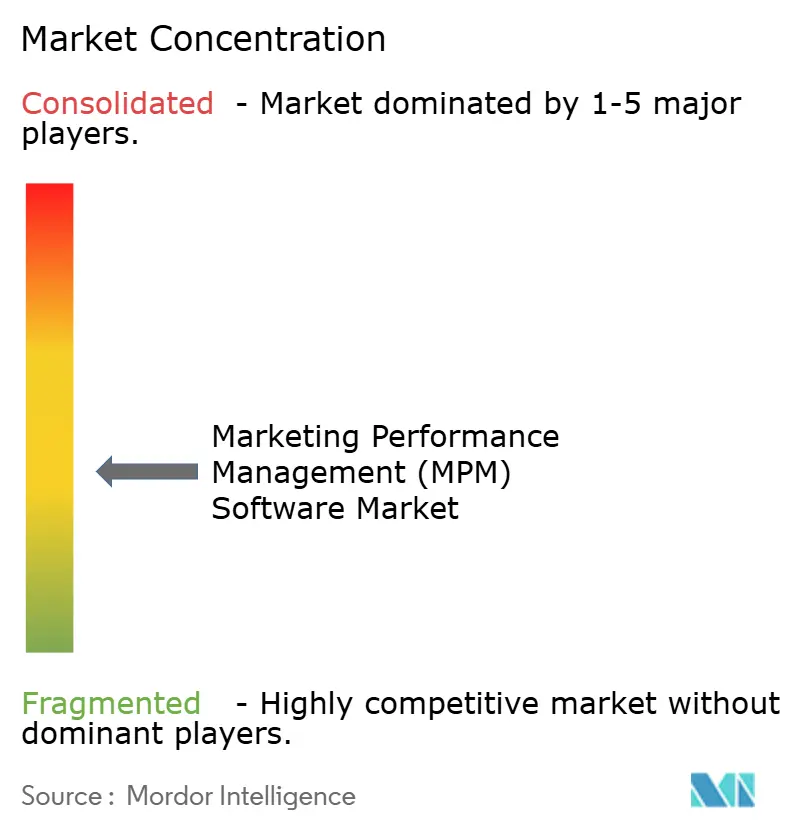
The Marketing Performance Management (MPM) Software Market shows moderate concentration among broad platform vendors and wider fragmentation among specialists. Adobe, Salesforce, Oracle, SAP, IBM, and Microsoft benefit from existing enterprise relationships and wider data footprints. Specialist vendors such as Aprimo, Uptempo, Analytic Partners, Ipsos MMA, Sprinklr, and Demandbase compete by going deeper into budget governance, content operations, or performance analytics. This split means buyers often choose between suite convenience and functional depth rather than between similar products. The result is a market where large vendors shape buying criteria, but specialists still win where workflow fit matters more than bundle scale.
Strategic moves in 2026 show that AI orchestration has become a leading competitive theme in the Marketing Performance Management (MPM) Software Market. Salesforce signed a definitive agreement in June 2026 to acquire Contentful, adding a content orchestration layer that supports AI-led campaign delivery across channels and audiences. Adobe released CX Enterprise Coworker to general availability in June 2026, linking campaign planning, audience work, content creation, and analytics through a multi-agent system.[3]Adobe, “Adobe Unveils CX Enterprise Coworker to Build Agentic-Enabled Workflows for Customer Experience Orchestration,” Adobe Newsroom, adobe.com Aprimo expanded its own position in May 2026 with Interconnected Content Operations, which tied AI, DAM, work management, and marketing spend more closely together.
Privacy-safe measurement standards and stronger governance are also shaping competitive decisions across the Marketing Performance Management Software Market. The W3C privacy-preserving attribution specification gives vendors a clearer path to build browser-aware measurement without relying on older identity methods. At the same time, smaller vendors are gaining market share by offering focused measurement quality and a lower implementation burden for teams that cannot support heavy integration work. This keeps competition active even as major platforms try to pull MPM capabilities deeper into broader customer experience and revenue systems.
Marketing Performance Management (MPM) Software Industry Leaders
Adobe Inc.
Microsoft Corporation
Oracle Corporation
Salesforce, Inc.
SAP SE
- *Disclaimer: Major Players sorted in no particular order

Recent Industry Developments
- June 2026: Salesforce announced at Connections 2026 in Chicago that it has signed a definitive agreement to acquire Contentful, a composable content platform trusted by more than 4,800 global brands. The acquisition adds a unified content orchestration layer to Salesforce's Headless 360 architecture, enabling AI agents within Agentforce Marketing to create content once and deliver it dynamically across every channel, audience segment, and language, directly expanding Salesforce's campaign performance management capabilities at scale.
- June 2026: Adobe released CX Enterprise Coworker to general availability on June 10, 2026, providing a multi-agent orchestration system built on MCP and A2A open standards. The platform coordinates campaign planning, audience segmentation, content creation, and performance analytics across Adobe Experience Platform, Real-Time CDP, Customer Journey Analytics, and Journey Optimizer, enabling autonomous customer experience workflows with human oversight at defined approval gates.
- May 2026: Aprimo launched its "Interconnected Content Operations" release on May 11, 2026, extending agentic AI capabilities across digital asset management and marketing spend. New capabilities include AI librarian agents for customizing content ingestion workflows, automated invoice processing, an MCP Server for connecting approved DAM content with external AI tools, and reverse image search for derivative and visually similar assets across enterprise content libraries.
- April 2026: Adobe introduced Brand Intelligence and expanded GenStudio at Adobe Summit Las Vegas on April 20, 2026. Brand Intelligence provides a continuously-learning AI engine for content production, trained on qualitative inputs including review feedback, annotations, rejections, and approvals, and accessible to AI agents across Workfront, GenStudio for Content Marketing, and GenStudio for Performance Marketing. Adobe simultaneously announced an OpenAI partnership supporting ChatGPT Ads in GenStudio for Performance Marketing.


Global Marketing Performance Management (MPM) Software Market Report Scope
The Marketing Performance Management (MPM) Software Market comprises software platforms that help organizations plan, budget, execute, measure, and optimize marketing activities and investments across multiple channels and campaigns. These solutions offer capabilities such as marketing planning, resource management, campaign performance measurement, marketing analytics, forecasting, and return-on-investment assessment. Increasing demand for data-driven marketing strategies, growing pressure to demonstrate marketing ROI, and rising adoption of advanced analytics technologies drive the market. These solutions help enterprises improve marketing effectiveness, optimize resource allocation, and enhance strategic decision-making.
The Marketing Performance Management (MPM) Software Market Report is Segmented by Functionality (Marketing Analytics and Reporting, Budget Planning and Forecasting, Performance Measurement and Optimization, Marketing Resource and Workflow Management), Deployment Type (Cloud-Based, On-Premises, and Hybrid), Organization Size (Large Enterprises, and Small and Medium Enterprises), End User Industry (Retail and E-Commerce, Healthcare and Life Sciences, Banking, Financial Services, and Insurance [BFSI], IT and Telecommunication, Consumer Goods, Travel and Hospitality, Media and Entertainment, Industrial Manufacturing, and Other End User Industries), and Geography (North America, South America, Europe, Asia-Pacific, Middle East, and Africa). The Market Forecasts are Provided in Terms of Value (USD).
| Marketing Analytics and Reporting |
| Budget Planning and Forecasting |
| Performance Measurement and Optimization |
| Marketing Resource and Workflow Management |
| Cloud-Based |
| On-Premises |
| Hybrid |
| Large Enterprises |
| Small and Medium Enterprises |
| Retail and E-Commerce |
| Healthcare and Life Sciences |
| Banking, Financial Services, and Insurance (BFSI) |
| IT and Telecommunication |
| Consumer Goods |
| Travel and Hospitality |
| Media and Entertainment |
| Industrial Manufacturing |
| Other End User Industries |
| North America | United States |
| Canada | |
| Mexico | |
| South America | Brazil |
| Argentina | |
| Rest of South America | |
| Europe | Germany |
| United Kingdom | |
| France | |
| Italy | |
| Spain | |
| Russia | |
| Rest of Europe | |
| Asia-Pacific | China |
| Japan | |
| India | |
| South Korea | |
| Australia and New Zealand | |
| Rest of Asia-Pacific | |
| Middle East | Saudi Arabia |
| United Arab Emirates | |
| Turkey | |
| Rest of Middle East | |
| Africa | South Africa |
| Nigeria |
| By Functionality | Marketing Analytics and Reporting | |
| Budget Planning and Forecasting | ||
| Performance Measurement and Optimization | ||
| Marketing Resource and Workflow Management | ||
| By Deployment Type | Cloud-Based | |
| On-Premises | ||
| Hybrid | ||
| By Organization Size | Large Enterprises | |
| Small and Medium Enterprises | ||
| By End User Industry | Retail and E-Commerce | |
| Healthcare and Life Sciences | ||
| Banking, Financial Services, and Insurance (BFSI) | ||
| IT and Telecommunication | ||
| Consumer Goods | ||
| Travel and Hospitality | ||
| Media and Entertainment | ||
| Industrial Manufacturing | ||
| Other End User Industries | ||
| By Geography | North America | United States |
| Canada | ||
| Mexico | ||
| South America | Brazil | |
| Argentina | ||
| Rest of South America | ||
| Europe | Germany | |
| United Kingdom | ||
| France | ||
| Italy | ||
| Spain | ||
| Russia | ||
| Rest of Europe | ||
| Asia-Pacific | China | |
| Japan | ||
| India | ||
| South Korea | ||
| Australia and New Zealand | ||
| Rest of Asia-Pacific | ||
| Middle East | Saudi Arabia | |
| United Arab Emirates | ||
| Turkey | ||
| Rest of Middle East | ||
| Africa | South Africa | |
| Nigeria | ||


Key Questions Answered in the Report
What is the current size and forecast outlook for the Marketing Performance Management (MPM) Software Market?
The Marketing Performance Management (MPM) Software Market is valued at USD 2.97 billion in 2026 and is forecast to reach USD 5.92 billion by 2031 at a 14.78% CAGR.
Which functionality leads current demand for MPM software?
Marketing analytics and reporting led with 66.12% share in 2025 because most buyers still need a unified reporting base before they scale optimization and governance.
Which deployment model is growing the fastest through 2031?
Hybrid deployment is projected to grow at a 17.05% CAGR as regulated buyers seek cloud scale while keeping tighter control over sensitive data.
Why does retail and e-commerce remain the largest end user group?
Retail and e-commerce held 22.45% share in 2025 because teams manage high campaign volumes and increasing retail media complexity across multiple networks.
Which region leads today and which one is expanding the fastest?
North America held 37.23% share in 2025, while Asia-Pacific is projected to grow the fastest at a 16.37% CAGR through 2031.
What is shaping competition among software vendors in 2026?
Competition is being shaped by AI orchestration, privacy-safe measurement, and integration depth, with Salesforce, Adobe, and Aprimo all expanding capabilities through product launches and platform moves.
Page last updated on:






