
Marketing Operations-as-a-Service Market Size and Share
Market Overview
| Study Period | 2020 - 2031 |
|---|---|
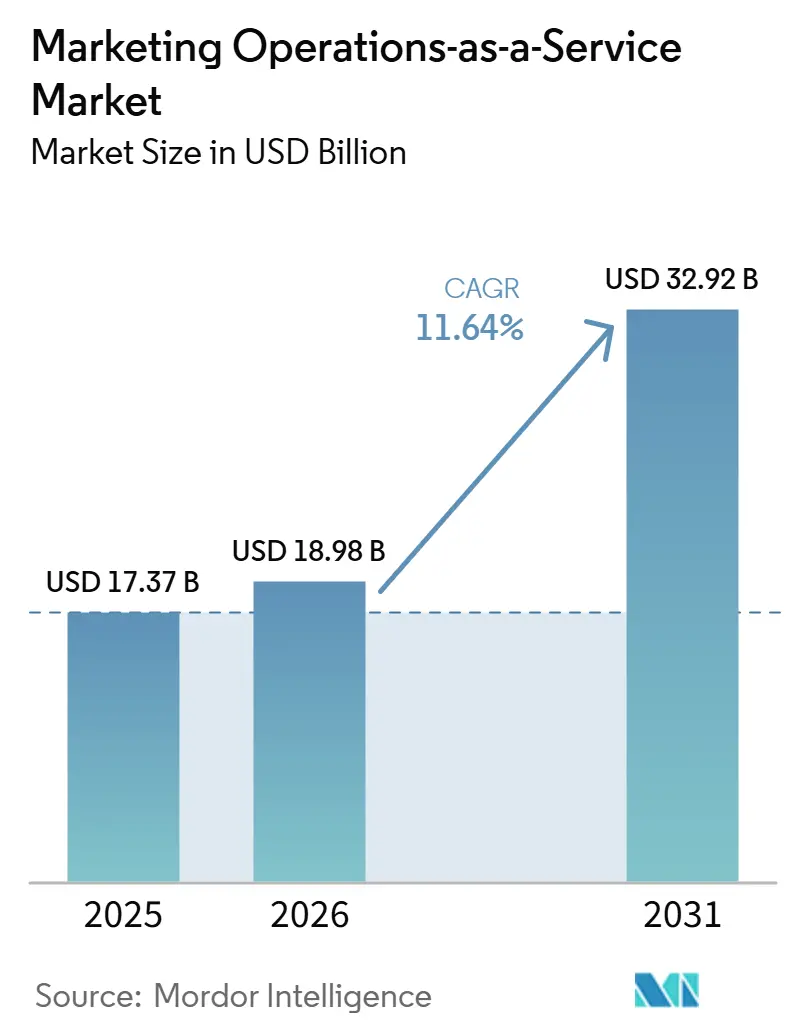
| Market Size (2026) | USD 18.98 Billion |
| Market Size (2031) | USD 32.92 Billion |
| Growth Rate (2026 - 2031) | 11.64% CAGR |
| Fastest Growing Market | Asia-Pacific |
| Largest Market | North America |
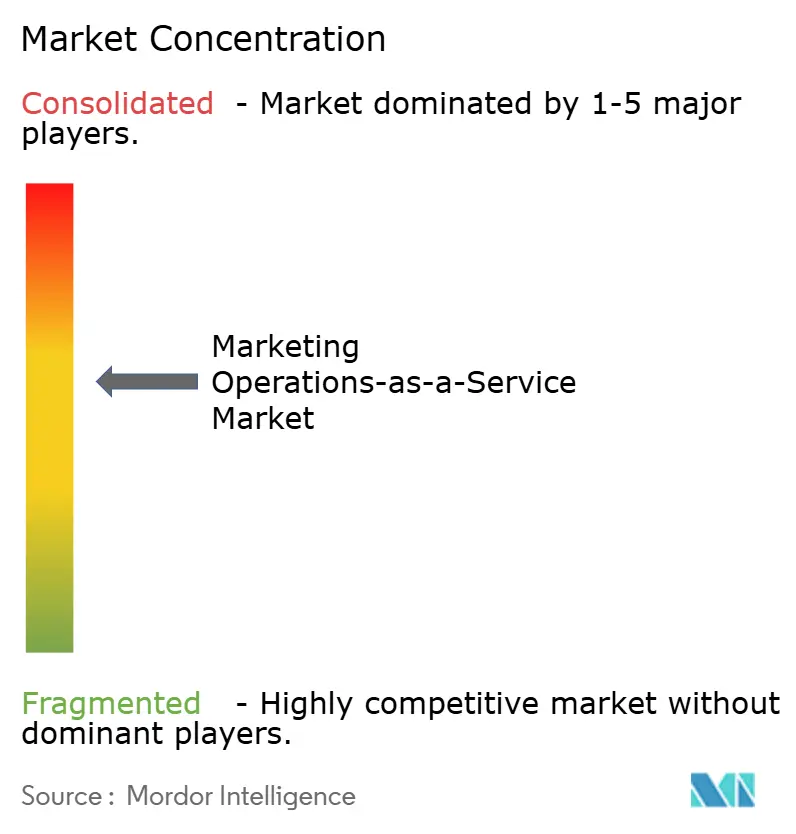
| Market Concentration | Medium |
Major Players *Disclaimer: Major Players sorted in no particular order Image © Mordor Intelligence. Reuse requires attribution under CC BY 4.0. | |
Marketing Operations-as-a-Service Market Analysis by Mordor Intelligence
The Marketing Operations-as-a-Service Market size is projected to expand from USD 17.37 billion in 2025 and USD 18.98 billion in 2026 to USD 32.92 billion by 2031, registering a CAGR of 11.64% between 2026 and 2031. Growth is being supported by a broad shift away from fragmented in-house execution toward specialist partners that can run campaign workflows, platform administration, and data processes with clearer accountability. The market is also benefiting from the wider use of AI in campaign execution, rising cross-channel complexity, and greater management attention to marketing efficiency and measurable returns. Enterprises are increasingly favoring operating models that combine internal oversight with outside execution support, especially where campaign volume, platform sprawl, and reporting demands continue to rise. At the same time, privacy rules across major jurisdictions and integration gaps across older MarTech and ERP systems are slowing onboarding and raising delivery complexity for providers. Providers that can pair operational scale with compliance-ready workflows, platform expertise, and prebuilt integration assets are therefore positioned to capture a larger share of new demand.
Key Report Takeaways
- By service type, MarTech administration and platform management led with 26.41% share in 2025, while data operations and marketing data quality management are projected to expand at a 14.82% CAGR through 2031.
- By delivery model, managed services accounted for 54.73% of the Marketing Operations-as-a-Service market in 2026, while hybrid services are projected to record the fastest CAGR of 13.69% through 2031.
- By organization size, large enterprises accounted for 63.18% of the market in 2025, while small and medium enterprises are expected to grow at a 14.24% CAGR through 2031.
- By end-user industry, retail and e-commerce captured 23.47% of the market in 2025, while healthcare and life sciences are projected to grow at a 13.91% CAGR through 2031.
- By geography, North America held 35.62% share in 2025, while Asia-Pacific is projected to register the fastest regional CAGR at 14.36% through 2031.
Note: Market size and forecast figures in this report are generated using Mordor Intelligence’s proprietary estimation framework, updated with the latest available data and insights as of January 2026.
Global Marketing Operations-as-a-Service Market Trends and Insights
Drivers Impact Analysis*
| Driver | (~) % Impact on CAGR Forecast | Geographic Relevance | Impact Timeline |
|---|---|---|---|
| GenAI-Assisted Workflow Standardization | +3.1% | Global, concentrated in North America and Western Europe | Short term (≤ 2 years) |
| Rising Demand for Centralized Campaign Operations | +2.4% | Global, with notable concentration in North America and Asia-Pacific | Medium term (2-4 years) |
| Rapid Expansion of Cross-Channel Marketing Complexity | +2.0% | Global, most acute in North America, Europe, and Asia-Pacific e-commerce hubs | Medium term (2-4 years) |
| Wider Adoption of Marketing Automation and CRM Stacks | +1.6% | Global, with strongest uptake in North America, Europe, South Korea, and Australia | Medium term (2-4 years) |
| Growth of Outcome-Based Outsourcing Models | +1.3% | North America and the EU, with spillover to India delivery centers | Long term (≥ 4 years) |
| Pressure to Improve Marketing Spend Accountability and Attribution | +1.0% | North America and the EU, with early gains in Australia and Singapore | Medium term (2-4 years) |
| Source: Mordor Intelligence | |||
GenAI-Assisted Workflow Standardization in Marketing Operations
GenAI has moved beyond trial use and is becoming part of the daily execution layer for the Marketing Operations-as-a-Service market. Salesforce reported that 75% of marketers had already adopted AI tools, yet 84% still ran generic campaigns, indicating that access to tools alone does not close the execution gap.[1]Salesforce, “State of Marketing, Tenth Edition,” Salesforce, salesforce.com That gap creates space for providers to turn AI into repeatable operating procedures rather than isolated experimentation. Adobe also expanded its customer experience platform in 2026 with agentic orchestration across content, data, and journey tools, underscoring the need for external teams to manage these workflows end to end. In the Marketing Operations-as-a-Service market, this shift supports providers that can standardize production, shorten turnaround times, and spread delivery costs across more clients. It also favors firms that can show model governance and audit discipline as AI use becomes more tightly reviewed in enterprise environments.[2]Adobe, “Adobe Unveils CX Enterprise Coworker to Build Agentic-Enabled Workflows for Customer Experience Orchestration,” Adobe Newsroom, adobe.com
Rising Demand for Centralized Campaign Operations
The Marketing Operations-as-a-Service market is also gaining from the steady move toward centralized campaign management. As brands run paid social, email, retail media, connected TV, and web programs simultaneously, team-by-team execution becomes harder to control at scale. Salesforce's 2026 marketing findings showed that widespread AI use had not yet translated into sufficient personalization, pointing to a coordination issue as much as a technology issue. Adobe's 2026 platform expansion was built around unified orchestration across customer experience functions, reflecting the same need for centralized control and clearer workflow ownership. In the Marketing Operations-as-a-Service market, outside partners are increasingly used to provide that central layer across campaign planning, activation support, approvals, and reporting. Providers that can link execution speed with better coordination across platforms are therefore placed more strongly in enterprise buying cycles.
Rapid Expansion of Cross-Channel Marketing Complexity
The Marketing Operations-as-a-Service market is being driven by the growing complexity of working across multiple channels, platforms, and reporting systems simultaneously. The IAB expected U.S. ad spend to rise 9.5% in 2026, which means campaign activity is still expanding even as teams face pressure to control headcount and operating costs.[3]Interactive Advertising Bureau, “2026 Outlook Study, U.S. Ad Spend to Rise 9.5%,” IAB, iab.com More volume across digital channels creates more data, more approvals, more asset versions, and more reconciliation work between internal teams. Adobe's 2026 CX Enterprise launch and Salesforce's 2026 agentic marketing announcements both show that the market is moving toward multi-step orchestration rather than single-tool execution. In the Marketing Operations-as-a-Service market, that environment raises the value of providers that can normalize workflows across media, CRM, content, analytics, and attribution. It also increases demand for neutral operating support when internal channel ownership is spread across different business units and agencies.
Wider Adoption of Marketing Automation and CRM Stacks
Broader adoption of marketing automation and CRM systems continues to support the Marketing Operations-as-a-Service market. HubSpot reported that 56% of companies were already using marketing automation, while another 26% planned to adopt it within 12 months, showing that operational complexity is spreading across a larger buyer base.[4]HubSpot, “State of Marketing 2026,” HubSpot, hubspot.com Salesforce added Agentic Work Units as a new pricing and measurement model in 2026, and Adobe extended orchestration across its customer experience stack in the same year. These platform moves make automation more powerful, but they also make administration, integration, and compliance work more demanding. In the Marketing Operations-as-a-Service market, certified partners can turn that added complexity into longer contracts because clients still need outside help to run platforms well after implementation. This driver is also widening the addressable market because smaller firms are now entering automation with fewer internal specialists than large enterprises.
Restraints Impact Analysis*
| Restraint | (~) % Impact on CAGR Forecast | Geographic Relevance | Impact Timeline |
|---|---|---|---|
| Data Privacy and Consent Management Complexity Across Jurisdictions | -1.7% | Global, most acute in the EU, California, India, and China | Short term (≤ 2 years) |
| Integration Debt Across Legacy MarTech and ERP Environments | -1.4% | Global, concentrated in large enterprises in North America and Western Europe | Medium term (2-4 years) |
| Internal Resistance to Outsourcing Strategic Marketing Processes | -0.9% | North America and the EU, with spillover to Japan and South Korea | Long term (≥ 4 years) |
| Talent Scarcity in Advanced Marketing Operations and Analytics | -0.7% | Global, most acute in Asia-Pacific and the Middle East and Africa | Medium term (2-4 years) |
| Source: Mordor Intelligence | |||
Data Privacy and Consent Management Complexity Across Jurisdictions
Privacy fragmentation remains a direct constraint on the Marketing Operations-as-a-Service market because campaign execution now depends on how customer data is collected, stored, shared, and activated across borders. Providers serving multinational clients must align workflows with varying consent expectations, data transfer rules, and audit requirements across jurisdictions. Adobe's 2026 customer experience expansion placed strong emphasis on governed orchestration and enterprise data controls, which reflects how central compliance has become to operational design. Salesforce's 2026 marketing direction also showed that more AI-driven execution is entering mainstream marketing processes, which means customer data governance is becoming part of day-to-day campaign operations rather than a side issue. In the Marketing Operations-as-a-Service market, this raises onboarding effort and extends review cycles for cross-border work. It also favors providers that can offer documented consent handling, regional operating models, and cleaner governance controls as part of their standard delivery framework.
Integration Debt Across Legacy MarTech And ERP Environments
Integration debt is another clear restraint on the Marketing Operations-as-a-Service market, as providers often inherit older systems that were not built to work together cleanly. Even when the business case for outsourcing is strong, time-to-value can slip if customer data is spread across disconnected CRM, ERP, email, and analytics systems. Adobe's 2026 orchestration model and Zeta's 2026 partnership with Palantir both point to a market response centered on cleaner interoperability and governed data movement. Salesforce also launched Agentforce Operations in 2026 to reduce manual work and improve process flow, underscoring the significant operational friction that still exists in enterprise marketing environments. In the Marketing Operations-as-a-Service market, providers with prebuilt connectors, data normalization assets, and structured onboarding playbooks can shorten ramp-up periods and protect contract economics. Providers without those assets face longer implementation cycles and weaker near-term return discussions with clients.
*Our forecasts treat driver/restraint impacts as directional, not additive. The impact forecasts reflect baseline growth, mix effects, and variable interactions.
Segment Analysis
By Service Type: Data Demand Reshapes The Operations Value Chain
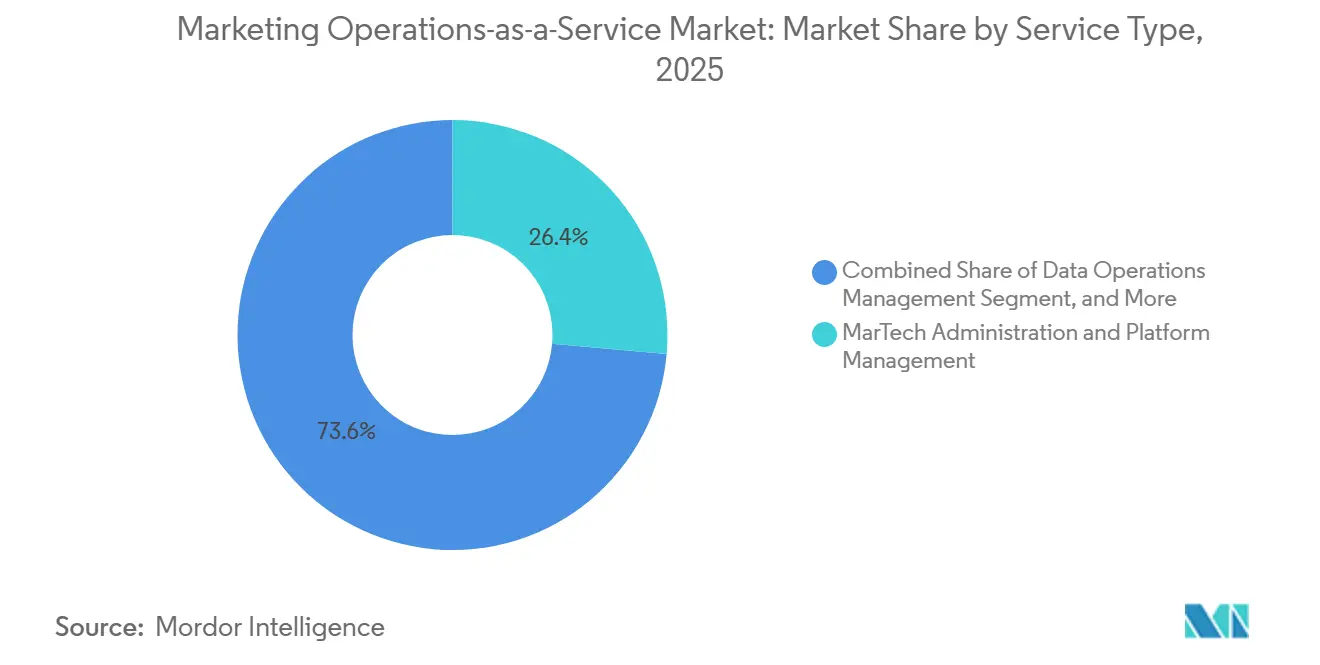
MarTech administration and platform management accounted for 26.41% of the Marketing Operations-as-a-Service market share in 2025, underscoring the demand for ongoing platform oversight rather than one-time setup work. Large enterprises continue to need external support for user administration, workflow configuration, release management, integrations, and platform governance. This part of the Marketing Operations-as-a-Service market remains central because campaign execution depends on stable systems before content, analytics, and personalization can scale. Marketing operations consulting, campaign operations, and execution also played a substantial role because many buyers still need help with process design and daily throughput. In practice, this means providers are being asked to advise on operating models while also handling recurring execution tasks that internal teams cannot absorb consistently.
Content operations and asset governance are becoming increasingly important as brands produce more localized, format-specific creative across regions and channels. Adobe expanded its GenStudio content supply chain offering in 2025 and then extended orchestration across broader customer experience workflows in 2026, which aligns with this service layer's direction. Data operations and marketing data quality management are projected to record the fastest 14.82% CAGR in the Marketing Operations-as-a-Service market through 2031, reflecting the higher value now placed on clean first-party data and dependable customer records. Zeta's 2026 Athena launch also showed how quickly analytics workflows can move when intelligence layers are built into operating environments. As a result, the Marketing Operations-as-a-Service industry is moving toward bundled offerings in which data quality, analytics support, and attribution reporting are bundled rather than sold as separate tasks.



By Delivery Model: Hybrid Structures Challenge The Managed Services Hierarchy
Managed services accounted for 54.73% of the Marketing Operations-as-a-Service market in 2026, reflecting the value clients place on stable capacity and recurring operational coverage. This model works well where campaign calendars are dense, MarTech estates are large, and data management needs do not drop between launches. The Marketing Operations-as-a-Service market still depends heavily on these longer retainer structures because they support predictable staffing and clearer service accountability. Project-based services continue to hold a place where buyers need targeted support for migrations, redesign work, or short-duration campaign bursts. That structure remains useful when the work is important but does not justify a standing external team.
Hybrid services are projected to post the fastest 13.69% CAGR through 2031, indicating that buyers increasingly want flexibility rather than choosing only one delivery model. In the Marketing Operations-as-a-Service market, hybrid contracts fit the reality of marketing work, where a steady core of tasks is often interrupted by product launches, seasonal spikes, new platform rollouts, and temporary reporting demands. Salesforce's 2026 move toward Agentic Work Units reflected the same preference for variable execution tied to real activity rather than fixed seats alone. Providers that can separate baseline support from surge capacity are likely to compete more effectively than firms that offer only fully retained or fully project-led structures. This shift is also encouraging more modular contract design, with clearer pricing around recurring administration, campaign bursts, analytics support, and AI-enabled execution layers.
By Organization Size: SME Momentum Reshapes The Competitive Demand Map
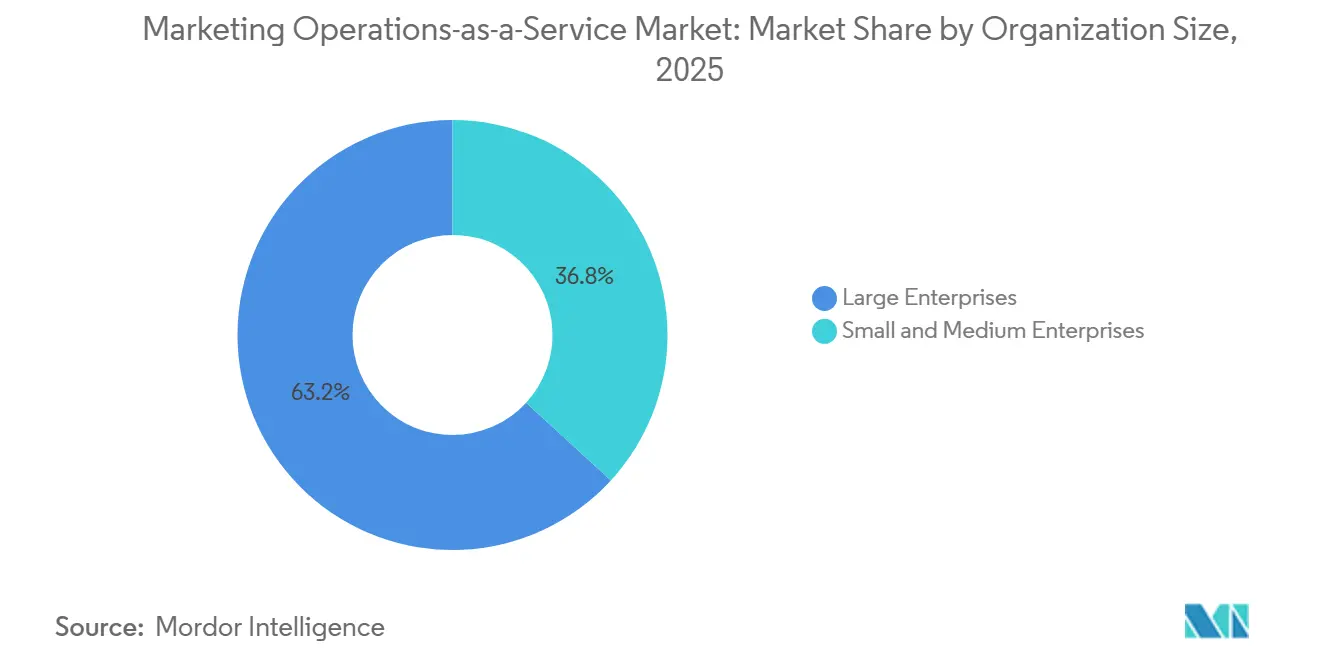
Large enterprises accounted for 63.18% of the Marketing Operations-as-a-Service market in 2025, which reflects their heavier platform investments, larger campaign volumes, and more layered approval structures. These buyers often have enough complexity to justify specialist providers for campaign execution, stack administration, data operations, and reporting support. In the Marketing Operations-as-a-Service market, large accounts also create stronger retention dynamics because the provider becomes embedded in daily workflows and governance processes. The leading service groups are therefore still anchored by enterprise relationships that can span regions, brands, and business units. That base continues to shape provider economics because large contracts fund talent depth, delivery infrastructure, and specialized capability building.
Small and medium enterprises are projected to expand at a 14.24% CAGR through 2031, making them the fastest-growing segment in the Marketing Operations-as-a-Service market. HubSpot's 2026 data on automation use supports this direction, as smaller firms are adopting platforms without adding large in-house operations teams. That creates demand for simpler managed services, lighter onboarding, and productized support that is easier to buy and scale. Providers that already work well with mid-market clients are better placed here than firms whose cost model depends on very large enterprise retainers. The Marketing Operations-as-a-Service industry is therefore seeing a gradual shift toward lower-ticket but more repeatable service delivery, supported by templates, self-service elements, and AI-assisted execution.
By End-User Industry: Healthcare's Compliance Complexity Fuels Specialist Demand
Retail and e-commerce held 23.47% of the Marketing Operations-as-a-Service market in 2025, making it the largest end-user segment in the current demand mix. This position reflects constant campaign activity, heavy reliance on customer data, and the need to coordinate promotions across digital, physical, and marketplace channels. In the Marketing Operations-as-a-Service market, retail demand tends to span campaign operations, data quality management, attribution support, and content production, as these functions often operate together in high-volume environments. Adobe and Salesforce both expanded orchestration and agentic marketing capabilities in 2026, which aligns closely with the operational needs of retail teams handling fast campaign cycles. BFSI, IT, and telecom also remain important because customer journey complexity and governance requirements are high, even when campaign structures differ from consumer commerce.
Healthcare and life sciences are projected to grow at a 13.91% CAGR through 2031, making it the fastest-expanding vertical in the Marketing Operations-as-a-Service market. That pace reflects the need to modernize commercial workflows without weakening medical, legal, and regulatory control. EVERSANA launched an AI-powered life sciences marketing agency in 2025 on Google Cloud, and the model achieved 80% automation across multiple pharmaceutical brand deployments. The case shows why specialist delivery is gaining ground in regulated sectors where cycle times, approval complexity, and audit expectations are high. The Marketing Operations-as-a-Service industry is therefore seeing healthcare become a segment where compliance capability is not a supporting feature but a core buying condition.
Geography Analysis
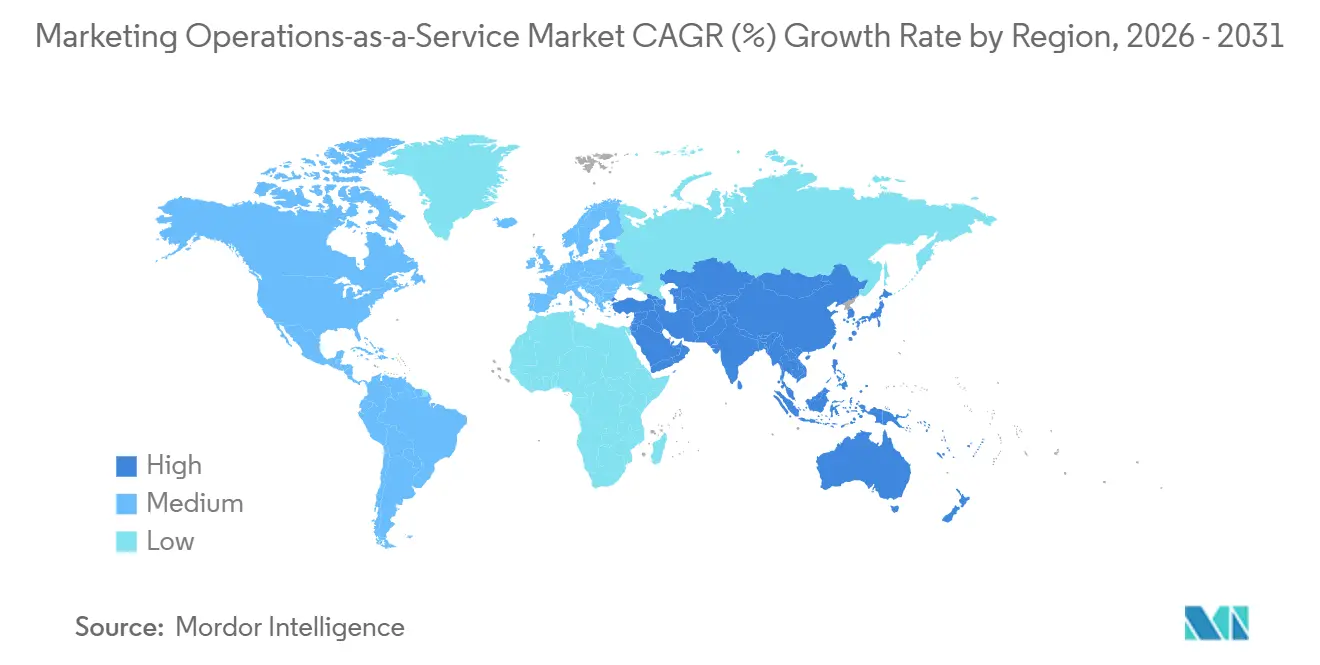
North America accounted for 35.62% of the Marketing Operations-as-a-Service market in 2025, keeping the region in the lead on the back of mature MarTech adoption and a long-established outsourcing culture. The United States remains the largest single-country market in the region because marketing spend is deep and digital campaign execution continues to expand. The IAB projected 9.5% growth in total U.S. ad spend for 2026, which supports the view that operating complexity is still increasing for brands and service partners alike. Canada adds a smaller but meaningful contribution, especially where financial services and retail organizations need structured support across customer data, content, and campaign workflows. Mexico is also gaining relevance as a nearshore delivery location for North American programs because cost efficiency and time-zone alignment continue to matter for ongoing operations.
Asia-Pacific is projected to post the fastest regional CAGR at 14.36% through 2031, giving the region the strongest growth profile in the Marketing Operations-as-a-Service market. India is central to that expansion because it serves as both a delivery base and an increasingly active buyer market for automation-led services. The region is also supported by broad digital commerce growth, which keeps campaign volumes high and raises the need for execution support, reporting consistency, and customer data management. China remains important, but data localization and privacy requirements shape how providers can structure delivery, especially when customer data moves across systems or borders.
Europe continues to hold a meaningful position in the Marketing Operations-as-a-Service market, driven by demand from Germany, the United Kingdom, and France, where enterprise marketing environments are already advanced and process-heavy. GDPR and the wider focus on governed AI use make Europe one of the stricter operating environments for campaign and customer data work. South America is still smaller in value terms, but Brazil and Argentina are creating more space for service providers as e-commerce activity and formal marketing functions continue to develop. The Middle East and Africa remain the smallest regional segment, though activity in Saudi Arabia and the UAE is rising as digital transformation programs expand and more organizations seek outside execution support.

Competitive Landscape
The Marketing Operations-as-a-Service market has a clear two-layer structure, with a stronger upper tier of diversified service groups and a broader lower tier of niche specialists, regional firms, and newer AI-led entrants. The upper tier includes names such as Accenture Song, IBM, Publicis Groupe, Deloitte Digital, Cognizant, TCS, Infosys, and Merkle, all of which compete through broad delivery coverage, enterprise relationships, and platform partnerships. In the Marketing Operations-as-a-Service market, these larger firms are better positioned when clients want a single provider that can support strategy, platform operations, campaign execution, analytics, and governance. The lower tier stays relevant by focusing on narrower functional depth, lower delivery cost, or stronger expertise in a specific vertical or platform stack. This mix keeps competition active because buyers are not choosing only on scale, they are also choosing on fit, responsiveness, and operating model alignment.
Strategic moves in 2025 and 2026 indicate that the Marketing Operations-as-a-Service market is being shaped by AI platform expansion, ecosystem partnerships, and focused capability-building. Accenture agreed to acquire Whalar in June 2026, adding creator and social capabilities to its broader marketing operations and transformation offering. Adobe launched CX Enterprise in April 2026, and agency partners, including Dentsu, Publicis, and WPP, were already deploying it as a standard for agent-based client work. Zeta also launched Athena for general availability in March 2026 and then expanded it through a USD 100 million strategic partnership with Palantir in June 2026, showing how AI-led operating layers are moving deeper into enterprise marketing environments.
White space remains visible in parts of the Marketing Operations-as-a-Service market that need different economics or stronger specialization than the large providers typically offer. Mid-market managed services is one such area because smaller companies need lower-cost, more productized delivery that still covers automation, campaign support, and data operations. Healthcare-specific operations support is another opening because regulated content and approval workflows require specialist design rather than generic execution. A third area is privacy-ready, multi-jurisdiction delivery, where providers that embed compliance into their operating model may face stronger switching costs and more defensible client relationships.
Marketing Operations-as-a-Service Industry Leaders
Accenture plc
Adobe Inc
Salesforce, Inc
IBM Corporation
Capgemini SE
- *Disclaimer: Major Players sorted in no particular order

Recent Industry Developments
- July 2026: Plaid and SORAMICHI announced joint development of an AI-BPO service for the customer experience domain in Japan, combining SORAMICHI's ATLAS AI operations platform with Plaid's customer intelligence capabilities. Rollout to initial enterprise clients is scheduled for H2 2026.
- June 2026: Accenture Song agreed to acquire Whalar, a global creator and social agency with over 170 employees, from Whalar Group. The deal extends Accenture Song's creator economy capabilities following prior acquisitions of Superdigital (2025) and Unlimited (2024), and includes a three-year strategic partnership with Whalar Group entities.
- June 2026: Zeta Global and Palantir Technologies announced a strategic partnership valued at USD 100 million to integrate Palantir Foundry's ontology and data governance infrastructure with Zeta's Athena AI intelligence layer. The combined platform aims to set a new standard for governed, agentic marketing at enterprise scale.
- June 2026: Zeta Global expanded Athena by Zeta to agencies ahead of Cannes Lions 2026, offering agentic workflows for continuous performance monitoring, next-best-action recommendations, and identity-powered attribution. Full agency availability is scheduled throughout the remainder of 2026.


Global Marketing Operations-as-a-Service Market Report Scope
The Marketing Operations-as-a-Service (MOaaS) market refers to an outsourced service model in which third-party providers manage, optimize, and execute the technical and operational backend of marketing functions. This market encompasses a range of services, including marketing operations consulting, campaign execution, administration of marketing technology (MarTech) platforms, performance analytics and attribution, content operations, and marketing data quality management. Delivered through managed, project-based, or hybrid models, MOaaS enables organizations of all sizes, ranging from large enterprises to small and medium enterprises, across various industries such as retail, BFSI, and healthcare, to bridge internal skill gaps and reduce the complexity of managing disparate marketing tools. By outsourcing these operational and technical tasks, businesses can focus on strategic initiatives and creative endeavors while ensuring their marketing infrastructure is scalable, data-driven, and aligned with overall return-on-investment goals.
The Marketing Operations-as-a-Service Market Report is Segmented by Service Type (Marketing Operations Consulting, Campaign Operations and Execution, MarTech Administration and Platform Management, Analytics, Attribution, and Performance Reporting, Content Operations and Asset Governance, and Data Operations and Marketing Data Quality Management), Delivery Model (Managed Services, Project-Based Services, and Hybrid Services), Organization Size (Large Enterprises, and Small and Medium Enterprises), End-User Industry (Retail and E-Commerce, BFSI, Healthcare and Life Sciences, IT and Telecom, Media and Entertainment, Industrial Manufacturing, Government and Public Administration, and Other End-User Industries), and Geography (North America, South America, Europe, Asia-Pacific, and Middle East and Africa). The Market Forecasts are Provided in Terms of Value (USD).
| Marketing Operations Consulting |
| Campaign Operations and Execution |
| MarTech Administration and Platform Management |
| Analytics, Attribution, and Performance Reporting |
| Content Operations and Asset Governance |
| Data Operations and Marketing Data Quality Management |
| Managed Services |
| Project-Based Services |
| Hybrid Services |
| Large Enterprises |
| Small and Medium Enterprises |
| Retail and E-Commerce |
| BFSI |
| Healthcare and Life Sciences |
| IT and Telecom |
| Media and Entertainment |
| Industrial Manufacturing |
| Government and Public Administration |
| Other End-User Industries |
| North America | United States | |
| Canada | ||
| Mexico | ||
| South America | Brazil | |
| Argentina | ||
| Rest of South America | ||
| Europe | Germany | |
| United Kingdom | ||
| France | ||
| Italy | ||
| Spain | ||
| Russia | ||
| Rest of Europe | ||
| Asia-Pacific | China | |
| India | ||
| Japan | ||
| South Korea | ||
| Australia | ||
| Rest of Asia-Pacific | ||
| Middle East and Africa | Middle East | Saudi Arabia |
| United Arab Emirates | ||
| Rest of Middle East | ||
| Africa | South Africa | |
| Nigeria | ||
| Rest of Africa | ||
| By Service Type | Marketing Operations Consulting | ||
| Campaign Operations and Execution | |||
| MarTech Administration and Platform Management | |||
| Analytics, Attribution, and Performance Reporting | |||
| Content Operations and Asset Governance | |||
| Data Operations and Marketing Data Quality Management | |||
| By Delivery Model | Managed Services | ||
| Project-Based Services | |||
| Hybrid Services | |||
| By Organization Size | Large Enterprises | ||
| Small and Medium Enterprises | |||
| By End-User Industry | Retail and E-Commerce | ||
| BFSI | |||
| Healthcare and Life Sciences | |||
| IT and Telecom | |||
| Media and Entertainment | |||
| Industrial Manufacturing | |||
| Government and Public Administration | |||
| Other End-User Industries | |||
| By Geography | North America | United States | |
| Canada | |||
| Mexico | |||
| South America | Brazil | ||
| Argentina | |||
| Rest of South America | |||
| Europe | Germany | ||
| United Kingdom | |||
| France | |||
| Italy | |||
| Spain | |||
| Russia | |||
| Rest of Europe | |||
| Asia-Pacific | China | ||
| India | |||
| Japan | |||
| South Korea | |||
| Australia | |||
| Rest of Asia-Pacific | |||
| Middle East and Africa | Middle East | Saudi Arabia | |
| United Arab Emirates | |||
| Rest of Middle East | |||
| Africa | South Africa | ||
| Nigeria | |||
| Rest of Africa | |||


Key Questions Answered in the Report
What is the current and forecast value of the Marketing Operations-as-a-Service Market?
The Marketing Operations-as-a-Service Market is projected at USD 18.98 billion in 2026 and is forecast to reach USD 32.92 billion by 2031, growing at an 11.64% CAGR.
Which service type leads demand in this space?
MarTech administration and platform management led with 26.41% share in 2025, showing that clients still place high value on platform oversight and operational continuity.
Which delivery model is expanding the fastest?
Hybrid services is projected to grow at a 13.69% CAGR through 2031 as buyers combine retained support with flexible surge capacity for launches and peak activity periods.
Which type of customer contributes the most revenue?
Large enterprises held 63.18% share in 2025 because they manage larger MarTech stacks, higher campaign volumes, and more complex operating structures than smaller firms.
Which end-user vertical is growing the fastest?
Healthcare and life sciences is projected to expand at a 13.91% CAGR through 2031, supported by demand for compliant, audit-ready workflows and faster MLR processes.
Which region offers the strongest growth outlook?
Asia-Pacific is expected to post the fastest regional CAGR at 14.36% through 2031, while North America remained the largest region with 35.62% share in 2025.
Page last updated on:






