
Malaysia Pet Treats Market Size and Share
Market Overview
| Study Period | 2021 - 2031 |
|---|---|
| Forecast Data Period | 2026 - 2031 |
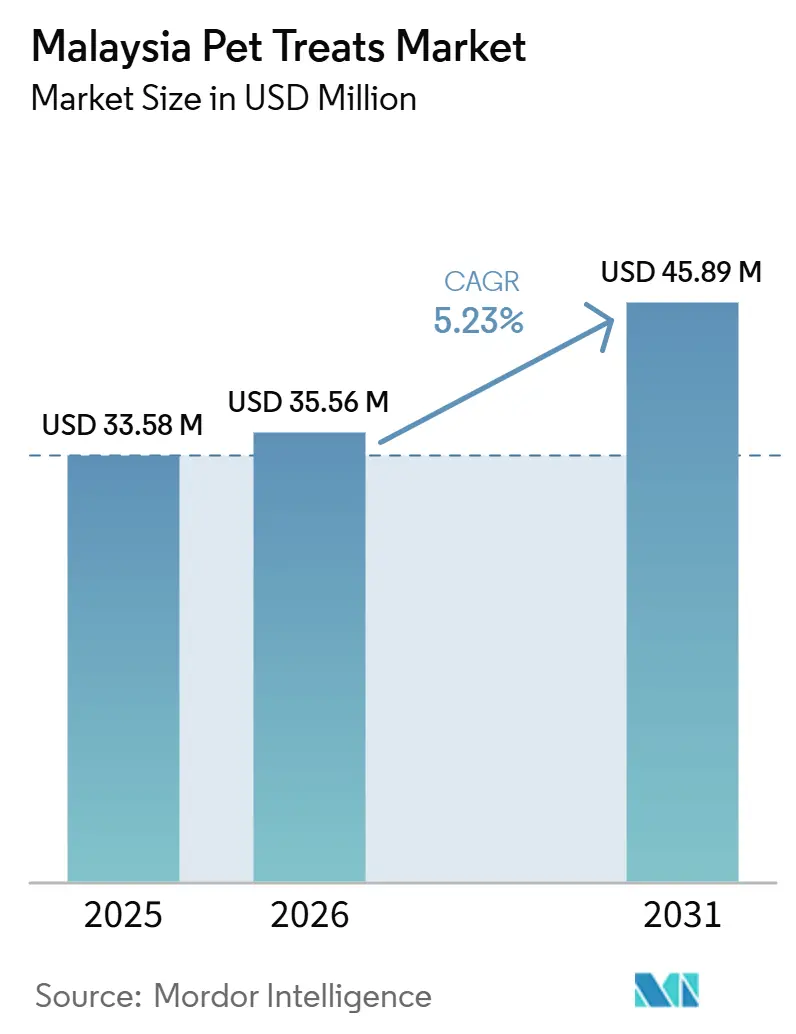
| Base Year Market Size (2025) | USD 33.58 Million |
| Market Size (2026) | USD 35.56 Million |
| Market Size (2031) | USD 45.89 Million |
| Growth Rate (2026 - 2031) | 5.23 % |
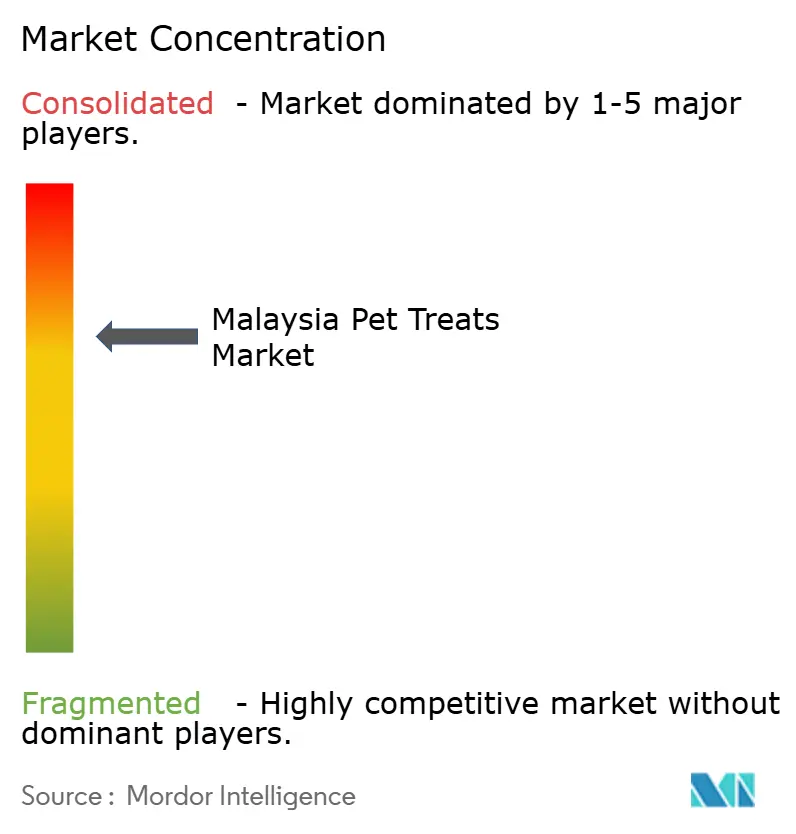
| Market Concentration | Medium |
Major Players
*Disclaimer: Major Players sorted in no particular order Image © Mordor Intelligence. Reuse requires attribution under CC BY 4.0. |
|
Malaysia Pet Treats Market Analysis by Mordor Intelligence
The Malaysia pet treats market is projected to grow from USD 33.58 million in 2025 and USD 35.56 million in 2026 to USD 45.89 million, registering a CAGR of 5.23% between 2026 and 2031. The market is being shaped by a steady shift toward premium formats, stronger demand for health-linked products, and wider use of treats as part of regular pet care rather than occasional spending. Freeze-dried and jerky products lead the current product mix, reflecting greater buyer preference for protein-led, less processed formats. Cat-focused demand remains central to category development, supporting continued growth in specialized formats with stronger repeat purchase patterns. Supermarkets and hypermarkets hold the largest share of distribution, but online retail is widening access, improving price visibility, and making replenishment easier for repeat buyers. Growth is also being influenced by import cost pressures, stricter compliance requirements for functional claims, and a competitive landscape where large multinationals benefit from scale, brand depth, and product development pipelines.
Key Report Takeaways
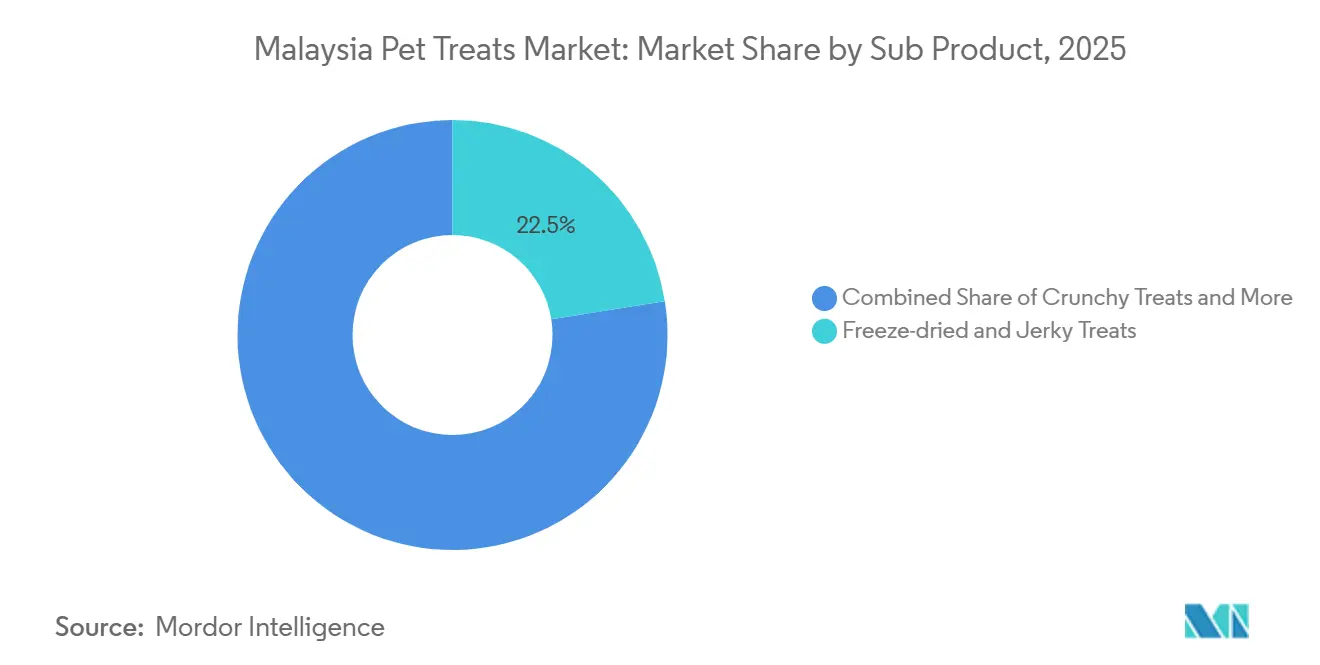
- By sub product, freeze dried and jerky treats was the largest segment and held 22.5% of the Malaysia Pet treats market share in 2025, and the segment is also the fastest-growing, projected to grow at a 6.1% CAGR between 2026 and 2031.
- By pets, cats were the largest segment and held 44.5% of the Malaysia Pet treats market size in 2025, and are anticipated to grow the fastest at a 6.8% CAGR between 2026 and 2031.
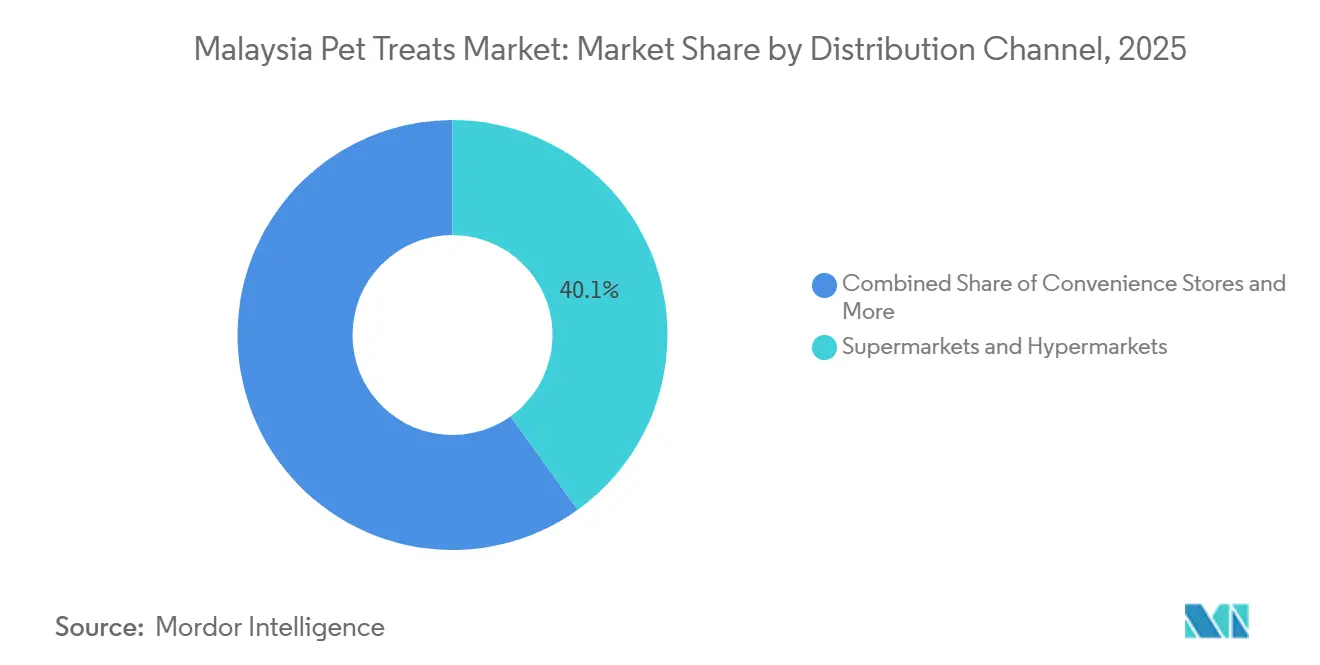
- By distribution channel, supermarkets and hypermarkets are the largest segment and held 40.1% of the market share in 2025, while the online channel is the fastest-growing segment and is anticipated to expand at a 5.8% CAGR between 2026 and 2031.
Note: Market size and forecast figures in this report are generated using Mordor Intelligence’s proprietary estimation framework, updated with the latest available data and insights as of January 2026.
Malaysia Pet Treats Market Trends and Insights
Drivers Impact Analysis*
| Driver | (~) % Impact on CAGR Forecast | Geographic Relevance | Impact Timeline |
|---|---|---|---|
| Rising demand for premium imported treats among urban pet owners | +1.4% | Malaysia, concentrated in Kuala Lumpur, Selangor, Penang, and Johor Bahru | Short term (≤ 2 years) |
| Growing veterinary awareness of dental and functional treats | +1.0% | Malaysia, urban areas with higher veterinary access density | Medium term (2-4 years) |
| Expansion of shopee and lazada pet treat purchases | +1.0% | Malaysia, national, with strongest gains in Peninsular urban corridors | Short term (≤ 2 years) |
| Retailer expansion of private label and value treats | +0.7% | Malaysia, national, with early gains in major hypermarket clusters | Medium term (2-4 years) |
| Rising use of functional and nutritional claims | +0.8% | Malaysia, urban premium tier, with spillover to secondary cities | Medium term (2-4 years) |
| Interest in sustainable and upcycled protein ingredients | +0.4% | Asia-Pacific, with spillover to Malaysia’s premium specialty segment | Long term (≥ 4 years) |
| Source: Mordor Intelligence | |||
Rising Demand for Premium Imported Treats Among Urban Pet Owners
Premium demand is becoming more visible in the Malaysia pet treats market as buyers place greater value on ingredient quality, minimal processing, and specialized usage formats. The Department of Statistics Malaysia (DOSM) reported a mean monthly household consumption expenditure of MYR 5,566 (USD 1,180) in 2024, and this spending base supports categories that are transitioning from occasional purchases to planned household buying in urban markets. This is relevant because premium treats can increase spending per pet without depending on the same pace of pet population growth. It also creates more room for imported brands and higher-value product ranges to compete on formulation, pack design, and product credibility. As this pattern develops, the Malaysia pet treats market is likely to generate a larger share of value growth from trade-up behavior within the category rather than from volume expansion alone.
Growing Veterinary Awareness of Dental and Functional Treats
Veterinary recommendation is becoming more important as functional positioning gains traction in the Malaysia pet treats market. Nestlé S.A. reported in its 2024 Capital Markets Day materials that only 22% of veterinarians globally currently discuss nutrition with clients, indicating significant room for practitioner-led category development. The same materials showed that two-thirds of the global pet care category by value sits in premium and super-premium tiers, supporting the commercial relevance of health-focused treat formats beyond niche demand. In Malaysia, this is particularly relevant because regulatory scrutiny for functional ingredients remains significant and buyers are more likely to trust products backed by recognized companies with clear benefit communication. This combination supports stronger long-term positioning for brands that can link product claims with veterinary credibility in the Malaysia pet treats market.
Expansion Of Shopee and Lazada Pet Treat Purchases
Digital retail is emerging as an important growth channel in the Malaysia pet treats market by improving product access, enabling price comparison, and simplifying replenishment for repeat buyers. The online channel is anticipated to record the fastest growth among all distribution channels. Digital platforms reduce friction in repeat ordering and provide specialized products with greater visibility than is typically possible in physical retail environments with limited shelf space. This dynamic also supports the reach of premium and functional products among buyers who have established replenishment habits and are open to trying new products within the same channel. As online shopping becomes a more regular part of pet care spending, brands with stronger search visibility, clearer product pages, and disciplined digital assortment planning are better positioned to benefit in the Malaysia pet treats market.
Retailer Expansion of Private Label and Value Treats
Value-tier expansion is widening the addressable base of the Malaysia pet treats market by bringing more price-sensitive households into regular treat purchasing. Category growth is being driven not only by premium trade-up, but also by broader affordability across modern retail shelves. Large retailers support this shift, as they already control consumer traffic, shelf space, and promotion cycles that help value products scale faster. At the same time, wider value assortments create a price ceiling that makes it harder for premium brands to sustain higher pricing without a clear functional or quality difference. As a result, both premiumization and value recruitment remain active in the market, keeping the Malaysia pet treats market commercially broad across several price bands.
Restraints Impact Analysis*
| Restraint | (~) % Impact on CAGR Forecast | Geographic Relevance | Impact Timeline |
|---|---|---|---|
| Exposure to currency and import cost fluctuations | -0.9% | Malaysia, national, amplified by high import dependence on USD-denominated raw inputs | Short term (≤ 2 years) |
| Compliance burden for functional ingredient claims | -0.5% | Malaysia, applies to all imported and domestically manufactured functional treats | Medium term (2-4 years) |
| Competition from homemade treat substitutes | -0.4% | Malaysia, concentrated in urban Gen Z and Millennial pet-owner segments | Medium term (2-4 years) |
| Premium product price sensitivity outside major cities | -0.7% | Malaysia, secondary cities and rural markets outside the four major urban corridors | Long term (≥ 4 years) |
| Source: Mordor Intelligence | |||
Exposure to Currency and Import Cost Fluctuations
Import cost exposure remains one of the clearest operating constraints in the Malaysia pet treats market. Persistent capital outflow pressure and recurring Malaysian ringgit (MYR) depreciation have added to this challenge. These conditions are relevant because imported ingredients and finished products remain integral to branded treat supply, particularly in premium formats. When the Malaysian ringgit (MYR) weakens, brands face direct pressure on gross margins and cannot always pass the full cost increase through to retail prices. This constraint is likely to persist in the Malaysia pet treats market, as price sensitivity outside the largest urban centers limits the extent to which imported cost inflation can be passed on to end consumers.
Compliance Burden for Functional Ingredient Claims
Malaysia's Department of Veterinary Services (DVS) administers the Feed Act 2009 (Act 698), which governs the manufacture, import, labeling, and sale of all pet food, including treats. In 2025 and 2026, DVS issued a series of regulatory amendments updating labeling and ingredient compliance requirements, the Feed (Licence to Import Feed or Feed Additive) (Amendment) Regulations 2025, the Feed (Labelling of Feed or Feed Additive) (Amendment) Regulations 2026, and the Feed (Prohibited Antibiotics, Hormones and Other Chemicals) (Amendment of Schedule) Regulations 2026[1]Source: Department of Veterinary Services,"ANIMAL FEED ACT 2009 AND REGULATIONS UNDER THE ANIMAL FEED ACT 2009," eamh.dvs.gov.my. For manufacturers of functional treats bearing digestive, immunity, or oral health claims, the DVS registration pathway requires ingredient-by-ingredient approval, which can extend new product launch timelines by 6–18 months. This compliance burden disproportionately affects smaller regional brands and direct-to-consumer companies that lack the regulatory resources available to multinational firms, creating a structural advantage for established players in the highest-growth treat formats.
*Our forecasts treat driver/restraint impacts as directional, not additive. The impact forecasts reflect baseline growth, mix effects, and variable interactions.
Segment Analysis
By Sub Product: Freeze-Dried and Jerky Formats Lead Malaysia's Premium Treat Uptake
Freeze dried and jerky treats held 22.5% of the Malaysia pet treats market share in 2025, making it the largest sub-product category. It is also anticipated to expand at a 6.1% CAGR between 2026 and 2031, giving it both the largest current scale and the fastest forecasted growth among sub-product categories. This position reflects strong buyer preference for products that signal higher protein quality, lower processing intensity, and more premium nutritional value. These formats also support better category economics, as premium products generally capture more value per purchase than conventional reward treats.
Dental treats represent an important growth opportunity within the Malaysia pet treats market, as they align well with the broader shift toward preventive care and daily wellness routines. Soft and Chewy Treats and Crunchy Treats continue to support mainstream volume by serving everyday reward use cases at accessible price points. Other Treats retain a niche role, where novelty, specific texture requirements, or occasional purchase behavior can sustain repeat demand.



By Pets: Cat Ownership Fuels Structural Demand for Specialized Treats
Cats accounted for 44.5% of the Malaysia pet treats market share in 2025, making them the largest pet segment by value. The cat segment is also anticipated to grow at a 6.8% CAGR between 2026 and 2031, making it both the largest and the fastest-growing segment within the pets segmentation. This position influences flavor development, pack sizes, price ladders, and communication priorities across a large part of the category. It also supports stronger repeat purchase potential, as specialized cat formats tend to align closely with everyday feeding and reward routines.
Dogs, though they do not currently define the overall growth pace of the Malaysia pet treats market hold a considerable share in the market. Other pets add diversity to the category demand, but their current role remains considerably smaller than the cat and dog segments. In June 2026, Mars launched Greenies Pill Pockets for dogs, reflecting a broader shift toward functional utility and medication support rather than indulgence-only positioning[2]Source: Press Release,"Mars brand Greenies launches Pill Pockets," insidefmcg.com.au. The strongest product and channel returns are therefore likely to remain concentrated in segments that align with repeat-use behavior, clearer functional value, and specialized pet care routines within the Malaysia pet treats market.
By Distribution Channel: Online Growth Reshapes Malaysia's Treat Purchase Patterns
Supermarkets and hypermarkets held 40.1% of the Malaysia pet treats market in 2025, making them the largest distribution channel by current scale. Their position reflects the continued importance of modern trade for routine household shopping, broad product visibility, and higher basket sizes across mainstream pet products. This channel provides established brands with consistent physical reach and allows consumers to compare familiar products within a single shopping trip. It also supports bulk and planned purchasing behavior, particularly in a market where repeat food and treat purchases are closely linked.
The online channel is anticipated to expand at a 5.8% CAGR between 2026 and 2031, making it the fastest-growing distribution channel in the Malaysia pet treats market. Digital retail is relevant because it simplifies replenishment, improves price transparency, and increases the discoverability of premium and specialized products. Specialty stores also remain relevant, as they support premium formats through more focused assortments and stronger product explanation. Companies with coordinated presence across supermarkets and hypermarkets, online platforms, and specialty outlets are better positioned than those relying on a single distribution channel in the Malaysia pet treats market.
Geography Analysis
Selangor, Kuala Lumpur, and Johor remain the strongest centers of pet population and demand in Malaysia, supported by dense urbanization, higher household incomes, and housing conditions that favor cats over dogs. Cat treat spending continues to drive category expansion in the Malaysia pet treats market. Penang and Johor Bahru also form part of the primary premium demand corridor, with similar urban retail structures and strong digital access supporting premium treat purchases. These locations give brands better access to younger, apartment-based households that show a stronger preference for freeze-dried and functional products over economy private label formats.
East Malaysia remains a developing but structurally constrained part of the Malaysia pet treats market. Sabah and Sarawak continue to face higher logistics costs, lower specialty retail density, and tighter household budgets than Peninsular Malaysia. These conditions limit the accessibility of premium single-ingredient products and give value-tier and basic functional treats a clearer commercial fit. Affordability remains a key purchasing consideration in these regions, supporting demand for competitively priced pet treats over premium offerings.
Malaysia's supply structure also shapes regional pricing and product availability across the Malaysia pet treats market. In 2025, GlobalPETS stated that Taiwan's pet food exports to Malaysia surged by 377% over 6 years, widening the supply base and adding more competitively priced mid-tier Asian formulations to the market[3]Source: News,"Source: Press Release,"Mars brand Greenies launches Pill Pockets," insidefmcg.com.au," globalpetindustry.com. The United Kingdom's accession to the Comprehensive and Progressive Agreement for Trans-Pacific Partnership (CPTPP), which entered into force with Malaysia on 15 December 2024, established the first free trade agreement between the two countries. The agreement provides preferential tariff treatment and streamlined trade procedures for qualifying United Kingdom exports, including pet food products where the applicable CPTPP tariff schedule and rules of origin are met. This multi-origin import structure benefits online platforms and specialty retailers most, as they can offer wider country-of-origin assortments to price-comparing buyers. It also makes sourcing geography a more active commercial consideration for companies seeking to manage landed costs and remain competitive in the Malaysia pet treats market.
Competitive Landscape
The Malaysia pet treats market remains moderately concentrated, led by large multinational companies with broader portfolios, stronger quality systems, and greater cross-border operational depth. Mars, Incorporated and Nestlé Purina Petcare are central to this structure, as both companies support multiple price tiers and continue investing in premium, health-focused, and science-backed product development. Their competitive advantage is reinforced by a greater ability to absorb import cost fluctuations and comply with ingredient and labeling requirements under the DVS (Department of Veterinary Services) Malaysia framework. As a result, competition in the Malaysia pet treats market is moving beyond shelf presence and becoming more dependent on formulation credibility, regulatory readiness, and innovation speed.
Competition in the Malaysia pet treats market is increasingly centered on premiumization and omnichannel distribution as manufacturers respond to rising demand for functional and natural pet treats. Companies are expanding their portfolios with dental treats, high-protein snacks, limited-ingredient formulations, and products supporting digestive, skin, and joint health while strengthening their presence through pet specialty retailers, veterinary clinics, supermarkets, and e-commerce platforms. As pet owners become more conscious of ingredient quality and nutritional benefits, companies are differentiating themselves through premium formulations, transparent labeling, and continuous product innovation.
The market still offers room for regional and local challengers, though the most accessible growth opportunities are likely to be focused rather than broad. Dental treats, digitally driven repeat-purchase models, and targeted functional propositions remain the most open areas where smaller companies can differentiate. Halal-aligned product positioning may also gain relevance where companies can combine it with clear quality standards and reliable channel execution. Overall, the Malaysia pet treats market continues to favor players that can manage price pressure, regulatory approvals, and innovation simultaneously, which keeps the competitive structure moderately concentrated rather than fragmented.
Malaysia Pet Treats Industry Leaders
-
Mars, Incorporated
-
Hill’s Pet Nutrition (Colgate-Palmolive Company)
-
The J.M. Smucker Company
-
Blue Buffalo (General Mills, Inc.)
-
Nestle Purina Petcare (Nestle S.A.)
- *Disclaimer: Major Players sorted in no particular order

Recent Industry Developments
- July 2026: Japanese seafood group Umios agreed to acquire a 51% stake in Malaysia's Pet World International (PWI) for USD 70.4 million. The deal positions Malaysia as the anchor of Umios's Southeast Asian pet food network alongside existing operations in Japan and Thailand, and the company signaled further production investment and acquisition activity across the region over the next 2 years.
- April 2026: UTM (Universiti Teknologi Malaysia) announced that Global Petcare Holdings became the first Malaysian company to establish a science-driven cat food research collaboration with the university, backed by a MYR 230,000 (USD 51,000) grant, over 3 years. The research covers nutritional profiling, ingredient-composition verification, and porcine contamination detection for halal compliance, with findings intended for the Evocat and Cat Master product lines.
- February 2026: SmartHeart, part of Perfect Companion Group, introduced 5 Pet Buddies mascots at Lot 10 in Kuala Lumpur and launched a nationwide consumer roadshow covering more than 100 stops across Peninsular Malaysia, including Penang and Johor Bahru. The activation received recognition from The Star 2026 for the largest rubber stamp artwork in the country.


Malaysia Pet Treats Market Report Scope
Pet treats are snack and reward products formulated for companion animals and are used for indulgence, training, oral care, and functional health support.
The Malaysia Pet Treats Market is Segmented by Sub Product Type (Crunchy Treats, Dental Treats, Freeze-Dried and Jerky Treats, Soft and Chewy Treats, and Other Treats), by Pet Type (Dogs, Cats, and Other Pets), and by Distribution Channel (Convenience Stores, Online Channel, Specialty Stores, Supermarkets and Hypermarkets, and Other Channels). The Market Forecasts are Provided in Terms of Value (USD) and Volume (Metric Tons).
| Crunchy Treats |
| Dental Treats |
| Freeze Dried and Jerky Treats |
| Soft and Chewy Treats |
| Other Treats |
| Cats |
| Dogs |
| Other Pets |
| Convenience Stores |
| Online Channel |
| Specialty Stores |
| Supermarkets and Hypermarkets |
| Other Channels |
| By Sub Product | Crunchy Treats |
| Dental Treats | |
| Freeze Dried and Jerky Treats | |
| Soft and Chewy Treats | |
| Other Treats | |
| By Pets | Cats |
| Dogs | |
| Other Pets | |
| By Distribution Channel | Convenience Stores |
| Online Channel | |
| Specialty Stores | |
| Supermarkets and Hypermarkets | |
| Other Channels |


Key Questions Answered in the Report
What is the forecasted value of Malaysia pet treats by 2031?
The Malaysia pet treats market is forecasted to reach USD 45.89 million by 2031 from USD 35.56 million in 2026, at a 5.23% CAGR between 2026 and 2031.
Which pet segment was leading demand in Malaysia pet treats?
Cats was the leading pet segment with 44.5% share in 2025, and it is also the fastest growing one with a 6.8% CAGR between 2026 and 2031.
Which distribution channel is growing the fastest in Malaysia?
Online channel is the fastest growing distribution route and is anticipated to expand at a 5.8% CAGR between 2026 and 2031, while supermarkets and hypermarkets remained the largest in 2025.
What are the main risks for companies selling pet treats in Malaysia?
The main risks are imported cost volatility and stricter compliance requirements for functional ingredient and labeling claims under Department of Veterinary Services (DVS) Malaysia regulations.
Page last updated on:





