
Malaysia Fertilizer Market Size and Share
Market Overview
| Study Period | 2021 - 2031 |
|---|---|
| Forecast Data Period | 2026 - 2031 |
| Base Year Market Size (2025) | USD 0.94 Billion |
| Market Size (2026) | USD 0.98 Billion |
| Market Size (2031) | USD 1.23 Billion |
| Growth Rate (2026 - 2031) | 4.65 % |
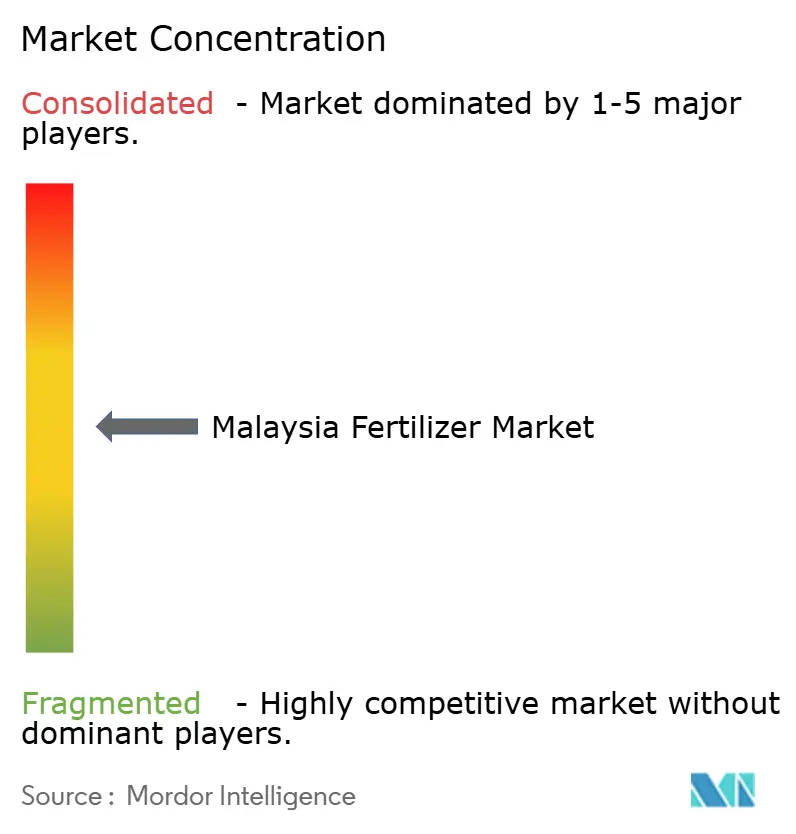
| Market Concentration | Medium |
Major Players *Disclaimer: Major Players sorted in no particular order Image © Mordor Intelligence. Reuse requires attribution under CC BY 4.0. | |
Malaysia Fertilizer Market Analysis by Mordor Intelligence
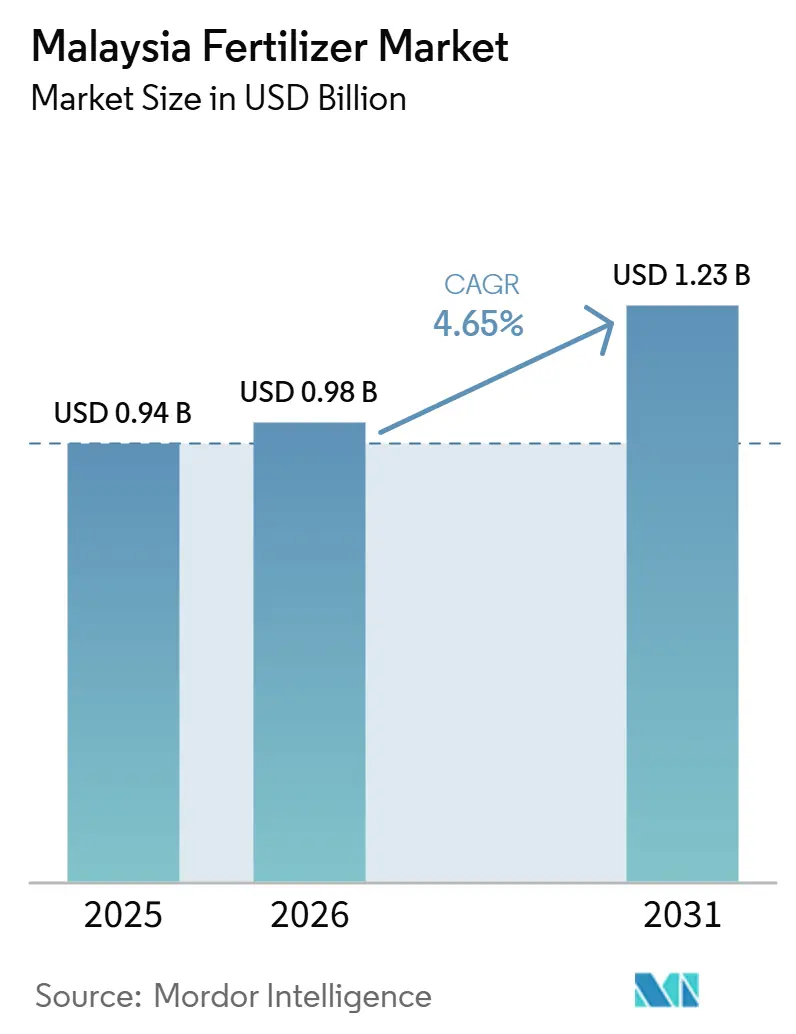
The Malaysia fertilizers market size was expanded from USD 0.94 billion in 2025 and USD 0.98 billion in 2026 to USD 1.23 billion by 2031, registering a CAGR of 4.65% between 2026 and 2031. The Malaysia fertilizer market is supported by recurring nutrient demand from oil palm cultivation, stable paddy input support, and a broader policy focus on maintaining agricultural production amid cost pressures. The Malaysia fertilizer market is also seeing a gradual shift in product mix as fertigation and precision farming raise demand for water-soluble, liquid, and controlled-release products in horticulture and protected cultivation systems. Domestic nitrogen production gives the Malaysia fertilizer market some short-term supply protection, but phosphatic dependence still leaves buyers exposed to imported raw material risk and external price shocks. Proposed quality regulation and tighter oversight of distribution are likely to favor more compliant producers and organized suppliers over time. Replanting remains below the recommended pace, keeping current spending focused on maintaining older plantation blocks and leaving room for stronger nutrient demand as a wider replanting cycle gathers pace.
Key Report Takeaways
- By type, straight fertilizers accounted for the largest share of the Malaysia fertilizer market, representing 64.0% in 2025, and are projected to be the fastest-growing segment, registering a CAGR of 8.6% from 2026 to 2031.
- By form, conventional fertilizers accounted for the largest share of the Malaysia fertilizer market, representing 78.0% in 2025, while specialty fertilizers are projected to be the fastest-growing segment, registering a CAGR of 8.1% from 2026 to 2031.
- By application mode, soil application accounted for the largest share of the Malaysia fertilizer market, representing 66.0% in 2025, while fertigation is projected to be the fastest-growing segment, registering a CAGR of 8.7% from 2026 to 2031.
- By crop type, field crops accounted for the largest share of the Malaysia fertilizer market, representing 54.0% in 2025, while horticultural crops are projected to be the fastest-growing segment, registering a CAGR of 7.9% from 2026 to 2031.
Note: Market size and forecast figures in this report are generated using Mordor Intelligence’s proprietary estimation framework, updated with the latest available data and insights as of January 2026.
Malaysia Fertilizer Market Trends and Insights
Drivers Impact Analysis*
| Driver | (~) % Impact on CAGR Forecast | Geographic Relevance | Impact Timeline |
|---|---|---|---|
| Rising oil palm nutrient demand | +1.2% | Malaysia, strongest in plantation belts across Peninsular Malaysia, Sabah, and Sarawak | Long term (≥ 4 years) |
| Government subsidies and input support | +0.9% | Malaysia, strongest in paddy and food crop zones | Medium term (2-4 years) |
| Precision farming and fertigation adoption | +0.8% | Peninsular Malaysia first, then Sarawak and selected Sabah zones | Medium term (2-4 years) |
| Domestic production and stock buffering efforts | +0.6% | Malaysia, led by Kedah and Sabah production hubs | Short term (≤ 2 years) |
| Fertilizer quality regulation and supply chain oversight | +0.5% | Malaysia-wide, strongest for formal producers and distributors | Long term (≥ 4 years) |
| Replanting cycles in plantation agriculture | +0.7% | Sabah, Sarawak, and Peninsular Malaysia plantation belts | Long term (≥ 4 years) |
| Source: Mordor Intelligence | |||
Rising Oil Palm Nutrient Demand
Oil palm remains the largest end-use anchor for the Malaysia fertilizer market because it consumes large recurring nutrient volumes across mature and replanted acreage. According to the International Fertilizer Association, muriate of potash imports into Malaysia totaled 1.6 million tons in 2023, and higher crude palm oil prices in 2024 supported estate cash flow and kept nutrient spending more resilient than anticipated[1]Source: International Fertilizer Association, “Short-Term Fertilizer Outlook,” International Fertilizer Association, fertilizer.org. Strong palm oil prices also reduce the urgency to replace aging palms, as growers often prefer to sustain output from older trees rather than temporarily take land out of production. That behavior keeps demand steady for potassic and nitrogenous products because mature stands still require maintenance feeding and corrective nutrient application to sustain bunch output. This gives the Malaysia fertilizer market a stable plantation-led demand base even before a larger replanting cycle starts to move faster.
Government Subsidies and Input Support
Government support remains one of the clearest demand stabilizers in the Malaysia fertilizer market because part of national consumption is linked to policy support instead of only farm-level purchasing ability. The Ministry of Agriculture and Food Security allocated MYR 2.279 billion (USD 484.9 million) in 2025 for agricultural support, covering seeds, fertilizers, and pest control for paddy farmers. In 2026, the allocation stands at MYR 2.62 billion (USD 557.4 million), indicating that shielding food producers from cost pressures remains an active policy priority. The Sales and Service Tax exemption for rock phosphate and magnesium sulfate from January 2026 through December 2027 further reduces delivered cost and helps keep subsidized demand in the Malaysia fertilizer market more stable during periods of price stress.
Precision Farming and Fertigation Adoption
Precision agriculture is gradually reshaping the fertilizer market in Malaysia by influencing both fertilizer application methods and product selection. Among the most significant technologies is fertigation, which combines irrigation and fertilizer application to deliver nutrients directly to the plant root zone with greater precision. This approach improves nutrient use efficiency, reduces fertilizer losses through leaching and runoff, lowers labor requirements, and supports higher crop yields and quality, particularly for high-value horticultural crops such as chili, tomato, cucumber, capsicum, and rock melon. The Malaysian Agricultural Research and Development Institute (MARDI) has played a key role in developing and promoting fertigation technologies suited to local farming conditions. Through research, demonstration farms, extension services, and technology transfer programs, MARDI has encouraged farmers to adopt precision nutrient management practices.
Domestic Production and Stock Buffering Efforts
Domestic production resilience is emerging as an important driver of the Malaysia fertilizer market as the government seeks to strengthen food security and reduce the agricultural sector's vulnerability to global supply chain disruptions. Although Malaysia continues to rely heavily on imported fertilizer raw materials and finished products, national policies such as the National Agrofood Policy 2.0 (2021–2030) and the National Food Security Policy 2030 emphasize increasing domestic agricultural productivity through technology adoption, efficient input use, and the development of more resilient local supply chains. These initiatives encourage investments in domestic fertilizer production, biofertilizers, and specialty fertilizers while supporting farmers through modernization programs and input assistance. According to the National Food Security Policy 2030, Malaysia remains heavily dependent on imported chemical fertilizers, exposing the market to international price volatility and supply disruptions, reinforcing the need to strengthen domestic production capacity and diversify fertilizer sources.
Restraints Impact Analysis*
| Restraint | (~) % Impact on CAGR Forecast | Geographic Relevance | Impact Timeline |
|---|---|---|---|
| Heavy dependence on imported raw materials | -0.8% | Malaysia-wide, strongest in phosphatic supply lines | Short term (≤ 2 years) |
| Exposure to global price volatility | -0.7% | Malaysia-wide, strongest in imported nutrient categories | Medium term (2-4 years) |
| Smallholder price sensitivity | -0.5% | Peninsular Malaysia and Sabah smallholder belts | Long term (≥ 4 years) |
| Limited specialty fertilizer penetration beyond plantations | -0.4% | Rest of Malaysia and lower-tech farming zones | Long term (≥ 4 years) |
| Source: Mordor Intelligence | |||
Heavy Dependence on Imported Raw Materials
The Malaysia fertilizer market still carries a structural vulnerability because domestic production does not cover all nutrient categories evenly. Local urea output provides meaningful nitrogen support, but the same protection does not apply to phosphatic inputs. As of March 2026, Malaysia sources 50% of its phosphatic fertilizer imports from Egypt, maintaining significant corridor concentration risk despite having reduced dependence on some earlier origins. In the same month, the Ministry of Plantation and Commodities moved to secure alternative supply partners and activate new channels, indicating that procurement diversification has become an active policy priority task[2]Source: Ministry of Agriculture and Food Security coverage, “Agricultural Support Allocation For 2026,” Astro Awani, astroawani.com. The proposed Fertilizer Bill may improve oversight, but the Malaysia fertilizer market will remain vulnerable until import sourcing becomes broader and less concentrated.
Smallholder Price Sensitivity
Smallholder affordability remains a meaningful brake on the Malaysia fertilizer market because cost pressure is not absorbed evenly across farm types. Large plantation groups can often manage volatility through broader procurement arrangements, while smaller growers remain more exposed to spot pricing and short credit cycles. When prices rise, these farmers often reduce application rates rather than switching smoothly to higher-performing alternatives, which weakens nutrient intensity without always showing up as a sharp decline in reported demand. This pattern also slows premium product adoption because specialty inputs remain harder to justify outside high-value crop systems or direct support schemes. As a result, the Malaysia fertilizer market can keep expanding while the shift toward higher-margin inputs stays slower than the technical case alone would suggest.
*Our forecasts treat driver/restraint impacts as directional, not additive. The impact forecasts reflect baseline growth, mix effects, and variable interactions.
Segment Analysis
By Type: Straight Fertilizers Lead Demand While Micronutrients Gain Traction
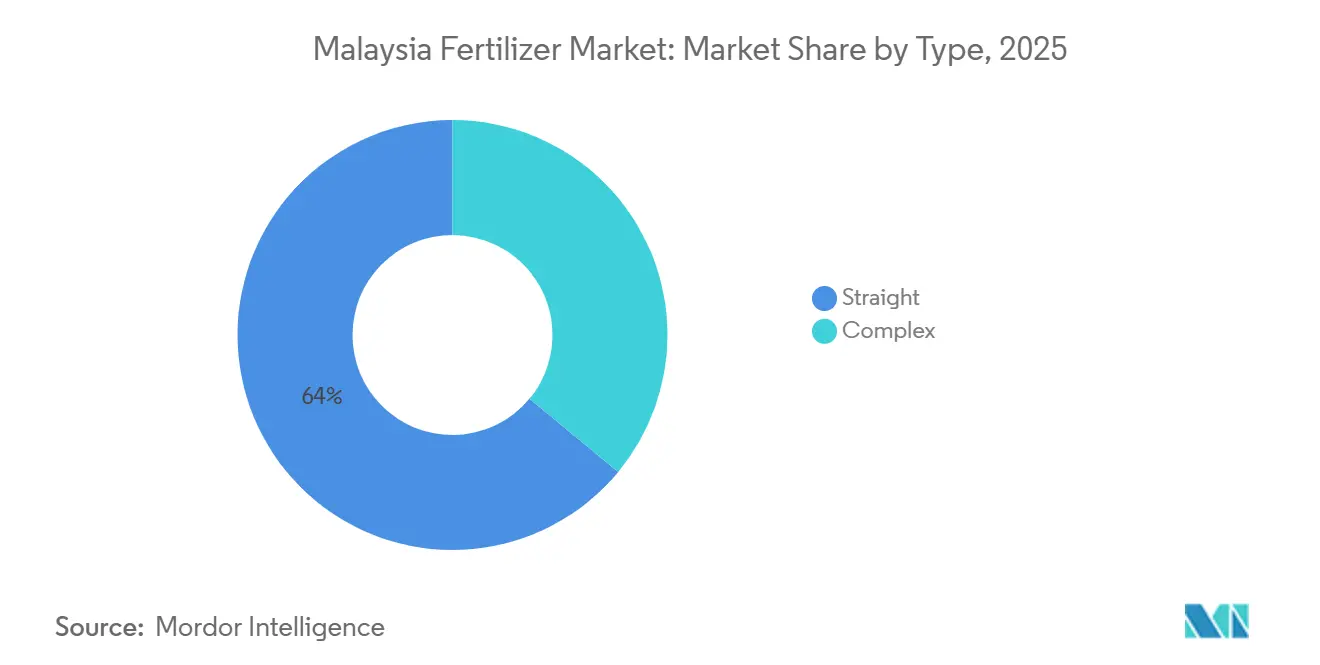
Straight fertilizers held the largest, 64.0% of the Malaysia fertilizer market share in 2025, which kept the segment at the center of national volume demand. Urea, muriate of potash, and di-ammonium phosphate remained the core products used across oil palm, paddy, and rubber plantations because they fit established nutrient programs and large-scale field application. Within nitrogenous fertilizers, urea dominated the sub-segment in 2025, and domestic plants in Kedah and Sabah helped maintain supply continuity during global disruption.
Straight fertilizers are projected to expand at a CAGR of 8.6% from 2026 to 2031, making them the fastest-growing segment, reflecting the increasing focus on correcting deficiencies in field nutrient strategies. Boron is projected to grow as oil palm estates use it to reduce flower abortion and leaf deformation, both of which can negatively affect fresh fruit bunch performance. Complex fertilizers support estates transitioning toward more precise nutrient programs based on leaf tissue analysis and structured field diagnostics. While straight fertilizers lead the Malaysia fertilizer market in terms of scale, growth is increasingly being driven by nutrient balancing and deficiency management.



By Form: Conventional Products Held the Largest Share While Specialty Products Drive Value Growth
Conventional fertilizers held 78.0% of the form segment in 2025, which shows that the Malaysia fertilizer market size still rests on the broad use of standard granular products. Plantation operators manage nutrient programs across very large planted areas, so cost per nutrient unit still matters more than delivery precision in many buying decisions. Conventional products also benefit from established logistics, familiar handling practices, and strong compatibility with the current distributor base. This is why conventional fertilizers continue to hold the larger share of the Malaysia fertilizer market even as product sophistication increases.
Specialty fertilizers are projected to grow at 8.1% through 2031, making them the fastest-growing part of the form split. Controlled-release fertilizers are gaining popularity in oil palm nurseries because nutrient timing is critical during early plant establishment. Slow-release and water-soluble products also fit tropical conditions where nutrient loss can be higher, and crop response needs to be tighter. As a result, the Malaysian fertilizer market is evolving toward a dual structure. Conventional fertilizers continue to dominate large-scale plantation agriculture, while specialty fertilizers are expanding their role in horticulture, nursery production, and precision nutrient management.
By Application Mode: Soil Application Dominates While Fertigation Records the Fastest Growth
Soil application accounted for 66.0% of the application mode segment in 2025, which kept it as the operational base of the Malaysia fertilizer market. The method remains dominant across plantation crops because broadcasting and mechanized spreading are practical for large acreages. Foliar application plays a more targeted role in micronutrient correction and in high-value crops where fast uptake is needed during critical growth stages. Malaysian Agricultural Research and Development Institute (MARDI) guidance indicates that boron and zinc deficiencies in oil palm can respond more quickly to foliar correction than to soil-only treatment in some cases.
Fertigation is projected to grow at 8.7% through 2031, making it the fastest-growing application mode by a clear margin. Growth is being supported by protected cultivation, smart farming programs, and better proof of commercial viability in vegetables and fruit crops. As more farms install automated systems, the Malaysia fertilizer market is likely to see more durable demand for branded water-soluble and liquid formulations that are tied closely to specific delivery platforms.
By Crop Type: Field Crops Dominate by Volume While Horticulture Improves Value Mix
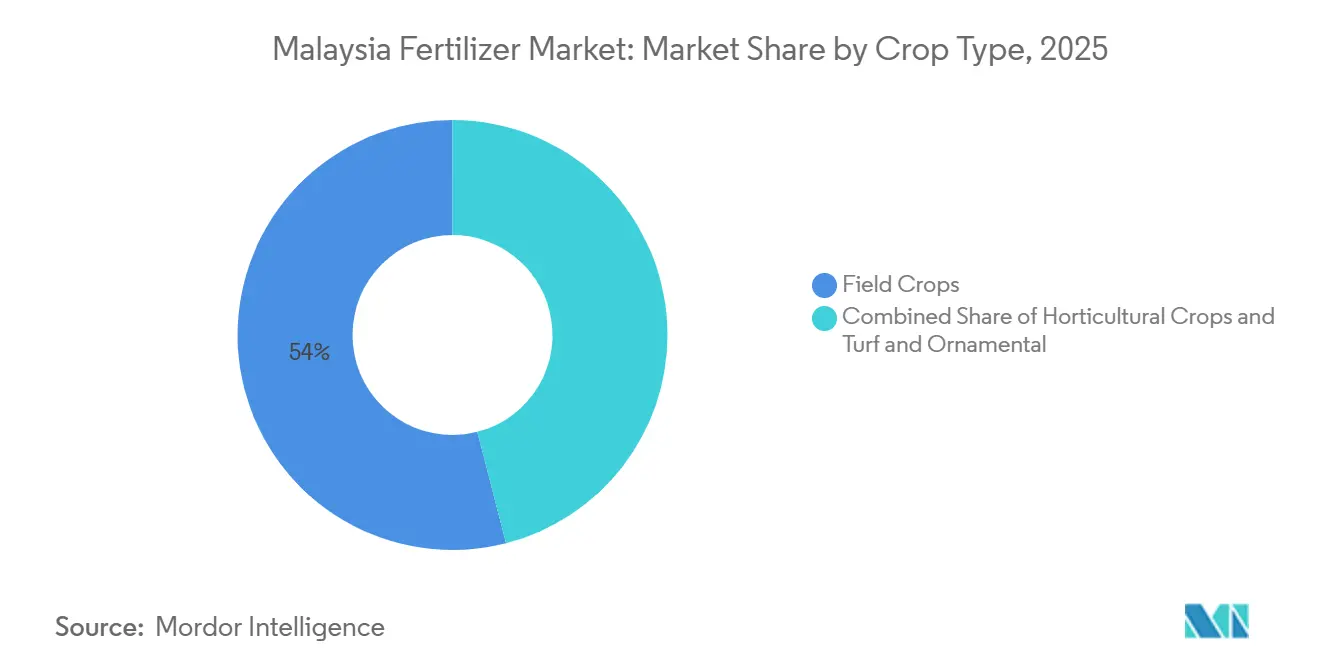
Field crops accounted for 54% of Malaysia fertilizer market size in 2025, supported mainly by oil palm, paddy, rubber, and other commodity crops. Paddy remains important because policy support protects input demand more effectively than in purely commercial crop systems. These crops occupy a significant share of Malaysia's agricultural land and require regular fertilizer applications to sustain productivity, maintain soil fertility, and meet domestic and export demand. Oil palm represents the largest source of fertilizer consumption due to its nutrient-intensive nature and Malaysia's position as one of the world's largest palm oil producers. Rubber plantations and other field crops also contribute substantially to fertilizer demand, particularly in regions where maintaining crop yields and quality is essential for export competitiveness.
Horticultural crops are projected to grow at 7.9% through 2031, making them the fastest-growing crop group in the Malaysia fertilizer market. This reflects policy support for higher-value food production, in which vegetables and fruits use more intensive nutrient programs and adopt smart farming methods more quickly. These crops consume more specialty fertilizers, micronutrients, and precision application services per hectare, which lifts value mix more quickly than broad-acre crops. A 2026 publication on a chili fertigation project in Pahang showed strong production performance and efficient fertilizer use, reinforcing the commercial logic for smallholder precision horticulture. The Malaysia fertilizer industry therefore remains volume-led by field crops, while value growth is being shaped more by horticultural expansion.
Geography Analysis
Peninsular Malaysia is the largest fertilizer-consuming region in the country due to its concentration of commercial agriculture, including oil palm plantations, rubber estates, paddy cultivation, and high-value horticultural crops. The region benefits from well-developed transportation networks, major ports, fertilizer blending facilities, and distribution infrastructure, enabling efficient movement of imported and locally produced fertilizers. Paddy-producing states such as Kedah, Perlis, and Selangor continue to receive government support through fertilizer subsidies and agricultural assistance programs, sustaining fertilizer demand. In addition, PETRONAS (Petroliam Nasional Berhad) Chemicals Fertiliser Kedah serves as one of Malaysia's key domestic nitrogen fertilizer production facilities, strengthening local supply and reducing dependence on imported urea. The government's extension of the Sales and Service Tax (SST) exemption on selected agricultural inputs, including rock phosphate and magnesium sulphate, through December 2027 also helps lower input costs for farmers and supports fertilizer affordability.
Sarawak is emerging as an increasingly important fertilizer market, supported by continued investment in the oil palm sector, agricultural modernization, and industrial development. Plantation companies in the state have reported improvements in fresh fruit bunch (FFB) production and yield through replanting, mechanization, and better plantation management, all of which contribute to sustained fertilizer requirements. The growing adoption of precision agriculture and digital farming technologies by large plantation operators is driving demand for specialized and higher-efficiency fertilizers, as producers seek to optimize nutrient use, improve crop productivity, and reduce input costs.
Sabah remains a key fertilizer-consuming region due to its extensive oil palm cultivation. A significant proportion of the state's oil palm trees are reaching maturity, increasing the need for replanting programs that typically require substantial fertilizer application during the establishment and early growth stages of new palms. PETRONAS (Petroliam Nasional Berhad) Chemicals Fertiliser Sabah continues to support domestic nitrogen fertilizer production following major maintenance activities completed in 2025, helping ensure a reliable fertilizer supply for plantations in East Malaysia. Other regions of Malaysia are also experiencing gradual growth in fertilizer demand, particularly for specialty fertilizers and organic nutrient products, driven by expanding horticulture, protected cultivation, and community-based food production initiatives.
Competitive Landscape
The Malaysia fertilizer market is moderately concentrated in 2025. The top five players are PETRONAS Chemicals Group Berhad, Yara International ASA, FGV Holdings Berhad, and Consolidated Fertiliser Corporation Sdn. Bhd., and Agroharta Fertilizer Sdn. Bhd. Domestic producers compete primarily on supply reliability, local manufacturing capabilities, and long-established relationships with plantation companies. Multinational suppliers differentiate themselves through broader product portfolios, specialty fertilizers, water-soluble formulations, and precision agriculture solutions.
Yara operates in Malaysia through Yara International (M) Sdn. Bhd. supplying a broad portfolio that includes compound fertilizers, water-soluble fertilizers for fertigation, foliar nutrients, and specialty crop nutrition products[3]Source: Yara International, “Crop Nutrition Portfolio In Malaysia,” Yara International, yara.com . PETRONAS Chemicals remains strategically important as its domestic nitrogen fertilizer production enhances supply security, reduces dependence on imports, and improves market resilience during periods of global supply disruption. FGV Holdings continues to leverage its integrated plantation operations and fertilizer business to meet nutrient requirements across its oil palm estates and serve external customers. The most evident strategic gap in the Malaysia fertilizer market is the distribution of specialty fertilizers to smallholders, where technical advisory services, customized nutrient recommendations, and credit-linked input financing remain limited.
Competition in the market is increasingly shifting beyond product pricing toward value-added services and sustainable crop nutrition solutions. Manufacturers and distributors are investing in agronomic advisory services, digital farm management tools, precision nutrient recommendations, and environmentally friendly fertilizer formulations to strengthen customer relationships and improve fertilizer use efficiency. Growing demand for specialty fertilizers, controlled-release products, biofertilizers, and fertigation-compatible formulations is also encouraging companies to expand their research, product development, and distribution capabilities. These trends are anticipated to intensify competition over the coming years as suppliers seek to differentiate themselves through innovation, technical support, and integrated crop nutrition solutions rather than conventional fertilizer sales alone.
Malaysia Fertilizer Industry Leaders
PETRONAS Chemicals Group Berhad
Yara International ASA
FGV Holdings Berhad
Consolidated Fertiliser Corporation Sdn Bhd
Agroharta Fertilizer Sdn Bhd
- *Disclaimer: Major Players sorted in no particular order

Recent Industry Developments
- July 2025: Bangladesh signed a government-to-government agreement with Malaysia's FELCRA Niaga Sdn Bhd to import premium-grade fertilizers. The agreement aims to improve agricultural productivity while facilitating joint ventures, technology exchange, and capacity building initiatives.
- April 2025: PETRONAS Chemicals Fertilizer Sabah Sdn Bhd (PC FSSB) completed a planned turnaround of its ammonia and urea production facilities, restoring fertilizer production capacity after scheduled maintenance. The turnaround supported continued domestic supply and export availability of nitrogen fertilizers.
- April 2025: Pursell Agri-Tech and Wastech Group are constructing a fertilizer production facility in Malaysia to manufacture controlled-release fertilizers (CRFs), supporting sustainable agriculture practices in Southeast Asia.


Malaysia Fertilizer Market Report Scope
A fertilizer is a natural or chemical substance added to soil or plants to supply essential nutrients, promote healthy growth, and increase crop yield.
Malaysia fertilizer market report is segmented by type (complex and straight), by form (conventional and specialty), by application mode (fertigation, foliar, and soil), and by crop type (field crops, horticultural crops, and turf and ornamental). The market forecasts are provided in terms of Value (USD) and Volume (Metric Tons).
| Complex | ||
| Straight | Micronutrients | Boron |
| Copper | ||
| Iron | ||
| Manganese | ||
| Molybdenum | ||
| Zinc | ||
| Others | ||
| Nitrogenous | Ammonium Nitrate | |
| Anhydrous Ammonia | ||
| Urea | ||
| Others | ||
| Phosphatic | Di-ammonium Phosphate | |
| Mono Ammonium Phosphate | ||
| Single Super Phosphate | ||
| Triple Superphosphate | ||
| Others | ||
| Potassic | Muriate of Potash | |
| Sulphate of Potash | ||
| Others | ||
| Secondary Macronutrients | Calcium | |
| Magnesium | ||
| Sulfur | ||
| Conventional | |
| Specialty | Controlled-Release Fertilizer |
| Liquid Fertilizer | |
| Slow-Release Fertilizer | |
| Water Soluble |
| Fertigation |
| Foliar |
| Soil |
| Field Crops |
| Horticultural Crops |
| Turf and Ornamental |
| By Type | Complex | ||
| Straight | Micronutrients | Boron | |
| Copper | |||
| Iron | |||
| Manganese | |||
| Molybdenum | |||
| Zinc | |||
| Others | |||
| Nitrogenous | Ammonium Nitrate | ||
| Anhydrous Ammonia | |||
| Urea | |||
| Others | |||
| Phosphatic | Di-ammonium Phosphate | ||
| Mono Ammonium Phosphate | |||
| Single Super Phosphate | |||
| Triple Superphosphate | |||
| Others | |||
| Potassic | Muriate of Potash | ||
| Sulphate of Potash | |||
| Others | |||
| Secondary Macronutrients | Calcium | ||
| Magnesium | |||
| Sulfur | |||
| By Form | Conventional | ||
| Specialty | Controlled-Release Fertilizer | ||
| Liquid Fertilizer | |||
| Slow-Release Fertilizer | |||
| Water Soluble | |||
| By Application Mode | Fertigation | ||
| Foliar | |||
| Soil | |||
| By Crop Type | Field Crops | ||
| Horticultural Crops | |||
| Turf and Ornamental | |||


Key Questions Answered in the Report
What is the projected value of the Malaysia fertilizer market by 2031?
The Malaysia fertilizer market is forecast to reach USD1.23 billion by 2031 from USD 0.94 billion in 2025, growing at a 4.65% CAGR.
Which fertilizer type leads demand in Malaysia?
Straight fertilizers led with 64.0% share in 2025 because urea, muriate of potash, and di-ammonium phosphate remain central to plantation and paddy nutrient programs.
Which application method is growing fastest in Malaysia?
Fertigation is the fastest-growing application mode and is projected to expand to 8.7% through 2031 as smart farming and controlled nutrient delivery become more common.
Why is oil palm so important for fertilizer demand in Malaysia?
Oil palm is the largest demand anchor because it covers a large planted area and requires recurring nutrient application across both mature and replanted acreage.
Page last updated on:





