
Malaysia and Vietnam Floriculture Inputs Market Size and Share
Market Overview
| Study Period | 2021 - 2031 |
|---|---|
| Forecast Data Period | 2026 - 2031 |
| Base Year Market Size (2025) | USD 262.53 Million |
| Market Size (2026) | USD 282.31 Million |
| Market Size (2031) | USD 406.32 Million |
| Growth Rate (2026 - 2031) | 7.55 % |
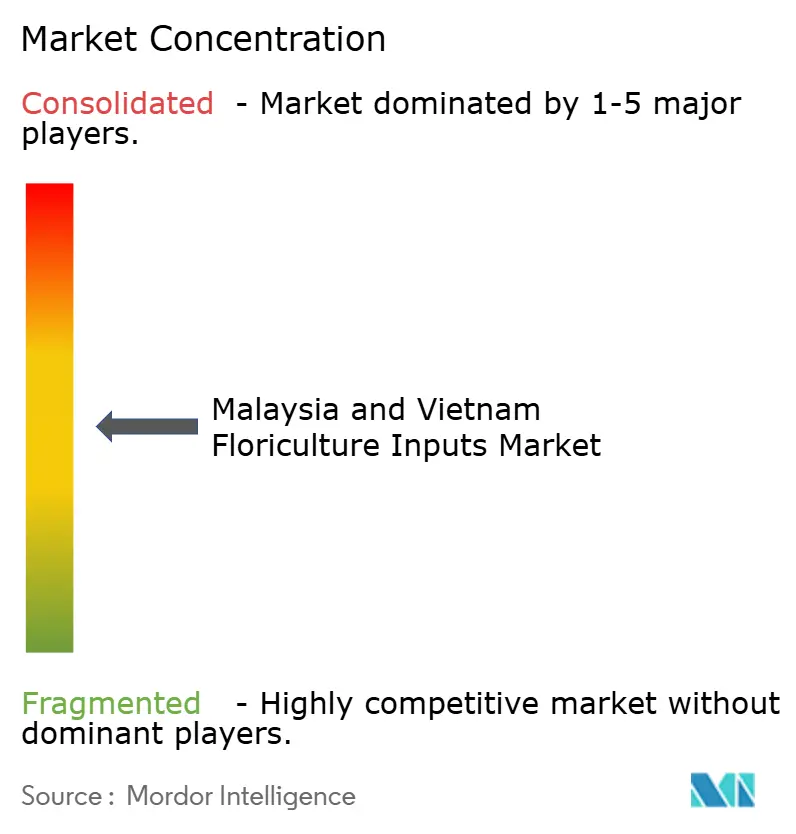
| Market Concentration | Medium |
Major Players *Disclaimer: Major Players sorted in no particular order Image © Mordor Intelligence. Reuse requires attribution under CC BY 4.0. | |
Malaysia and Vietnam Floriculture Inputs Market Analysis by Mordor Intelligence
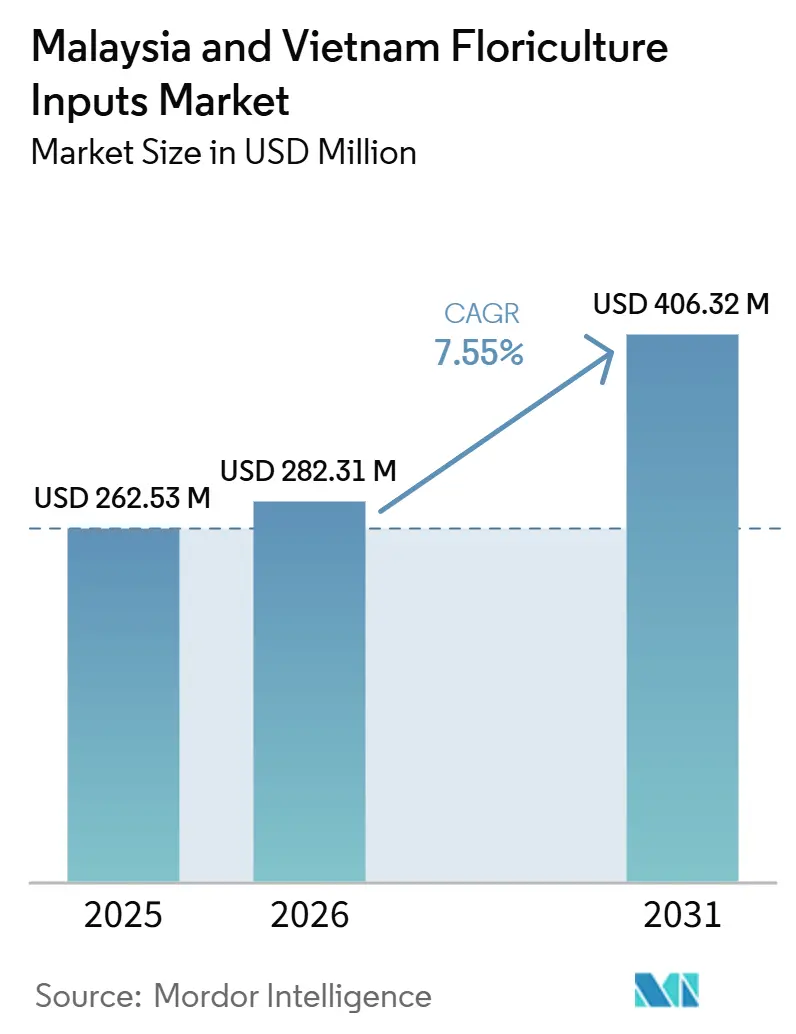
The Malaysia and Vietnam floriculture inputs market size is anticipated to expand from USD 262.53 million in 2025 and USD 282.31 million in 2026 to USD 406.32 million by 2031, registering a CAGR of 7.55% between 2026 and 2031. The Malaysia and Vietnam floriculture inputs market is being supported by two demand patterns that work well together, such as Malaysia’s export-led flower production and Vietnam’s larger domestic flower use, which keeps input demand active across both commercial farms and supply chains for ornamentals. Vietnam’s flower and ornamental area reached nearly 45,000 hectares in 2025, pointing to a broader shift toward higher-value cultivation that requires more reliable nutrition, crop care, and propagation inputs[1]Source: Vietnam National University of Agriculture, “Affirming the Position of Vietnam’s Flower and Ornamental Plant Industry on the International Arena,” Vietnam National University of Agriculture, eng.vnua.edu.vn. Demand is also shifting toward cleaner crop management, better planting material, and more precise feeding programs because growers serving export channels are under tighter quality and maximum residue limit requirements. Malaysia’s labor-tightening plans, Vietnam’s push for high-tech flower farming, and recurring cost pressures on imported inputs are pushing buyers to favor suppliers that can offer consistent product performance, agronomic support, and steady availability across the Malaysia and Vietnam floriculture input markets.
Key Report Takeaways
- By product type, fertilizers and plant nutrition products held 38.4% of the Malaysia and Vietnam floriculture inputs market size in 2025, while biologicals recorded the highest projected CAGR at 10.9% between 2026 and 2031.
- By end user, commercial floriculture growers held 45.6% of the Malaysia and Vietnam floriculture inputs market share in 2025, while nurseries and propagation centers recorded the highest projected CAGR at 9.6% between 2026 and 2031.
- By geography, Malaysia accounted for 52.4% share of the Malaysia and Vietnam floriculture inputs market size in 2025, while Vietnam is estimated to grow at a CAGR of 8.3% between 2026 and 2031.
Note: Market size and forecast figures in this report are generated using Mordor Intelligence’s proprietary estimation framework, updated with the latest available data and insights as of January 2026.
Malaysia and Vietnam Floriculture Inputs Market Trends and Insights
Drivers Impact Analysis*
| Driver | (~) % Impact on CAGR Forecast | Geographic Relevance | Impact Timeline |
|---|---|---|---|
| Expansion of commercial floriculture production and export-oriented nurseries | +1.60% | Malaysia and Vietnam | Short term (≤ 2 years) |
| Rising adoption of protected cultivation and controlled-environment production | +1.40% | Malaysia and Vietnam | Medium term (2-4 years) |
| Increasing demand for high-quality planting material and crop inputs | +1.20% | Vietnam (high priority) and Malaysia (growing) | Medium term (2-4 years) |
| Growing use of biologicals and sustainable crop management solutions | +0.90% | Vietnam (maximum residue limit compliance-driven) and Malaysia (premium export segments) | Medium term (2-4 years) |
| Urban landscaping, hospitality, and ornamental plant demand | +0.80% | Malaysia (Kuala Lumpur, Penang) and Vietnam (Ho Chi Minh City, Hanoi) | Short term (≤ 2 years) |
| Adoption of precision nutrition and specialized plant nutrition programs | +1.00% | Malaysia and Vietnam | Medium term (2-4 years) |
| Source: Mordor Intelligence | |||
Expansion of Commercial Floriculture Production and Export-Oriented Nurseries
The Malaysia and Vietnam floriculture inputs market gains direct support from the scale of flower production that is already in place across both countries. Vietnam’s cut flowers and flower buds export turnover passed USD 81.5 million in 2025[2] Source: International Trade Centre, Trade statistics for international business development: Vietnam – Cut flowers and flower buds of a kind suitable for bouquets or for ornamental purposes (HS 0603), trademap.org, and the production area reached nearly 45,000 hectares, which shows that commercial flower growing is no longer a small niche in that market. Malaysia also remained a major regional exporter, and fresh-cut flower exports alone reached more than USD 82.3 million in 2025, according to ITC Trade Map. In Lam Dong, high-grade flower farms are already producing significant value, which supports repeat spending on better fertilizers, crop protection programs, and propagation materials rather than one-time low-cost purchases. Malaysia’s Department of Agriculture also issued its 2026 phytosanitary requirements for horticulture exports, which adds another reason for growers to use certified planting material and quality-assured inputs. As export nurseries and larger growers expand, the Malaysia and Vietnam floriculture inputs market benefits from more regular ordering patterns and stronger demand for products that help meet shipment quality standards. This driver is especially important because it supports recurring input use over many crop cycles rather than a short burst of demand tied to a single season.
Rising Adoption of Protected Cultivation and Controlled-Environment Production
The Malaysia and Vietnam floriculture inputs market is also moving with the wider use of net houses, greenhouses, and controlled growing systems. In March 2024, the Asian Productivity Organization and the Vietnam National Productivity Institute established a demonstration greenhouse farm in Da Lat with a Japanese Internet of Things-enabled microclimate control system, which shows that precision production tools are already being introduced in a key flower-growing area. A commercial orchid facility in Hanoi also used reverse osmosis water treatment, advanced air conditioning, and tissue culture methods in 2024, which reflects the move toward more managed growing conditions for ornamentals. These systems change the input mix because soilless or substrate-based cultivation depends on soluble nutrition, cleaner water, and targeted plant protection rather than broad field applications. In Malaysia, weather disruptions in Cameron Highlands have shown how exposed open cultivation remains, which strengthens the business case for protected structures that can stabilize production and reduce losses. Once growers shift into these structures, they also become more dependent on growing media, irrigation tools, and measured feeding programs. That is why protected cultivation is not only a farming upgrade, but also a demand multiplier for the Malaysia and Vietnam floriculture inputs market.
Increasing Demand for High-Quality Planting Material and Crop Inputs
High-quality planting material is becoming more important in the Malaysia and Vietnam floriculture inputs market because flower growers are putting more weight on consistency, survival rates, and export readiness. Lam Dong has set a target to produce 120 million tissue-cultured seedlings each year by 2030, which signals a clear effort to reduce dependence on imported planting stock and to raise local quality standards. In Hanoi, a local orchid grower moved into commercial-scale Phalaenopsis tissue culture production in 2024, which shows that advanced nursery systems are already being built and supplied with specialized media and stage-specific crop inputs. Malaysia’s export rules also raise the value of uniform, healthy, and well-documented material because export growers cannot afford rejection tied to quality problems or phytosanitary gaps. Better planting material usually pulls through more spending on compatible fertilizers, root health products, and propagation care because growers want to protect the value of that starting stock. This pattern gives suppliers room to sell bundled programs rather than single products. It also raises the premium tier of the Malaysia and Vietnam floriculture inputs market, since growers buying better genetics usually want more reliable crop inputs from the same commercial network.
Growing Use of Biologicals and Sustainable Crop Management Solutions
The Malaysia and Vietnam floriculture inputs market is seeing stronger interest in biological products as growers balance crop performance with residue and sustainability concerns. Vietnam’s Plant Protection Department entered a cooperation agreement with UPL Limited in 2025 to register 3 biological plant protection products and support demonstration models, which shows that biologicals are moving into formal commercial programs[3]Source: Vietnam.vn, “The Plant Protection Department Is Collaborating with Businesses to Train 40,000 Farmers on the Use of Biological Pesticides,” Vietnam.vn, vietnam.vn. The same initiative also included training linked to biological pesticide use, which supports wider familiarity among growers and advisers. A sector study backed by the Netherlands Embassy in Vietnam shows that growers serving buyers in Japan, South Korea, and the Netherlands face demanding quality requirements, which supports the use of lower-residue crop care programs in export flowers. Corteva Agriscience expanded its Singapore research laboratory by 50.0% in May 2026 to accelerate bio-based and spinosyn-derived crop protection research for Asia-Pacific. This expansion is estimated to benefit growers in Malaysia and Vietnam, where increasing floriculture production is driving demand for advanced crop protection inputs. These developments matter because biologicals usually enter through trials, then move into integrated programs once growers see stable results. As that process continues, biologicals should claim a larger role in the Malaysia and Vietnam floriculture inputs market, especially in protected cultivation and export-linked flower production.
Restraints Impact Analysis*
| Restraint | (~) % Impact on CAGR Forecast | Geographic Relevance | Impact Timeline |
|---|---|---|---|
| Fragmented grower base and limited investment capacity among small-scale producers | -0.80% | Malaysia and Vietnam | Long term (≥ 4 years) |
| Dependence on imported planting material and specialized inputs | -0.60% | Vietnam (high) and Malaysia (moderate) | Medium term (2-4 years) |
| Input cost volatility and rising production expenses | -0.70% | Malaysia (fertilizer import exposure) and Vietnam (currency and logistics sensitivity) | Short term (≤ 2 years) |
| Pest, disease, and climate-related production risks | -0.50% | Malaysia (Cameron Highlands rainfall) and Vietnam (Da Lat humidity, pest pressure) | Short term (≤ 2 years) |
| Source: Mordor Intelligence | |||
Fragmented Grower Base and Limited Investment Capacity Among Small-Scale Producers
The Malaysia and Vietnam floriculture inputs market still faces a basic limit because many growers remain small and cannot absorb the cost of premium programs easily. In Lam Dong, small farming households account for the major share of flower production, which means a large part of the market still buys with short cash cycles and tight working capital. Malaysia’s grower base is also scattered across associations such as the Cameron Highlands Floriculturist Association and the Nursery Industry Association of Johor, which shows that supplier reach still depends on many smaller accounts rather than a few dominant farm groups. This structure slows adoption of controlled-release fertilizers, biological crop care, and fertigation systems because the payback often comes over several crop cycles. Higher fertilizer prices make that hesitation worse because growers first protect operating cash before they move into premium inputs. As a result, suppliers often sell more advanced programs only to larger nurseries and export farms, while the wider base stays with conventional products. This keeps the Malaysia and Vietnam floriculture inputs market growing, but it slows the speed at which higher-value inputs can spread across the full customer base.
Dependence on Imported Planting Material and Specialized Inputs
Dependence on imported genetics and specialty materials remains a restraint in the Malaysia and Vietnam floriculture inputs market because it adds lead times, exchange-rate exposure, and supply uncertainty. The Netherlands Embassy-backed study on Vietnam’s flower sector noted heavy dependence on imported copyrighted varieties from countries such as the Netherlands and Japan, especially in higher-value flower production. Bayer AG’s new seed production center in Thailand strengthens regional supply for Southeast Asia[4]Source: Bayer AG, “Bayer Inaugurates Khon Kaen Vegetable Seeds Production Center as Asia Hub,” Bayer Thailand, bayer.com, yet it also shows that seed and planting material networks still rely on cross-border hubs rather than local production in each end market. The same issue applies to specialized substrates, greenhouse materials, and some premium crop care products that are not always sourced domestically. When supply is delayed or costs move sharply, growers often postpone upgrades and return to lower-cost alternatives. That creates friction in the premium layers of the Malaysia and Vietnam floriculture inputs market, even when underlying flower demand remains healthy.
*Our forecasts treat driver/restraint impacts as directional, not additive. The impact forecasts reflect baseline growth, mix effects, and variable interactions.
Segment Analysis
By Product Type: Biologicals and Specialty Nutrition Reshape Input Demand
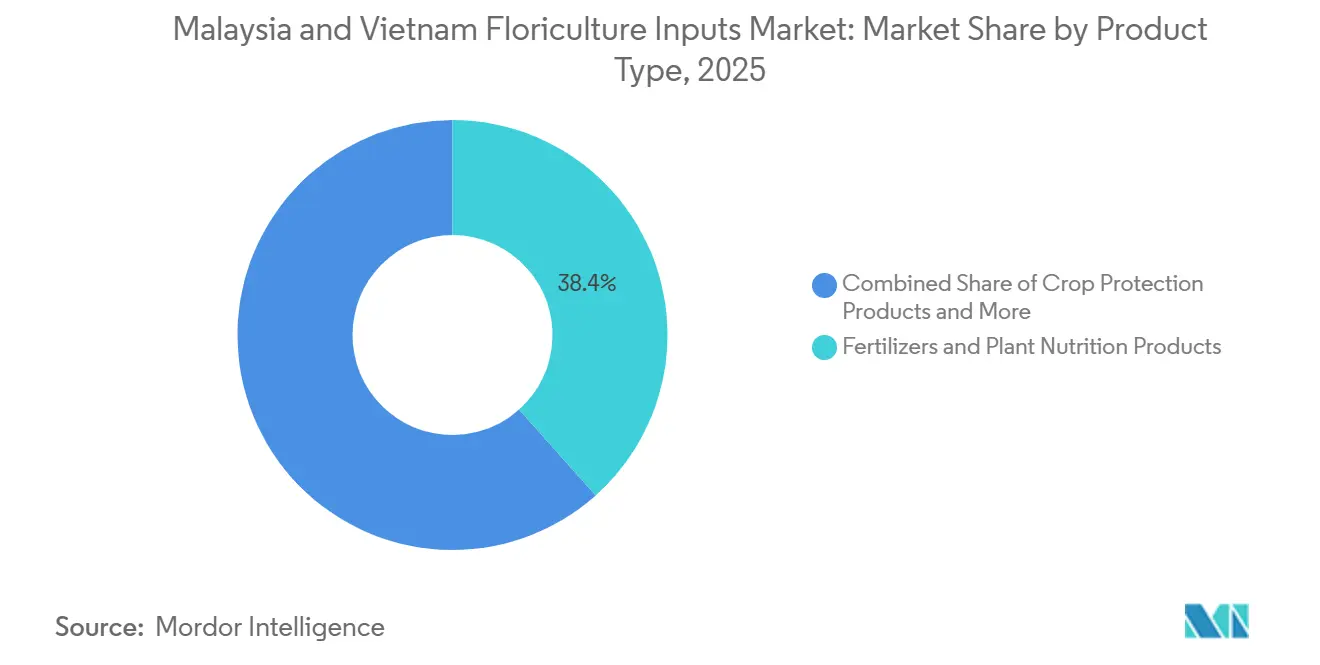
Fertilizers and plant nutrition products held 38.4% of the Malaysia and Vietnam floriculture inputs market size in 2025, which kept them firmly ahead of crop protection products and the other product groups. Their lead came from the daily nutrient needs of cut flowers, potted ornamentals, and nursery stock, where balanced feeding affects stem strength, flower uniformity, and post-harvest life. Crop protection products followed because humid production areas in both countries require steady disease and pest management. Growing media, soil amendments, irrigation inputs, and seeds were then added to support demand across the Malaysia and Vietnam floriculture inputs market.
Biologicals are anticipated to record the fastest CAGR at 10.9% through 2031 in the Malaysia and Vietnam floriculture inputs market, supported by residue-sensitive export channels and more formal promotion of biological crop care in Vietnam. Seeds and planting material also gain relevance as local tissue culture capacity expands and growers seek more reliable plant quality. Precision nutrition products are likely to keep growing because greenhouse and fertigation systems need soluble and stage-specific feeding. Irrigation-related inputs and advanced media should rise with protected cultivation, while crop protection remains essential as growers manage disease risk and weather-related pressure across the product mix.



By End User: Commercial Growers Anchor Volume While Nurseries Lead Growth
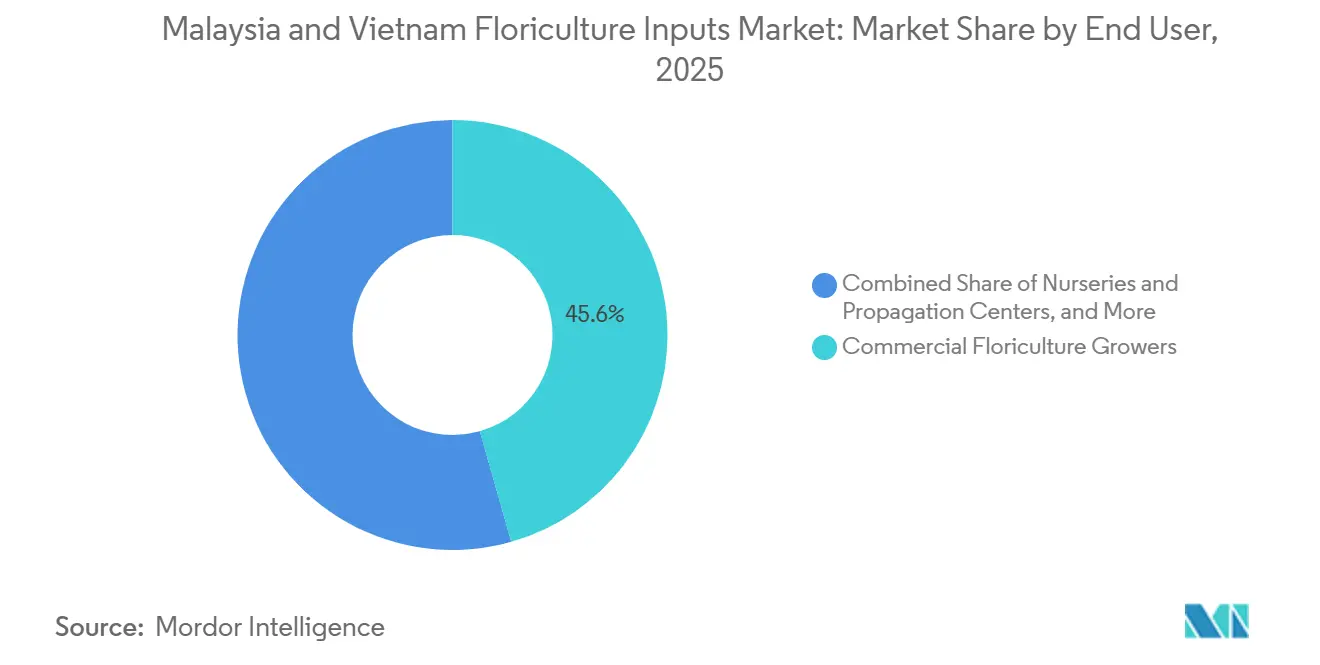
Commercial floriculture growers accounted for 45.6% of the Malaysia and Vietnam floriculture inputs market share in 2025, making them the core buying group across both countries. Their position reflected the wide basket of products they use, from fertilizers and fungicides to growing media and irrigation tools, across the largest cultivation areas. Nurseries and propagation centers followed because they supply planting stock and require more controlled media and crop care. Landscaping operators formed the third layer of demand, supported by public spaces, urban ornamentals, and contractor-led maintenance in the Malaysia and Vietnam floriculture market.
Nurseries and propagation centers are anticipated to expand at the fastest CAGR of 9.6% through 2031 in the Malaysia and Vietnam floriculture inputs market because tissue culture and seedling localization are becoming more important. Commercial growers should remain the largest customers because export volume and domestic flower demand still center on farm production at scale. Landscaping operators are also likely to post steady gains as Malaysia’s policy support for landscaping and contractor activity sustains recurring use of ornamental nutrition and soil products. This keeps end-user demand diversified, even though the fastest value creation is moving toward nurseries and propagation systems that need cleaner and more specialized inputs.
Geography Analysis
Malaysia accounted for 52.4% of the Malaysia and Vietnam floriculture inputs market in 2025, which gave it the largest revenue base within the combined study area. The country exported more than USD 82.3 million of cut flowers and flower buds products in 2025, according to ITC Trade Map, which explains the high intensity of input use in that cluster. Johor added a broader ornamental base with significant hectares of nursery and landscaping activity, which supported demand for growing media, soil amendments, and ornamental nutrition products. Export compliance also shapes purchasing behavior because the Department of Agriculture Malaysia and the Malaysian Quarantine and Inspection Services set clear phytosanitary requirements for horticulture shipments. At the same time, fertilizer bags approaching USD 68 in early 2026 showed that Malaysian growers remain exposed to imported input cost shocks.
Vietnam is the fastest-growing geography in the Malaysia and Vietnam floriculture inputs market and is estimated to advance at an 8.3% CAGR through 2031. According to the Da Lat Flower Association, Lam Dong produced 4.4 billion flower stems from 10,908 hectares in the province in 2024, which shows the scale already present in the country’s main flower hub. Vietnam’s domestic flower consumption is increasing each year, which gives the market a broad demand base beyond exports. The Ministry of Agriculture and Environment has also raised support for high-tech flower farming, including greenhouse control, drip irrigation, tissue culture, and digital cultivation tools. That policy direction makes Vietnam the more dynamic growth engine inside the Malaysia and Vietnam floriculture inputs market.
Together, the two countries create a balanced regional profile for the Malaysia and Vietnam floriculture inputs market. Malaysia brings a more mature export structure and an established commercial base, while Vietnam adds faster growth, broader domestic demand, and a stronger push into greenhouse and propagation upgrades. Malaysia appears more exposed to import cost volatility, while Vietnam shows more room for premiumization through high-tech cultivation and local planting material development. This mix keeps demand steady across routine inputs and also opens room for higher-value products such as biologicals, sterile media, and precision nutrition programs.
Competitive Landscape
The Malaysia and Vietnam floriculture inputs market is moderately fragmented, with Syngenta Group, Yara International ASA, Bayer AG, UPL Limited, and BASF SE accounted for a significant share in 2025. This structure shows that the leading companies matter, but none has enough scale to control the full market on its own. Large multinational suppliers compete through wide product portfolios, technical service, and better ability to support residue management and crop quality programs. Regional and domestic suppliers still matter because they are close to local distributors and often adapt products to local growing conditions faster.
Strategic activity in the Malaysia and Vietnam floriculture inputs market has focused on premium nutrition, biologicals, and planting material access. BASF SE identified Malaysia and Vietnam among its priority Association of Southeast Asian Nations countries for stronger organization, production investment, and research and development activity in 2025. Syngenta Group announced in May 2026 that it would move its Flowers business into a joint venture with Dümmen Orange, which can reshape how growers in Malaysia and Vietnam access breeding, propagation, and related input programs. Yara International ASA confirmed in January 2026 that its premium products were outgrowing its commodity portfolio in Asia, which supports stronger positioning in high-value horticulture. UPL Limited’s reorganization into a pure-play crop protection and biologicals platform points to the same direction, with sharper focus on categories that are gaining weight in floriculture production.
The rest of the Malaysia and Vietnam floriculture inputs market remains open enough for niche and regional specialists to keep meaningful positions. Companies such as Corteva Agriscience, FMC Corporation, Sumitomo Chemical Co., Ltd., Nutrien Ltd., Haifa Group, Vinaseed (PAN Group), Tiến Nông Group, Advansia Sdn Bhd, Agromaster Fertilizer Sdn Bhd, and Known-You Seed remain relevant because buyers still value crop-specific support and established distribution reach. Corteva Agriscience’s expansion of its Singapore laboratory in 2026 also shows that product development for Asia-Pacific floriculture is still active and competitive. The clearest openings ahead are in ornament-focused biologicals, premium growing media, and specialized fertigation nutrition, where customer needs are rising faster than market concentration.
Malaysia and Vietnam Floriculture Inputs Industry Leaders
Syngenta Group
Yara International ASA
Bayer AG
UPL Limited
BASF SE
- *Disclaimer: Major Players sorted in no particular order

Recent Industry Developments
- May 2026: Syngenta Group announced the divestiture of its Flowers business into a strategic joint venture with Dümmen Orange, combining the two organizations’ ornamental breeding and propagation assets under a new entity in which Syngenta Group retains a significant economic interest.
- May 2026: Corteva Agriscience expanded its Singapore research laboratory by 50%, designating it as a regional hub for developing bio-based and spinosyn-derived crop protection solutions for the Asia-Pacific region, including floriculture and high-value horticulture systems in Malaysia and Vietnam
- January 2025: UPL Limited entered a cooperation agreement with Vietnam’s Plant Protection Department to register 3 biological plant protection products and build pilot demonstration models for their use on key crops, supporting Vietnam’s push to integrate biological inputs into commercial floriculture and horticulture production programs.


Malaysia and Vietnam Floriculture Inputs Market Report Scope
Floriculture inputs are the essential materials, resources, and technologies used in the cultivation, processing, and marketing of flowers and ornamental plants. The Malaysia and Vietnam Floriculture Inputs Market is Segmented by Product Type (Seeds and Planting Material, Fertilizers and Plant Nutrition Products, Crop Protection Products, Growing Media and Soil Amendments, Irrigation and Protected Cultivation Inputs, and Biologicals), By End User (Commercial Floriculture Growers, Nurseries and Propagation Centers, and Landscaping Operators), and By Geography (Malaysia and Vietnam). The Report Offers Market Size and Forecasts in Terms of Value (USD).
| Seeds and Planting Material |
| Fertilizers and Plant Nutrition Products |
| Crop Protection Products |
| Growing Media and Soil Amendments |
| Irrigation and Protected Cultivation Inputs |
| Biologicals |
| Commercial Floriculture Growers |
| Nurseries and Propagation Centers |
| Landscaping and Urban Horticulture Operators |
| Malaysia |
| Vietnam |
| By Product Type | Seeds and Planting Material |
| Fertilizers and Plant Nutrition Products | |
| Crop Protection Products | |
| Growing Media and Soil Amendments | |
| Irrigation and Protected Cultivation Inputs | |
| Biologicals | |
| By End User | Commercial Floriculture Growers |
| Nurseries and Propagation Centers | |
| Landscaping and Urban Horticulture Operators | |
| By Geography | Malaysia |
| Vietnam |


Key Questions Answered in the Report
What is the 2031 outlook for floriculture inputs in Malaysia and Vietnam?
The Malaysia and Vietnam floriculture inputs market is projected to reach USD 406.32 million by 2031.
Which product category leads demand across the two countries?
Fertilizers and plant nutrition products led with 38.4% share in 2025 because flower growers depend on reliable nutrition for stem quality, uniformity, and post-harvest life.
Which product group is growing the fastest?
Biologicals are estimated to record the fastest growth at 10.9% through 2031 as growers focus more on residue control and sustainable crop care.
Why are nurseries and propagation centers gaining importance?
Nurseries and propagation centers are projected to grow at 9.6% through 2031 as Vietnam and the wider region try to localize tissue-cultured planting material and improve seedling quality.
Page last updated on:





