
Machine Customer Platform Market Size and Share
Market Overview
| Study Period | 2020 - 2031 |
|---|---|
| Market Size (2026) | USD 0.51 Billion |
| Market Size (2031) | USD 1.63 Billion |
| Growth Rate (2026 - 2031) | 26.16 % |
| Fastest Growing Market | Asia-Pacific |
| Largest Market | North America |
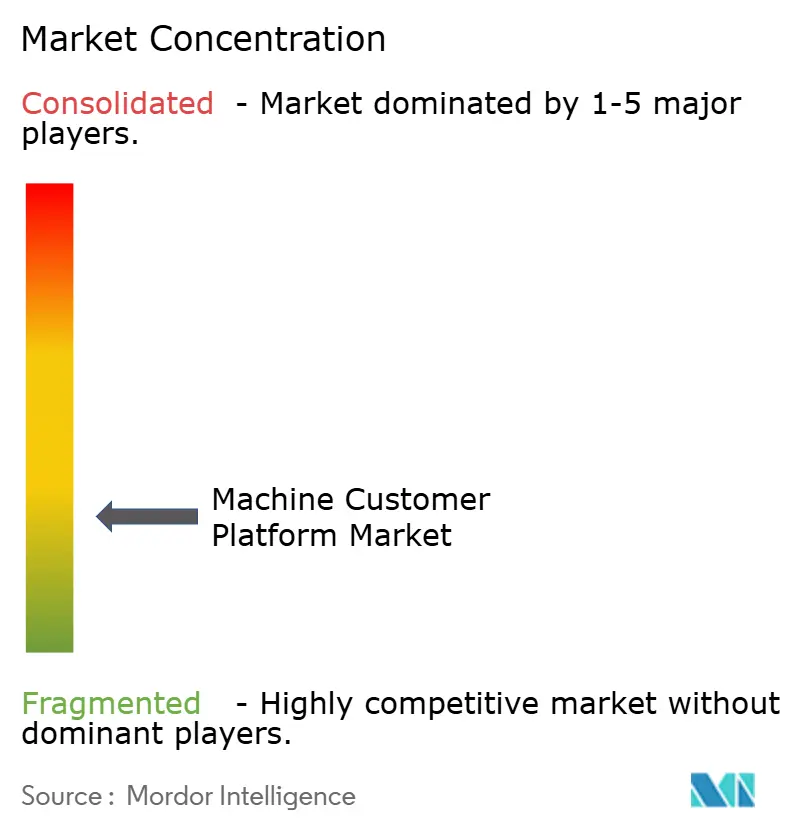
| Market Concentration | Low |
Major Players *Disclaimer: Major Players sorted in no particular order Image © Mordor Intelligence. Reuse requires attribution under CC BY 4.0. | |
Machine Customer Platform Market Analysis by Mordor Intelligence
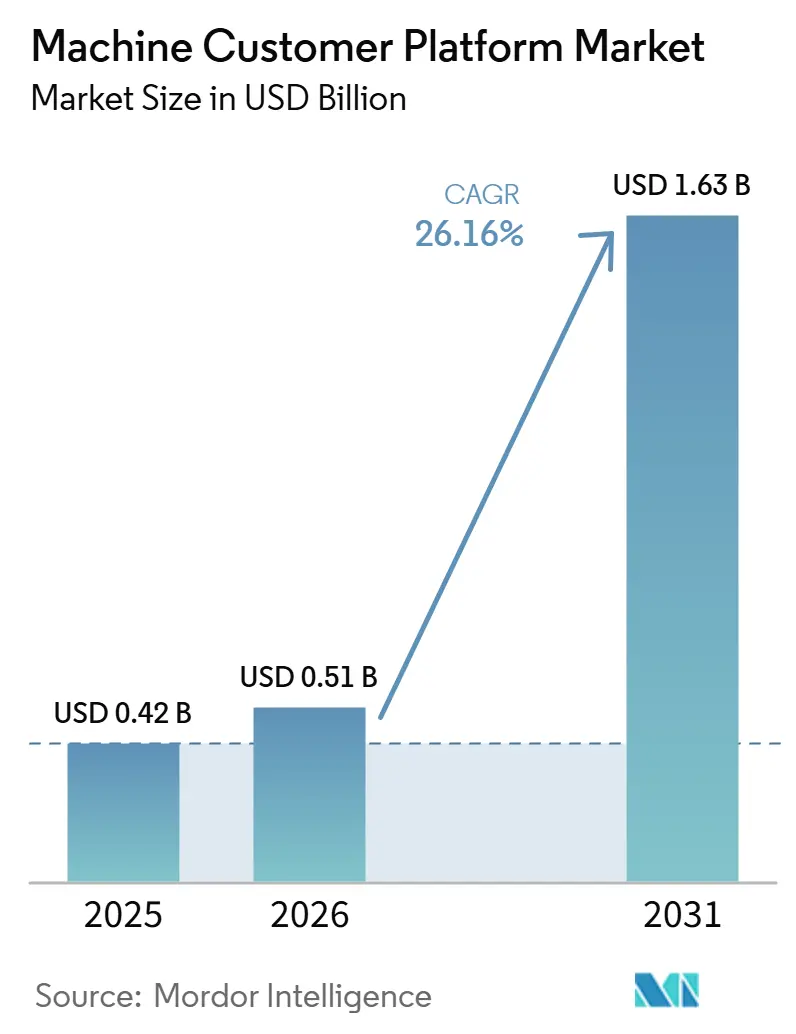
The Machine Customer Platform Market size was valued at USD 0.42 billion in 2025 and estimated to grow from USD 0.51 billion in 2026 to reach USD 1.63 billion by 2031, at a CAGR of 26.16% during the forecast period (2026-2031). The Machine Customer Platform Market is developing as AI agents begin to evaluate products, initiate purchases, and complete commercial tasks across business and consumer channels. The Machine Customer Platform Market is moving toward systems that can complete a transaction rather than simply guide a human buyer. Common technical rules for discovery, checkout, payment, and post-purchase activity are making these workflows easier to deploy across platforms. This change shifts competition toward platforms that can connect commerce execution with trusted authorization and policy controls. Catalog quality is becoming equally important because autonomous agents need current prices, inventory, and return terms in a structured format.
Key Report Takeaways
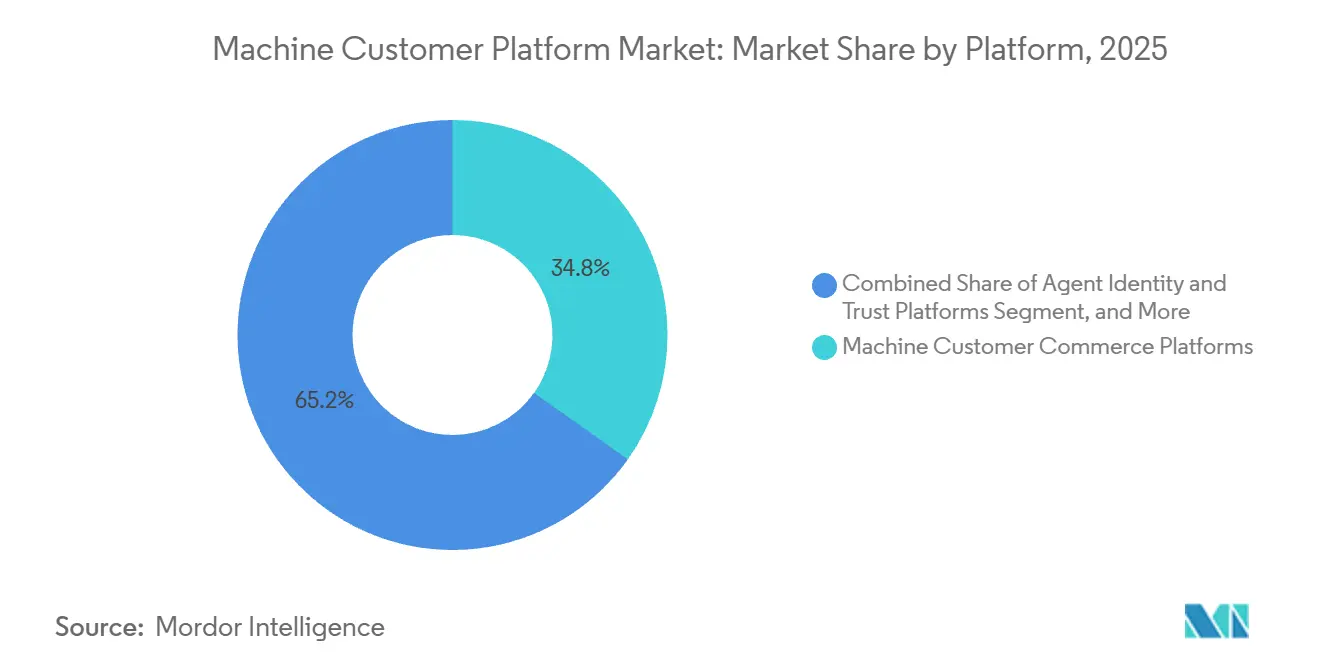
- By platform, Machine Customer Commerce Platforms held 34.82% of the Machine Customer Platform Market share in 2025, while Agent Identity and Trust Platforms are projected to expand at a 27.34% CAGR through 2031.
- By deployment model, cloud held 68.14% of the Machine Customer Platform Market share in 2025, while hybrid is projected to expand at a 26.91% CAGR through 2031.
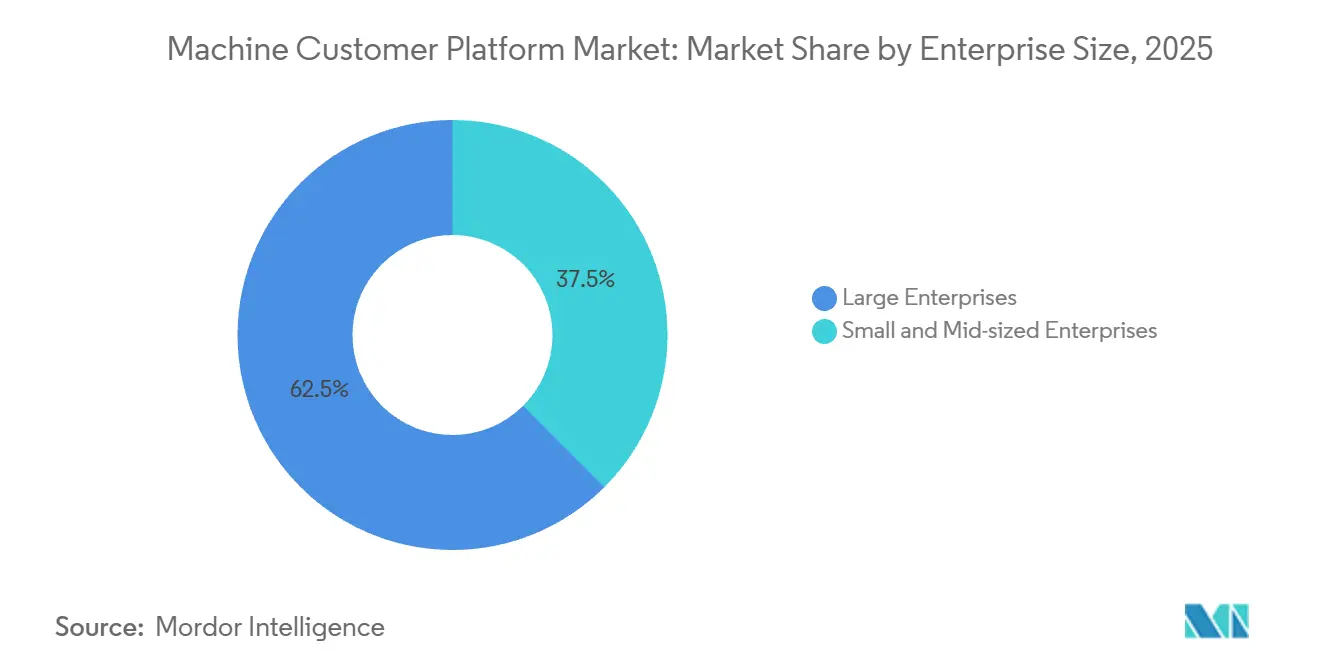
- By enterprise size, large enterprises held 62.47% of the Machine Customer Platform Market share in 2025, while SMEs are projected to expand at a 27.18% CAGR through 2031.
- By application, IT and telecommunication held 21.63% of the Machine Customer Platform Market share in 2025, while healthcare and life sciences are projected to expand at a 26.74% CAGR through 2031.
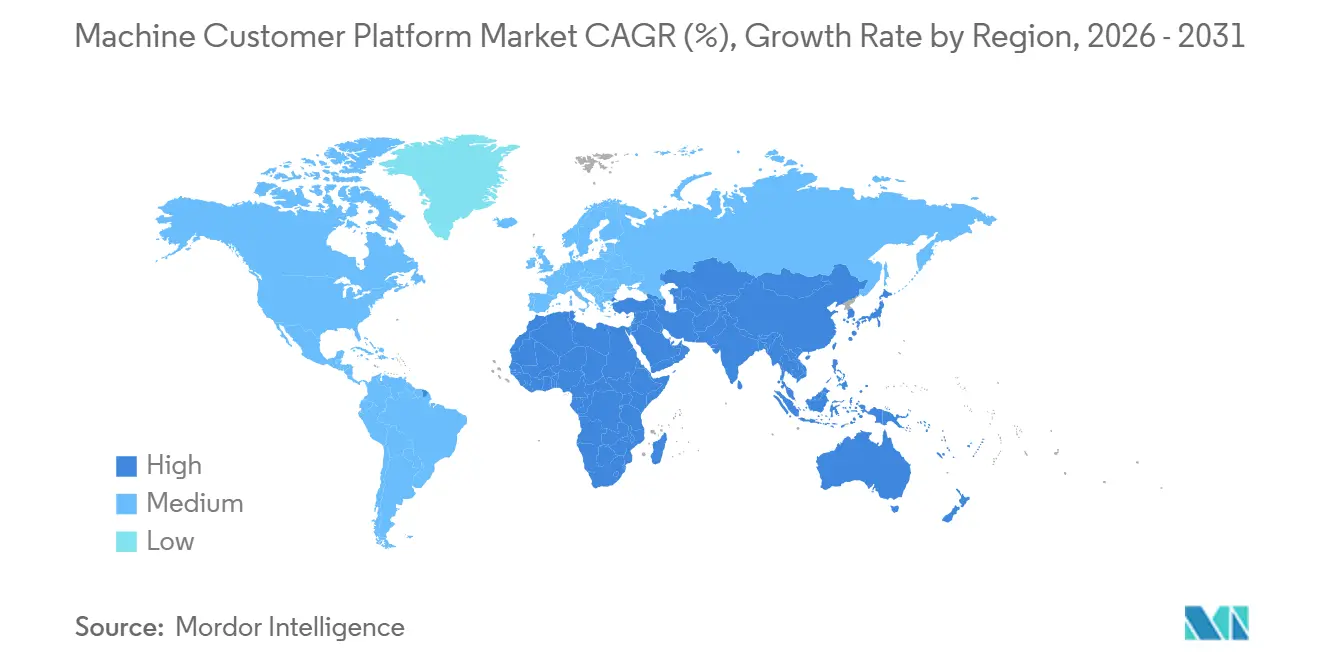
- By geography, North America held 32.59% of the Machine Customer Platform Market share in 2025, while Asia-Pacific is projected to expand at a 27.28% CAGR through 2031.
Note: Market size and forecast figures in this report are generated using Mordor Intelligence’s proprietary estimation framework, updated with the latest available data and insights as of January 2026.
Market Trends and Insights
Drivers Impact Analysis of Machine Customer Platform Market*
| Driver | (~) % Impact on CAGR Forecast | Geographic Relevance | Impact Timeline |
|---|---|---|---|
| Rising Adoption of AI-Mediated Buying and Reordering | +7.8% | Global, with early concentration in North America and East Asia | Short term (≤ 2 years) |
| Expansion of Machine-Readable Product and Service Data | +5.2% | Global, with immediate pressure in North America and Europe | Medium term (2-4 years) |
| Standardization of Agentic Commerce Protocols | +4.4% | North America and Europe, with spillover to Asia-Pacific | Medium term (2-4 years) |
| Enterprise Demand for Autonomous B2B Transaction Workflows | +3.8% | North America, Europe, and core Asia-Pacific markets | Medium term (2-4 years) |
| Rising Connected-Device and IoT Transaction Triggers | +2.6% | Core Asia-Pacific markets and North America, with spillover to the Middle East and Africa | Long term (≥ 4 years) |
| Decision-Grade Agentic AI and Lower Inference Costs | +2.1% | Global | Long term (≥ 4 years) |
| Source: Mordor Intelligence | |||
Rising Adoption of AI-Mediated Buying and Reordering
AI-assisted buying is moving from product discovery into product selection, order setup, and repeat purchasing. Shopify reported that AI-driven orders on its platform increased 15-fold during 2025, while AI catalog surfaces converted at twice the rate of recommendations based on scraped data.[1] These results support the need for a Machine Customer Platform Market to manage transactions after an agent identifies a suitable product. They also show why the Machine Customer Platform Market needs dependable product records and clear authority settings. Connected devices can identify depletion or maintenance needs and initiate approved replenishment workflows. This enables an ongoing commercial relationship in which an agent acts within the limits set by its user or organization.
Expansion of Machine-Readable Product and Service Data
Machine-readable catalog data is becoming a practical requirement for automated commerce. Mirakl stated in April 2026 that fewer than 1% of product pages were ready for large language models to read, compare, and use in transactions.[2] Many existing catalogs were built for keyword search and visual browsing rather than for exact product and commercial terms. The OpenAI product feed specification requires current pricing, inventory, and return policy fields. Catalog management is becoming a commercial operations function rather than a promotional task. Merchants with complete product records are better positioned to receive agent-mediated demand.[3]
Standardization of Agentic Commerce Protocols
Shared protocols reduce the need for each merchant, payment provider, and platform to create separate transaction connections. Google launched the Agent Payments Protocol in September 2025 as an open standard for payment-agent interactions, using cryptographically signed mandates for authorization records. Google and Shopify introduced the Universal Commerce Protocol in January 2026 for machine-readable discovery, checkout, and post-purchase workflows. Visa also extended Trusted Agent Protocol to European banking networks in July 2026. These steps provide a clearer record of who authorized a transaction and which limits applied. They make protocol compatibility an important selection criterion in the Machine Customer Platform Market.[4]
Enterprise Demand for Autonomous B2B Transaction Workflows
Large organizations are applying agentic systems to steps from supplier selection through payment. SAP introduced Autonomous Spend Management in May 2026, placing AI agents across procurement, travel, and finance processes. This approach places automation inside established enterprise systems rather than treating it as a separate purchasing tool. It is relevant where orders must follow spending limits, supplier rules, and approval requirements. The Machine Customer Platform Market benefits when procurement teams seek agents that execute within recorded controls. Platforms with approval logic, audit records, and clear exception handling can address that need.
Restraints Impact Analysis of Machine Customer Platform Market*
| Restraint | (~) % Impact on CAGR Forecast | Geographic Relevance | Impact Timeline |
|---|---|---|---|
| Identity, Consent, and Liability Gaps for Nonhuman Buyers | -6.4% | Global, most acute in North America and Europe | Short term (≤ 2 years) |
| Incomplete Catalog, Pricing, and Policy Data for Agents | -4.2% | Global, most acute in SME-heavy markets | Medium term (2-4 years) |
| Merchant Disintermediation and First-Party Data Leakage Risk | -3.5% | North America and Europe | Medium term (2-4 years) |
| Error, Fraud, and Irreversible Purchase Risk | -2.8% | Global | Long term (≥ 4 years) |
| Source: Mordor Intelligence | |||
Identity, Consent, and Liability Gaps for Nonhuman Buyers
Commercial rules generally assume that a person makes or accepts a purchase. This creates uncertainty when an agent selects an item, approves a substitution, or submits payment within a pre-set authority. CERRE found that European consumer law does not provide a clear liability structure for agent-initiated failures. The unresolved issues include consent, delegated authority, and responsibility for an incorrect result. Visa's Trusted Agent Protocol and Experian Agent Trust seek to connect an authorized agent with a verified user or organization. Legal treatment of nonhuman buyers will remain a constraint on fully autonomous purchasing.
Incomplete Catalog, Pricing, and Policy Data for Agents
An agent cannot reliably purchase a product when material terms are missing, outdated, or inconsistent. Mirakl identified gaps in tiered pricing, structured return terms, and product taxonomy in April 2026. Maintaining product records across different protocol requirements creates further work. Similar information needs do not eliminate all implementation differences among commerce specifications. This limits usable transaction volume for the Machine Customer Platform Market until data quality improves. Catalog quality determines which products an agent can evaluate safely.
*Our forecasts treat driver/restraint impacts as directional, not additive. The impact forecasts reflect baseline growth, mix effects, and variable interactions.
Machine Customer Platform Market Segment Analysis
By Platform:
Commerce Execution Leads While Trust Infrastructure Scales FastestMachine Customer Commerce Platforms accounted for 34.82% of the Machine Customer Platform Market share in 2025. This segment covers product discovery, cart assembly, checkout, and order management. Enterprises commonly begin here because these functions have a direct connection to revenue and purchasing activity. The segment also supports a phased deployment, allowing firms to introduce commercial automation before adding multi-agent processes. Shopify's commerce capabilities show how catalog access and transaction flows can be exposed to AI channels.
Agent Identity and Trust Platforms are projected to grow at a 27.34% CAGR from 2026 to 2031. They determine whether an AI agent has authority to act on behalf of a named person or business. This need becomes more pressing when agents move from recommendations to payment, contract, and procurement actions. Experian introduced Agent Trust in April 2026, while Visa advanced Trusted Agent Protocol across European banking networks in July 2026. Orchestration, analytics, and governance platforms then support multi-step work, monitoring, policy enforcement, and documentation.

By Deployment Model:
Cloud Leads While Hybrid Addresses Data ControlCloud deployment held 68.14% of the Machine Customer Platform Market share in 2025. Cloud services support rapid model updates, elastic computing capacity, and easier protocol integration. These features are useful during early experiments when teams need to adjust workflows quickly. The model can lower the operational burden for firms that do not want to manage a full technical stack. It remains the leading choice where data controls permit external processing.
Hybrid deployment is projected to grow at a 26.91% CAGR from 2026 to 2031. It uses cloud-managed agent interfaces while retaining sensitive pricing, compliance, or customer records within local systems. The structure responds to the concern that the full transaction context could pass through third-party AI layers. On-premises deployment remains relevant where health data, sovereignty, or national security controls limit public cloud use. Salesforce described Agentforce Commerce as a portable layer that works with merchant-owned data infrastructure.
By Enterprise Size:
Large Enterprises Lead While SMEs Gain Easier EntryLarge enterprises held 62.47% of the Machine Customer Platform Market share in 2025. These organizations commonly have established ERP systems, procurement controls, and resources for integration projects. Their internal records can help define approved suppliers, thresholds, and purchasing policies. They can test agents in tightly defined processes before granting broader transaction authority. This explains why early spending is concentrated among organizations with more developed internal systems.
SMEs are projected to grow at a 27.18% CAGR from 2026 to 2031. Lower-friction tools reduce the cost and effort that once restricted advanced commerce automation to larger organizations. Shopify's Agentic Plan lets merchants on other ecommerce platforms access Shopify catalog capabilities and AI channels without re-platforming. Standard catalog connections and managed services can simplify deployment. Growth will depend on accessible tools and adequate controls for payment, product data, and customer consent.
By Application:
IT and Telecommunication Leads While Healthcare and Life Sciences AccelerateIT and telecommunication held 21.63% of the Machine Customer Platform Market share in 2025. The sector is both a provider of digital infrastructure and an early user of automated purchasing workflows. Software licenses, cloud services, and network equipment can have structured catalogs and repeatable contract terms. These conditions reduce the effort required to configure agents for approved purchases. BFSI is adopting identity-linked payment authorization, while automotive and transportation use connected-device signals for replenishment.
Healthcare and life sciences are projected to grow at a 26.74% CAGR from 2026 to 2031. Regulated research and procurement create demand for agents that operate with documented controls. Labviva launched The Agentic Crew in June 2026 for life sciences R&D source-to-pay workflows, using specialized models and an LLM orchestrator. Healthcare payers also face new compliance needs as interoperability and prior authorization requirements take effect. Energy, utilities, industrial manufacturing, travel, and hospitality can use agents for replenishment, maintenance, booking, and service procurement.
Geography Analysis
North America Machine Customer Platform Market
North America held 32.59% of the Machine Customer Platform Market share in 2025. The United States combines a substantial vendor base with early enterprise users of agent-based commercial systems. U.S.-based companies have played a central role in protocol development for commerce, payments, and agent verification. California's AB 316 took effect on January 1, 2026, increasing focus on responsibility for AI-initiated commercial actions. Shopify's 15-fold increase in AI-driven orders during 2025 also showed active demand on consumer-facing commerce surfaces.
APAC Machine Customer Platform Market
Asia-Pacific is projected to grow at a 27.28% CAGR from 2026 to 2031. The region combines China's digital commerce infrastructure, India's demand for digital services, and Southeast Asia's mobile-first payment ecosystems. Meituan launched the Xiaomei AI agent in late 2025 to interpret user intent and complete transactions with minimal screen interaction. Regional growth will depend on trusted payment methods and clear rules for agent authority.
EMEA and South America Machine Customer Platform Market
Europe is shaped by regulatory requirements that increase the need for governance tools. The EU AI Act's Article 9 documentation requirements for high-risk systems have an August 2026 deadline. CERRE has noted unresolved consumer protection questions regarding agent-initiated failures. South America is at an earlier stage, while the Middle East and Africa are building momentum through AI procurement activity in healthcare and public services. Adoption will vary with payment maturity, regulation, and structured supplier data.
Competitive Landscape
The Machine Customer Platform Market is moderately fragmented in commerce execution, while competition is shifting toward full-stack capabilities. Shopify, commercetools, VTEX, and Salesforce are linking merchant data with AI-led discovery and commerce channels. Their strategies include protocol support and the placement of agents within core platform functions. commercetools released its Sphere platform, Autonomous Commerce category, and AgenticLift offering in June 2026. The offering allows businesses to pursue agentic revenue opportunities without re-platforming.
Identity and payments providers are competing around authorization and fraud prevention. Visa extended Trusted Agent Protocol to European banking networks in July 2026, and Experian introduced Agent Trust in April 2026. These moves place identity evidence at the center of defensible agent transactions. Mirakl is addressing the catalog layer through Agentic Activation and product enrichment tools.
No supplier has a dominant position across commerce execution, orchestration, identity, and governance. SAP's Autonomous Spend Management brings agentic orchestration into enterprise applications. VTEX's AI-Native Commerce Suite adds agents for catalog management, B2B quotations, and post-sales support. These moves show vendors seeking to cover more of the transaction path. Durable positions will combine usable commercial data, interoperable workflows, and safeguards for autonomous action.
Machine Customer Platform Industry Leaders
-
commercetools GmbH
-
Shopify Inc.
-
Salesforce, Inc.
-
VTEX
-
BigCommerce Holdings, Inc.
- *Disclaimer: Major Players sorted in no particular order
Machine Customer Platform Market Companies Covered in this Report
- commercetools GmbH
- VTEX
- Shopify Inc.
- BigCommerce Holdings, Inc.
- Elastic Path Software Inc.
- Spryker Systems GmbH
- Salesforce, Inc.
- Kibo Software, Inc.
- Intershop Communications AG
- Sana Commerce B.V.
- Shopware AG
- Virto Commerce, Inc.
- Oro, Inc.
- Mirakl SAS
- SCAYLE GmbH
- Commerce Layer, Inc.
- Fabric, Inc.
- Constructor.io, Inc.
- Algolia, Inc.
- Bloomreach, Inc.
Recent Industry Developments in Machine Customer Platform Market
- July 2026: Visa and banks across Europe reached a new deployment phase for Trusted Agent Protocol, enabling merchants to cryptographically verify AI agent identity and authorization before granting site access, extending TAP coverage to European financial institution workflows and cross-border agentic commerce compliance.
- June 2026: Labviva launched "The Agentic Crew," a multi-agent architecture pairing specialized small language models with an LLM orchestrator for life sciences R&D source-to-pay workflows with full compliance auditability, the first agentic procurement system designed natively for regulated pharmaceutical environments.
- June 2026: commercetools released its Sphere platform and Autonomous Commerce category on June 9, 2026, alongside AgenticLift, a standalone offering enabling enterprises not on the commercetools platform to adopt agentic revenue capture without re-platforming, formally positioning the company as a full-stack agentic commerce player.
- May 2026: SAP introduced Autonomous Spend Management at SAP Sapphire, applying agentic AI across procurement, travel, and finance as the core pillar of its Autonomous Enterprise vision, positioning agent orchestration natively within ERP-licensed environments at production scale.
Global Machine Customer Platform Market Report Scope
The machine customer platform market refers to the ecosystem of specialized software solutions designed to enable, facilitate, and manage commercial transactions initiated by autonomous AI agents, algorithms, and IoT devices acting as buyers. As the digital economy evolves toward autonomous commerce, these platforms provide the necessary infrastructure for non-human economic actors to discover products, negotiate pricing, execute purchases, and manage post-sale interactions without direct human intervention. The market encompasses platforms for machine customer commerce, agent orchestration, agent identity and trust verification, and the analytics and governance required to ensure these autonomous transactions remain secure, auditable, and compliant. Deployed via cloud, hybrid, or on-premises models, these solutions cater to organizations of varying sizes across diverse industries, including IT, BFSI, manufacturing, and automotive. By facilitating this new paradigm of algorithmic buying and selling, machine customer platforms empower businesses to capture emerging revenue streams, optimize supply chains for automated demand, and build trust-based ecosystems for the future of autonomous digital commerce.
The Machine Customer Platform Market Report is Segmented by Platform, (Machine Customer Commerce Platforms, Agent Orchestration Platforms, Agent Identity and Trust Platforms, and Analytics and Governance Platforms), Deployment Model, (Cloud, Hybrid, and On-Premises), Enterprise Size, (Large Enterprises, and Small and Mid-sized Enterprises), Application, (IT and Telecommunication, BFSI, Automotive and Transportation, Healthcare and Life Sciences, Energy and Utilities, Industrial Manufacturing, Travel and Hospitality, and Other End Users), and Geography, (North America, South America, Europe, Asia-Pacific, and Middle East and Africa). The Market Forecasts are Provided in Terms of Value (USD).
| Machine Customer Commerce Platforms |
| Agent Orchestration Platforms |
| Agent Identity and Trust Platforms |
| Analytics and Governance Platforms |
| Cloud |
| Hybrid |
| On-Premises |
| Large Enterprises |
| Small and Mid-sized Enterprises |
| IT and Telecommunication |
| BFSI |
| Automotive and Transportation |
| Healthcare and Life Sciences |
| Energy and Utilities |
| Industrial Manufacturing |
| Travel and Hospitality |
| Other End Users |
| North America | United States | |
| Canada | ||
| Mexico | ||
| South America | Brazil | |
| Argentina | ||
| Rest of South America | ||
| Europe | Germany | |
| United Kingdom | ||
| France | ||
| Russia | ||
| Spain | ||
| Rest of Europe | ||
| Asia-Pacific | China | |
| Japan | ||
| India | ||
| South Korea | ||
| Southeast Asia | ||
| Rest of Asia-Pacific | ||
| Middle East and Africa | Middle East | Saudi Arabia |
| United Arab Emirates | ||
| Rest of Middle East | ||
| Africa | South Africa | |
| Nigeria | ||
| Rest of Africa | ||
| By Platform | Machine Customer Commerce Platforms | ||
| Agent Orchestration Platforms | |||
| Agent Identity and Trust Platforms | |||
| Analytics and Governance Platforms | |||
| By Deployment Model | Cloud | ||
| Hybrid | |||
| On-Premises | |||
| By Enterprise Size | Large Enterprises | ||
| Small and Mid-sized Enterprises | |||
| By Application | IT and Telecommunication | ||
| BFSI | |||
| Automotive and Transportation | |||
| Healthcare and Life Sciences | |||
| Energy and Utilities | |||
| Industrial Manufacturing | |||
| Travel and Hospitality | |||
| Other End Users | |||
| By Geography | North America | United States | |
| Canada | |||
| Mexico | |||
| South America | Brazil | ||
| Argentina | |||
| Rest of South America | |||
| Europe | Germany | ||
| United Kingdom | |||
| France | |||
| Russia | |||
| Spain | |||
| Rest of Europe | |||
| Asia-Pacific | China | ||
| Japan | |||
| India | |||
| South Korea | |||
| Southeast Asia | |||
| Rest of Asia-Pacific | |||
| Middle East and Africa | Middle East | Saudi Arabia | |
| United Arab Emirates | |||
| Rest of Middle East | |||
| Africa | South Africa | ||
| Nigeria | |||
| Rest of Africa | |||
Key Questions Answered in the Report
What is the Machine Customer Platform Market size?
The Machine Customer Platform Market was valued at USD 0.42 billion in 2025, is estimated at USD 0.51 billion in 2026, and is forecast to reach USD 1.63 billion by 2031 at a 26.16% CAGR.
What is driving adoption of machine customer platforms?
AI-mediated buying, structured product data, common commerce protocols, and demand for autonomous B2B workflows are supporting adoption.
Which platform category led the Machine Customer Platform Market in 2025?
Machine Customer Commerce Platforms led with 34.82% share in 2025 because commerce execution is a common first use case.
Which deployment model is growing fastest in the Machine Customer Platform Market?
Hybrid deployment is projected to expand at a 26.91% CAGR through 2031 as firms seek cloud flexibility while retaining control of sensitive data.
Which region is expected to grow fastest in the Machine Customer Platform Market?
Asia-Pacific is projected to expand at a 27.28% CAGR from 2026 to 2031, supported by digital commerce and mobile payment ecosystems.
Why is agent identity important in the Machine Customer Platform Market?
Identity tools help establish whether an AI agent has permission to act for a person or business and provide evidence for transaction authorization.