
Low-Code Mobile App Development Platform Market Size and Share
Market Overview
| Study Period | 2020 - 2031 |
|---|---|
| Market Size (2026) | USD 7.93 Billion |
| Market Size (2031) | USD 18.85 Billion |
| Growth Rate (2026 - 2031) | 18.91% CAGR |
| Fastest Growing Market | Asia-Pacific |
| Largest Market | North America |
| Market Concentration | Medium |
Major Players *Disclaimer: Major Players sorted in no particular order Image © Mordor Intelligence. Reuse requires attribution under CC BY 4.0. | |
Low-Code Mobile App Development Platform Market Analysis by Mordor Intelligence
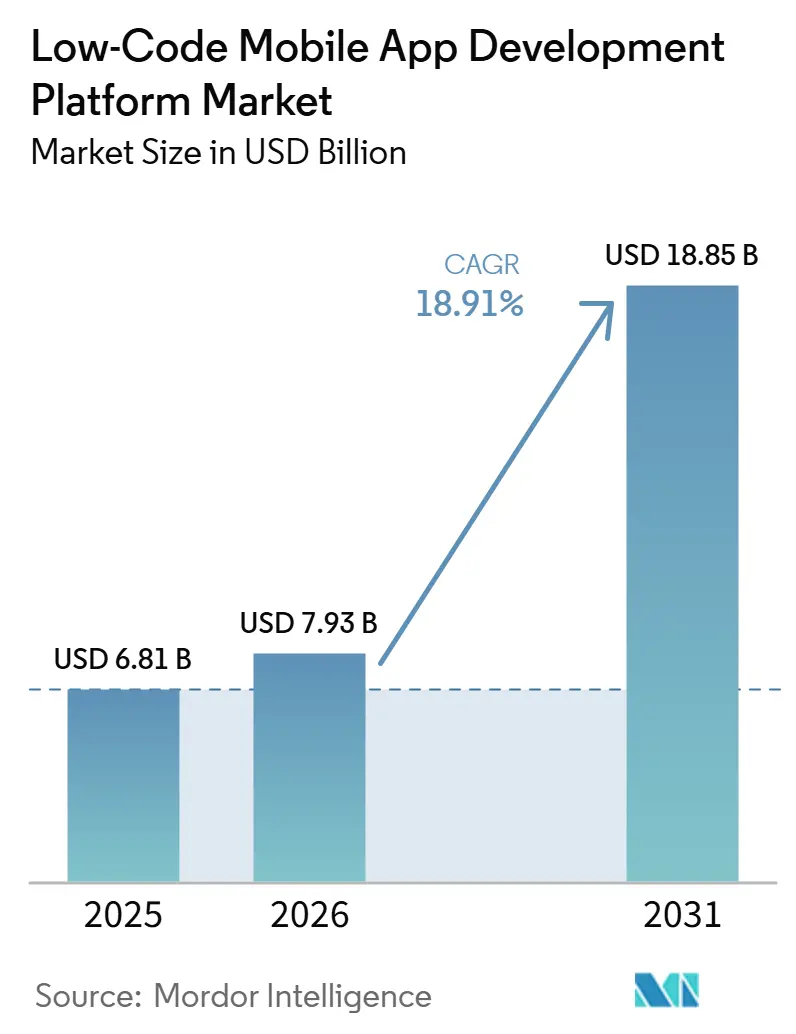
The low-code mobile app development platform market size is expected to increase from USD 6.81 billion in 2025 to USD 7.93 billion in 2026 and reach USD 18.85 billion by 2031, growing at a CAGR of 18.91% over 2026-2031. The low-code mobile app development platform market has entered a phase in which adoption is driven more by speed and delivery pressure than by simple cost reduction. Enterprises are using these platforms to release mobile tools faster than conventional development teams can support, especially as internal application demand continues to grow. The low-code mobile app development platform market is also gaining support from AI-assisted app creation, tighter cloud integration, and a stronger mobile-first approach in enterprise software design. Competition is centered on product depth, AI capability, integration strength, and deployment flexibility, which is raising the pressure on vendors that do not have a clear roadmap in those areas. Governance remains an important issue because faster app creation can also expand shadow IT, security exposure, and compliance gaps when internal controls do not keep pace.
Key Report Takeaways
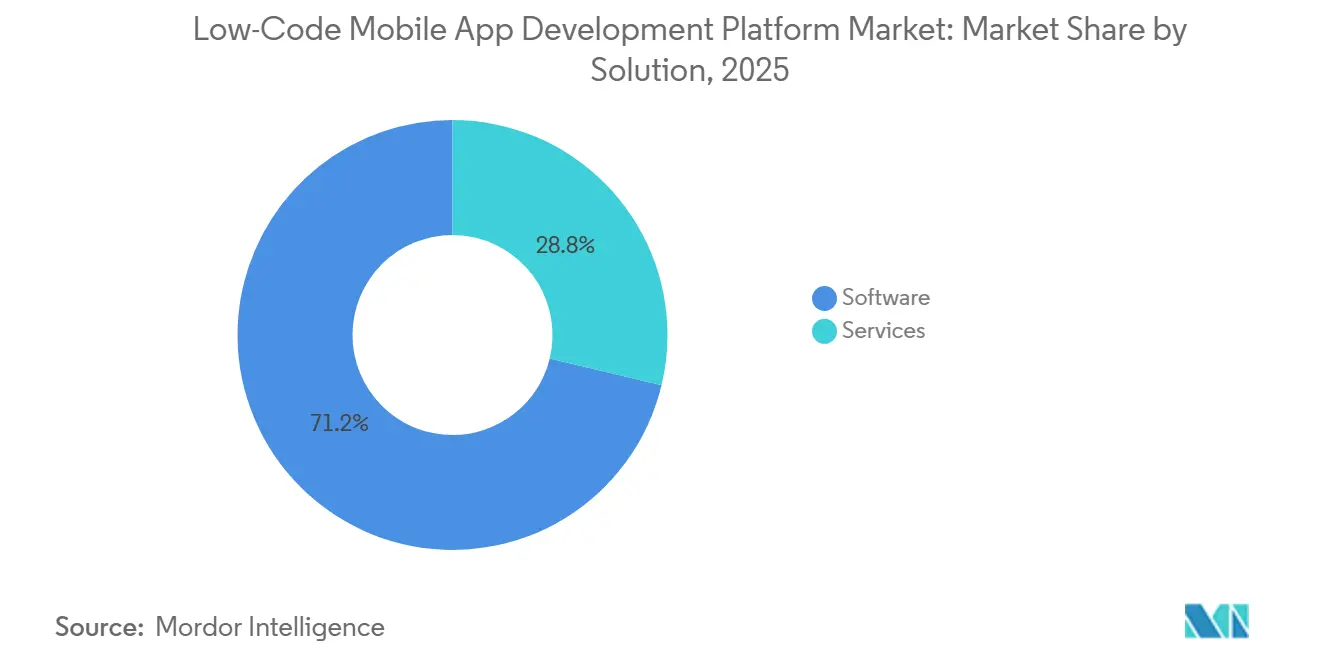
- By solution, software accounted for 71.24% of revenue in 2025, while services are projected to expand at a 21.82% CAGR through 2031.
- By deployment, cloud-based delivery held 68.41% of the low-code mobile app development platform market in 2025, while hybrid deployment is expected to record the fastest growth at a 20.43% CAGR through 2031.
- By application type, enterprise workforce applications held 34.28% of the low-code mobile app development platform market share in 2025, while customer-facing mobile applications are projected to grow at a 22.16% CAGR through 2031.
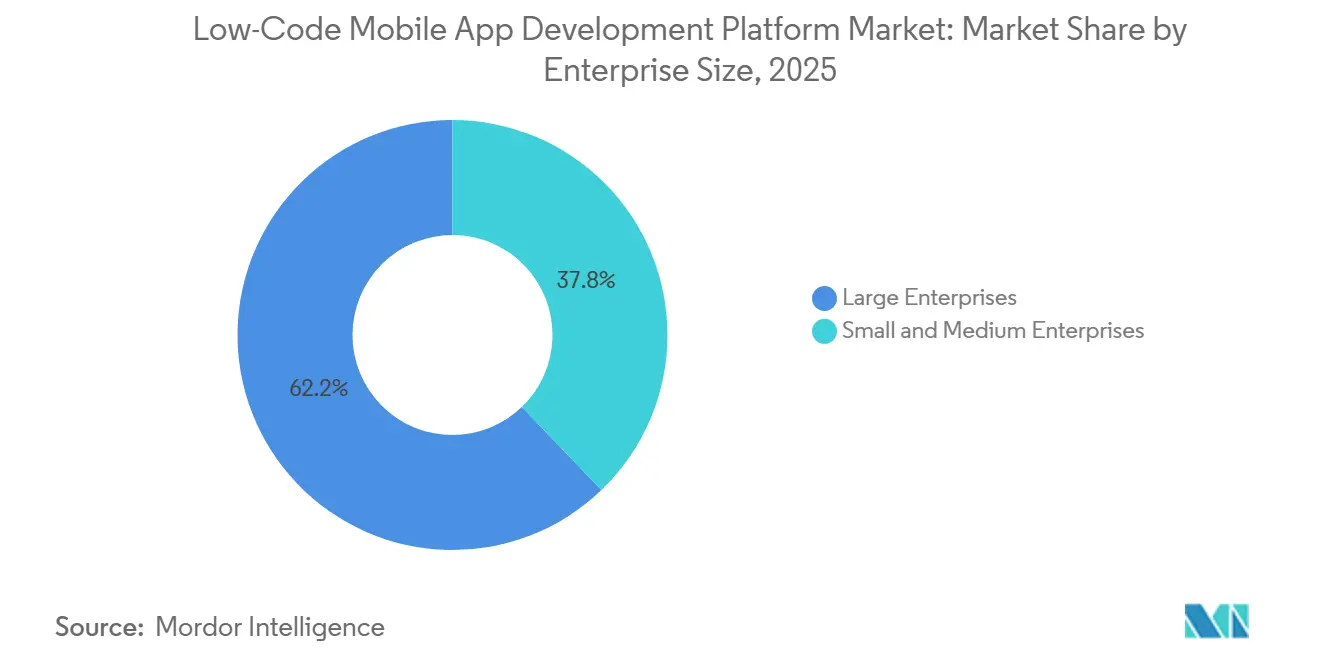
- By enterprise size, large enterprises represented 62.18% of spending in 2025, while SMEs are expected to expand at a 21.74% CAGR through 2031.
- By end user, IT and telecommunication captured 24.86% of revenue in 2025, while healthcare and life sciences are projected to advance at a 21.39% CAGR through 2031.
- By geography, North America held 34.62% of revenue in 2025, while Asia-Pacific is projected to grow at a 23.48% CAGR through 2031.
Note: Market size and forecast figures in this report are generated using Mordor Intelligence’s proprietary estimation framework, updated with the latest available data and insights as of January 2026.
Global Low-Code Mobile App Development Platform Market Trends and Insights
Drivers Impact Analysis*
| Driver | (~) % Impact on CAGR Forecast | Geographic Relevance | Impact Timeline |
|---|---|---|---|
| Rapid enterprise shift to mobile-first internal workflows | +4.2% | Global, with early intensity in North America and Europe | Short term (≤ 2 years) |
| AI-assisted app generation and testing | +3.8% | Global, strongest in North America and Asia-Pacific | Short term (≤ 2 years) |
| Demand for cross-platform delivery with lower maintenance burden | +3.1% | Global, with emphasis in Asia-Pacific and South America | Medium term (2-4 years) |
| Legacy modernization through visual development | +2.6% | North America and Europe, with spillover to Middle East and Africa | Medium term (2-4 years) |
| Cloud-native integration with ERP, CRM, and data platforms | +2.4% | Global, with highest impact in large enterprises | Medium term (2-4 years) |
| Mobile governance needs in regulated industries | +1.9% | North America, Europe, and core Asia-Pacific markets | Long term (≥ 4 years) |
| Source: Mordor Intelligence | |||
Rapid Enterprise Shift to Mobile-First Internal Workflows
The low-code mobile app development platform market is seeing strong demand from enterprises seeking to improve internal workflows on mobile devices. This shift is especially visible in field service, approvals, HR tasks, logistics, and day-to-day operating processes, where desktop dependence slows execution. As business teams take a larger role in application requests, low-code platforms help reduce the backlog that traditional mobile development teams often struggle to clear. Microsoft highlighted Rabobank as an example of a company that used more than 2,500 Power Apps and Power Automate solutions to support 40,000 employees across 38 countries and reduce a three-week reorganization process to 3 minutes.[1]Microsoft Power Platform Team, “Microsoft Is a Leader in the 2025 Forrester Wave for Low-Code Platforms for Professional Developers,” Microsoft Power Platform Blog, microsoft.com In the low-code mobile app development platform market, results like that encourage organizations to expand platform use from a single operational workflow to many others.
AI-Assisted App Generation And Testing
The low-code mobile app development platform market is being reshaped by AI features that reduce the time needed to design, build, test, and refine mobile applications. What started as visual drag-and-drop development is moving toward prompt-based generation and guided automation across the software lifecycle. OutSystems made Mentor generally available in February 2025, positioning it as a digital worker that can support application generation and broader lifecycle automation from a single requirements document.[2]OutSystems, “OutSystems Announces General Availability of Mentor,” Business Wire, businesswire.com That shift makes platform procurement more attractive for organizations that need usable mobile scaffolds quickly and cannot wait for long development cycles. In the low-code mobile app development platform market, AI is no longer an add-on feature because it is becoming part of the core product definition.
Demand for Cross-Platform Delivery with Lower Maintenance Burden
The low-code mobile app development platform market benefits when enterprises try to reduce the ongoing cost of supporting both iOS and Android applications. Many buyers now recognize that maintenance pressure continues long after launch because operating systems, SDKs, and app store requirements keep changing. OutSystems stated that MABS 12 added support for iOS 26 SDKs and Android API level 36, which helps developers stay aligned with platform requirements without maintaining separate native codebases.[3]OutSystems, “MABS 12 Release Notes,” OutSystems Support, success.outsystems.com Mendix also moved to React Native 0.84 in its 11.12 LTS release, which improved startup performance, iOS build speed, and app footprint through a redesigned architecture. In the low-code mobile app development platform market, those maintenance gains matter more as application portfolios grow and become harder to support with conventional development models.[4]Mendix, “Mendix Release 11.12,” Mendix Blog, mendix.com
Legacy Modernization Through Visual Development
The low-code mobile app development platform market is also being supported by legacy modernization programs that need modern mobile interfaces without full core replacement. This is especially relevant in sectors where older systems still run critical workflows but cannot support current user expectations on mobile devices. Pegasystems launched Pega Blueprint AI integration with AWS Transform in June 2026 to help organizations extract COBOL code and reimagine it as cloud-ready agentic applications. OutSystems also introduced legacy modernization services powered by AWS Transform in June 2026, focusing on converting aging systems into modern applications. In the low-code mobile app development platform market, these programs matter because they typically run for years and can generate recurring subscription and services revenue rather than one-time project demand.
Restraints Impact Analysis*
| Restraint | (~) % Impact on CAGR Forecast | Geographic Relevance | Impact Timeline |
|---|---|---|---|
| Security, privacy, and data residency constraints | -1.8% | Global, most acute in Europe and Asia-Pacific data sovereignty markets | Short term (≤ 2 years) |
| Vendor lock-in and proprietary runtime dependency | -1.5% | Global, highest concern in large enterprises across North America and Europe | Medium term (2-4 years) |
| Integration complexity with legacy systems | -1.2% | North America and Europe, with spillover to Middle East and Africa | Medium term (2-4 years) |
| Citizen developer sprawl and governance risk | -0.9% | Global | Long term (≥ 4 years) |
| Source: Mordor Intelligence | |||
Security, Privacy, And Data Residency Constraints
The low-code mobile app development platform market still faces friction in industries where mobile applications handle sensitive data or operate under strict regional controls. Procurement teams in those environments often want clear answers on hosting models, data separation, access controls, and regional deployment options before they scale usage. Those requirements can slow decision-making and can favor vendors with broader infrastructure reach or more flexible deployment models. OutSystems emphasized runtime isolation and self-hosting capabilities in its June 2026 platform announcement, which shows how strongly enterprise buyers are pushing vendors to address sovereignty and control needs. In the low-code mobile app development platform market, this restraint is less about blocking demand and more about delaying broader rollouts until governance and hosting concerns are resolved.
Vendor Lock-In and Proprietary Runtime Dependency
The low-code mobile app development platform market also faces buyer hesitation, as customers worry that business logic, runtime behavior, and deployment tools may become overly dependent on a single vendor. This risk becomes more visible after the first wave of applications is live and the customer starts thinking about long-term portability. Customer-facing apps and field operations tools are especially vulnerable because the user experience is often closely tied to platform components and workflows. OutSystems framed its June 2026 announcement around open, governed enterprise AI, reflecting how strongly buyers are seeking greater flexibility and control. In the low-code mobile app development platform market, vendors that reduce lock-in concerns are likely to be in a stronger position during large enterprise evaluations.
*Our forecasts treat driver/restraint impacts as directional, not additive. The impact forecasts reflect baseline growth, mix effects, and variable interactions.
Segment Analysis
By Solution: Software Dominance Holds While Services Gains Weight
Software accounted for 71.24% of the low-code mobile app development platform market in 2025, indicating that licensing and platform subscriptions remained the main commercial model. Most organizations still buy the platform first and then decide whether implementation work will be handled internally, through partners, or through the vendor. This pattern keeps software revenue at the center of the spending mix because the platform is the foundation for every deployment. In the low-code mobile app development platform market, that also means vendors with strong core functionality and a broad developer ecosystem still hold an advantage.
Services are projected to grow at a 21.82% CAGR through 2031, which reflects the rising complexity of enterprise deployments. As customers add AI functionality, legacy integration, governance controls, and multi-environment operations, professional support becomes harder to avoid. Appian’s April 2026 product update paired AI-assisted spec-driven development with broader partner and integration capabilities, reinforcing the role of services in speeding delivery for enterprise customers. The low-code mobile app development platform industry is therefore moving toward a fuller lifecycle model where advisory, implementation, and managed support matter more than they did in earlier adoption stages.


By Deployment: Cloud Leads While Hybrid Becomes More Strategic
Cloud-based deployment accounted for 68.41% of the low-code mobile app development platform market in 2025, underscoring that buyers still prefer elastic capacity and vendor-managed updates. For many organizations, cloud remains the fastest way to start development, roll out updates, and scale new mobile workflows across teams. This model also lowers infrastructure management demands for customers who do not want to maintain complex environments on their own. In the low-code mobile app development platform market, cloud keeps its lead because convenience and speed still matter to a wide range of buyers.
Hybrid deployment is projected to expand at a 20.43% CAGR through 2031, underscoring the growing importance of control in regulated and data-sensitive use cases. Financial services, healthcare, and government users often want some data and runtime elements kept closer to internal systems while still using cloud-based development and orchestration layers. OutSystems highlighted self-hosting and runtime isolation in its 2026 platform announcement, directly aligning with that enterprise demand pattern. On-premises deployment still serves specialized environments, but much of the practical shift in the low-code mobile app development platform market is now moving toward hybrid rather than back to fully local models.
By Application Type: Workforce Apps Lead While Customer Apps Expand Faster
Enterprise workforce applications accounted for 34.28% of the low-code mobile app development platform market share in 2025, making them the largest application segment. Internal approvals, inventory visibility, HR tools, operations support, and field workflow apps remain easier starting points because they have clearer users and measurable efficiency gains. These use cases also help organizations build trust in the platform before extending it into more public-facing work. In the low-code mobile app development platform market, workforce apps remain the operational entry point for many deployment programs.
Customer-facing mobile applications are projected to grow at a 22.16% CAGR through 2031, which signals a broader move into external digital experiences. Once organizations become comfortable with internal deployment, they often apply the same platform model to retail apps, banking interfaces, patient portals, and service applications. Salesforce introduced MAGE in developer preview in February 2026 to generate production-ready iOS and Android app scaffolds from natural language prompts, showing how quickly the category is moving into customer app creation. Field service and operational apps remain important because they often require offline support, while consumer mobile applications continue to grow as buyers seek lower development costs and faster release cycles in the low-code mobile app development platform market.
By Enterprise Size: Large Enterprises Lead While SMEs Move Faster
Large enterprises held 62.18% of the low-code mobile app development platform market in 2025, which reflects the scale advantage they bring to modernization programs. These organizations usually have the budget, governance structure, and application backlog needed to justify broad platform licenses across departments. They also tend to be the earliest adopters of AI extensions, governance tooling, and large integration projects tied to mobile delivery. In the low-code mobile app development platform market, their spending sets the baseline for demand.
SMEs are projected to expand at a 21.74% CAGR through 2031 as pricing flexibility and easier product onboarding reduce the entry barrier. Template libraries, guided development tools, and AI-based setup features make the platforms more usable for firms without large specialist teams. That change matters because smaller organizations now have a more realistic path to structured mobile app delivery, rather than relying solely on custom external development. The low-code mobile app development platform industry is therefore seeing faster expansion from SMEs, even though large enterprises still account for the bigger spending pool.
By End User: IT And Telecommunication Leads While Healthcare Builds Momentum
IT and telecommunications accounted for 24.86% of the low-code mobile app development platform market in 2025, underscoring the sector’s role as both a direct buyer and an internal technology enabler. These companies often run large application estates, manage integration-heavy workflows, and need faster release cycles across employee and customer channels. Their familiarity with platform-based development also supports earlier adoption than in many other end-user groups. In the low-code mobile app development platform market, IT and telecommunications are the segments that currently set the operating standard for wider enterprise use.
Healthcare and life sciences are projected to grow at a 21.39% CAGR through 2031, supported by rising demand for mobile workflows in payer, provider, and patient-facing environments. Mobile access, process automation, and workflow simplification all matter more as organizations try to improve coordination across fragmented systems. The segment is also attractive because mobile interfaces can be added to legacy environments without forcing a full system replacement at the start of the program. BFSI remains a major buyer group, while retail, manufacturing, education, media, government, and utilities continue to expand the addressable market for the low-code mobile app development platform.
Geography Analysis
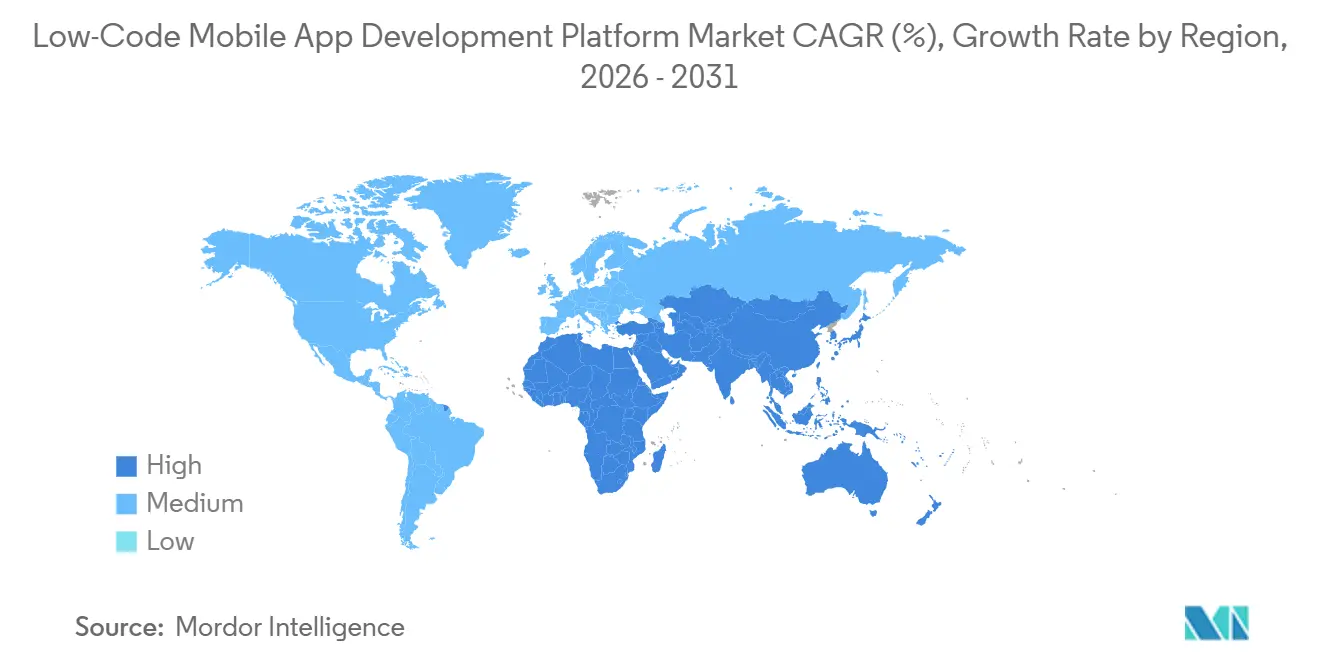
North America accounted for 34.62% of the low-code mobile app development platform market in 2025. The region benefits from deep enterprise technology spending, mature cloud ecosystems, and a strong push toward AI-enabled application delivery. Large organizations in the United States have been among the earliest adopters of structured low-code programs for both internal and customer-facing mobile use cases. Microsoft reported 56 million monthly active users on Power Platform in April 2025, underscoring the scale of enterprise adoption already achieved. Canada and Mexico contribute smaller shares, but both remain relevant in financial services, manufacturing, and cross-border enterprise operations.
Asia-Pacific is projected to grow at a 23.48% CAGR through 2031, making it the fastest-growing region in the low-code mobile app development platform market. Growth in this region comes from a different mix than in North America because developer shortages, digital transformation programs, and SME adoption all play a stronger role. Buyers across India, China, Japan, South Korea, and Southeast Asia are looking for faster app delivery without building very large specialist development teams. That makes AI-assisted development and reusable templates especially valuable in regional adoption patterns. The low-code mobile app development platform market is also benefiting from domestic integrator activity in several Asia-Pacific countries, where firms are building customer engagement and operational tools on top of these platforms.
Europe held a significant share of the low-code mobile app development platform market in 2025, with Germany, the United Kingdom, and France leading adoption. The region’s demand is shaped by enterprise modernization needs, but growth often moves more carefully because privacy and data control requirements remain central to procurement decisions. Hybrid and controlled hosting models are therefore important when buyers evaluate deployment choices in the region. South America, the Middle East, and Africa remain smaller markets, yet they continue to drive demand through financial services, public-sector digitization, manufacturing, and enterprise mobile modernization. In the low-code mobile app development platform market, these regions matter less for current scale than for the next wave of adoption as platform costs fall and deployment models become more flexible.

Competitive Landscape
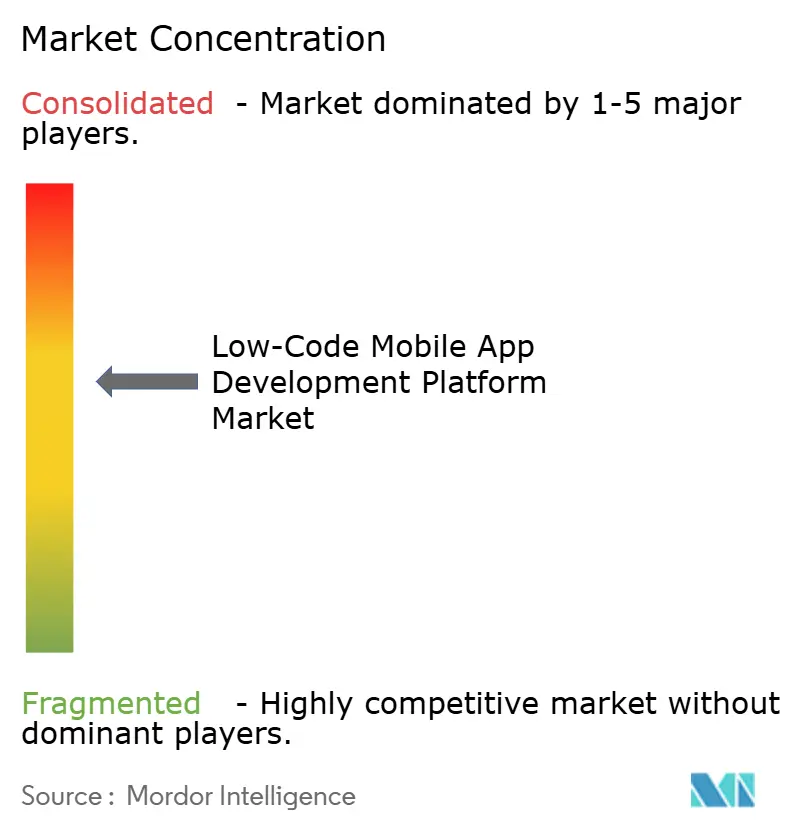
The low-code mobile app development platform market is moderately consolidated around a top group that includes Microsoft, Salesforce, ServiceNow, Oracle, SAP, and OutSystems. These companies benefit from product breadth, established enterprise relationships, and the ability to connect mobile app development with wider data, workflow, and cloud ecosystems. At the same time, specialist vendors such as Mendix, Appian, and others continue to compete by offering focused strengths in development speed, governance, or modernization support. The low-code mobile app development platform market, therefore, remains competitive even though spending is concentrated around a limited number of enterprise-grade providers.
A clear pattern across the low-code mobile app development platform market in 2025 and 2026 has been the rapid buildout of AI-enabled development capabilities. ServiceNow made Build Agent generally available in May 2026 and extended it across major coding tools, demonstrating how governance and AI-assisted development are being more closely tied together. Salesforce launched MAGE in developer preview in February 2026 to generate mobile app scaffolds from natural language prompts, signaling a stronger move into AI-led mobile development. Microsoft also broadened the reach of its Dataverse plugin for coding agents in July 2026, extending platform relevance beyond the core Power Platform environment. These moves show that buyers now expect faster development, stronger governance, and more flexible AI integration from leading vendors.
Competition in the low-code mobile app development platform market is also being shaped by modernization and deployment control. OutSystems introduced an Agentic Systems Platform in June 2026, featuring runtime isolation, self-hosting, and expanded AWS collaboration, thereby strengthening its position in enterprise AI and sovereignty-sensitive use cases. Mendix released version 11.12 LTS in June 2026, featuring React Native 0.84 and Maia AI capabilities, demonstrating a fast release pace and continued product investment. Appian also linked AI-assisted development with process orchestration and Snowflake integration in April 2026, reinforcing the push toward broader enterprise workflow value rather than stand-alone app building. The result is a market where leading vendors are defending share not only through app builders themselves, but also through governance, AI orchestration, and modernization support that make switching harder for enterprise customers.
Low-Code Mobile App Development Platform Industry Leaders
Microsoft Corporation
Salesforce, Inc.
Oracle Corporation
ServiceNow, Inc.
Appian Corporation
- *Disclaimer: Major Players sorted in no particular order

Recent Industry Developments
- July 2026: Microsoft expanded its Dataverse plugin for coding agents into Claude, Cursor, and GitHub Copilot marketplaces, alongside a catalog of more than 60 MCP servers connecting agents to productivity, developer tools, and business applications. This cross-platform availability extends Power Apps' reach into AI-assisted mobile development workflows beyond the Power Platform ecosystem itself.
- July 2026: Salesforce made Multi-Framework support (React) generally available on its platform, enabling developers to use React components natively within the Salesforce development environment. This broadens the mobile and web application development surface for enterprise Salesforce deployments.
- June 2026: Pegasystems launched Pega Blueprint AI integration with Amazon Web Services Transform, enabling organizations to extract COBOL mainframe code and reimagine it as cloud-ready agentic applications in a single guided experience. This positions Pega as a key enabler for mobile-interface modernization of legacy core systems.
- June 2026: OutSystems unveiled an Agentic Systems Platform at its ONE Conference in Amsterdam, introducing the Enterprise Context Graph, self-hosting capabilities, and an expanded collaboration with AWS for legacy modernization services. The platform also launched a first end-to-end banking solution for loan origination, accelerating time-to-value for financial services customers.


Global Low-Code Mobile App Development Platform Market Report Scope
The low-code mobile app development platform market refers to the ecosystem of software solutions and services that enable organizations to design, develop, and deploy mobile applications with minimal hand-coding and traditional programming. These platforms provide visual development interfaces, drag-and-drop functionalities, pre-built templates, and ready-to-use connectors that accelerate the entire app development lifecycle. Deployed across cloud-based, hybrid, or on-premises models, these solutions cater to organizations of all sizes across diverse industries, including BFSI, healthcare, retail, and manufacturing. They are used to build a wide variety of applications, ranging from internal enterprise workforce tools and field service operations to external customer-facing and consumer applications. By democratizing development and bridging the gap between professional IT developers and business users (citizen developers), low-code mobile app development platforms help organizations reduce development costs, significantly speed time-to-market, alleviate IT backlogs, and rapidly adapt to evolving digital business requirements across multiple mobile operating systems.
The Low-Code Mobile App Development Platform Market Report is Segmented by Solution (Software and Services), Deployment (Cloud-Based, Hybrid, and On-Premises), Application Type (Enterprise Workforce Applications, Customer-Facing Mobile Applications, Field Service and Operational Applications, and Consumer Mobile Applications), Enterprise Size (Large Enterprises, and Small and Medium Enterprises), End User (IT and Telecommunication, BFSI, Healthcare and Life Sciences, Retail and E-Commerce, Industrial Manufacturing, Education and Research Institutions, Media and Entertainment, Government and Administration, Energy and Utilities, and Other End-User Industries), and Geography (North America, South America, Europe, Asia-Pacific, and Middle East and Africa). The Market Forecasts are Provided in Terms of Value (USD).
| Software |
| Services |
| Cloud-Based |
| Hybrid |
| On-Premises |
| Enterprise Workforce Applications |
| Customer-Facing Mobile Applications |
| Field Service and Operational Applications |
| Consumer Mobile Applications |
| Large Enterprises |
| Small and Medium Enterprises |
| IT and Telecommunication |
| BFSI |
| Healthcare and Life Sciences |
| Retail and E-Commerce |
| Industrial Manufacturing |
| Education and Research Institutions |
| Media and Entertainment |
| Government and Administration |
| Energy and Utilities |
| Other End-user Industries |
| North America | United States | |
| Canada | ||
| Mexico | ||
| South America | Brazil | |
| Argentina | ||
| Rest of South America | ||
| Europe | Germany | |
| United Kingdom | ||
| France | ||
| Russia | ||
| Spain | ||
| Rest of Europe | ||
| Asia-Pacific | China | |
| Japan | ||
| India | ||
| South Korea | ||
| Southeast Asia | ||
| Rest of Asia-Pacific | ||
| Middle East and Africa | Middle East | Saudi Arabia |
| United Arab Emirates | ||
| Rest of Middle East | ||
| Africa | South Africa | |
| Nigeria | ||
| Rest of Africa | ||
| By Solution | Software | ||
| Services | |||
| By Deployment | Cloud-Based | ||
| Hybrid | |||
| On-Premises | |||
| By Application Type | Enterprise Workforce Applications | ||
| Customer-Facing Mobile Applications | |||
| Field Service and Operational Applications | |||
| Consumer Mobile Applications | |||
| By Enterprise Size | Large Enterprises | ||
| Small and Medium Enterprises | |||
| By End-user Industry | IT and Telecommunication | ||
| BFSI | |||
| Healthcare and Life Sciences | |||
| Retail and E-Commerce | |||
| Industrial Manufacturing | |||
| Education and Research Institutions | |||
| Media and Entertainment | |||
| Government and Administration | |||
| Energy and Utilities | |||
| Other End-user Industries | |||
| By Geography | North America | United States | |
| Canada | |||
| Mexico | |||
| South America | Brazil | ||
| Argentina | |||
| Rest of South America | |||
| Europe | Germany | ||
| United Kingdom | |||
| France | |||
| Russia | |||
| Spain | |||
| Rest of Europe | |||
| Asia-Pacific | China | ||
| Japan | |||
| India | |||
| South Korea | |||
| Southeast Asia | |||
| Rest of Asia-Pacific | |||
| Middle East and Africa | Middle East | Saudi Arabia | |
| United Arab Emirates | |||
| Rest of Middle East | |||
| Africa | South Africa | ||
| Nigeria | |||
| Rest of Africa | |||


Key Questions Answered in the Report
What is the 2026 size of the low-code mobile app development platform market?
The low-code mobile app development platform market stood at USD 7.93 billion in 2026 and is forecast to reach USD 18.85 billion by 2031 at a CAGR of 18.91%.
What is driving adoption of low-code mobile app development platforms?
Faster mobile app delivery, AI-assisted development, legacy modernization, and the need to support internal workflows on mobile devices are the main demand drivers.
Which deployment model leads this space?
Cloud-based deployment led with 68.41% of revenue in 2025, while hybrid deployment is expected to post the fastest growth through 2031.
Which application segment is expanding the fastest?
Customer-facing mobile applications are projected to grow at a 22.16% CAGR through 2031, while enterprise workforce applications remained the largest segment in 2025.
Which region offers the strongest growth outlook?
Asia-Pacific is expected to be the fastest-growing region, with a 23.48% CAGR through 2031, supported by digital transformation and developer shortages.
Which end-user group currently leads spending?
IT and telecommunication held the largest end-user share at 24.86% in 2025, while healthcare and life sciences are projected to grow the fastest through 2031.
Page last updated on:






