
Logistics Workforce Management Software Market Size and Share
Market Overview
| Study Period | 2020 - 2031 |
|---|---|
| Market Size (2026) | USD 409.63 Million |
| Market Size (2031) | USD 830.44 Million |
| Growth Rate (2026 - 2031) | 15.18 % |
| Fastest Growing Market | Asia-Pacific |
| Largest Market | North America |
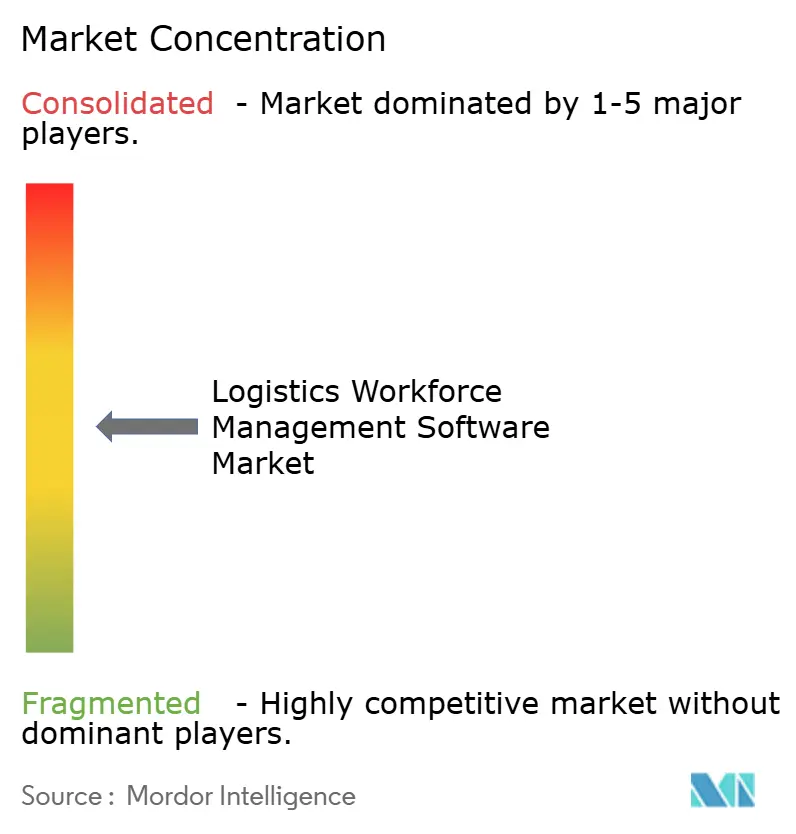
| Market Concentration | Medium |
Major Players *Disclaimer: Major Players sorted in no particular order Image © Mordor Intelligence. Reuse requires attribution under CC BY 4.0. | |
Logistics Workforce Management Software Market Analysis by Mordor Intelligence
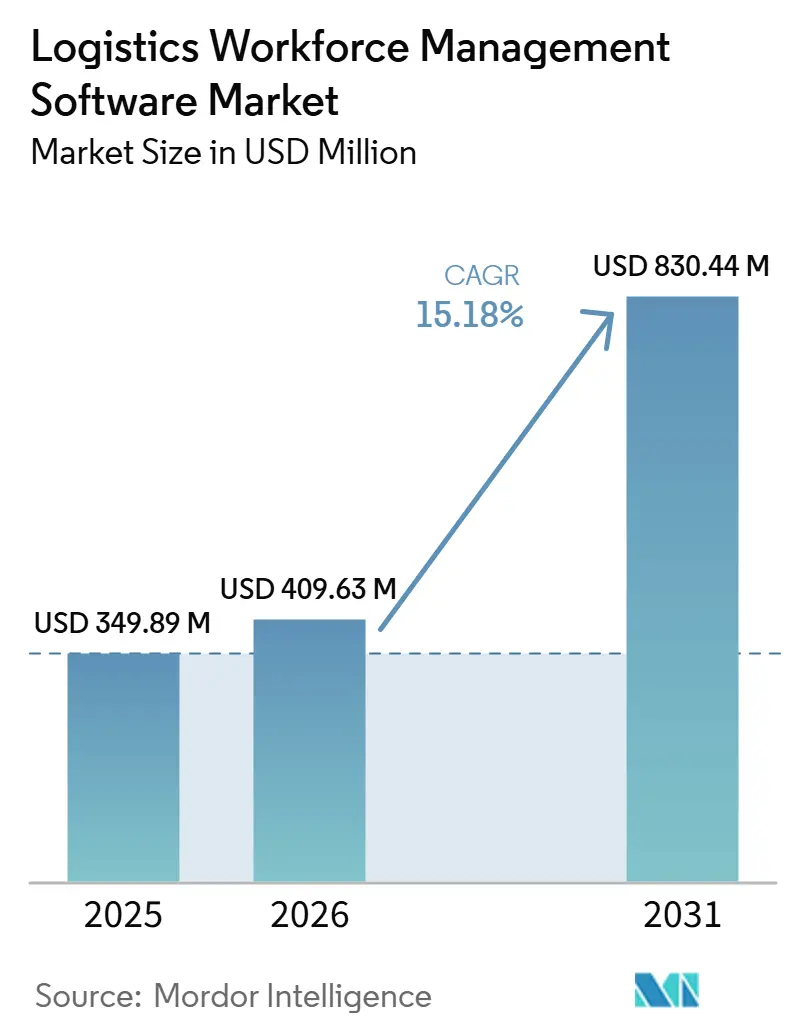
The logistics workforce management software market size is projected to expand from USD 349.89 million in 2025 and USD 409.63 million in 2026 to USD 830.44 million by 2031, registering a CAGR of 15.18% between 2026 and 2031. The logistics workforce management software market is growing because operators need to manage drivers, dispatch, and compliance through connected systems rather than add staff. Tighter delivery windows are increasing the value of tools that can allocate workers and vehicles as conditions change. Labor costs and driver retention are also moving workforce software from a support function to a core operating priority. Providers are responding with cloud products, AI-enabled dispatch, and service models that help customers connect existing systems. Integration work remains a constraint, particularly for operators with separate telematics, payroll, warehouse, and carrier applications.
Key Report Takeaways
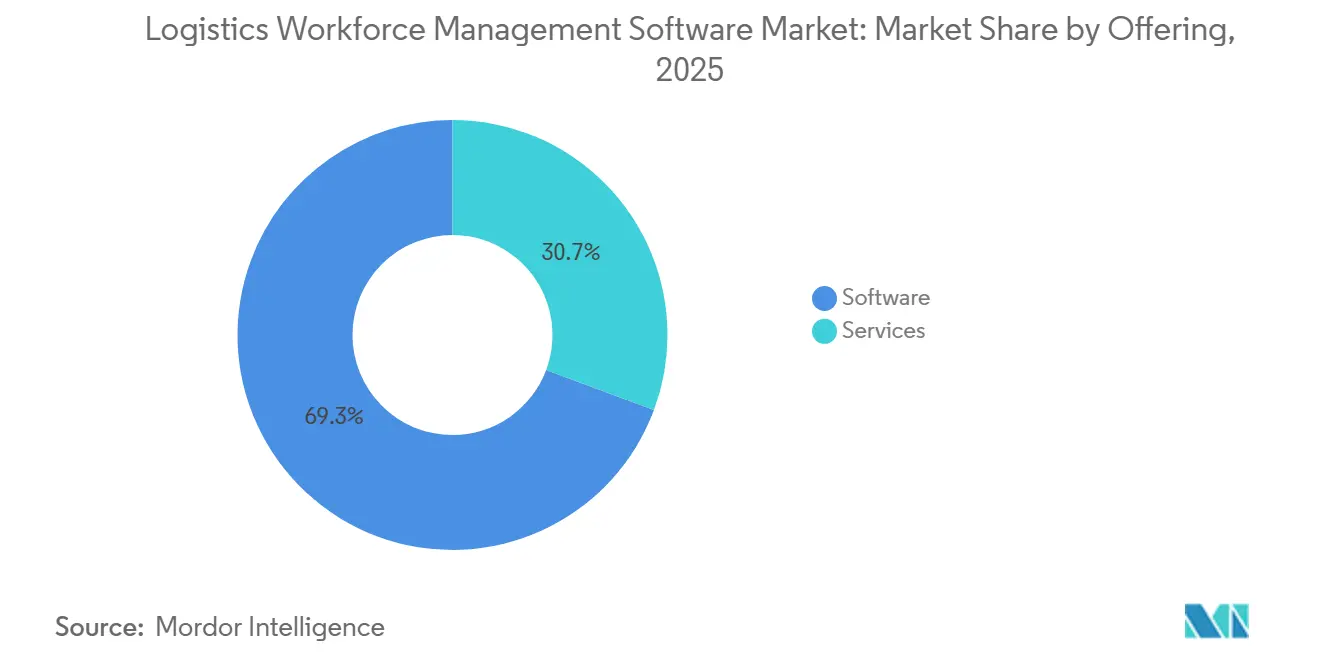
- By offering, software held 69.32% of the logistics workforce management software market share in 2025, while services are projected to expand at a 17.12% CAGR through 2031.
- By deployment mode, cloud accounted for 64.81% of the logistics workforce management software market share in 2025 and is expected to record the highest CAGR of 18.79% through 2031.
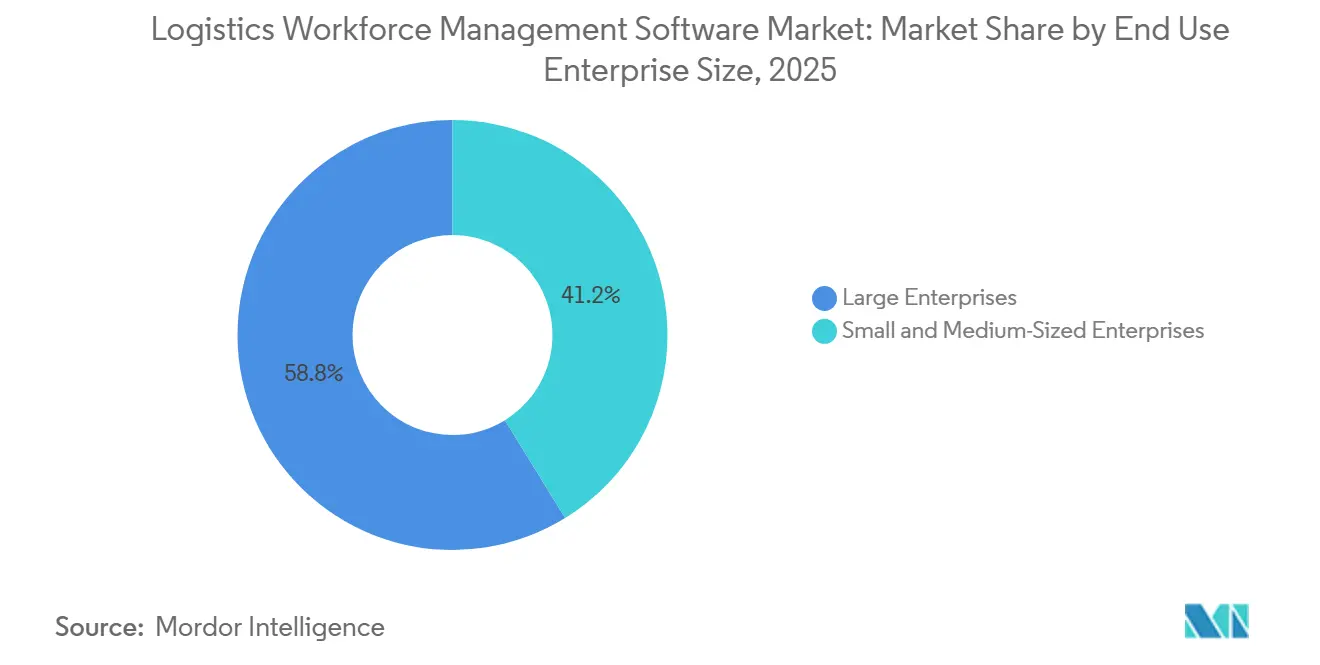
- By enterprise size, large enterprises held 58.78% of revenue in 2025, while small and medium-sized enterprises are projected to grow at a 19.04% CAGR through 2031.
- By end user, logistics and third-party logistics providers accounted for 33.27% of revenue in 2025, while parcel, courier, and express delivery are expected to expand at a 19.83% CAGR through 2031.
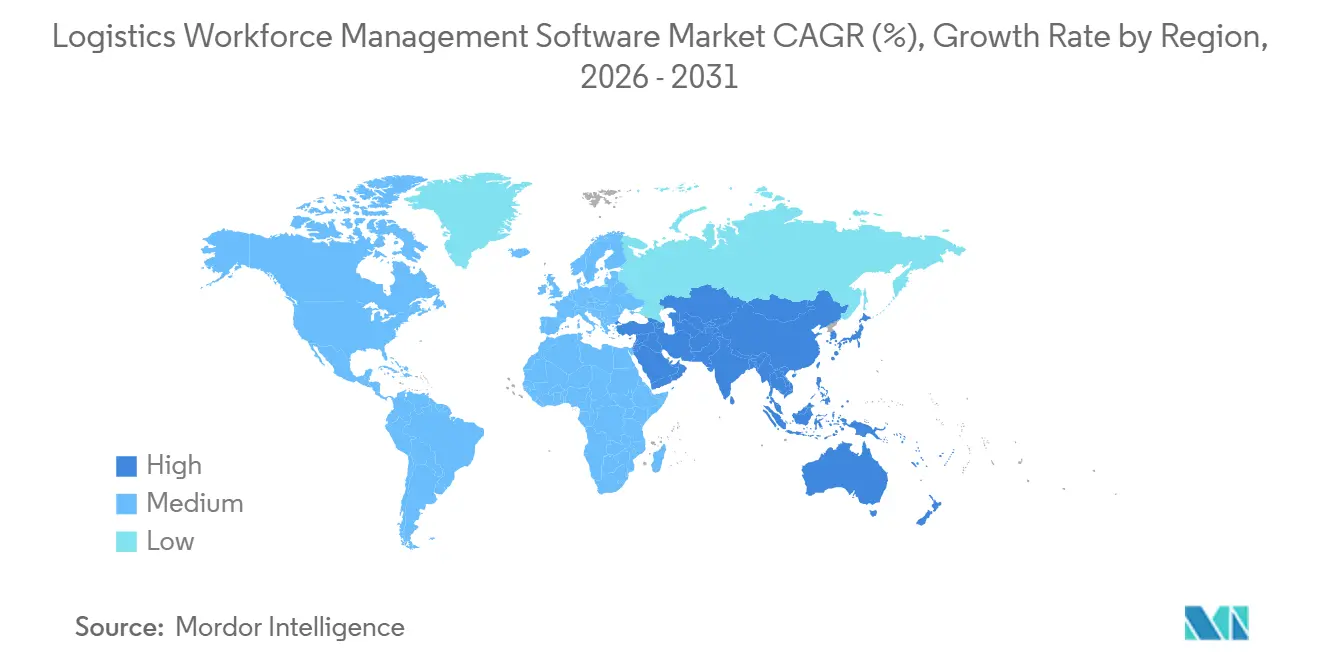
- By geography, North America held 38.19% of revenue in 2025, while Asia-Pacific is projected to grow at a 17.26% CAGR through 2031.
Note: Market size and forecast figures in this report are generated using Mordor Intelligence’s proprietary estimation framework, updated with the latest available data and insights as of January 2026.
Market Trends and Insights
Drivers Impact Analysis of Logistics Workforce Management Software Market*
| Driver | (~) % Impact on CAGR Forecast | Geographic Relevance | Impact Timeline |
|---|---|---|---|
| E-Commerce and Same-Day Delivery Expansion | +3.2% | Global, led by North America and Asia-Pacific | Short term (≤ 2 years) |
| Labor Cost Optimization and Driver Retention | +2.8% | Global, highest in North America and Europe | Short term (≤ 2 years) |
| AI-Native Dynamic Dispatch and Predictive Rescheduling | +2.4% | Global, early adoption concentrated in North America and Asia-Pacific core | Medium term (2-4 years) |
| Real-Time Visibility and Customer Communication | +2.0% | Global | Short term (≤ 2 years) |
| Sustainability Reporting and Low-Emission Fleet Compliance | +1.5% | Europe, with spillover to North America and Asia-Pacific | Medium term (2-4 years) |
| Cross-Platform Worker Identity and Skills Portability | +0.9% | Global, with early gains in North America and Southeast Asia | Long term (≥ 4 years) |
| Source: Mordor Intelligence | |||
E-Commerce and Same-Day Delivery Expansion
Consumer delivery expectations are reducing the time available for route and workforce planning. Amazon expanded its same-day delivery network to various facilities in late May 2026 and extended the service to additional metropolitan areas, increasing the pressure on logistics providers to plan around sub-24-hour delivery windows. The logistics workforce management software market therefore needs systems that can reassign drivers and routes during the operating day. Shipium reported that the share of direct-to-consumer orders delivered within 24 hours increased year over year from Q2 2025 to Q2 2026, driven by merchants using 4 or more fulfillment locations. This shift makes static shift plans less useful for third-party logistics providers that serve direct-to-consumer brands. Software that joins dispatch, worker availability, and delivery exceptions can help operators respond without adding manual coordination.
Labor Cost Optimization and Driver Retention
Labor expense and driver turnover are making better workforce planning more important for carriers. ATRI reported an average truck operating cost of USD 2.336 per mile in 2025, with driver wages and benefits as the largest cost component. Platform Science reported in February 2026 that technology affected 52% of surveyed drivers’ decisions to stay with or leave an employer. The logistics workforce management software market can support retention when scheduling, time tracking, route communication, payroll integration, and compliance workflows reduce administrative burden rather than add to it. These tools also help fleet managers improve shift planning, monitor hours-of-service requirements, manage last-minute schedule changes, and provide drivers with clearer visibility into assignments and payments. Reducing annual turnover from 90% toward 60%-70% can lower replacement costs for a 200-driver fleet, but the benefit depends on drivers accepting the tools used in daily work.
AI-Native Dynamic Dispatch and Predictive Rescheduling
AI is becoming part of the daily control process for dispatch and labor allocation. FarEye introduced PILOT in 2026, an agentic dispatcher that coordinates 11 specialized agents across planning, route management, recovery, and driver communication.[1]FarEye, “FarEye Launches PILOT: The First Fully Integrated Agentic AI Dispatcher Purpose-Built for Last-Mile Logistics,” FarEye News, fareye.com. Manhattan Associates made its AI Agent Workforce commercially available in January 2026 to guide associate deployment using work volumes in its warehouse management environment. These products require inputs from telematics, order management, and customer communication systems to ensure fragmented data does not limit the value available to buyers. C.H. Robinson introduced Lean AI Engineer in June 2026 to assess and improve supply chain performance in live operations. Vendors in the logistics workforce management software market can differentiate by leveraging AI that works with imperfect data and does not require a full technology replacement.
Real-Time Visibility and Customer Communication
Real-time delivery information is becoming a basic expectation for carriers serving e-commerce customers. More than 40% of US Prime orders were delivered on the same day or the next day in Q1 2026, compared with 28% in Q1 2024. This delivery standard increases the need for location updates, exception alerts, and estimated arrival times that can be shared with customers. Integrating those updates with SMS or WhatsApp communications can reduce status calls to dispatch and customer service teams. Shipsy stated that its Astra planning agent can produce route plans 15%-25% cheaper than legacy transportation management system planning and in minutes rather than hours. The logistics workforce management software market is increasingly linking route-planning speed with customer communication, as both depend on current operational data.
Restraints Impact Analysis of Logistics Workforce Management Software Market*
| Restraint | (~) % Impact on CAGR Forecast | Geographic Relevance | Impact Timeline |
|---|---|---|---|
| Legacy Integration and Data Migration Complexity | -2.5% | Global, most acute in North America and Europe | Medium term (2-4 years) |
| High Implementation Costs for Small and Medium-Sized Operators | -2.0% | Global, highest impact in South America, Middle East, and Africa | Medium term (2-4 years) |
| Driver Privacy, Surveillance, and Workforce Resistance | -1.2% | North America and European Union, with spillover to Asia-Pacific | Short term (≤ 2 years) |
| Fragmented Telematics, Carrier, and Payroll Data Standards | -0.8% | Global | Long term (≥ 4 years) |
| Source: Mordor Intelligence | |||
Legacy Integration and Data Migration Complexity
Legacy integration is a significant restraint on adoption across large logistics networks. A 2025 operations survey found that 42% of supply chain respondents identified integration with existing systems as a leading adoption challenge, while 37% cited data availability and quality issues. Many operators run a legacy transportation management system, acquired warehouse applications, and separate labor tools at the same time. Replacing 1 application can disrupt undocumented workflows that connect those systems. The logistics workforce management software market favors providers that offer application programming interfaces and middleware compatibility, rather than requiring a full system replacement. EDI-to-API transition requirements can add cost and extend the evaluation and deployment process.
High Implementation Costs for Small and Medium-Sized Operators
Implementation costs can keep smaller logistics operators from adopting advanced platforms. The logistics workforce management software market must therefore offer subscription options that align with the scale, budget, and information technology capacity of smaller fleets. Enterprise transportation and workforce management rollouts can be costly and take 18 months, while cloud-based mid-market deployments can vary depending on fleet size and integration depth. According to the Material Handling Industry (MHI), a logistics survey found that 68% of shippers and 80% of logistics providers identified cost as the main obstacle to digitization. Cloud workforce tools involve monthly per-user costs for small and medium-sized enterprises, while on-premises licenses include per-user fees plus 15%-20% annual maintenance.[2]proLogistik Group, “WMS, MES and ERP Integration: Costs for SMEs,” prologistik.com. Modular subscriptions and pre-built freight platform connections can lower the initial barrier for the fastest-growing enterprise-size group. The logistics workforce management software market still needs shorter implementation paths, as lower subscription prices alone do not eliminate deployment risk.
*Our forecasts treat driver/restraint impacts as directional, not additive. The impact forecasts reflect baseline growth, mix effects, and variable interactions.
Logistics Workforce Management Software Market Segment Analysis
By Offering:
Software Platforms Lead While Services ExpandSoftware held 69.32% of revenue in 2025. This result reflects the ongoing move from separate scheduling tools to integrated platforms that combine dispatch, tracking, analytics, and compliance capabilities in a single environment. Large logistics providers often standardize on 1 or 2 platforms to reduce the number of system connections they must maintain and simplify operational oversight. This concentration gives established software vendors recurring customer relationships, strengthens platform adoption, and supports continued product development.
Services are projected to grow at a 17.12% CAGR through 2031, making them the fastest-growing offering. In the logistics workforce management software market, this growth reflects the operational work required to turn platform features into usable day-to-day processes. Implementation, configuration, and managed support are becoming more important as platforms add AI-based dispatch and multi-system coordination. Manhattan Associates introduced Solution Design Studio in May 2026, using AI to help configure supply chain systems through natural-language inputs. The tool still depends on expert service teams for focused customer deployments before direct customer use. Combined software and service offerings can increase switching costs because the provider supports both the product and the operating design.


By Deployment Mode:
Cloud Leads Adoption and GrowthCloud accounted for 64.81% of revenue in 2025 and is expected to record an 18.79% CAGR through 2031. This share indicates an increasing preference for cloud-based deployment among customers seeking more flexible, scalable technology models. Cloud reduces the need for hardware ownership and dedicated maintenance staff, thereby lowering operational complexity for organizations managing logistics technology environments. It also gives customers access to updated AI capabilities without requiring them to replace or significantly upgrade on-premises computing resources. Modular software-as-a-service products can be deployed faster than traditional local installations, allowing companies to implement new capabilities more efficiently while maintaining the same core operational objectives.
SAP made SAP Logistics Management generally available in February 2026 as a software-as-a-service product designed for localized and satellite operations. The company stated that the product can go live in days and supports carrier collaboration through SAP Business Network. On-premises systems remain relevant for government, defense, and regulated operations with data-residency obligations. National requirements in China, Germany, and the Gulf markets can prompt customers to adopt hybrid designs. Under those designs, scheduling logic operates in the cloud while sensitive driver identity data remains on local servers.
By Enterprise Size:
Large Enterprises Lead While Small and Medium-Sized Enterprises Gain GroundLarge enterprises accounted for 58.78% of the logistics workforce management software market size in 2025, reflecting their earlier adoption of workforce digitization and their greater ability to invest in connected systems. These organizations generally spend more per user because they require broader functionality, stronger integration capabilities, and tools that can support complex operating environments. They can also fund integrations across multiple sites, carriers, and operating units, allowing workforce management systems to operate as part of a wider digital ecosystem. As a result, their systems increasingly connect workforce schedules with warehouse, transportation, and enterprise resource planning applications, supporting better coordination across logistics operations.
Small and medium-sized enterprises are projected to grow at a 19.04% CAGR through 2031. Software-as-a-service pricing reduces upfront capital needs, while modular products allow operators to adopt driver scheduling or dispatch without buying a full platform. According to a 2025 OECD study on logistics, organizational readiness and digital leadership were more significant adoption barriers for small and medium-sized enterprises than cost alone. Providers can better address this group with automated onboarding, preconfigured workflows, and customer support for teams with limited information technology capacity. Lower prices will have less effect when the deployment process remains difficult for the customer.
By End User:
Logistics Providers Anchor Demand While Parcel Networks Grow FastestLogistics and third-party logistics providers accounted for 33.27% of revenue in 2025. These providers coordinate multi-carrier, multi-client, and multi-depot operations, where worker scheduling remains complex and requires close alignment with daily service requirements. They manage contracts with different service levels, seasonal demand patterns, and compliance needs across varied customer and location requirements. This operating model creates ongoing demand for specialized workforce and dispatch platforms that can support scheduling, resource allocation, visibility, and operational coordination across distributed logistics networks.
Parcel, courier, and express delivery is projected to expand at a 19.83% CAGR through 2031. Same-day and next-day networks need dynamic redispatch, real-time exception management, and direct communication with drivers. Locus was acquired by Ingka Group in October 2025 and continued to operate independently while supporting enterprise customers in more than 30 countries.[3]Locus, “Ingka Group Acquires Locus to Transform the IKEA Home Delivery Experience,” Locus Press Releases, locus.sh. The company later secured a USD 30 million Series B round led by Vertex Ventures. E-commerce and retail, food and grocery delivery, manufacturing and industrial distribution, and healthcare and pharmaceutical distribution remain important end users with distinct scheduling needs. Healthcare distribution also requires records that support cold-chain and chain-of-custody compliance.
Geography Analysis
North America Logistics Workforce Management Software Market
North America held 38.19% of revenue in 2025, supported by the region’s mature logistics technology ecosystem and early adoption of digital workforce management tools. The region has a high concentration of logistics technology vendors, major third-party logistics providers, parcel networks, and established platform budgets, which support continued investment in scheduling, time tracking, dispatch, and compliance solutions. US Department of Transportation Hours-of-Service rules have driven demand for driver time and attendance tools, as logistics operators seek systems to monitor working hours and maintain regulatory compliance. The United States is the leading country in the region, driven by its large logistics base and advanced technology adoption, while Canada and Mexico are advancing adoption through cross-border trade infrastructure and the expansion of logistics corridors.
North America and Europe Logistics Workforce Management Software Market
North American carriers are using AI dispatch and predictive scheduling to improve miles per driver without extending work hours. ATRI reported that drivers averaged 7.41 hours of actual driving per day against 11 available hours in 2025, giving scheduling platforms a clear operational target. Europe has a large installed base and changing compliance requirements, including transport emissions disclosure under the EU Corporate Sustainability Reporting Directive and ISO 14083:2023. Quinyx, a Sweden-based provider of workforce management software, has strengthened its footprint in AI-enabled scheduling, workforce optimization, and compliance solutions across EMEA. Labor regulations, working-time requirements, and data protection standards in the region continue to drive demand for workforce management platforms with robust scheduling, compliance tracking, and employee data governance capabilities.
APAC, MEA and South America Logistics Workforce Management Software Market
Asia-Pacific is projected to grow at a 17.26% CAGR through 2031 as China, India, Japan, and Southeast Asian countries expand e-commerce and quick-commerce services that require large gig workforces. The logistics workforce management software market in these countries needs products that can support high delivery volumes and localized work practices. According to NITI Aayog, India’s e-commerce and quick-commerce gig workforce was 7.7 million workers in 2020-21 and is projected to reach 23.5 million by 2029-30. Moreover, the Middle East and Africa are early adopters, while the UAE and Saudi Arabia invest in digital logistics infrastructure, and South America adopts biometric time-and-attendance tools to improve payroll accuracy and labor compliance.

Competitive Landscape
The logistics workforce management software market is moderately fragmented, and no provider holds a dominant position across all buyers and geographies. Enterprise suite providers include SAP SE, Oracle Corporation, and Infor Inc., which offer workforce management capabilities within their broader enterprise resource planning and supply chain products. Specialist providers include Manhattan Associates, Blue Yonder, ORTEC, UKG, and Quinyx, which compete through scheduling depth, AI development, and logistics functionality. Delivery-focused providers such as FarEye, Shipsy, Locus, Bringg, and LogiNext compete through dispatch and last-mile coordination.
In the logistics workforce management software market, competition is shifting toward AI tools that guide worker deployment and respond to operational changes. Blue Yonder introduced a Workforce Management Knowledge Agent at ICON 2026 in May 2026 to guide operators through configured solution parameters. UKG added Workforce Intelligence Hub and Dynamic Workforce Operations capabilities that use real-time information to identify demand shifts and recommend actions for frontline managers. SAP released predictive labor-demand planning functions for Extended Warehouse Management in February 2026, using historical execution data to forecast staffing needs.[4]SAP SE, “The SAP Extended Warehouse Management FAQ Series: AI-Assisted Predictive Labor Demand Planning,” SAP Community, community.sap.com. These product moves show that vendors are shifting from reactive scheduling toward planning based on expected demand.
Open areas include cross-carrier worker identity portability, sustainability-linked workforce measures, and payroll reconciliation for gig and multi-contractor fleets. No provider has established a clear platform standard across those areas. EU General Data Protection Regulation Article 22 can limit fully automated decisions in European settings and encourages vendors to retain human review. Providers that include human oversight can therefore have an advantage when AI dispatch affects workers. The logistics workforce management software market has a concentration score of 3 out of 10 because no top player or top-5 combined share was provided, and the competitive structure is described as moderately fragmented across several vendor groups.
Logistics Workforce Management Software Industry Leaders
Descartes Systems Group Inc.
Locus.sh Technologies Private Limited
Onfleet, Inc.
Bringg Delivery Technologies Ltd.
FarEye Technologies Private Limited
- *Disclaimer: Major Players sorted in no particular order
Logistics Workforce Management Software Market Companies Covered in this Report
- Ehrhardt + Partner Group GmbH & Co. KG
- Manhattan Associates, Inc.
- Blue Yonder Group, Inc.
- ORTEC B.V.
- Infios, Inc.
- Infor Inc.
- SAP SE
- Oracle Corporation
- Softeon, Inc.
- Made4net LLC
- Lucas Systems, Inc.
- Easy Metrics, Inc.
- Quinyx AB
- UKG Inc.
- Tecsys Inc.
- Locus.sh Technologies Private Limited
- FarEye Technologies Private Limited
- Bringg Delivery Technologies Ltd.
- Shipsy Technologies Private Limited
- LogiNext Solutions Private Limited

Recent Industry Developments in Logistics Workforce Management Software Market
- July 2026: Oracle released its Fusion Cloud SCM 26C update, introducing 13 logistics features across inbound and outbound logistics modules with AI-powered enhancements, improved dock appointment scheduling, and expanded agentic application capabilities that bring information, recommendations, and actions into a single operational workflow.
- June 2026: C.H. Robinson launched the Lean AI Engineer, the first AI technology designed to both operate and continuously improve a shipper's global supply chain in real time. The system works in concert with the Lean AI Planner, providing 4PL Managed Solutions customers with connected AI-driven supply chain assessment and corrective action before service failures occur.
- June 2026: FarEye Technologies launched PILOT, an agentic AI dispatcher orchestrating 11 specialized sub-agents across planning, execution, and control domains. The system manages route planning, driver coordination, delivery failure recovery, and invoice reconciliation autonomously, reducing a dispatcher's 10-hour operational day to 60 minutes.
- May 2026: Manhattan Associates unveiled Solution Design Studio at Momentum 2026, an AI-powered workspace enabling business users to configure complex supply chain systems in natural language. Part of the ActivePlatform, the tool marks the next phase of Manhattan's Agentic AI strategy, moving from individual agents to a platform that configures and extends the full supply chain commerce experience.


Global Logistics Workforce Management Software Market Report Scope
The Logistics Workforce Management Software Market refers to the global industry focused on software platforms and related services that enable organizations to efficiently plan, schedule, dispatch, monitor, and optimize logistics and field workforce operations across supply chain and transportation networks. These solutions help organizations improve labor productivity, workforce utilization, operational efficiency, regulatory compliance, and service quality by leveraging technologies such as artificial intelligence (AI), machine learning (ML), predictive analytics, cloud computing, mobile applications, and real-time location tracking.
The Logistics Workforce Management Software Market Report is Segmented by Offering (Software, and Services), Deployment Mode (Cloud, and On-Premises), End Use Enterprise Size (Large Enterprises, and Small and Medium-Sized Enterprises), End User (Logistics and Third-Party Logistics Providers, E-Commerce and Retail, Food and Grocery Delivery, Parcel, Courier, and Express Delivery, Manufacturing and Industrial Distribution, and Healthcare and Pharmaceutical Distribution), and Geography (North America, South America, Europe, Asia-Pacific, Middle East, and Africa). The Market Forecasts are Provided in Terms of Value (USD).
| Software |
| Services |
| Cloud |
| On-Premises |
| Large Enterprises |
| Small and Medium-Sized Enterprises |
| Logistics and Third-Party Logistics Providers |
| E-commerce and Retail |
| Food and Grocery Delivery |
| Parcel, Courier, and Express Delivery |
| Manufacturing and Industrial Distribution |
| Healthcare and Pharmaceutical Distribution |
| North America | United States |
| Canada | |
| Mexico | |
| South America | Brazil |
| Argentina | |
| Rest of South America | |
| Europe | Germany |
| United Kingdom | |
| France | |
| Russia | |
| Rest of Europe | |
| Asia-Pacific | China |
| India | |
| Japan | |
| Australia | |
| Rest of Asia-Pacific | |
| Middle East | United Arab Emirates |
| Saudi Arabia | |
| Turkey | |
| Rest of Middle East | |
| Africa | South Africa |
| Egypt | |
| Nigeria | |
| Rest of Africa |
| By Offering | Software | |
| Services | ||
| By Deployment Mode | Cloud | |
| On-Premises | ||
| By End Use Enterprise Size | Large Enterprises | |
| Small and Medium-Sized Enterprises | ||
| By End User | Logistics and Third-Party Logistics Providers | |
| E-commerce and Retail | ||
| Food and Grocery Delivery | ||
| Parcel, Courier, and Express Delivery | ||
| Manufacturing and Industrial Distribution | ||
| Healthcare and Pharmaceutical Distribution | ||
| By Geography | North America | United States |
| Canada | ||
| Mexico | ||
| South America | Brazil | |
| Argentina | ||
| Rest of South America | ||
| Europe | Germany | |
| United Kingdom | ||
| France | ||
| Russia | ||
| Rest of Europe | ||
| Asia-Pacific | China | |
| India | ||
| Japan | ||
| Australia | ||
| Rest of Asia-Pacific | ||
| Middle East | United Arab Emirates | |
| Saudi Arabia | ||
| Turkey | ||
| Rest of Middle East | ||
| Africa | South Africa | |
| Egypt | ||
| Nigeria | ||
| Rest of Africa | ||


Key Questions Answered in the Report
What is the logistics workforce management software market size?
The logistics workforce management software market size is projected to grow from USD 409.63 million in 2026 to USD 830.44 million by 2031 at a 15.18% CAGR.
What is driving demand for logistics workforce management software?
Same-day delivery needs, labor costs, driver retention, AI dispatch, and real-time customer communication are increasing demand for connected workforce tools.
Which deployment model is growing fastest?
Cloud held 64.81% of revenue in 2025 and is projected to grow at an 18.79% CAGR through 2031.
Which customer group is expected to grow fastest?
Small and medium-sized enterprises are projected to grow at a 19.04% CAGR as subscription pricing and modular adoption lower entry barriers.
Which end user is expanding most quickly?
Parcel, courier, and express delivery is expected to grow at a 19.83% CAGR through 2031 because rapid delivery networks need dynamic dispatch and exception management.
Which region is expected to grow fastest?
Asia-Pacific is projected to expand at a 17.26% CAGR through 2031, supported by e-commerce and quick-commerce workforce coordination needs.
Page last updated on:


 Your data is secure and never sold or shared.


