
Locust Bean Gum Market Size and Share
Market Overview
| Study Period | 2021 - 2031 |
|---|---|
| Market Size (2026) | USD 335.23 Million |
| Market Size (2031) | USD 400.27 Million |
| Growth Rate (2026 - 2031) | 3.61 % |
| Fastest Growing Market | Asia-Pacific |
| Largest Market | Europe |
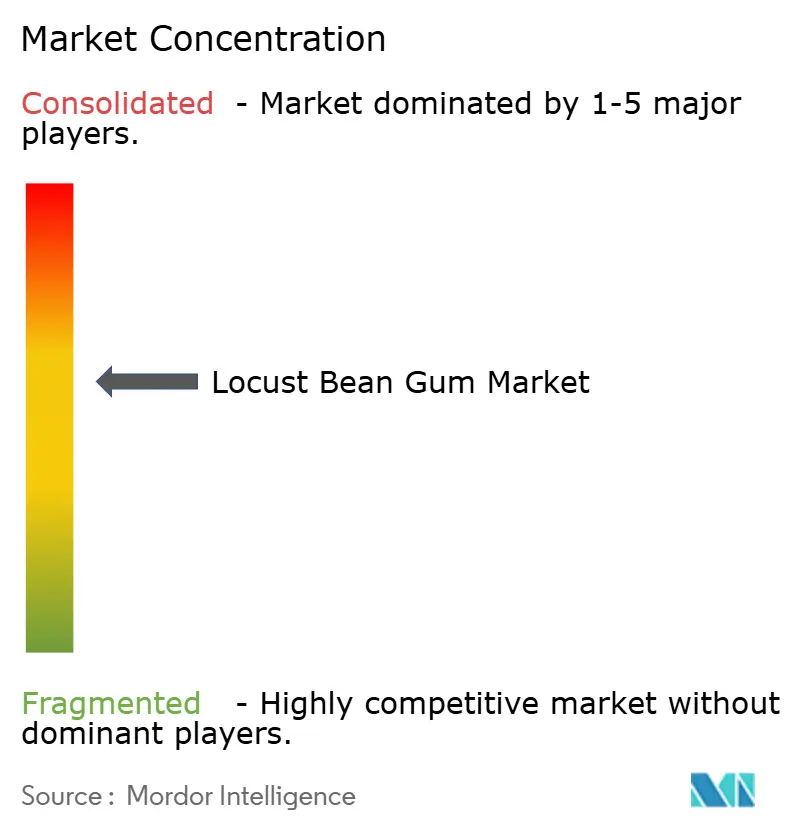
| Market Concentration | Medium |
Major Players
*Disclaimer: Major Players sorted in no particular order Image © Mordor Intelligence. Reuse requires attribution under CC BY 4.0. |
|
Locust Bean Gum Market Analysis by Mordor Intelligence
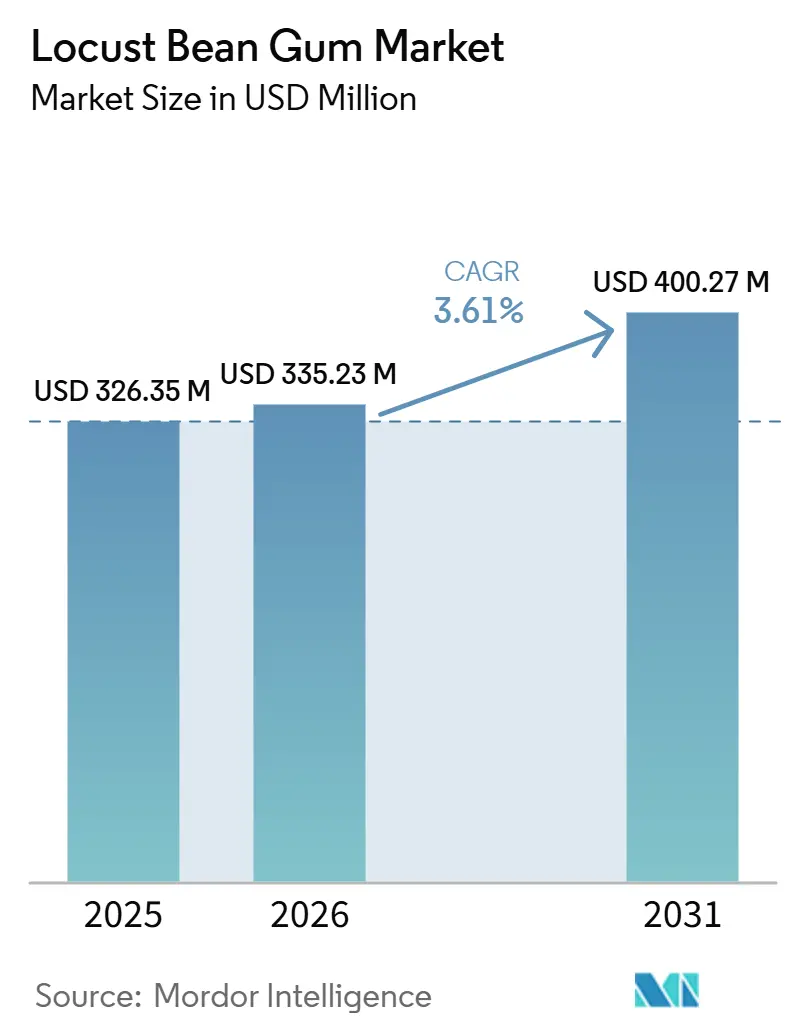
The locust bean gum market was valued at USD 326.35 million in 2025 and is estimated at USD 335.23 million in 2026, projected to reach USD 400.27 million by 2031, expanding at a CAGR of 3.61% during the forecast period. The market is witnessing steady growth, supported by rising demand for natural and clean-label ingredients, increasing adoption of plant-based food formulations, and expanding production of convenience and ready-to-eat foods. Manufacturers are increasingly utilizing locust bean gum for its ability to enhance texture, viscosity, stability, and overall formulation performance while improving processing efficiency. Additionally, growing adoption of multifunctional food ingredients and advancements in hydrocolloid processing and blending technologies are further supporting the market by enabling high-performance formulations with improved consistency and optimized ingredient utilization.
Key Report Takeaways
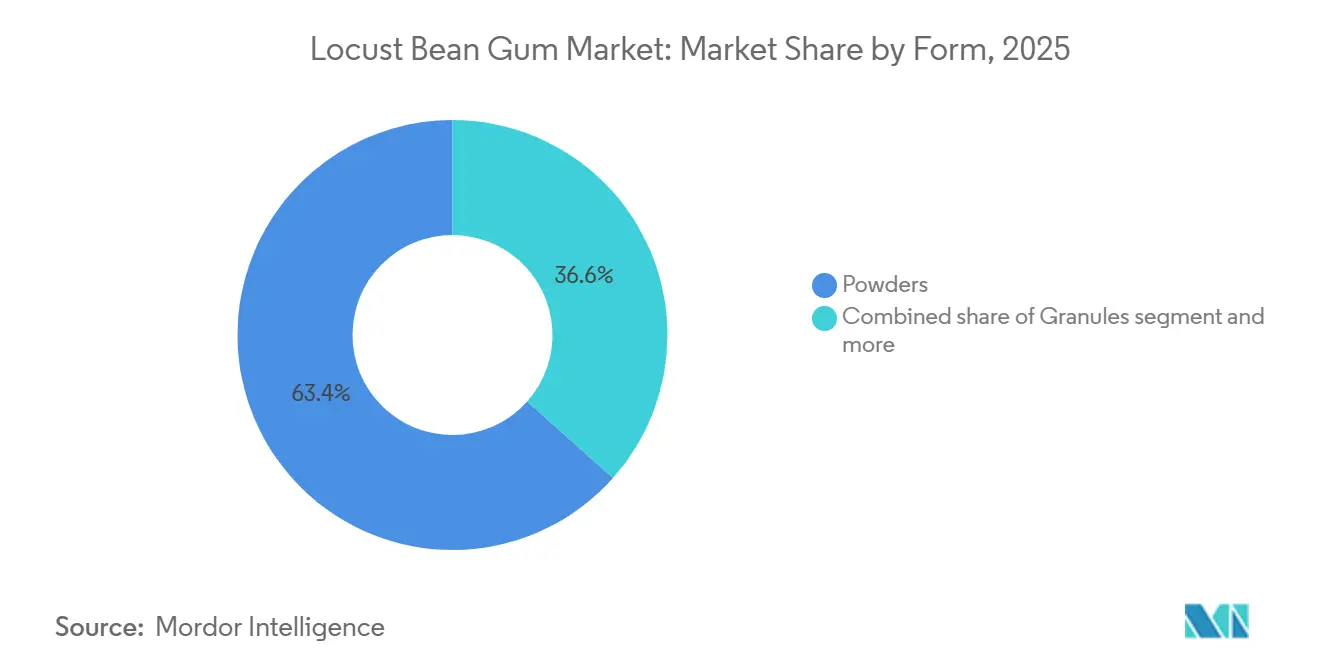
- By form, powders held 63.42% of the locust bean gum market share in 2025, while granules are forecast to grow at a 5.49% CAGR through 2031.
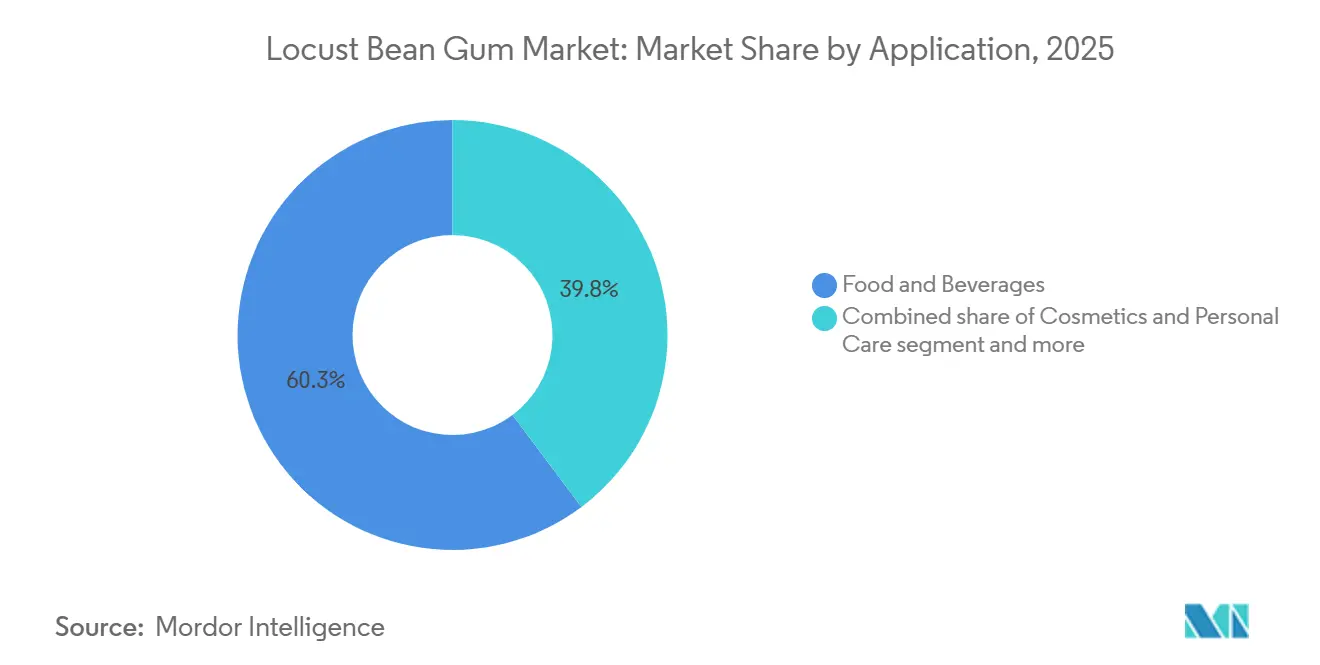
- By application, food and beverages accounted for 60.25% of the locust bean gum market share in 2025, while cosmetics and personal care is projected to expand at a 4.92% CAGR through 2031.
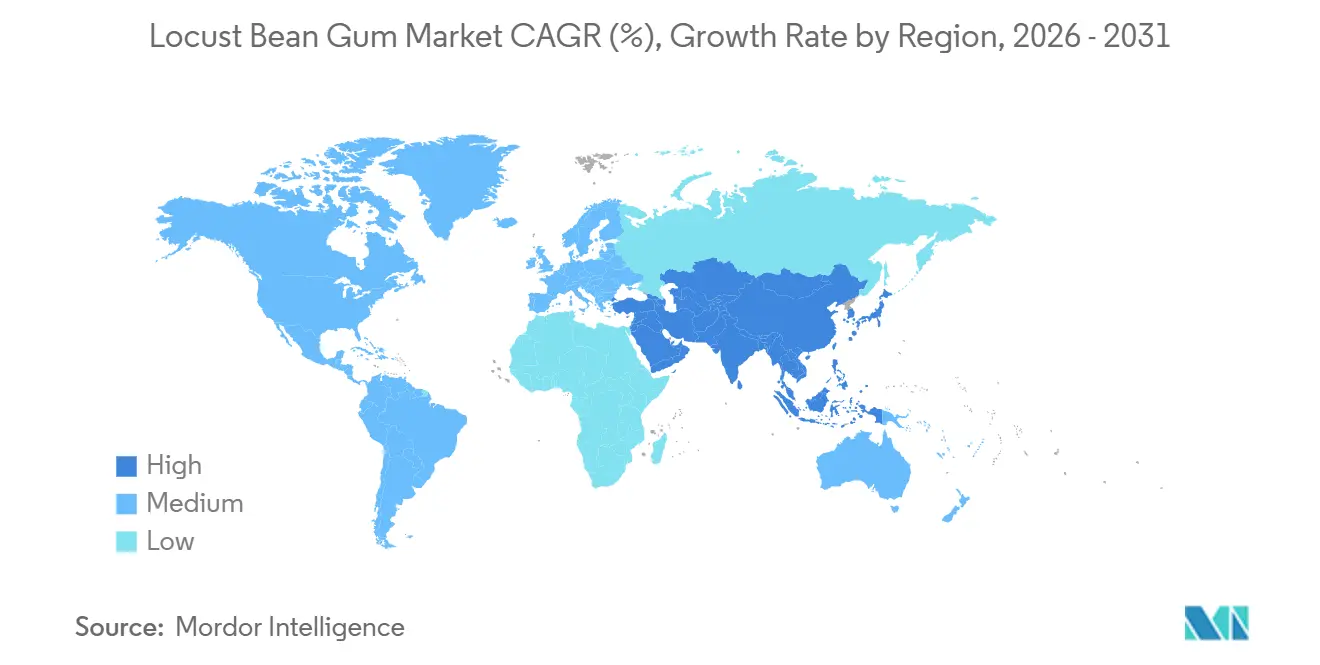
- By geography, Europe held 32.31% of the locust bean gum market share in 2025, while Asia-Pacific is forecast to record the highest CAGR at 5.53% through 2031.
Note: Market size and forecast figures in this report are generated using Mordor Intelligence’s proprietary estimation framework, updated with the latest available data and insights as of January 2026.
Market Trends and Insights
Drivers Impact Analysis of Locust Bean Gum Market*
| Driver | (~) % Impact on CAGR Forecast | Geographic Relevance | Impact Timeline |
|---|---|---|---|
| Rising adoption in plant-based food formulations | +0.7% | Global, led by North America and Europe | Medium term (2–4 years) |
| Expansion of convenience and ready-to-eat food products | +0.5% | Asia-Pacific, Middle East and Africa | Short term (≤ 2 years) |
| Growing demand for natural and clean-label ingredients | +0.8% | Europe and North America | Medium term (2–4 years) |
| Advancements in hydrocolloid blending technologies | +0.4% | Global | Long term (≥ 4 years) |
| Increasing demand for natural thickening and stabilizing agents | +0.6% | Global, with early momentum in Asia-Pacific | Medium term (2–4 years) |
| Increasing use in pharmaceutical formulations | +0.4% | Asia-Pacific and North America | Long term (≥ 4 years) |
| Source: Mordor Intelligence | |||
Rising adoption in plant-based food formulations
Adoption of locust bean gum in plant-based food formulations is rising as manufacturers increasingly require natural ingredients that improve texture, stability, and consistency while supporting clean-label formulations. Locust bean gum provides effective viscosity control, water-binding capacity, and processing stability, making it a preferred plant-derived hydrocolloid for food formulations. Its compatibility with other natural gums further improves formulation performance and product quality. The Plant Based Foods Association (PBFA) reported that 60% of United States households purchased plant-based products in 2025, reflecting growing consumer acceptance of plant-based foods and supporting increased demand for functional ingredients such as locust bean gum [1]Source: The Plant Based Foods Association (PBFA), "60% of US Households Buy Plant-Based Products", plantbasedfoods.org.
Expansion of convenience and ready-to-eat food products
The expansion of convenience and ready-to-eat food products is driving the locust bean gum market, as manufacturers increasingly seek functional ingredients that ensure consistent texture, viscosity, and product stability throughout processing, packaging, storage, and distribution. Locust bean gum helps maintain product integrity under varying processing conditions while improving moisture retention and extending formulation stability, making it well suited for large-scale food manufacturing. The ingredient also supports freeze-thaw stability and reduces syneresis, which are critical performance requirements in chilled and frozen food applications. As demand for convenient, minimally prepared food products continues to rise, manufacturers are incorporating multifunctional natural hydrocolloids such as locust bean gum to enhance processing efficiency, reduce reliance on synthetic additives, and maintain consistent product quality across extended shelf lives.
Growing demand for natural and clean-label ingredients
Growing demand for natural and clean-label ingredients is driving the locust bean gum market, as food manufacturers increasingly replace synthetic additives with naturally derived functional ingredients that support ingredient transparency and simple labeling. Locust bean gum is valued for its natural origin, multifunctional properties, and ability to enhance texture, viscosity, stability, moisture retention, and overall product quality while supporting clean-label formulations. This shift is particularly evident across dairy, bakery, and processed food segments, where manufacturers are reformulating products to meet evolving consumer expectations. According to the International Food Information Council (IFIC), 53% of consumers in 2025 checked the ingredients list on food products, highlighting the increasing emphasis on ingredient transparency and strengthening demand for natural ingredients such as locust bean gum [2]Source: International Food Information Council (IFIC), "2025 IFIC Food & Health Survey", ific.org.
Advancements in hydrocolloid blending technologies
Advancements in hydrocolloid blending technologies are driving the locust bean gum market by enabling the development of high-performance ingredient systems with enhanced functional properties and improved formulation efficiency. Modern blending technologies improve viscosity control, gel strength, texture, mouthfeel, water-binding capacity, suspension stability, emulsion stability, freeze-thaw resistance, and overall formulation consistency, allowing manufacturers to achieve targeted product characteristics with greater precision. These advancements also improve hydration performance, optimize ingredient utilization, reduce overall gum usage, simplify formulation design, and ensure consistent batch-to-batch quality across large-scale manufacturing operations. As food manufacturers increasingly prioritize high-performance, multifunctional, and clean-label ingredient systems, advancements in hydrocolloid blending technologies are accelerating the adoption of locust bean gum in modern food processing.
Restraints Impact Analysis of Locust Bean Gum Market*
| Restraint | (~) % Impact on CAGR Forecast | Geographic Relevance | Impact Timeline |
|---|---|---|---|
| Limited availability of carob seeds | -0.9% | Mediterranean basin: Spain, Portugal, Italy, Morocco | Short term (≤ 2 years) |
| Competition from alternative hydrocolloids | -0.8% | Global | Medium term (2–4 years) |
| Risk of supply chain disruptions and logistics bottlenecks | -0.4% | Global, spill-over from Mediterranean to Europe and Asia-Pacific | Short term (≤ 2 years) |
| Regulatory scrutiny and documentation requirements | -0.3% | Europe and North America | Medium term (2–4 years) |
| Source: Mordor Intelligence | |||
Limited availability of carob seeds
The limited availability of carob seeds is a key restraint on the locust bean gum market. Locust bean gum is extracted exclusively from the seeds of the carob tree, restricting the raw material base to a narrow agricultural source. Carob cultivation is concentrated in specific Mediterranean regions, limiting the ability to rapidly expand production when demand increases. The long maturation period of carob trees further constrains supply growth, making it difficult for producers to respond quickly to market requirements. Seasonal yield variations and climate sensitivity in these growing regions add another layer of unpredictability to the supply chain. This dependence on a limited raw material source creates supply uncertainty, affects production planning, and can restrict the consistent availability of locust bean gum for industrial manufacturers, particularly during periods of heightened demand or adverse weather conditions in key producing areas.
Competition from alternative hydrocolloids
Competition from alternative hydrocolloids is a significant restraint on the locust bean gum market. Manufacturers have access to a wide range of functional ingredients, such as guar gum, xanthan gum, carrageenan, agar, pectin, and modified starches, that provide similar thickening, stabilizing, gelling, and water-binding properties. Many of these alternatives can be used individually or in customized blends to achieve comparable formulation performance, giving manufacturers greater flexibility in ingredient selection. Their broad availability, established application expertise, and compatibility with diverse processing conditions intensify competitive pressure, limiting the adoption of locust bean gum across certain formulations and end-use industries.
*Our forecasts treat driver/restraint impacts as directional, not additive. The impact forecasts reflect baseline growth, mix effects, and variable interactions.
Locust Bean Gum Market Segment Analysis
By Form:
Powder Grade Anchors Volume as Granules Attract Specialty DemandPowder held a 63.42% share of the locust bean gum market in 2025, driven by its processing efficiency, storage stability, and compatibility with modern manufacturing operations. The powdered form offers uniform particle size and consistent physical properties, enabling precise dosing, improved dispersion during processing, and reliable batch-to-batch performance. It is easier to transport, store, and handle than other forms due to its lower susceptibility to physical damage and longer shelf stability under appropriate storage conditions. Manufacturers prefer powder as it integrates well with automated weighing, conveying, blending, and mixing equipment, reducing manual intervention while improving production efficiency and process control. The powdered format also allows greater flexibility in formulation adjustments, simplifies inventory management, and supports standardized production across multiple manufacturing facilities.
Granules are forecast to grow at a CAGR of 5.49% from 2026 to 2031, driven by their superior flowability, reduced dust generation, and improved handling efficiency in industrial processing environments. Their larger particle size minimizes airborne material loss during transportation, storage, and production, contributing to cleaner manufacturing conditions and improved workplace safety. Granular locust bean gum also offers improved compatibility with automated feeding, conveying, and metering systems, enabling more precise ingredient delivery and reducing processing interruptions. In addition, granules are less prone to caking during storage and exhibit greater physical stability under varying environmental conditions, simplifying inventory management and maintaining consistent product quality over extended periods.



By Application:
Food and Beverages Leads While Cosmetics Scales FastestFood & beverages accounted for 60.25% of the locust bean gum market in 2025, driven by the ingredient's functional properties that enhance product quality, processing efficiency, and formulation stability across large-scale food manufacturing. The ingredient performs effectively under a wide range of processing conditions, including heating, cooling, freezing, and mechanical mixing, making it suitable for modern food production systems. The increasing preference for naturally derived hydrocolloids and clean-label formulation strategies has further supported its adoption, as manufacturers seek multifunctional ingredients that improve product performance without relying on synthetic additives. According to the Office for National Statistics (UK), consumer spending on food and non-alcoholic beverages in the United Kingdom increased from GBP 142.18 billion in 2024 to nearly GBP 147.95 billion in 2025, reflecting sustained demand for processed and packaged food products that supports continued utilization of functional ingredients such as locust bean gum [3]Source: Office for National Statistics (UK), "Consumer spending on food and non-alcoholic drinks in the United Kingdom", ons.gov.uk.
The cosmetics & personal care segment is projected to expand at a CAGR of 4.92% from 2026 to 2031, supported by the growing preference for naturally derived multifunctional ingredients that improve formulation performance while aligning with clean beauty and sustainability trends. Locust bean gum is increasingly valued for its ability to enhance viscosity, stabilize emulsions, improve spreadability, and deliver a smooth sensory profile without the use of synthetic rheology modifiers. Its natural origin, biodegradability, and compatibility with a wide range of formulation systems make it an attractive ingredient for manufacturers seeking ingredient transparency and environmentally responsible formulations. The ingredient also contributes to improved product stability during storage by reducing phase separation and maintaining consistent texture over time. Advances in cosmetic formulation technologies have further expanded its compatibility with modern manufacturing processes, enabling efficient processing and consistent batch quality.
Geography Analysis
Europe Locust Bean Gum Market
Europe accounted for 32.31% of the global locust bean gum market revenue in 2025, maintaining its leadership due to its well-established hydrocolloid processing industry, stringent food ingredient regulatory framework, and strong emphasis on product quality and traceability. The region benefits from a mature value chain supported by advanced processing capabilities, high adoption of natural food additives, and continuous innovation in ingredient technologies. Furthermore, the authorization of E 410 (Locust Bean Gum) under Regulation (EC) No. 1333/2008 has provided a harmonized regulatory framework for its use across food products, strengthening manufacturer confidence and encouraging long-term incorporation into commercial formulations. Europe's strong technical expertise, established quality standards, and integrated supply network continue to reinforce its dominant position in the global market.
APAC Locust Bean Gum Market
Asia-Pacific is projected to register the fastest CAGR of 5.53% during 2026–2031, supported by the rapid expansion of regional hydrocolloid processing capabilities, increasing investments in ingredient manufacturing, and strengthening domestic value addition. The region is steadily transitioning from being primarily a net importer of locust bean gum to becoming a more active participant in the global hydrocolloid value chain through improvements in processing technologies, blending capabilities, and ingredient standardization. Growing investments in modern manufacturing infrastructure, enhanced technical expertise, and expanding industrial processing capacity are enabling regional manufacturers to reduce import dependence while improving competitiveness in both domestic and international markets. This structural transformation is expected to sustain the region's above-average growth over the forecast period.
The Americas and MEA Locust Bean Gum Market
North America, South America, and the Middle East and Africa (MEA) collectively account for a smaller yet strategically important share of the global locust bean gum market. North America is characterized by strong demand for high-performance natural hydrocolloids, advanced formulation technologies, and stringent quality requirements that support the adoption of premium-grade ingredients. South America is gradually strengthening its position through expanding food ingredient processing capabilities and increasing integration into international supply chains. Meanwhile, the Middle East & Africa benefits from its proximity to Mediterranean carob-producing regions, supporting raw material accessibility and regional trade. Although these regions contribute comparatively lower volumes than Europe and Asia-Pacific, ongoing investments in processing infrastructure, supply chain modernization, and value-added ingredient manufacturing continue to enhance their strategic importance in the global locust bean gum market…

Competitive Landscape
The locust bean gum market exhibits moderate concentration, with a mix of global ingredient manufacturers and specialized hydrocolloid processors competing on product quality, processing capabilities, supply reliability, and technical support. Key participants include LBG Sicilia Ingredients S.R.L., Tate & Lyle PLC, Compañía Española de Algas Marinas (CEAMSA), Cargill, Incorporated, and Ingredion Incorporated. Competition is driven by expertise in hydrocolloid processing, consistent raw material sourcing, customized ingredient solutions, and compliance with stringent international food quality and safety standards.
Vertical integration is a key competitive strategy in the market, particularly among companies with close access to Mediterranean carob-growing regions. By strengthening procurement networks, investing in primary processing facilities, and improving quality control throughout the supply chain, manufacturers enhance raw material security, maintain consistent product quality, reduce supply risks, and improve operational efficiency. Companies are also expanding their portfolios with customized hydrocolloid systems and application-specific formulations to differentiate themselves in increasingly specialized end-use markets.
Pharmaceutical-grade and cosmetic-grade refined locust bean gum represent the most attractive growth opportunities, as these segments command significantly higher margins than conventional food-grade products. Growth in these premium segments is creating opportunities for manufacturers to invest in advanced purification technologies, microbiological control systems, high-purity processing, and certified traceability programs. Companies that can deliver refined, high-performance locust bean gum with stringent quality assurance and regulatory compliance are well positioned to capture demand in value-added applications and strengthen their competitive differentiation.
Locust Bean Gum Industry Leaders
-
LBG Sicilia Ingredients S.R.L.
-
Tate & Lyle PLC
-
Compañia Española de Algas Marinas (CEAMSA)
-
Cargill, Incorporated
-
Ingredion Inc.
- *Disclaimer: Major Players sorted in no particular order
Locust Bean Gum Market Companies Covered in this Report
- LBG Sicilia Ingredients S.R.L.
- Tate & Lyle PLC
- Compania Espanola de Algas Marinas (CEAMSA)
- Cargill, Incorporated
- Ingredion Inc.
- CAROB S.A.
- CP Kelco
- Nexira
- Polygal AG
- KERAGUM SA
- INCOM A.S.
- Gumix International, Inc.
- AEP Colloids
- Gum Technology Corporation
- Brenntag SE
- DuPont de Nemours, Inc.
- FMC Corporation
- Fiberstar, Inc.
- Kerry Group plc
- E. A. Calvo S.L.

Recent Industry Developments in Locust Bean Gum Market
- July 2026: Nexira acquired Keragum, a Moroccan company specializing in carob-based ingredients. The acquisition is part of Nexira's Ambitions 2030 growth strategy and strengthens the Group's position across the natural ingredients value chain, particularly in the carob segment.
- July 2025: Tate & Lyle PLC introduced its expanded hydrocolloid and specialty gum portfolio at IFT FIRST 2025 in Chicago, marking its first major showcase following its strategic combination with CP Kelco.


Global Locust Bean Gum Market Report Scope
Locust bean gum is a natural, plant-based thickening and stabilizing agent extracted from the seeds of the Mediterranean carob tree. The locust bean gum market is segmented by form, application, and geography. Based on form, the market is segmented into powders, granules, and others. Based on application, the market is segmented into food and beverages, pharmaceutical and nutraceutical, cosmetics and personal care, industrial applications, and others. Based on geography, the market is segmented into North America, Europe, Asia-Pacific, South America, and Middle East and Africa. The report provides market size and forecasts in both value (USD) and volume (tons) for all the mentioned segments.
| Powders |
| Granules |
| Others |
| Food and Beverages |
| Pharmaceutical and Nutraceutical |
| Cosmetics and Personal Care |
| Industrial Applications |
| Others |
| North America | United States |
| Canada | |
| Mexico | |
| Rest of North America | |
| Europe | Germany |
| United Kingdom | |
| Italy | |
| France | |
| Spain | |
| Rest of Europe | |
| Asia-Pacific | China |
| India | |
| Japan | |
| Rest of Asia-Pacific | |
| South America | |
| Middle East and Africa |
| By Form | Powders | |
| Granules | ||
| Others | ||
| By Application | Food and Beverages | |
| Pharmaceutical and Nutraceutical | ||
| Cosmetics and Personal Care | ||
| Industrial Applications | ||
| Others | ||
| By Geography | North America | United States |
| Canada | ||
| Mexico | ||
| Rest of North America | ||
| Europe | Germany | |
| United Kingdom | ||
| Italy | ||
| France | ||
| Spain | ||
| Rest of Europe | ||
| Asia-Pacific | China | |
| India | ||
| Japan | ||
| Rest of Asia-Pacific | ||
| South America | ||
| Middle East and Africa | ||


Key Questions Answered in the Report
What is the projected size of the locust bean gum market by 2031?
The locust bean gum market is projected to reach USD 400.27 million by 2031, expanding from USD 335.23 million in 2026 at a 3.61% CAGR.
Which form of locust bean gum has the largest share?
Powder held the leading 63.42% share in 2025 because it disperses effectively in dairy, bakery, sauces, and plant-based food formulations.
Which locust bean gum application is growing the fastest?
Cosmetics and personal care is forecast to grow at a 4.92% CAGR through 2031, supported by demand for plant-derived thickeners and film-forming ingredients.
Why is locust bean gum used in food and beverage products?
Food and beverages represented 60.25% of demand in 2025, as locust bean gum improves texture, freeze-thaw stability, and consistency in dairy, bakery, sauces, and plant-based products.
Page last updated on:





