
Lobster Market Size and Share
Market Overview
| Study Period | 2022 - 2032 |
|---|---|
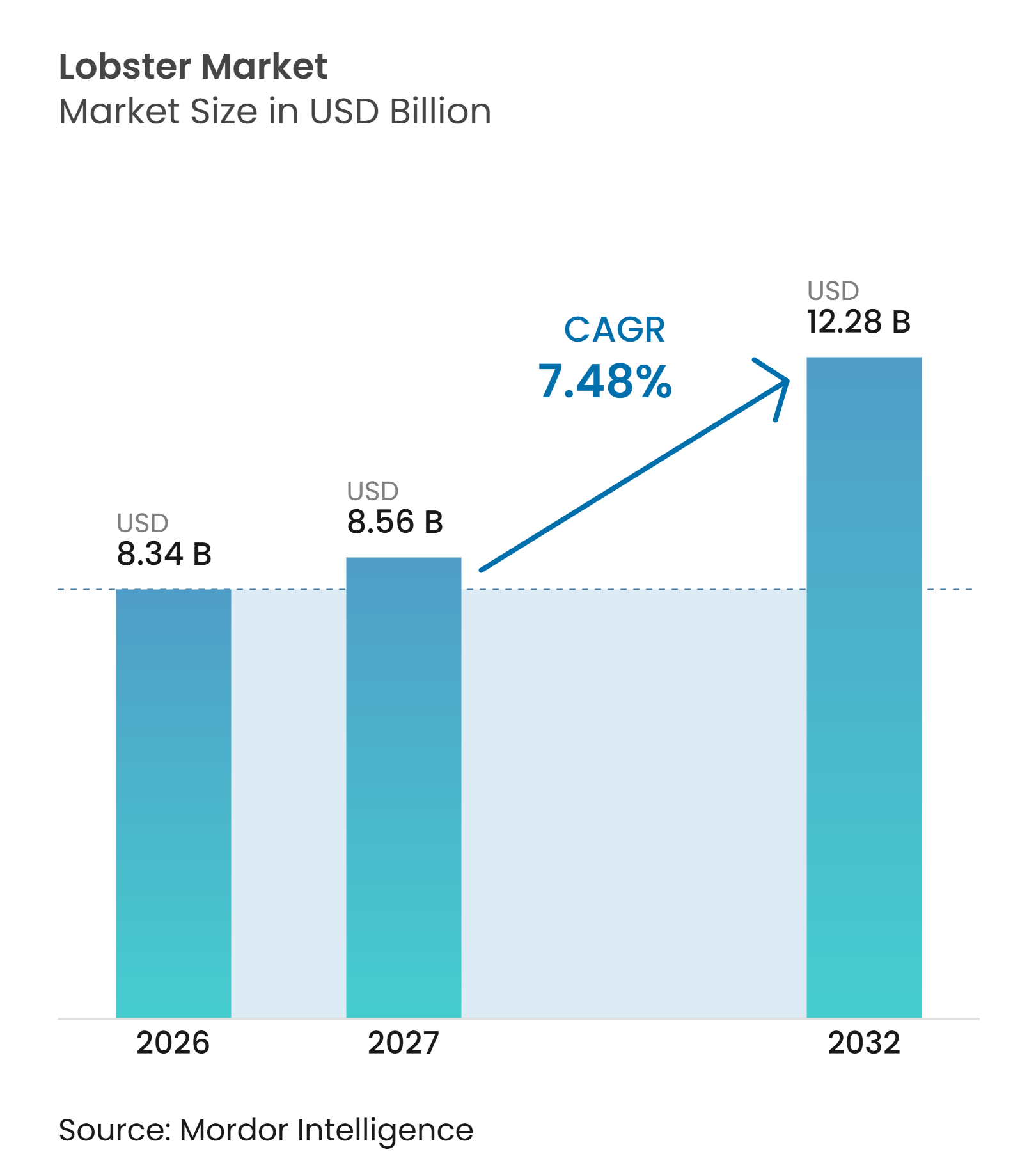
| Market Size (2027) | USD 8.56 Billion |
| Market Size (2032) | USD 12.28 Billion |
| Growth Rate (2027 - 2032) | 7.48 % |
| Fastest Growing Market | Asia-Pacific |
| Largest Market | North America |
| Market Concentration | Low |
Major Players *Disclaimer: Major Players sorted in no particular order Image © Mordor Intelligence. Reuse requires attribution under CC BY 4.0. | |
Lobster Market Analysis by Mordor Intelligence
The lobster market size is expected to grow from USD 8.34 billion in 2026 to USD 8.56 billion in 2027 and is forecast to reach USD 12.28 billion by 2032 at a 7.48% CAGR over 2027-2032. The lobster market is expanding beyond its traditional North Atlantic base, driven by growth in premium foodservice, specialty retail, and cross-border seafood trade. Trade conditions increasingly favor processors that can maintain quality, provide traceability, and supply live, frozen, and prepared formats through reliable cold chains. Demand in Asian markets supports premium pricing, as gifting, hospitality, and restaurant occasions place high value on freshness, provenance, and presentation. China's tariff measures on Canadian supply redirected purchasing toward Viet Nam and Australia, altering supplier relationships and prompting Canada to develop alternative export routes. Supply uncertainty in the Gulf of Maine remains a key constraint, as stock conditions, harvest controls, rising logistics costs, variable catch availability, and the need to maintain live-product quality can limit the availability of premium product. These factors increase procurement pressure for processors and make diversified sourcing, frozen supply, and carefully managed handling systems more important for both domestic and export customers.
Key Report Takeaways
-
By product type, whole lobster held 61.23% of segment value in 2026, while lobster meat is forecast to grow at an 8.24% CAGR through 2032.
-
By species, American lobster held 57.65% of segment value in 2026, while spiny lobster is forecast to grow at an 8.33% CAGR through 2032.
-
By form, frozen lobster accounted for 58.46% of the Lobster market size in 2026, while fresh or chilled lobster is forecast to grow at an 8.45% CAGR through 2032.
-
By distribution channel, foodservice accounted for 71.24% of market value in 2026, while retail is forecast to grow at an 8.51% CAGR through 2032.
-
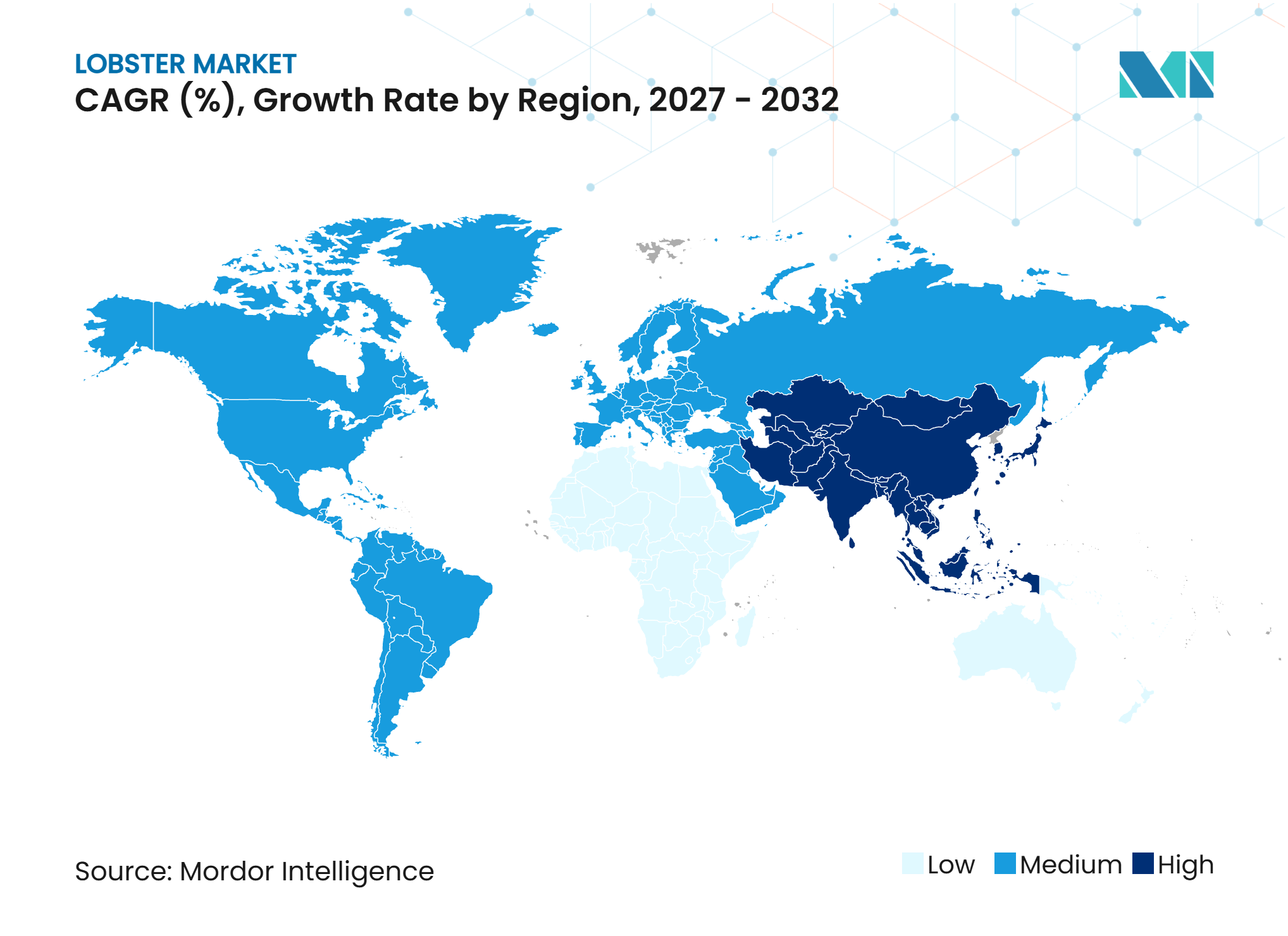
By geography, North America held 48.76% of the global Lobster market in 2026, while Asia-Pacific is forecast to grow at an 8.46% CAGR through 2032.
Note: Market numbers in this report are based on Mordor Intelligence's proprietary estimation framework, which combines nine months of actuals with Q4 projections for base year 2026.
Market Trends and Insights
Drivers Impact Analysis of Lobster Market of Lobster Market*
| Driver | (~) % Impact on CAGR Forecast | Geographic Relevance | Impact Timeline |
| Rising global demand for premium seafood | +2.1% | Global, strongest in Asia-Pacific and the Middle East and Africa | Long term (≥ 4 years) |
| Expansion of the global foodservice and hospitality industry | +1.6% | North America, Europe, and Asia-Pacific | Medium term (2-4 years) |
| Increasing consumer preference for high-protein and nutrient-rich seafood | +0.9% | Global, strongest in North America and Europe | Long term (≥ 4 years) |
| Expansion of e-commerce and organized retail distribution channels | +0.7% | North America, Asia-Pacific, and Europe | Medium term (2-4 years) |
| Product innovation and growing demand for processed and value-added lobster products | +0.6% | North America and Europe | Long term (≥ 4 years) |
| Growing international seafood trade and cross-border lobster exports | +1.0% | Global, particularly Asia-Pacific and North America | Short term (≤ 2 years) |
| Source: Mordor Intelligence | |||
Rising Global Demand for Premium Seafood
Premium seafood demand is expanding the customer base for the lobster market, particularly in Asian foodservice and retail channels, where live presentation, product condition, and traceable origin are central to purchase decisions. FAO-Globefish reported that the value of global lobster trade rose 14.4% in 2025 even as volume declined 2.9%, indicating that demand is shifting toward higher-value products rather than larger volumes[1]. China's purchases reached a five-year high in 2025, and tariff changes helped redirect supply from Canada toward Viet Nam and Australia[2]. These new supply patterns favor exporters that can provide live product, stable quality, formal export records, reliable collection systems, and rapid delivery to restaurant distributors. Viet Nam's industry association reported strong lobster export momentum in 2025, driven by Chinese demand, reinforcing the role of Asian supply in the global trade pattern. These conditions give processors reason to invest in quality assurance, origin documentation, and handling capability rather than relying solely on high seasonal volumes.
Expansion of the Global Foodservice and Hospitality Industry
The expansion of the global foodservice and hospitality industry is supporting lobster demand, as restaurants, hotels, resorts, cruise operators, and premium catering establishments increasingly incorporate high-value seafood into their menus. Lobster is particularly relevant to full-service restaurants and luxury dining establishments, as it can be prepared in multiple ways, including grilled lobster, lobster thermidor, lobster rolls, seafood platters, and pasta dishes. According to the National Restaurant Association, the US restaurant and foodservice industry was projected to generate approximately USD 1.5 trillion in sales in 2025, with total employment expected to reach 15.9 million. Additionally, UN Tourism reported approximately 1.4 billion international tourist arrivals in 2024, representing an 11% increase over 2023, while international tourism receipts reached approximately USD 1.6 trillion[3]. The recovery and expansion of international tourism are supporting premium dining occasions and seafood consumption across major tourist destinations. As a result, the growing number of hospitality establishments and experience-oriented dining occasions is creating additional procurement opportunities for lobster suppliers and processors.
Increasing Consumer Preference for High-Protein and Nutrient-Rich Seafood
Consumers seeking nutrient-rich protein increasingly examine the source, condition, and handling of seafood, which supports demand for traceable lobster products across retail, restaurant, and direct-delivery channels. Research from the Virginia Institute of Marine Science found that warmer conditions can affect American lobster larvae, drawing greater attention to stock resilience, long-term availability, and responsible sourcing. Sustainable sourcing therefore carries commercial importance alongside environmental value, as it provides buyers with information they can use when comparing premium shellfish suppliers. Retailers, foodservice operators, and consumers can use verified origin, harvesting practices, and product handling records to distinguish products that meet their sourcing expectations. The lobster market can benefit when processors translate these requirements into clear labeling, documented supply chains, practical cooking guidance, and formats suited to both home preparation and restaurant use. This preference is particularly relevant in established North American and European channels, where retailer standards, restaurant procurement requirements, and environmental concerns can influence purchasing decisions.
Growing International Seafood Trade and Cross-Border Lobster Exports
Cross-border trade remains essential to the lobster market because major producing regions and major consuming regions are often separated by long distances, different regulatory systems, and distinct preferences for live, frozen, or prepared product. FAO-Globefish reported that China's tariff policy encouraged a redirection of Canadian, Vietnamese, and Australian supply routes in 2025, which altered the commercial balance among suppliers. This change demonstrated how quickly trade policy can affect product origin, freight routes, customer relationships, processor planning, and the viability of established live-export corridors. Canada's need to diversify export destinations increased the importance of routes into Southeast Asia and Europe, while alternative suppliers gained a larger share of China-facing trade. Formal traceability, including documented farm and collection-site information, can support access to regulated export markets and provide distributors, retailers, and foodservice buyers with greater confidence in product origin. Trade growth will remain dependent on live-handling capacity, cold-chain performance, airline and freight availability, and the ability to consistently meet importing-country requirements.
Restraints Impact Analysis of Lobster Market of Lobster Market*
| Restraint | (~) % Impact on CAGR Forecast | Geographic Relevance | Impact Timeline |
| High and volatile lobster prices affecting consumer affordability | -1.5% | North America and Europe | Short term (≤ 2 years) |
| Climate change and ocean temperature fluctuations affecting lobster availability | -1.3% | North America, particularly Gulf of Maine and Southern New England | Long term (≥ 4 years) |
| Stringent fishing regulations, quotas, and sustainability requirements | -0.8% | North America and Australia | Medium term (2-4 years) |
| Perishability of lobster and high costs associated with cold-chain logistics and transportation | -0.6% | Global, strongest in Asia-Pacific | Medium term (2-4 years) |
| Source: Mordor Intelligence | |||
High and Volatile Lobster Prices Affecting Consumer Affordability
High prices can limit purchases in price-sensitive restaurant and retail channels, even when premium consumer interest in lobster remains strong and high-end foodservice demand stays resilient. Lower catch availability can increase procurement costs for processors, distributors, and foodservice operators, while volatile daily pricing complicates menu planning and retail promotions. Tariff-related changes can also raise supply costs in specific destination markets and shift pricing pressure across exporters, importers, and distributors. This pressure is most acute where operators cannot fully pass higher input costs to diners or shoppers without affecting demand. Processed, frozen, and portion-controlled formats can help buyers manage purchase sizes, reduce waste, create more predictable portion costs, and limit exposure to losses from live-product handling. The lobster market therefore requires efficient handling, flexible sourcing, and product innovation to protect demand when live-product prices rise or availability declines.
Climate Change and Ocean Temperature Fluctuations Affecting Lobster Availability
Ocean temperature change presents a long-term supply risk for the lobster market, particularly in the Gulf of Maine and Southern New England, where stock conditions are closely monitored by harvesters, processors, regulators, and seafood buyers. The ASMFC's 2025 benchmark assessment found that the Gulf of Maine and Georges Bank stock was experiencing overfishing, making management actions and catch conditions commercially significant. The same assessment described the Southern New England stock as significantly depleted, posing a more serious constraint for suppliers dependent on that part of the U.S. East Coast. Research on future warming conditions found smaller larvae under warmer water temperatures, a result that may reduce wild survival rates and affect future recruitment. These findings could lead to tighter management measures, greater sourcing uncertainty, and increased interest in alternatives among processors reliant on U.S. East Coast landings. As supply patterns shift, alternative species, diversified sourcing, well-managed fisheries, processed formats, and aquaculture development may grow in importance.
*Our forecasts treat driver/restraint impacts as directional, not additive. The impact forecasts reflect baseline growth, mix effects, and variable interactions.
Lobster Market Segment Analysis
By Product Type:
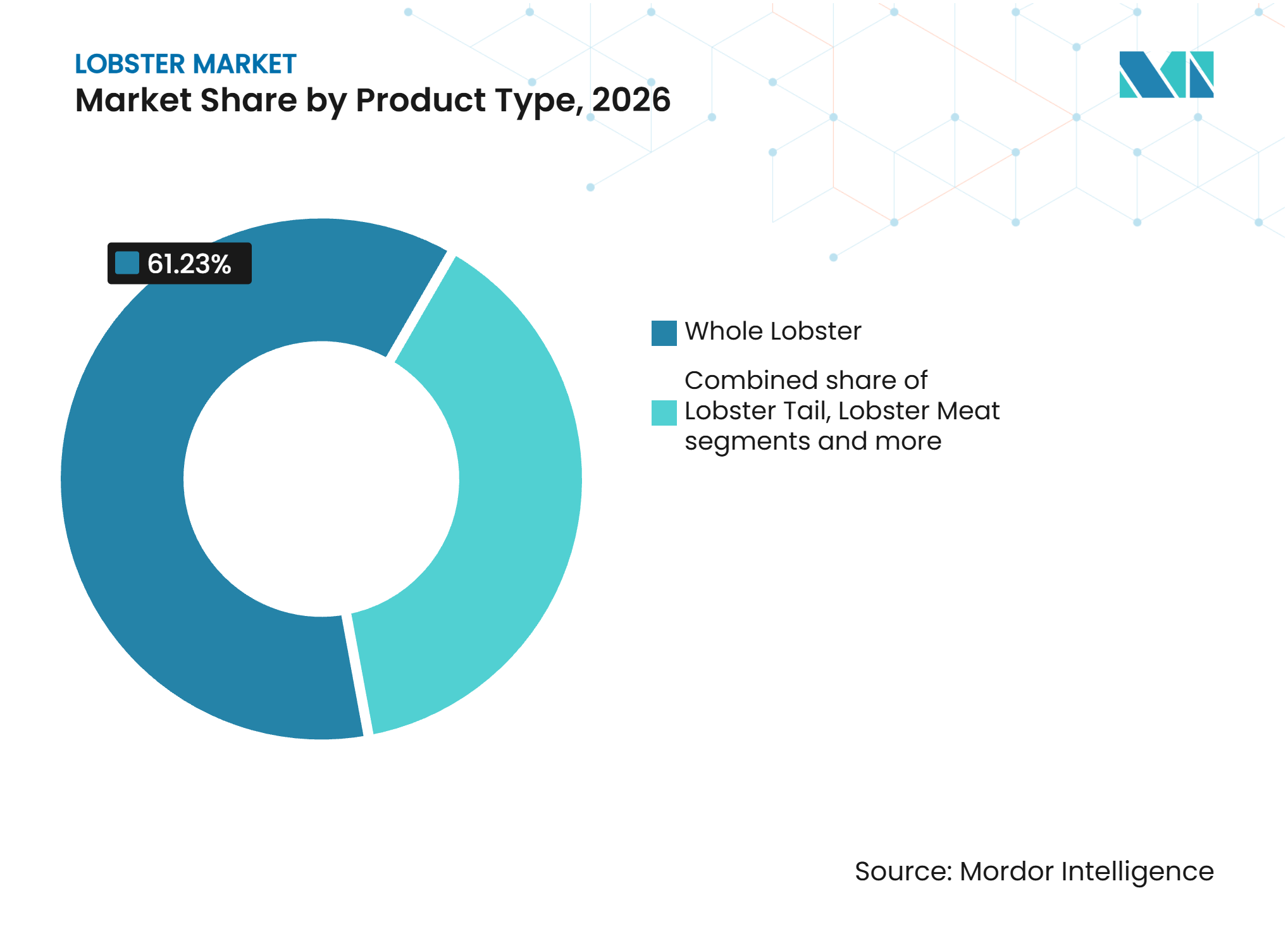
Whole Lobster Holds Value While Meat Gains DemandWhole lobster accounted for 61.23% of the lobster market size in 2026. Its position is supported by the visual appeal and premium presentation of live and cooked whole-animal offerings. Fine dining establishments, hotels, and specialty retailers continue to use this format, where the customer experience supports higher menu or retail pricing. The segment also benefits from established handling systems in traditional producing and consuming regions. Lobster tails provide convenient portioning for restaurants, meal kits, and retail cooking occasions. Lobster claw meat is gaining attention as a flexible ingredient for lobster rolls, salads, and smaller restaurant dishes.
Lobster meat is projected to grow at an 8.24% CAGR through 2032, supported by ready-to-use applications that offer convenience to restaurant kitchens, caterers, specialty retailers, and consumers who prefer premium seafood without handling a whole live product. This format reduces preparation work for foodservice kitchens and gives processors more ways to use available raw material, including meat recovered from claws and other portions suited to processed applications. It is well suited to soups, ready meals, premium sandwiches, lobster rolls, prepared salads, and other products where consistent portioning helps operators manage cost, labor, and menu execution. Packaged meat can also extend the reach of the lobster market into inland areas where live distribution is more difficult, more costly, or less reliable, as the product does not require the same local holding capability. Processors can use this format to create more consistent portions, reduce waste, simplify storage, and serve customers who prefer products with clear preparation guidance.



By Species:
American Lobster Remains Established While Spiny Lobster ExpandsAmerican lobster held 57.65% of the lobster market share in 2026, supported by established supply chains in Atlantic Canada and New England and a long history of use across restaurant, hospitality, retail, and export channels. The species is well recognized among restaurant buyers and retail customers in North America, Europe, and select Asian markets, where its appearance, taste, and live presentation are closely associated with premium seafood occasions. This broad recognition supports a premium position across live, frozen, and prepared products, allowing processors to offer whole animals, tails, meat, and cooked formats for different customer requirements. However, the segment faces growing supply uncertainty due to stock conditions, shifting catch availability, management requirements, and the cost of maintaining product quality from landing through distribution. The ASMFC's 2025 assessment confirmed that the Gulf of Maine and Georges Bank stock was experiencing overfishing. This makes sourcing diversity increasingly important for processors that depend on Atlantic supply and need to maintain continuity for customers during seasonal or regulatory changes.
Spiny lobster is forecast to grow at an 8.33% CAGR through 2032, driven by demand from China and export activity from Viet Nam, which support the segment's position in Asia-focused trade. Its growth provides buyers with an alternative premium species at a time when American lobster supply faces greater stock-related uncertainty, although product specifications, sourcing systems, and consumer familiarity vary by destination market. VASEP reported rising lobster export activity in 2025, led by shipments to the Chinese market, confirming the growing commercial importance of Vietnamese supply. Aquaculture research on ornate spiny lobster identified a rearing system that improved juvenile survival under trial conditions, pointing to potential supply development if commercial systems can build on those findings. Progress in juvenile rearing at a commercial scale could reduce reliance on wild catch, expand supply planning options, and support a more consistent flow of product for export and domestic premium channels over time. European lobster and rock lobster continue to serve distinct regional demand patterns, including Northern Europe and the Australia-China trade route, rather than directly substituting for American lobster applications.
By Form:
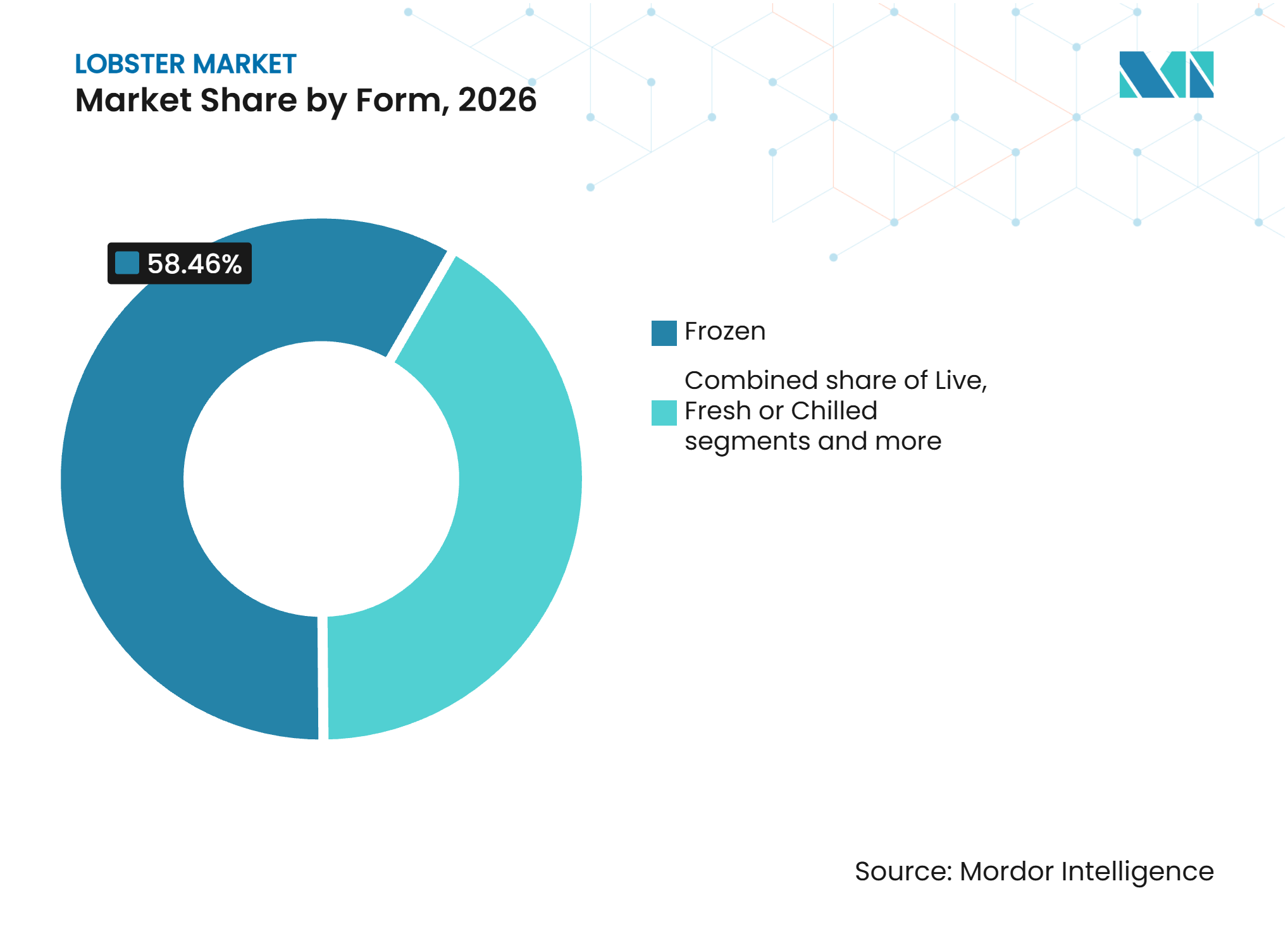
Frozen Supply Supports Trade While Fresh Demand GrowsFrozen lobster accounted for 58.46% of the lobster market size in 2026, reflecting the form's role in long-distance distribution, inventory management, and the supply of tails, meat, and prepared products to customers outside harvesting regions. The form supports cross-border trade because buyers can manage delivery timing, maintain safety stock, and plan menus more easily than with live product, which requires closely timed transport and holding conditions. Frozen supply also allows foodservice operators to maintain stock through seasonal variations in landings, respond to demand changes, and serve products in locations without specialist live-shellfish infrastructure. Export Development Canada identified Japan and South Korea as important importers of Canadian seafood products, including lobster formats, highlighting the role of export-ready frozen supply in Asian markets. The segment will remain central to product availability in markets far from harvesting regions, as it supports retailers, distributors, and foodservice operators with more predictable storage and transport conditions.
Fresh or chilled lobster is projected to grow at an 8.45% CAGR through 2032, driven by demand for live and fresh product in China, Japan, and other high-value Asian markets where product appearance, vitality, and delivery speed affect perceived quality. Its expansion is linked to foodservice and retail occasions in which consumers and chefs prefer fresh preparation and are willing to pay for products that arrive in good condition. Fresh product can command premium pricing when suppliers maintain vitality, appearance, short delivery times, suitable water conditions, and careful transfers between harvesters, exporters, airlines, importers, and local distributors. It requires specialized packaging, holding capacity, and close coordination among these parties, so operational failure at any point can reduce quality and raise costs. The lobster industry is therefore investing in handling methods that preserve quality across longer routes and help exporters reach destinations that were previously more difficult to serve. Cooked and processed products remain important where buyers prefer labor-saving formats, more predictable storage conditions, and products that can be used consistently by kitchens with limited preparation time.

By Distribution Channel:
Foodservice Leads While Retail Broadens AccessFoodservice accounted for 71.24% of the lobster market share in 2026, making restaurant menus, hotels, airlines, cruise lines, and catered functions central to premium product consumption and demand for different grades, portions, and preparation formats. Buyers use lobster to differentiate menus and meet demand for celebratory dining occasions, while also requiring products suited to varying levels of kitchen skill, service speed, and customer price expectations. The Maine Lobster Marketing Collaborative's 2025 activities focused on chefs and wholesale restaurant buyers, reflecting foodservice's continued importance and the value of helping operators use lobster across a wider range of dishes. Foodservice demand favors dependable quality, product availability, portion consistency, and formats compatible with different kitchen workflows, from fine-dining preparation to high-volume casual service. Whole lobster, tails, meat, and cooked products each support different restaurant concepts, allowing suppliers to serve both traditional premium menus and more accessible dishes such as rolls, salads, soups, and prepared plates.
Retail is forecast to grow at an 8.51% CAGR through 2032, as specialty grocers, supermarkets, online seafood sellers, and direct-delivery businesses give consumers more ways to purchase premium shellfish for home preparation. Frozen products and prepared formats are more practical than live lobster for many households, as they reduce the need for immediate cooking, specialist handling, and close coordination with delivery windows. Retail packaging also allows sellers to communicate provenance, handling guidance, cooking instructions, product form, and sourcing information directly to consumers, supporting premium positioning at the point of purchase. E-commerce growth depends on delivery systems that protect product condition and manage the cost of temperature-controlled shipping, particularly when sellers offer time-sensitive or live delivery. The lobster market can benefit from retail growth when processors offer reliable formats for home preparation, everyday premium meals, special occasions, and consumers who live far from traditional coastal seafood markets.
Geography Analysis
North America: Supply Strength Meets Stock and Cost Pressures
North America held 48.76% of the global lobster market in 2026, with the United States and Canada anchoring the region's harvesting, processing, trade, and premium foodservice demand across live, frozen, and prepared formats. Canada remained an important supplier to world markets, although tariff-related changes altered some trade routes in 2025, prompting exporters to pursue customers in Europe and Southeast Asia. The region's established position reflects longstanding product recognition, specialist live-handling systems, access to Atlantic catch, extensive processing capacity, and restaurant demand spanning fine dining, hospitality, casual premium concepts, and specialty retail. The ASMFC accepted its 2025 benchmark assessment for management use, making regulatory decisions a direct influence on available supply, harvesting expectations, and sourcing plans for businesses dependent on U.S. East Coast product. With the Gulf of Maine and Georges Bank stock experiencing overfishing and the Southern New England stock significantly depleted, processors may need to broaden supplier relationships, increase use of frozen product, and strengthen traceability to maintain availability for customers.
Asia-Pacific: Premium Consumption and New Supply Corridors
Asia-Pacific is projected to grow at an 8.46% CAGR through 2032, supported by China's demand for live and fresh lobster and by established imports of frozen and prepared seafood products into Japan and South Korea. Tariffs on Canadian lobster during 2025 favored increased supply from Viet Nam and Australia, highlighting the importance of geographic proximity, reliable freight, commercial links with importers, and the ability to serve fast-moving live-product demand. Viet Nam's exporter association reported strong lobster trade momentum in 2025, particularly for China-facing supply, while Australian rock lobster also regained a clearer route into the Chinese market. Importers in the region place high value on freshness, product condition, formal origin records, and dependable delivery, which favors suppliers that can connect farms, collection sites, export facilities, chilled transport, and local distribution. This combination supports premium pricing, but it also raises the operational importance of quality checks, freight coordination, traceability documentation, and product formats that match the varying needs of restaurants, retailers, and household buyers.
Regional Diversification: Europe, South America, and the Middle East and Africa
Europe remains an important premium destination for live lobster, particularly in France, Italy, Spain, and the United Kingdom, where restaurants and specialty retailers value reliable product condition, certification, handling quality, and established supplier relationships. Canada's search for alternative destinations following Chinese tariff measures directed greater attention to European and Southeast Asian routes, and the broader trade shift demonstrated that established exporters must be able to adjust their destination mix quickly. South America includes both producing and emerging consuming markets, with Brazil and Peru relevant to supply and Chile, Argentina, and Colombia developing interest in premium seafood through urban foodservice and retail channels. The Middle East and Africa represent a smaller premium consumption base concentrated in hotel, restaurant, and specialty retail channels. South Africa's regulated West Coast rock lobster fishery remains part of the global supply picture, and regulatory requirements continue to shape the pace at which these markets can develop.
Competitive Landscape
Market Concentration
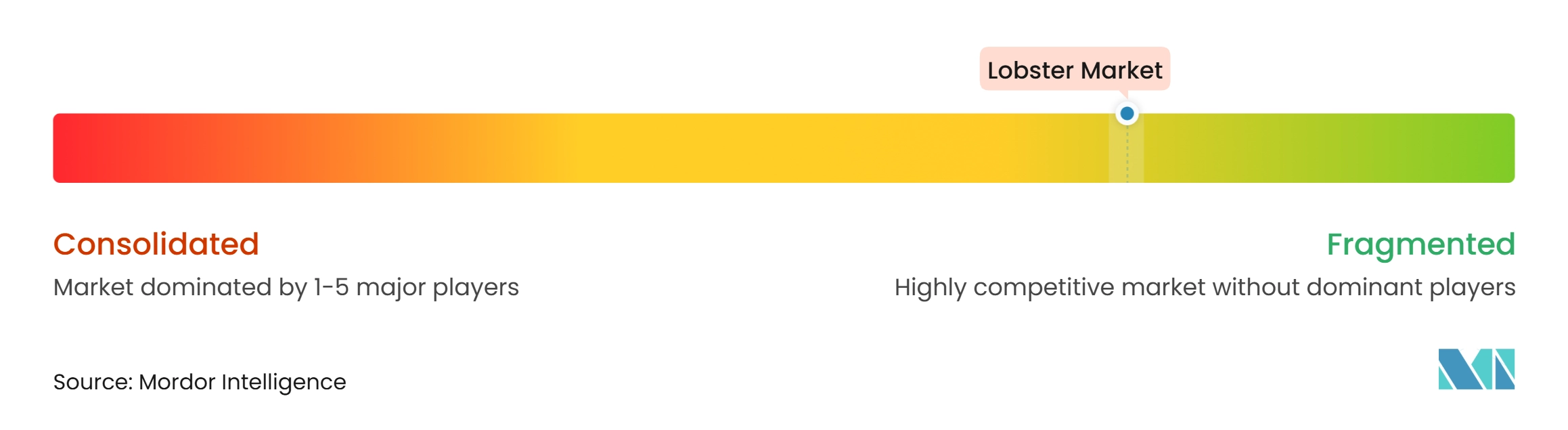
The global lobster market has a relatively fragmented competitive structure. Regional fishing cooperatives, mid-sized processors, and larger seafood groups operate across separate sourcing areas, and no single company holds a dominant global position across all product forms and geographies. Competition is shaped by access to harvesting rights, seasonal landings, processing capacity, cold-chain capability, live-handling expertise, customer relationships, and the ability to meet destination-market requirements. Clearwater Seafoods illustrates the need to adjust assets to changing conditions, as the company exited its Arichat live-lobster holding and processing operation in 2025 while commissioning a purpose-built offshore lobster vessel for delivery in 2027. The vessel will use a moonpool trap-deployment system and live tanks with circulating seawater, reflecting an investment in harvesting quality and crew operations rather than a continuation of the former inshore live-processing model. Other suppliers compete through local sourcing access, long-standing harvester relationships, direct links with exporters, specialist processing, and service reliability for restaurant, retail, and overseas customers.
Asian seafood groups use distribution reach, processing capacity, trade relationships, and access to major consuming markets to defend positions in frozen and value-added products, while North American companies continue to rely on strong product recognition and established Atlantic supply relationships. Vietnam's producers became more prominent in China-facing live supply after tariff changes redirected buying away from Canada, and this shift raised the strategic value of integrated collection, export, and delivery systems. VASEP's 2025 reporting shows the rising commercial role of Vietnamese lobster supply, while Australian suppliers also benefit from recognized rock lobster offerings and renewed access to Chinese buyers.
Sustainability credentials and traceability are becoming more relevant sources of differentiation as buyers seek clearer evidence about product origin, handling, and fishery management, particularly when supply conditions change. The ASMFC's assessment gives processors, distributors, retailers, and foodservice buyers reason to monitor the condition of American lobster supply and consider the resilience of their sourcing plans. Smaller companies can compete by offering local origin, direct harvester links, transparent handling information, and tailored customer service, while larger companies can use scale in processing and refrigerated distribution to serve multiple destinations and product formats. Product development in bisques, meal kits, ready-to-heat preparations, portioned meat, and retail-friendly frozen formats provides another way to reach consumers outside coastal markets, reduce kitchen labor requirements, and create more consistent product use.
Lobster Industry Leaders
-
Clearwater Seafoods
-
East Coast Seafood Group
-
Thai Union Group PCL
-
Geraldton Fishermen’s Co-operative
-
High Liner Foods Incorporated
- *Disclaimer: Major Players sorted in no particular order
Lobster Market Companies Covered in this Report
- Clearwater Seafoods
- Cooke Aquaculture
- East Coast Seafood Group
- Thai Union Group PCL
- Geraldton Fishermen's Co-operative
- High Liner Foods Incorporated
- Boston Lobster Company
- Supreme Lobster and Seafood Company
- Tangier Lobster Company Limited
- Douty Bros
- Pescanova Espa'a, S.L.U.
- Austevoll Seafood ASA
- Maruha Nichiro Corporation
- Nippon Suisan Kaisha, Ltd.
- Pacific Seafood
- Trident Seafoods Corporation
- The Lobster Co.
- Cousins Maine Lobster
- Island Seafood
- Royal Greenland A/S
Recent Industry Developments in Lobster Market
- April 2025: Ferguson Australia and China Eastern Group signed a 5-year memorandum of understanding for the supply and distribution of South Australian rock lobster through China Eastern Airlines' network of 100,000 top-tier club members. The agreement secures dedicated cold-chain freight infrastructure for South Australia's premium lobster re-entry into the Chinese market and supports the movement of live products through a dedicated commercial and logistics relationship.
- April 2025: Maine Lobster Marketing Collaborative launched a targeted campaign comprising a digital chef toolkit to assist restaurant buyers with menu integration, an immersive Maine lobster industry experience in Maine for wholesale buyers and chefs, and a consumer influencer program aimed at positioning Maine lobster as a celebratory everyday ingredient.
- April 2025: Clearwater Seafoods signed a newbuild contract with Denmark's Hvide Sande Shipyard for a 40.9-meter purpose-built lobster fishing vessel designed by Skipsteknisk AS, with delivery scheduled for 2027. The vessel features a moonpool trap-deployment system and live tanks with circulating seawater.
- March 2025: China imposed an additional 25% tariff on Canadian lobster, raising the total effective import rate to 32%. This measure restructured trade flows, with Vietnam, Australia, and Indonesia expanding their roles as alternative suppliers.
Global Lobster Market Report Scope
The lobster market encompasses the commercial production, harvesting, processing, distribution, and sale of lobsters for human consumption. It includes various lobster species, such as American lobster, European lobster, spiny lobster, and slipper lobster, sourced through wild-capture fisheries and aquaculture. The lobster market report is segmented by product type, species, form, distribution channel, and geography. Based on product type, the market is segmented into whole lobster, lobster tail, lobster meat, and lobster claw. Based on species, the market is segmented into American lobster, European lobster, Spiny lobster, Rock lobster, and Other Species. Based on form, the market is segmented into live, fresh or chilled, frozen, cooked, and processed. Based on distribution channel, the market is segmented into foodservice and retail. Retail is further segmented into supermarkets and hypermarkets, specialty stores, online retail stores, and other retail channels. Based on geography, the market is segmented into North America, Europe, Asia-Pacific, South America, and the Middle East and Africa. For each segment, the market sizing and forecast have been done based on value (in USD).
Segmentation Overview
| Whole Lobster |
| Lobster Tail |
| Lobster Meat |
| Lobster Claw |
| American Lobster |
| European Lobster |
| Spiny Lobster |
| Rock Lobster |
| Other Species |
| Live |
| Fresh or Chilled |
| Frozen |
| Cooked and Processed |
| Foodservice | |
| Retail | Supermarkets and Hypermarkets |
| Specialty Stores | |
| Online Retail Stores | |
| Other Retail Channels |
| North America | United States |
| Canada | |
| Mexico | |
| Rest of North America | |
| Europe | United Kingdom |
| Germany | |
| France | |
| Italy | |
| Spain | |
| Sweden | |
| Belgium | |
| Poland | |
| Netherlands | |
| Rest of Europe | |
| Asia-Pacific | China |
| India | |
| Japan | |
| Thailand | |
| Singapore | |
| Indonesia | |
| South Korea | |
| Australia | |
| New Zealand | |
| Rest of Asia-Pacific | |
| South America | Brazil |
| Argentina | |
| Peru | |
| Colombia | |
| Chile | |
| Rest of South America | |
| Middle East and Africa | South Africa |
| Saudi Arabia | |
| United Arab Emirates | |
| Nigeria | |
| Egypt | |
| Morocco | |
| Rest of Middle East and Africa |
| By Product Type | Whole Lobster | |
| Lobster Tail | ||
| Lobster Meat | ||
| Lobster Claw | ||
| By Species | American Lobster | |
| European Lobster | ||
| Spiny Lobster | ||
| Rock Lobster | ||
| Other Species | ||
| By Form | Live | |
| Fresh or Chilled | ||
| Frozen | ||
| Cooked and Processed | ||
| By Distribution Channel | Foodservice | |
| Retail | Supermarkets and Hypermarkets | |
| Specialty Stores | ||
| Online Retail Stores | ||
| Other Retail Channels | ||
| By Geography | North America | United States |
| Canada | ||
| Mexico | ||
| Rest of North America | ||
| Europe | United Kingdom | |
| Germany | ||
| France | ||
| Italy | ||
| Spain | ||
| Sweden | ||
| Belgium | ||
| Poland | ||
| Netherlands | ||
| Rest of Europe | ||
| Asia-Pacific | China | |
| India | ||
| Japan | ||
| Thailand | ||
| Singapore | ||
| Indonesia | ||
| South Korea | ||
| Australia | ||
| New Zealand | ||
| Rest of Asia-Pacific | ||
| South America | Brazil | |
| Argentina | ||
| Peru | ||
| Colombia | ||
| Chile | ||
| Rest of South America | ||
| Middle East and Africa | South Africa | |
| Saudi Arabia | ||
| United Arab Emirates | ||
| Nigeria | ||
| Egypt | ||
| Morocco | ||
| Rest of Middle East and Africa | ||
Key Questions Answered in the Report
What is the projected value of the lobster sector by 2032?
The sector is forecast to reach USD 12.28 billion by 2032, growing at a 7.48% CAGR from 2027 to 2032.
Which lobster product type has the largest value share?
Whole lobster leads with 61.23% of value in 2026, supported by demand from premium foodservice and retail channels.
Which species is forecast to expand fastest through 2032?
Spiny lobster is projected to record an 8.33% CAGR through 2032, supported by growing Asian demand and export activity.
What risks affect American lobster availability?
Warming conditions, stock pressure, and possible management restrictions affect supply, especially in the Gulf of Maine and Southern New England.