
Lithium Manganese Iron Phosphate (LMFP) Battery Market Size and Share
Market Overview
| Study Period | 2021 - 2031 |
|---|---|
| Market Size (2026) | USD 2.11 Billion |
| Market Size (2031) | USD 9.17 Billion |
| Growth Rate (2026 - 2031) | 34.13 % |
| Fastest Growing Market | Asia-Pacific |
| Largest Market | Asia-Pacific |
| Market Concentration | High |
Major Players *Disclaimer: Major Players sorted in no particular order Image © Mordor Intelligence. Reuse requires attribution under CC BY 4.0. | |
Lithium Manganese Iron Phosphate (LMFP) Battery Market Analysis by Mordor Intelligence
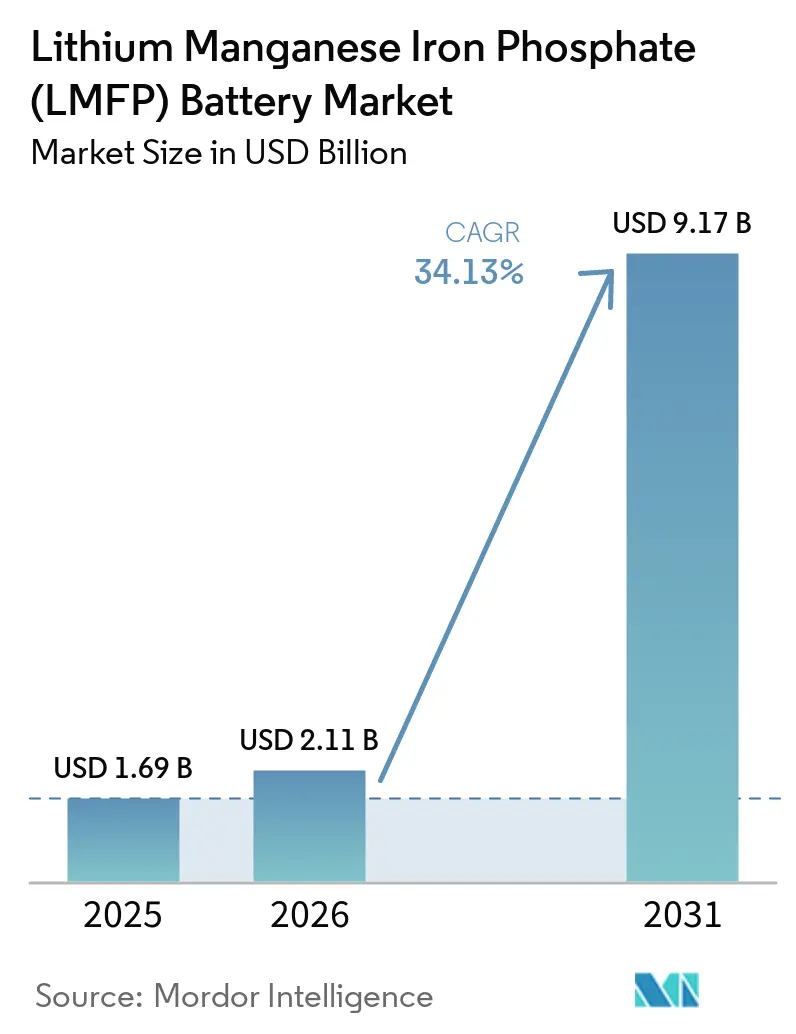
The Lithium Manganese Iron Phosphate Battery Market size is projected to be USD 1.69 billion in 2025, USD 2.11 billion in 2026, and reach USD 9.17 billion by 2031, at a CAGR of 34.13% from 2026 to 2031. The LMFP battery market is gaining demand because it offers higher energy density than standard LFP while retaining an iron-phosphate chemistry. Mid-range electric vehicles, stationary storage, and Chinese production scale are supporting this demand. Established LFP supply chains, electrolyte systems, and manufacturing equipment can also support LMFP production with fewer changes than a new battery chemistry would require. The LMFP battery market benefits when vehicle makers seek to reduce exposure to nickel and cobalt while maintaining safety and cost control. Supply security, technical validation, and battery-management integration will shape which producers capture the next stage of growth.
Key Report Takeaways
- By battery type, LMFP Cells held 68.3% of the overall LMFP category in 2025, while LMFP Battery Packs are forecast to grow at a 34.5% CAGR through 2031.
- By end user, Automotive held 58.1% of the overall LMFP category in 2025 and is forecast to grow at a 36.3% CAGR through 2031.
- By geography, Asia-Pacific held 61.4% of the overall LMFP category in 2025 and is forecast to grow at a 35.9% CAGR through 2031.
Note: Market size and forecast figures in this report are generated using Mordor Intelligence’s proprietary estimation framework, updated with the latest available data and insights as of January 2026.
Market Trends and Insights
Drivers Impact Analysis of Lithium Manganese Iron Phosphate (LMFP) Battery Market*
| Driver | (~) % Impact on CAGR Forecast | Geographic Relevance | Impact Timeline |
|---|---|---|---|
| Lower-Cost Mid-Range EV Packs | +8.40% | Global | Medium term (2–4 years) |
| EV Range Improvement Without Nickel and Cobalt | +6.10% | Global, APAC-led | Medium term (2–4 years) |
| Grid and Distributed Energy-Storage Procurement | +5.70% | Global (China, North America, Europe) | Short term (≤ 2 years) |
| China-Led Manufacturing Scale and Process Transfer | +5.00% | APAC core, spill-over to Europe | Medium term (2–4 years) |
| Policy-Led Battery-Supply-Chain Localization | +4.20% | North America & EU | Medium to Long term (2–5 years) |
| Qualification Pull from Iron-Based Chemistry Platforms | +2.40% | Global | Short term (≤ 2 years) |
| Source: Mordor Intelligence | |||
Lower-Cost Mid-Range EV Packs
The LMFP battery market is supported by vehicle makers that need more range without moving fully to nickel- and cobalt-based battery systems. LMFP can provide 15% to 25% higher energy density than standard LFP, with a cost premium below 5% per watt-hour. IONETIC reported a pack-level LMFP system energy density of 186 Wh/kg in 2026. This performance can help mid-range vehicle programs balance range, safety, and cost. It also reduces dependence on cobalt, which can create supply-chain exposure for manufacturers. The LMFP battery market, therefore, has a route into mainstream vehicle platforms where affordability remains important.
Vehicle manufacturers can use the energy-density gain to reduce cell count or make smaller battery enclosures. That can offset part of the higher cell cost through lower pack-assembly requirements. The chemistry also retains the thermal stability associated with phosphate cathodes. This matters for manufacturers, insurers, and regulators that place value on predictable battery safety behavior. Qualification of existing iron-based chemistry platforms can shorten the path from cell testing to vehicle use. These factors support wider adoption by original equipment manufacturers that already understand LFP manufacturing and system design.
EV Range Improvement Without Nickel and Cobalt
Manganese substitution raises the nominal LMFP cell voltage to 3.6 V to 3.8 V, compared with 3.2 V for LFP[1]. The higher voltage helps LMFP narrow the energy-density gap with lower-tier NMC cells while retaining the phosphate framework. The LMFP battery market can benefit where vehicle makers want this improvement without adding nickel or cobalt to the cathode. Research on LMFP materials has also identified the different iron and manganese redox plateaus as an important part of the chemistry’s performance profile. This operating profile gives developers another option when setting range, safety, and cost targets. It also makes LMFP relevant to blended-cathode approaches that can be processed without changing cell assembly lines.
The performance gain has operational importance beyond the cell specification. Smaller or lighter pack designs can give vehicle makers greater flexibility in packaging and platform design. These choices may reduce the assembly burden that follows a higher-priced cell. LMFP can therefore serve programs that cannot accept the cost or materials exposure of NMC, but require more energy density than standard LFP. The LMFP battery market also gains from continued work on cathode composition and electrolyte design. This development work is likely to remain important as manufacturers pursue reliable high-voltage operation in commercial cells.
Grid and Distributed Energy Storage Procurement
The LMFP battery market is also supported by procurement programs for grid and distributed energy storage. Illinois enacted the Clean and Renewable Grid Affordability Act in January 2026 and targeted 3,000 MW of cumulative nameplate storage by 2030, with an initial 1,038 MW procurement event scheduled for August 2026[2]. Duke Energy Carolinas and Duke Energy Progress issued a 2026 South Carolina battery request for proposals for 400 MW of four-hour resources[3]. These programs create visible demand pipelines for storage equipment. Long-duration procurement processes can give battery suppliers more time to qualify a newer chemistry. They also place greater attention on cycle life, warranties, and system-level performance.
The supplied analysis identified a Huadian Group 2026 framework tender covering 12 GWh of LFP and LMFP electrochemical storage. That tender illustrates the scale at which storage buyers are assessing iron-phosphate chemistries. Utilities and independent power producers increasingly need battery-management systems that satisfy project-specific performance standards. This moves competition beyond cathode selection and toward firmware, controls, and integration. Requirements for long calendar life and high cycle life can favor suppliers able to offer strong warranty support. The LMFP battery market can expand in storage only when cell performance, battery-management systems, and contractual guarantees work together.
China-Led Manufacturing Scale and Process Transfer
China’s manufacturing base remains central to the LMFP battery market because it connects cathode production, cell assembly, and downstream demand. The supplied analysis stated that more than 62,000 tonnes of new LMFP cathode capacity were commissioned in China during a two-month period in mid-2025. Dynanonic operated a 110,000-tonne-per-year LMFP production line, while Ronbay Technology targeted 560,000 tonnes per year by 2030. Flexible LFP and LMFP production lines allow producers to adjust the chemistry mix at the cathode-synthesis stage. That capability limits the capital loss that would follow a complete change in equipment. It also gives producers more scope to respond as customer qualifications move into volume production.
This manufacturing position can influence prices outside China as well as domestic supply. Niobia AI blog stated that Chinese gigafactory scrap rates were below 10%, compared with 30% to 40% for global peers. Lower scrap can improve material use and support cost competitiveness during scale-up. Technology licensing, engineering partnerships, and joint ventures can transfer process experience to planned facilities in Europe and Southeast Asia. Policy support for supply-chain localization in North America and Europe may increase demand for these capabilities. The LMFP battery market will still face a difficult transition if new regional facilities cannot secure high-purity manganese inputs and proven process knowledge. Manufacturing efficiency is therefore closely linked to the speed at which new regions can develop viable supply.
Restraints Impact Analysis of Lithium Manganese Iron Phosphate (LMFP) Battery Market*
| Restraint | (~) % Impact on CAGR Forecast | Geographic Relevance | Impact Timeline |
|---|---|---|---|
| Limited Field Validation and Warranty Evidence | -0.80% | Global | Short to Medium term (≤ 4 years) |
| Manganese-Driven Cycle-Life and Dissolution Risk | -0.60% | Global | Medium term (2–4 years) |
| Concentrated High-Purity Manganese Processing | -0.50% | North America & EU | Long term (≥ 4 years) |
| Dual-Voltage BMS and Charging Optimization | -0.20% | Global | Short term (≤ 2 years) |
| Source: Mordor Intelligence | |||
Manganese-Driven Cycle-Life and Dissolution Risk
Manganese dissolution remains a technical restraint for the LMFP battery market. An Electrochemical Society discussion on aged LMFP and graphite pouch cells reported that manganese concentration on anode surfaces depends strongly on the upper cutoff voltage[4]. Manganese movement can thicken the solid electrolyte interphase and reduce available lithium during cycling. These effects can reduce usable capacity over time. Limited field validation and warranty evidence make this issue especially important for buyers with long service-life requirements. Producers must show that laboratory advances can perform consistently in commercial cells and packs.
Electrolyte development offers a possible way to manage this limitation. Research on LMFP and graphite pouch cells found that LiFSI and LiTFSI salt blends with LiDFOB co-salts could reduce manganese dissolution, while dual-additive systems recorded first-cycle coulombic efficiency of 89.3%. The supplied analysis also cited capacity retention above 85% after 600 cycles for dual-additive carbonate blends. These results show why electrolyte-cathode interphase design is an important commercial differentiator. Proprietary electrolyte formulations can favor established suppliers with stronger materials research and intellectual-property positions. The LMFP battery market will require reliable charging controls and battery-management systems that account for its dual-voltage behavior.
Concentrated High-Purity Manganese Processing
High-purity manganese sulfate processing is a supply-security restraint for the LMFP battery market. The process requires multi-stage hydrometallurgical treatment that differs from conventional steel-grade manganese production. The International Energy Agency stated that China accounted for 95% of global battery-grade manganese sulfate refining capacity in 2025. It also projected that committed battery-grade manganese sulfate projects would cover 55% of demand by 2035 in its Stated Policies Scenario. This concentration makes regional supply-chain development difficult, even where cell production is being encouraged by policy. It also places greater attention on traceable and certified manganese supply.
The supplied draft identified the commissioning of South Africa’s first battery-grade high-purity manganese sulfate monohydrate plant by Manganese Metal Company in 2026. It described a price above USD 2,500 per tonne, compared with a lower Chinese spot price, showing the cost challenge associated with diversification. European battery rules and U.S. foreign-entity-of-concern requirements are increasing interest in ex-China material sources. However, new capacity must develop enough scale and cost competitiveness to supply emerging cathode plants. The LMFP battery market may therefore face higher input costs in regions trying to localize production. This remains relevant through the forecast period because upstream materials capacity is harder to build than downstream pack assembly.
*Our forecasts treat driver/restraint impacts as directional, not additive. The impact forecasts reflect baseline growth, mix effects, and variable interactions.
Lithium Manganese Iron Phosphate (LMFP) Battery Market Segment Analysis
By Battery Type:
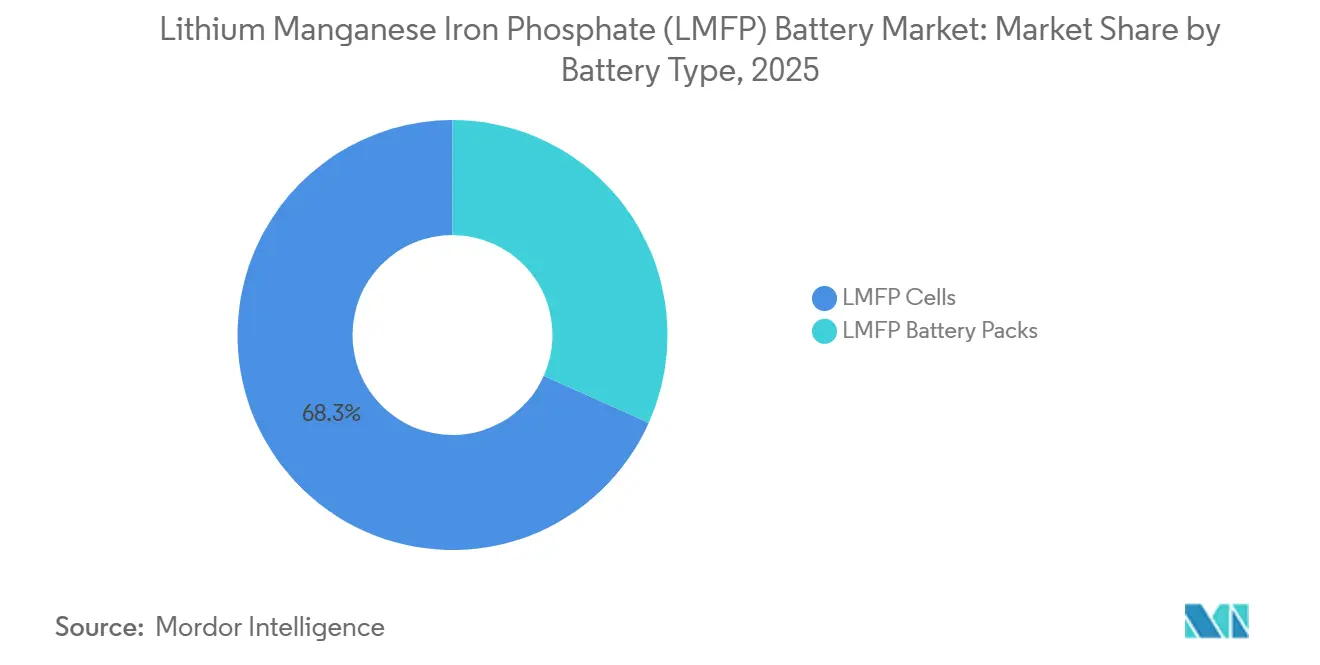
Cells Lead Current Demand While Pack Integration AdvancesLMFP Cells held 68.3% of the overall LMFP category in 2025, reflecting the stage of commercial qualification. Original equipment manufacturers and storage developers generally test and approve cells before they commit to complete pack integration. Cell volumes can therefore precede pack volumes by 18 to 24 months. LMFP Battery Packs are projected to record a 34.5% CAGR from 2026 to 2031 as more cell programs complete validation. The LMFP battery market size for packs should benefit as automotive, grid, and industrial customers move from sample testing to system deployment. Battery-electric commercial vehicles are particularly relevant because modular pack designs can accept LMFP cells without a full platform redesign.
CALB’s Phase IV Wuhan production base was under equipment commissioning and was designed to produce 400,000 battery-pack units per year, with production expected within 2026. That capacity can support the pack-level supply needed after cell qualification. Gotion High-Tech’s Qichen Gen 2 cell demonstrated a compaction density of 2.58 g/cm³, which can reduce pack volume requirements. Research has continued to identify electronic conductivity and dual-voltage operation as integration challenges. Doping approaches, including high-entropy lattice modifications, are being explored to improve rate performance. Pack producers will need to combine these cell improvements with BMS calibration, thermal design, and warranty evidence. The LMFP battery industry can gain from this shift when pack suppliers convert chemistry capability into a reliable system offering.

By End User:
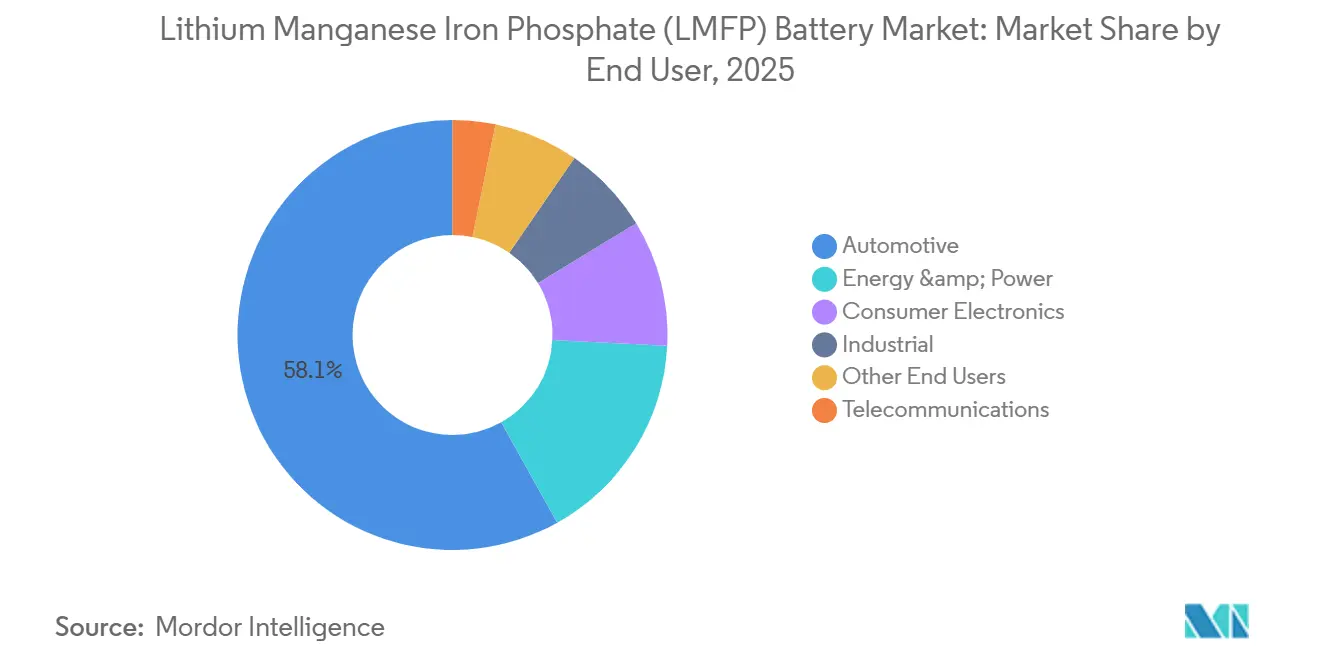
Automotive Leads Demand While Energy and Power Builds a Broader BaseAutomotive held 58.1% of the overall LMFP category in 2025 and is projected to grow at a 36.3% CAGR through 2031. Mid-range electric vehicles are the leading use case because they need a balanced cost, safety, and range proposition. High-volume automotive contracts can encourage cathode producers to build capacity, improving scale for other users. The supplied analysis identified CATL’s commercialization of its M3P chemistry across mid- and high-end EV lines as an important signal for vehicle qualification. It also cited CATL’s 48.3% power-battery share in 2026, though that figure relates to the overall power-battery category rather than LMFP alone. Automotive buyers will continue to assess cell durability, charging behavior, and availability of manganese supply before expanding use.
Energy and Power is building a longer-term demand base as storage deployment expands after 2026. The supplied analysis stated that first-half 2026 global lithium-battery energy-storage-system shipments exceeded 461 GWh. It also stated that CATL, EVE Energy, and Hithium collectively accounted for 47.5% of that volume. Storage applications can value LMFP’s combination of energy density and thermal safety when projects require long operating life. Consumer Electronics, Industrial, and Telecommunications remain smaller but stable end uses within the LMFP battery market. Portable devices emphasize safe battery performance, while telecommunications systems need dependable cycling at partial state of charge. Two-wheeled electric vehicles and light commercial vehicles in South and Southeast Asia also create demand where the cost difference from NMC remains important.
Geography Analysis
APAC Lithium Manganese Iron Phosphate (LMFP) Battery Market
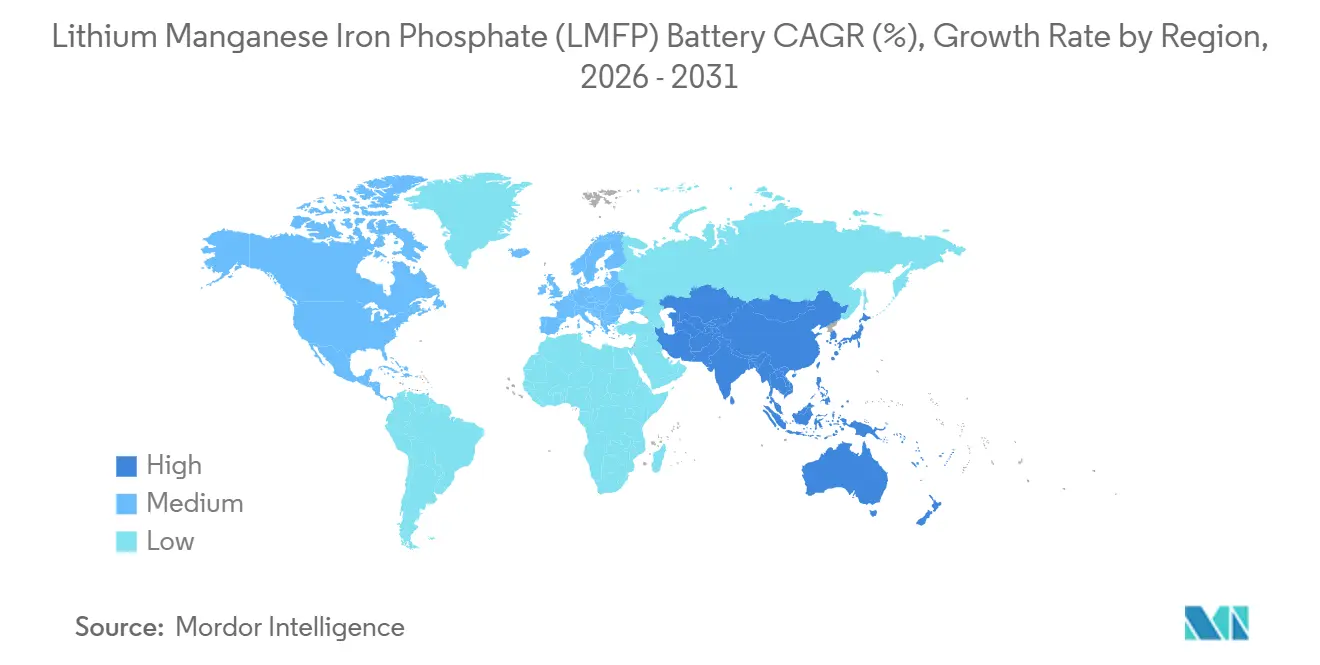
Asia-Pacific held 61.4% of the overall LMFP category in 2025 and is forecast to grow at a 35.9% CAGR through 2031. China’s integrated chain from cathode materials to finished cells underpins the region’s position. The International Energy Agency reported that China produced more than 98% of global LFP and LMFP cathode material in the cited analysis and accounted for 95% of high-purity manganese sulfate refining capacity. India, Vietnam, and Indonesia provide additional demand potential as their electric-vehicle and storage needs develop. India’s Advanced Chemistry Cell Production Linked Incentive program supports investment in battery manufacturing and aligns with interest in cobalt-free chemistries.
North America and Europe Lithium Manganese Iron Phosphate (LMFP) Battery Market
North America and Europe were largely LMFP cell import markets and had limited cathode manufacturing in the supplied analysis. Their role is increasingly shaped by policy support for local battery supply. U.S. production credits and foreign-entity-of-concern rules encourage domestic LFP and LMFP production, although manganese sulfate supply remains constrained. Europe did not manufacture LMFP at a commercial scale in the supplied analysis. The EUR 1.8 billion European battery package for 2025 to 2027 supported gigafactory investment. The LMFP battery market size in Europe can gain from local pack production, but upstream chemistry is likely to remain linked to China during the forecast period.
EMEA and South America Lithium Manganese Iron Phosphate (LMFP) Battery Market
CATL and Stellantis started construction of a EUR 4.1 billion LFP and LMFP-capable cell plant in Figueruelas, Spain, in November 2025, with initial output targeted by the end of 2026. CALB also signed a EUR 2.07 billion investment agreement for a Sines battery plant in Portugal in January 2026. South America, the Middle East, and Africa remain earlier-stage markets where grid stability and distributed power needs can support storage before mass electric-vehicle demand develops. The LMFP battery market in these regions depends on practical storage procurement and project financing. BYD announced up to BRL 500 million, equivalent to USD 90 million, for battery production in Brazil in June 2026, connected to the country’s first energy-storage auction framework. Saudi Arabia, the UAE, and South Africa are also pursuing storage and battery-material capabilities, although these areas are expected to represent a smaller share of revenue through 2031.
Competitive Landscape
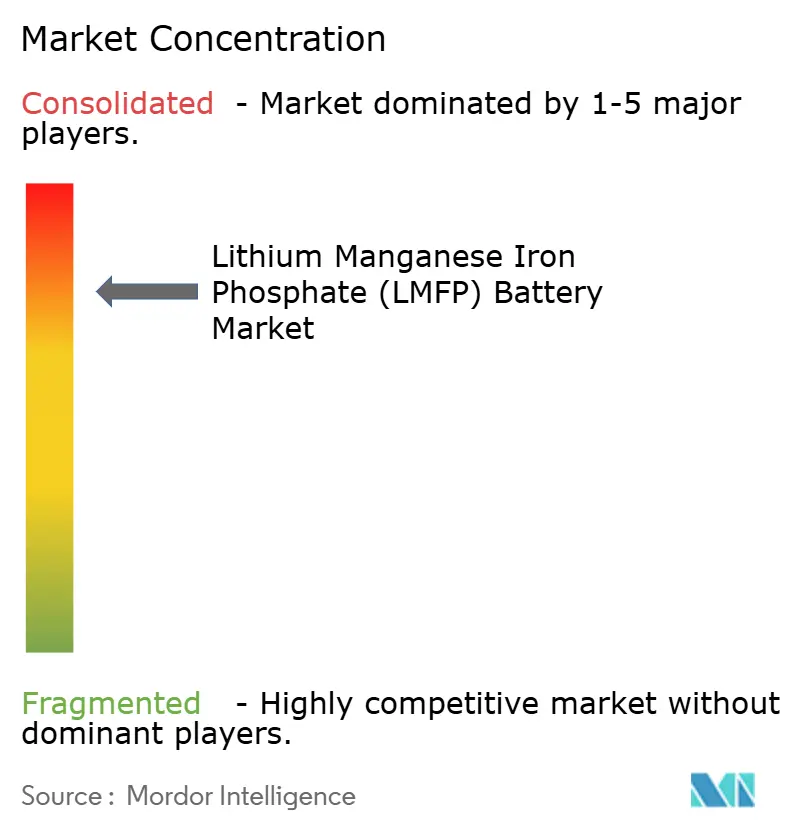
The LMFP battery market is concentrated in cell manufacturing and more fragmented in cathode materials. CATL, BYD, FinDreams Battery, and CALB were identified in the supplied analysis as the leading Chinese cell producers. Their position is supported by scale, vertical cathode supply agreements, and proprietary electrolyte and doping formulations. The LMFP battery market rewards this integrated model because each part of the value chain affects delivered cost and qualification speed. These factors create meaningful capital and process barriers for new producers. More than 30 manufacturers were developing LMFP formulations, while 5 had reached annual shipment levels above 1,000 tonnes in the supplied analysis. Producers with flexible LFP and LMFP lines can manage capacity use more effectively than firms dedicated only to LMFP.
CATL presented third-generation LFP and Qilin battery systems at its April 2026 Technology Day, alongside plans for a USD 5 billion Hong Kong secondary share sale for capacity expansion and research and development. EVE Energy reported more than 160 GWh of energy-storage offtake agreements in the first half of 2026, according to the supplied analysis. These agreements can reserve capacity and make entry harder for producers without established customer relationships. Gotion planned CNY 11.7 billion of expansion in Shandong and separately announced a EUR 950 million project in Spain. Such investments spread manufacturing risk across regions and place established companies closer to local customers.
Battery-management-system design is an important area of competition because LMFP’s dual-voltage operation requires tailored algorithms rather than standard LFP or NMC controls. System integrators with strong BMS capability may capture value through pack integration and long-term warranty support. The LMFP battery market can therefore create opportunities for specialized engineering suppliers as well as cell manufacturers. Battery Passport requirements under the European Union Battery Regulation can add further value to traceability and lifecycle management. The supplied analysis expected BMS complexity, warranty requirements, and localization rules to encourage consolidation by 2028. For smaller producers, these requirements increase the importance of quality systems, documentation, and verified field performance. They also make it harder to compete only on cell price. European customers may favor suppliers that can provide material traceability, service support, and evidence for long-life operation. Chinese producers retain an advantage where they can combine material supply, cell manufacturing, and pack engineering. Regional entrants can still compete where local manufacturing, compliance, and customer integration outweigh the benefits of imported cells. The competitive outcome will depend on whether these firms can develop reliable upstream supply and meet system-level warranty expectations.
Lithium Manganese Iron Phosphate (LMFP) Battery Industry Leaders
-
CATL (Contemporary Amperex Technology Co., Limited)
-
BYD Company Limited
-
Gotion High-tech Co., Ltd.
-
EVE Energy Co., Ltd.
-
CALB Group Co., Ltd.
- *Disclaimer: Major Players sorted in no particular order
Lithium Manganese Iron Phosphate (LMFP) Battery Market Companies Covered in this Report
- BYD Company Limited / FinDreams Battery
- CALB Group Co., Ltd.
- CATL (Contemporary Amperex Technology Co., Ltd.)
- Dynanonic Co., Ltd.
- EVE Energy Co., Ltd.
- Gotion High-tech Co., Ltd.
- Great Power Energy & Technology Co., Ltd.
- Guangdong Tianneng Lithium Technology Co., Ltd.
- Hefei Guoxuan High-Tech Power Energy Co., Ltd.
- Hithium Energy Storage Technology
- Hunan Yuneng New Material Technology Co., Ltd.
- Integrals Power Limited
- Lishen Battery (Tianjin Lishen Battery Joint-Stock Co., Ltd.)
- REPT BATTERO Energy Co., Ltd.
- Sunwoda Electronic Co., Ltd.
- SVOLT Energy Technology Co., Ltd.
Recent Industry Developments in Lithium Manganese Iron Phosphate (LMFP) Battery Market
- July 2026: Gotion High-Tech and Spain's Ministry of Industry officially confirmed a EUR 950 million, equivalent to USD 1.09 billion, project in Valladolid, comprising a 200,000-tonne-per-year battery cathode plant and a 200,000-tonne-per-year battery recycling facility. Construction is scheduled to begin in 2027, with the recycling facility entering Phase 1 first, forming part of an integrated circular battery economy strategy in Southern Europe.
- June 2026: BYD announced an investment of up to BRL 500 million, equivalent to USD 90 million, in battery production in Brazil. The announcement was triggered by the federal government's inaugural energy-storage auction format incorporating local-content requirements. The company was evaluating the expansion of its Manaus LFP and LMFP battery factory or the construction of a new plant and expected to finalize the location within 90 days.
- April 2026: CATL launched a USD 5 billion secondary share sale in Hong Kong. Proceeds were earmarked for global manufacturing-capacity expansion, zero-carbon initiatives, and research and development.
- February 2026: CATL signed a strategic cooperation agreement with the Yunnan provincial government to construct a lithium-battery manufacturing facility in the Dianzhong New Area. The facility targeted completion by the end of 2026 and represented CATL’s third capacity-expansion agreement in 1 month.
Global Lithium Manganese Iron Phosphate (LMFP) Battery Market Report Scope
A Lithium Manganese Iron Phosphate (LMFP) battery is a type of lithium-ion battery that uses a cathode material composed of lithium, manganese, iron, and phosphate (LiMnₓFe₁₋ₓPO₄). It is an enhanced variant of Lithium Iron Phosphate (LFP) chemistry, in which a portion of iron is replaced with manganese to increase the battery's operating voltage and energy density. LMFP batteries generally offer higher energy density than conventional LFP batteries, while retaining key advantages such as high thermal stability, long cycle life, safety, and relatively low reliance on expensive or critical metals such as nickel and cobalt. They are being developed for applications including electric vehicles (EVs), energy storage systems (ESS), electric mobility, and other rechargeable battery applications.
The Lithium Manganese Iron Phosphate (LMFP) Battery Market is segmented by battery type, end user, and geography. By battery type, the market is segmented into LMFP cells and LMFP battery packs. By end user, the market is segmented into automotive, energy and power, consumer electronics, industrial, telecommunications, and other end users. The report also covers the market size and forecasts for the global Lithium Manganese Iron Phosphate (LMFP) Battery Market across 26 countries in key regions. For each segment, the market sizing and forecasts have been provided on the basis of value (USD).
Segmentation Overview
| LMFP Cells |
| LMFP Battery Packs |
| Automotive |
| Energy & Power |
| Consumer Electronics |
| Industrial |
| Telecommunications |
| Other End Users |
| North America | United States |
| Canada | |
| Mexico | |
| Europe | Germany |
| France | |
| Italy | |
| Spain | |
| United Kingdom | |
| Poland | |
| Russia | |
| Rest of Europe | |
| Asia-Pacific | China |
| India | |
| Japan | |
| South Korea | |
| Australia | |
| Indonesia | |
| Vietnam | |
| Thailand | |
| Rest of Asia-Pacific | |
| South America | Brazil |
| Argentina | |
| Chile | |
| Rest of South America | |
| Middle East and Africa | Saudi Arabia |
| United Arab Emirates | |
| Egypt | |
| South Africa | |
| Morocco | |
| Rest of Middle East and Africa |
| By Battery Type | LMFP Cells | |
| LMFP Battery Packs | ||
| By End User | Automotive | |
| Energy & Power | ||
| Consumer Electronics | ||
| Industrial | ||
| Telecommunications | ||
| Other End Users | ||
| By Geography | North America | United States |
| Canada | ||
| Mexico | ||
| Europe | Germany | |
| France | ||
| Italy | ||
| Spain | ||
| United Kingdom | ||
| Poland | ||
| Russia | ||
| Rest of Europe | ||
| Asia-Pacific | China | |
| India | ||
| Japan | ||
| South Korea | ||
| Australia | ||
| Indonesia | ||
| Vietnam | ||
| Thailand | ||
| Rest of Asia-Pacific | ||
| South America | Brazil | |
| Argentina | ||
| Chile | ||
| Rest of South America | ||
| Middle East and Africa | Saudi Arabia | |
| United Arab Emirates | ||
| Egypt | ||
| South Africa | ||
| Morocco | ||
| Rest of Middle East and Africa | ||
Key Questions Answered in the Report
What is the forecast value of the LMFP battery market by 2031?
The LMFP battery market is projected to reach USD 9.17 billion by 2031, growing at a 34.13% CAGR from 2026 to 2031.
Why are automakers considering lithium manganese iron phosphate batteries?
LMFP can provide 15% to 25% higher energy density than standard LFP while avoiding nickel and cobalt exposure.
Which battery type currently leads LMFP demand?
LMFP Cells led with 68.3% share in 2025, while Battery Packs are expected to grow at a 34.5% CAGR through 2031.
Which end user is expected to grow fastest for LMFP batteries?
Automotive held 58.1% in 2025 and is forecast to grow at a 36.3% CAGR through 2031.
Which region leads demand for LMFP batteries?
Asia-Pacific held 61.4% in 2025 and is projected to grow at a 35.9% CAGR through 2031.
What is the main supply-chain risk for LMFP battery producers?
Battery-grade manganese sulfate refining is highly concentrated, with China accounting for 95% of global refining capacity in 2025.