
Lithium-Ion Black-Mass Flotation Reagents Market Size and Share
Market Overview
| Study Period | 2021 - 2031 |
|---|---|
| Market Size (2026) | USD 35.58 Million |
| Market Size (2031) | USD 60.47 Million |
| Growth Rate (2026 - 2031) | 11.19 % |
| Fastest Growing Market | Asia-Pacific |
| Largest Market | Asia-Pacific |
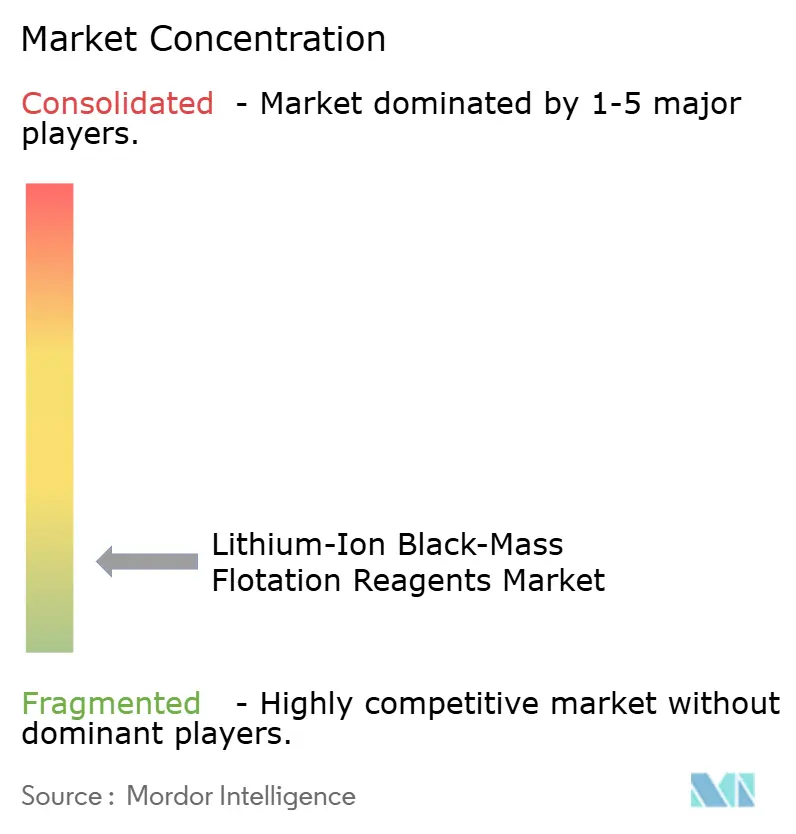
| Market Concentration | Low |
Major Players *Disclaimer: Major Players sorted in no particular order Image © Mordor Intelligence. Reuse requires attribution under CC BY 4.0. | |
Lithium-Ion Black-Mass Flotation Reagents Market Analysis by Mordor Intelligence
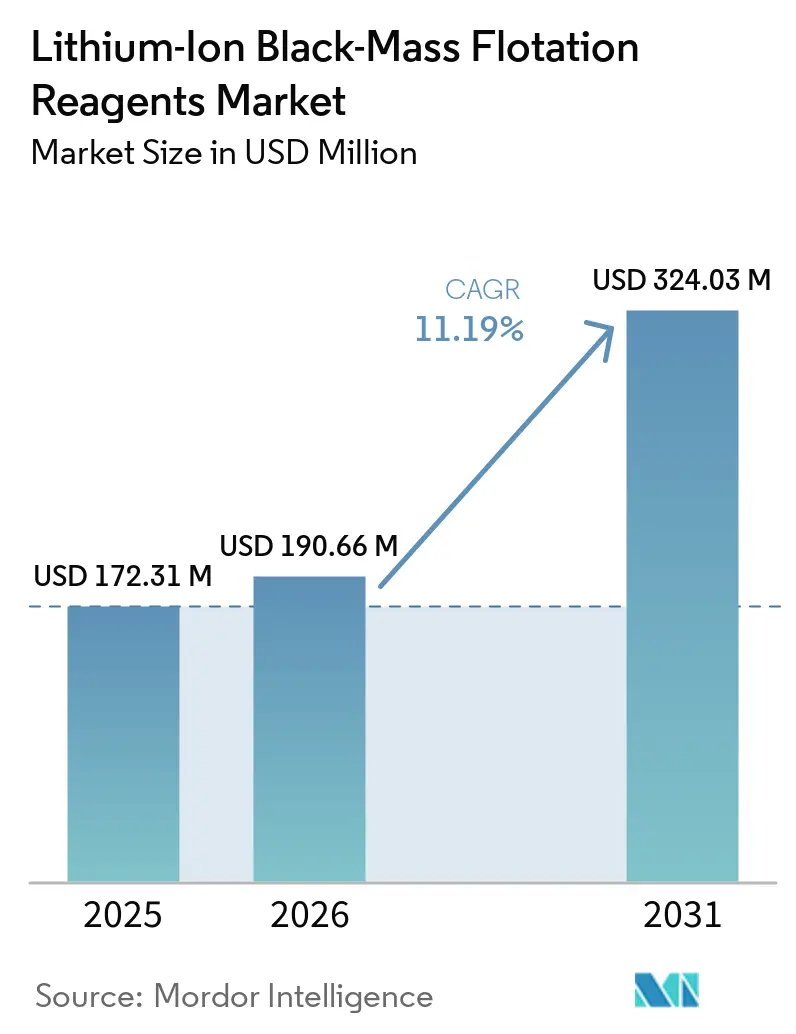
The Lithium-Ion Black-Mass Flotation Reagents Market size is expected to grow from USD 32.05 million in 2025 to USD 35.58 million in 2026 and is forecast to reach USD 60.47 million by 2031 at 11.19% CAGR over 2026-2031. Retiring electric vehicle battery packs are increasing the volume of black mass that requires separation before hydrometallurgical treatment. European recycling rules are making the selective recovery of lithium and other materials more important for recyclers. Processing capacity must expand as take-back requirements and reverse logistics develop, although emerging battery chemistries will require process changes. Suppliers are competing through battery-specific formulations, local technical support, and validation with recycling operators. Continuous commercial operating data remain limited, so feedstock variation and process validation continue to affect buying decisions in the lithium-ion black-mass flotation reagents market.
Key Report Takeaways
- By reagent type, collectors held 34.83% of the lithium-ion black-mass flotation reagents market in 2025, while depressants are projected to grow at a 12.14% CAGR through 2031.
- By black-mass source, electric vehicle batteries held 54.16% of the lithium-ion black-mass flotation reagents market in 2025, while energy storage system batteries are projected to grow at a 13.02% CAGR through 2031.
- By target material recovery, nickel and cobalt recovery held 39.51% of the lithium-ion black-mass flotation reagents market in 2025, while lithium recovery is projected to grow at a 13.21% CAGR through 2031.
- By battery chemistry, NMC batteries held 46.73% of the lithium-ion black-mass flotation reagents market in 2025, while LFP batteries are projected to grow at a 12.73% CAGR through 2031.
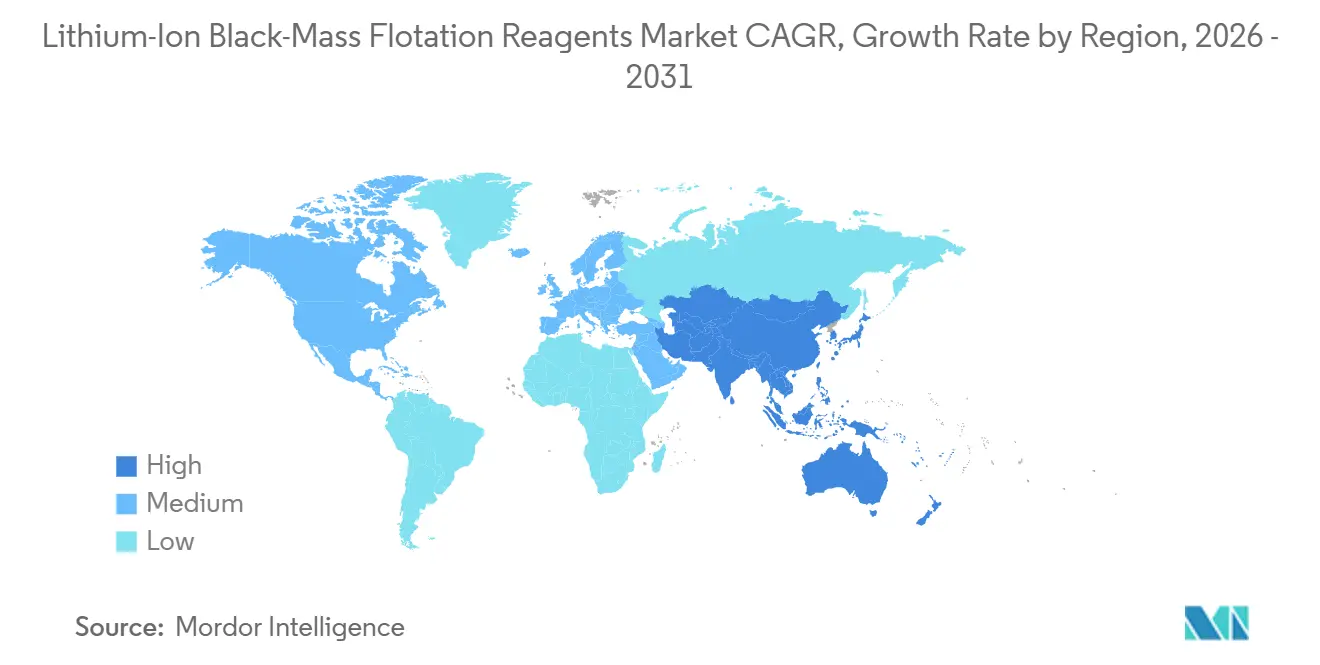
- By geography, Asia-Pacific held 37.29% of the lithium-ion black-mass flotation reagents market in 2025 and is projected to grow at a 12.98% CAGR through 2031.
Note: Market size and forecast figures in this report are generated using Mordor Intelligence’s proprietary estimation framework, updated with the latest available data and insights as of January 2026.
Market Trends and Insights
Drivers Impact Analysis of Lithium-Ion Black-Mass Flotation Reagents Market*
| Driver | (~) % Impact on CAGR Forecast | Geographic Relevance | Impact Timeline |
|---|---|---|---|
| Rising Black-Mass Volumes From Electric Vehicle Batteries | +3.5% | Global, with early gains in China, South Korea, Germany, and the United States | Short term (≤ 2 years) |
| Mandatory Battery Recycling and Critical-Material Recovery Targets | +2.8% | EU and China core; spill-over to North America, South Korea, Japan | Short term (≤ 2 years) |
| Growing Need to Recover Graphite Alongside Cathode Metals | +1.6% | Global, accelerating in Asia-Pacific and Europe | Medium term (2–4 years) |
| Shift Toward Integrated Physical and Hydrometallurgical Recycling | +1.2% | EU, North America, Japan, South Korea | Medium term (2–4 years) |
| Chemistry-Specific Flotation Optimization for LFP and NMC Feedstocks | +1.0% | China (LFP primary); EU and North America (NMC primary) | Medium term (2–4 years) |
| Low-Temperature, Low-Reagent Separation Innovation | +0.8% | Global, with early gains in EU R&D hubs and Singapore | Long term (≥ 4 years) |
| Source: Mordor Intelligence | |||
Rising Black-Mass Volumes from Electric Vehicle Batteries
Global electric vehicle battery retirements are becoming an operating reality in 2026, increasing the supply of black mass for the lithium-ion black-mass flotation reagents market. The global electric vehicle sales exceeded 17 million units in 2024, while battery cohorts produced during 2017-2019 are now entering collection and disassembly. Recycling capacity must rise from 2026 as automaker take-back obligations, and European Union battery passport requirements mature. China is likely to receive the earliest volume increase because it has both an older electric vehicle fleet and established processing capacity. This timing supports early demand for validated reagent packages in China before comparable volumes develop in Europe and North America.
Mandatory Battery Recycling and Critical-Material Recovery Targets
Regulatory compliance is now a primary demand factor for the lithium-ion black-mass flotation reagents market in Europe. Commission Delegated Regulation (EU) 2025/606 entered into force on July 24, 2025, and set methods for measuring recycling efficiency and material recovery[1]. The regulation requires 90% recovery for cobalt, copper, lead, and nickel, and 50% recovery for lithium by the end of 2027. These requirements are expected to rise to 95% and 80%, respectively, by the end of 2031. Such thresholds encourage operators to use upstream pre-concentration and selective depressant and pH-modifier systems before leaching. China also allowed compliant recycled black mass to be imported from August 1, 2025, after changing its classification under GB/T 45203-2024. Regulation (EU) 2026/1738 now extends circularity requirements through the end-of-life vehicle supply chain.
Growing Need to Recover Graphite Alongside Cathode Metals
Graphite recovery received less attention than cathode metal recovery during the earlier development of battery recycling. A 2025 study showed that optimized collector and frother combinations produced graphite fractions with 92 wt% carbon content and 89% recovery from several lithium-ion battery types. The lithium-ion black-mass flotation reagents market, therefore, benefits when recyclers pursue graphite alongside nickel, cobalt, and lithium. The European Union and the United States identify natural graphite as a critical raw material, while supply remains concentrated in China. Multi-stage circuits require accurate depressant dosing to limit cathode-active-material carry-over into graphite froth. A study by Helmholtz-Zentrum Dresden-Rossendorf achieved 85% graphite recovery and 80% lithium metal oxide recovery from pyrolyzed black mass, while water recirculation did not materially reduce recovery. This supports continuous-loop circuit designs and can increase demand for more complex reagent systems.
Chemistry-Specific Flotation Optimization for LFP and NMC Feedstocks
Using one reagent protocol for lithium iron phosphate and nickel manganese cobalt black mass can reduce separation performance. Lithium iron phosphate particles have a point of zero charge that differs by 2.5 pH units from nickel manganese cobalt cathode material. This difference changes bubble attachment and requires distinct depressant dosing and pH control. A 2025 study comparing lithium iron phosphate, lithium manganese oxide, lithium cobalt oxide, nickel manganese cobalt, and graphite found that lithium iron phosphate requires its own treatment because of ultrafine particles and different surface properties. Commercial lithium iron phosphate recycling began at IS Eco Solution in South Korea in January 2026, showing that such feedstock is now processed outside China.
Restraints Impact Analysis of Lithium-Ion Black-Mass Flotation Reagents Market*
| Restraint | (~) % Impact on CAGR Forecast | Geographic Relevance | Impact Timeline |
|---|---|---|---|
| Variable Black-Mass Composition and Inconsistent Feed Quality | -2.0% | Global; most acute in North America, South America, and nascent EU recycling corridors | Medium term (2–4 years) |
| Binder, Electrolyte, and Fine-Particle Entrainment Interference | -1.3% | Global | Short term (≤ 2 years) |
| Environmental Pressure on Hydrocarbon Collectors and Volatile Frothers | -0.9% | EU, California, South Korea; spill-over to Japan | Long term (≥ 4 years) |
| Limited Commercial-Scale Validation of Reagent-Based Flotation | -0.6% | Global, most critical in North America and Europe | Medium term (2–4 years) |
| Source: Mordor Intelligence | |||
Variable Black-Mass Composition and Inconsistent Feed Quality
Variable black-mass composition and inconsistent feed quality limit stable reagent selection in the lithium-ion black-mass flotation reagents market. Material from electric vehicle fleets can combine several cathode chemistries, cell formats, and degradation states. The resulting particle-size distribution, surface chemistry, and binder content can vary widely. A circuit calibrated for 1 chemistry can then show changes in graphite recovery, cathode selectivity, and frother consumption. China introduced compositional classifications and hazardous-substance limits for recycled black mass through GB/T 45203-2024, which took effect on July 1, 2025[2]. Sorting, characterization, and quality certification must improve before operators can consistently set circuit parameters and commit to recurring reagent demand.
Binder, Electrolyte, and Fine-Particle Entrainment Interference
Polyvinylidene fluoride, or PVDF, binder residues remain a persistent barrier to froth flotation selectivity in the lithium-ion black-mass flotation reagents market. Intact PVDF coatings can make cathode particles hydrophobic and carry them into graphite-rich froth. This reduces cathode purity in the underflow and contaminates graphite in the overflow. A 2025 study assessed dihydrolevoglucosenone, known as Cyrene, as a bio-based solvent pretreatment for PVDF. Combined with high-intensity attritioning, the treatment improved separation efficiency from 0.30 to 0.53 for single-chemistry black mass. Electrolyte residues and conductive particles below 1 μm can increase frother use, require extra depressant stages, and alter pH when process water is recirculated.
*Our forecasts treat driver/restraint impacts as directional, not additive. The impact forecasts reflect baseline growth, mix effects, and variable interactions.
Lithium-Ion Black-Mass Flotation Reagents Market Segment Analysis
By Reagent Type:
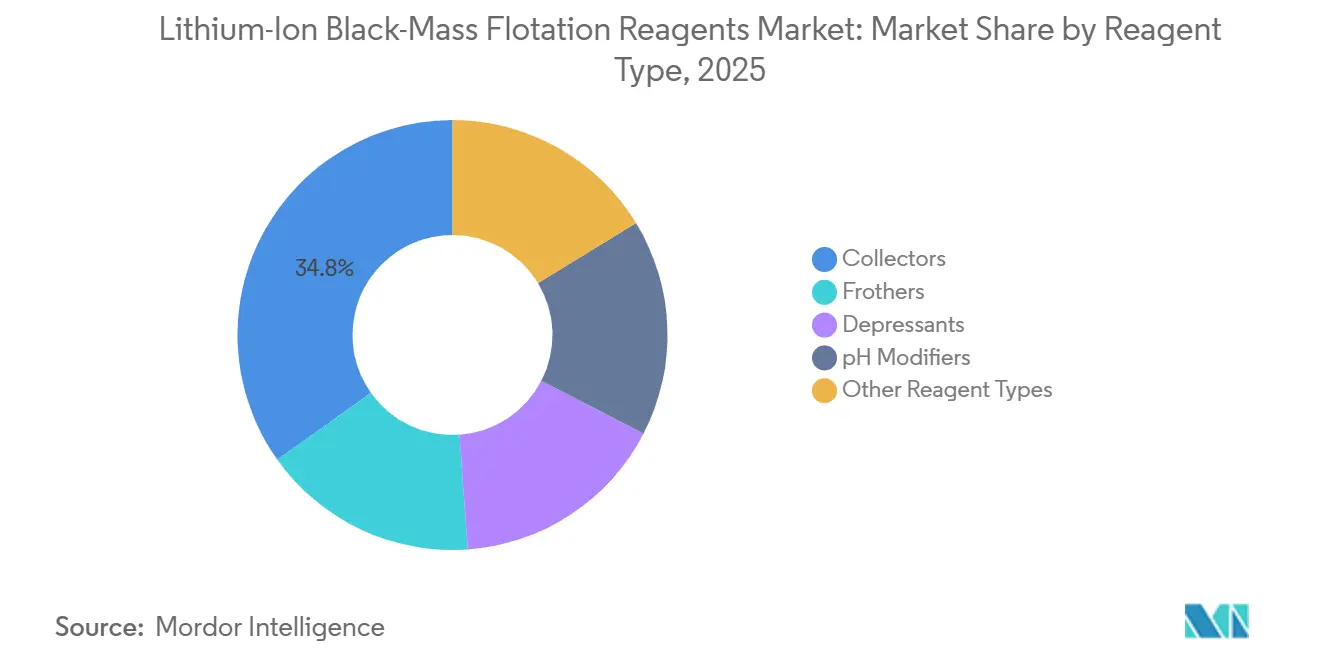
Collectors Hold the Largest Position While Depressants Gain MomentumCollectors held 34.83% of the lithium-ion black-mass flotation reagents market share in 2025. Non-polar hydrocarbon oils, including kerosene, diesel, and proprietary formulations, promoted graphite hydrophobicity during anode-cathode separation. Their dosage rates are higher than those for frothers or pH modifiers. Peer-reviewed trials documented collector application rates of 350 g per metric ton of black mass, compared with 100-150 g per metric ton for frothers. This consumption pattern increased collectors’ contribution to total reagent spending. In frothers, methyl isobutyl carbinol and pine-oil derivatives are used for froth stability and bubble-size control.
Depressants are forecast to advance at a 12.14% CAGR through 2031 within the lithium-ion black-mass flotation reagents industry. Their role grows as lithium recovery joins cobalt and nickel recovery as a required processing outcome in the lithium-ion black-mass flotation reagents market. Sodium silicate, dextrin, and emerging polymer formulations can suppress cathode flotation without suppressing graphite. A 2025 green pretreatment study found that gamma-valerolactone with atmospheric pyrolysis improved cathode hydrophilicity, achieved 100% graphite recovery to froth, and reduced cathode carry-over to 15.63% without an external collector. Wider use of this approach could reduce collector demand and move spending toward pretreatment and depressant chemistry. Specialty blends and flocculants also gain relevance as operators replace individual additions with formulated packages.

By Black-Mass Source:
Electric Vehicle Batteries Lead Revenue While Energy Storage System Batteries Expand FasterElectric vehicle batteries accounted for 54.16% of the lithium-ion black-mass flotation reagents market size in 2025. Their leading position reflected the central role of electric vehicle fleets in global black-mass supply. Purpose-built processing infrastructure is being developed to absorb electric vehicle battery feedstock in North America. Consumer electronics batteries also remain an important source, although small cell formats produce fine particles that can complicate flotation hydrodynamics. Industrial batteries provide a more predictable composition because they come from controlled operating environments.
Energy storage system batteries are forecast to advance at a 13.02% CAGR through 2031 in the lithium-ion black-mass flotation reagents market. Retirements of early commercial grid-storage systems installed from 2017 to 2020 are increasing this feedstock stream. These packs mainly use lithium iron phosphate in large prismatic cells. Their high iron phosphate content creates a mineralogy that behaves differently from nickel manganese cobalt automotive black mass. Formulations validated for electric vehicle-derived nickel manganese cobalt material require recalibration for lithium iron phosphate feedstock, particularly in depressant choice, methyl isobutyl carbinol dosage, and pH setpoint.
By Target Material Recovery:
Nickel and Cobalt Recovery Leads Revenue While Lithium Recovery AcceleratesNickel and cobalt recovery held 39.51% of the market demand in 2025. This result reflected longstanding hydrometallurgical investment in nickel, manganese, and cobalt cathode processing and the economic value historically attached to those metals. Direct flotation trials on nickel, manganese, cobalt, and black mass achieved 96-99% cathode active material recovery grades and 98-99% overall recovery after effective binder removal. These results support reagent-intensive pre-concentration before leaching. Multi-metal recovery processes seek nickel, cobalt, manganese, and lithium in the same flow sheet. Their complex circuit design can create high reagent consumption per metric ton, while graphite recovery remains a smaller but growing application in the lithium-ion black-mass flotation reagents market.
Lithium recovery is forecast to advance at a 13.21% CAGR through 2031 in the lithium-ion black-mass flotation reagents market. Under the EU Sustainable Batteries Regulation, the European Union mandates that waste battery recycling must achieve a lithium material recovery rate of at least 50% by the end of 2027, increasing to 80% by the end of 2031. Ascend Elements produced recycled lithium carbonate at a commercial scale with more than 99% purity in August 2025. Engineering of Artificial Minerals (EnAM) processes use controlled cooling to create flotation-amenable gamma-lithium aluminate phases from smelted black mass. A 2026 study reported 76% lithium immobilization in slag from full battery cells. As recovery becomes mandatory, operators will require selective pH modifiers, lithium-targeted depressants, and charge-controlled frother systems.
By Battery Chemistry:
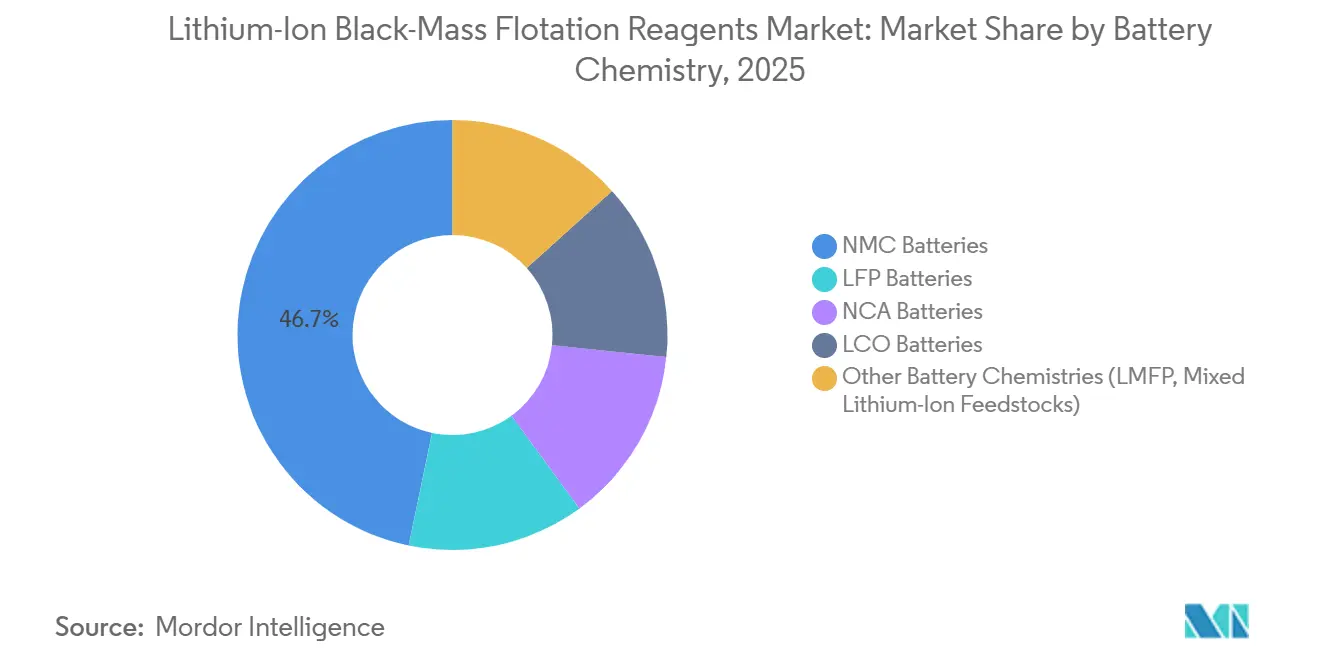
NMC Batteries Lead Revenue While LFP Batteries Raise Formulation NeedsNMC batteries held 46.73% of the market demand by battery chemistry in 2025. Their position reflected prior electric vehicle cathode use and the relative maturity of nickel manganese cobalt flotation protocols. The RHINOCEROS project validated an integrated process for nickel, manganese, and cobalt-rich black mass in 2025. It achieved more than 90% electrolyte recovery, more than 80% polymer recovery, and more than 95% lithium recovery through mechanical and supercritical carbon dioxide pretreatment, followed by flotation. Lithium cobalt oxide batteries remain concentrated in consumer electronics and are declining as nickel manganese cobalt chemistry is used in more energy-intensive applications.
LFP batteries are projected to grow at a 12.73% CAGR through 2031 in the lithium-ion black-mass flotation reagents market. Their rising use in electric vehicles, 2-wheelers, and stationary storage is creating a larger retirement pipeline. Their point of zero charge differs from nickel manganese cobalt materials by 2.5 pH units, requiring distinct collector and depressant strategies. Lithium manganese iron phosphate and mixed lithium-ion feedstocks are still emerging categories. Their less-defined flotation behavior creates a technical requirement for pilot-scale validation before substantial commercial volumes arrive. This requirement supports chemistry-specific formulation work in the lithium-ion black-mass flotation reagents market.
Geography Analysis
APAC and China Lithium-Ion Black-Mass Flotation Reagents Market
Asia-Pacific held 37.29% of the lithium-ion black-mass flotation reagents market share in 2025 and is projected to grow at a 12.98% CAGR through 2031. China combines a mature electric vehicle fleet, black-mass processing infrastructure, and evolving regulation. Its import policy allowed compliant recycled black mass to be traded freely from August 1, 2025. This raised the throughput available to Chinese flotation and hydrometallurgical processors.
North America and United States Lithium-Ion Black-Mass Flotation Reagents Market
In North America, processing capacity is being added to handle electric vehicle batteries, manufacturing scrap, and consumer electronics. State-level extended producer responsibility rules can expand the collected supply of batteries in the United States. However, operating economics and reliance on policy support still create risk for recyclers. The region’s demand in the lithium-ion black-mass flotation reagents market will depend on the availability of consistent feedstock as well as the financial strength of processors.
EMEA and South America Lithium-Ion Black-Mass Flotation Reagents Market
Europe’s demand is supported by material-recovery requirements under Regulation (EU) 2023/1542. The 50% lithium recovery target for 2027 and the future 95% recovery threshold for cobalt, copper, and nickel encourage investment in pre-separation circuits. BASF began commercial operation of its Schwarzheide black-mass plant in June 2025, with an annual capacity of 15,000 metric tons. South America, and Middle-East and Africa remain early-stage markets, despite forward-looking interest in Brazil.
Competitive Landscape
The lithium-ion black-mass flotation reagents market is highly fragmented, with the top five players including BASF, CLARIANT, Syensqo, American Battery Technology Company, and Green Li-ion Pte Ltd. Clariant offers FLOTINOR and FLOTIGAM collectors with FLOTANOL frothers for lithium processing. BASF offers Lupromin collectors, Luprofroth frothers, and Luproset modifiers, while continuing research on tailored flotation solutions. The main strategic priorities in the lithium-ion black-mass flotation reagents market are patent development, technical resources near recycling clusters, and validated performance data.
BASF moved beyond reagent supply when it began commercial operation of its Schwarzheide black-mass plant in June 2025. The plant can process 15,000 metric tons annually, which is equivalent to material from 40,000 electric vehicle batteries. Redwood Materials also expanded its financial capacity through a USD 425 million Series E financing round in January 2026. Ascend Elements showed commercial lithium carbonate production in August 2025. These moves show that access to feedstock, processing capacity, and financing can influence purchasing in the lithium-ion black-mass flotation reagents market as much as product formulation. Mixed lithium iron phosphate and nickel manganese cobalt feedstock remains a key formulation gap in the lithium-ion black-mass flotation reagents market. Better battery sorting can reduce feed variability before flotation and improve the value of chemistry-specific formulations. Established chemical companies have an advantage in Registration, Evaluation, Authorisation and Restriction of Chemicals compliance for new non-hydrocarbon collectors. Environmental pressure on hydrocarbon collectors and volatile frothers may further increase the value of lower-emission alternatives in the lithium-ion black-mass flotation reagents market.
Lithium-Ion Black-Mass Flotation Reagents Industry Leaders
-
BASF
-
CLARIANT
-
Syensqo
-
American Battery Technology Company
-
Green Li-ion Pte Ltd.
- *Disclaimer: Major Players sorted in no particular order
Lithium-Ion Black-Mass Flotation Reagents Market Companies Covered in this Report
- ACCUREC-Recycling GmbH
- American Battery Technology Company
- Ascend Elements Inc.
- BASF
- Cirba Solutions
- CLARIANT
- Duesenfeld GmbH
- ECOBAT
- Elemental Holding S.A.
- Green Li-ion Pte Ltd.
- Lithion Technologies
- RecycLiCo Battery Materials Inc.
- Redwood Materials Inc.
- Syensqo
- Umicore
Recent Industry Developments in Lithium-Ion Black-Mass Flotation Reagents Market
- July 2026: The European Union adopted Regulation (EU) 2026/1738 on circularity requirements for vehicles, amending the Batteries Regulation (EU) 2023/1542 to introduce mandatory closed-loop material requirements for end-of-life vehicle batteries. The regulation is expected to increase lithium-ion battery recycling volumes, supporting demand for black-mass flotation reagents used to recover valuable battery materials during recycling.
- June 2025: BASF began commercial operation of its black-mass recycling plant in Schwarzheide, Germany, with an annual processing capacity of 15,000 metric tons, equivalent to approximately 40,000 electric vehicle batteries. The facility increased black-mass processing capacity in Europe, supporting higher demand for flotation reagents used to separate and recover valuable battery materials during lithium-ion battery recycling.
Global Lithium-Ion Black-Mass Flotation Reagents Market Report Scope
Lithium-ion black-mass flotation reagents are specialized chemical formulations used to selectively separate and recover valuable materials from black mass generated during lithium-ion battery recycling. These reagents improve flotation efficiency, enhance material purity, and support the recovery of critical battery materials such as lithium, nickel, cobalt, and graphite for reuse in battery manufacturing.
The Lithium-Ion Black-Mass Flotation Reagents Market is segmented by reagent type, black-mass source, target material recovery, battery chemistry, and geography. By reagent type, the market is segmented into collectors, frothers, depressants, pH modifiers, and other reagent types (including dispersants, flocculants and coagulants, and specialty/proprietary blends). By black-mass source, the market is segmented into electric vehicle batteries, consumer electronics batteries, energy storage system batteries, industrial batteries, and other black-mass sources (including mixed battery waste streams). By target material recovery, the market is segmented into nickel and cobalt recovery, lithium recovery, graphite recovery, multi-metal recovery, and other target material recoveries (including manganese and minor metals). By battery chemistry, the market is segmented into NMC batteries, LFP batteries, NCA batteries, LCO batteries, and other battery chemistries (including LMFP and mixed lithium-ion feedstocks). The report also covers the market size and forecasts for lithium-ion black-mass flotation reagents in 15 countries across major regions. For each segment, the market sizing and forecasts have been done on the basis of value (USD).
Segmentation Overview
| Collectors |
| Frothers |
| Depressants |
| pH Modifiers |
| Other Reagent Types (Dispersants, Flocculants and Coagulants, Specialty/Proprietary Blends) |
| Electric Vehicle Batteries |
| Consumer Electronics Batteries |
| Energy Storage System Batteries |
| Industrial Batteries |
| Other Black-Mass Sources (Mixed Battery Waste Streams) |
| Nickel and Cobalt Recovery |
| Lithium Recovery |
| Graphite Recovery |
| Multi-Metal Recovery |
| Other Target Material Recoveries (Manganese and Minor Metals) |
| NMC Batteries |
| LFP Batteries |
| NCA Batteries |
| LCO Batteries |
| Other Battery Chemistries (LMFP, Mixed Lithium-Ion Feedstocks) |
| Asia-Pacific | China |
| India | |
| Japan | |
| South Korea | |
| Rest of Asia-Pacific | |
| North America | United States |
| Canada | |
| Mexico | |
| Europe | Germany |
| United Kingdom | |
| France | |
| Italy | |
| Rest of Europe | |
| South America | Brazil |
| Argentina | |
| Rest of South America | |
| Middle-East and Africa | Saudi Arabia |
| South Africa | |
| Rest of Middle-East and Africa |
| By Reagent Type | Collectors | |
| Frothers | ||
| Depressants | ||
| pH Modifiers | ||
| Other Reagent Types (Dispersants, Flocculants and Coagulants, Specialty/Proprietary Blends) | ||
| By Black-Mass Source | Electric Vehicle Batteries | |
| Consumer Electronics Batteries | ||
| Energy Storage System Batteries | ||
| Industrial Batteries | ||
| Other Black-Mass Sources (Mixed Battery Waste Streams) | ||
| By Target Material Recovery | Nickel and Cobalt Recovery | |
| Lithium Recovery | ||
| Graphite Recovery | ||
| Multi-Metal Recovery | ||
| Other Target Material Recoveries (Manganese and Minor Metals) | ||
| By Battery Chemistry | NMC Batteries | |
| LFP Batteries | ||
| NCA Batteries | ||
| LCO Batteries | ||
| Other Battery Chemistries (LMFP, Mixed Lithium-Ion Feedstocks) | ||
| By Geography | Asia-Pacific | China |
| India | ||
| Japan | ||
| South Korea | ||
| Rest of Asia-Pacific | ||
| North America | United States | |
| Canada | ||
| Mexico | ||
| Europe | Germany | |
| United Kingdom | ||
| France | ||
| Italy | ||
| Rest of Europe | ||
| South America | Brazil | |
| Argentina | ||
| Rest of South America | ||
| Middle-East and Africa | Saudi Arabia | |
| South Africa | ||
| Rest of Middle-East and Africa | ||
Key Questions Answered in the Report
What is the size of the lithium-ion black-mass flotation reagents market?
The Lithium-Ion Black-Mass Flotation Reagents Market size is expected to grow from USD 32.05 million in 2025 to USD 35.58 million in 2026 and is forecast to reach USD 60.47 million by 2031 at 11.19% CAGR over 2026-2031.
Which reagent type led the market demand in 2025?
Collectors led with 34.83% of demand in 2025 because they promoted graphite hydrophobicity during anode-cathode separation.
Which black-mass source is expected to grow fastest through 2031?
Energy storage system batteries are forecast to grow at a 13.02% CAGR through 2031, supported by retirements of early grid-storage installations.
Why does lithium iron phosphate require different flotation chemistry?
Lithium iron phosphate has different surface properties and a point of zero charge that is 2.5 pH units different from nickel manganese cobalt material. This requires different pH and depressant settings.