
Liquid Alternate Fuel and Raw Materials (AFR) Firing Systems Market Size and Share
Market Overview
| Study Period | 2021 - 2031 |
|---|---|
| Market Size (2026) | USD 185.61 Million |
| Market Size (2031) | USD 258.11 Million |
| Growth Rate (2026 - 2031) | 6.82 % |
| Fastest Growing Market | Asia-Pacific |
| Largest Market | Europe |
| Market Concentration | Medium |
Major Players *Disclaimer: Major Players sorted in no particular order Image © Mordor Intelligence. Reuse requires attribution under CC BY 4.0. | |
Liquid Alternate Fuel and Raw Materials (AFR) Firing Systems Market Analysis by Mordor Intelligence
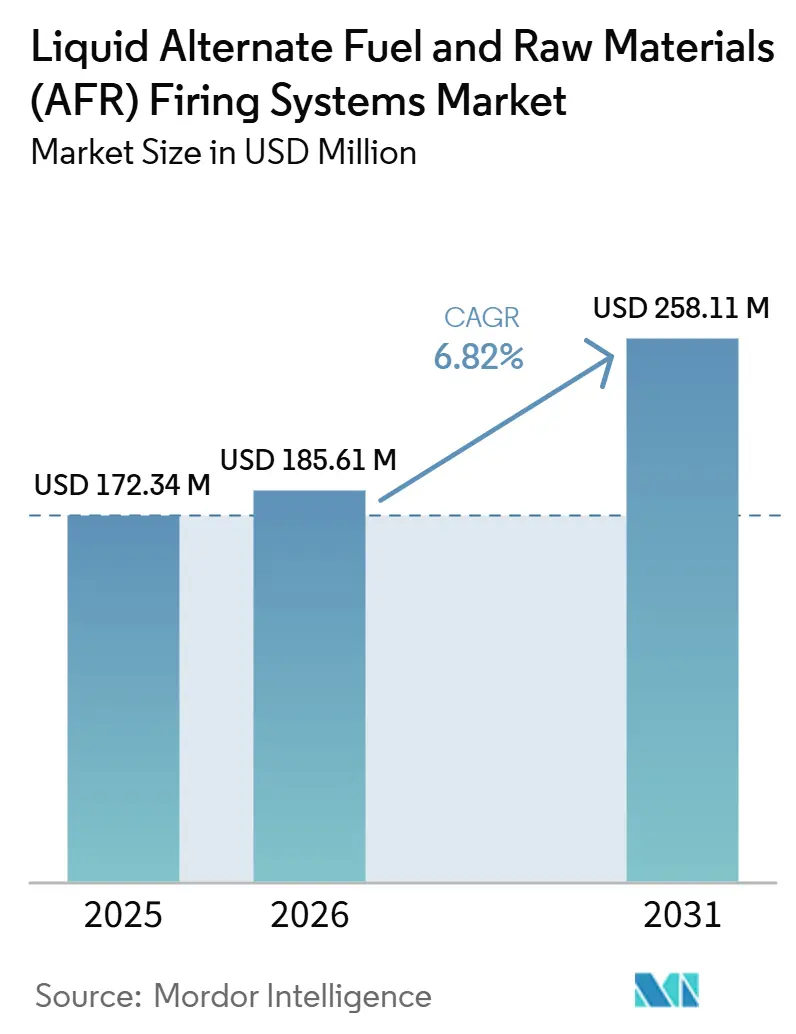
The Liquid Alternate Fuel and Raw Materials Firing Systems Market size was valued at USD 172.34 million in 2025 and is estimated to grow from USD 185.61 million in 2026 to reach USD 258.11 million by 2031, at a CAGR of 6.82% during the forecast period (2026-2031). The Liquid AFR firing systems market is supported by cement producers that need to cut fossil fuel use while maintaining dependable kiln performance. Modern systems combine liquid preheating, atomization, feed control, and injection equipment to manage fuels with different viscosities, energy contents, and contaminant levels. Energy costs represented 40% of cement production expenses, which makes fuel substitution important for plant operating economics. Carbon pricing, landfill-diversion rules, and volatile coal and petcoke prices are increasing the value of systems that can use processed waste oils, solvents, and biomass-derived liquids. Suppliers compete through combustion control, integration with existing kiln equipment, and documentation that supports regulatory compliance.
Key Report Takeaways
- By burner and system type, Rotary Kiln Main Burner Liquid AFR Systems held 47.3% of the Liquid AFR firing systems market share in 2025, while Multi-Point Liquid AFR Firing Systems are expected to grow at a 7.7% CAGR through 2031.
- By fuel type, Waste Oils held 39.6% of the Liquid AFR firing systems market share in 2025, while Liquid Biomass and Bio-Oils are projected to grow at a 8.1% CAGR through 2031.
- By end-user industry, the cement industry accounted for 81.4% of the Liquid AFR firing systems market share in 2025 and is projected to grow at a 7.6% CAGR through 2031.
- By geography, Europe held 41.3% of the Liquid AFR firing systems market share in 2025, while Asia-Pacific is expected to grow at a 8.7% CAGR through 2031.
Note: Market size and forecast figures in this report are generated using Mordor Intelligence’s proprietary estimation framework, updated with the latest available data and insights as of January 2026.
Global Liquid Alternate Fuel and Raw Materials (AFR) Firing Systems Market Trends and Insights
Drivers Impact Analysis*
| Driver | % Impact on CAGR Forecast | Geographic Relevance | Impact Timeline |
|---|---|---|---|
| Decarbonization Mandates and Emissions-Cost Avoidance | +1.80% | Global, with highest intensity in EU and East Asia | Medium term (2–4 years) |
| Fossil-Fuel Price Volatility and Energy-Security Priorities | +1.00% | Global, with acute exposure in import-dependent MEA and South Asia | Short term (≤ 2 years) |
| Circular-Economy and Landfill-Diversion Requirements | +0.70% | EU core, with spill-over to North America and ANZ | Medium term (2–4 years) |
| Cement-Plant Modernization and Thermal Substitution Targets | +1.20% | Global, intensifying in Europe, India, and Southeast Asia | Medium term (2–4 years) |
| Liquid AFR Specification Variability Driving Adaptive Atomization Demand | +0.50% | Global, highest in regions with heterogeneous industrial waste streams | Long term (≥ 4 years) |
| Localized Waste Logistics and Seasonal Feedstock Availability | +0.40% | Regional; APAC, South America, and MEA | Short to medium term |
| Source: Mordor Intelligence | |||
Decarbonization Mandates and Emissions Cost Avoidance
Carbon pricing changes the cost of operating a kiln and makes lower-carbon fuel inputs more attractive. The EU Emissions Trading System gives cement producers a financial reason to replace fossil fuels with liquid alternative fuels that have lower or partly biogenic carbon content. Holcim’s Eclépens plant increased its thermal substitution rate from 70% to nearly 95% within 6 months by expanding waste oil and animal fat use. The change reduced net CO₂ emissions by 40,000 metric tons annually. [1]Holcim, “La Cimenterie Sans Pétrole Devient Réalité à Eclépens,” Holcim Switzerland, holcim.ch China included cement producers in its national carbon emissions trading scheme and issued enterprise-level guidance for alternative-fuel accounting in June 2025. These rules increase demand in the Liquid AFR firing systems market for control systems that can measure and document fuel use and emissions.
Fossil Fuel Price Volatility and Energy Security
Energy represented 40% of cement production costs, leaving producers exposed to coal and petcoke price movements. Flexible systems that use waste oils and solvents can reduce that exposure when conventional fuel prices increase. A 2026 study found that replacing 40% of fuel with oily sludge reduced conventional production costs from CNY 392.89 to CNY 358.45 per metric ton and reduced CO₂ emissions by 13.17%. [2]“Hybrid Fuels Enhance Sustainability and Economics of Cement Manufacturing,” Science and Chemical Engineering, doi.org The result shows why imported-fuel markets in MEA and South Asia are considering liquid alternative fuels for supply security as well as for carbon management. Fuller Technologies evaluated its FUELFLEX Pyrolyzer in 2025 to produce pyrolysis oil from waste and RDF at cement plants. [3]Fuller Technologies, “Creating Value from Waste,” Fuller Technologies, fuller-technologies.com On-site production can reduce the Liquid AFR firing systems market’s dependence on external liquid fuel supply chains.
Circular Economy and Landfill Diversion Requirements
Waste oils, spent solvents, and liquid chemical residues can create disposal costs when they are landfilled or sent to dedicated treatment facilities. Cement kilns can use qualifying materials as energy inputs while providing compliant co-processing. This arrangement can lower fuel costs for producers and create a disposal route for waste generators. The EU Circular Economy Action Plan and fuel classification standards reduce uncertainty around processed waste streams. Standards such as EN 15359 provide common quality parameters for energy content and contaminant limits. Baudelet Group commissioned a EUR 11.5 million solid recovered fuel line in France in July 2026 and signed a 10-year supply agreement with EQIOM’s Lumbres plant.
Cement Plant Modernization and Thermal Substitution Targets
Many cement plants need equipment upgrades before they can operate reliably with high shares of liquid alternative fuels. A typical upgrade can include a main burner, calciner modifications, liquid preheating circuits, and chlorine bypass equipment. These systems allow operators to raise thermal substitution rates without relying on occasional fuel switching. KHD reported 23 global Pyrorotor installations in February 2026, including applications that use low-quality and minimally processed fuels. Plant modernization, therefore, creates replacement and retrofit opportunities across the Liquid AFR firing systems market. The same upgrades can help operators meet thermal substitution targets included in climate and industrial policy programs.
Restraints Impact Analysis*
| Restraint | % Impact on CAGR Forecast | Geographic Relevance | Impact Timeline |
|---|---|---|---|
| High Retrofit Capex and Integration Complexity | -1.50% | Global, most acute in developing economies with limited capital access | Medium term (2–4 years) |
| Variable Fuel Quality and Process-Instability Risk | -0.80% | Global; highest in regions with informal waste supply chains | Short to medium term |
| Hazardous-Liquid Handling Permitting and Liability Exposure | -0.60% | EU, North America, East Asia (stricter regulatory regimes) | Medium to long term |
| Contaminant-Driven Corrosion and Burner-Tip Wear | -0.40% | Global | Long term (≥ 4 years) |
| Source: Mordor Intelligence | |||
High Retrofit Capital Expenditure and Integration Complexity
A legacy kiln needs more than a burner replacement to co-fire liquid alternative fuels safely. The required equipment can include dual-fluid atomization nozzles, preheating circuits, feed monitoring, emergency isolation, and control-system integration. These requirements make a full retrofit expensive before operating savings are realized. Research published in 2025 identified capital cost and technical integration as continuing barriers, particularly in lower-income markets without carbon-pricing incentives. Cement Australia’s AUD 77.5 million kiln upgrade required a 45-day shutdown in 2026, illustrating why some operators delay extensive conversions. This constraint favors gradual co-firing in the Liquid AFR firing systems market, especially in South America and parts of Southeast Asia.
Variable Fuel Quality and Process Instability Risk
Liquid alternative fuels vary in viscosity, calorific value, chlorine content, and moisture. These differences can affect flame stability, kiln temperature, emissions, and clinker quality when the feed system is not controlled well. A 2026 industrial study observed CO emissions rising from 155 mg/m³ to 247 mg/m³ in a 4,000 tpd rotary kiln test when liquid waste feed exceeded optimized rates. [4]“Interaction Effects and Engineering Applications of Multi-Source Organic Liquid Waste Co-Incineration in Cement Kilns,” Energies, doi.orgOperators need real-time viscosity measurement, temperature-controlled preheating, and batch testing to manage several liquid fuel streams. Limited specification standards in some APAC and MEA markets add uncertainty for plant engineers. This issue slows adoption in the Liquid AFR firing systems market among smaller operators that do not have dedicated monitoring infrastructure.
*Our forecasts treat driver/restraint impacts as directional, not additive. The impact forecasts reflect baseline growth, mix effects, and variable interactions.
Segment Analysis
By Burner and System Type: Main Burner Systems Lead While Multi-Point Systems Expand
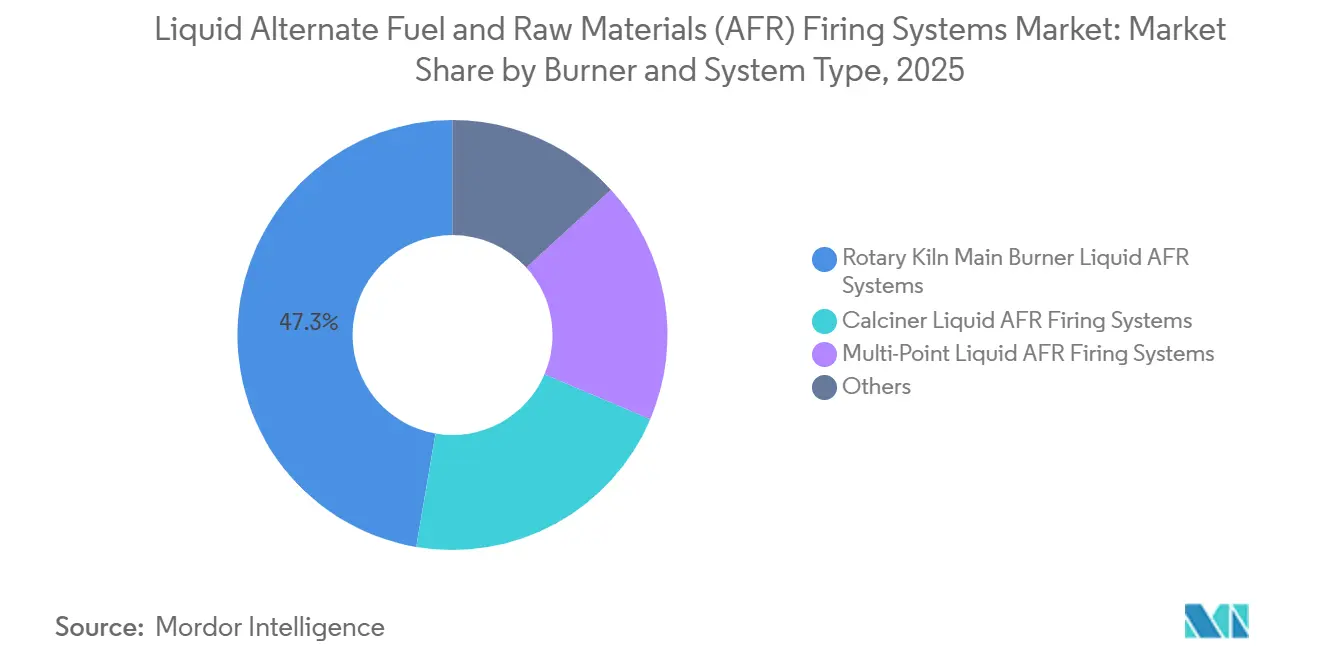
Rotary Kiln Main Burner Liquid AFR Systems held 47.3% of the Liquid AFR firing systems market size in 2025. Their position reflects the main burner’s role as the primary heat source in cement pyroprocessing. Most kiln modernization projects begin with this location because it has a large installed base and a clear operating role. Main burners can co-fire liquid, solid, and gaseous fuels in established plant layouts. Their use provides a practical first step for plants that are moving away from conventional fossil fuels. However, main burner substitution normally reaches 50-60% unless the plant adds satellite or multi-point capability. This limitation creates a reason for operators to consider more extensive injection configurations.
Multi-Point Liquid AFR Firing Systems are expected to grow at a 7.7% CAGR from 2026 to 2031. They distribute liquid fuel across the calciner, main burner, and satellite injection locations. This arrangement lets the operator adjust combustion to fuel quality and kiln load. A 2026 study found that specific mixed liquid-waste ratios can reduce CO emissions by as much as 93.29% against single-fuel baseline cases. European emissions-monitoring requirements also favor systems that offer precise and traceable injection control. Calciner systems remain another major category because they can achieve 80-100% thermal substitution in the precalciner zone. KHD’s Pyrorotor installations demonstrate how calciner equipment can process lower-quality fuel streams. Other systems include satellite burners that provide a lower-capital route to incremental substitution gains.



By Fuel Type: Waste Oils Hold the Largest Position and Bio-Oils Grow Fastest
Waste Oils captured 39.6% of the Liquid AFR firing systems market share by fuel type in 2025. Their high energy content makes them suitable for kiln combustion. Waste engine and lubricating oils averaged 44,591 kJ/kg in a 2026 study. Automotive, industrial maintenance, and refinery activities also provide established waste oil streams. Plants can use familiar filtration, preheating, and viscosity-control processes for these fuels. Used solvents and liquid chemical residues form the second major fuel category because they combine high calorific value with a disposal need in the chemical sector.
Liquid Biomass and Bio-Oils represent the fastest-growing fuel type, with an 8.1% CAGR projected through 2031. Their growth is linked to biomass certification rules and to on-site pyrolysis technology. Fuller Technologies assessed a system in 2025 that converts waste and RDF into CircFuel pyrolysis oil within the cement plant boundary. This approach can give operators a direct source of liquid fuel and reduce reliance on imports. Sewage sludge and pumpable slurries are gaining interest where treatment infrastructure has improved supply consistency. Their high moisture content still requires dewatering, preheating, and specialized atomization. European sustainability criteria for liquid biofuels also influence which streams can receive carbon-accounting benefits.
By End-User Industry: Cement Retains Its Dominant Position
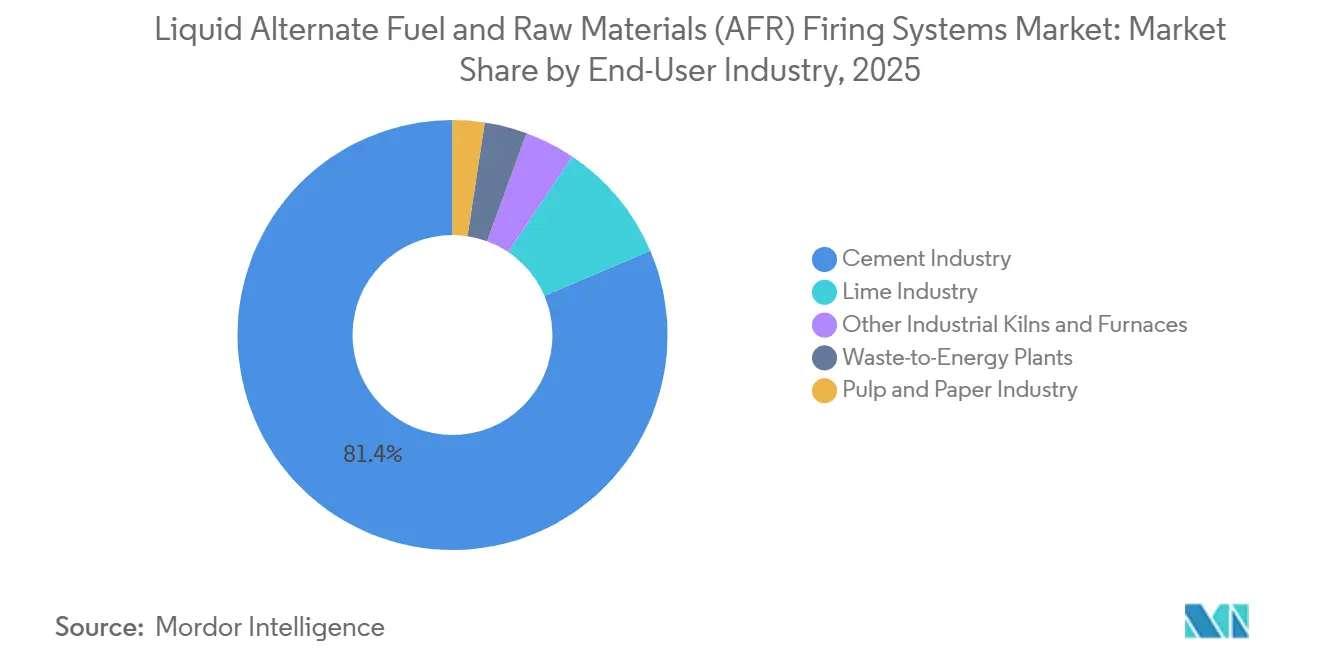
The cement industry held 81.4% of the Liquid AFR firing systems market size in 2025 and is expected to grow at a 7.6% CAGR through 2031. Cement kilns operate continuously at temperatures above 1,400°C. They require around 3 GJ of thermal energy for each metric ton of clinker. This energy requirement creates a large and recurring need for alternative fuel systems. Cement producers also face increasing pressure to lower emissions and improve fuel flexibility. These conditions make cement the largest and fastest-growing end-user group.
China’s leading cement producers illustrate the range of current adoption. Huaxin Cement reported a liquid-inclusive thermal substitution rate of 14.9% in 2025, while Taiwan Cement reached 19% against a national average of 8%. India’s cement producers are also increasing co-processing under policy programs that support alternative fuel use. Lime kilns, waste-to-energy plants, and pulp and paper operations are adjacent opportunities, but their operating conditions differ from cement plants. Lime kilns have lower temperatures and varying schedules, while pulp and paper recovery systems face uneven approval for waste-derived liquids. Waste-to-energy plants can also compete with cement plants for the same waste oil and solvent feedstocks. Other industrial kilns and furnaces remain a smaller and fragmented group within the Liquid AFR firing systems market.
Geography Analysis
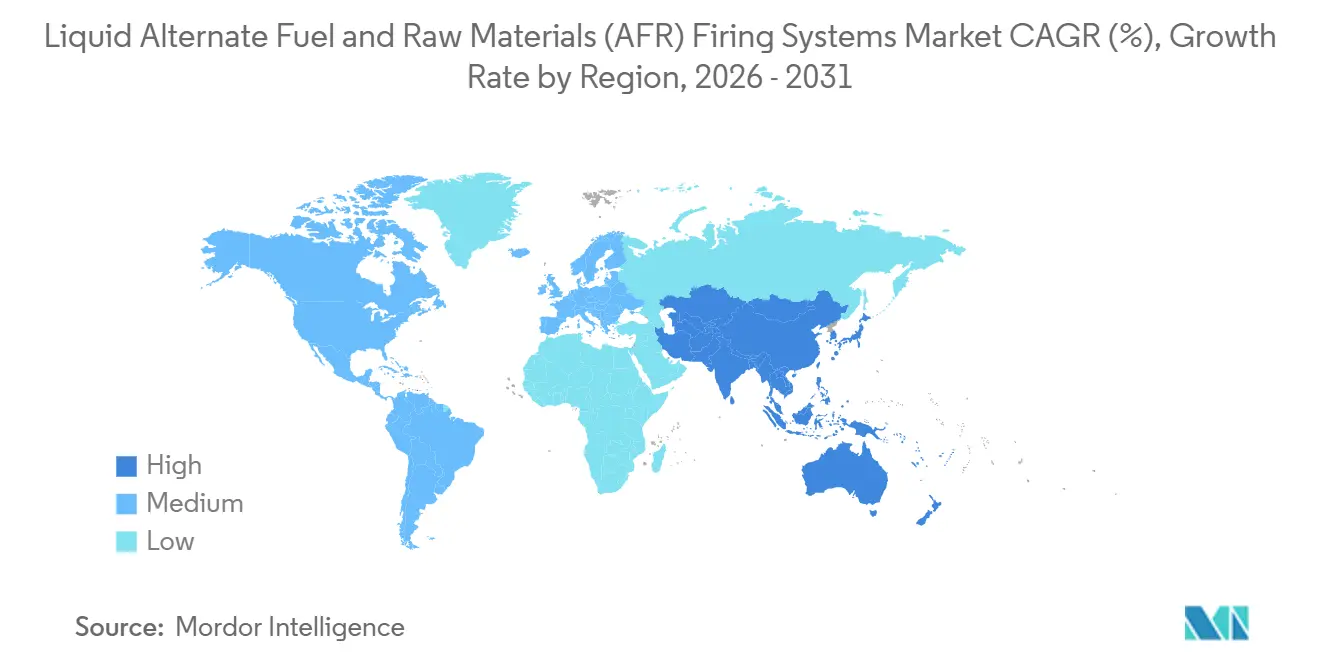
Europe held 41.3% of the Liquid AFR firing systems market share in 2025. EU carbon costs, landfill-diversion requirements, and long-established waste infrastructure support a consistent liquid fuel supply. France, Germany, Italy, Poland, and Spain are the region’s main high-volume markets. Austria and Switzerland have demonstrated high thermal substitution performance. Holcim’s Eclépens plant reached nearly 95% substitution within 6 months and reduced net CO₂ output by 40,000 metric tons a year. Europe’s upcoming Industrial Emissions Directive requirements are likely to increase spending on monitoring and control equipment through the late 2020s.
Asia-Pacific is projected to expand at an 8.7% CAGR from 2026 to 2031, the fastest rate among the geographic segments. China’s inclusion of cement in its national carbon market gives alternative-fuel investments a clearer financial basis. KHD commissioned its second Pyrorotor system for Conch Group’s Baoshan plant in December 2025. Conch then stated that it would assess further installations across its network. Indonesia’s Semen Baturaja increased liquid-inclusive AFR use by 41% in 2024 and raised thermal substitution to 3.18%. India’s plants averaged 3-5% thermal substitution, leaving material capacity for additional system adoption.
North America, South America, and MEA have different demand conditions. North America’s average thermal substitution rate was 16% in 2024, compared with 52% in Europe, and fuel security remains a stronger motivation than carbon pricing. South America is building momentum through circular-economy initiatives and combustion-system investment. The Middle East and Africa have direct fuel-conversion opportunities, but projects are shaped by local policy and capital availability. Sinoma signed a USD 12 million EPC contract with Qassim Cement in August 2025 to convert Buraydah plant lines from crude oil firing to natural gas. The project had a 15-month schedule.

Competitive Landscape
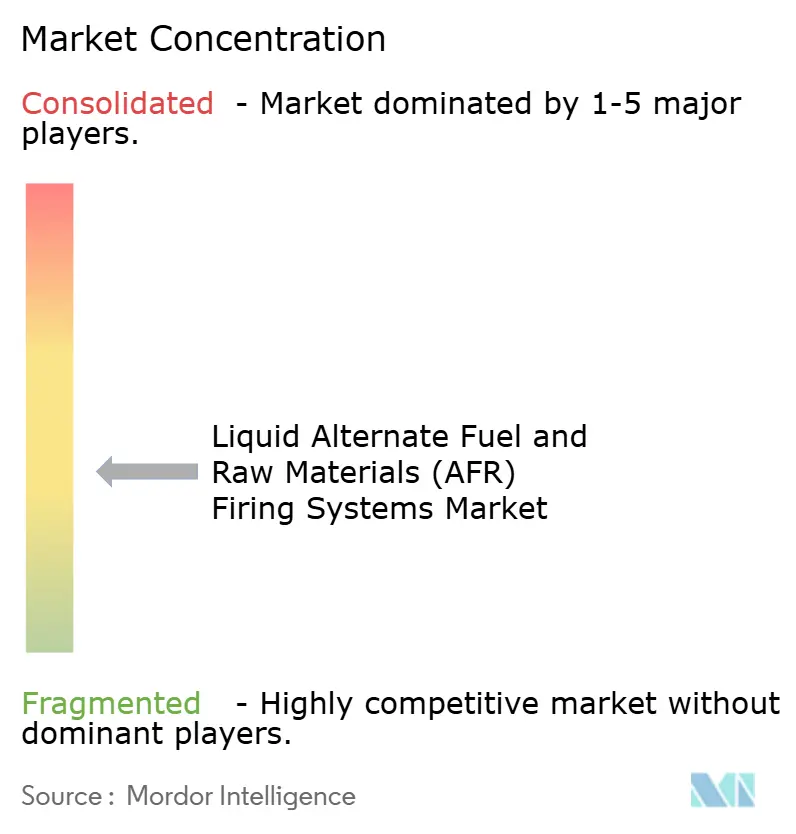
The Liquid AFR firing systems market has a moderate level of concentration. KHD Humboldt Wedag and thyssenkrupp Polysius are full-scope pyroprocess equipment suppliers. Their liquid fuel capabilities are part of broader kiln modernization packages. This position gives them access to long-term plant relationships and integrated upgrade programs. FCT Combustion and Fives Pillard compete as burner-focused specialists. They can supply systems designed for high alternative-fuel substitution within larger EPC projects.
Regional specialists address fuel handling, preheating, and atomization needs that vary by plant and fuel stream. SATAREM’s work on waste oil preheating and injection for CEMEX Panama in June 2026 shows how targeted equipment can support direct liquid fuel use in regional markets. KHD’s February 2026 Batisöke order increased its global Pyrorotor footprint to 23 sold units. Sinoma’s scale as a turnkey EPC provider supports its position in emerging markets that prefer single-source project delivery. Suppliers increasingly differentiate through feed control, adaptive atomization, maintenance support, and compliance documentation. These capabilities matter because liquid fuels can differ considerably from one delivery batch to another.
The Liquid AFR firing systems market also has room for modular systems that require less capital than a full kiln overhaul. Many cement plants still operate below 25% thermal substitution and need staged upgrades. Suppliers that pair equipment with service agreements can reduce the operating risk faced by kiln owners. FCT Combustion’s European contracts for high-substitution burner and calciner packages show that specialized combustion suppliers can support ambitious fuel-replacement projects. Fives Pillard received a NOVAFLAM Evolution main kiln burner contract from Cementos Progreso in May 2026. No company market-share data is available to support a more precise ranking of the named suppliers.
Liquid Alternate Fuel and Raw Materials (AFR) Firing Systems Industry Leaders
Fives Group
Fuller Technologies, Inc.
KHD Humboldt Wedag International AG
thyssenkrupp Polysius GmbH
Unitherm Cemcon Feuerungsanlagen GmbH
- *Disclaimer: Major Players sorted in no particular order

Recent Industry Developments
- July 2026: Baudelet Group commissioned a new solid recovered fuel production line in Blaringhem, France, with a EUR 11.5 million investment that doubled output capacity to 75,000 metric tons per year. A 10-year supply contract with EQIOM's Lumbres cement plant secures dedicated long-term demand.
- February 2026: KHD commenced the Pyrorotor® alternative fuel system project at Batisöke’s cement plant in Türkiye. The order was KHD’s 21st global Pyrorotor order and its second installation in the country.
- December 2025: KHD commissioned its second Pyrorotor alternative fuel system at Conch Group’s Baoshan cement plant in Yunnan Province, China. The plant has a 5,000 tpd production line, and Conch expressed interest in assessing further installations.
- May 2025: Fives Pillard S.A.S. was awarded a Pillard NOVAFLAM® Evolution main kiln burner contract by Cementos Progreso in Guatemala, the second consecutive burner replacement at the customer’s 3-kiln facility.


Global Liquid Alternate Fuel and Raw Materials (AFR) Firing Systems Market Report Scope
A Liquid Alternate Fuel and Raw Materials (AFR) Firing System is an engineered fuel handling, storage, dosing, and combustion system designed to receive, condition, meter, and inject liquid waste-derived fuels into high-temperature industrial kilns or furnaces. It is used primarily in the cement industry as a substitute for conventional fossil fuels such as coal, petroleum coke, heavy fuel oil, or natural gas.
The Liquid AFR Firing Systems Market is segmented by burner and system type, fuel type, end-user industry, and geography. By burner and system type, the market is segmented into Rotary Kiln Main Burner Liquid AFR Systems, Calciner Liquid AFR Firing Systems, Multi-Point Liquid AFR Firing Systems, and Other Liquid AFR Firing Systems. By fuel type, the market is segmented into Waste Oils, Used Solvents, Liquid Biomass/Bio-Oils, and Other Liquid Alternative Fuels. By end-user industry, the market is segmented into Cement, Lime, Waste-to-Energy, Pulp & Paper, and Other Industrial Kilns and Furnaces. The report also covers the market size and forecasts for the Global Liquid AFR Firing Systems Market across 26 countries in key regions. For each segment, the market sizing and forecasts are provided on the basis of value (USD).
| Rotary Kiln Main Burner Liquid AFR Systems |
| Calciner Liquid AFR Firing Systems |
| Multi-Point Liquid AFR Firing Systems |
| Others |
| Waste Oils |
| Used Solvents and Liquid Chemical Residues |
| Liquid Biomass and Bio-Oils |
| Sewage Sludge and Pumpable Slurries |
| Others |
| Cement Industry |
| Lime Industry |
| Waste-to-Energy Plants |
| Pulp & Paper Industry |
| Other Industrial Kilns and Furnaces |
| North America | United States |
| Canada | |
| Mexico | |
| Europe | Germany |
| France | |
| Italy | |
| Spain | |
| United Kingdom | |
| Poland | |
| Russia | |
| Rest of Europe | |
| Asia-Pacific | China |
| India | |
| Japan | |
| South Korea | |
| Australia | |
| Indonesia | |
| Vietnam | |
| Thailand | |
| Rest of Asia-Pacific | |
| South America | Brazil |
| Argentina | |
| Chile | |
| Rest of South America | |
| Middle East and Africa | Saudi Arabia |
| United Arab Emirates | |
| Egypt | |
| South Africa | |
| Morocco | |
| Rest of Middle East and Africa |
| By Burner and System Type | Rotary Kiln Main Burner Liquid AFR Systems | |
| Calciner Liquid AFR Firing Systems | ||
| Multi-Point Liquid AFR Firing Systems | ||
| Others | ||
| By Fuel Type | Waste Oils | |
| Used Solvents and Liquid Chemical Residues | ||
| Liquid Biomass and Bio-Oils | ||
| Sewage Sludge and Pumpable Slurries | ||
| Others | ||
| By End-User Industry | Cement Industry | |
| Lime Industry | ||
| Waste-to-Energy Plants | ||
| Pulp & Paper Industry | ||
| Other Industrial Kilns and Furnaces | ||
| By Geography | North America | United States |
| Canada | ||
| Mexico | ||
| Europe | Germany | |
| France | ||
| Italy | ||
| Spain | ||
| United Kingdom | ||
| Poland | ||
| Russia | ||
| Rest of Europe | ||
| Asia-Pacific | China | |
| India | ||
| Japan | ||
| South Korea | ||
| Australia | ||
| Indonesia | ||
| Vietnam | ||
| Thailand | ||
| Rest of Asia-Pacific | ||
| South America | Brazil | |
| Argentina | ||
| Chile | ||
| Rest of South America | ||
| Middle East and Africa | Saudi Arabia | |
| United Arab Emirates | ||
| Egypt | ||
| South Africa | ||
| Morocco | ||
| Rest of Middle East and Africa | ||


Key Questions Answered in the Report
How large is the liquid AFR firing systems market?
The Liquid AFR firing systems market size is estimated at USD 185.61 million in 2026 and is forecast to reach USD 258.11 million by 2031.
What is driving demand for liquid AFR firing systems?
Carbon-cost exposure, landfill-diversion requirements, energy security needs, and cement-plant modernization are supporting demand.
Which fuel type has the largest role in liquid AFR systems?
Waste oils held 39.6% share in 2025 because they offer high energy content and have established handling infrastructure.
Which end-user sector uses liquid AFR systems most extensively?
Cement held 81.4% share in 2025 and is projected to grow at 7.6% through 2031 because kilns require high, continuous thermal energy input.
Which region is growing fastest for liquid AFR firing systems?
Asia-Pacific is projected to grow at an 8.7% CAGR through 2031, supported by policy developments in China, India, and Southeast Asia.
Page last updated on:





