
Lipid Nanoparticle CDMO Market Size and Share
Market Overview
| Study Period | 2020 - 2031 |
|---|---|
| Market Size (2026) | USD 451.41 Million |
| Market Size (2031) | USD 881.32 Million |
| Growth Rate (2026 - 2031) | 14.32 % |
| Fastest Growing Market | Asia-Pacific |
| Largest Market | North America |
| Market Concentration | Medium |
Major Players *Disclaimer: Major Players sorted in no particular order Image © Mordor Intelligence. Reuse requires attribution under CC BY 4.0. | |
Lipid Nanoparticle CDMO Market Analysis by Mordor Intelligence
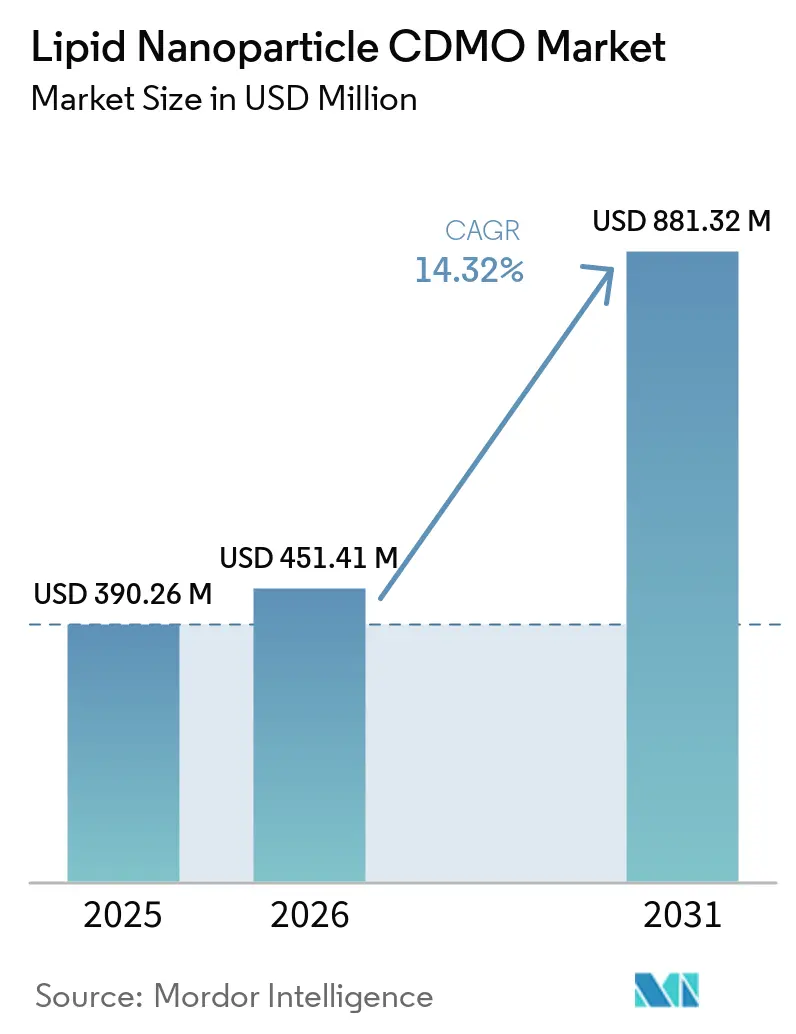
The Lipid Nanoparticle CDMO Market size is expected to increase from USD 390.26 million in 2025 to USD 451.41 million in 2026 and reach USD 881.32 million by 2031, growing at a CAGR of 14.32% over 2026-2031.
Sponsors are shifting toward outsourced expertise because formulation science, analytical method validation, and aseptic fill-finish all demand capital-intensive infrastructure and talent pools that few drug developers can justify building internally. Public-sector funding accelerates this trend; BARDA’s USD 150 million grant to Evonik’s Lafayette lipid hub in 2025 exemplifies sovereign efforts to secure domestic supply chains. Patent barriers are also easing, as the European Patent Office revoked Arbutus’s foundational EP 2279254 in 2026, widening technology access for contract manufacturers. At the same time, FDA guidance encouraging continuous processing and real-time release testing is nudging CDMOs toward microfluidic and modular systems that compress release timelines and reduce batch variability [1]. Capacity build-outs in North Carolina, South Korea, and Australia signal that geographic footprints are expanding in lockstep with a diversified mRNA pipeline spanning oncology, rare disease, and pandemic-preparedness vaccines.
Key Report Takeaways
- By service type, cGMP drug product manufacturing captured 27.96% of 2025 revenue while LNP formulation & encapsulation posting the fastest 15.87% CAGR to 2031, reflecting early-stage optimization needs that trigger repeat engagements.
- By application, infectious disease vaccines therapeutics led with 40.11% revenue share in 2025, whereas oncology therapeutics are advancing at a 15.92% CAGR through 2031.
- By scale of operation, commercial is forecasted to grow quickest at 15.28% annually even though clinical operations retained 48.65% share in 2025.
- By end user, small & mid-sized biotechnology companies held 47.13% of lipid nanoparticle CDMO market share in 2025, whereas large pharmaceutical companies is expanding at 15.23% CAGR.
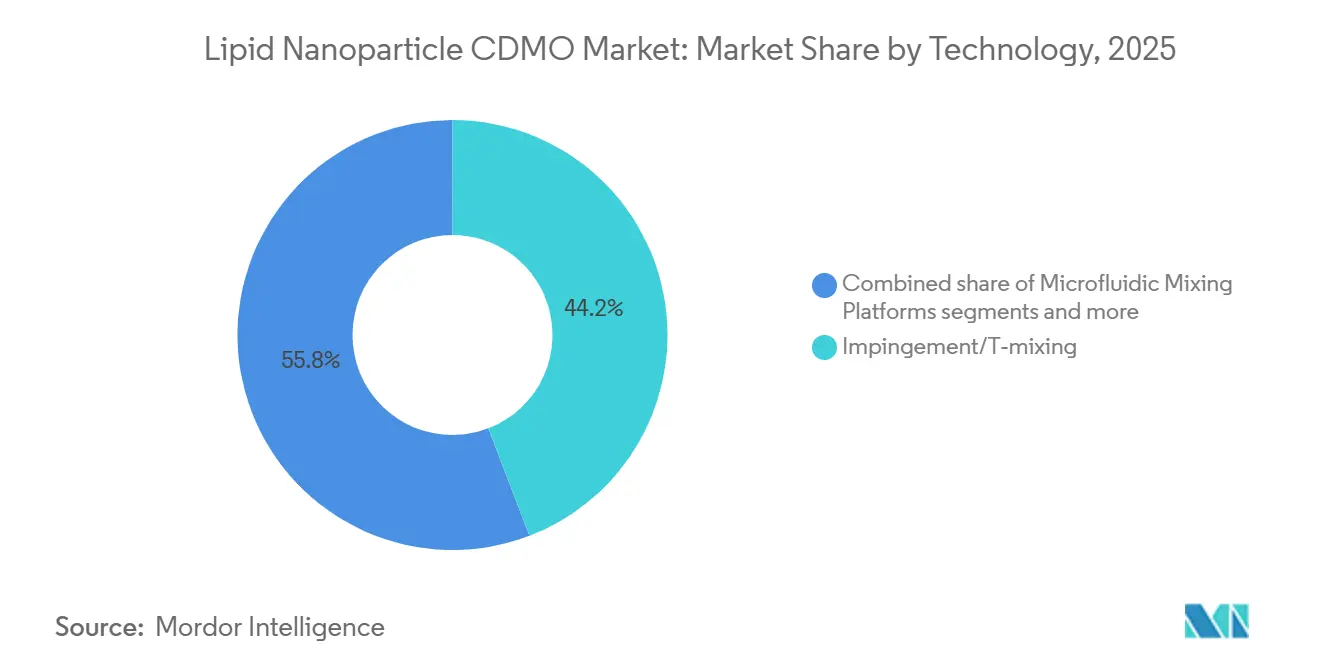
- By technology, continuous/modular LNP production platforms are rising at a 16.02% CAGR, outpacing impingement/T-mixing that still represented 44.17% of 2025 revenue.
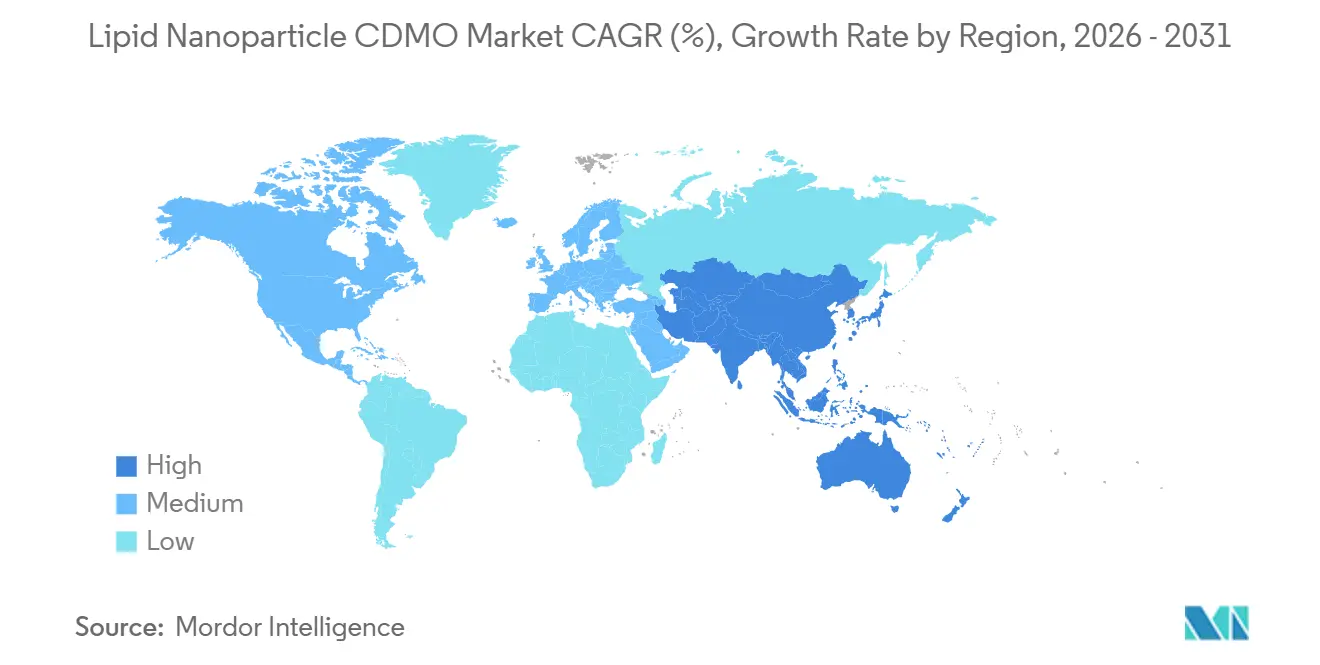
- North America led with 42.83% revenue share in 2025; Asia-Pacific is the fastest-growing region at 15.82% CAGR to 2031.
Note: Market size and forecast figures in this report are generated using Mordor Intelligence’s proprietary estimation framework, updated with the latest available data and insights as of January 2026.
Market Trends and Insights
Drivers Impact Analysis of Lipid Nanoparticle CDMO Market*
| Driver | (~) % Impact on CAGR Forecast | Geographic Relevance | Impact Timeline |
|---|---|---|---|
| Pipeline expansion in mRNA vaccines and therapeutics | +3.2% | Global, strongest in North America and Europe | Medium term (2-4 years) |
| Outsourcing of complex LNP formulation and fill-finish | +2.8% | Global | Short term (≤2 years) |
| Government-backed capacity investments | +2.1% | North America, Europe, Asia-Pacific | Medium term (2-4 years) |
| Scalable microfluidic and single-use platforms | +1.9% | Global, early adoption in North America and Europe | Long term (≥4 years) |
| Decentralized continuous manufacturing hubs | +1.6% | Africa, Latin America, Southeast Asia | Long term (≥4 years) |
| Lyophilized thermostable formulations | +1.4% | Global, priority in low-resource settings | Medium term (2-4 years) |
| Source: Mordor Intelligence | |||
Pipeline Expansion in mRNA Vaccines and Therapeutics
Dozens of late-stage oncology trials, including Moderna’s mRNA-4157 and BioNTech’s BNT122, are generating persistent demand for lipid ratio tuning, encapsulation-efficiency optimization, and particle-size control. Personalized vaccine workflows require CDMOs to compress manufacturing cycles from eight weeks to four, reinforcing multi-year service contracts. Rare-disease programs such as mRNA-3927 for propionic acidemia validate the platform’s versatility and extend the service horizon beyond seasonal vaccines. Regulatory familiarity with mRNA constructs, supported by FDA analytical guidance issued in 2024, shortens review timelines and emboldens sponsors to advance diversified pipelines [2]. The broadened indication mix lengthens engagement periods and elevates the strategic value of CDMOs with integrated development-to-commercial capabilities.
Outsourcing of Complex LNP Formulation and Fill-Finish
Pharma innovators now view specialist CDMOs as partners for capabilities that are uneconomical to replicate internally. Lonza expanded its Stein and Geleen sites to bundle lipid synthesis through aseptic vial filling under one quality system. Analytical method development alone can exceed USD 10 million in capital outlay per lab, pushing small biotechs now growing at 14.75% CAGR toward external partnerships. Lyophilization expertise further differentiates suppliers, with Precision NanoSystems validating GenVoy-ILM for room-temperature storage in 2025. Continuous processing magnifies this outsourcing imperative because real-time analytics demand cross-functional talent pools that few sponsors maintain in-house.
Government-Backed Capacity Investments in Lipids and LNP
The United Kingdom’s GBP 520 million Biomanufacturing Fund, Canada’s CAD 200 million Resilience hub, and BARDA’s USD 150 million grant to Evonik are underwriting lipid and LNP infrastructure that would otherwise struggle to clear private hurdle rates. These subsidies accelerate time-to-capacity and improve regional supply resilience, thereby supporting demand growth across the lipid nanoparticle CDMO market. Sovereign involvement also incentivizes CDMOs to locate facilities closer to strategic stockpile programs, locking in long-term volume commitments.
Scalable Microfluidic and Single-Use Platforms
Recipharm’s CP1 line, built with USD 82 million in FDA funding, integrates inline sensors and closed-loop control that cut batch variability below 5%. Precision NanoSystems’ staggered-herringbone micromixers routinely achieve sub-100 nm particles with PDIs under 0.15, a benchmark that enhances cellular uptake. Single-use assemblies eliminate cross-contamination risk and shorten changeovers, advantages that resonate with personalized oncology programs. Although a GMP microfluidic suite costs roughly USD 25 million, the regulatory push for continuous processing positions these platforms as future industry standards.
Restraints Impact Analysis of Lipid Nanoparticle CDMO Market*
| Restraint | (~) % Impact on CAGR Forecast | Geographic Relevance | Impact Timeline |
|---|---|---|---|
| LNP intellectual property litigation | −1.8% | Global, concentrated in US, EU, Asia | Short term (≤2 years) |
| GMP-grade lipid and component supply constraints | −1.5% | Global | Medium term (2-4 years) |
| Solvent handling and sustainability pressures | −0.9% | North America, Europe | Long term (≥4 years) |
| Talent shortages and Pharma 4.0 adoption gaps | −1.2% | Global, acute in Asia-Pacific | Medium term (2-4 years) |
| Source: Mordor Intelligence | |||
LNP Intellectual Property Litigation and Licensing Complexity
Arbutus and Genevant sued Moderna across 30 jurisdictions in 2025, creating uncertainty over royalty stacking and freedom-to-operate for licensees. Although the EPO revoked EP 2279254 in 2026, overlapping patents on ionizable lipids still complicate contracting and extend negotiations by up to six months. Smaller sponsors bear higher risk premiums, dampening near-term demand growth within the lipid nanoparticle CDMO market.
GMP-Grade Lipid and Component Supply Constraints
Fewer than ten manufacturers supply GMP-grade ionizable lipids globally, and a single pandemic-scale campaign can consume up to 100 metric tons annually. Evonik’s Lafayette plant added 200 metric tons of capacity in 2025 yet leaves little buffer for therapeutics. Prolonged lead times force CDMOs to stockpile inventory, tying up working capital and elevating write-off risk if formulations evolve. Vertical integration is capital-intensive, so access remains uneven across the supply base.
*Our forecasts treat driver/restraint impacts as directional, not additive. The impact forecasts reflect baseline growth, mix effects, and variable interactions.
Lipid Nanoparticle CDMO Market Segment Analysis
By Service Type:
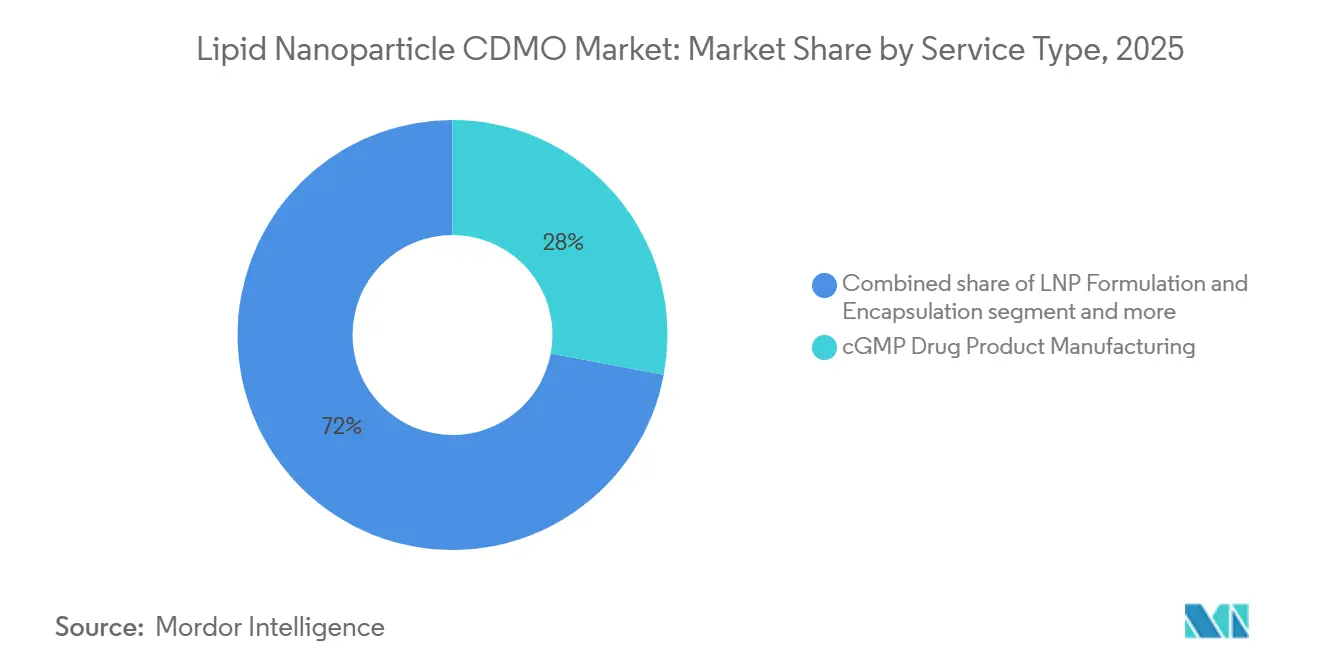
Early-Stage Development Activities Fuel Long-Term Outsourcing DemandBy service type, cGMP drug product manufacturing accounted for 27.96% of the lipid nanoparticle CDMO market revenue in 2025, reflecting strong demand for GMP-compliant production of mRNA therapeutics, vaccines, gene-editing products, and other nucleic acid-based medicines. The segment benefits from increasing clinical and commercial manufacturing requirements as sponsors seek reliable partners capable of meeting regulatory standards and supporting large-scale production needs.
Meanwhile, LNP formulation & encapsulation is projected to expand at the fastest CAGR of 15.87% through 2031, driven by the growing complexity of RNA-based drug development and the need for specialized formulation expertise. Developers increasingly rely on CDMOs for lipid selection, encapsulation optimization, particle characterization, stability enhancement, and process development activities during early-stage development. In addition, demand for analytical testing, quality control, fill-finish, and lyophilization services continues to increase as companies seek integrated outsourcing solutions. Consequently, CDMOs offering comprehensive development and manufacturing capabilities are strengthening their competitive position across the lipid nanoparticle CDMO market.

By Application:
Oncology Emerges as the Fastest-Growing Therapeutic AreaBy application, infectious disease vaccines and therapeutics accounted for 40.11% of the lipid nanoparticle CDMO market revenue in 2025, supported by the established adoption of LNP-enabled mRNA technologies and continued investments in vaccine development programs. The segment continues to generate substantial outsourcing demand for formulation development, clinical manufacturing, analytical testing, and commercial production services.
However, oncology therapeutics are anticipated to register the fastest CAGR of 15.92% through 2031, driven by increasing research activity in cancer vaccines, personalized immunotherapies, and RNA-based therapeutic platforms. The rising number of oncology candidates entering clinical trials is creating demand for specialized LNP formulation and manufacturing expertise. In addition, rare, genetic, and metabolic disorders are projected to grow at a CAGR of 14.34% through 2031, supported by advances in mRNA, gene-editing, and nucleic acid therapeutics aimed at addressing complex diseases. As therapeutic applications continue to diversify, CDMOs with expertise in formulation optimization, process scale-up, and GMP manufacturing are expected to benefit from expanding outsourcing requirements across multiple disease areas.
By Scale of Operation:
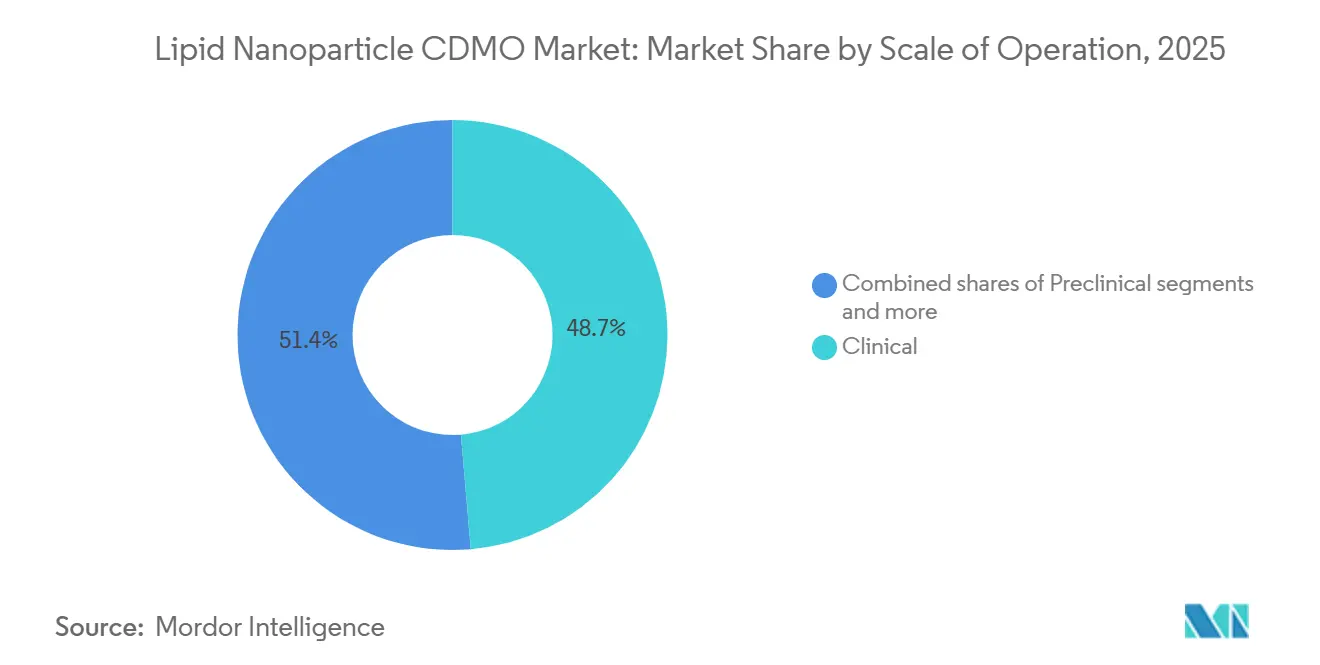
Commercial Manufacturing Gains Momentum as Pipelines MatureBy scale of operation, clinical manufacturing held the largest share of the lipid nanoparticle CDMO market at 48.65% in 2025, reflecting the significant number of RNA therapeutics and nucleic acid-based products currently progressing through preclinical and clinical development. Demand remains strong for small- and mid-scale manufacturing services that support process development, formulation optimization, and clinical trial supply requirements.
In contrast, commercial manufacturing is expected to record the fastest CAGR of 15.28% through 2031, driven by the anticipated progression of late-stage programs toward regulatory approval and commercialization. Growing demand for large-scale GMP production, supply security, and global distribution capabilities is encouraging sponsors to establish long-term manufacturing partnerships with specialized CDMOs. As more LNP-enabled products approach commercialization, providers with scalable production platforms and integrated development-to-commercialization capabilities are expected to capture significant market opportunities.
By End User:
Growing Pharmaceutical Investments Complement Strong Biotech DemandBy end user, small and mid-sized biotechnology companies held 47.13% of the lipid nanoparticle CDMO market share in 2025, reflecting their substantial reliance on outsourced development and manufacturing services. Limited internal manufacturing infrastructure and increasing innovation in mRNA, siRNA, and gene-editing therapies continue to drive demand for CDMO support across formulation development, analytical testing, process optimization, and GMP manufacturing activities.
Meanwhile, large pharmaceutical companies are projected to grow at the fastest CAGR of 15.23% through 2031, supported by expanding investments in RNA-based therapeutics and strategic efforts to secure advanced LNP development and manufacturing capabilities. Pharmaceutical companies are increasingly partnering with specialized CDMOs to accelerate development timelines, enhance manufacturing flexibility, and access technical expertise in nanoparticle formulation. Additionally, government agencies, academic institutions, and public-private research partnerships continue to contribute to market development through funding, innovation, and translational research initiatives. Consequently, CDMOs offering integrated end-to-end services are expected to benefit from increasing outsourcing demand across both biotechnology and pharmaceutical organizations.
By Technology or Process Continuous Platforms Disrupt Batch Incumbency
Impingement and T-mixing systems still delivered 44.17% of 2025 revenue thanks to regulatory familiarity. However, continuous and modular LNP production will grow at 16.02% CAGR as platforms like CP1 demonstrate sub-5% batch variability and real-time release. Microfluidic equipment such as NanoAssemblr enables sub-100 nm particles and precise lipid-to-mRNA ratios, supporting personalized oncology workflows.
Alternative non-viral nanoparticles remain exploratory, but interest is rising as sponsors seek chemistries that avoid PEG-related hypersensitivity. CDMOs investing early in continuous control architectures and diversified lipid portfolios are advantaged in securing long-term master-service agreements within the lipid nanoparticle CDMO market.
Geography Analysis
North America Lipid Nanoparticle CDMO Market
North America held 42.83% of 2025 revenue, supported by Thermo Fisher’s USD 650 million Greenville expansion and Evonik’s BARDA-funded lipid center in Indiana. Dense biotech clusters in Boston and San Francisco sustain early-stage pipeline flow, while regulatory familiarity with mRNA expedites approvals.
Europe Lipid Nanoparticle CDMO Market
Europe accounted for roughly one-quarter of 2025 revenue. Germany’s Rhineland corridor links CordenPharma’s lipid synthesis, Rentschler’s formulation, and Evonik’s fill-finish capabilities, offering sponsors EU-GMP compliance without complex cross-border logistics [3]. The United Kingdom’s GBP 520 million biomanufacturing fund signals intent to reclaim post-Brexit competitiveness, though divergent regulations add documentation burdens.
APAC Lipid Nanoparticle CDMO Market
Asia-Pacific is projected to grow fastest at 15.82% CAGR through 2031. Samsung Biologics’ Songdo facility, Moderna’s Melbourne build, and Chinese partnerships between Walvax, CSPC, and WuXi Biologics underscore regional momentum. India’s Gennova advanced GEMCOVAC-19 toward approval, showcasing ambitions for indigenous mRNA capacity. WHO’s technology-transfer hub extended to 15 countries by 2025, but uneven regulatory capacity limits immediate volume.
Competitive Landscape
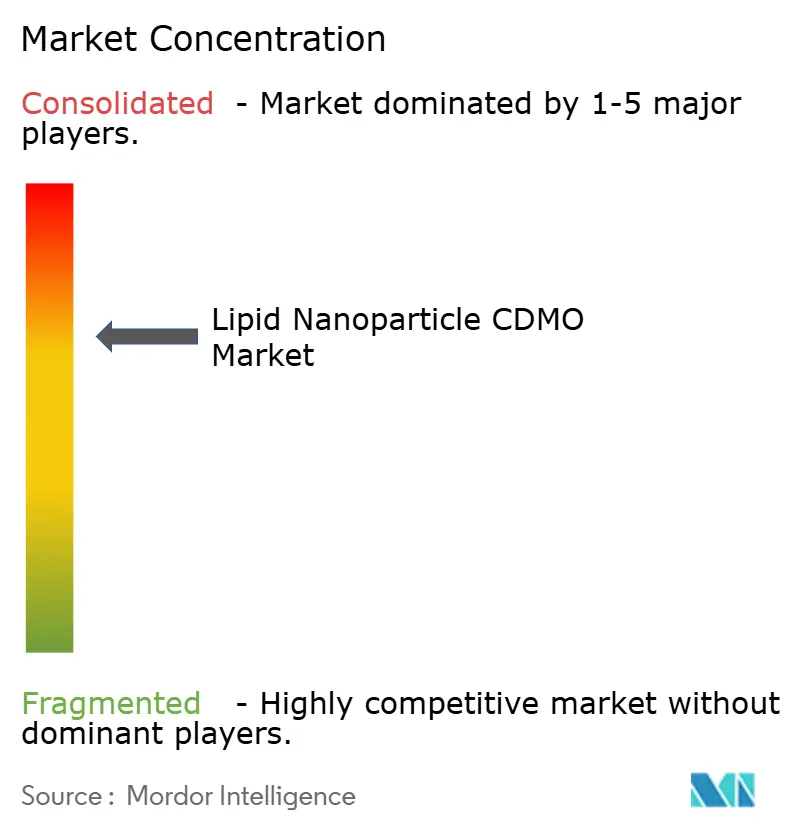
The top five suppliers controlled a majority of 2025 revenue, producing a moderately concentrated structure within the lipid nanoparticle CDMO market. Integrated players such as Lonza and Thermo Fisher bundle mRNA plasmid production, lipid synthesis, formulation, analytics, and fill-finish under unified quality systems, easing tech-transfer risk for global sponsors. Samsung Biologics and WuXi AppTec leverage large campuses and cost advantages to court multinational pharma while adding proprietary continuous lines.
Specialists such as Polymun Scientific Immunbiologische Forschung GmbH and Recipharm AB compete through advanced formulation expertise, microfluidic-enabled development capabilities, and rapid process optimization services. Evonik’s vertical integration into ionizable lipid supply provides a hedge against raw-material shortages and positions the firm as a preferred partner for North American programs under domestic-content rules. Continuous-manufacturing pioneers such as Recipharm are building competitive moats by achieving real-time release profiles that batch systems struggle to match.
Litigation risks remain a wild card. The Arbutus and Genevant suit against Moderna could recalibrate licensing economics if royalties rise or chemistries shift. Mid-tier CDMOs lacking differentiated platforms or secured lipid supply are likely acquisition targets as leaders seek scale. Thermostable formulation, decentralized modular plants, and Pharma 4.0 analytics represent the next battlegrounds, and early movers stand to lock in multi-year government stockpile contracts that stabilize volume in the lipid nanoparticle CDMO market.
Lipid Nanoparticle CDMO Industry Leaders
-
Evonik Industries AG
-
Lonza Group AG
-
CordenPharma
-
Merck KGaA
-
Curia Global Inc.
- *Disclaimer: Major Players sorted in no particular order
Lipid Nanoparticle CDMO Market Companies Covered in this Report
- AGC Inc.
- Ardena
- CordenPharma
- Curia Global Inc.
- Evonik
- FUJIFILM
- Kaneka Eurogentec SA (Kaneka Corporation)
- Lonza Group
- Merck
- PCI Pharma Services (Ajinomoto Co. Inc.)
- Polymun Scientific Immunbiologische Forschung GmbH
- Recipharm AB (EQT)
- Samsung Group
- ST Pharm Co. Ltd
- Thermo Fisher Scientific Inc. (Patheon)
- TriLink BioTechnologies (Maravai LifeSciences)
- Wacker Chemie AG
- WuXi TIDES (WuXi AppTec Co. Ltd)
Recent Industry Developments in Lipid Nanoparticle CDMO Market
- January 2026: Acuitas acquired a majority stake in RNA Technologies & Therapeutics to broaden its RNA pipeline.
- October 2025: Evonik’s USD 220 million Lafayette lipid center became operational with BARDA support, adding 200 metric tons of annual capacity.
- September 2025: Biocytogen Pharmaceuticals reached an agreement with Merck KGaA to accelerate work on antibody-linked lipid carriers that can transport nucleic-acid drugs.
Global Lipid Nanoparticle CDMO Market Report Scope
As per the scope of the report, Lipid nanoparticle (LNP) Contract Development and Manufacturing Organizations (CDMOs) are specialized partners that provide end-to-end services for the development, formulation, and GMP-compliant manufacturing of advanced drug delivery systems.
The Lipid Nanoparticle CDMO Market is segmented by service type, applications, scale of operation, end-users, technology, and geography. By service type, it is segmented into formulation & process development, LNP formulation & encapsulation, analytical & quality control, CGMP drug product manufacturing, and fill-finish & lyophilization. By application, the market is segmented into infectious disease vaccines, oncology therapeutics, rare/genetic & metabolic disorders, and other applications. By scale of operation, the market is divided into preclinical, clinical, and commercial. By end-users, the segmentation includes large pharmaceutical companies, small & mid-sized biotechnology companies, government & academic institutions, and others. By technology, the market is segmented into microfluidic mixing platforms, impingement/T‑mixing, continuous/modular LNP production, and batch manufacturing systems. Geographically, the market is segmented across North America, Europe, the Asia-Pacific region, the Middle East & Africa, and South America. The market report also covers the estimated market sizes and trends for 17 countries across major regions globally. For each segment, the market size and forecast are provided in terms of value (USD).
Segmentation Overview
| Formulation & Process Development |
| LNP Formulation & Encapsulation |
| Analytical & Quality Control |
| cGMP Drug Product Manufacturing |
| Fill-Finish & Lyophilization |
| Infectious Disease Vaccines |
| Oncology Therapeutics |
| Rare/Genetic & Metabolic Disorders |
| Other Applications |
| Preclinical |
| Clinical |
| Commercial |
| Large Pharmaceutical Companies |
| Small & Mid-Sized Biotechnology Companies |
| Government & Academic Institutions |
| Other End Users |
| Microfluidic Mixing Platforms |
| Impingement/T?mixing |
| Continuous/Modular LNP Production |
| Batch Manufacturing Systems |
| North America | United States |
| Canada | |
| Mexico | |
| Europe | Germany |
| United Kingdom | |
| France | |
| Italy | |
| Spain | |
| Rest of Europe | |
| Asia-Pacific | China |
| Japan | |
| India | |
| Australia | |
| South Korea | |
| Rest of Asia-Pacific | |
| Middle East and Africa | GCC |
| South Africa | |
| Rest of Middle East and Africa | |
| South America | Brazil |
| Argentina | |
| Rest of South America |
| By Service Type | Formulation & Process Development | |
| LNP Formulation & Encapsulation | ||
| Analytical & Quality Control | ||
| cGMP Drug Product Manufacturing | ||
| Fill-Finish & Lyophilization | ||
| By Application | Infectious Disease Vaccines | |
| Oncology Therapeutics | ||
| Rare/Genetic & Metabolic Disorders | ||
| Other Applications | ||
| By Scale of Operation | Preclinical | |
| Clinical | ||
| Commercial | ||
| 5.4 By End User | Large Pharmaceutical Companies | |
| Small & Mid-Sized Biotechnology Companies | ||
| Government & Academic Institutions | ||
| Other End Users | ||
| By Technology/Process | Microfluidic Mixing Platforms | |
| Impingement/T?mixing | ||
| Continuous/Modular LNP Production | ||
| Batch Manufacturing Systems | ||
| By Geography | North America | United States |
| Canada | ||
| Mexico | ||
| Europe | Germany | |
| United Kingdom | ||
| France | ||
| Italy | ||
| Spain | ||
| Rest of Europe | ||
| Asia-Pacific | China | |
| Japan | ||
| India | ||
| Australia | ||
| South Korea | ||
| Rest of Asia-Pacific | ||
| Middle East and Africa | GCC | |
| South Africa | ||
| Rest of Middle East and Africa | ||
| South America | Brazil | |
| Argentina | ||
| Rest of South America | ||
Key Questions Answered in the Report
How large is the lipid nanoparticle CDMO market in 2026?
The lipid nanoparticle CDMO market size is estimated to reached USD 451.41 million in 2026.
What CAGR is projected for lipid nanoparticle CDMO services to 2031?
Market revenue is expected to grow at a 14.32% CAGR between 2026 and 2031.
Which service segment is expanding fastest?
LNP Formulation & Encapsulation services are forecast to post the quickest 15.87% CAGR.
Why is Asia-Pacific the fastest-growing region?
Government subsidies, new modular plants in South Korea and Australia, and rising local biotech pipelines are driving a 15.82% regional CAGR.
What technological trend is disrupting traditional batch production?
Continuous and modular LNP lines with real-time analytics are outpacing legacy impingement systems as sponsors seek shorter release timelines.