
Legal Document Automation Software Market Size and Share
Market Overview
| Study Period | 2020 - 2031 |
|---|---|
| Market Size (2026) | USD 2.98 Billion |
| Market Size (2031) | USD 6.49 Billion |
| Growth Rate (2026 - 2031) | 16.82% CAGR |
| Fastest Growing Market | Asia-Pacific |
| Largest Market | North America |
| Market Concentration | Medium |
Major Players *Disclaimer: Major Players sorted in no particular order Image © Mordor Intelligence. Reuse requires attribution under CC BY 4.0. | |
Legal Document Automation Software Market Analysis by Mordor Intelligence
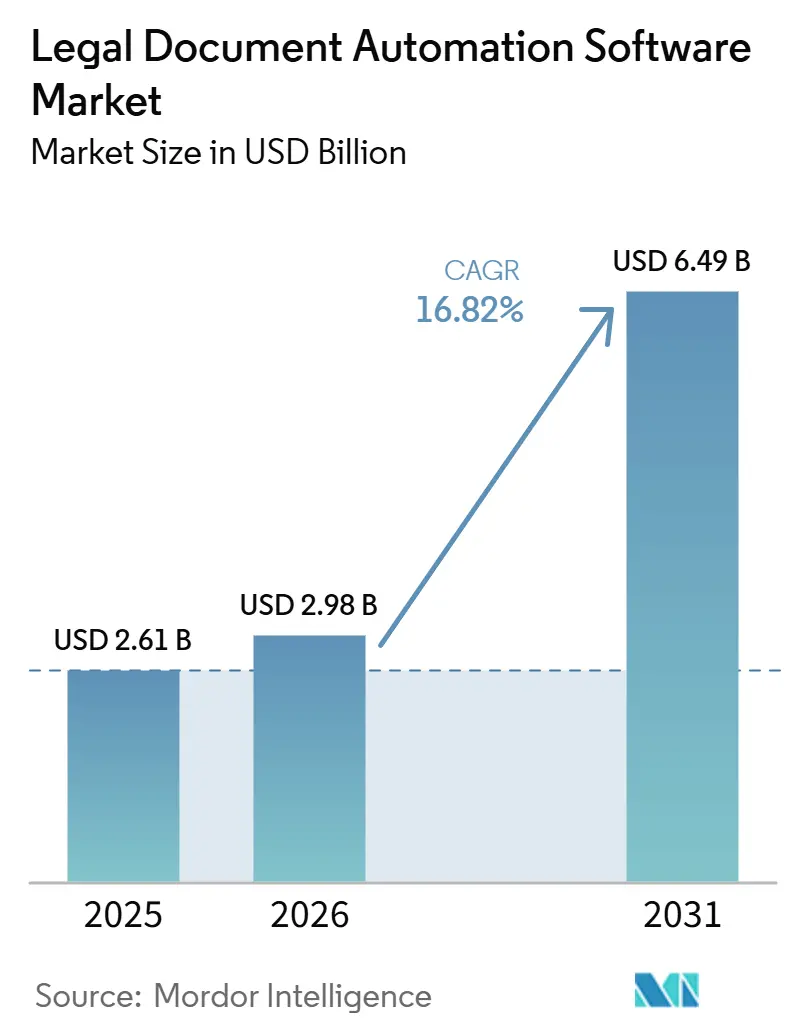
The legal document automation software market size is expected to increase from USD 2.61 billion in 2025 to USD 2.98 billion in 2026 and reach USD 6.49 billion by 2031, growing at a CAGR of 16.82% over 2026-2031. The legal document automation software market is moving beyond rule-based templates as legal teams adopt tools that support drafting, review, and governance in day-to-day work. The shift from billable-hour pricing to fixed-fee and outcome-based pricing is pushing firms and legal departments to reduce time per matter and gain greater process control within digital workflows. Budget growth in technology and knowledge management in 2025 also gave the legal document automation software market a stronger spending base as it entered 2026. Vendors are responding with cloud delivery, broader platform integration, and workflow tools that connect drafting, approvals, and records in one environment. Concerns about privilege, data retention, and difficult links to legacy systems continue to slow some deployments, but the legal document automation software market is moving toward broader operational use.
Key Report Takeaways
- By deployment mode, cloud-based deployment held 69.84% of the legal document automation software market share in 2025, while hybrid deployment is projected to expand at a 19.74% CAGR through 2031.
- By application, contract lifecycle management accounted for 34.27% of the legal document automation software market size in 2025, while legal document automation and drafting is projected to expand at a 20.18% CAGR through 2031.
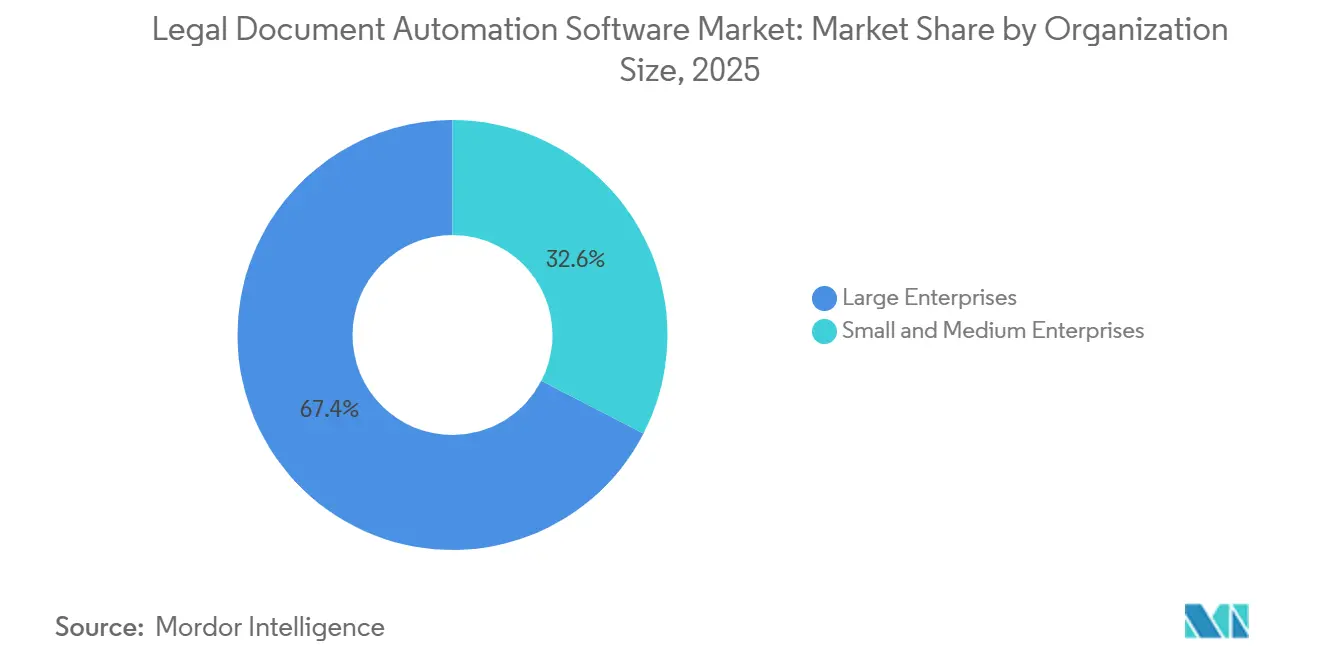
- By organization size, large enterprises held 67.42% share in 2025, while small and medium enterprises are projected to expand at an 18.91% CAGR through 2031.
- By end user, corporate legal departments held 46.53% share in 2025, while the government and public sector is projected to expand at a 19.36% CAGR through 2031.
- By geography, North America held 41.18% of the legal document automation software market share in 2025, while Asia-Pacific is projected to expand at a 21.47% CAGR through 2031.
Note: Market size and forecast figures in this report are generated using Mordor Intelligence’s proprietary estimation framework, updated with the latest available data and insights as of January 2026.
Global Legal Document Automation Software Market Trends and Insights
Drivers Impact Analysis*
| Driver | (~) % Impact on CAGR Forecast | Geographic Relevance | Impact Timeline |
|---|---|---|---|
| Rising Adoption Of AI-Assisted Drafting And Review Workflows | +4.8% | Global, strongest in North America and Asia-Pacific | Short term (≤ 2 years) |
| Expanding Need For Faster Contract Turnaround In Legal Operations | +3.4% | Global, with early gains in the United States, United Kingdom, and Australia | Short term (≤ 2 years) |
| Cloud Migration Of Law Firm And In-House Document Systems | +2.7% | North America and Europe core, spill-over to Asia-Pacific | Medium term (2-4 years) |
| Growing Demand For Audit-Ready, Version-Controlled Legal Workflows | +2.0% | Global, with early gains in regulated industries across North America and Europe | Medium term (2-4 years) |
| Higher Budget Allocation For Legal Technology Modernization | +1.6% | North America and Europe | Medium term (2-4 years) |
| Increasing Regulatory Pressure For Traceable Document Governance | +1.2% | Europe, North America, Asia-Pacific | Long term (≥ 4 years) |
| Source: Mordor Intelligence | |||
Rising Adoption Of AI-Assisted Drafting And Review Workflows
AI-assisted drafting moved from pilot activity into daily legal work across much of the legal document automation software market in 2025 and 2026. NetDocuments reported that legal AI adoption in law firms rose from 37% in 2024 to 80% in 2025, which showed that firms were no longer treating these tools as limited experiments.[1]NetDocuments, “2026 Legal Tech Trends,” NetDocuments, NETDOCUMENTS.COM That change is influencing how buyers evaluate software, as in-house teams now expect faster first drafts, stronger review support, and tighter integration between research and document creation. Thomson Reuters continued building CoCounsel Legal into a broader legal workspace in 2025, which reflected how major vendors were moving toward integrated AI environments rather than isolated point tools. As the legal document automation software market expands, attorney time is shifting away from first-draft production and toward judgment, negotiation, and exception review. This keeps demand high for platforms that can support both speed and legal defensibility inside the same workflow.
Expanding Need For Faster Contract Turnaround In Legal Operations
Contract cycle time remains one of the clearest pain points for buyers in the legal document automation software market. Buyers increasingly want a single system that manages intake, routing, review, negotiation support, and post-signature follow-up without pushing work across multiple disconnected tools. Ironclad said in 2026 that its Jurist Redlining Agent with Playbooks could deliver a playbook-grounded first-pass redline in under 5 minutes.[2]Ironclad, “Jurist Redlining Agent with Playbooks Is Now Generally Available,” Ironclad, IRONCLADAPP.COM That benchmark changes how legal teams measure attorney effort because the first draft no longer needs to be the slowest stage in the process. Ironclad also pointed to Microsoft Word as the primary setting for contract review, which explains why embedded workflows have become more attractive than separate drafting environments. In the legal document automation software market, vendors that integrate seamlessly with the tools attorneys already use are gaining favor because they reduce disruption while still improving turnaround time.
Cloud Migration Of Law Firm And In-House Document Systems
Cloud migration in the legal document automation software market moved beyond file storage and became the foundation for broader AI use in 2026. The American Bar Association said cloud computing had become a cornerstone of modern legal practice, supporting the continued movement away from isolated on-premises tools.[3]American Bar Association, “2024 Cloud Computing TechReport,” American Bar Association, AMERICANBAR.ORG Clio reported that only 57% of mid-sized law firms were fully cloud-based in 2026, which left a large installed base with migration work still ahead.[4]Clio, “2026 Legal Trends for Solo and Small Law Firms,” Clio, CLIO.COM iManage found that knowledge work maturity, which is closely tied to cloud adoption, was the strongest predictor of successful AI deployment in legal firms. This gap will keep demand strong for cloud-native platforms, managed migration programs, and hybrid architectures throughout the forecast period. The legal document automation software market is therefore likely to keep drawing spend from both software subscriptions and surrounding implementation services.
Growing Demand For Audit-Ready, Version-Controlled Legal Workflows
Demand for audit-ready workflows rose as buyers in the legal document automation software market faced closer scrutiny over how drafts, approvals, and versions were tracked. Generic document tools do not create the structured approval records and timestamped histories that regulated legal work often requires. Tungsten Automation achieved FedRAMP High Authority to Operate for TotalAgility Cloud in March 2026, demonstrating that secure, traceable cloud workflows were becoming acceptable even for sensitive public-sector use cases. In the legal document automation software market, this progress reduces the gap between compliance needs and cloud adoption for buyers who once remained fully on-premises. Vendors with stronger governance, version control, and approval tracking can defend premium pricing because risk reduction matters as much as efficiency. This keeps governance features near the center of product selection, especially in regulated buyer groups.
Restraints Impact Analysis*
| Restraint | (~) % Impact on CAGR Forecast | Geographic Relevance | Impact Timeline |
|---|---|---|---|
| Concerns Around Confidentiality And Privileged Data Exposure | -3.1% | Global, strongest in North America and Europe | Short term (≤ 2 years) |
| Integration Complexity With Legacy DMS And CLM Environments | -2.4% | North America and Europe, where legacy DMS penetration is highest | Medium term (2-4 years) |
| Inconsistent Legal Output Quality In Edge-Case Drafting Use Cases | -1.5% | Global | Short term (≤ 2 years) |
| Change Resistance From Attorney-Heavy Workflows | -0.9% | North America and Europe | Medium term (2-4 years) |
| Source: Mordor Intelligence | |||
Concerns Around Confidentiality And Privileged Data Exposure
Confidentiality risk remains the strongest brake on the legal document automation software market because legal teams cannot risk privileged material leaving controlled environments. Reuters Practical Law noted in 2025 that the use of generative AI raises important questions around confidentiality, data ownership, and trade secret protection. That concern becomes sharper when a tool retains user inputs or lacks clear contractual limits on reuse and retention. Buyers, therefore, treat zero-retention design, strong encryption, and audited controls as baseline requirements rather than premium options. This favors larger vendors with mature governance programs and slows adoption among firms that are still evaluating lightly governed tools. The legal document automation software market continues to grow, but procurement takes longer when buyers cannot fully resolve privilege concerns at the start of a deployment.
Integration Complexity With Legacy DMS And CLM Environments
Legacy document and contract systems still slow the legal document automation software market because many firms keep critical files in fragmented repositories. Microsoft said organizations using older enterprise content management systems often struggle to generate reliable AI outputs when data remains incomplete or inconsistently organized. That problem extends implementation timelines because teams must review permissions, security settings, indexing, and document quality before rollout. iManage also linked stronger AI outcomes to higher knowledge work maturity, which showed that infrastructure readiness still shapes software value. Vendors with established connectors and governed document layers therefore gain a procurement advantage, even though broader standardization is still some way off. This keeps integration work as a meaningful cost and timing factor across the legal document automation software market.
*Our forecasts treat driver/restraint impacts as directional, not additive. The impact forecasts reflect baseline growth, mix effects, and variable interactions.
Segment Analysis
By Deployment Mode: Cloud Infrastructure Anchors Revenue As Hybrid Deployments Gain Traction
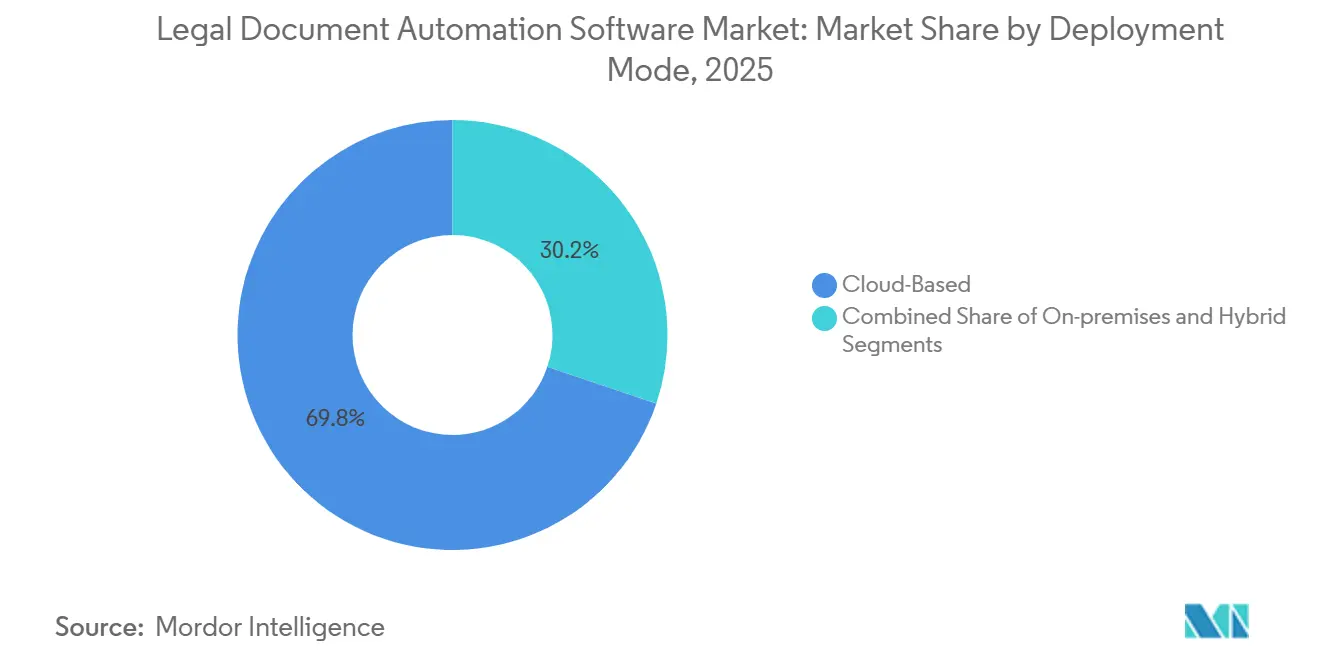
Cloud-based deployment accounted for 69.84% of the legal document automation software market share in 2025, making it the established delivery model across law firms and corporate legal teams. Cloud platforms support quicker model updates, easier collaboration, and remote document access, which are difficult to match at a similar cost in server-based environments. They also reduce internal infrastructure burden for firms that do not want to maintain complex legal systems in-house. On-premise deployments still matter in defense, financial services, and government settings where data residency or internal policy limits third-party hosting. The legal document automation software market continues to favor cloud delivery as compliance-certified environments become more accepted across sensitive use cases.
Hybrid deployment is projected to expand at a 19.74% CAGR from 2026 to 2031, making it the fastest-growing subsegment in the legal document automation software market. This model lets organizations keep sensitive repositories on-premise while using cloud tools for AI inference and workflow orchestration. That balance suits large firms and public-sector buyers that want stronger control without giving up newer AI capabilities. Hybrid also supports phased migration because firms can modernize workflow layers before moving entire document estates. The result is a market structure where cloud remains dominant for smaller buyers while hybrid gains ground with larger and more regulated organizations.



By Application: Contract Automation Anchors Revenue While AI-Driven Legal Drafting Accelerates
Contract lifecycle management accounted for 34.27% of the legal document automation software market in 2025, underscoring the need to centralize counterparty risk, obligations, and renewals. CLM platforms tend to keep clients for long periods because they become the system of record for agreements, playbooks, and approval history. That record-keeping role increases switching costs once workflows, counterparties, and executed documents are embedded in the platform. Legal knowledge management and e-discovery also remain important because legal teams want research, preservation, and records tools to connect with drafting workflows. The legal document automation software market is therefore moving toward platforms that manage agreements across their full life cycle rather than only automating templates.
Legal document automation and drafting is projected to grow at a 20.18% CAGR from 2026 to 2031, making it the fastest-growing application in the legal document automation software market. Ironclad said around 70% of contract review still occurs in Microsoft Word, which explains why embedded drafting tools are attracting attention.[5]Ironclad, “Introducing Ironclad Jurist for Microsoft Word,” Ironclad, IRONCLADAPP.COM Vendors that bring redlining, clause generation, and negotiation support into attorney-native environments face less workflow resistance. Those design choices matter because lawyers usually prefer process improvement within familiar tools rather than a full workflow replacement. This shift is moving the application segment toward broader orchestration across drafting, review, and negotiation rather than isolated drafting assistance.
By Organization Size: Large Enterprises Lead While Small And Medium Enterprises Drive The Next Growth Wave
Large enterprises represented 67.42% of the legal document automation software market in 2025 because they adopted CLM and legal operations platforms earlier than smaller buyers. These organizations have larger legal teams, higher licensing budgets, and dedicated operations staff that can manage integration and governance. They also face stronger pressure to standardize outside counsel work and internal contract processes across business units. That makes enterprise buyers central to product road maps in the legal document automation software market. The group also tends to demand broader governance, stronger integrations, and cross-functional reporting before approving large deployments.
Small and medium enterprises are projected to grow at an 18.91% CAGR from 2026 to 2031 in the legal document automation software market. Clio reported in 2025 that 71% of solo practitioners and 75% of small-firm lawyers had adopted AI in some capacity, even though deeper deployment still remained concentrated in larger firms.[6]Clio, “2026 Legal Trends for Solo and Small Law Firms,” Clio, CLIO.COM Subscription pricing, pre-built workflows, and lower IT overhead are reducing the barriers that once kept these buyers out of advanced legal software. Smaller firms also benefit from software that turns limited staffing into more consistent drafting and document handling capacity. This leaves a wide runway for vendors that can package drafting, review, and document control into simple SaaS offerings for smaller teams.
By End User: Corporate Legal Departments Lead As Government And Public Sector Adoption Accelerates
Corporate legal departments accounted for 46.53% of the legal document automation software market in 2025, making them the largest end-user group. They manage large volumes of standardized commercial agreements and operate within procurement and compliance structures that favor repeatable workflows. They also tend to have clearer cost-per-matter accountability, which strengthens the case for software that shortens review cycles and improves document control. Law firms remain an important buyer group because corporate clients increasingly expect AI-enabled work product and faster turnaround. That pressure is reshaping service delivery in the legal document automation software market as firms invest to close the capability gap with in-house teams.
The government and public sector are projected to grow at a 19.36% CAGR from 2026 to 2031, making it the fastest-growing end-user segment in the legal document automation software market. Public bodies are moving away from paper-heavy legal and regulatory processes and are seeking secure digital systems that can support traceable document handling. Kofile has already used Amazon Bedrock-powered document intelligence across more than 3,000 county governments, demonstrating that public-sector document automation has moved beyond the pilot stage. Spain's General State Attorney's Office also deployed TEMIS in 2026 to locate, analyze, and organize large volumes of legal documentation for state lawyers. These examples show that secure legal process modernization is becoming a practical procurement priority across government buyers.
Geography Analysis
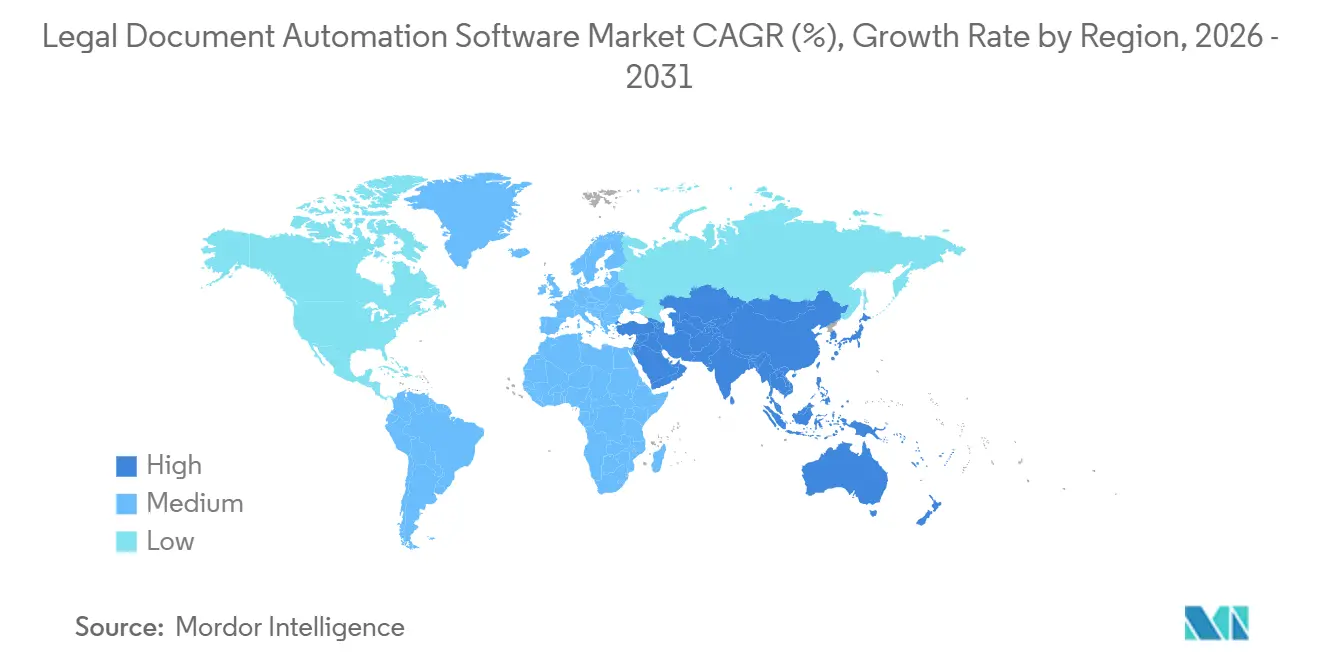
North America held 41.18% of the legal document automation software market in 2025, maintaining its leading regional position. The United States supports that lead through high technology spending, large corporate legal departments, and a dense vendor ecosystem. Thomson Reuters said technology spending at US law firms grew 9.7% in 2025, and knowledge management spending rose 10.5%, which showed how strongly budgets now support workflow automation.[7]Thomson Reuters and Georgetown Law Center on Ethics and the Legal Profession, “2026 Report on the State of the US Legal Market,” Thomson Reuters, THOMSONREUTERS.COM Canada also strengthens the region because Clio completed its USD 1 billion acquisition of vLex and raised USD 500 million in Series G funding in November 2025, giving North America a larger platform footprint. Mexico and South American markets remained earlier-stage adopters, although multinational legal and compliance needs continue to widen demand for more standardized document workflows.
Europe remained the second-largest region in the legal document automation software market, led by Germany, the United Kingdom, and France. Regional demand is supported by regulated industries and large firms that need stronger auditability across contract and document workflows. The EU AI Act and GDPR continue to favor platforms with transparent governance, flexible deployment, and defensible document controls. Spain's General State Attorney's Office deployed TEMIS in February 2026, which showed that government legal bodies in Southern Europe were also moving document intelligence into operational use.
Asia-Pacific is projected to expand at a 21.47% CAGR from 2026 to 2031, making it the fastest-growing region in the legal document automation software market. Growth in the region is tied to court modernization, enterprise digitization, and the growing adoption of AI tools in legal workflows. India and China remain central to this expansion because both markets are pushing legal process modernization at scale. Japan and South Korea remain more conservative adopters, but cloud-first procurement is expected to lift demand as legacy on-premise systems age. The Middle East and Africa also remained early stage, but legal digitalization programs in Saudi Arabia, the United Arab Emirates, and South Africa are creating a clearer path for future adoption.

Competitive Landscape
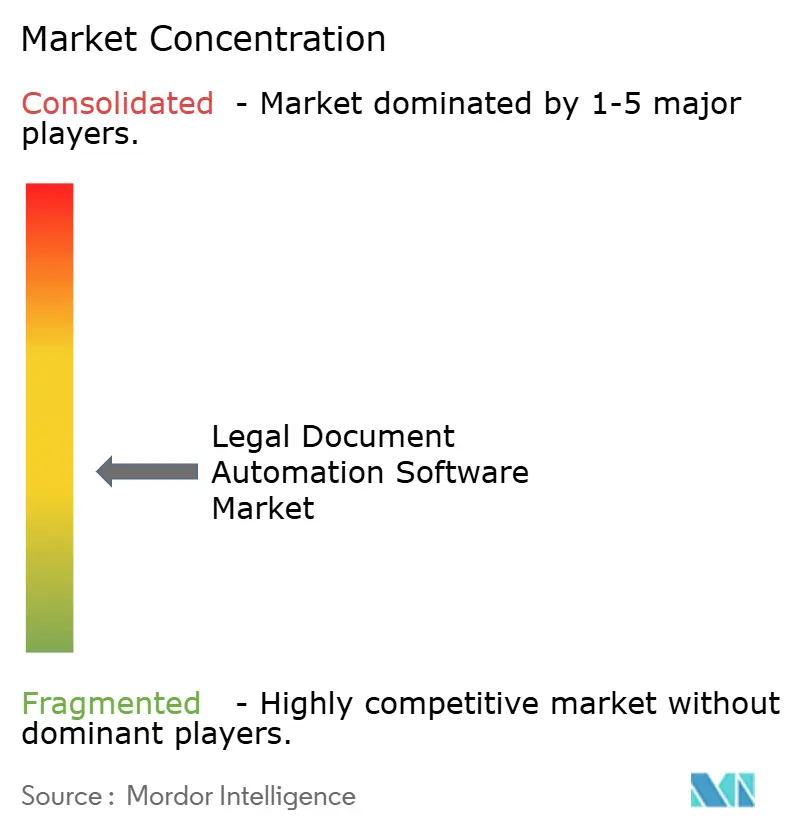
The legal document automation software market remained moderately fragmented in 2026, but consolidation was moving faster as buyers preferred broader platforms and stronger governance. Thomson Reuters and DocuSign followed integration-led strategies that linked drafting, research, review, and agreement workflows in connected environments. DocuSign added AI assistants, agents, and MCP integrations with Harvey, Legora, OpenAI, and Anthropic to its Intelligent Agreement Management platform in May 2026. Thomson Reuters also continued to extend CoCounsel through deeper product integration and broader geographic rollout throughout 2025. These moves raise switching costs because customers can keep legal work within familiar systems rather than stitching together multiple point solutions.
Specialist vendors are still winning business by going deeper into a narrow workflow rather than trying to cover the full legal stack. LexisNexis and Luminance partnered in April 2026 to bring Protégé AI into Luminance's contract negotiation platform, extending research and review within a single interface. Clio also changed the shape of competition when it combined its legal operating system with vLex's global legal research assets in 2025. Freshfields and Anthropic showed another route in 2026 by co-building AI legal workflows inside a major law firm environment. The legal document automation software market, therefore, rewards vendors that can pair specialized workflow depth with authoritative content, trusted deployments, or installed user bases.
Competitive opportunities remain open in hybrid deployments for regulated buyers, multilingual models for Asia-Pacific, and post-signature obligation management across mixed CLM environments. No single vendor has established a decisive lead across all those needs, which keeps the door open for challengers and targeted acquisitions. Buyers are also becoming less willing to accept tools that cannot prove data control, system integration, and enterprise readiness. That combination keeps the legal document automation software market open enough for innovation while steadily favoring vendors with stronger platforms and partner ecosystems.
Legal Document Automation Software Industry Leaders
Thomson Reuters Corporation
LexisNexis Risk Solutions Group Ltd.
Ironclad Inc.
Clio Inc.
DocuSign Inc.
- *Disclaimer: Major Players sorted in no particular order

Recent Industry Developments
- July 2026: Legible and Carahsoft Technology Corp. announced a distribution partnership, making Legible's AI-driven bill-tracking and policy intelligence platform available to US government agencies through NASA SEWP V, NASPO ValuePoint, and OMNIA Partners procurement vehicles. The deal expands access to automated regulatory document tools for state and local government legal operations.
- June 2026: Spellbook Legal Technologies Inc. launched early access to its Autonomous Contract Management system for law firms and enterprise departments managing high-volume contracts. The platform integrates multiple large language models, including Anthropic's Claude, and connects natively with Salesforce, Google tools, and HubSpot.
- June 2026: DocuSign Inc. announced its Intelligent Agreement Management platform is available in ChatGPT and Codex, enabling organizations to create, analyze, manage, and execute agreements using natural language prompts within OpenAI's products.
- June 2026: Thomson Reuters opened early access to the next generation of CoCounsel Legal, including workspace collaboration features, a Brief Builder AI agent, and organizational tools. Full general availability is planned for August 2026 in the United States, followed by Canada, the United Kingdom, and Australia.


Global Legal Document Automation Software Market Report Scope
The Legal Document Automation Software Report is Segmented by Deployment Mode (Cloud-Based, On-Premise, and Hybrid), Application (Legal Document Automation and Drafting, CLM, Legal Knowledge Management, and E-Discovery), Organization Size (Large Enterprises, and SMEs), End User (Law Firms, Corporate Legal Departments, Government and Public Sector, and more), and Geography. The Market Forecasts are in Value (USD).
| Cloud-Based |
| On-Premise |
| Hybrid |
| Legal Document Automation and Drafting |
| Contract Lifecycle Management |
| Legal Knowledge and Research Management |
| Litigation Support and E-Discovery |
| Large Enterprises |
| Small And Medium Enterprises |
| Law Firms |
| Corporate Legal Departments |
| Government And Public Sector |
| Other End Users |
| North America | United States |
| Canada | |
| Mexico | |
| South America | Brazil |
| Argentina | |
| Rest Of South America | |
| Europe | Germany |
| United Kingdom | |
| France | |
| Italy | |
| Spain | |
| Russia | |
| Rest Of Europe | |
| Asia-Pacific | China |
| Japan | |
| India | |
| South Korea | |
| Australia | |
| Rest Of Asia-Pacific | |
| Middle East | Turkey |
| Saudi Arabia | |
| United Arab Emirates | |
| Rest Of Middle East | |
| Africa | South Africa |
| Egypt | |
| Rest Of Africa |
| By Deployment Mode | Cloud-Based | |
| On-Premise | ||
| Hybrid | ||
| By Application | Legal Document Automation and Drafting | |
| Contract Lifecycle Management | ||
| Legal Knowledge and Research Management | ||
| Litigation Support and E-Discovery | ||
| By Organization Size | Large Enterprises | |
| Small And Medium Enterprises | ||
| By End User | Law Firms | |
| Corporate Legal Departments | ||
| Government And Public Sector | ||
| Other End Users | ||
| By Geography | North America | United States |
| Canada | ||
| Mexico | ||
| South America | Brazil | |
| Argentina | ||
| Rest Of South America | ||
| Europe | Germany | |
| United Kingdom | ||
| France | ||
| Italy | ||
| Spain | ||
| Russia | ||
| Rest Of Europe | ||
| Asia-Pacific | China | |
| Japan | ||
| India | ||
| South Korea | ||
| Australia | ||
| Rest Of Asia-Pacific | ||
| Middle East | Turkey | |
| Saudi Arabia | ||
| United Arab Emirates | ||
| Rest Of Middle East | ||
| Africa | South Africa | |
| Egypt | ||
| Rest Of Africa | ||


Key Questions Answered in the Report
What is the current and forecast value of legal document automation software?
The legal document automation software market size was USD 2.61 billion in 2025, stands at USD 2.98 billion in 2026, and is forecast to reach USD 6.49 billion by 2031 at a 16.82% CAGR.
Which deployment model leads legal document automation software?
Cloud-based deployment led with 69.84% share in 2025 because it supports faster updates, easier collaboration, and lower infrastructure burden.
Which application area is growing fastest in legal document automation software?
Legal document automation and drafting is the fastest-growing application, with a projected 20.18% CAGR from 2026 to 2031.
Why are corporate legal departments the biggest buyers?
Corporate legal departments held 46.53% share in 2025 because they manage high volumes of standardized agreements and work under strong procurement and compliance controls.
Which region is expanding fastest for legal document automation software?
Asia-Pacific is projected to grow at a 21.47% CAGR through 2031, supported by legal process modernization and wider acceptance of AI workflows.
What is slowing adoption of legal document automation tools?
The main barriers are confidentiality concerns and complex integration with legacy DMS and CLM systems, which lengthen procurement and implementation timelines.
Page last updated on:






