
LED Test And Bin Equipment Market Size and Share
Market Overview
| Study Period | 2020 - 2031 |
|---|---|
| Market Size (2026) | USD 1.73 Billion |
| Market Size (2031) | USD 2.68 Billion |
| Growth Rate (2026 - 2031) | 9.15 % |
| Fastest Growing Market | Asia Pacific |
| Largest Market | Asia Pacific |
| Market Concentration | Medium |
Major Players *Disclaimer: Major Players sorted in no particular order Image © Mordor Intelligence. Reuse requires attribution under CC BY 4.0. | |
LED Test And Bin Equipment Market Analysis by Mordor Intelligence
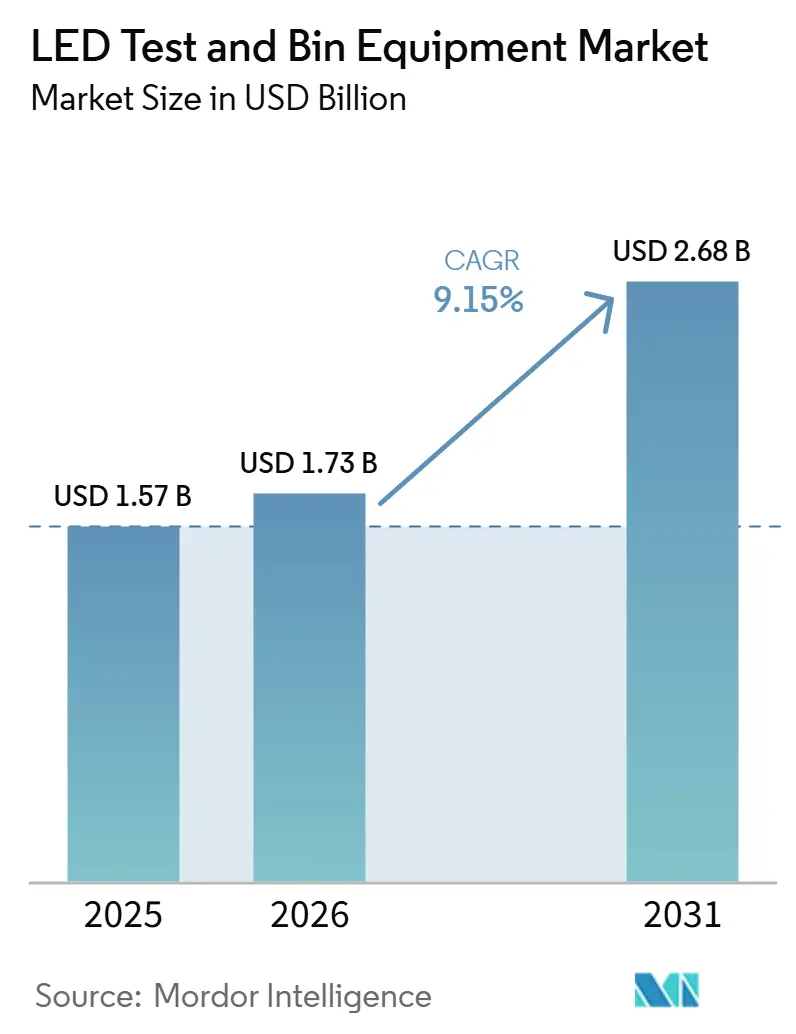
The LED test and bin equipment market size is expected to increase from USD 1.57 billion in 2025 to USD 1.73 billion in 2026 and reach USD 2.68 billion by 2031, growing at a CAGR of 9.15% over 2026-2031. Strong demand stems from Mini-LED integration in premium consumer electronics, the global rollout of high-accuracy automotive bin coding, and record capital spending by Chinese and Taiwanese packaging houses. Intensifying supplier competition, rapid platform consolidation, and AI-enabled throughput gains are reshaping equipment specifications. End users now prioritize wafer-level qualification to cut downstream rework, while tariffs and skills shortages create cost pressures that favor integrated solutions.
Key Report Takeaways
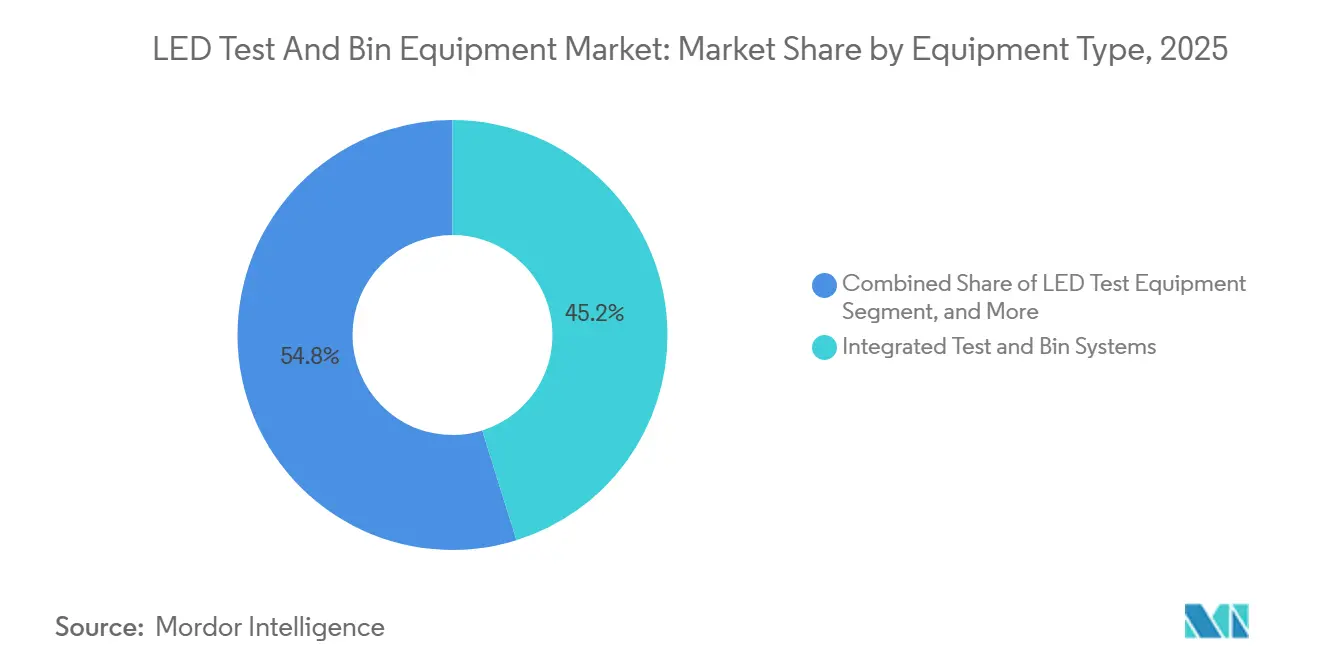
- By equipment type, integrated test-and-bin systems led with 45.19% revenue share in 2025, while they are projected to post the highest CAGR at 9.57% through 2031.
- By LED type, high-brightness LEDs held 41.37% share in 2025, yet Micro LEDs are forecast to expand at the fastest 9.99% CAGR to 2031.
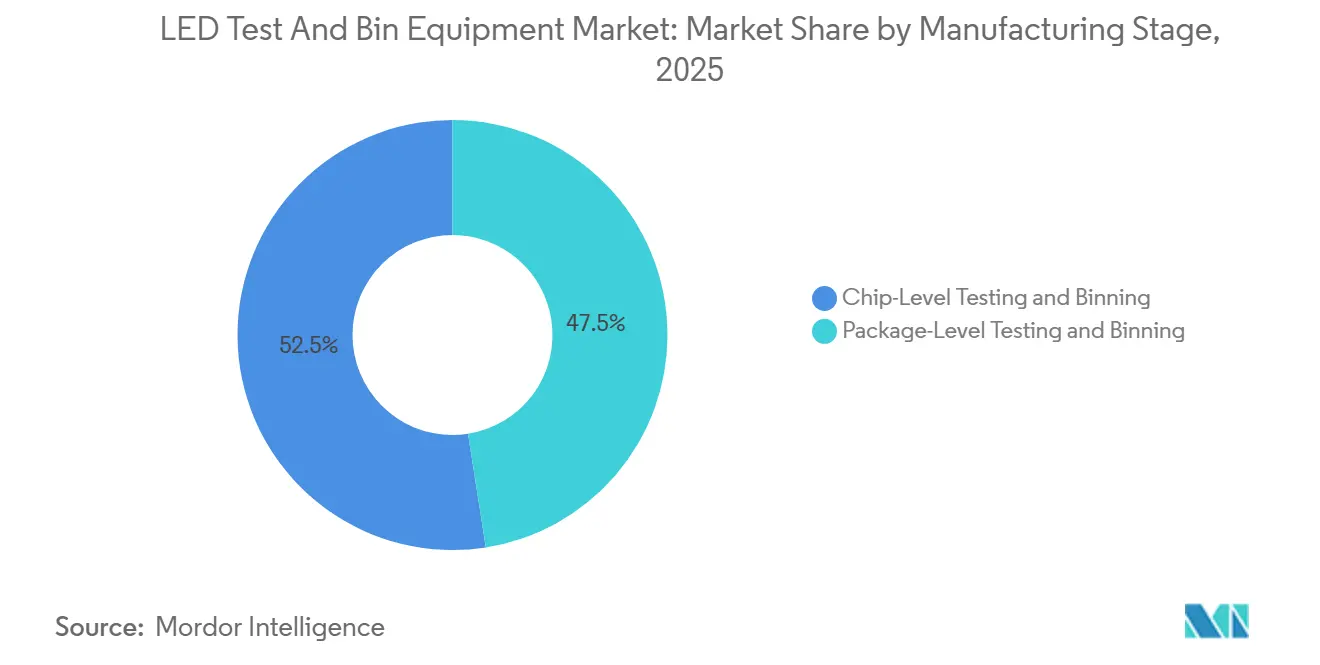
- By manufacturing stage, chip-level testing captured 52.48% share in 2025 and is set to advance at a 9.81% CAGR over 2026-2031.
- By end-use application, display and signage accounted for 38.73% of 2025 revenue, whereas automotive lighting is the fastest-growing segment at 9.78% CAGR to 2031.
- By geography, Asia-Pacific commanded 64.29% share in 2025 and is projected to grow at 10.01% CAGR, the strongest regional pace to 2031.
Note: Market size and forecast figures in this report are generated using Mordor Intelligence’s proprietary estimation framework, updated with the latest available data and insights as of January 2026.
Global LED Test And Bin Equipment Market Trends and Insights
Drivers Impact Analysis*
| Driver | (~) % Impact on CAGR Forecast | Geographic Relevance | Impact Timeline |
|---|---|---|---|
| Proliferation of Mini-LED Backlighting in Consumer Electronics | +2.1% | Asia-Pacific core, spill-over to North America | Short term (≤ 2 years) |
| Mandatory High-Accuracy Bin Coding in Automotive LED Modules | +1.8% | Global, early gains in Europe and North America | Medium term (2-4 years) |
| Cost-Down Pressures Accelerating Integrated Test-and-Bin Platforms | +1.5% | Global | Short term (≤ 2 years) |
| Rapid Capacity Expansions in China and Taiwan Packaging Houses | +1.9% | Asia-Pacific | Short term (≤ 2 years) |
| AI-Optimized Spectroradiometry Reducing Throughput Bottlenecks | +1.2% | Global | Medium term (2-4 years) |
| Intellectual-Property Driven Demand for Wafer-Level Test IP Cores | +0.9% | Asia-Pacific and North America | Long term (≥ 4 years) |
| Source: Mordor Intelligence | |||
Proliferation of Mini-LED Backlighting in Consumer Electronics
Shipments of Mini-LED-backlit televisions, tablets, and monitors surpassed 12 million units in 2025, nearly doubling the 2024 tally. Each backlight now integrates 1,000-2,000 dies, so OEMs mandate binning within ±1 SDCM and wavelength resolution better than 2.5 nanometers to avoid mura in local-dimming zones.[1]MiniMicroLED Insights, “Challenges And Breakthroughs In Micro-LED Mass Transfer,” MINIMICROLED.COM Test vendors responded by embedding AI vision that slashes cycle time from 45 seconds to under 30 seconds per module, allowing same-shift shipment to panel assemblers. Quantum-dot conversion films scheduled for broad release in late-2026 can trim color spread by 25%, yet until that ramp is proven, demand for high-precision testers will remain elevated.[2]Consumer Electronics Show, “2026 Product Launches,” CES.TECH Component price erosion is modest, spectroradiometer ASPs fell only 3% in 2025, indicating end users are willing to pay a premium for tighter optical control.
Mandatory High-Accuracy Bin Coding in Automotive LED Modules
Revisions to IEC 60810:2017 require chromaticity tolerances of ±0.005 and forward-voltage spreads within ±0.1 V for adaptive headlamps shipped after January 2026. Tier 1 suppliers now hot-test at 85 °C junction temperature because cold-bin results diverge by as much as 4% under real driving conditions.[3]Lumileds, “LED Binning and Testing Information,” LUMILEDS.COM Renesas and Lumileds demonstrated the value of embedded design-for-test circuitry with a 20,000-microLED headlamp that self-verifies every die post-assembly, cutting scrap by 70%. A defective die can junk a USD 150-200 module, so Tier 1s accept inline spectroradiometers priced up to USD 250,000 because payback targets of six months are realistic at current reject rates. Over-the-air software updates will push future tolerance bands even tighter for glare-free high-beam systems, sustaining long-term tester demand.
Cost-Down Pressures Accelerating Integrated Test-and-Bin Platforms
LED ASPs declined 8-12% year over year in 2025, squeezing gross margins at Chinese and Taiwanese packaging houses to near single digits. Integrated test-and-bin platforms combine electrical, optical, and thermal checks in a single cell, cutting labor by 25-40% and floor space by up to 40% compared to discrete setups, while maintaining throughputs of 24,000 parts per hour. Pay-per-use software unlocks optional wavelength bins on demand, letting mid-tier packagers avoid USD 100,000 capex for fixed hardware upgrades. Chroma ATE’s field-upgradeable spectroradiometer module won multiple Taiwan design-ins in 2025 precisely because customers fear Micro-LED obsolescence. As AI-guided spectral prediction matures, integrated cells are expected to trim measurement uncertainty below 1%, reinforcing their cost-down advantage.
Rapid Capacity Expansions in China and Taiwan Packaging Houses
Chinese and Taiwanese subsidies drove an 18-22% jump in LED packaging capacity during 2024-2025, setting off a parallel wave of tester procurement. Radiant Opto-Electronics alone spent TWD 13.3 billion (USD 415 million) on new Mini-LED and Micro-LED lines equipped with integrated test-and-bin systems. ASE and SPIL diverted portions of multi-billion-dollar advanced-packaging budgets into LED projects that leverage existing flip-chip infrastructure. A single 10,000-wafer-per-month plant now budgets USD 600,000-750,000 for three high-throughput testers just to stay on takt, anchoring near-term revenue visibility for equipment makers. Beijing’s localization drive further accelerates orders, as domestic vendors gain preference over imported Japanese optics amid tariff uncertainty.
Restraints Impact Analysis*
| Restraint | (~) % Impact on CAGR Forecast | Geographic Relevance | Impact Timeline |
|---|---|---|---|
| High Capital Intensity of Automated Sorters | -1.4% | Global, acute in Southeast Asia and South America | Short term (≤ 2 years) |
| Skills Gap in Spectroradiometric Calibration | -0.9% | Global | Medium term (2-4 years) |
| Equipment Obsolescence Amid Micro-LED Transition | -1.1% | Global | Long term (≥ 4 years) |
| Supply-Chain Tariffs on Opto-Mechanical Components | -0.7% | North America and Europe | Short term (≤ 2 years) |
| Source: Mordor Intelligence | |||
High Capital Intensity of Automated Sorters
Fully automated sorters with integrated spectroradiometry cost USD 180,000-250,000, an investment many Southeast Asian and South American packagers cannot recover within their preferred 18-month horizons.[4]Cal Lab Magazine, “Optical Radiation Calibration,” CALLABMAG.COM A 2025 survey showed 40% of Thai, Vietnamese, and Malaysian firms postponed sorter upgrades, instead extending manual or semi-automated lines even though yield loss averages 3-5%. Environmental build-outs, temperature control within ±0.5 °C and vibration isolation to sub-micron levels, add another USD 30,000-50,000 per line, stretching payback further. Chinese vendors now offer leasing at 60-70% lower upfront cost, but packagers hesitate because long-term service fees can eclipse purchase price after three years. Without affordable financing, capacity expansions in emerging regions will stay equipment-constrained through at least 2027.
Skills Gap in Spectroradiometric Calibration
NIST’s biennial short course trains only 18 technicians per session, while EURAMET workshops added fewer than 150 graduates in 2025, leaving a global annual shortfall of roughly 200 specialists. Emerging hubs such as India, Vietnam, and Mexico lack ISO 17025-accredited institutes, so new Micro-LED lines operate below nameplate throughput as operators struggle with sphere fluorescence and spectral mismatch errors. Vendors embed EEPROM-stored correction factors and auto-cal routines, yet unresolved artifacts still require human intervention that can halt an entire shift. Remote-support programs help, but latency in video diagnosis often forces local technicians to swap instruments rather than fine-tune setups, inflating maintenance budgets by 10-15%. Unless training capacity doubles by 2028, the talent gap will remain a drag on overall equipment utilization.
*Our forecasts treat driver/restraint impacts as directional, not additive. The impact forecasts reflect baseline growth, mix effects, and variable interactions.
Segment Analysis
By Equipment Type: Integrated Platforms Sustain Momentum
Integrated systems accounted for 45.19% of 2025 revenue, reflecting the shift toward single-cell solutions that merge spectroradiometry, electrical test, and robotic sorting. This share translates into the largest portion of the LED test and bin equipment market size at the equipment-type level. High throughput and smaller factory footprints have pushed adoption beyond China and Taiwan into North American automotive plants. Standalone LED test equipment captured roughly one-third of revenue, serving R&D labs that must meet LM-79 and LM-80 protocols. Discrete binning handlers trailed as customers migrated to unified cells, eroding their LED test and bin equipment market share.
As Micro-LED arrays increasingly demand sub-micron spatial resolution and the ability to probe electroluminescence at a staggering rate of over six million dies per hour, the appetite for integrated platforms remains robust. This trend is underscored by Keysight's unveiling of the i7090 in 2026, a move that not only highlights the company's innovation but also underscores a significant shift in the industry. Incumbent Automated Test Equipment (ATE) vendors, like Keysight, are now merging optical and in-circuit testing functions. This convergence is more than just a technological advancement; it signals a wave of broader consolidation within the industry, hinting at a future where integrated solutions become the norm.



By LED Type: Micro LEDs Accelerate Despite Dominance of High-Brightness
High-brightness devices led revenue with 41.37% in 2025, yet Micro LEDs are set for the fastest growth at 9.99% CAGR as mass-transfer yields approach 99.995%. Standard and Mini-LEDs provide mid-tier opportunities but face price pressures. As Micro-LED wafer inspection shifts to photoluminescence mapping, specialized equipment commands a premium, expanding its share of the LED test-and-bin equipment market.
Despite a dip in average tester prices by 6-8% in 2025, driven by the entry of cost-effective platforms from Chinese vendors, the demand for high-brightness volumes remains robust. Mini-LEDs, which sit in the market spectrum between standard LEDs and Micro LEDs, continue to be a viable option for integrating-sphere test lines. However, these Mini-LEDs necessitate a more stringent chromaticity control compared to their commodity counterparts.
By Manufacturing Stage: Chip-Level Testing Gains Priority
With 52.48% revenue share in 2025, chip-level qualification contributes the largest slice of LED test and bin equipment market share thanks to its ability to cut downstream scrap by up to 60%. Wafer-level electroluminescence mapping allows early defect removal and reduces package material waste. ficonTEC’s double-sided wafer tester showcases demand for simultaneous electrical and optical probing that aligns with co-packaged optics roadmaps.
Package-level testing plays a crucial role in ensuring the reliability of automotive headlamps, which are subjected to rigorous challenges like thermal cycling and vibrations. However, the industry is witnessing a shift in focus towards chip-level platforms. This change is largely attributed to the maturation of IP-embedded test cores, which now offer advanced capabilities such as predictive binning and real-time process feedback. As these technologies evolve, they promise to enhance the efficiency and accuracy of testing processes, signaling a potential pivot in industry priorities.
By End-Use Application: Automotive Lighting Outpaces Display
Display and signage accounted for 38.73% of 2025 revenue, but automotive lighting will expand the fastest at a 9.78% CAGR, as adaptive matrix headlamps require stringent per-module binning. Regulatory pressure from Europe and North America anchors spending on hot-test cells that verify chromaticity at elevated junction temperatures. General lighting, now a replacement market in developed economies, is showing moderate growth, whereas consumer electronics and UV-based industrial uses are driving niche demand for specialty testers with fluorescence-free spheres.
As the automotive industry increasingly embraces autonomous vehicle technology, the demand for precision in automotive components intensifies. A prime example is the integration of lidar-assisted LED arrays, which necessitate a more stringent control over wavelengths. This heightened demand for specificity results in a greater intensity of equipment usage, surpassing that of traditional displays. In the realm of displays, while quantum-dot films offer a slight reprieve from binning constraints, the overall equipment intensity remains notably elevated due to these evolving automotive demands.
Geography Analysis
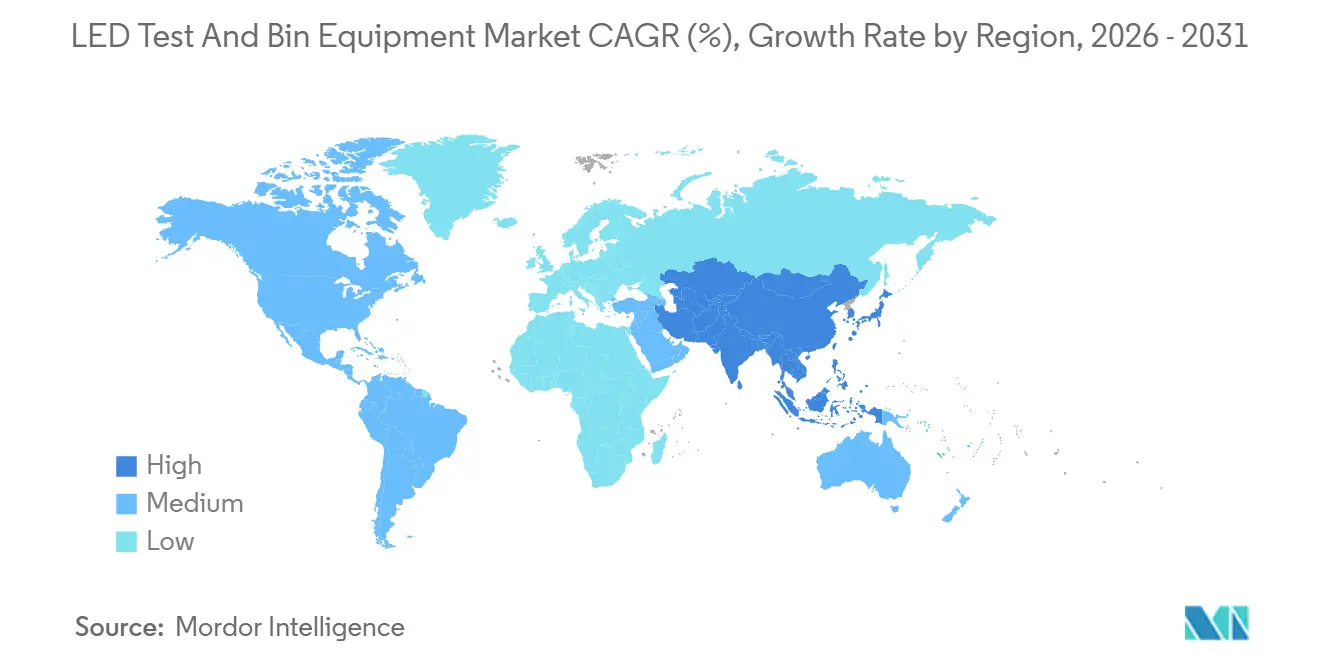
Asia-Pacific accounted for 64.29% of global revenue in 2025, reflecting Taiwan’s 35% share of global LED packaging capacity and China’s aggressive subsidy-backed buildouts. Regional growth is forecast at 10.01% CAGR, the highest worldwide. Taiwan’s flip-chip know-how positions it to supply co-packaged optics, while China uses favorable financing to localize integrated testers and reduce reliance on European optics. South Korea and Japan add demand for precision spectroradiometry in automotive and OLED-plus-Mini-LED hybrids, keeping the LED test and bin equipment market vibrant across the region.
North America held about 18% share, buoyed by automotive Tier 1 upgrades and expanding photonics hubs in California and Texas. Growth is expected at 8.2% CAGR as IEC 60810 enforcement tightens. Europe followed with roughly 12% share, centered on German and Italian automotive supply chains, but capacity growth lags Asia-Pacific, moderating equipment orders.
South America, the Middle East, and Africa jointly represented around 6% of 2025 revenue. High import tariffs on optical components and scarce ISO 17025 labs impede adoption. Nevertheless, leasing schemes and pay-per-test contracts could unlock incremental demand if financing barriers ease.

Competitive Landscape
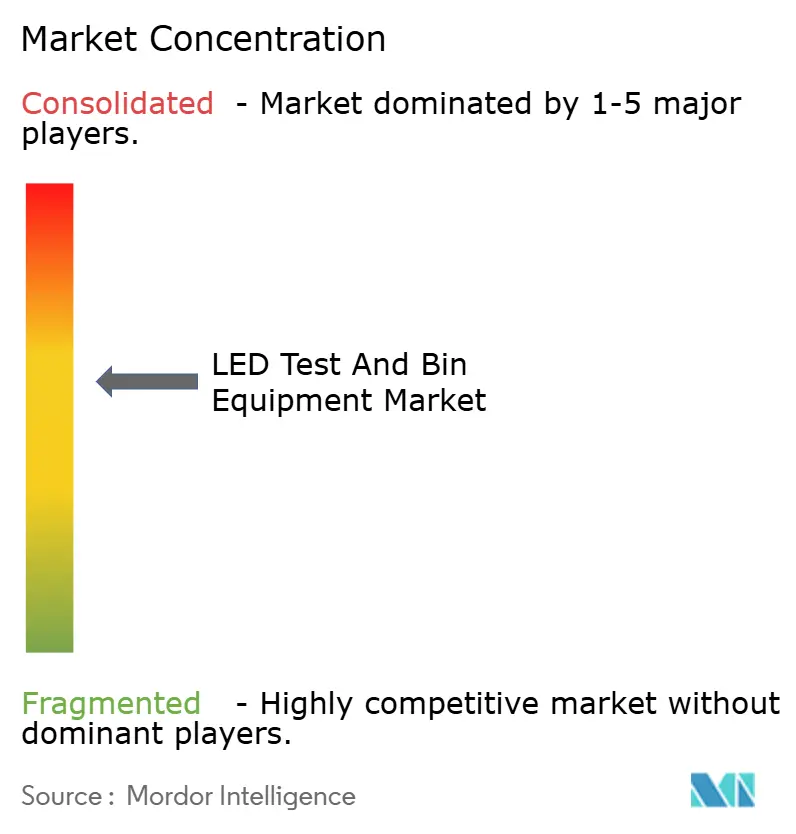
The market is moderately fragmented. The top five suppliers, Chroma ATE, Advantest, Teradyne, KLA, and Keysight, controlled roughly 55-60% of 2025 revenue, while numerous regional specialists serve UV, goniometric, and wafer-level niches. Chroma ATE’s semiconductor and photonics segment grew 141% year over year in Q4 2024 after Mini-LED pilot lines ramped. Keysight’s i7090 launch in 2026 leverages its automotive installed base to cross-sell optical test features. Advantest and Tokyo Seimitsu are co-developing die-level probers that integrate thermal management for AI-class devices.
White-space opportunities center on chromatic confocal inspection for passivation layers, next-generation spectral irradiance standards that cut calibration uncertainty below 0.5%, and embedded design-for-test IP that shifts some measurement burden from external ATE to the driver IC itself. Chinese challengers such as Han’s Laser undercut incumbents by 20-30% on price, while startups like InZiv claim six-million-die-per-hour throughput using soft-touch contacts. Private equity is fueling consolidation, as evidenced by KKR’s USD 4.9 billion purchase of Spectris and FormFactor’s move into wafer-level photonics through the Keystone acquisition.
Instrument Systems broadened its CAS spectroradiometer line in March 2026 to capture flicker indices at up to 300 kHz, a feature requested by automotive adaptive headlamp developers. Teradyne updated its UltraFlex platform in September 2025 with a plug-in optical module that lets logic ATE users qualify Micro-LED driver ICs without replacing the main frame. KLA debuted a digital-twin analytics suite in February 2026 that models spectroradiometer drift and schedules preventive calibration, cutting unplanned downtime by 15% during beta trials at two Taiwan packaging plants. Chroma ATE opened a calibration center in Guadalajara in early 2026, trimming North American turnaround times to three days and enlarging its post-sales moat over Japanese rivals. Advantest introduced an ECO-PRO power-management mode in January 2026 that lowers idle energy use by 20% while preserving thermal stability, aligning with automotive customers’ carbon-accounting mandates.
LED Test And Bin Equipment Industry Leaders
Chroma ATE Inc.
Advantest Corporation
Teradyne Inc.
FitTech Co. Ltd.
Cohu Inc.
- *Disclaimer: Major Players sorted in no particular order

Recent Industry Developments
- January 2026: Keysight Technologies introduced the i7090 PCBA test station with integrated LED functional testing, trimming test-floor footprint by 25 percent.
- January 2026: ProPhotonix unveiled the UV Pro Test Kit, a portable UV-C measurement solution compliant with LM-92-22.
- December 2025: Advantest and Tokyo Seimitsu agreed to co-develop a die-level prober for advanced 2.5D and 3D packages.
- December 2025: KKR completed its USD 4.9 billion acquisition of Spectris, adding optical metrology brands to its portfolio.


Global LED Test And Bin Equipment Market Report Scope
The LED Test and Bin Equipment Market Report is Segmented by Equipment Type (LED Test Equipment, LED Binning Equipment, Integrated Test and Bin Systems), LED Type (Standard LEDs, High Brightness LEDs, Mini LEDs, Micro LEDs), Manufacturing Stage (Chip-Level Testing and Binning, Package-Level Testing and Binning), End-Use Application (General Lighting, Display and Signage, Automotive Lighting, Consumer Electronics, Industrial and Specialty), and Geography (North America, South America, Europe, Asia-Pacific, Middle East, Africa). The Market Forecasts are Provided in Terms of Value (USD).
| LED Test Equipment |
| LED Binning Equipment |
| Integrated Test and Bin Systems |
| Standard LEDs |
| High Brightness LEDs |
| Mini LEDs |
| Micro LEDs |
| Chip-Level Testing and Binning |
| Package-Level Testing and Binning |
| General Lighting |
| Display and Signage |
| Automotive Lighting |
| Consumer Electronics |
| Industrial and Specialty |
| North America | United States |
| Canada | |
| Mexico | |
| South America | Brazil |
| Argentina | |
| Rest of South America | |
| Europe | Germany |
| United Kingdom | |
| France | |
| Italy | |
| Spain | |
| Russia | |
| Rest of Europe | |
| Asia-Pacific | China |
| Japan | |
| South Korea | |
| Taiwan | |
| India | |
| Rest of Asia-Pacific | |
| Middle East | United Arab Emirates |
| Saudi Arabia | |
| Turkey | |
| Rest of Middle East | |
| Africa | South Africa |
| Egypt | |
| Rest of Africa |
| By Equipment Type | LED Test Equipment | |
| LED Binning Equipment | ||
| Integrated Test and Bin Systems | ||
| By LED Type | Standard LEDs | |
| High Brightness LEDs | ||
| Mini LEDs | ||
| Micro LEDs | ||
| By Manufacturing Stage | Chip-Level Testing and Binning | |
| Package-Level Testing and Binning | ||
| By End-Use Application | General Lighting | |
| Display and Signage | ||
| Automotive Lighting | ||
| Consumer Electronics | ||
| Industrial and Specialty | ||
| By Geography | North America | United States |
| Canada | ||
| Mexico | ||
| South America | Brazil | |
| Argentina | ||
| Rest of South America | ||
| Europe | Germany | |
| United Kingdom | ||
| France | ||
| Italy | ||
| Spain | ||
| Russia | ||
| Rest of Europe | ||
| Asia-Pacific | China | |
| Japan | ||
| South Korea | ||
| Taiwan | ||
| India | ||
| Rest of Asia-Pacific | ||
| Middle East | United Arab Emirates | |
| Saudi Arabia | ||
| Turkey | ||
| Rest of Middle East | ||
| Africa | South Africa | |
| Egypt | ||
| Rest of Africa | ||


Key Questions Answered in the Report
What is the current size of the LED test and bin equipment market?
It was valued at USD 1.73 billion in 2026.
How fast is the LED test and bin equipment market growing?
The market is projected to expand at a 9.15% CAGR between 2026-2031.
Which region leads demand for LED test and bin equipment?
Asia-Pacific holds about 64% of global revenue and shows the fastest 10.01% CAGR.
Which equipment type dominates sales?
Integrated test-and-bin platforms led with 45.19% revenue share in 2025.
What end-use segment is growing quickest?
Automotive lighting is forecast to grow at a 9.78% CAGR through 2031.
Who are the major suppliers in this market?
Chroma ATE, Advantest, Teradyne, KLA, and Keysight collectively hold over half of global revenue.
Page last updated on:


 Your data is secure and never sold or shared.


