
Leather Footwear Market Size and Share
Market Overview
| Study Period | 2021 - 2031 |
|---|---|
| Market Size (2026) | USD 130.75 Billion |
| Market Size (2031) | USD 169.03 Billion |
| Growth Rate (2026 - 2031) | 5.27 % |
| Fastest Growing Market | Middle East and Africa |
| Largest Market | Asia-Pacific |
| Market Concentration | Low |
Major Players *Disclaimer: Major Players sorted in no particular order Image © Mordor Intelligence. Reuse requires attribution under CC BY 4.0. | |
Leather Footwear Market Analysis by Mordor Intelligence
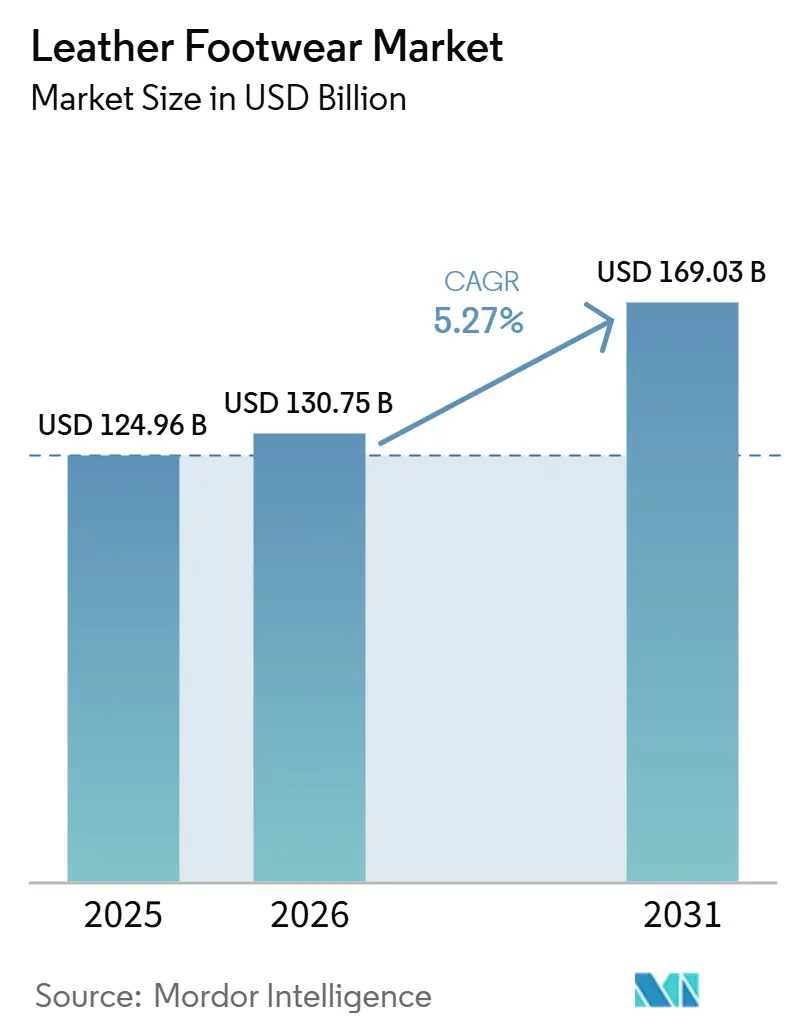
The global leather footwear market size was valued at USD 124.96 billion in 2025 and is estimated to grow from USD 130.75 billion in 2026 to reach USD 169.03 billion by 2031, at a CAGR of 5.27% during the forecast period (2026-2031). Demand is supported by recovering formalwear purchases, urban middle-class growth across Asia and Africa, and consumer preference for durable materials. Leather continues to hold a clear position in premium footwear because buyers associate it with strength, breathability, repairability, and a finish that improves through use. The global leather footwear market is also being reshaped by casual styles, as leather sneakers and smart-casual shoes bring traditional materials into everyday wardrobes. Supply risk remains material because cattle availability, trade measures, and tannery capacity can raise input costs and interrupt sourcing. Companies are responding through direct retail, traceability tools, upstream partnerships, and broader premium casual offerings, while alternatives made from vegan and bio-based materials create a growing competitive constraint.
Key Report Takeaways
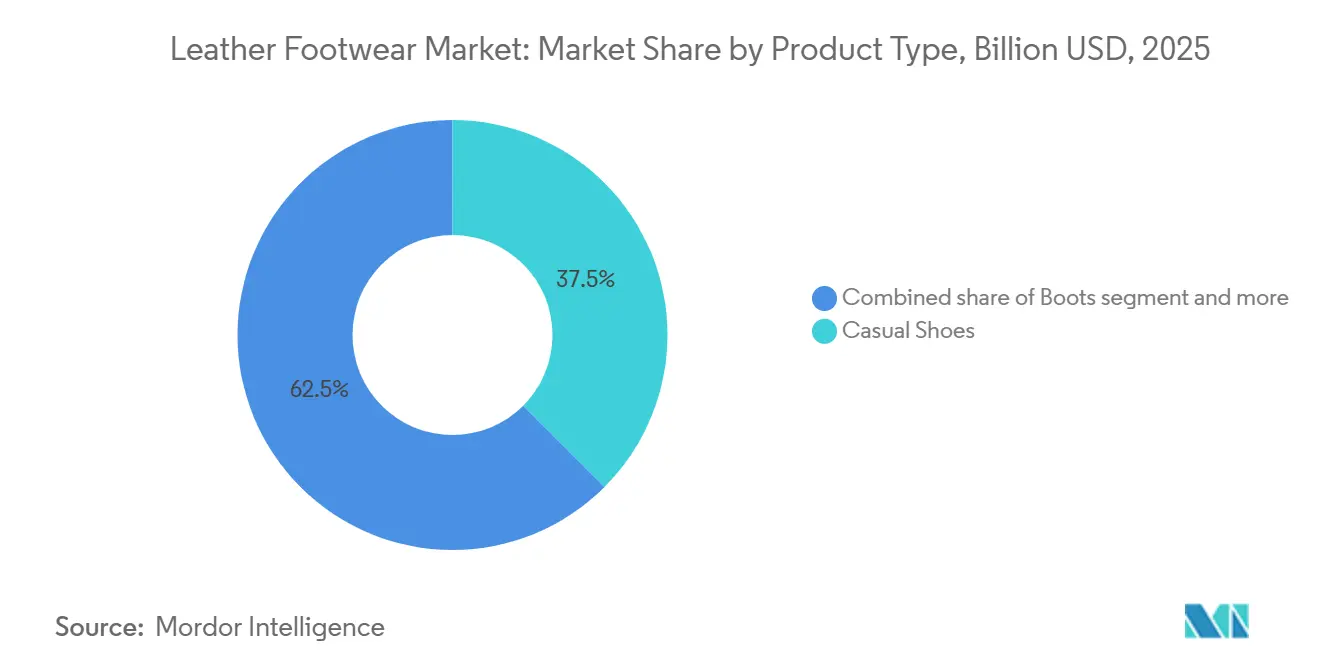
- By product type, casual shoes held 37.51% of the global leather footwear market share in 2025, while boots recorded the highest projected CAGR at 6.46% through 2031.
- By end user, men held 88.62% of the global leather footwear market share in 2025, while women recorded the highest projected CAGR at 7.11% through 2031.
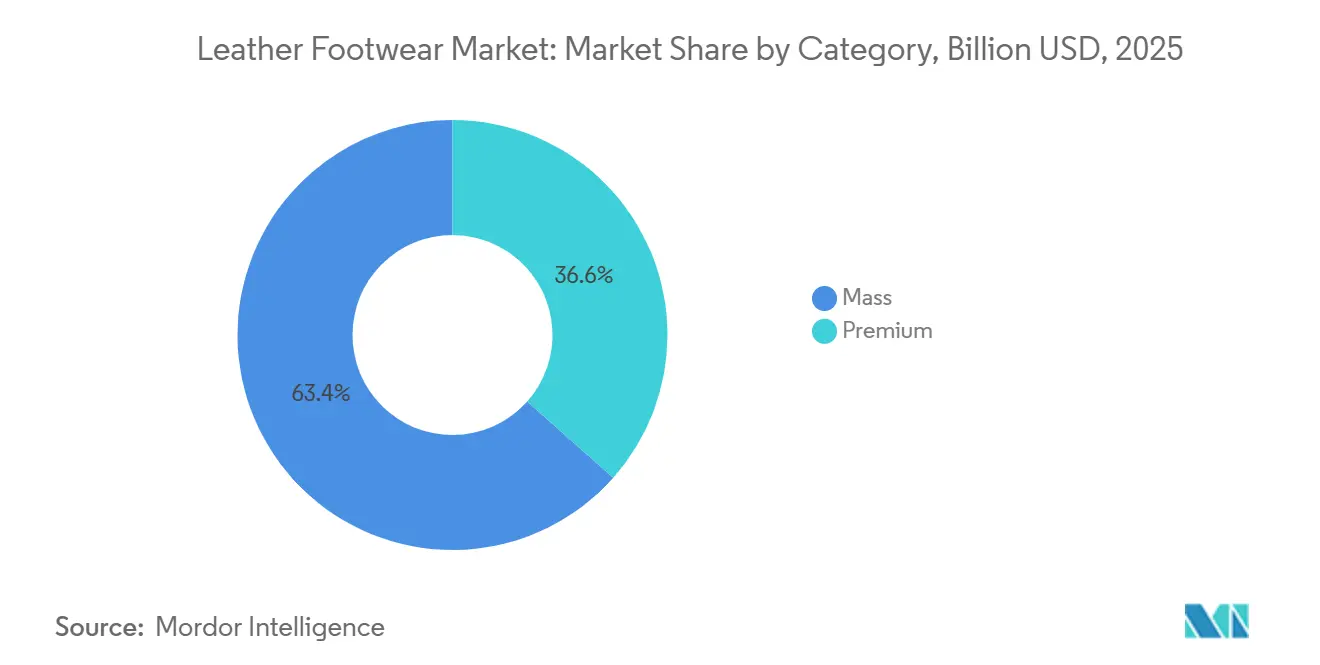
- By category, mass footwear accounted for a 68.51% share in the global leather footwear market in 2025, while premium footwear is projected to expand at a 6.88% CAGR through 2031.
- By distribution channel, offline retail represented a 69.13% share in the global leather footwear market in 2025, while online retail is expected to grow at a 7.51% CAGR through 2031.
- By geography, Asia-Pacific held 63.90% of the global leather footwear market share in 2025, while the Middle East and Africa recorded the highest projected CAGR at 6.98% through 2031.
Note: Market size and forecast figures in this report are generated using Mordor Intelligence’s proprietary estimation framework, updated with the latest available data and insights as of January 2026.
Global Leather Footwear Market Trends and Insights
Drivers Impact Analysis*
| Driver | (~) % Impact on CAGR Forecast | Geographic Relevance | Impact Timeline |
|---|---|---|---|
| Premiumization and durability preference | +1.1% | Global, concentrated in China, GCC, and North America | Medium term (2-4 years) |
| Rising online and omnichannel access | +0.9% | Global, concentrated in Asia-Pacific and North America | Short term (≤2 years) |
| Fashion-led casualization and leather sneaker adoption | +0.8% | North America, Europe, the Asia-Pacific core, spill-over to the Middle East and Africa | Short term (≤2 years) |
| Emerging-market income and urban professional demand | +0.9% | The Asia-Pacific, the Middle East and Africa, and South America | Long term (≥4 years) |
| Repair, resale, and product-life economics | +0.3% | Europe (Germany, the United Kingdom, France), North America | Medium term (2-4 years) |
| Traceability-enabled authenticity and provenance | +0.2% | Europe, North America, and early adoption in Japan | Medium term (2-4 years) |
| Source: Mordor Intelligence | |||
Premiumization and durability preference
Consumer spending behavior in leather footwear has shifted from occasion-based purchases to investment-driven acquisitions. Full-grain leather footwear commands margin premiums of up to 45% over entry-level constructions, while longer repeat purchase cycles create a structural advantage that sustains the revenue base without proportionate volume growth. Golden Goose’s FY2025 results, with net revenues of EUR 734 million, 15% year-on-year growth, and adjusted EBITDA margins of 34%, show how craftsmanship-led positioning strengthens consumer loyalty and pricing resilience[1]Source: Golden Goose Group, “FY2025 Financial Results,” Golden Goose Investor Relations, ir.goldengoose.com.. Broad market data does not fully capture how the durability argument varies across geographies. In China and the GCC, consumers view leather shoes as status symbols, while in Northern Europe and North America, they associate the same preference with sustainability and product longevity. Brands that can substantiate durability claims through material specifications and repair programs maintain a defensible position across both narratives.
Fashion-led casualization and leather sneaker adoption
The leather footwear industry is undergoing a structural redefinition of what “leather shoes” mean to end consumers. Leather sneakers, once a niche subcategory, now hold a premium casual positioning, as luxury houses incorporate classic leather materials into contemporary silhouettes. Jordan Brand x Levi’s is expected to launch four Air Jordan 3 colorways featuring premium pebbled leather and first-of-its-kind embroidered leather heel pieces in January and February 2026, targeting China, Japan, Korea, and the United States through sequential market windows. At the same time, Prada and Celine are set to debut satin-paneled slim leather trainers at their Spring/Summer 2026 runway shows, highlighting that luxury houses are actively competing for the casual footwear consumer rather than ceding this segment to athletic brands. The second-order implication is significant: as luxury entrants normalize premium price points in leather sneakers, the average selling price threshold for the entire casual leather shoes subcategory increases, benefiting mid-market players that can anchor their positioning on craftsmanship rather than celebrity marketing.
Emerging-market income and urban professional demand
Rising urban incomes across Asia, Africa, and Latin America are expanding the addressable market for leather footwear beyond developed economies. According to the Leather Industry Association of India, India’s leather footwear exports are projected to total USD 1,946.86 million in 2025-26, making leather shoes the largest export category in the Indian leather industry, accounting for 40.99% of total leather sector exports[2]Source: Council for Leather Exports and Leather Industry Association of India, “Overview of Indian Leather Industry 2026,” Leather Industry Association of India, leatherindia.org.. This performance is expected despite a 3.03% year-on-year decline, primarily due to tariff-related disruptions in the US-India trade corridor. In Colombia, household spending on footwear is expected to grow by 2.6% during January-May 2026 compared with the same period in 2025, driven by the back-to-school season and Mother’s Day sales cycles, according to the Asociación Colombiana de Industriales del Calzado (ACICAM). This trend indicates that periodic premium purchase occasions are gaining traction in emerging South American markets. A less recognized development is that Southeast Asia, particularly Vietnam and Indonesia, is shifting from being primarily a manufacturing hub to becoming a consumption market, shortening the timeline between production growth and domestic demand creation.
Rising online and omnichannel access
Online retail is the fastest-growing distribution channel for leather footwear globally and is expected to record a CAGR of 7.51% during 2026-2031, more than 200 basis points above the overall market growth rate. Zalando’s 2025 results, with GMV expected to reach EUR 17.6 billion and active customers projected at a record 62 million, indicate that digital fashion commerce will continue to achieve mainstream scale across European markets. Leather footwear is expected to benefit disproportionately from premium online search intent. Authentication remains the key leverage point for digital leather footwear sales. In March 2025, Tod’s is expected to expand its Digital Product Passport to the My Gommino collection through the AURA Blockchain Consortium, providing buyers with tamper-resistant provenance records that reduce online purchase risk for high-value leather shoes. Brands that deploy digital authentication signals are likely to convert premium online browsers more efficiently than brands that rely solely on brand heritage.
Restraints Impact Analysis*
| Restraint | (~) % Impact on CAGR Forecast | Geographic Relevance | Impact Timeline |
|---|---|---|---|
| Competition from synthetic and vegan alternatives | -0.8% | Global, most acute in Europe and North America | Medium term (2-4 years) |
| Environmental and chemical compliance burden | -0.5% | Europe, North America, and spillover to the Asia-Pacific exporters | Medium to long term (2-5 years) |
| Hide supply volatility and tannery capacity bottlenecks | -0.6% | Global, most acute in North America and South Asia | Short term (≤2 years) |
| Material-composition disclosure and SKU-level data costs | -0.3% | Europe and North America | Medium term (2-4 years) |
| Source: Mordor Intelligence | |||
Competition from synthetic and vegan alternatives
Vegan and synthetic footwear alternatives are moving from novelty products to credible quality challengers, narrowing the performance gap that has historically supported leather's market position. Vivobarefoot is expected to launch the Gobi sneaker in July 2025, made from 98% natural materials and using HyphaLite, a mycelium-based material developed with biotech firm HyphaLite. The product is both plastic-free and animal-free, directly addressing the two main objections to vegan leather alternatives. Stella McCartney's S-Wave Sport sneaker for Fall 2025, featuring Piñayarn uppers made from upcycled pineapple waste and a fully compostable BioCir Flex sole, further highlights that synthetic innovation is not limited to low-cost segments. For the leather footwear market, the primary risk is not immediate substitution but preference formation. Younger consumers who experience high-performance bio-based footwear before developing habitual leather purchasing behavior may never build the brand affinity that supports lifetime customer value in leather shoes.
Hide supply volatility and tannery capacity bottlenecks
The upstream raw material base for the leather footwear industry faces structural constraints that cyclical purchasing cannot easily offset. The U.S. cattle herd is at its smallest size since the 1950s. Weekly cattle harvests have declined from approximately 650,000 head to around 540,000-550,000 head, creating a multi-year constraint on premium hide availability. Trade policy disruption could further intensify this structural tightening. For instance, a 50% tariff imposed on many Indian leather exports in August 2025 would disrupt supply chains for U.S. brands. In addition, a global ILM tannery confidence survey in 2025 found that over 30% of companies reported poor revenue, with trade policies cited among the leading industry pain points. This creates a counterintuitive implication: brands with vertically integrated tannery relationships, such as ECCO, which operates its own tanneries, can better manage spot-market hide price volatility than asset-light leather shoe companies. As a result, vertical integration serves as a meaningful competitive moat rather than merely a cost line.
*Our forecasts treat driver/restraint impacts as directional, not additive. The impact forecasts reflect baseline growth, mix effects, and variable interactions.
Segment Analysis
By Product Type: Boots Outpacing Traditional Categories
Casual shoes are expected to command a 37.51% revenue share in 2025, the largest among all product types, driven by the casualization of workplace dress codes and the rising popularity of leather sneakers in formal-adjacent settings. Formal shoes, historically the dominant category, continue to lose share to casualized styles as hybrid work arrangements normalize smart-casual attire globally. Sandals and slippers drive seasonal demand, particularly in South Asia and the Middle East, while the “Other Leather Footwear” category includes niche occupational and sports-adjacent styles. The casual category’s durable share reflects its ability to absorb styles from adjacent categories, with sneaker-loafer hybrids and dressy casual driver shoes increasingly blurring the boundary between formal and casual footwear.
Boots are projected to record the fastest growth among product types, registering a 6.46% CAGR during 2026-2031. This growth reflects overlapping demand drivers, including occupational safety footwear used in construction and industrial applications, fashion boots supported by seasonal demand in Europe and North America, and cold-weather footwear needs in emerging APAC markets as higher-income consumer segments expand. The global leather boots market is forecast to grow between 2024 and 2029, with APAC identified as a key volume contributor. Boots typically offer a stronger margin profile than casual shoes because of higher material content and greater construction complexity, making the segment a meaningful driver of value growth that is expected to exceed volume growth over the forecast period.



By End User: Women's Segment Gaining Premium Momentum
Men are expected to account for an 88.62% share of the global leather footwear market in 2025. This dominance stems from demand for occupational footwear, formal dress shoes, safety boots, and work shoes, which remain predominantly male-oriented categories and continue to support high volumes. However, the scale of the men’s segment means that even marginal shifts in per-capita spending in the women’s segment can generate significant revenue contributions. Kering’s Saint Laurent is expected to record a “very strong performance in shoes” in Q1 2026, partly driven by women’s leather categories that the house has expanded aggressively. Trade compliance frameworks, particularly US tariff adjustments and REACH substance restrictions in EU markets, are creating asymmetric cost pressure on women’s premium leather shoe supply chains. Italian and Spanish tanneries that supply the luxury end of the market are facing higher input costs.
The women’s segment is projected to register the fastest growth by end user, with a CAGR of 7.11% during 2026-2031. Growth is driven by luxury fashion houses developing dedicated women’s leather lines, the formalization of women’s professional wardrobes in emerging Asian economies, and the fashion-leather sneaker trend, which is gaining traction among younger female consumers. Luxury market data indicates that full-price women’s leather footwear collections at major houses are expected to support outperformance in EMEA and the Americas through 2025. The children’s segment remains a stable volume contributor, supported by school reopening cycles and parental preference for durable leather over synthetic alternatives for growing feet. This preference is especially prevalent among middle-class households in South and Southeast Asia, where lifetime durability remains a key purchase rationale.
By Category: Premium Challenging Mass Market Dominance
The mass category is expected to hold a 68.51% share in 2025, driven by volume demand across high-population markets in South and Southeast Asia, Sub-Saharan Africa, and Latin America, where accessible price points remain the dominant purchase determinant. Bata, Deichmann, and Belle International collectively serve most of this demand through extensive distribution networks and value-oriented manufacturing. However, mass-segment players face structural margin compression risk, as synthetic alternatives and direct-to-consumer fast-fashion footwear brands are becoming increasingly competitive at the lower end of the mass market, narrowing the price range in which companies can position genuine leather footwear.
The premium category is expected to be the fastest-growing segment, registering a CAGR of 6.88% during 2026-2031. Its expansion is driven by trading-up behavior in China, India, and the GCC, where rising disposable incomes are bringing first-time premium leather shoe purchasers into the category. Golden Goose Group’s APAC revenues are expected to grow 17% in FY2025, while its EMEA revenues are expected to grow 18%, indicating geographically diversified demand for premium leather footwear across developed and emerging economies. Market data often overlooks a key insight: within the premium segment, premium casual leather shoes are expected to be the fastest-growing sub-category, outpacing formal and dress shoes as consumers increasingly define premium through lifestyle positioning rather than occasion-specific functionality.
By Distribution Channel: Online Retail Redefining Leather Footwear Purchase
Offline retail is projected to hold a 69.13% share in 2025. Physical stores remain integral to leather footwear purchase decisions, as they allow consumers to verify fit, assess material quality, and experience the brand, factors that are difficult to replicate digitally in premium and occupational categories. Bata operates over 5,800 stores across more than 50 countries, ECCO maintains an extensive retail presence across Europe and Asia, and Clarks is expected to launch Pace, its first performance walking shoe, through physical retail and brand e-commerce in August 2025. These developments indicate that established players continue to invest in a multi-channel physical presence. The expansion of regional retail infrastructure in MEA markets, particularly in the UAE and Saudi Arabia, is also widening the addressable offline base.
Online retail is expected to be the fastest-growing channel, registering a 7.51% CAGR during 2026-2031. This shift is structural rather than cyclical, as digital authentication technologies, flexible return policies, and AI-driven fit recommendation tools continue to reduce the perceived risk of buying leather footwear online. Tod's deployment of the Digital Product Passport for the My Gommino collection, accessible through a QR code and verified by the AURA Blockchain Consortium, shows how provenance technology can convert online browsing intent into purchase confidence. Caleres reported that owned e-commerce sales across Famous Footwear and its brand portfolio served as a strategic growth driver in fiscal 2025, with the company completing the Stuart Weitzman integration with minimal disruption. The broader platform implication is that omnichannel orchestration, where physical stores function as experience hubs and online channels capture repeat purchase volume, is becoming the baseline operating model rather than a competitive differentiator.
Geography Analysis
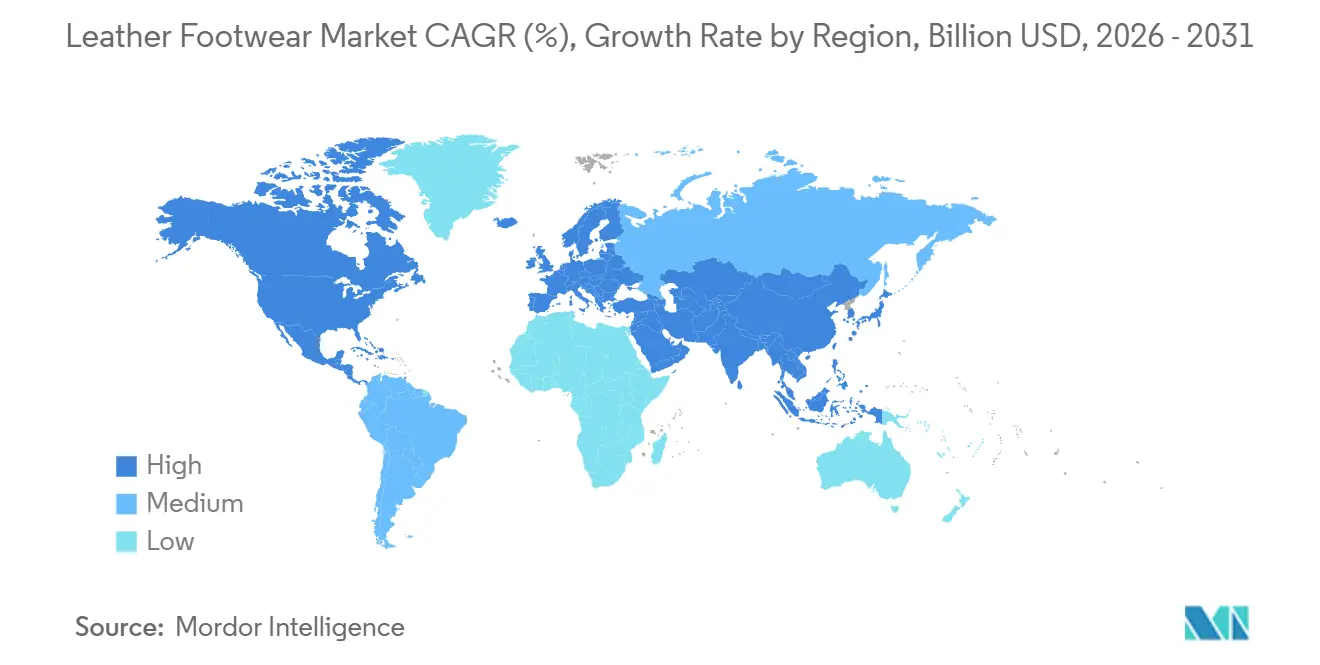
Asia-Pacific is expected to hold a 63.9% share of the global leather footwear market in 2025, supported by strong manufacturing capabilities and a growing consumer base. India is projected to remain the world’s second-largest footwear producer and export USD 4,750 million worth of leather and leather products from April 2025 through March 2026, according to the Leather Industry Association of India. The United States is expected to account for 20.5% of these exports, followed by Germany at 11.0% and the United Kingdom at 8.8%. Vietnam is expected to lead China’s 2024 leather footwear imports at USD 968 million, followed by Italy at USD 965 million, reflecting demand for both cost-competitive ASEAN supply and European luxury products. Vietnam, Indonesia, and Thailand are expanding from export manufacturing into larger domestic consumption markets. The region’s production capacity, retail development, and demand make it the leading geography in the global leather footwear market.
Europe and North America remain important premium markets. Europe combines leather manufacturing heritage with strict product, chemical, and waste requirements. The EU’s Ecodesign for Sustainable Products Regulation is expected to prohibit large companies from destroying unsold footwear from July 19, 2026, while the Packaging and Packaging Waste Regulation is expected to apply to footwear packaging from August 12, 2026. The European Commission is expected to adopt a Delegated Act in July 2026 removing cattle hides, skins, and leather from the scope of the EU Deforestation Regulation. REACH restrictions continue to affect tanning compounds and finishing processes. North American brands face tight raw material availability and higher input costs as the United States cattle herd remains historically low. The domestic tanning workforce is expected to decline from more than 300,000 people in the 1950s to 50,000 in 2025, limiting nearshoring options for companies seeking to reduce tariff exposure.
The Middle East and Africa are forecast to grow at a 7.0% CAGR from 2026 to 2031, the highest regional rate. Retail investment, tourism spending, and a young population support footwear demand across Gulf markets. South Africa is expected to grow quickly as tourism recovers and export activity develops under AGOA. Nigeria, Ethiopia, and Tanzania represented 66% of regional leather footwear consumption by volume in the supplied data, but domestic manufacturing captured only part of this demand. In South America, Brazil remains the largest regional producer and consumer, while Colombia’s footwear spending is expected to grow 2.6% in the first five months of 2026. Brazil’s 2026 production is forecast at 848 million pairs with minimal growth, reflecting mature demand and pressure from synthetic alternatives, according to the Banco Do Nordeste Do Brasil[3]Source: Banco do Nordeste do Brasil, “Couro e Calçados Caderno Setorial ETENE,” Banco do Nordeste do Brasil, bnb.gov.br..

Competitive Landscape
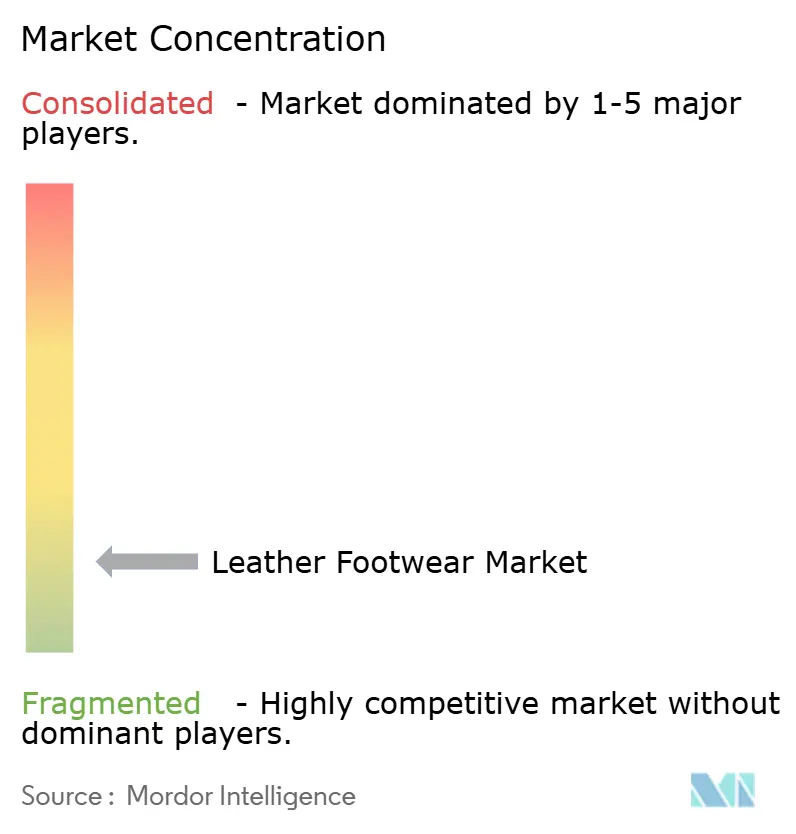
The leather footwear market remains moderately fragmented, as luxury groups and high-volume footwear companies serve different consumer segments and price points. Prada Group is expected to report first-quarter 2026 net revenue of EUR 1.43 billion, up 14% year on year, including newly consolidated Versace, with revenue from the Americas rising 34%. Kering is expected to report a 3% comparable revenue decline in the first quarter of 2026 while outlining plans to restore growth and improve margins. These results show that brand-level execution can matter more than portfolio size in selective luxury demand conditions. Caleres expects low-double-digit growth in its Brand Portfolio during fiscal 2026 after integrating Stuart Weitzman. Steven Madden raised its full-year 2026 revenue guidance to 10% to 12% growth over 2025, supported by direct sales, the Kurt Geiger London acquisition, and international activity. Bata appointed former ECCO Chief Executive Panos Mytaros as global chief executive, effective September 15, 2025, signaling an effort to modernize its retail network. Companies compete through brand positioning, product range, retail reach, and direct customer relationships.
Materials and supply-chain development are becoming key competitive factors. ECCO and Spinnova launched the BIOM 720 sneaker using protein-based fiber made from upcycled leather residuals, showing how established leather specialists are advancing material innovation. Prada Group completed a 10% investment in Rino Mastrotto Group in June 2025, strengthening its link to luxury leather processing as high-quality supply tightens. These initiatives support material availability and product differentiation. Tod’s has used a Digital Product Passport for My Gommino to provide verified provenance across boutiques and its website. Traceability can reduce concerns about authenticity and unauthorized resale, especially in premium online transactions. Repair and resale can also extend consumer relationships when brands support refurbishment. Companies that demonstrate material origin, product quality, and after-sales value have a stronger basis for premium pricing, particularly through digital channels.
New entrants and established brands are competing in premium casual footwear, where direct-to-consumer models have gained traction. Golden Goose generated EUR 734 million in FY2025 revenue, up 15% year on year, with direct-to-consumer accounting for 81% of total revenue. Its performance shows how a focused premium sneaker brand can scale outside traditional luxury group structures. Jordan Brand and Levi’s used a multi-market release of premium leather Air Jordan 3 products in early 2026 to connect material craftsmanship with cultural marketing. Luxury groups are also expanding casual leather offerings, increasing competition for specialist sneaker brands. Mass operators retain an advantage in price accessibility and physical distribution. No company in the supplied material holds a dominant share across all regions, customer groups, and price tiers. The global leather footwear market remains open to companies that can combine credible materials, product design, and channel execution.
Leather Footwear Industry Leaders
PRADA S.p.A.
LVMH Moët Hennessy Louis Vuitton SE
Kering SA
Hermès International
Salvatore Ferragamo S.p.A.
- *Disclaimer: Major Players sorted in no particular order

Recent Industry Developments
- May 2026: Skechers partnered with the WNBA, formalized a commercial relationship that began with individual athlete signings in 2024, and positioned Skechers as a committed competitor in women's basketball footwear, a category historically dominated by Nike and adidas.
- February 2026: Jordan Brand x Levi's launched four Air Jordan 3 colorways featuring premium pebbled leather uppers and embroidered leather heel detailing, staged across China (January 24), Japan and Korea (January 30), and San Francisco and Los Angeles (February 5-13). The global rollout reflected growing demand for premium leather sneaker collaborations, bridging heritage craftsmanship and cultural marketing.
- February 2026: The Italian Shoes Co. officially unveiled its brand new store in South Extension II, New Delhi, marking a significant milestone in its strategic expansion into the Indian luxury retail market. Rooted in a rich Italian heritage, the brand was globally recognized for its handcrafted premium leather and meticulous craftsmanship.


Global Leather Footwear Market Report Scope
Leather footwear refers to shoes, boots, and sandals made from the treated and tanned skin of animals, featuring parts like the upper body, lining, or sole crafted from this strong and flexible material. The global leather footwear market is segmented by product type, end user, category, distribution channel, and geography. By product type, the market is segmented into formal shoes, casual shoes, boots, sandals and slippers, and other leather footwear. By end user, the market is segmented into men, women, and children. By category, the market is segmented into mass and premium. By distribution channel, the market is segmented into offline retail and online retail. By geography, the market is segmented into North America, Europe, Asia-Pacific, South America, and Middle East and Africa). The market forecasts are provided in terms of value (USD).
| Formal Shoes |
| Casual Shoes |
| Boots |
| Sandals and Slippers |
| Other Leather Footwear |
| Men |
| Women |
| Children |
| Mass |
| Premium |
| Offline Retail |
| Online Retail |
| North America | United States |
| Canada | |
| Mexico | |
| Rest of North America | |
| Europe | United Kingdom |
| Germany | |
| France | |
| Italy | |
| Spain | |
| Sweden | |
| Belgium | |
| Poland | |
| Netherlands | |
| Rest of Europe | |
| Asia-Pacific | China |
| Japan | |
| India | |
| Thailand | |
| Singapore | |
| Indonesia | |
| South Korea | |
| Australia | |
| Rest of Asia-Pacific | |
| South America | Brazil |
| Argentina | |
| Colombia | |
| Peru | |
| Chile | |
| Rest of South America | |
| Middle East and Africa | United Arab Emirates |
| South Africa | |
| Saudi Arabia | |
| Nigeria | |
| Egypt | |
| Morocco | |
| Turkey | |
| Rest of Middle East and Africa |
| Product Type | Formal Shoes | |
| Casual Shoes | ||
| Boots | ||
| Sandals and Slippers | ||
| Other Leather Footwear | ||
| End User | Men | |
| Women | ||
| Children | ||
| Category | Mass | |
| Premium | ||
| Distribution Channel | Offline Retail | |
| Online Retail | ||
| Geography | North America | United States |
| Canada | ||
| Mexico | ||
| Rest of North America | ||
| Europe | United Kingdom | |
| Germany | ||
| France | ||
| Italy | ||
| Spain | ||
| Sweden | ||
| Belgium | ||
| Poland | ||
| Netherlands | ||
| Rest of Europe | ||
| Asia-Pacific | China | |
| Japan | ||
| India | ||
| Thailand | ||
| Singapore | ||
| Indonesia | ||
| South Korea | ||
| Australia | ||
| Rest of Asia-Pacific | ||
| South America | Brazil | |
| Argentina | ||
| Colombia | ||
| Peru | ||
| Chile | ||
| Rest of South America | ||
| Middle East and Africa | United Arab Emirates | |
| South Africa | ||
| Saudi Arabia | ||
| Nigeria | ||
| Egypt | ||
| Morocco | ||
| Turkey | ||
| Rest of Middle East and Africa | ||


Key Questions Answered in the Report
What is the projected growth rate for global leather footwear through 2031?
The global leather footwear market is forecast to grow at a 5.27% CAGR from 2026 to 2031, reaching USD 169.03 billion.
Which product category is expected to grow fastest through 2031?
Boots are projected to record the fastest product-type growth, at a 6.5% CAGR, supported by work, cold-weather, and fashion demand.
Why is online retail growing faster than physical footwear stores?
Online retail is projected to grow at 7.51% CAGR as authentication records, returns policies, and fit tools reduce purchase risk.
Which region leads global leather footwear demand?
Asia-Pacific led with a 63.9% value share in 2025, supported by production scale and growing domestic consumption.
Page last updated on:





