
Latex Mattress Market Size and Share
Market Overview
| Study Period | 2020 - 2031 |
|---|---|
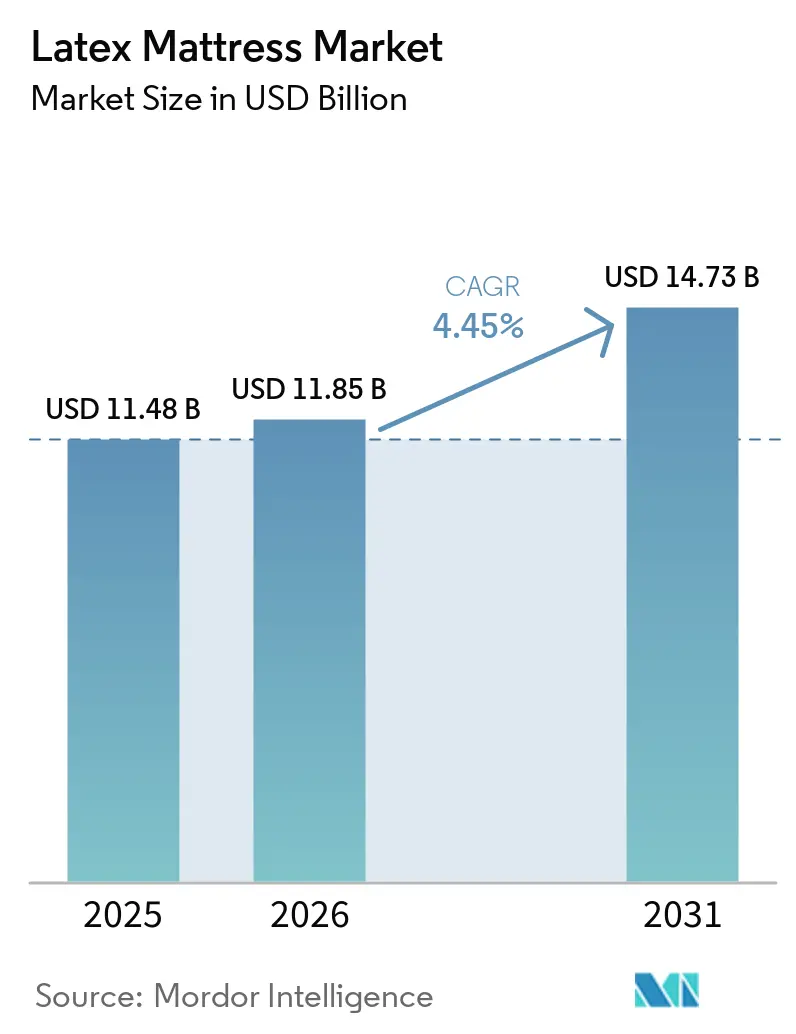
| Market Size (2026) | USD 11.85 Billion |
| Market Size (2031) | USD 14.73 Billion |
| Growth Rate (2026 - 2031) | 4.45 % |
| Fastest Growing Market | Asia-Pacific |
| Largest Market | North America |
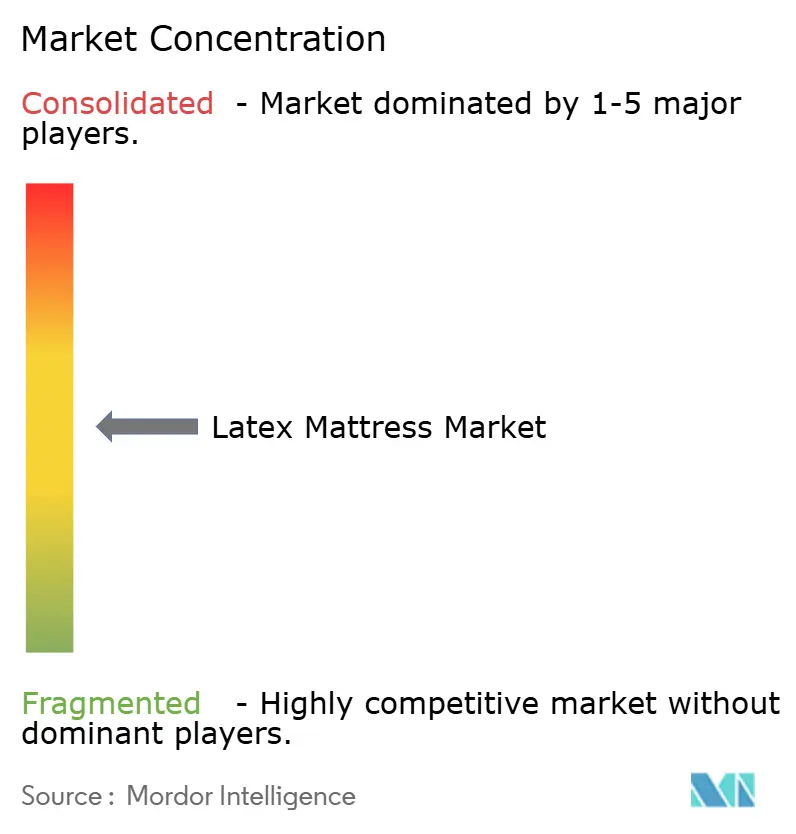
| Market Concentration | Medium |
Major Players *Disclaimer: Major Players sorted in no particular order Image © Mordor Intelligence. Reuse requires attribution under CC BY 4.0. | |
Latex Mattress Market Analysis by Mordor Intelligence
The latex mattress market size was valued at about USD 11.48 billion in 2025, is expected to reach USD 11.85 billion in 2026, and is forecast to reach USD 14.73 billion by 2031 at a 4.45% CAGR over 2026-2031. The latex mattress market is moving beyond a narrow premium position as more buyers treat sleep quality and physical support as factors in a mattress purchase. The World Health Organization reported 619 million people with low back pain in 2020 and expects 843 million cases by 2050, supporting demand for sleep surfaces designed to distribute pressure. Certification is becoming an important part of competitive positioning because it gives buyers a way to assess natural-material and chemical-safety claims. The latex mattress market also benefits from wider online access and from commercial buyers, which are upgrading bedding specifications. Natural rubber availability remains a material risk because supply is concentrated in Southeast Asia, and prices can affect manufacturer margins.
Key Report Takeaways
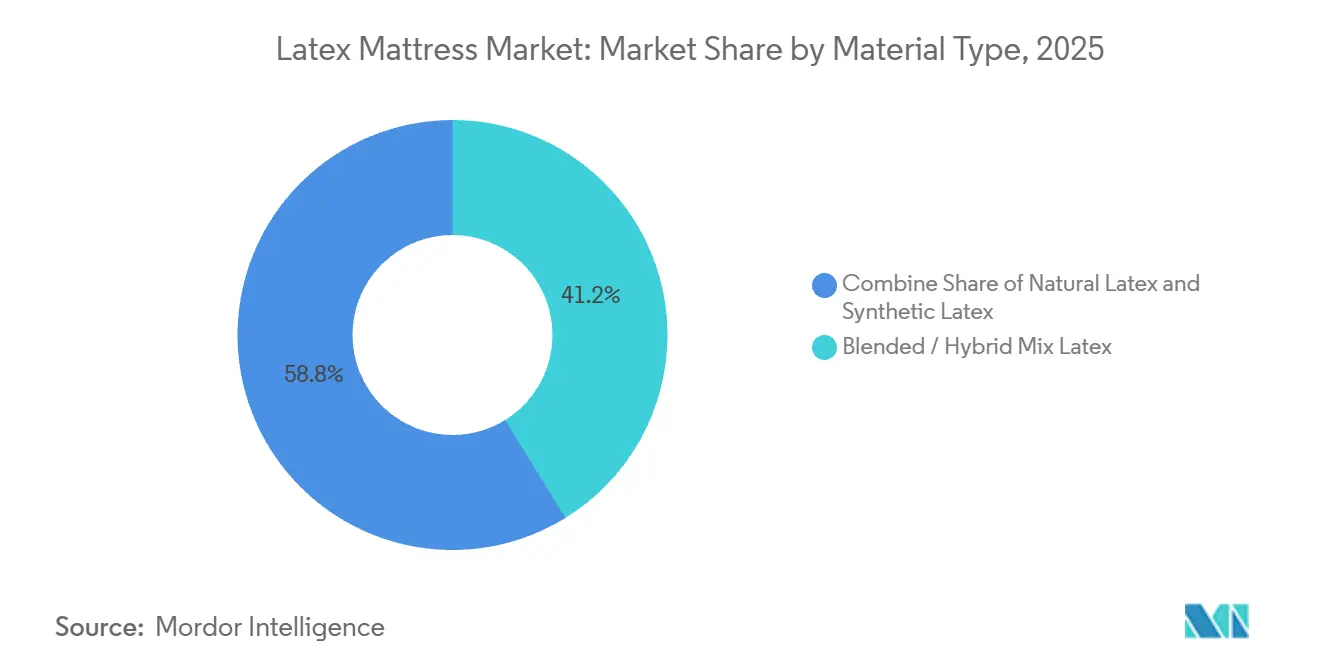
- By material type, Blended and Hybrid Mix Latex held 41.19% of the latex mattress market in 2025, while Natural Latex is projected to register a 5.32% CAGR through 2031.
- By size, Queen held 43.36% of the latex mattress market share in 2025, while Twin XL is projected to register a 5.01% CAGR through 2031.
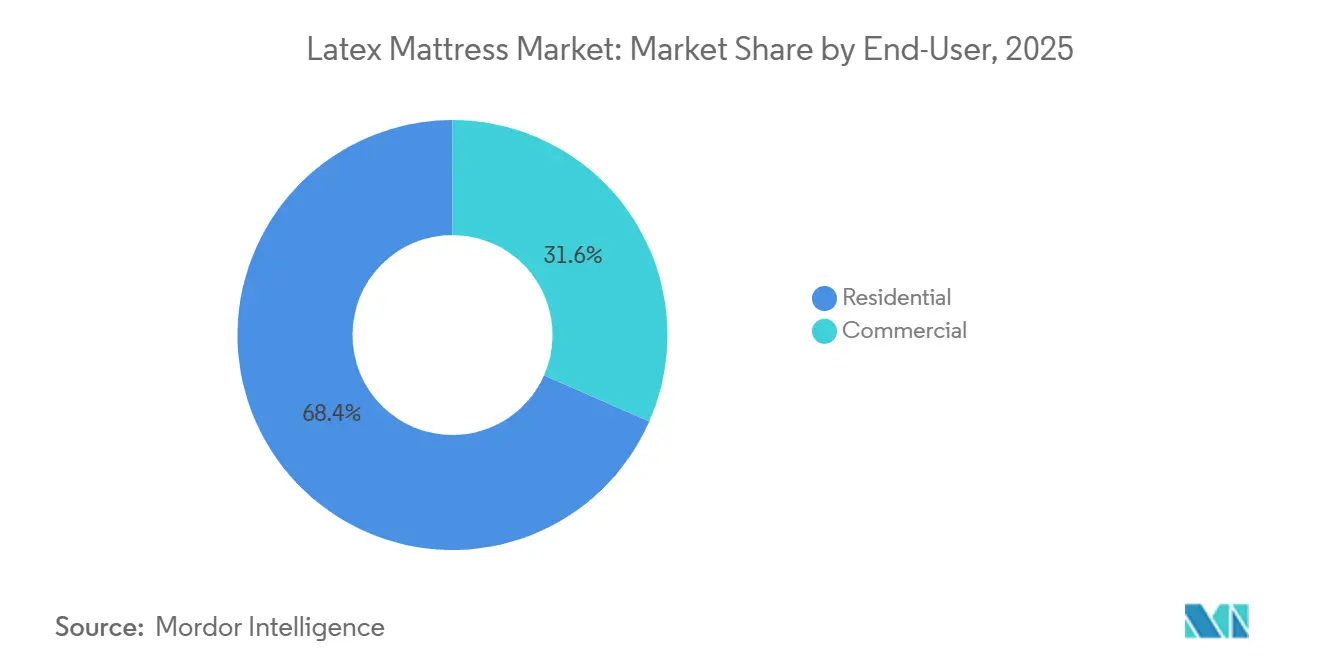
- By end user, Residential held 68.45% of the latex mattress market in 2025, while Commercial is projected to register a 4.88% CAGR through 2031.
- By distribution channel, B2C Retail Channels held 71.12% of the latex mattress market in 2025, while B2B Direct Purchases are projected to register a 4.67% CAGR through 2031.
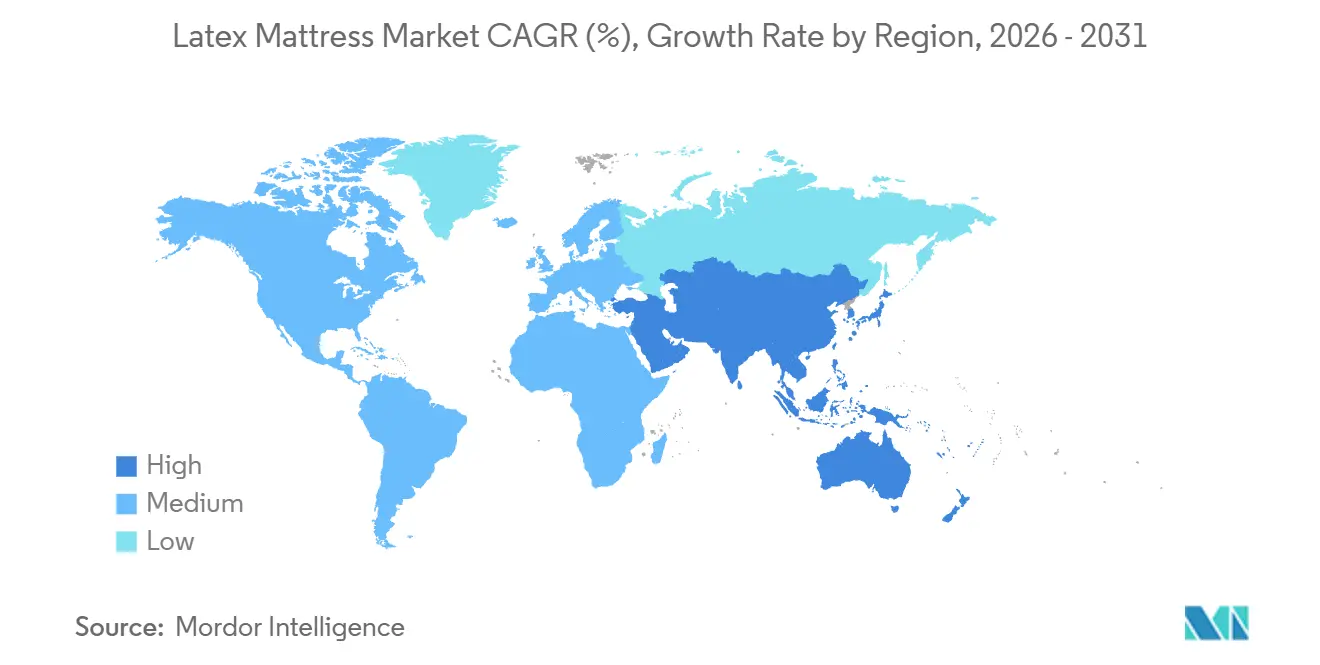
- By geography, North America held 48.56% of the latex mattress market share in 2025, while Asia-Pacific is projected to register a 5.50% CAGR through 2031.
Note: Market size and forecast figures in this report are generated using Mordor Intelligence’s proprietary estimation framework, updated with the latest available data and insights as of January 2026.
Global Latex Mattress Market Trends and Insights
Drivers Impact Analysis*
| Driver | % Impact on CAGR Forecast | Geographic Relevance | Impact Timeline |
|---|---|---|---|
| Sleep-Health and Orthopedic Support Demand | +1.1% | Global, most acute in North America and Western Europe | Long term (≥ 4 years) |
| Natural and Organic Bedding Preference | +0.9% | North America & Northern Europe; spill-over to the Asia-Pacific premium tier | Long term (≥ 4 years) |
| Premiumization of Sleep and Wellness Spending | +0.8% | North America, Germany, the United Kingdom, Australia, and China tier-1 cities | Medium term (2–4 years) |
| E-Commerce and Direct-to-Consumer Accessibility | +0.7% | Global; Asia-Pacific, and North America lead | Short term (≤ 2 years) |
| Hospitality and Healthcare Bedding Upgrades | +0.5% | Global; Middle East, Asia-Pacific resort corridors, North America | Medium term (2–4 years) |
| Modular, Hybrid, and Personalized Firmness Designs | +0.4% | North America, Europe | Short to Medium term |
| Source: Mordor Intelligence | |||
Sleep-Health and Orthopedic Support Demand
Sleep deficiency is changing the criteria used to evaluate mattresses in the latex mattress market. The 2024 National Health Interview Survey found that 30.5% of United States adults slept fewer than 7 hours in a 24-hour period[1]Centers for Disease Control and Prevention, National Center for Health Statistics, “Short Sleep Duration and Sleep Difficulties Among Adults: United States, 2024,” NCHS Data Brief, cdc.gov. Adults aged 35-64 had the highest short-sleep prevalence, at 33%-34%, which is relevant because this group includes many premium mattress buyers. Low back pain is another long-term demand factor, with the World Health Organization projecting 843 million cases globally by 2050. Latex can be positioned around pressure distribution and durable support rather than comfort claims alone. This framing supports the premium price tiers where manufacturers compete with certified natural and hybrid alternatives.
Natural and Organic Bedding Preference
Natural latex demand is supported by certification systems that make sourcing and material claims more visible to buyers. The Global Organic Latex Standard requires certified products to contain at least 95% certified organic raw latex, giving brands a defined threshold for organic product claims. In September 2025, Naturepedic received UL Solutions Environmental Claim Validation for non-detectable PFAS chemicals in children’s mattresses[2]Naturepedic, “Naturepedic Sets New Global Standard in Baby and Kids Safe Sleep as the First Mattress Brand Validated for Non-Detectable PFAS,” Naturepedic, prnewswire.com. The validation covered approximately 80 PFAS compounds and used a 50 ppm total-fluorine threshold. These requirements place more value on traceable sourcing in the latex mattress market. They also make it harder for manufacturers without auditable supply chains to maintain premium organic positioning.
Premiumization of Sleep and Wellness Spending
Premium sleep purchases are becoming more closely tied to health, comfort, durability, and material credibility. The International Sleep Products Association reported that 83% of buyers spending more than USD 2,500 on a mattress cited health and comfort as their primary motivation[3]International Sleep Products Association, “Consumer Spending Habits and Priorities for 2025,” BedTimes Magazine, bedtimesmagazine.com. That purchase logic favors materials that can support a clear performance and certification narrative. Natural latex competes most directly in this higher-value range, where price comparisons alone do not determine the sale. The latex mattress market, therefore, depends on brands communicating why natural materials, durability, and support features justify a higher initial cost. The same positioning can help retailers distinguish certified latex products from foam products with less defined material provenance.
E-Commerce and Direct-to-Consumer Accessibility
Online retail has widened access to latex mattresses for buyers who may not live near a specialty bedding store. Long trial periods, free delivery, and return policies reduce the importance of an in-store test before purchase. Direct-to-consumer brands use these programs to sell certified organic latex products while maintaining direct contact with customers. Avocado had expanded to 845 United States retail doors by August 2026 while continuing to operate its direct-to-consumer channel. This combination shows how physical retail can support online sales through product access and consumer confidence. The latex mattress market is likely to remain shaped by brands that balance direct selling with selective store partnerships.
Restraints Impact Analysis*
| Restraint | % Impact on CAGR Forecast | Geographic Relevance | Impact Timeline |
|---|---|---|---|
| Premium Price and Affordability Barrier | -0.7% | Global; most acute in South America, Southeast Asia, Eastern Europe | Long term (≥ 4 years) |
| Natural-Rubber Supply and Price Volatility | -0.6% | Global; Southeast Asia supply affects all markets | Medium to Long term |
| Imported-Core Logistics and Bulky-Product Costs | -0.4% | APAC, South America, MEA | Medium term (2–4 years) |
| Certification, Claim-Verification and Consumer-Confusion Burden | -0.3% | North America & Europe | Short to Medium term |
| Source: Mordor Intelligence | |||
Premium Price and Affordability Barrier
The price difference between latex and lower-cost foam or innerspring alternatives remains a persistent limit on broader adoption. Certified organic latex queen mattresses typically retail for USD 1,400-2,500 from established direct-to-consumer brands. Comparable memory foam options typically retail for USD 300-800. This difference is especially important in South and Southeast Asia, where orthopedic awareness can rise faster than household purchasing power. Blended and hybrid products partially address the affordability issue, which helps explain their 41.19% share of the latex mattress market in 2025. However, adding synthetic material can weaken the organic proposition that supports the highest-price tiers.
Natural-Rubber Supply and Price Volatility
Natural rubber supply concentration is a material cost risk for latex mattress manufacturers. ANRPC projected 2026 global production of 15.28 million tons against demand of 15.36 million tons, extending the supply deficit to a sixth consecutive year. Latex-in-bulk averaged USD 1.81/kg in Kuala Lumpur in July 2026, while RSS-3 and STR-20 averaged USD 2.92/kg and USD 2.35/kg, respectively. Southeast Asia produces more than 84% of global natural rubber output, leaving the supply chain exposed to regional weather, land-use, and trade disruptions. Manufacturers using concentrated natural latex face a greater margin of exposure than suppliers that can use blended material formats. This constraint affects sourcing decisions, inventory planning, and the ability to hold retail prices steady.
*Our forecasts treat driver/restraint impacts as directional, not additive. The impact forecasts reflect baseline growth, mix effects, and variable interactions.
Segment Analysis
By Material Type: Certification Pull Reshapes the Premium Tier
Blended and Hybrid Mix Latex held 41.19% of the latex mattress market in 2025, showing the importance of cost-accessible products that still retain a latex performance proposition. These constructions lower the per-unit raw-material cost relative to fully natural formats. They give manufacturers a way to address mass-market buyers who cannot justify the price of a certified organic model. Natural Latex is forecast to expand at a 5.32% CAGR through 2031, making it the fastest-growing material type. This growth is tied to the role of GOLS and OEKO-TEX certification in premium product selection. Certification gives buyers a clearer basis for assessing natural-content and chemical-safety claims.
Pure Synthetic and Hybrid Synthetic products serve entry-level residential and institutional demand where price has a stronger influence than material provenance. The material mix lets brands manage the tension between wider access and a premium natural positioning. Talalay Global announced in August 2026 that it planned a second North Carolina facility for the first quarter of 2027. The company also announced Moreganic-certified product releases before the end of 2026 and a new phase-change-material latex foam formulation. These actions show how suppliers can expand capacity while developing higher-value material options. Earthfoam’s plantation-through-finished-core vertical integration similarly reflects the value of supply reliability and differentiated sourcing. The latex mattress industry uses these approaches to protect product availability while supporting premium natural latex positioning.



By Size: Queen Anchors Revenue While Twin XL Targets New Household Types
Queen held 43.36% of the latex mattress market share in 2025, supported by broad availability across direct-to-consumer, specialty, and multibrand retail. The format is widely used in the United States and Canadian residential settings. It also attracts a wide group of suppliers, from value-oriented blended products to GOLS-certified natural options. Queen products can carry high average selling prices within the size range because they are common in primary bedrooms. This makes the segment important for both volume and revenue planning. The latex mattress market size associated with Queen products is therefore shaped by replacement demand as well as premium product upgrades.
Twin XL is forecast to grow at a 5.01% CAGR through 2031, supported by college dormitory and young-adult renter demand. This customer group is more likely to encounter brands through digital channels and online comparison tools. King and California King products remain important to luxury product lines, including Saatva’s Zenhaven, Royal-Pedic, and Avocado’s premium offerings. Full/Double and Twin/Single products address secondary-bedroom demand, where a high natural-latex material cost can be harder to absorb. Crib and Toddler products form a small but important safety-focused category. Naturepedic’s 2025 PFAS validation for children’s mattresses raised the importance of chemical-safety disclosure for this part of the segment.
By End User: Residential Scale Meets Faster Commercial Growth
Residential buyers accounted for 68.45% of the latex mattress market in 2025. Household sleep investment among the 25-55 age group supports the scale of this segment. Direct-to-consumer economics are also strongest in residential sales because manufacturers can avoid some of the margin structure of commercial procurement. Commercial demand is forecast to grow at a 4.88% CAGR through 2031. Hotels, healthcare and elderly-care facilities, dormitories, military settings, and other institutions make up this commercial base. The faster growth rate shows the expanding role of specification-led buying in the latex mattress market.
Hotel groups can use mattress quality as part of their service and sustainability positioning. Piana Sleep’s October 2024 arrangement with Reveille Hospitality supplied the Rinnovo mattress to upscale hotel properties with a take-back recovery program. Healthcare and elderly-care buyers also evaluate materials through the lens of use intensity, support, and durability. The World Health Organization found that low back pain disability burden was greatest among adults aged 80-84, while cases among people aged 70 and older more than doubled between 1990 and 2019. Japan, Germany, Italy, and South Korea have older demographic profiles that can support institutional demand. Latex is positioned in these settings as a functional material choice rather than solely as a premium household product.
By Distribution Channel: Omnichannel Direct-to-Consumer and Accelerating B2B Direct
B2C Retail Channels held 71.12% of the latex mattress market in 2025. This category includes multibrand stores, specialty bedding and exclusive-brand outlets, online channels, and other retail formats. Extended trials, free delivery, and returns have reduced the historical advantage held by stores that offered physical product testing. Brands can use direct channels to explain certifications, materials, and firmness options in greater detail. Retail partnerships still matter because they provide a physical point of contact for buyers considering a high-value purchase. Avocado’s expansion to 845 United States retail doors by August 2026 illustrates the role of an omnichannel model.
B2B Direct Purchases are projected to grow at a 4.67% CAGR through 2031. The channel is supported by hotel and healthcare buyers that purchase against defined specifications and operate 7-10 year replacement cycles across larger room footprints. Contracted commercial sales can provide revenue visibility even when unit selling prices are lower than in residential direct-to-consumer sales. Sustainability requirements in hotel and healthcare networks can favor certifiable organic and hypoallergenic materials. This changes GOLS-certified latex from a discretionary premium feature into a specification that can support procurement compliance. The latex mattress industry, therefore, has a clear reason to develop separate products and sales processes for commercial accounts.
Geography Analysis
North America held 48.56% of the latex mattress market share in 2025. The region is supported by high willingness to pay, established direct-to-consumer brands, and broad recognition of GOLS and GOTS certifications. The United States drives demand, while Canada and Mexico add regional demand. Mexico is showing increased premium-tier awareness as its middle class expands. North American growth is expected to moderate during 2026-2031 as premium-segment penetration matures in core United States cities.
Europe is supported by deep organic-product preferences, particularly in Germany, the Nordics, and Benelux. The EU Ecodesign for Sustainable Products Regulation adds support for durable and recyclable products, which benefits long-lasting latex products relative to more disposable foam alternatives. The United Kingdom, France, Spain, and Italy combine specialty bedding retail with a growing direct-to-consumer channel. The Middle East and Africa have a split demand picture. The United Arab Emirates and Saudi Arabia are shaped by luxury hospitality investment, while South Africa and Nigeria represent aspirational consumer demand with improving premium retail infrastructure. Demand in the region is closely tied to hotel construction and procurement cycles in the United Arab Emirates, Saudi Arabia, and Egypt.
Asia-Pacific is projected to grow at a 5.50% CAGR through 2031, the fastest rate among regions in the latex mattress market. China led Asia-Pacific submarket value in 2024, supported by urbanization and e-commerce platforms that distribute premium natural latex products. India is the fastest-growing Asia-Pacific country as domestic direct-to-consumer brands add latex layers across semi-urban markets. Japan is moving from traditional futon formats toward Western-style latex and hybrid mattresses, supported by an aging population and orthopedic-care priorities. Southeast Asia benefits from proximity to natural rubber production in Thailand, Malaysia, Vietnam, and Indonesia. This proximity supports domestic manufacturing and partly offsets lower average selling prices relative to developed markets.

Competitive Landscape
The latex mattress market is moderately fragmented, with integrated manufacturers, latex specialists, and direct-to-consumer organic brands serving different price points and channels. Integrated companies compete through retail access, branded manufacturing, and broader supply-chain control. Pureplay specialists compete through material knowledge and latex-processing capability. Direct-to-consumer organic brands compete through certifications, long trial periods, and brand identity. The competitive structure gives buyers a broad set of choices across natural, blended, and hybrid products.
Avocado, Naturepedic, PlushBeds, and My Green Mattress use GOLS and GOTS compliance to support a certified-organic proposition. Avocado partnered with City Home in September 2026 to place certified organic latex sleep products in 24 of the retailer’s 25 Florida locations. It also completed the expansion to 25 Levin Furniture and JV Schultz locations across Pennsylvania and Ohio in July 2026. These moves show how direct-to-consumer brands are adding store access without leaving their online-sales model. Naturepedic’s PFAS validation is another example of competition based on third-party safety verification.
Mid-tier hybrid brands compete through temperature regulation and modular construction. Brooklyn Bedding launched the ThermoBalance luxury cooling range in February 2026, beginning at USD 1,772 for a queen mattress. Saatva launched its Murphy Bed Mattress in March 2025 in Twin, Full, and Queen formats, with a 365-night trial, white-glove delivery, and a lifetime warranty. Commercial specialists supply specification-grade latex cores to hospitality and institutional buyers. Talalay Global’s planned North Carolina facility and certified product releases show continued supplier investment in capacity and material innovation.
Latex Mattress Industry Leaders
Tempur Sealy International
Serta Simmons Bedding LLC
Latexco NV
Avocado Mattress LLC
Naturepedic
- *Disclaimer: Major Players sorted in no particular order

Recent Industry Developments
- September 2026: Avocado Green Mattress partnered with City Home to bring its certified organic latex sleep products to 24 of the retailer's 25 Florida locations, extending Avocado's Southern United States retail footprint as part of its omnichannel growth strategy.
- September 2026: Somnigroup International raised its synergy target to USD 75 million after closing the Leggett & Platt bedding components acquisition, completing a vertically integrated operation spanning raw materials, branded manufacturing, and specialty retail through Mattress Firm and Dreams.
- July 2026: Avocado Green Mattress completed its expansion to all 25 Levin Furniture and JV Schultz locations across Pennsylvania and Ohio, fulfilling a network rollout that began with a single March 2025 Erie, PA trial that exceeded sales expectations.
- July 2026: Somnigroup International (Stearns & Foster) launched four redesigned 2026 luxury mattress collections, Estate, Lux Estate, Legacy, and Reserve, with enhanced cooling materials and patented innerspring support systems; retailer availability from October 2026 and DTC from November 2026.


Global Latex Mattress Market Report Scope
| Blended / Hybrid Mix Latex | Blend of Natural and Synthetic Latex |
| Multi-Layer Blended Latex Mattress | |
| Natural Latex | 100% Natural Latex Mattress |
| Organic Latex Mattress | |
| Synthetic Latex | Pure Synthetic Latex Mattress |
| Hybrid Synthetic Latex Mattress |
| Twin and Single |
| Twin XL |
| Full and Double |
| Queen |
| King |
| Rest of Sizes (California King, Super King, Crib, and Toddler) |
| Residential | |
| Commercial | Hospitality, Hotels and Resorts |
| Healthcare and Elderly-Care Facilities | |
| Institutional, Dormitories and Military | |
| Other Commercial End Users |
| B2C / Retail Channels | Multi-Brand Stores |
| Specialty Bedding Stores, Including Exclusive Brand Outlets | |
| Online | |
| Other Distribution Channels | |
| B2B / Direct Purchases from Manufacturers by Large Commercial Users |
| North America | Canada |
| United States | |
| Mexico | |
| South America | Brazil |
| Peru | |
| Chile | |
| Argentina | |
| Rest of South America | |
| Europe | United Kingdom |
| Germany | |
| France | |
| Spain | |
| Italy | |
| BENELUX (Belgium, Netherlands, and Luxembourg) | |
| NORDICS (Denmark, Finland, Iceland, Norway, and Sweden) | |
| Rest of Europe | |
| Asia-Pacific | India |
| China | |
| Japan | |
| Australia | |
| South Korea | |
| South East Asia (Singapore, Malaysia, Thailand, Indonesia, Vietnam, and the Philippines) | |
| Rest of Asia-Pacific | |
| Middle East and Africa | United Arab Emirates |
| Saudi Arabia | |
| South Africa | |
| Nigeria | |
| Rest of the Middle East and Africa |
| By Material Type | Blended / Hybrid Mix Latex | Blend of Natural and Synthetic Latex |
| Multi-Layer Blended Latex Mattress | ||
| Natural Latex | 100% Natural Latex Mattress | |
| Organic Latex Mattress | ||
| Synthetic Latex | Pure Synthetic Latex Mattress | |
| Hybrid Synthetic Latex Mattress | ||
| By Size | Twin and Single | |
| Twin XL | ||
| Full and Double | ||
| Queen | ||
| King | ||
| Rest of Sizes (California King, Super King, Crib, and Toddler) | ||
| By End-User | Residential | |
| Commercial | Hospitality, Hotels and Resorts | |
| Healthcare and Elderly-Care Facilities | ||
| Institutional, Dormitories and Military | ||
| Other Commercial End Users | ||
| By Distribution Channel | B2C / Retail Channels | Multi-Brand Stores |
| Specialty Bedding Stores, Including Exclusive Brand Outlets | ||
| Online | ||
| Other Distribution Channels | ||
| B2B / Direct Purchases from Manufacturers by Large Commercial Users | ||
| By Geography | North America | Canada |
| United States | ||
| Mexico | ||
| South America | Brazil | |
| Peru | ||
| Chile | ||
| Argentina | ||
| Rest of South America | ||
| Europe | United Kingdom | |
| Germany | ||
| France | ||
| Spain | ||
| Italy | ||
| BENELUX (Belgium, Netherlands, and Luxembourg) | ||
| NORDICS (Denmark, Finland, Iceland, Norway, and Sweden) | ||
| Rest of Europe | ||
| Asia-Pacific | India | |
| China | ||
| Japan | ||
| Australia | ||
| South Korea | ||
| South East Asia (Singapore, Malaysia, Thailand, Indonesia, Vietnam, and the Philippines) | ||
| Rest of Asia-Pacific | ||
| Middle East and Africa | United Arab Emirates | |
| Saudi Arabia | ||
| South Africa | ||
| Nigeria | ||
| Rest of the Middle East and Africa | ||


Key Questions Answered in the Report
What is the projected growth rate for latex mattresses through 2031?
The latex mattress market is forecast to grow at a 4.45% CAGR from 2026 to 2031, reaching USD 14.73 billion by 2031.
Which material type leads latex mattress sales?
Blended and Hybrid Mix Latex led with 41.19% share in 2025, while Natural Latex is expected to record the fastest growth at a 5.32% CAGR through 2031.
Why are natural latex mattresses gaining interest?
Certifications, traceable sourcing, pressure-distribution claims, and chemical-safety validation are supporting interest in certified natural products.
Which end user is growing fastest for latex mattresses?
Commercial end users are projected to grow at a 4.88% CAGR through 2031, led by hospitality, healthcare, elderly care, and institutional demand.
Page last updated on:


 Your data is secure and never sold or shared.


