
Latex Agglutination Test Kits Market Size and Share
Market Overview
| Study Period | 2020 - 2031 |
|---|---|
| Market Size (2026) | USD 678.96 Million |
| Market Size (2031) | USD 882.86 Million |
| Growth Rate (2026 - 2031) | 5.39 % |
| Fastest Growing Market | Asia Pacific |
| Largest Market | North America |
| Market Concentration | Medium |
Major Players *Disclaimer: Major Players sorted in no particular order Image © Mordor Intelligence. Reuse requires attribution under CC BY 4.0. | |
Latex Agglutination Test Kits Market Analysis by Mordor Intelligence
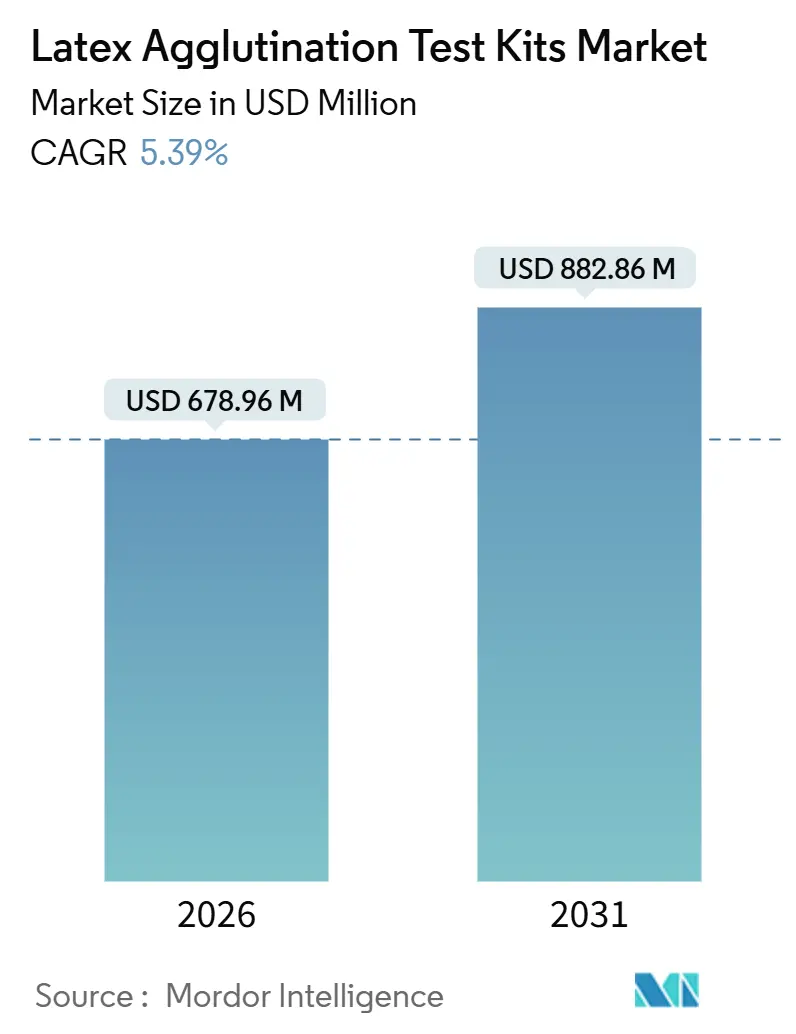
The Latex Agglutination Test Kits Market size is estimated at USD 678.96 million in 2026, and is expected to reach USD 882.86 million by 2031, at a CAGR of 5.39% during the forecast period (2026-2031).
Hospital formularies continue to fund the kits because each test costs USD 2–4 and delivers a result within 10 minutes, a speed–to–decision advantage that molecular platforms still struggle to match. Stewardship programs, new WHO guidelines for meningitis surveillance, and food-safety mandates together form a self-reinforcing demand loop that keeps volumes rising even in high-income countries. Manufacturers are upgrading from manual slide formats to turbidimetric assays that run on chemistry analyzers, cutting labor while expanding menu breadth. Supply-chain concentration in three Asian bead suppliers introduces price volatility, yet integrated players are cushioning margins by in-house particle production.
Key Report Takeaways
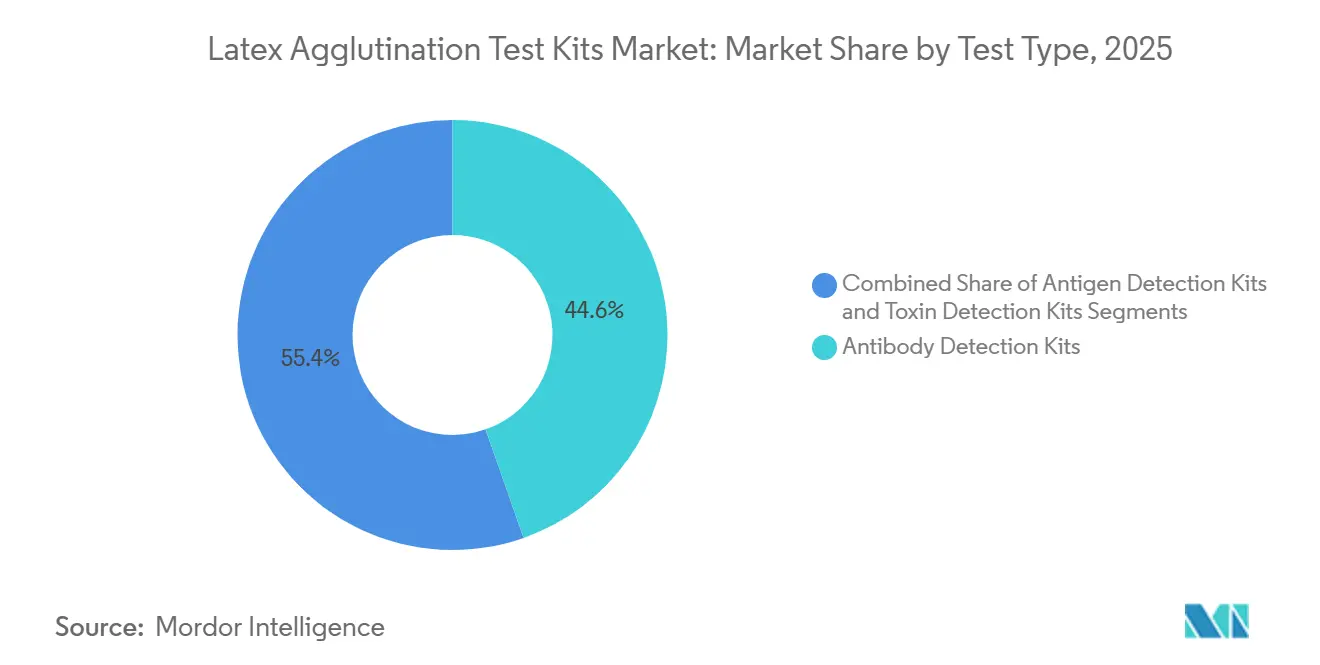
- By test type, antibody detection kits led with 44.63% revenue share in 2025; toxin detection kits are projected to expand at a 7.94% CAGR through 2031.
- By sample type, blood and serum captured 62.47% share of the latex agglutination test kits market size in 2025; urine and other body fluids are advancing at 7.29% CAGR through 2031.
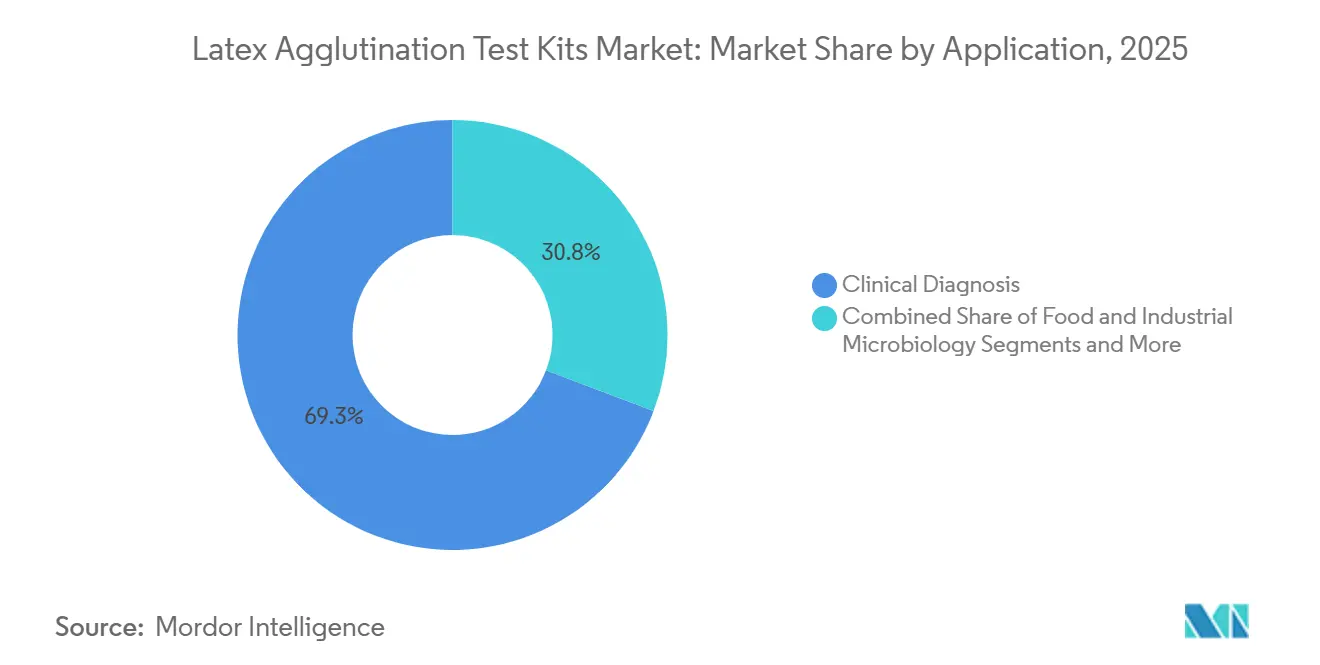
- By application, clinical diagnosis held 69.25% of the latex agglutination test kits market share in 2025; food and industrial microbiology is forecast to expand at 8.57% CAGR to 2031.
- By end user, hospital-based laboratories commanded 53.21% revenue share in 2025; point-of-care and decentralized settings are poised to grow at 9.35% CAGR through 2031.
- By geography, North America led with 33.15% share in 2025; Asia-Pacific is projected to post the highest regional CAGR at 8.23% through 2031.
Note: Market size and forecast figures in this report are generated using Mordor Intelligence’s proprietary estimation framework, updated with the latest available data and insights as of January 2026.
Market Trends and Insights
Drivers Impact Analysis of Latex Agglutination Test Kits Market*
| Driver | (~) % Impact on CAGR Forecast | Geographic Relevance | Impact Timeline |
|---|---|---|---|
| Growing demand for rapid, low-cost diagnostics in antimicrobial-resistance programs | +1.2% | North America, Europe, with global spillover | Medium term (2-4 years) |
| Rising prevalence of bacterial meningitis and invasive staphylococcal or streptococcal infections | +0.9% | Africa, Latin America, Asia-Pacific core | Long term (≥ 4 years) |
| Expansion of point-of-care testing through NGO procurement pipelines | +0.8% | Sub-Saharan Africa and South Asia | Medium term (2-4 years) |
| Integration of latex turbidimetric reagents with clinical chemistry analyzers | +0.7% | North America, Europe, Japan | Short term (≤ 2 years) |
| Emergence of polyoxazoline-sensitized beads improving sensitivity | +0.5% | Early adoption in North America and EU | Long term (≥ 4 years) |
| Regional government tenders favoring latex kits over PCR | +0.6% | India, China, Brazil, Indonesia | Medium term (2-4 years) |
| Source: Mordor Intelligence | |||
Growing Demand for Rapid, Low-Cost Diagnostics in Antimicrobial-Resistance Stewardship Programs
Hospital infection-control teams now value a ten-minute result over molecular depth when guiding empiric therapy. Latex results cost USD 2–4 while PCR panels often exceed USD 50.[1] The Centers for Disease Control and Prevention’s 2024 stewardship framework specifically highlights rapid bacterial antigen tests because every hour of delay raises mortality risk in sepsis cases. Formulary reviews continue to renew blanket purchase orders for Staphylococcus aureus and Streptococcus pneumoniae kits. Procurement officers also note that latex cartridges fit current biosafety workflows without capital upgrades. The latex agglutination test kits market benefits directly from these policy shifts.
Rising Prevalence of Bacterial Meningitis and Invasive Staphylococcal or Streptococcal Infections
WHO recorded 58,000 suspected bacterial meningitis cases across 26 African nations in 2024 with 72% of district hospitals relying on latex agglutination.[2] A 2025 study in The Lancet Infectious Diseases showed a 14% uptick in invasive MRSA across the European Union between 2020 and 2024.[3] Hospitals now pair blood-culture flags with latex confirmation to accelerate isolation protocols. The trend secures recurring reagent orders, especially for antibody detection formats. Growth therefore accrues not just from new users but from higher test frequency per patient episode.
Expansion of Point-of-Care Testing in Low-Resource Settings Through NGO Procurement Pipelines
UNICEF’s 2024 supply data ranked latex meningitis tests above malaria antigen tests in shipment volumes to several African countries. PATH distributed 2.1 million kits across 14 low-income countries in 2025, specifying two-year ambient stability. Manufacturers now design dual portfolios: a premium, analyzer-ready line for regulated markets and a manual, heat-stable line for humanitarian tenders. This bifurcated strategy enlarges the latex agglutination test kits market without cannibalizing high-margin hospital sales. Steady NGO demand also buffers suppliers against cyclical capital spending in high-income regions.
Integration of Latex Turbidimetric Reagents with High-Throughput Clinical Chemistry Analyzers
Roche and Abbott platforms exceed 1,000 tests per hour by running latex turbidimetric assays for C-reactive protein and anti-streptolysin. The same architecture now hosts bacterial antigen menus, allowing labs to consolidate workflows. A 2024 CLSI bulletin reported <5% coefficient of variation for polysaccharide antigens using latex turbidimetry. Automation reduces technician hands-on time and supports continuous loading, so hospital finance committees approve reagent rental agreements quickly. The development shifts latex kits from a manual niche to a core-lab workhorse.
Restraints Impact Analysis of Latex Agglutination Test Kits Market*
| Restraint | (~) % Impact on CAGR Forecast | Geographic Relevance | Impact Timeline |
|---|---|---|---|
| Competition from molecular PCR and isothermal NAAT panels | -0.9% | North America, Europe, urban Asia-Pacific | Short term (≤ 2 years) |
| Regulatory tightening on qualitative kits under EU IVDR and US FDA QSR | -0.6% | Europe, North America | Medium term (2-4 years) |
| Cross-reactivity and false positives in complex food matrices | -0.4% | Global food industry hubs | Medium term (2-4 years) |
| Supply-chain volatility in medical-grade latex microparticles | -0.5% | Global, acute in Asia manufacturing hubs | Short term (≤ 2 years) |
| Source: Mordor Intelligence | |||
Competition from Molecular PCR and Isothermal NAAT Panels
Cepheid’s repurposed GeneXpert cartridges now price at USD 25 in bulk, narrowing the historic cost gulf. LAMP assays achieve 96% sensitivity versus 78% for latex formats while matching a 20-minute turnaround. Hospital consortia negotiating bulk PCR contracts threaten to relegate latex to backup status. Point-of-care NAAT devices also bypass the laboratory, reducing latex’s edge in decentralized settings. The restraint chiefly affects high-income urban markets where capital budgets cover instrumentation.
Regulatory Tightening on Qualitative Kits Under EU IVDR and US FDA QSR
EU IVDR reclassified many latex kits to Class C, requiring notified-body review and extensive clinical data. Compliance costs estimated at EUR 200,000–500,000 per SKU forced several small manufacturers to exit. The US FDA’s 2024 QSR revision aligned with ISO 13485:2016 and heightened post-market surveillance expectations. Larger companies absorb the burden, but new entrants face barriers that slow product refresh cycles. The latex agglutination test kits market therefore risks supply bottlenecks in Europe and the United States until certification backlogs clear.
*Our forecasts treat driver/restraint impacts as directional, not additive. The impact forecasts reflect baseline growth, mix effects, and variable interactions.
Latex Agglutination Test Kits Market Segment Analysis
By Test Type:
Toxin Detection Drives Menu InnovationToxin detection kits represent the fastest-growing slice, advancing at 7.94% CAGR through 2031 as hospitals tighten Clostridium difficile control protocols and food regulators demand enterotoxin screening. Antibody detection retained 44.63% of 2025 revenue but faces commoditization as turbidimetric analyzers absorb routine immunology tests. Antigen detection remains the volumetric anchor for bacterial meningitis diagnosis, yet multiplex PCR is nibbling share in tertiary centers. The latex agglutination test kits market size attributable to toxin detection is forecast to expand steadily because assay menus are still short, leaving headroom for new Staphylococcus aureus enterotoxin products. Polyoxazoline beads further lift sensitivity, closing the performance gap with ELISA. Manufacturers are revising product roadmaps accordingly.
Automated chemistry analyzers now run quantitative latex turbidimetry, allowing toxin assays to migrate from manual benches to core labs. Food plants adopt rapid Salmonella enterotoxin screens to comply with EU Regulation 2073/2005. Hospitals favor toxin detection because PCR confirmation can be reserved for discordant results, optimizing budget. Antibody detection kits still dominate absolute sales volumes, yet price pressure is intense. Antigen detection revenue remains resilient in meningitis-belt countries where PCR capacity is low. The interplay of these forces keeps the latex agglutination test kits market dynamic rather than mature.

By Sample Type:
Urine and Alternative Matrices Gain TractionBlood and serum generated 62.47% of 2025 revenue and anchored the latex agglutination test kits market share in hospital settings. Urine and other body fluids, however, are set to post a 7.29% CAGR through 2031 as decentralized urinary tract infection panels gain national guideline acceptance. Cerebrospinal fluid retains its critical niche because meningitis calls for a 10-minute result in emergency wards. Veterinary labs validate latex for bovine mastitis detection in milk, adding to the non-traditional matrix story. Environmental monitoring of Legionella in cooling-tower water is another small yet expanding pocket.
Product engineers now pre-treat beads to resist interfering proteins in milk, urine, and water. That innovation supports penetration into veterinary and environmental workflows without cannibalizing blood-based tests. The latex agglutination test kits market size linked to blood and serum will keep topping the revenue chart, yet its growth decelerates because automated immunoassay analyzers absorb routine antibody testing. Urine assays enjoy NGO distribution in primary clinics, reinforcing their high-growth profile. CSF volumes are stable where PCR infrastructure is scarce, preserving latex’s status as the frontline technology for meningitis triage.
By Application:
Food Microbiology Emerges as Growth FrontierClinical diagnosis generated 69.25% of revenue in 2025 but its CAGR now trails food microbiology, which is projected at 8.57% through 2031. Regulatory agencies expect quicker lot release in ready-to-eat foods, so manufacturers adopt latex for presumptive pathogen screens before PCR confirmation. Veterinary and environmental uses are steady, helped by government funding for livestock disease surveillance. The latex agglutination test kits market size for food applications is expanding because the installed base of traditional culture labs can adopt latex with minimal training.
Hospitals still cut the largest purchase orders, but cost pressures and reimbursement cuts temper their growth. Food processors view latex as a line-side quality gate that avoids expensive downtime. Veterinary clinics appreciate on-farm kits that minimize sample shipment delays. Environmental labs welcome a two-day reduction in Legionella detection compared with culture, supporting compliance with new water-safety codes. The diverse application landscape spreads risk and sustains the latex agglutination test kits industry.
By End User:
Decentralized Settings Accelerate FastestHospital laboratories held 53.21% of 2025 revenue but growth is modest as molecular syndromic panels gain traction. Point-of-care and decentralized facilities are forecast to surge at 9.35% CAGR, aided by CLIA-waived approvals in the United States and NGO tenders in sub-Saharan Africa. Stand-alone clinical labs serve outpatient volumes yet confront reimbursement pressure. The latex agglutination test kits market size in decentralized settings benefits from kits designed for two-year ambient stability and visual readout.
Hospitals continue procuring premium analyzer-compatible reagents that integrate with LIS. Small clinics choose manual kits with color-coded cards to reduce training. NGOs specify low-cost foil-packaged tests for field deployment. Such stratified demand lets suppliers segment pricing and features without internal cannibalization. The result is a balanced end-user mix that underpins steady overall market expansion.
Geography Analysis
North America Latex Agglutination Test Kits Market
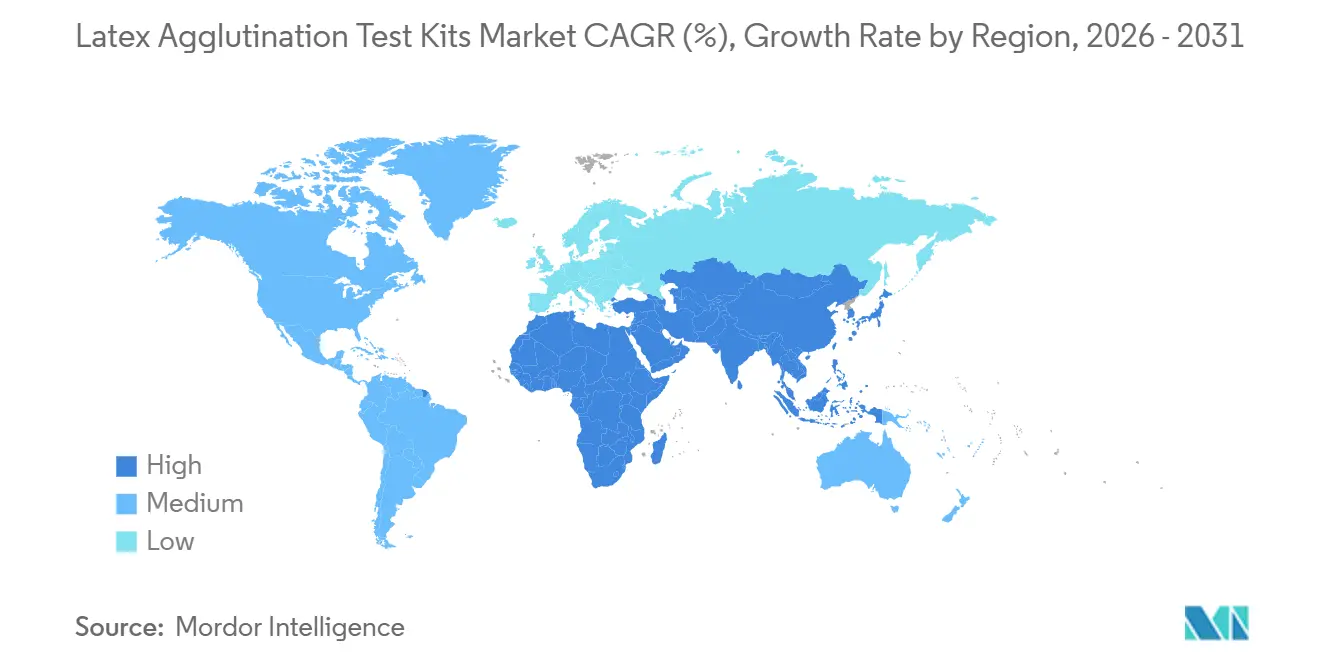
North America generated 33.15% of 2025 revenue, backed by entrenched hospital formularies and Medicare codes that still reimburse bacterial antigen tests. Growth moderates because fee-schedule cuts trimmed payments by 8% in 2024. Rural Canadian hospitals keep latex kits due to limited molecular infrastructure, showing how geography within a region shapes demand. Mexico’s public health ministry shipped 340,000 meningitis kits in 2025, underscoring continued volume in lower-income areas.
Europe Latex Agglutination Test Kits Market
Europe copes with IVDR compliance delays that trimmed kit availability by 18% since May 2024. Germany and France still use latex for bacterial antigen testing in emergency departments, yet reimbursement caps slow expansion. Southern Europe pushes point-of-care deployment in primary clinics, creating modest incremental demand. ECDC recorded 12,400 confirmed meningitis cases in 2024, with latex covering 58% of diagnoses, proof of its clinical staying power.
APAC, MEA and South America Latex Agglutination Test Kits Market
Asia-Pacific is the growth engine, projected at 8.23% CAGR through 2031. India’s rapid-test tender and China’s new approvals secure baseline volume while Japan and South Korea spearhead bead innovation. ASEAN countries adopt donor-funded meningitis surveillance programs, further lifting shipments. The Middle East and Africa rely on UNICEF and PATH channels that distribute kits to primary centers. South America mirrors that pattern with Brazil’s federal program for meningococcal monitoring.
Competitive Landscape
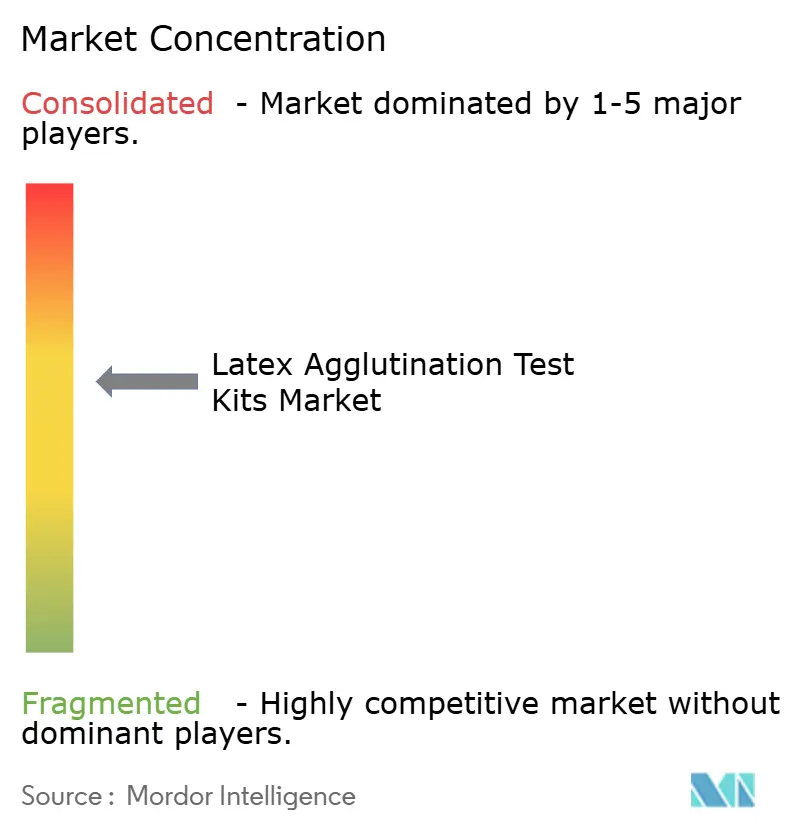
The market equates to a moderate concentration. Integrated players protect gross margins through captive bead production and ISO 13485 compliance, while price-focused entrants target emerging markets. Automation-ready latex menus secure equipment tie-ins that lock hospitals for multi-year reagent contracts. Smaller companies pivot to heat-stable, manual kits for NGO and CLIA-waived niches, avoiding direct competition.
Technology refresh looms as polyoxazoline beads near commercial scale. Patentees in Japan expect cost parity with polystyrene within three years, a shift that could upend incumbent supply chains. Bio-Rad and Hardy Diagnostics expand food-testing lines to capture the fastest-growing segment. Thermo Fisher retools a U.S. bead plant to hedge styrene volatility.
Isothermal NAAT remains the existential threat. To counter, latex vendors stress ten-minute workflow and no-instrument deployment. Some bundle confirmatory molecular cartridges at a discount, offering a hybrid pathway that keeps latex in the algorithm while acknowledging sensitivity advantages of nucleic assays. Overall, strategic positioning centers on speed, cost, and supply resilience rather than head-to-head analytical performance.
Latex Agglutination Test Kits Industry Leaders
-
bioMérieux SA
-
Bio-Rad Laboratories
-
Cardinal Health
-
Thermo Fisher Scientific Inc
-
Eurofins Technologies
- *Disclaimer: Major Players sorted in no particular order
Latex Agglutination Test Kits Market Companies Covered in this Report
- Arlington Scientific
- Atlas Medical
- bioMérieux
- Bio-Rad Laboratories
- Biotec
- Cardinal Health
- Creative Diagnostics
- Eurofins Technologies
- Gold Standard Diagnostics
- HiMedia Laboratories
- Liofilchem S.r.l.
- Mast Group Ltd.
- Microgen Bioproducts
- Ngaio Diagnostics
- Pointe Scientific
- Pro-Lab Diagnostics
- RIDACOM
- Sekisui Medical
- Thermo Fisher Scientific
Recent Industry Developments in Latex Agglutination Test Kits Market
- May 2025: EKF Diagnostics launched the RaPET range, delivering C-reactive protein, rheumatoid factor, and syphilis results from serum in two minutes.
- October 2024: Gold Standard Diagnostics introduced Microgen rapid kits for Salmonella, Legionella, and Staphylococcus aureus colony confirmation in two minutes, requiring no specialized equipment.
Global Latex Agglutination Test Kits Market Report Scope
Latex agglutination test kits are rapid, cost-effective immunological tools that detect specific antigens or antibodies in bodily fluids through visible clumping (agglutination), aiding in the diagnosis of infectious diseases, autoimmune disorders, and pregnancy.
The Latex Agglutination Test Kits Market Report is segmented by Test Type, Sample Type, Application, End User, and Geography. By Test Type, the market is segmented into Antibody Detection, Antigen Detection, and Toxin Detection. By Sample Type, the market is segmented into Blood/Serum, Cerebrospinal Fluid, and Urine & Other Body Fluids. By Application, the market is segmented into Clinical Diagnosis, Food & Industrial Microbiology, and Veterinary & Environmental Testing. By End User, the market is segmented into Hospital-Based Laboratories, Standalone Clinical Laboratories, and Point-of-Care/Decentralised Settings. By Geography, the market is segmented into North America, Europe, Asia-Pacific, Middle East & Africa, and South America. The market report also covers the estimated market sizes and trends across major regions globally. Market Forecasts are Provided in Terms of Value (USD).
Segmentation Overview
| Antibody Detection Kits |
| Antigen Detection Kits |
| Toxin Detection Kits |
| Blood / Serum |
| Cerebrospinal Fluid |
| Urine & Other Body Fluids |
| Clinical Diagnosis |
| Food & Industrial Microbiology |
| Veterinary & Environmental Testing |
| Hospital-Based Laboratories |
| Standalone Clinical Laboratories |
| Point-of-Care / Decentralised Settings |
| North America | United States |
| Canada | |
| Mexico | |
| Europe | Germany |
| France | |
| United Kingdom | |
| Italy | |
| Spain | |
| Rest of Europe | |
| Asia-Pacific | China |
| Japan | |
| India | |
| South Korea | |
| Australia | |
| Rest of Asia-Pacific | |
| Middle East & Africa | GCC |
| South Africa | |
| Rest of Middle East & Africa | |
| South America | Brazil |
| Argentina | |
| Rest of South America |
| By Test Type | Antibody Detection Kits | |
| Antigen Detection Kits | ||
| Toxin Detection Kits | ||
| By Sample Type | Blood / Serum | |
| Cerebrospinal Fluid | ||
| Urine & Other Body Fluids | ||
| By Application | Clinical Diagnosis | |
| Food & Industrial Microbiology | ||
| Veterinary & Environmental Testing | ||
| By End User | Hospital-Based Laboratories | |
| Standalone Clinical Laboratories | ||
| Point-of-Care / Decentralised Settings | ||
| By Geography | North America | United States |
| Canada | ||
| Mexico | ||
| Europe | Germany | |
| France | ||
| United Kingdom | ||
| Italy | ||
| Spain | ||
| Rest of Europe | ||
| Asia-Pacific | China | |
| Japan | ||
| India | ||
| South Korea | ||
| Australia | ||
| Rest of Asia-Pacific | ||
| Middle East & Africa | GCC | |
| South Africa | ||
| Rest of Middle East & Africa | ||
| South America | Brazil | |
| Argentina | ||
| Rest of South America | ||
Key Questions Answered in the Report
How large is the latex agglutination test kits market in 2026?
It is valued at USD 678.96 million in 2026 with a 5.39% CAGR forecast to 2031.
Which test type is growing the fastest?
Toxin detection kits are projected to post a 7.94% CAGR through 2031, the highest among all test types.
Why do hospitals still buy latex agglutination kits despite PCR options?
Hospitals value the ten-minute turnaround and USD 2–4 cost per test, which align with antimicrobial stewardship goals.
Which region will contribute most to future growth?
Asia-Pacific is forecast to grow at 8.23% CAGR because of large government tenders in India and China.
What is the main threat to latex agglutination suppliers?
The cost gap with molecular NAAT platforms is narrowing, challenging latex’s traditional low-price advantage.