
L-Arginine Market Size and Share
Market Overview
| Study Period | 2027 - 2032 |
|---|---|
| Market Size (2027) | USD 0.78 Billion |
| Market Size (2032) | USD 1.11 Billion |
| Growth Rate (2027 - 2032) | 7.22 % |
| Fastest Growing Market | Asia-Pacific |
| Largest Market | Europe |
| Market Concentration | Medium |
Major Players *Disclaimer: Major Players sorted in no particular order Image © Mordor Intelligence. Reuse requires attribution under CC BY 4.0. | |
L-Arginine Market Analysis by Mordor Intelligence
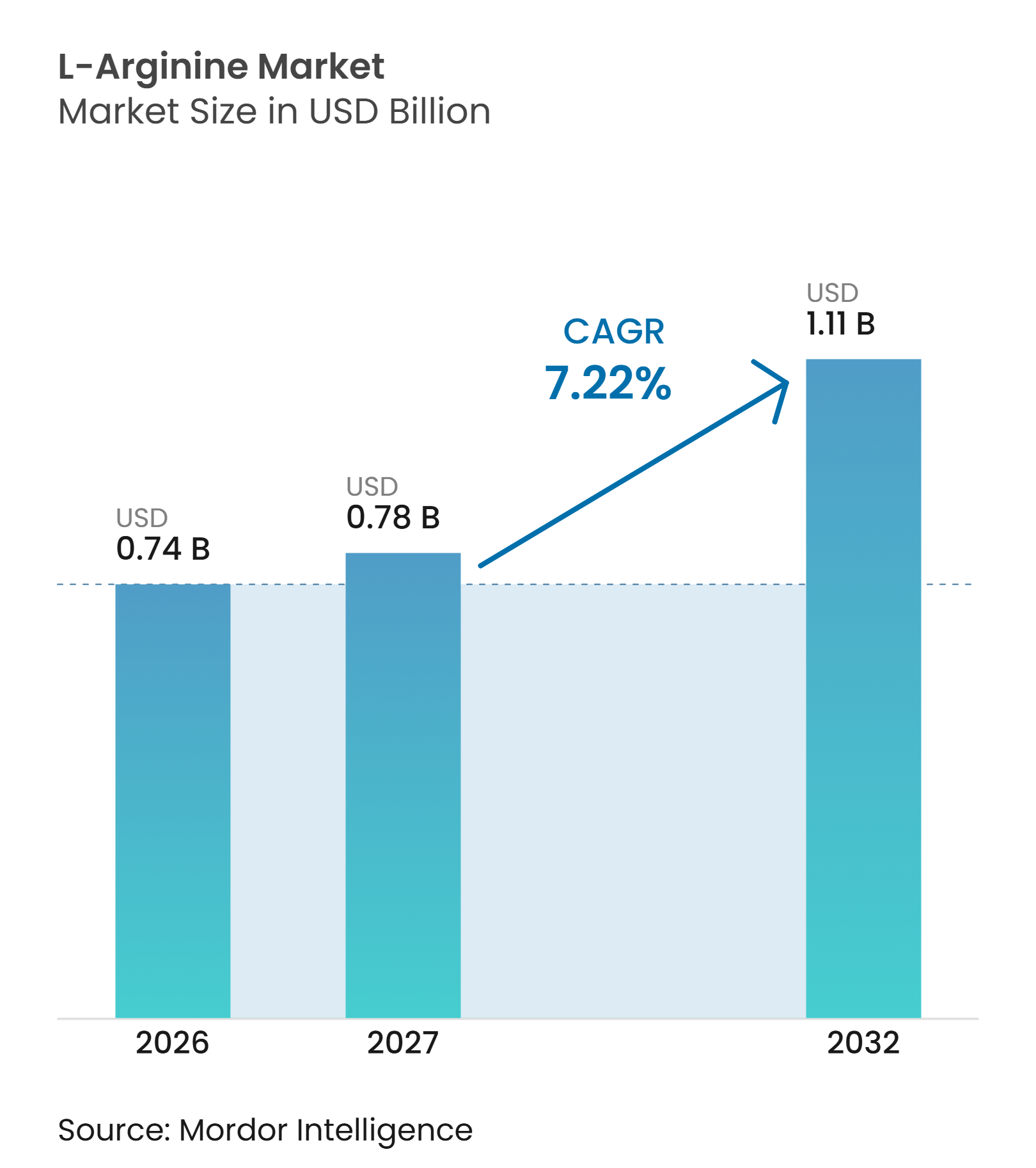
The L-Arginine Market size is expected to increase from USD 0.737 billion in 2026 to USD 0.78 billion in 2027 and reach USD 1.105 billion by 2032, growing at a CAGR of 7.22% over 2027–2032. Growth is supported by increasing demand for L-arginine across dietary supplements, sports nutrition, pharmaceutical formulations, and functional food applications. Rising consumer interest in amino acid supplementation and performance nutrition is encouraging manufacturers to expand their L-arginine product portfolios. Growing pharmaceutical applications, particularly in specialized medical formulations, alongside increasing use in animal feed and biopharmaceutical manufacturing, are creating additional demand opportunities. However, high production costs associated with specialized fermentation processes, raw material price volatility, and stringent quality requirements for pharmaceutical-grade products may constrain market expansion. Growth therefore favors manufacturers that can improve fermentation efficiency, maintain consistent product quality, and strengthen supply capabilities across food-grade, pharmaceutical-grade, and industrial applications.
Key Report Takeaways
- By grade, food-grade L-arginine accounted for the largest share at 48.00% in 2026, while pharmaceutical-grade L-arginine is forecast to grow fastest at an 8.40% CAGR over 2027–2032.
-
By form, powder dominated with a 62.00% market share in 2026, while liquid L-arginine is projected to record the fastest growth at an 8.80% CAGR over 2027–2032.
-
By application, dietary supplements accounted for the largest share at 42.00% in 2026, while pharmaceutical applications are expected to grow fastest at an 8.50% CAGR over 2027–2032.
-
Among geographies, Europe led with a 34.00% share of the L-arginine market in 2026, while Asia-Pacific is forecast to grow fastest at an 8.20% CAGR over 2027–2032.
Note: Market numbers in this report are based on Mordor Intelligence's proprietary estimation framework, which combines nine months of actuals with Q4 projections for base year 2026.
Market Trends and Insights
Drivers of L-Arginine Market*
| Driver | (~) % Impact on CAGR Forecast | Geographic Relevance | Impact Timeline |
|---|---|---|---|
| Rising demand for L-arginine in dietary supplements and sports nutrition products | +1.0% | Global, particularly North America and Europe, where demand for amino acid supplements and sports nutrition products is established | Medium term (2–4 years) |
| Growing pharmaceutical applications of L-arginine in specialized medical formulations | +0.8% | Global, particularly North America, Europe and Asia-Pacific, supported by pharmaceutical manufacturing and clinical applications | Long term (More than 4 years) |
| Increasing adoption of amino acids in animal feed and livestock nutrition | +0.6% | Global, particularly Asia-Pacific, North America and Europe, where commercial livestock production supports amino acid demand | Medium term (2–4 years) |
| Expanding use of L-arginine in functional foods and fortified beverages | +0.5% | Global, particularly North America and Asia-Pacific, where functional food and beverage product development is expanding | Medium term (2–4 years) |
| Rising demand for L-arginine in cell culture media and biopharmaceutical manufacturing | +0.7% | Global, particularly North America, Europe and Asia-Pacific, supported by biopharmaceutical production and biotechnology investments | Long term (More than 4 years) |
| Growing application of L-arginine in plant-based meat alternatives and protein formulations | +0.4% | Global, particularly North America and Europe, with emerging opportunities across Asia-Pacific | Medium term (2–4 years) |
| Source: Mordor Intelligence | |||
Rising Demand for L-Arginine in Dietary Supplements and Sports Nutrition Products
Growing consumer interest in sports nutrition, amino acid supplementation, and active lifestyle products is creating opportunities for L-arginine manufacturers. L-arginine is a precursor to nitric oxide, which supports blood vessel dilation and regulates blood flow. Its inclusion in pre-workout supplements, amino acid blends, powdered nutrition products, and capsules supports its positioning in the sports nutrition segment. The National Institutes of Health (NIH) identifies L-arginine as an ingredient used in exercise and athletic performance supplements, although clinical evidence for performance enhancement remains limited and conflicting [1]. For manufacturers, expanding sports nutrition portfolios and developing combination formulations provide opportunities to strengthen ingredient demand.
Growing Pharmaceutical Applications of L-Arginine in Specialized Medical Formulations
The physiological role of L-arginine in nitric oxide production is supporting its investigation and application across pharmaceutical and specialized medical formulations. As a substrate for nitric oxide synthesis, L-arginine contributes to vascular regulation, endothelial function, and several metabolic processes. Research published in Annual Review of Pharmacology and Toxicology identifies its involvement in endothelium-dependent vasodilation and cardiovascular physiology. Additional clinical research has examined its role in wound healing, tissue repair, and vascular conditions. These applications create opportunities for pharmaceutical-grade L-arginine in research-backed medical formulations and specialized nutritional products. Manufacturers with consistent purity, controlled production processes, and pharmaceutical-quality specifications are better positioned to serve these applications.
Increasing Adoption of Amino Acids in Animal Feed and Livestock Nutrition
Increasing attention to amino acid balancing in livestock nutrition is creating opportunities for L-arginine in animal feed formulations. Arginine plays an important role in protein synthesis, nitrogen metabolism, immune function, and the production of biologically active compounds in animals. Its supplementation is particularly relevant in poultry nutrition, where dietary amino acid requirements influence growth performance, feed utilization, and intestinal development. A 2026 meta-analysis published in PubMed examined functional amino acid supplementation, including L-arginine, and reported improvements in broiler growth performance and intestinal development under specific feeding conditions. For feed manufacturers, incorporating L-arginine into optimized amino acid blends provides opportunities to support targeted nutritional requirements and specialized livestock diets.
Expanding Use of L-Arginine in Functional Foods and Fortified Beverages
The growing development of functional foods, fortified beverages, and specialized nutritional products is creating additional application opportunities for L-arginine. As an amino acid involved in protein synthesis and nitric oxide metabolism, L-arginine can be incorporated into selected nutritional formulations to enhance their amino acid composition. Its recognition as a nutrient supplement in the United States Food and Drug Administration's (FDA) inventory of substances added to food provides a regulatory reference for its food-related applications [2]. In India, the Food Safety and Standards Authority of India (FSSAI) also includes L-arginine in its list of amino acids permitted under the relevant health supplement and nutraceutical framework. These regulatory provisions support formulation opportunities, subject to applicable usage conditions, product standards, and labeling requirements. Manufacturers can therefore explore fortified beverages, nutritional powders, and amino acid-enriched food products as additional application areas.
Rising Demand for L-Arginine in Cell Culture Media and Biopharmaceutical Manufacturing
The expansion of biopharmaceutical manufacturing and recombinant protein production is creating demand for specialized amino acids used in cell culture media. L-arginine is an important component of mammalian cell metabolism and supports cellular growth, protein synthesis, and recombinant protein production. Research published in PubMed examining Chinese hamster ovary (CHO) cell cultures found that arginine supplementation influenced cell viability and monoclonal antibody production, highlighting the importance of amino acid composition in culture media optimization [3]. Further research on amino acid consumption in recombinant CHO cell cultures has demonstrated the need to manage amino acid availability during monoclonal antibody production [4]. These requirements create opportunities for high-purity L-arginine in basal media, feed supplements, and customized bioprocess formulations. Manufacturers capable of supplying consistent pharmaceutical and biotechnology-grade ingredients can benefit from the specialized requirements of biopharmaceutical production.
Restraints of L-Arginine Market*
| Restraint | (~) % Impact on CAGR Forecast | Geographic Relevance | Impact Timeline |
|---|---|---|---|
| High production costs and dependence on specialized fermentation processes | −0.8% | Global, particularly in markets with limited fermentation infrastructure and higher manufacturing input costs across Asia-Pacific, South America and the Middle East and Africa | Medium term (2–4 years) |
| Stringent regulatory requirements and quality compliance across pharmaceutical-grade applications | −0.6% | Global, particularly North America and Europe, where pharmaceutical manufacturing and ingredient quality requirements are stringent | Long term (More than 4 years) |
| Price volatility of raw materials and energy-intensive manufacturing operations | −0.5% | Global, particularly manufacturing hubs across China, India and Europe that are exposed to fluctuations in feedstock, energy and production costs | Medium term (2–4 years) |
| Limited consumer awareness and understanding of L-arginine ingredients | −0.3% | Global, particularly emerging markets across Asia-Pacific, South America and the Middle East and Africa, where awareness of specialized amino acid supplementation remains developing | Short term (Less than 2 years) |
| Source: Mordor Intelligence | |||
High Production Costs and Dependence on Specialized Fermentation Processes
L-arginine production relies heavily on microbial fermentation processes, which require specialized production infrastructure, optimized microbial strains, controlled fermentation conditions, and downstream purification technologies. Maintaining consistent product quality and achieving high fermentation yields can involve significant investments in equipment, energy, raw materials, and quality-control systems. Pharmaceutical-grade L-arginine production can be particularly demanding because manufacturers must meet stringent purity specifications and comply with applicable manufacturing standards. These requirements increase overall production costs and can create pricing pressures, particularly for smaller manufacturers and suppliers operating in cost-sensitive markets. Manufacturers therefore need to improve fermentation efficiency, optimize raw-material utilization, and invest in scalable purification technologies to maintain competitive pricing while meeting quality requirements.
Stringent Regulatory Requirements and Quality Compliance Across Pharmaceutical-Grade Applications
L-arginine manufacturers supplying pharmaceutical and specialized nutritional applications must comply with regulatory requirements governing ingredient purity, manufacturing practices, product safety, and quality assurance. Pharmaceutical-grade amino acids require consistent specifications for identity, strength, impurities, and microbiological quality, increasing the complexity of manufacturing and product approval processes. Regulatory frameworks such as the United States Food and Drug Administration's (FDA) current Good Manufacturing Practice (cGMP) requirements and the European Union's pharmaceutical quality standards place additional responsibilities on manufacturers to maintain validated production processes, documentation, and traceability. These requirements can increase compliance costs, extend product qualification timelines, and create entry barriers for smaller suppliers. Manufacturers therefore need to strengthen quality-control systems, maintain regulatory documentation, and invest in compliant production infrastructure to serve pharmaceutical and specialized healthcare applications.
*Our forecasts treat driver/restraint impacts as directional, not additive. The impact forecasts reflect baseline growth, mix effects, and variable interactions.
L-Arginine Market Segment Analysis
By Grade:
Food Grade Leads While Pharmaceutical Grade Expands FasterIn 2026, food-grade L-arginine accounted for an estimated 48.00% of the L-Arginine Market, making it the leading grade segment. Its position reflects the use of L-arginine in dietary supplements, sports nutrition products, functional foods, and fortified beverages. Food-grade ingredients are used in formulations where amino acid supplementation and nutritional composition are important product considerations. Meanwhile, pharmaceutical-grade L-arginine is projected to record the fastest growth, at an estimated CAGR of 8.40% through 2032. Growing pharmaceutical applications, increasing demand for specialized medical formulations, and the need for high-purity amino acids are supporting this segment's expansion.
Other industrial-grade L-arginine serves applications requiring amino acids as functional ingredients or processing inputs across selected industrial and biotechnology-related uses. Demand across grade categories depends on product specifications, purity requirements, and application-specific quality standards. Manufacturers therefore need to balance production efficiency with consistent ingredient quality and regulatory compliance to serve food, pharmaceutical, and industrial customers.
By Form:
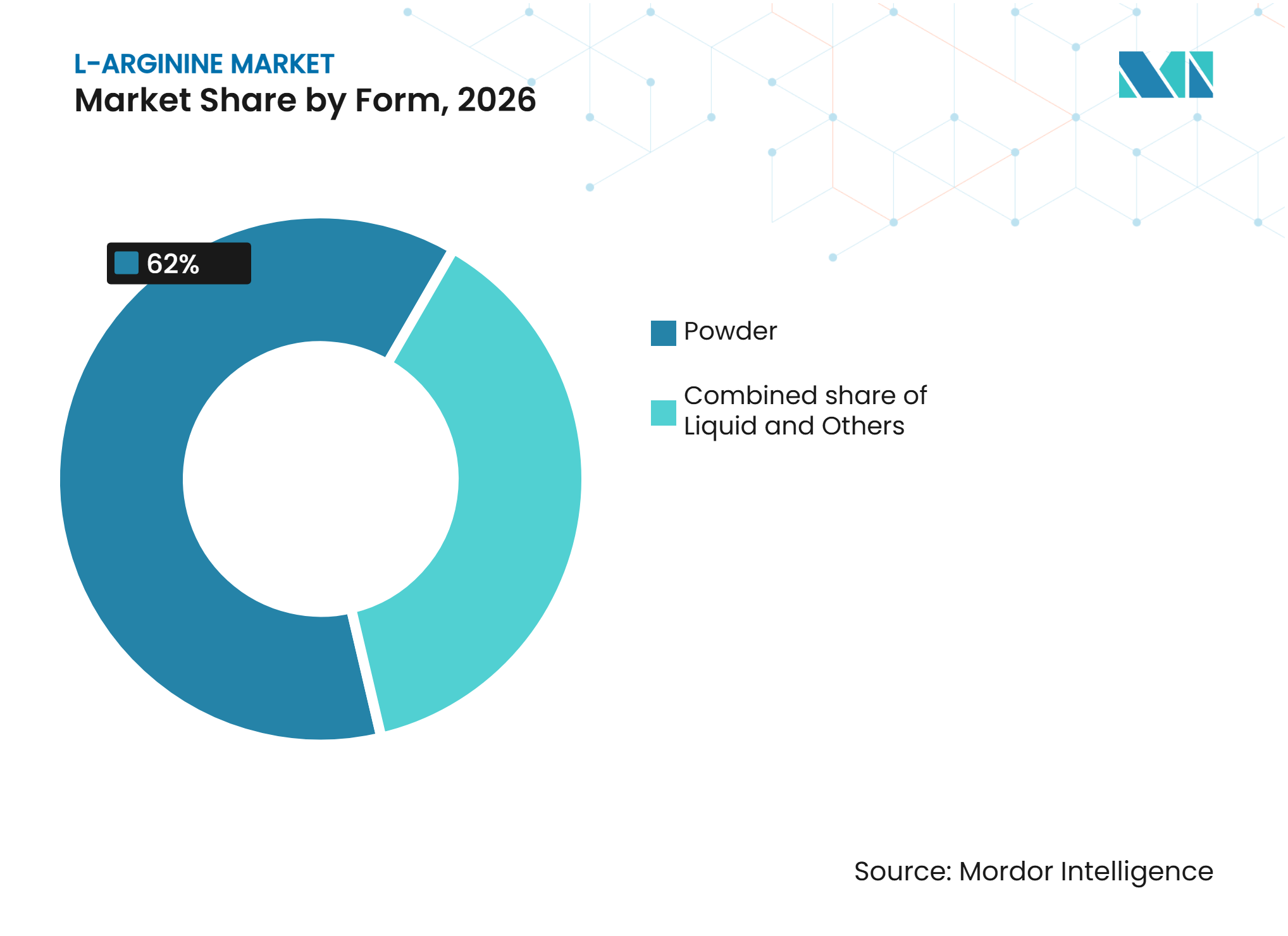
Powder Dominates While Liquid L-Arginine Gains MomentumIn 2026, powdered L-arginine accounted for an estimated 62.00% of the L-Arginine Market, making it the leading segment by form. Its position reflects the convenience of handling, storage, transportation, and incorporation into dietary supplements, pharmaceutical formulations, food products, and animal nutrition applications. Powdered formulations also allow manufacturers to measure and blend the ingredient according to specific formulation requirements. Meanwhile, liquid L-arginine is projected to record the fastest growth, at an estimated CAGR of 8.80% through 2032. Liquid formulations offer flexibility for applications requiring ready-to-use ingredients, liquid nutritional products, and specialised pharmaceutical preparations.
Other forms serve more specific formulation and processing requirements across end-use industries. The choice between powder and liquid depends on solubility, dosage requirements, processing compatibility, shelf stability, and storage conditions. Manufacturers focusing on formulation convenience, product stability, and application-specific requirements will influence the adoption of different L-arginine formats.


By Application:
Dietary Supplements Lead While Pharmaceuticals Expand FasterIn 2026, dietary supplements accounted for an estimated 42.00% of the L-Arginine Market, making them the largest application segment. This position reflects the use of L-arginine in sports nutrition, fitness supplements, and general nutritional formulations. The amino acid is incorporated into products targeting active consumers and individuals seeking specialised nutritional support. Meanwhile, pharmaceutical applications are projected to record the fastest growth, at an estimated CAGR of 8.50% through 2032. Growth in this segment is supported by the use of L-arginine in specialised medical formulations, pharmaceutical preparations, and applications requiring controlled ingredient purity and quality.
Animal feed applications provide another area of demand, with L-arginine used in amino acid supplementation and livestock nutrition formulations. Food and beverage manufacturers also incorporate L-arginine into selected functional food and fortified beverage products. Other applications include biotechnology-related uses, such as cell culture media and biopharmaceutical manufacturing. Across these applications, demand will depend on formulation requirements, regulatory compliance, ingredient quality, and the ability of manufacturers to provide consistent supply.
Geography Analysis
Europe L-Arginine Market
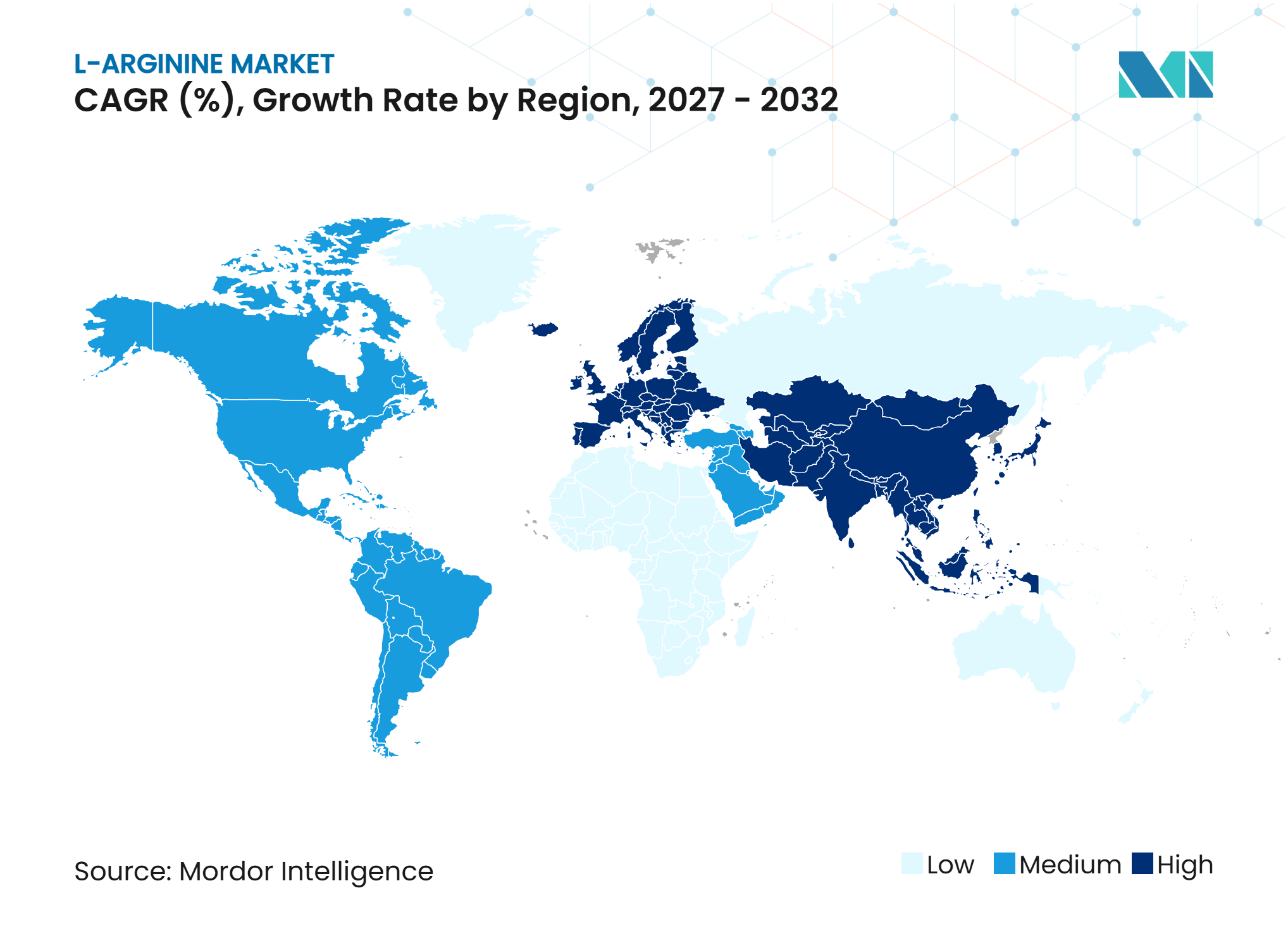
Europe accounted for an estimated 34.00% of the L-Arginine Market in 2026, making it the largest regional market. The region benefits from established pharmaceutical manufacturing capabilities, a developed dietary supplement industry, and demand for specialised nutritional ingredients. Countries such as Germany, France, the United Kingdom, and Italy support regional demand through their pharmaceutical, food ingredient, and nutraceutical industries. The presence of established amino acid suppliers and stringent quality requirements also supports demand for food-grade and pharmaceutical-grade L-arginine.
Asia-Pacific L-Arginine Market
Asia-Pacific is projected to be the fastest-growing regional market, with an estimated CAGR of 8.20% over 2027–2032. China, Japan, and India are important markets, supported by amino acid manufacturing capabilities, expanding pharmaceutical production, and growing dietary supplement consumption. China also has an established fermentation-based amino acid manufacturing industry, supporting the regional supply of L-arginine. Increasing applications in sports nutrition, animal feed, functional foods, and biopharmaceutical manufacturing are expected to create additional opportunities for producers.
North America, South America, and Middle East and Africa
North America represents an important market for L-arginine, supported by established dietary supplement and sports nutrition industries, pharmaceutical manufacturing, and demand for specialised nutritional formulations. The United States is a key market, with applications spanning dietary supplements, pharmaceutical preparations, and animal nutrition. South America offers growth opportunities through expanding food processing, livestock nutrition, and pharmaceutical applications, particularly in Brazil and Argentina. In the Middle East and Africa, demand is supported by developing pharmaceutical industries, increasing nutritional product consumption, and applications in animal feed. Saudi Arabia, the United Arab Emirates, and South Africa represent important markets to watch. Across these regions, manufacturers need to address regulatory requirements, supply-chain reliability, production costs, and varying end-user specifications.
Competitive Landscape
Market Concentration
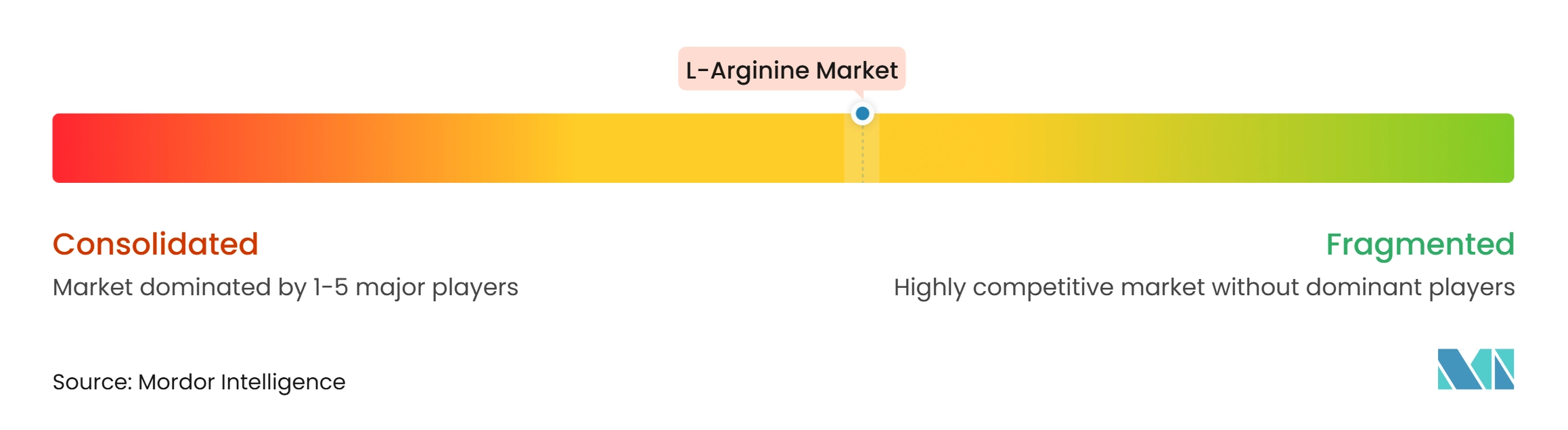
The L-Arginine Market includes global amino acid manufacturers, biotechnology companies, pharmaceutical ingredient suppliers, and specialised chemical producers competing through production capabilities, product quality, manufacturing efficiency, and distribution networks. The companies have varying levels of exposure to L-arginine through amino acid portfolios, pharmaceutical ingredients, nutritional products, and fermentation-based manufacturing operations. Large manufacturers can leverage established fermentation technologies, integrated production facilities, and global customer relationships, while specialised producers can compete through application-specific grades, product purity, and customised supply solutions.
Competitive strategies in the L-Arginine Market focus on expanding amino acid production capacity, improving fermentation efficiency, strengthening pharmaceutical-grade product portfolios, and serving demand across dietary supplements, pharmaceuticals, animal feed, and food and beverages. Companies such as Ajinomoto Co., Inc., CJ CheilJedang Corporation, and Daesang Corporation have established amino acid manufacturing businesses, while Evonik Industries AG and KYOWA HAKKO BIO CO., LTD. bring expertise in specialty amino acids, biotechnology, and fermentation-based production. Chinese manufacturers, including Meihua Holdings Group Co., Ltd., Fufeng Group Limited, and Ningxia Eppen Biotech Co., Ltd., also participate in the broader amino acid manufacturing and supply landscape. These capabilities allow companies to address different customer requirements across food-grade, pharmaceutical-grade, and industrial-grade applications.
Sourcing, production efficiency, and quality compliance remain important competitive considerations. Manufacturers with established fermentation infrastructure, reliable raw-material procurement networks, and consistent production processes can strengthen their supply capabilities and serve customers across multiple end-use industries. Pharmaceutical-grade production requires particular attention to purity specifications, quality assurance, and regulatory compliance, while food-grade suppliers must meet applicable food safety and ingredient standards. However, energy-intensive fermentation processes, raw-material price fluctuations, production costs, and competition from established Asian manufacturers can affect operating margins. Companies must also address varying customer specifications across dietary supplements, pharmaceutical formulations, animal nutrition, and biotechnology applications. These factors make manufacturing efficiency, product consistency, technological capabilities, and dependable global distribution important areas of competition in the L-Arginine Market.
L-Arginine Industry Leaders
-
Ajinomoto Co., Inc.
-
CJ CheilJedang Corporation
-
Daesang Corporation
-
Evonik Industries AG
-
KYOWA HAKKO BIO CO., LTD.
- *Disclaimer: Major Players sorted in no particular order
L-Arginine Market Companies Covered in this Report
- Ajinomoto Co., Inc.
- CJ CheilJedang Corporation
- Daesang Corporation
- Evonik Industries AG
- KYOWA HAKKO BIO CO., LTD.
- Meihua Holdings Group Co., Ltd.
- Fufeng Group Limited
- Global Bio-Chem Technology Group Company Limited
- Wuxi Jinghai Amino Acid Co., Ltd.
- Jingjing Pharmaceutical Co., Ltd.
- Shijiazhuang Jirong Pharmaceutical Co., Ltd.
- Zhejiang Starry Pharmaceutical Co., Ltd.
- Shine Star Hubei Biological Engineering Co., Ltd.
- Ningxia Eppen Biotech Co., Ltd.
- Jiahe Biotech
- Wuhan Amino Acid Bio-Chemical Co., Ltd.
- Sichuan Tongsheng Amino Acid Co., Ltd.
- Amino GmbH
- ACS Dobfar S.p.A.
- Tokyo Chemical Industry Co., Ltd.
Recent Industry Developments in L-Arginine Market
- December 2025: Nature’s Sunshine Products announced that Euromonitor International had recognised Synergy Worldwide’s Pro-Argi-9+ as the world's leading L-arginine supplement based on 2024 retail sales value. The recognition highlighted the product's positioning in the circulation and wellness supplement category and strengthened the visibility of L-arginine-based combination formulations.
- February 2025: Jagat Pharma launched L-Arginine Capsules in India, targeting athletes and individuals pursuing active lifestyles. The formulation combines L-arginine with chromium picolinate and is positioned around circulation, stamina, energy, and post-workout recovery. The launch expanded the company's dietary supplement portfolio into amino acid-based sports nutrition products.
- February 2025: Jagat Pharma launched L-Arginine Capsules in India, targeting athletes and individuals pursuing active lifestyles. The formulation combines L-arginine with chromium picolinate and is positioned around circulation, muscle stamina, energy, and post-workout recovery. The launch expanded the company's dietary supplement portfolio into amino acid-based sports nutrition products.
- January 2024: Merck KGaA announced an expansion of its L-arginine production capacity at its Danvers, Massachusetts, facility in the United States. The investment was intended to address increasing demand for L-arginine from the nutritional supplement and pharmaceutical industries, strengthening the company's manufacturing capabilities and supporting the supply of amino acid ingredients to specialised end-use markets.
Global L-Arginine Market Report Scope
For this study, the L-Arginine Market is defined as the sales value of commercially produced L-arginine, an amino acid used in dietary supplements, pharmaceutical formulations, animal nutrition, food and beverages, and biotechnology applications. The market covers L-arginine by grade, including food grade, pharma grade, and other industrial grade; by form, including powder, liquid, and other forms; and by application, including dietary supplements, pharmaceuticals, animal feed, food and beverages, and other applications. The market is analyzed across North America, Europe, Asia-Pacific, South America, and the Middle East and Africa, with country-level coverage including the United States, Canada, Mexico, the United Kingdom, Germany, France, Italy, Spain, the Netherlands, China, Japan, India, Indonesia, Australia, Brazil, Argentina, Colombia, South Africa, Saudi Arabia, and the United Arab Emirates, alongside the respective regional rest-of-market categories. Market sizing and forecasts are presented in value terms (USD) across the defined segments and geographies.
Segmentation Overview
| Food Grade |
| Pharma Grade |
| Other Industrial Grade |
| Powder |
| Liquid |
| Others |
| Dietary Supplements |
| Pharmaceuticals |
| Animal Feed |
| Food and Beverages |
| Others |
| North America | United States |
| Canada | |
| Mexico | |
| Rest of North America | |
| Europe | United Kingdom |
| Germany | |
| France | |
| Italy | |
| Spain | |
| Netherlands | |
| Rest of Europe | |
| Asia-Pacific | China |
| Japan | |
| India | |
| Indonesia | |
| Australia | |
| Rest of Asia-Pacific | |
| South America | Brazil |
| Argentina | |
| Colombia | |
| Rest of South America | |
| Middle East and Africa | South Africa |
| Saudi Arabia | |
| United Arab Emirates | |
| Rest of Middle East and Africa |
| By Grade | Food Grade | |
| Pharma Grade | ||
| Other Industrial Grade | ||
| By Form | Powder | |
| Liquid | ||
| Others | ||
| By Application | Dietary Supplements | |
| Pharmaceuticals | ||
| Animal Feed | ||
| Food and Beverages | ||
| Others | ||
| By Geography | North America | United States |
| Canada | ||
| Mexico | ||
| Rest of North America | ||
| Europe | United Kingdom | |
| Germany | ||
| France | ||
| Italy | ||
| Spain | ||
| Netherlands | ||
| Rest of Europe | ||
| Asia-Pacific | China | |
| Japan | ||
| India | ||
| Indonesia | ||
| Australia | ||
| Rest of Asia-Pacific | ||
| South America | Brazil | |
| Argentina | ||
| Colombia | ||
| Rest of South America | ||
| Middle East and Africa | South Africa | |
| Saudi Arabia | ||
| United Arab Emirates | ||
| Rest of Middle East and Africa | ||
Key Questions Answered in the Report
What is the size of the L-Arginine Market?
The L-Arginine Market is estimated at USD 0.737 billion in 2026 and is projected to reach USD 1.105 billion by 2032.
What is the growth rate of the L-Arginine Market?
The market is expected to register a CAGR of 7.22% over 2027–2032.
Which segment holds the largest share of the L-Arginine Market?
Food grade is the largest grade segment, accounting for an estimated 48.00% of the market in 2026. Powder is the leading form, while dietary supplements represent the largest application segment, with a 42.00% share.
Which region is expected to witness the fastest growth in the L-Arginine Market?
Asia-Pacific is projected to be the fastest-growing regional market, registering an estimated CAGR of 8.20% over 2027–2032, supported by expanding pharmaceutical manufacturing, dietary supplement consumption, and amino acid production capabilities.