
Krypton Gas Market Size and Share
Market Overview
| Study Period | 2022 - 2032 |
|---|---|
| Market Size (2027) | USD 213.71 Million |
| Market Size (2032) | USD 286.39 Million |
| Growth Rate (2027 - 2032) | 6.03 % |
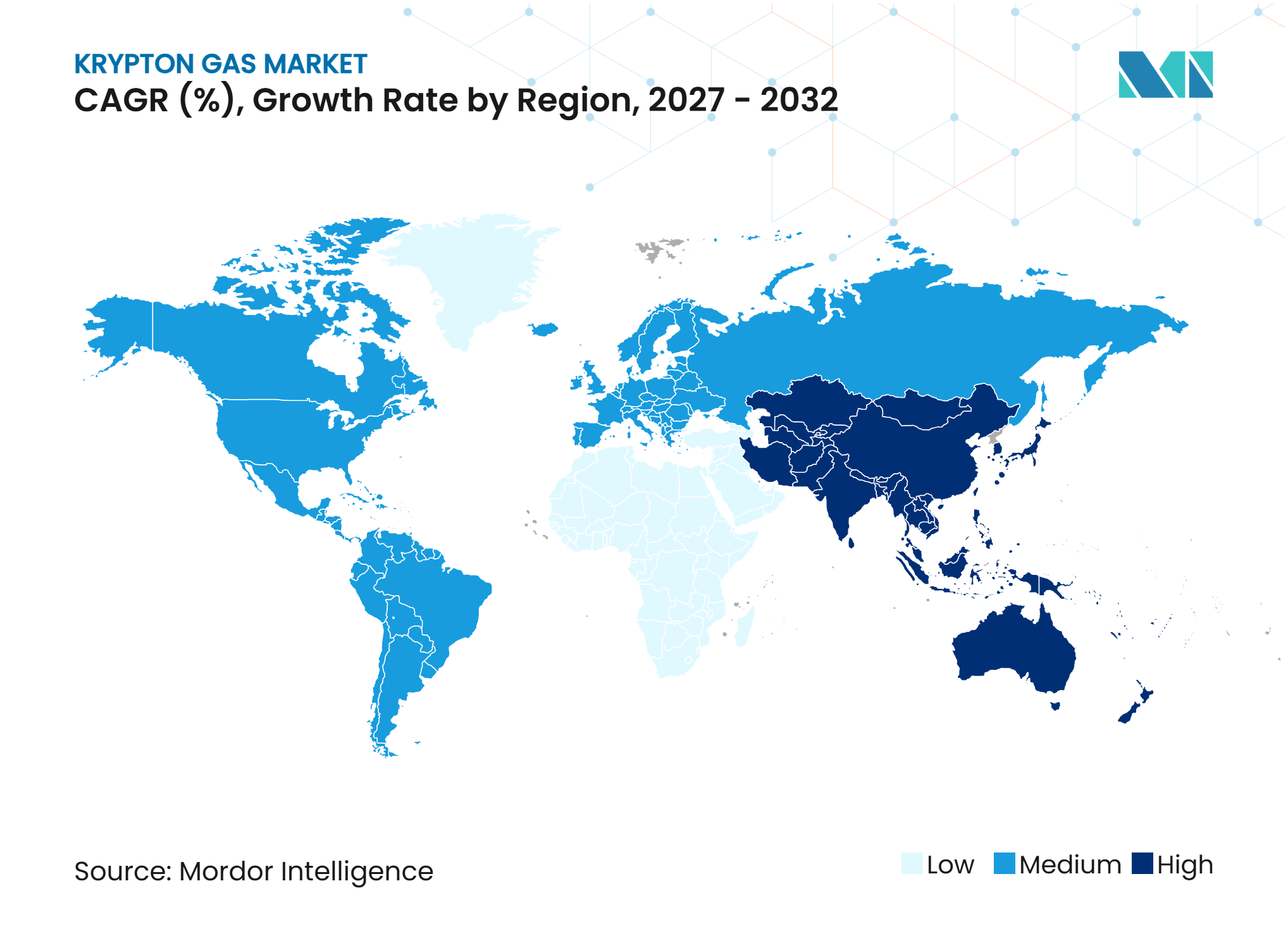
| Fastest Growing Market | Asia-Pacific |
| Largest Market | Asia-Pacific |
| Market Concentration | High |
Major Players *Disclaimer: Major Players sorted in no particular order Image © Mordor Intelligence. Reuse requires attribution under CC BY 4.0. | |
Krypton Gas Market Analysis by Mordor Intelligence
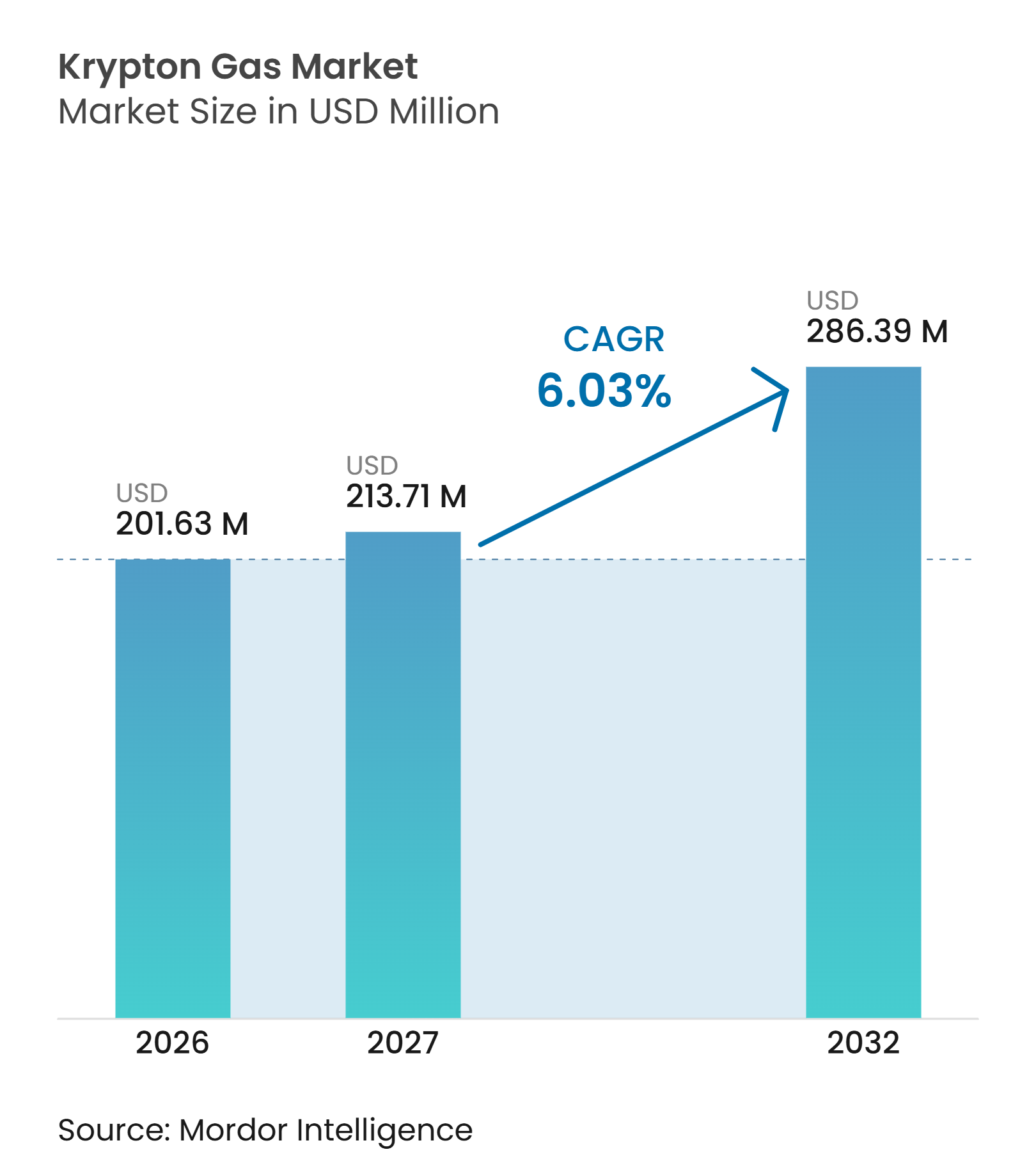
The Krypton gas market size was valued at USD 201.63 million in 2026 and is estimated to grow from USD 213.71 million in 2027 to USD 286.39 million by 2032, at a CAGR of 6.03% during the forecast period (2027-2032). Demand is supported by semiconductor fabrication and high-performance window systems, which use krypton for different technical reasons. Semiconductor customers require high-purity gas for krypton fluoride (KrF) lithography, plasma etching, and other controlled processes. Building applications use krypton in thin glazing cavities where thermal performance beyond what argon can provide is needed. Supply remains tied to large air separation units that primarily serve oxygen demand, which can create shortages when rare-gas demand rises faster than recovery capacity. The krypton gas market therefore depends on supply security, purity assurance, and customer proximity as much as on end-user demand.
Key Report Takeaways
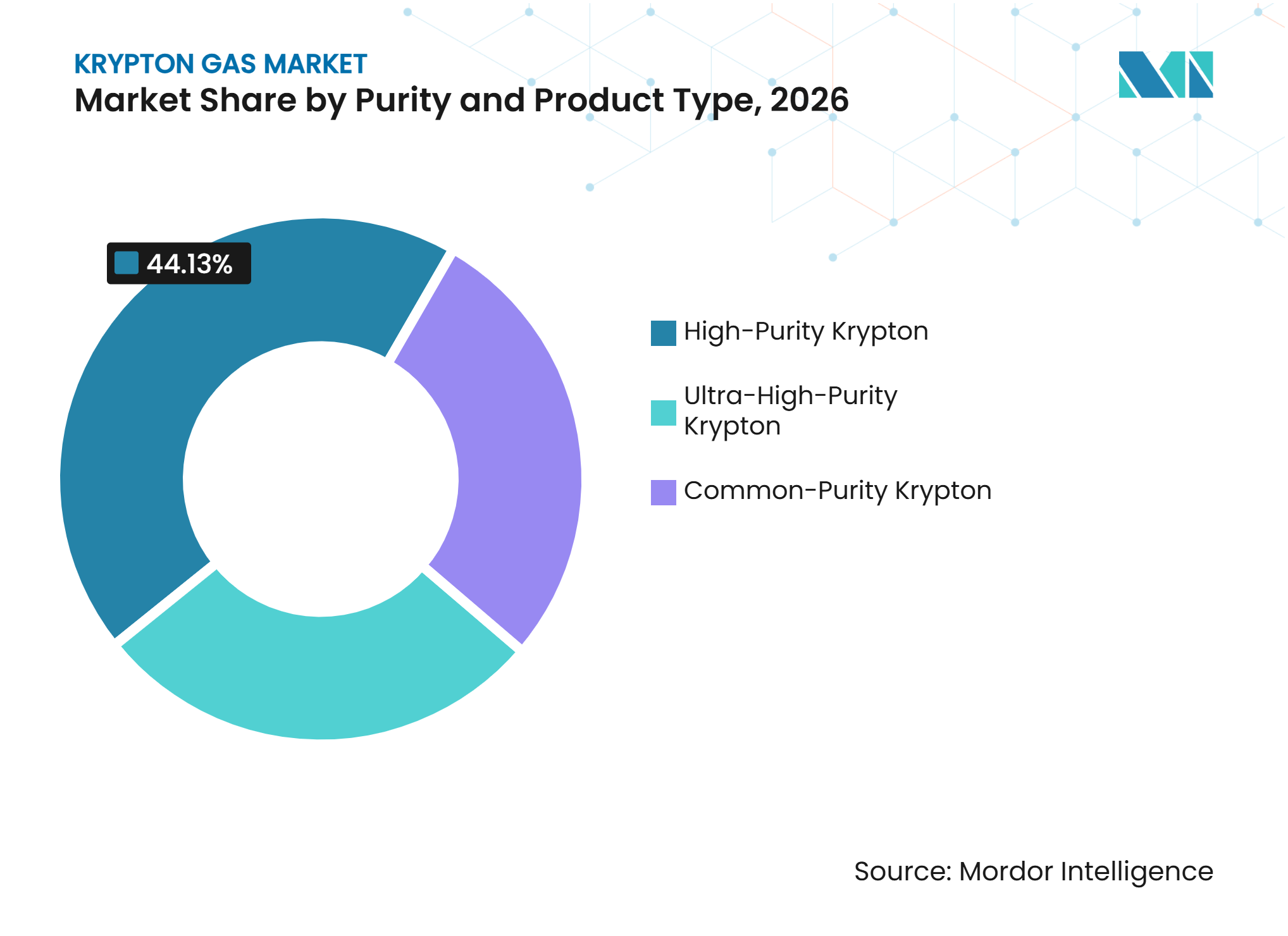
- By purity and product type, High-Purity Krypton held 44.13% of the Krypton gas market share in 2026 and is projected to grow at a CAGR of 6.87% through 2032.
- By supply mode, Cylinders held 39.45% of the Krypton gas market’s value in 2026, while Bulk and Micro-Bulk are projected to grow at a CAGR of 6.75% through 2032.
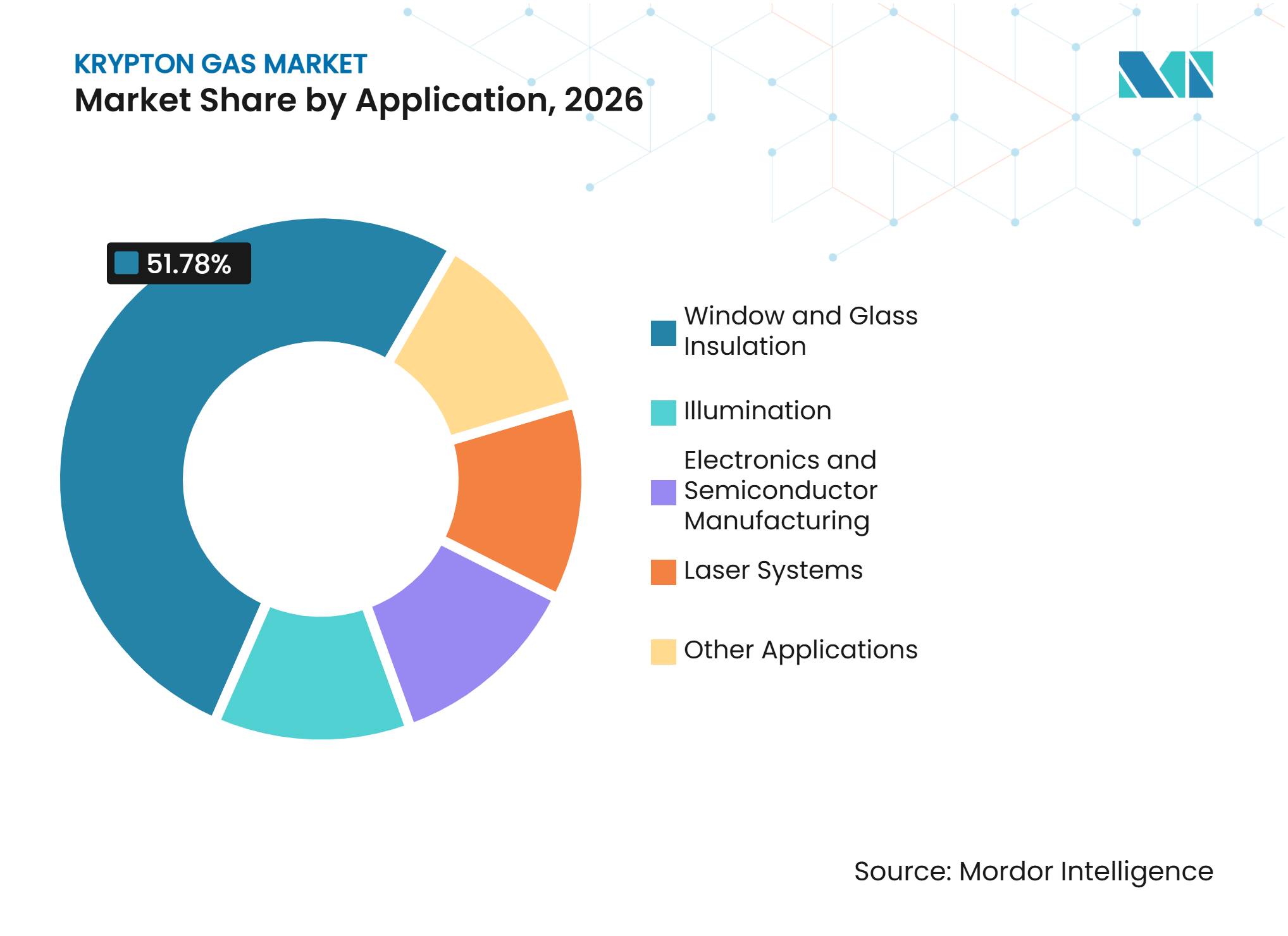
- By application, Window and Glass Insulation accounted for 51.78% of the Krypton gas market size in 2026, while Electronics and Semiconductor Manufacturing is projected to grow at a 7.34% CAGR through 2032.
- By geography, Asia-Pacific held 40.71% of market value in 2026 and is projected to grow at a 7.01% CAGR through 2032.
Note: Market numbers in this report are based on Mordor Intelligence's proprietary estimation framework, which combines nine months of actuals with Q4 projections for base year 2026.
Market Trends and Insights
Drivers Impact Analysis of Krypton Gas Market*
| Drivers | (~) % Impact on CAGR Forecast | Geographic Relevance | Impact Timeline |
|---|---|---|---|
| Semiconductor and KrF Excimer-Laser Capacity Expansion | +2.40% | Global, concentrated in Asia-Pacific and North America | Short term (≤ 2 years) |
| Energy-Efficient Triple-Glazed and Thin-Triple Windows | +1.50% | North America and EU, emerging in Asia-Pacific | Medium term (2-4 years) |
| Satellite Electric Propulsion Adoption | +0.80% | Global, with manufacturing hubs in EU and U.S. | Medium term (2-4 years) |
| Krypton Recovery from New Air-Separation Capacity | +0.60% | Asia-Pacific core, spillover to Middle East and Africa | Medium term (2-4 years) |
| High-Purity Gas Demand for Advanced Physical Vapor Deposition (PVD) and Display Manufacturing | +1.00% | Asia-Pacific and North America | Short term (≤ 2 years) |
| Source: Mordor Intelligence | |||
Semiconductor and KrF Excimer-Laser Capacity Expansion
Semiconductor fabrication remains a central driver of demand for the krypton gas market, as KrF lithography enables high production at mature chip nodes. Extreme Ultraviolet (EUV) tools are used for selected leading-edge layers, while KrF tools remain relevant for broad production at mature nodes. Gigaphoton Inc. introduced the G65K as a 6 kHz KrF light source with 90 W output, compared with 40 W for existing systems. The higher output can improve tool throughput while reducing the frequency of gas refills. This change can moderate gas use per wafer, but the installed base of KrF equipment continues to grow with capacity additions for memory, power devices, and legacy logic. Krypton-fluoride plasma etch gas also supports high-aspect-ratio 3D NAND structures, creating demand that does not depend solely on lithography choices.
Energy-Efficient Triple-Glazed and Thin-Triple Windows
Energy codes in North America and Europe support the krypton gas market by encouraging its use in thin, high-performance glazing systems. California's nonresidential compliance requirements set fenestration U-factor limits that can favor narrow-cavity solutions in relevant building designs[1]. Krypton has a lower thermal conductivity than argon, which becomes important when the cavity width is below 10 mm. The U.S. Department of Energy states that thin-triple assemblies using krypton-filled 4-8-4-8-4 mm configurations can provide thermal performance comparable with standard argon-filled double glazing. That configuration can fit frames originally designed for double-glazed units, which supports retrofit demand. The krypton gas market benefits when builders must improve energy performance without materially increasing frame depth.
Satellite Electric Propulsion Adoption
Small-satellite operators are increasingly evaluating krypton for Hall-effect thrusters, creating an additional demand path for the krypton gas market. The European Space Agency is advancing a PPS®X00 hollow-cathode thruster for krypton operation under its ARTES AT Kr project. The project is targeted at Technology Readiness Level 6 and is intended to support the production economics needed for large satellite constellations. NASA identifies krypton as an inert propellant for solar electric propulsion and notes that it has a higher specific impulse than xenon under the same thruster configuration. Aerospace output remains modest relative to construction and semiconductors. However, aerospace-grade material at 5N purity or above competes for a constrained high-purity supply, linking aerospace procurement more closely to semiconductor availability.
Krypton Recovery from New Air-Separation Capacity and High-Purity Manufacturing Demand
New air separation investments can add rare-gas recovery capacity for the krypton market, although their timing is largely driven by oxygen demand. Taiyo Nippon Sanso began krypton and xenon production at the Kimitsu Sanso Center in August 2025. The facility has an annual krypton capacity of 1 million liters, taking combined production with the company's Oita operation to 2 million liters per year. Physical vapor deposition and display-panel processes create additional demand for high-purity krypton because its greater atomic mass can improve momentum transfer for selected sputtering targets. Air Liquide identifies krypton as a high-purity gas for applications including advanced industrial processes. Demand is concentrated in the display and semiconductor manufacturing clusters of South Korea, Japan, and Taiwan Province of China.
Restraints Impact Analysis of Krypton Gas Market*
| Restraints | (~) % Impact on CAGR Forecast | Geographic Relevance | Impact Timeline |
|---|---|---|---|
| Limited Byproduct Availability and Production Concentration | -0.90% | Global | Long term (≥ 4 years) |
| Argon Substitution and Relative Cost Disadvantage | -0.70% | North America and Europe | Medium term (2-4 years) |
| Dependence on Large-Scale Oxygen and Steel Operations | -0.50% | Global | Long term (≥ 4 years) |
| Source: Mordor Intelligence | |||
Limited Byproduct Availability, Production Concentration, and Oxygen Dependence
Krypton is recovered as a byproduct of oxygen production in large air separation units, which limits the krypton gas market's ability to secure a responsive supply. The operating rate of oxygen-driven facilities can reduce available rare gases even when krypton demand remains firm. Large air separation units are often connected to steel infrastructure, meaning changes in blast-furnace production affect the base for rare-gas recovery. New semiconductor-grade sources require customer qualification, a process that can take from 6 months to more than 1 year. Linde plc reports periodic supply-shortage exposure for products produced at a limited number of locations, including rare gases[2]. This structure can extend periods of tightness when semiconductor demand outpaces qualified supply.
Argon Substitution and Relative Cost Disadvantage
Argon remains the default insulation fill gas where glazing dimensions allow it to meet thermal requirements. In standard 16-18 mm double-glazed units, argon can provide performance close enough to limit the addressable use of krypton. Krypton remains most relevant in slim-profile, high-end, and passive-house applications where narrow cavities change the performance balance. The fixed atmospheric recovery relationship between argon and krypton restricts the ability of a higher krypton price to change relative production economics. This preserves argon's cost advantage in applications that do not require krypton's low thermal conductivity. The krypton gas market is therefore more exposed to the premium-building segment than to the full double-glazing base.
*Our forecasts treat driver/restraint impacts as directional, not additive. The impact forecasts reflect baseline growth, mix effects, and variable interactions.
Krypton Gas Market Segment Analysis
By Purity and Product Type:
Semiconductor Demand Supports the High-Purity TierHigh-Purity Krypton held 44.13% of the krypton gas market's value in 2026 and is projected to grow at a 6.87% CAGR through 2032. This position reflects semiconductor requirements for 5N (99.999%) material across lithography and etch processes. China issued GB/T 5829-2025 in August 2025, with the standard taking effect in March 2026. It defines impurity requirements for pure, high-purity, and ultra-pure krypton produced through air separation, ammonia synthesis tail gas, or nuclear reactor fission gas. The framework supports documented procurement and favors suppliers that can demonstrate controlled purification.
Ultra-High-Purity Krypton is the fastest-growing subsegment within this category, although it starts from a smaller base. It serves excimer laser and ion-thruster applications that require 99.9999% (6N) material with very low contamination levels. These requirements increase the importance of source qualification and dedicated purification infrastructure. Common-Purity Krypton plays a significant role in insulating glass applications, where window producers typically use 4N (99.99%) grades. The krypton gas market therefore serves high-specification and construction demand through distinct quality tiers.



By Supply Mode:
Cylinder Distribution Remains Important as Bulk Demand ExpandsCylinders accounted for 39.45% of the krypton gas market's value in 2026. Their position reflects the flexibility needed by research institutions, specialty lighting manufacturers, and smaller insulating glass producers. Regional transfilling facilities allow producers to supply fragmented customer locations without requiring on-site storage. This supply mode supports customers with modest and variable needs and remains relevant where demand does not justify a fixed delivery installation.
Bulk and Micro-Bulk are projected to grow at a 6.75% CAGR through 2032, making them the fastest-growing supply modes. Semiconductor fabs and large display manufacturers require continuous, high-output delivery under closely managed purity conditions. These customers increasingly prefer bulk contracts, pipeline delivery, or ISO-container supply tied to multi-gas agreements. Drum Tanks serve users that need intermediate quantities between cylinder and bulk formats. On-Site Supply of krypton remains limited, but is emerging around dense semiconductor clusters in South Korea and the Taiwan Province of China.
By Application:
Construction Leads Demand While Electronics Grows FasterWindow and Glass Insulation accounted for 51.78% of the krypton gas market in 2026. Construction demand exceeds electronics use in output, despite the latter's higher purity requirements. Low-U-factor requirements support the use of krypton in slim-profile glazing systems. The U.S. Department of Energy reports that krypton-filled thin-triple assemblies with a total thickness of 28 mm can match the thermal performance of conventional argon-filled double-glazed units. This creates an application path in existing buildings where frame depth limits retrofit choices.
Electronics and Semiconductor Manufacturing is forecast to expand at a 7.34% CAGR through 2032. Growth is supported by KrF excimer laser installations and capacity additions at mature-node fabs. The application also includes processes requiring controlled rare-gas purity for plasma and deposition activities. Illumination continues to decline structurally as LED products replace incandescent and halogen lamps. Laser systems and other applications, including space propulsion and research, remain smaller but high-value demand areas within the krypton gas market.

Geography Analysis
Asia-Pacific: Semiconductor Clusters Support Regional Demand
Asia-Pacific held 40.71% of the krypton gas market share in 2026 and is forecast to grow at a 7.01% CAGR through 2032. South Korea is a key investment area due to its semiconductor and display manufacturing base. Air Liquide opened a rare-gas purification unit in Cheonan in June 2025 to supply ultra-high-purity krypton and xenon to local semiconductor customers. China's GB/T 5829-2025 standard defines purity specifications for krypton across its domestic supply chain. Japan added domestic recovery capacity in August 2025, while India and ASEAN are emerging as secondary demand locations.
North America: Energy Codes and Semiconductor Reshoring Shape Procurement
North America's krypton gas market is supported by semiconductor capacity projects in Arizona, Texas, and Ohio. These facilities require long-term rare-gas supply arrangements and local quality assurance. California's compliance framework establishes regulatory requirements for fenestration U-factor standards. Thin triple glazing provides builders a means to improve thermal performance without requiring deeper replacement frames.
Europe and Emerging Markets: Supply Resilience Changes Regional Priorities
Europe is rebuilding resilience in rare-gas supply following disruptions to Ukrainian output, which exposed its import dependence. Regulation (EU) 2024/1252 establishes a framework for secure and sustainable critical raw-material supply, including strategic project oversight relevant to rare gases. The European Commission approved an initial set of Critical Raw Materials Act strategic projects in March 2025, providing a policy framework for domestic investment in purification. South America remains primarily served by cylinder imports for specialty lighting and limited insulating-glass applications. The Middle East and Africa represent a smaller base; however, Air Liquide reported the startup of a krypton and xenon purification unit in South Africa, targeting space and semiconductor demand, thereby broadening the regional supply base for the krypton gas market.
Competitive Landscape
Market Concentration
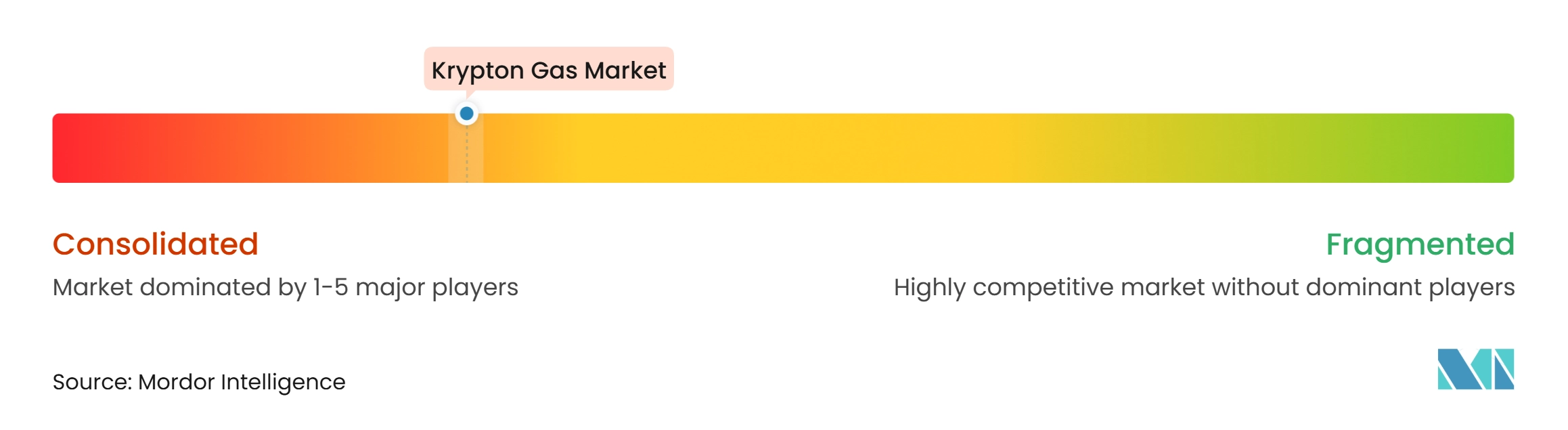
The krypton gas market is consolidated. Linde, Air Liquide, Air Products, and Nippon Sanso Holdings hold the majority of large air-separation-unit-integrated krypton purification capacity. Their position is supported by cryogenic separation capability, established logistics, and long-term customer relationships. Linde reported USD 33,986 million in 2024 sales and identifies krypton among atmospheric rare-gas products co-produced across its facilities. The company also notes that rare gases can be subject to supply constraints, as production is concentrated at a limited number of sites.
Localization is a recurring competitive strategy. Air Liquide inaugurated a purification plant in Cheonan in June 2025, located near South Korean semiconductor customers. Taiyo Nippon Sanso added capacity for krypton and xenon at its Kimitsu Sanso Center in August 2025. These investments reduced transport dependency and positioned purification closer to advanced manufacturing clusters.
Chinese producers have been working to supply more technically demanding electronics customers. Yueyang Kaimeite received qualified supplier status from GIGAPHOTON for KrF lithography gas in May 2025, indicating that regional suppliers are investing in the specifications required for high-purity applications. Ukrainian suppliers remain part of the supply base but operate in a more disrupted regional environment. The krypton gas market retains opportunities in recovery-and-recycle services and localized supply in regions with limited purification capacity.
Krypton Gas Industry Leaders
-
Linde PLC
-
Air Products and Chemicals, Inc.
-
Air Liquide
-
Messer SE & Co. KGaA
-
Nippon Sanso Holdings Corporation
- *Disclaimer: Major Players sorted in no particular order
Krypton Gas Market Companies Covered in this Report
- Air Liquide
- Air Products and Chemicals, Inc.
- AIR WATER INC
- Baowu (Wisco Gases)
- Cryoin Engineering
- Hangzhou Hangyang Co., Ltd.
- Iceblick Ltd.
- INGAS
- Iwatani Corporation
- Linde PLC
- Messer SE & Co. KGaA
- Nippon Sanso Holdings Corporation
- SOL Spa
- Universal Industrial Gases, LLC
- Yueyang Kaimeite Electronic Specialty Rare Gases Co., Ltd.
Recent Industry Developments in Krypton Gas Market
- June 2025: Air Liquide inaugurated a rare gases purification unit in Cheonan, South Chungcheong Province, South Korea. The facility supplies krypton and xenon to major local semiconductor customers, using proprietary cryogenic purification technology to achieve the ultra-high-purity grades required for chip manufacturing. The unit positions Air Liquide close to Samsung Electronics and SK Hynix production facilities.
- May 2025: Messer SE & Co. KGaA opened a new electronics and specialty products laser mix facility in Coolbaugh Township, Pennsylvania, producing krypton, neon, and xenon for the merchant market. Messer described the facility as a response to evolving demand in the electronics and specialty gases sectors and as a domestic supply chain risk mitigation measure.
Global Krypton Gas Market Report Scope
Krypton is a rare, colorless, odorless noble gas present in the atmosphere. It finds application in lighting, lasers, photographic flashes, and specialized industrial uses. The gas is extracted as a byproduct of air separation processes, where liquid air is fractionally distilled to isolate individual gases. Krypton is used in high-performance lighting systems, including krypton-fluoride lasers, which are applied in semiconductor manufacturing and medical procedures.
The krypton gas market is segmented by purity and product type, supply mode, application, and geography. By purity and product type, the market is segmented into high-purity krypton, common-purity krypton, and ultra-high-purity krypton. By supply mode, the market is segmented into cylinders, bulk and micro-bulk, drum tanks, and on-site supply. By application, the market is segmented into window and glass insulation, illumination, electronics and semiconductor manufacturing, laser systems, and other applications. The report also covers market sizes and forecasts for krypton gas across 15 countries in major regions. The market sizes and forecasts are provided in terms of value (USD).
Segmentation Overview
| High-Purity Krypton |
| Common-Purity Krypton |
| Ultra-High-Purity Krypton |
| Cylinders |
| Bulk and Micro-Bulk |
| Drum Tanks |
| On-Site Supply |
| Window and Glass Insulation |
| Illumination |
| Electronics and Semiconductor Manufacturing |
| Laser Systems |
| Other Applications |
| Asia-Pacific | China |
| India | |
| Japan | |
| South Korea | |
| ASEAN Countries | |
| Rest of Asia-Pacific | |
| North America | United States |
| Canada | |
| Mexico | |
| Europe | Germany |
| United Kingdom | |
| France | |
| Italy | |
| NORDIC Countries | |
| Rest of Europe | |
| South America | Brazil |
| Argentina | |
| Rest of South America | |
| Middle East and Africa | Saudi Arabia |
| South Africa | |
| Rest of Middle East and Africa |
| By Purity and Product Type | High-Purity Krypton | |
| Common-Purity Krypton | ||
| Ultra-High-Purity Krypton | ||
| By Supply Mode | Cylinders | |
| Bulk and Micro-Bulk | ||
| Drum Tanks | ||
| On-Site Supply | ||
| By Application | Window and Glass Insulation | |
| Illumination | ||
| Electronics and Semiconductor Manufacturing | ||
| Laser Systems | ||
| Other Applications | ||
| By Geography | Asia-Pacific | China |
| India | ||
| Japan | ||
| South Korea | ||
| ASEAN Countries | ||
| Rest of Asia-Pacific | ||
| North America | United States | |
| Canada | ||
| Mexico | ||
| Europe | Germany | |
| United Kingdom | ||
| France | ||
| Italy | ||
| NORDIC Countries | ||
| Rest of Europe | ||
| South America | Brazil | |
| Argentina | ||
| Rest of South America | ||
| Middle East and Africa | Saudi Arabia | |
| South Africa | ||
| Rest of Middle East and Africa | ||
Key Questions Answered in the Report
What is current market size of Krypton Gas Market?
The Krypton gas market size was valued at USD 201.63 million in 2026 and is estimated to grow from USD 213.71 million in 2027 to USD 286.39 million by 2032, at a CAGR of 6.03% during the forecast period (2027-2032).
Which application is expanding fastest?
Electronics and Semiconductor Manufacturing is forecast to grow at a 7.34% CAGR through 2032. KrF tools and controlled semiconductor processes support this rate.
Why is high-purity krypton important for chip manufacturing?
Semiconductor processes require controlled purity levels for lithography, etching, and deposition. China’s GB/T 5829-2025 formalizes purity classifications for qualified supply.
Which region leads krypton gas demand?
Asia-Pacific held a 40.71% share in 2026 and is projected to record a 7.01% CAGR through 2032. South Korean, Japanese, and Chinese manufacturing clusters support regional demand.