
Japan Vinyl Wallpaper Market Size and Share
Market Overview
| Study Period | 2020 - 2031 |
|---|---|
| Forecast Data Period | 2026 - 2031 |
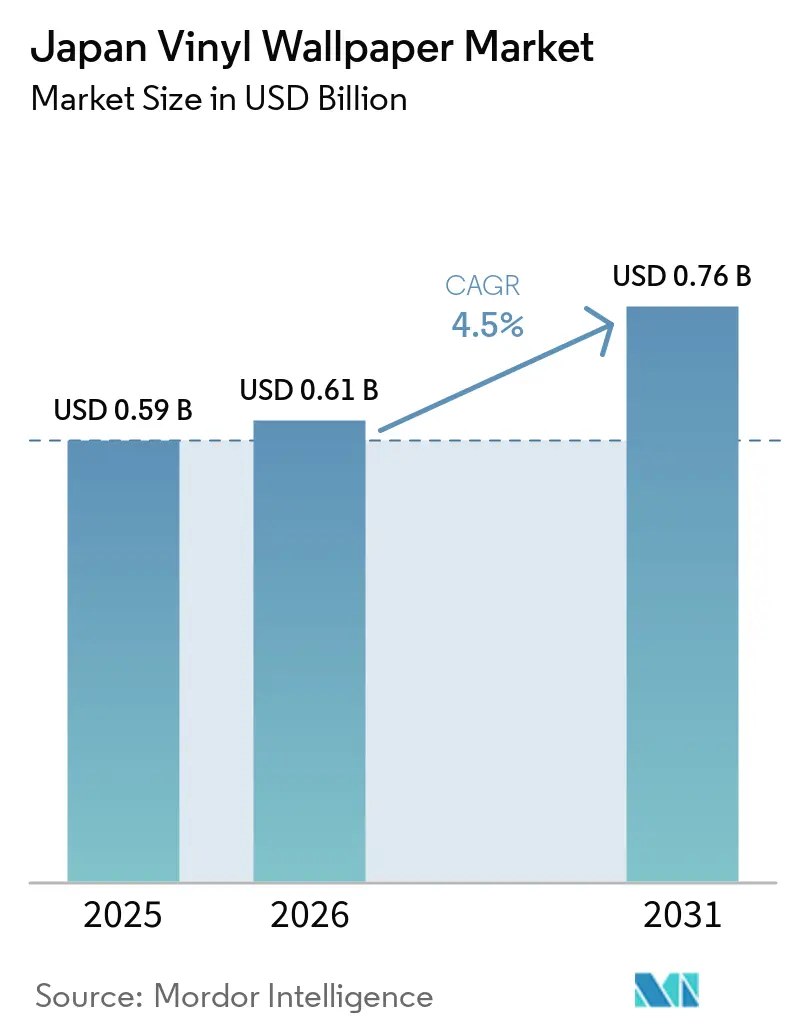
| Base Year Market Size (2025) | USD 0.59 Billion |
| Market Size (2026) | USD 0.61 Billion |
| Market Size (2031) | USD 0.76 Billion |
| Growth Rate (2026 - 2031) | 4.50 % |
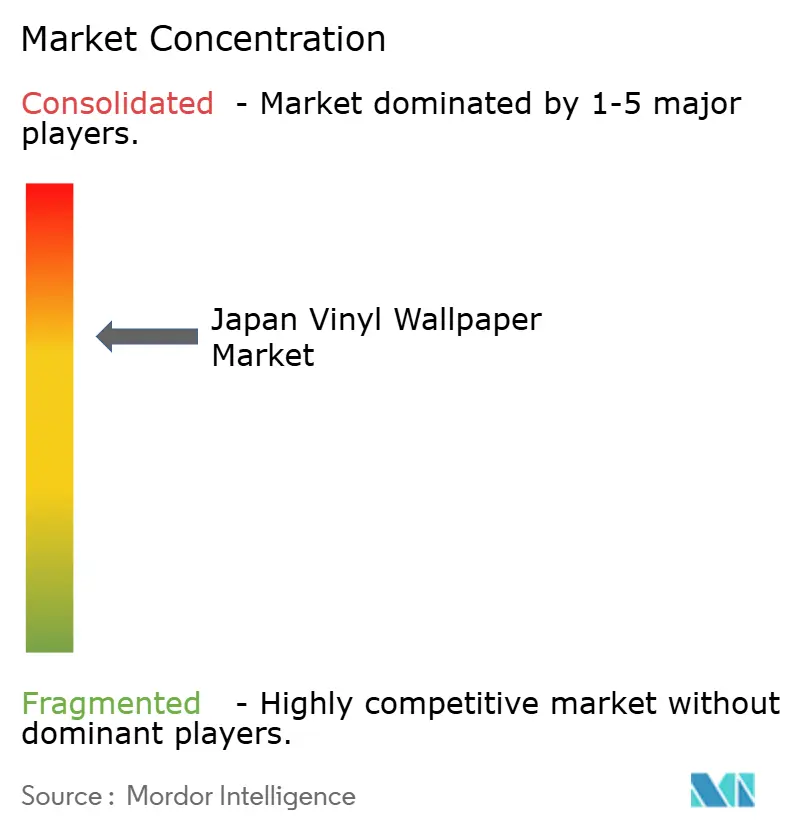
| Market Concentration | Medium |
Major Players *Disclaimer: Major Players sorted in no particular order Image © Mordor Intelligence. Reuse requires attribution under CC BY 4.0. | |
Japan Vinyl Wallpaper Market Analysis by Mordor Intelligence
The Japan vinyl wallpaper market size was valued at USD 0.59 billion in 2025 and is estimated to grow from USD 0.61 billion in 2026 to reach USD 0.76 billion by 2031, at a CAGR of 4.50% during the forecast period (2026-2031). Replacement demand in aging homes and commercial buildings supports steady demand even when new construction slows. Renovation activity also gives suppliers recurring access to established properties, where wallcoverings are renewed as part of interior maintenance. Hotel, healthcare, and welfare projects favor materials that meet performance and fire-safety requirements. Larger domestic suppliers can serve these needs through broad catalogs, technical documentation, and distributor relationships. The Japan vinyl wallpaper market therefore, depends more on specification quality and replacement timing than on rapid construction-led volume growth.
Key Report Takeaways
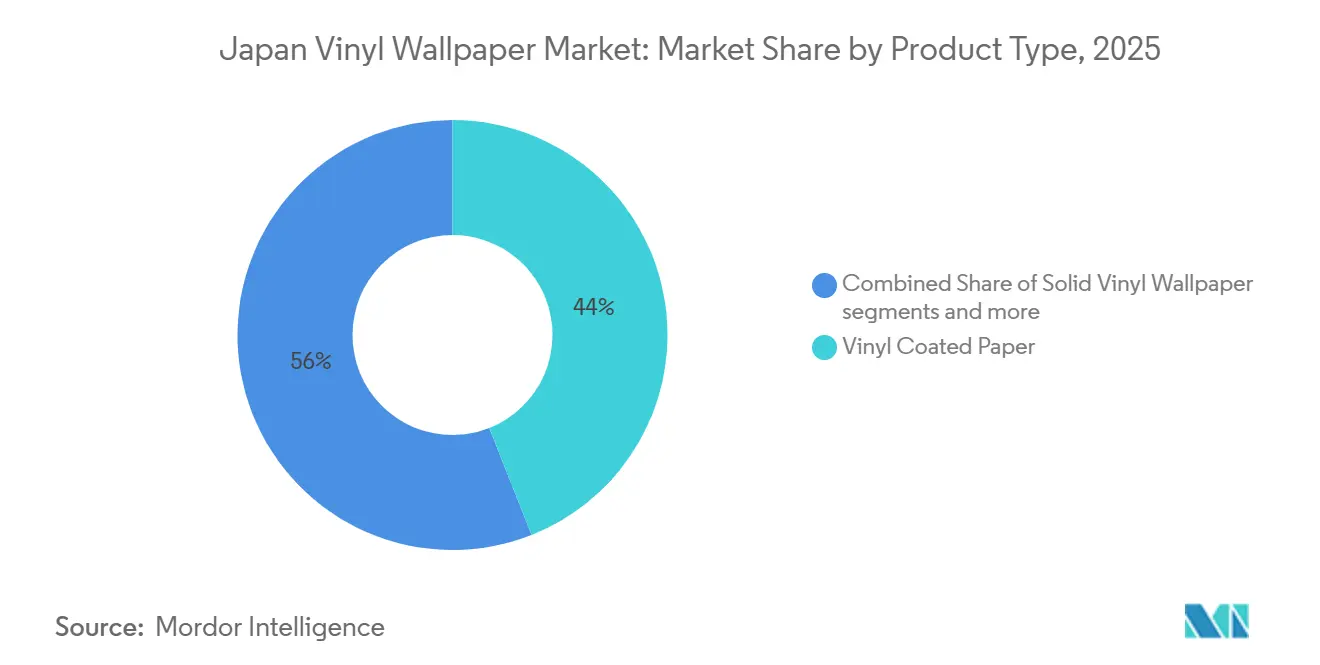
- By product type, vinyl-coated paper held 44% of the Japanese vinyl wallpaper market share in 2025, while fabric-backed vinyl is forecast to grow at a 5.5% CAGR through 2031.
- By installation type, Traditional and Non Self-Adhesive formats held 78% of the Japanese vinyl wallpaper market share in 2025, while self-adhesive and peel-and-stick products are forecast to grow at a 5.7% CAGR through 2031.
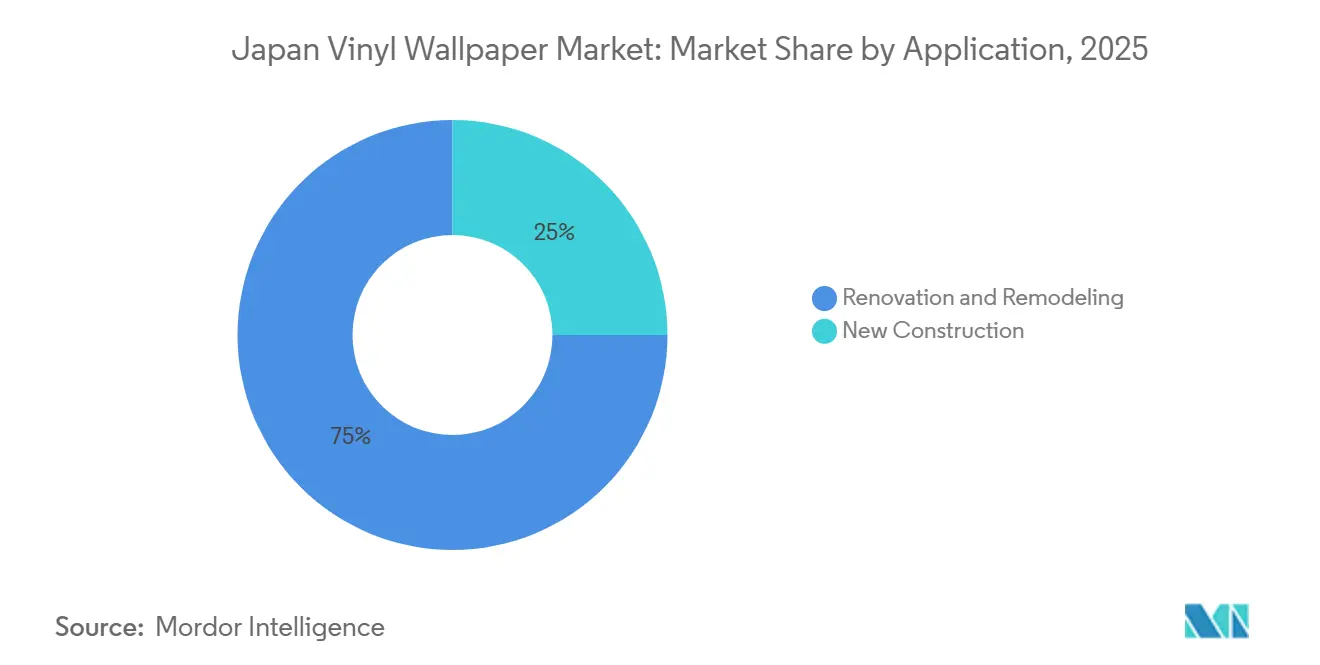
- By application, renovation and remodeling represented 75% of demand in 2025, while new construction is forecast to expand at a 4.6% CAGR through 2031.
- By end user, residential represented 61% of demand in 2025, while commercial is forecast to expand at a 4.8% CAGR through 2031.
- By distribution channel, B2C channels represented 61% of demand in 2025, while B2B channels are forecast to grow at a 4.6% CAGR through 2031.
- By geography, Kanto held 39% of the Japanese vinyl wallpaper category share in 2025, and the rest of Japan is forecast to expand at a 5.2% CAGR through 2031.
Note: Market size and forecast figures in this report are generated using Mordor Intelligence’s proprietary estimation framework, updated with the latest available data and insights as of January 2026.
Japan Vinyl Wallpaper Market Trends and Insights
Drivers Impact Analysis*
| Driver | (~) % Impact on CAGR Forecast | Geographic Relevance | Impact Timeline |
|---|---|---|---|
| Renovation-Led Replacement Demand | +0.8% | National, with concentration in Kanto and Chubu urban markets | Short term (≤ 2 years) |
| Hospitality and Commercial Fit-Out Expansion | +0.7% | Kanto, Tohoku, and emerging regional hubs including Sapporo, Hiroshima, and Nagoya | Medium term (2-4 years) |
| Demand for Washable and High-Durability Wallcoverings | +0.5% | National across commercial, healthcare, and rental residential uses | Medium term (2-4 years) |
| Functional Wallcoverings for Healthcare and Welfare Facilities | +0.5% | National, with earliest gains in Kanto and Hokkaido aged-care clusters | Medium term (2-4 years) |
| Design-Led Customization Through Digital Printing | +0.4% | Kanto urban core, with spillover to Kansai and Chubu design markets | Long term (≥ 4 years) |
| Compact-Housing Interior Personalization | +0.3% | Kanto urban rental zones, including Tokyo’s 23 wards and Yokohama, and Chubu rental zones including Nagoya | Short term (≤ 2 years) |
| Source: Mordor Intelligence | |||
Renovation-Led Replacement Demand
Japan’s housing stock creates recurring demand for interior renewal, rather than a short-term increase in wallcovering purchases. The Ministry of Land, Infrastructure, Transport and Tourism recorded JPY 3.45 trillion in building reform and renewal orders during the first quarter of fiscal 2023, up 23.1% from the prior year[1]. Vinyl wallcoverings are widely used in residential and commercial interior contracts, so renovation spending supports replacement activity across many building types. Professional contractors can renew a room without changing the building structure, which makes wallcoverings suitable for routine refurbishment work. Higher labor costs encourage interest in formats that reduce installation time, including self-adhesive and paste-the-wall products. This shift supports the Japan vinyl wallpaper market by directing part of the replacement demand toward products designed for faster renovation work.
Hospitality and Commercial Fit-Out Expansion
Hotel construction and refurbishment support demand for commercial-grade wallcoverings in the Japan vinyl wallpaper market. Hotels require interior materials that can withstand frequent use in corridors, guestrooms, and shared spaces. Fire-rated, abrasion-resistant, and easy-clean wallcoverings are therefore relevant to hotel specifications. Sangetsu offers non-flammable wallpaper collections for non-residential spaces, including hotels and offices[2]. Sincol also maintains product offerings for commercial and institutional projects that require non-flammable materials[3]. These requirements create a qualification advantage for established suppliers that can provide documented performance standards and consistent product availability.
Demand for Washable and High-Durability Wallcoverings
Washability, contamination resistance, and antiviral surface treatments are increasingly important in institutional interiors. These features are also relevant to rental housing and residential renovation, where easier cleaning can reduce maintenance needs. TOLI has included SIAA-certified antiviral wallpaper in its renovation-oriented wallcovering lineup[4]. Hotel operators, care providers, and property managers can use functional finishes to support longer maintenance cycles. Longer replacement cycles can increase the value placed on durable products, even where replacement volumes remain moderate. The Japan vinyl wallpaper market benefits when functional performance becomes a standard product requirement instead of a premium option.
Functional Wallcoverings for Healthcare and Welfare Facilities
Healthcare and welfare projects favor materials that can support durability, cleaning, and indoor comfort. The Japan Welfare and Medical Service Agency reported fiscal 2025 construction costs of JPY 517,000 per square meter for hospitals and JPY 443,000 per square meter for unit-type special nursing homes. Higher construction costs encourage operators to consider interior materials that can remain serviceable through longer use periods. RUNON promotes its Air-cleaning Wall Coverings® with TRIPLE FRESH® deodorizing technology for hospitals, elderly care facilities, and welfare institutions. Japan’s aging population supports ongoing demand for care facilities and related refurbishment activity. The Japan vinyl wallpaper market has a stable institutional demand base when wallcoverings meet functional requirements in patient and resident areas.
Restraints Impact Analysis*
| Restraint | (~) % Impact on CAGR Forecast | Geographic Relevance | Impact Timeline |
|---|---|---|---|
| Competition from Paint and Alternative Wall Finishes | -0.5% | National, most pronounced in budget residential and small commercial segments | Short term (≤ 2 years) |
| Installation Labor and Renovation Scheduling Constraints | -0.4% | National, most acute in Kanto and Chubu where trades capacity is tightest | Medium term (2-4 years) |
| PVC Sustainability and End-of-Life Recycling Complexity | -0.4% | National, with regulatory influence driven by Japan’s amended Resource Circulation Act | Long term (≥ 4 years) |
| Import Dependence for Selected Inputs and Finished Products | -0.3% | National, with secondary effects most acute in Rest of Japan distribution zones | Medium term (2-4 years) |
| Source: Mordor Intelligence | |||
Competition from Paint and Alternative Wall Finishes
Paint remains an alternative interior finish in budget-sensitive homes and small offices. It can suit repair and spot-treatment work because it is familiar to do-it-yourself users and may require less specialist labor. Functional paints with antimicrobial properties can also meet some performance needs that previously favored vinyl wallcoverings. This reduces the product distinction available to wallpaper suppliers in selected applications. Installed wallpaper costs can rise when skilled labor is limited, which can make paint more attractive for simple refurbishment work. Suppliers respond through self-adhesive and paste-the-wall formats that reduce installation complexity and preserve the relevance of the Japan vinyl wallpaper market.
Installation Labor and Renovation Scheduling Constraints
A limited supply of skilled interior tradespeople can slow renovation work and delay wallpaper installation. Building owners may postpone a refurbishment if contractor schedules extend beyond their planned vacancy or reopening period. This effect is especially relevant in Greater Tokyo, where residential and commercial projects compete for qualified installers. Longer lead times can reduce the scope of renovation work or shift spending toward materials with easier application. Manufacturers are responding through products designed to reduce time per square meter, including self-adhesive, non-woven paste-the-wall, and pre-trimmed formats. The Japan vinyl wallpaper market can retain demand when product design helps contractors complete projects with less installation effort.
*Our forecasts treat driver/restraint impacts as directional, not additive. The impact forecasts reflect baseline growth, mix effects, and variable interactions.
Segment Analysis
By Product Type/Construction Type: Vinyl Coated Paper Holds a Broad Base While Fabric Backed Vinyl Expands
Vinyl Coated Paper held 44% of demand in 2025 and remained the largest product type in the Japan vinyl wallpaper market. Its position reflects predictable adhesion, dependable fire-related specifications, and a wide range of patterns and textures. Contractors, designers, and building managers are familiar with this material through established sample-book purchasing practices. This familiarity lowers product-selection friction in both residential and commercial refurbishment work. Solid Vinyl Wallpaper is relevant in heavy-use spaces such as healthcare settings and hotel corridors, where scrubbability and dimensional stability are important. Non-Woven Vinyl Wallpaper serves renovation and new-build projects through paste-the-wall application, which can reduce installation time when labor capacity is tight. Other product types, including acoustic and magnetic wallcoverings, remain specialist offerings that address higher-value functional needs.
Fabric Backed Vinyl is forecast to grow at a 5.5% CAGR through 2031, the highest rate among the listed product types. This material supports hospitality projects that require premium surface texture and acoustic control. It also fits healthcare uses that require greater durability and resistance to contamination. Sangetsu’s SOUNDIA acoustic panel incorporates 60% recycled PET material, showing how functional and material-related attributes are being combined in premium wallcovering design. Composite wallcoverings remain more difficult to recycle than single-material products, which keeps end-of-life recovery important for this category. The Vinyl Environmental Council has supported recycling work for PVC wallcovering materials in Japan. The Japan vinyl wallpaper industry uses these product improvements to address commercial specifications while responding to material recovery concerns.

By Installation Type: Traditional Formats Retain Scale While Peel-and-Stick Gains Use Cases
Traditional and non-self-adhesive formats represented 78% of demand in 2025, making them the main installation type. The Japan vinyl wallpaper market size for this format is supported by professional contractors, sample-book-led specification, and installation services that are commonly sold together. Professional installation remains important where projects require consistent finishing and compliance with material standards. The JIS A 6921 standard applies to adhesive wallcovering materials used in Japan. Long-standing relationships between contractors, distributors, and manufacturers help preserve the position of traditional formats. Sangetsu and Sincol maintain broad wallcovering catalogs that can support professional selection across residential, commercial, and institutional work. This established system still limits the immediate substitution of professional formats by direct consumer installation.
Self-Adhesive and peel-and-stick vinyl wallpaper is forecast to grow at a 5.7% CAGR through 2031. The format is suited to renters and households seeking to personalize compact living spaces without extensive renovation work. It also allows consumers to make decorative changes with lower dependence on professional installers. Online retail and home-center channels can support this segment because products are easier to demonstrate and purchase for smaller projects. Sangetsu’s Reform Up range includes renovation-oriented products that address the needs of refurbishment users. Manufacturers can use this format to reach consumers outside the traditional contractor-led supply chain. The Japan vinyl wallpaper industry may gain additional distribution options when self-adhesive products are paired with clear application guidance and appropriate product specifications.
By Application: Renovation Leads Demand While New Construction Supports Certified Materials
Renovation and remodeling represented 75% of demand in 2025 and was the largest application. Japan’s established housing base creates regular occasions for wallcovering replacement during tenant turnover, resale preparation, and interior upgrades. The Japan vinyl wallpaper market size is linked closely to these recurring property renewal activities. The Ministry of Land, Infrastructure, Transport, and Tourism publishes building reform and renewal statistics that show the scale of this work across building categories. Commercial refurbishment also adds a higher-value layer where hotel and office owners renew interiors to maintain property standards. Functional materials are relevant where operators want surfaces that are easier to clean and maintain. These uses provide a stable demand base that is less dependent on annual changes in housing starts.
New construction is forecast to grow at a 4.6% CAGR through 2031. The segment includes hotels, welfare facilities, and mixed-use commercial projects that require specified interior materials. New projects often favor certified wallcoverings because requirements are set at the design and procurement stage. Hospital construction costs reached JPY 517,000 per square meter in fiscal 2025, indicating the substantial scale of institutional building programs even when project counts vary. New construction gives suppliers an opportunity to place premium, durable, and non-flammable products within the original building specification. It also supports relationships with architects, designers, contractors, and project procurement teams. The Japan vinyl wallpaper market benefits from this application because technical documentation and certified performance can be considered before materials are installed.
By End User: Residential Holds Demand While Commercial Uses Add Growth
Residential end users represented 61% of demand in 2025 and remained the largest end-user group. Rental turnover, home improvement, and property resale preparation create recurring demand for wallcovering replacement in occupied housing. Living rooms, bedrooms, and kitchens are common uses, while bathrooms and children’s rooms can require washable or visually distinctive finishes. Residential buyers may select wallcoverings for both decoration and practical maintenance needs. Home centers, specialty stores, and online channels offer different routes for residential product selection. This demand base supports broad catalog coverage, from standard patterns to functional and renovation-focused products. The Japan vinyl wallpaper market continues to rely on residential replacement activity because it occurs across a large existing stock of homes.
Commercial end users are forecast to grow at a 4.8% CAGR through 2031, the highest end-user rate. Hotels, healthcare facilities, welfare sites, and commercial properties require wallcoverings that can withstand frequent use and meet project specifications. The Japan Welfare and Medical Service Agency’s construction-cost data illustrates the high-value setting in which healthcare and welfare materials are selected. Antiviral, deodorizing, washable, and non-flammable specifications are relevant in these environments. RUNON’s functional wallcovering range is positioned for hospitals, elderly care facilities, and welfare institutions. Commercial buyers also work through designers and contractors, which places importance on technical support and sample availability. The Japan vinyl wallpaper market has room for value growth when suppliers meet these more demanding institutional requirements.
By Distribution Channel: B2C Channels Retain Reach While B2B Procurement Broadens
B2C channels represented 61% of distribution demand in 2025. Specialty wallpaper stores, home centers, online retailers, and local channels give consumers access to standard and decorative wallcovering products. Home centers support residential renovation by offering interior materials alongside hardware and related home-improvement items. Specialty stores remain relevant where customers need complete sample-book selections or assistance with color and pattern choice. Online channels are particularly useful for self-adhesive products, where consumers can compare small projects and complete purchases directly. These channels also help manufacturers serve renters and homeowners who do not begin their purchase through a contractor. The Japan vinyl wallpaper industry depends on B2C access to maintain its connection with replacement demand in smaller residential projects.
B2B channels are forecast to grow at a 4.6% CAGR through 2031. Contractors, installers, designers, architects, project procurement teams, and institutional buyers use these channels to source specified materials. They require sample books, technical documents, product availability, and support for complex installations. Non-residential catalogs from Sangetsu and Sincol provide products for hotels, offices, commercial facilities, and other institutional spaces. B2B purchasing is concentrated where commercial refurbishment and new institutional projects are active, particularly in Kanto. The channel can support higher-value products because materials are selected through project specifications rather than only through retail price comparison. The Japan vinyl wallpaper market gains from B2B growth when suppliers maintain relationships with the professionals who influence material selection.
Geography Analysis
Kanto held 39% of the Japan vinyl wallpaper market share in 2025 and remained the leading regional market. Greater Tokyo concentrates residential, commercial, and institutional demand within a dense urban area. Office refurbishment, hotel upgrades, and mixed-use development create regular requirements for interior materials. Kanto’s building stock also generates replacement activity when apartments, offices, and public-facing properties are renewed. Dense commercial buildings require materials that meet relevant fire-safety specifications. This favors domestic suppliers with non-flammable wallcovering ranges and established commercial distribution. Sangetsu’s FAITH collection includes non-flammable products intended for non-residential applications.
Chubu held a meaningful national position in 2025, supported by Nagoya’s role as a manufacturing and commercial center. Office renovation, industrial welfare facilities, and commercial fit-outs provide demand across the region. Hospitality development adds a further use case for higher-specification wallcoverings. Tohoku has a more modest project base, but regional hospitality activity can generate renovation and fit-out requirements. Hokkaido has a different demand profile because resort development can require premium commercial interiors. Hotels and care facilities in these regions also use functional products where cleaning, durability, and long service life are important. The Japan vinyl wallpaper market therefore has demand across these areas even though the mix differs from Kanto’s dense urban profile.
The Rest of Japan is forecast to grow at a 5.2% CAGR through 2031, making it the fastest-growing geography. This area includes Kansai, Chugoku, Shikoku, and Kyushu-Okinawa. Regional hotel refurbishment and tourism-related property investment can extend demand beyond the established metropolitan core. Welfare facility construction also supports functional wallcovering demand in mid-sized cities. Japan’s aging population is distributed beyond major urban centers, which creates a wider need for care-related interiors. Suppliers that can serve regional distributors and contractors can reach this dispersed project base. The Japan vinyl wallpaper market can gain from this regional growth as hotel, care, and renovation requirements broaden beyond Tokyo-centered demand.
Competitive Landscape
Sangetsu holds the leading position by revenue, while Lilycolor, TOLI, Sincol, and RUNON form an important group of domestic specialists. Sangetsu holds a dominant position. Its product system covers mass-market residential, renovation, and premium commercial uses through catalogs including Reserve, SP, Reform Up, FAITH, and FINE. This breadth helps the company serve contractors, designers, and institutional buyers through one supply network. Sincol uses multiple catalogs to address residential, renovation, commercial, and non-flammable applications.
Scale matters because leading suppliers must maintain sample books, distribution coverage, certified materials, and a broad selection of patterns and functions. This structure makes it harder for foreign brands to compete in mainstream volume segments. International suppliers, including KOROSEAL, A.S. Création, and Graham & Brown, are more relevant in premium design, heavy-duty commercial, or specialized product categories. Domestic producers are also responding to demand for materials with clearer environmental attributes. Sangetsu introduced Japan’s first FSC-certified vinyl wallpaper in its 2025-2027 SP catalog. The product uses certified paper backing from responsibly managed forests. This move makes raw material traceability more visible in product competition.
Digital printing and self-adhesive formats create an additional competitive opening because they can reach consumers without relying fully on traditional sample-book systems. These formats may support smaller renovation projects and more individualized design choices. Established suppliers are responding through renovation-focused products and catalog updates. Sangetsu launched its 2026-2029 FINE catalog with 771 products, including 318 new items and an expanded range of non-flammable wallpapers. Sincol launched BIGACE 2026-2028 and Renovation Expert 2026-2028 for residential design and renovation users. TOLI renewed its TOLI Wall VS 2026-2028 catalog with continued antiviral wallpaper coverage for renovation and rental-property maintenance.
Japan Vinyl Wallpaper Industry Leaders
-
Sangetsu Corporation
-
TOLI Corporation
-
Lilycolor Co., Ltd.
-
Sincol Corporation
-
Runon Co., Ltd.
- *Disclaimer: Major Players sorted in no particular order
Recent Industry Developments
- June 2026: Sangetsu Corporation launched "2026-2029 FINE", a design-led wallpaper catalog featuring 771 products, including 318 new items, with a substantially expanded lineup of non-flammable certified wallpapers that extend coverage from residential into hotel and office applications. The catalog’s collaboration with disability-art organization HERALBONY marks a visible brand-values differentiation move by the market leader.
- May 2026: Sincol Corporation launched "BIGACE 2026-2028" and "Renovation Expert (リフォーム上手) 2026-2028", two simultaneous wallpaper catalogs targeting the residential design and renovation segments respectively. The launches signal Sincol’s commitment to maintaining parallel coverage across consumer-facing and renovation-trade channels within a single product cycle.
- November 2025: Sangetsu Corporation launched "2025-2028 FAITH", a non-flammable certified wallpaper catalog developed under the concept of "Diversity & Universality" with 901 wallpapers and 271 special wall materials for non-residential applications. The catalog includes the SOUNDIA acoustic panel, incorporating 60% recycled PET, underscoring functional and environmental dual positioning for the commercial segment.
- August 2025: Sangetsu launched the "TEXTURE & MATERIAL" and "BRAND & PATTERN" premium XSELECT collections, splitting the flagship XSELECT catalog into two design-distinct volumes to improve usability for interior designers and architects specifying at the premium end of the residential and contract markets.
Japan Vinyl Wallpaper Market Report Scope
| Solid Vinyl Wallpaper |
| Vinyl Coated Paper |
| Fabric Backed Vinyl |
| Non-Woven Vinyl Wallpapers |
| Other Product Types |
| Traditional/Non-Self-Adhesive |
| Self-Adhesive/Peel-and-Stick Vinyl Wallpaper |
| New Construction |
| Renovation and Remodeling |
| Residential | Living Room |
| Kitchen | |
| Bedroom | |
| Bathroom | |
| Kids Room | |
| Commercial |
| B2C Channels | Hypermarkets and Supermarkets |
| Specialty Wallpaper Stores | |
| Home Centers | |
| Online | |
| Local Shops (unorganized channels) | |
| Other Distribution Channels | |
| B2B Channels (Contractors and Installers, Interior Designers and Architects, Project Procurement and Institutional Sales) |
| Hokkaido |
| Tohoku |
| Kanto |
| Chubu |
| Rest of Japan |
| By Product Type/Construction Type | Solid Vinyl Wallpaper | |
| Vinyl Coated Paper | ||
| Fabric Backed Vinyl | ||
| Non-Woven Vinyl Wallpapers | ||
| Other Product Types | ||
| By Installation Type | Traditional/Non-Self-Adhesive | |
| Self-Adhesive/Peel-and-Stick Vinyl Wallpaper | ||
| By Application | New Construction | |
| Renovation and Remodeling | ||
| By End User | Residential | Living Room |
| Kitchen | ||
| Bedroom | ||
| Bathroom | ||
| Kids Room | ||
| Commercial | ||
| By Distribution Channel | B2C Channels | Hypermarkets and Supermarkets |
| Specialty Wallpaper Stores | ||
| Home Centers | ||
| Online | ||
| Local Shops (unorganized channels) | ||
| Other Distribution Channels | ||
| B2B Channels (Contractors and Installers, Interior Designers and Architects, Project Procurement and Institutional Sales) | ||
| By Geography | Hokkaido | |
| Tohoku | ||
| Kanto | ||
| Chubu | ||
| Rest of Japan | ||
Key Questions Answered in the Report
What is the forecast for the Japan vinyl wallpaper market?
The Japan vinyl wallpaper market is forecast to reach USD 0.51 billion by 2031 from USD 0.44 billion in 2026, growing at a 3% CAGR. The outlook reflects recurring renovation demand and continued requirements from commercial and institutional interior projects.
Which product type leads demand in Japan?
Vinyl Coated Paper led demand with a 44% share in 2025 because it offers familiar installation performance, broad design choice, and established contractor acceptance. It remains suitable for common residential and commercial replacement work where consistent specification and availability matter.
Which installation format is growing fastest?
Self-Adhesive and Peel-and-Stick vinyl wallpaper is forecast to grow at a 5.7% CAGR through 2031, supported by renovation and consumer applications. The format helps smaller projects proceed with lower dependence on professional installation and traditional contractor scheduling.
Why is renovation important for vinyl wallcovering demand?
Renovation and Remodeling represented 75% of demand in 2025, supported by regular interior renewal in homes, commercial buildings, and institutional properties. Replacement work allows owners to refresh surfaces without changing building structures or undertaking a complete reconstruction program.
Who are the main suppliers of vinyl wallpaper in Japan?
Sangetsu leads the domestic supplier group, with Lilycolor, TOLI, Sincol, and RUNON also serving residential, commercial, and institutional applications. Their competitive position is supported by product catalogs, distribution reach, and materials that meet functional project requirements.