
Japan Pet Treats Market Size and Share
Market Overview
| Study Period | 2021 - 2031 |
|---|---|
| Forecast Data Period | 2026 - 2031 |
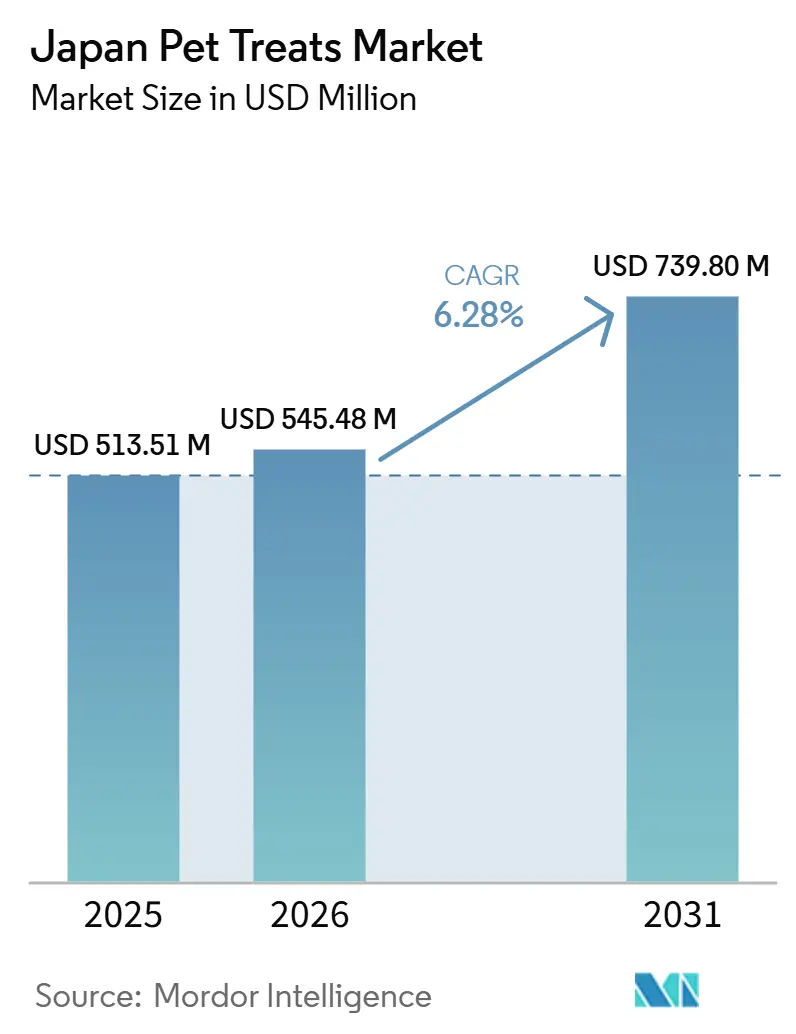
| Base Year Market Size (2025) | USD 513.51 Million |
| Market Size (2026) | USD 545.48 Million |
| Market Size (2031) | USD 739.80 Million |
| Growth Rate (2026 - 2031) | 6.28 % |
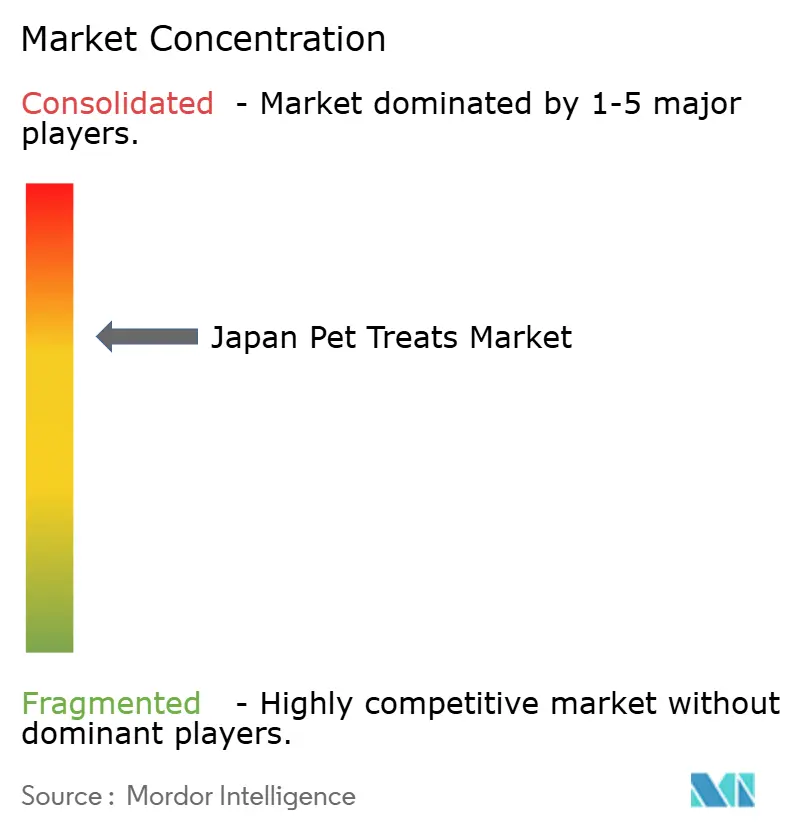
| Market Concentration | Medium |
Major Players *Disclaimer: Major Players sorted in no particular order Image © Mordor Intelligence. Reuse requires attribution under CC BY 4.0. | |
Japan Pet Treats Market Analysis by Mordor Intelligence
The Japan pet treats market size was valued at USD 513.51 million in 2025 and is projected to reach USD 545.48 million in 2026 and USD 739.80 million by 2031, growing at a CAGR of 6.3% from 2026 to 2031. Value growth is outpacing volume growth as spending per pet is increasing faster than household formation and pet ownership expansion. The Japan pet treats market is supported by premium purchasing behavior, growing demand for functional products, and an increasing preference for clean-ingredient formulations, while the declining dog and cat population continues to limit volume growth. Japan’s regulatory framework also plays an important role, as compliance with pet food standards for ingredients, additives, and labeling increases operational requirements for manufacturers. Online retail is expanding consumer access to premium product assortments and encouraging repeat purchases among urban households, supporting a more stable demand base for premium brands. Competitive activity in the Japan pet treats market is increasingly focused on health-oriented innovation, Japan-sourced product positioning, and a stronger presence across digital and specialty retail channels rather than only expanding flavor offerings.
Key Report Takeaways
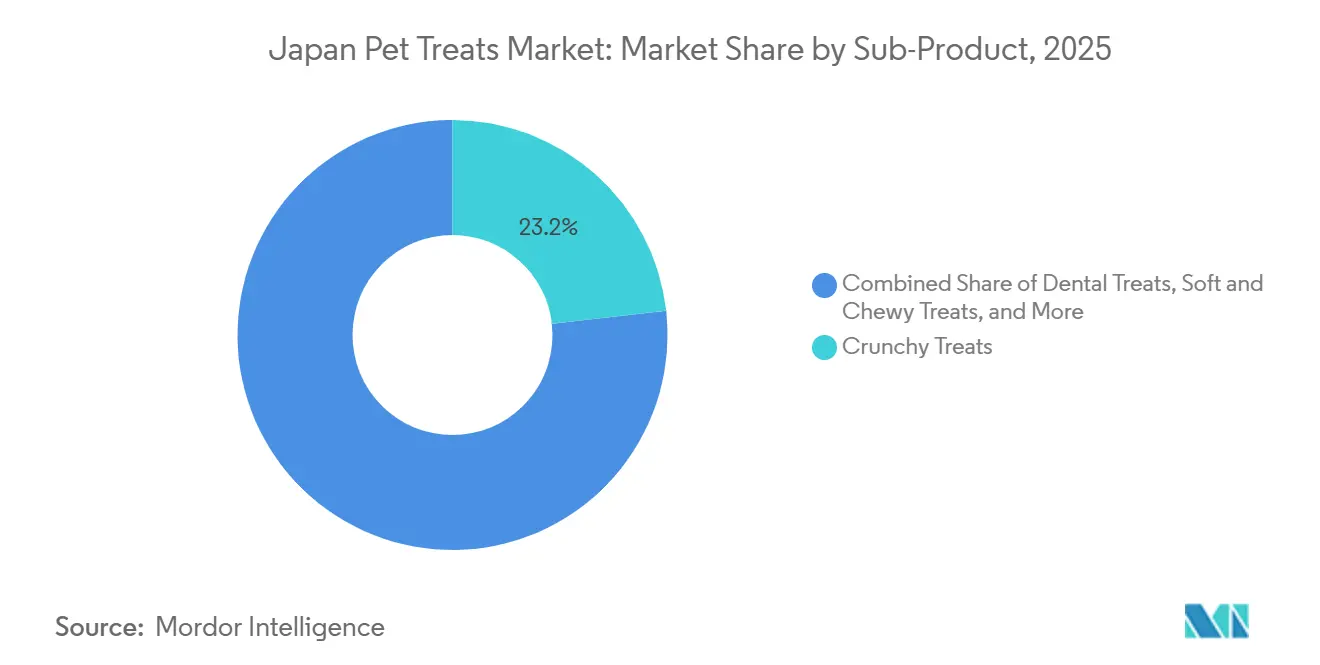
- By sub-product, crunchy treats held a 23.2% share of the Japan pet treats market size in 2025, while freeze-dried and jerky treats are projected to grow at an 8.0% CAGR through 2031.
- By pet type, dogs held 55.8% of the Japan pet treats market share in 2025, while cats are projected to grow at a 7.8% CAGR through 2031.
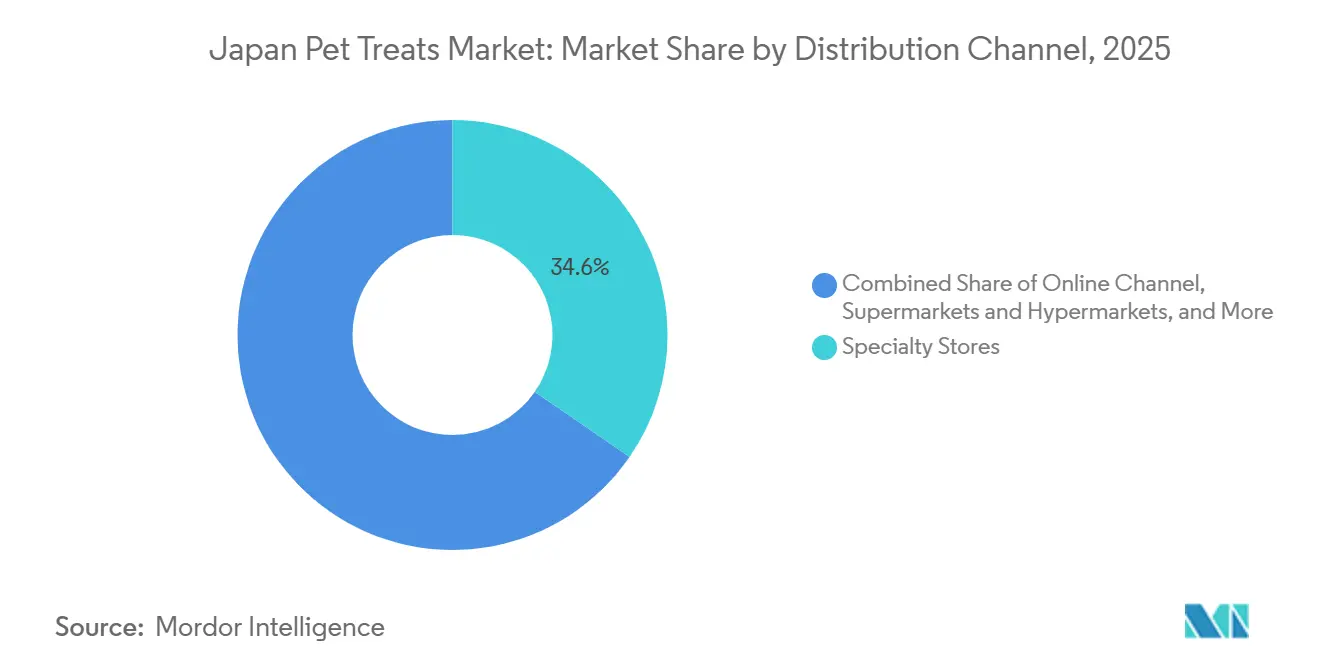
- By distribution channel, specialty stores held 34.6% share in 2025, while the online channel is projected to grow at an 8.0% CAGR through 2031.
Note: Market size and forecast figures in this report are generated using Mordor Intelligence’s proprietary estimation framework, updated with the latest available data and insights as of January 2026.
Japan Pet Treats Market Trends and Insights
Drivers Impact Analysis*
| Driver | (~) % Impact on CAGR Forecast | Geographic Relevance | Impact Timeline |
|---|---|---|---|
| Rising premiumization of pet treat purchases | +1.5% | Japan, with wider relevance across the Asia Pacific | Long term (≥ 4 years) |
| Aging pet population increasing functional treat demand | +1.2% | Japan, with similar patterns in mature pet markets | Medium term (2-4 years) |
| Shift toward clean label and limited ingredient formulations | +0.9% | Japan and premium urban corridors in the Asia Pacific | Long term (≥ 4 years) |
| Strong preference for Japanese-made and traceable products | +0.7% | Japan | Long term (≥ 4 years) |
| E-commerce replenishment and subscription behavior | +1.0% | Japan is strongest in metropolitan areas | Short term (≤ 2 years) |
| Vet recommended dental and digestive health treat adoption | +0.8% | Japan, strongest in specialist and clinical channels | Medium term (2-4 years) |
| Source: Mordor Intelligence | |||
Rising Premiumization of Pet Treat Purchases
Premiumization remains the primary value driver in the Japan pet treats market. Pet owners are increasingly choosing treats with premium ingredients, improved texture, and stronger health positioning rather than purchasing based only on price. This trend supports stronger value growth as spending per pet continues to increase despite slower growth in the pet population. Premium demand is particularly evident in dental, freeze-dried, and other functional treat categories. In March 2026, Inaba-Petfood Co., Ltd. introduced CIAO Active Churu, adding muscle and joint support benefits to its cat treat portfolio, reinforcing the growing importance of health-focused nutrition. As more products offer clear health benefits and premium quality, the Japan pet treats market is likely to continue attracting higher spending per pet from owners who increasingly view pets as family members.
Aging Pet Population Increasing Functional Treat Demand
Japan’s aging pet population is steadily shifting demand toward treats that support mobility, digestion, urinary health, and oral care. Although the overall pet population is declining, spending per pet is becoming increasingly important for market growth. Government data indicate that Japan’s dog population continues to decline, increasing demand for products that deliver greater value through health and wellness benefits. Older pets also require softer textures and more targeted nutrition, shifting consumer preference away from conventional reward treats toward products that support daily care. In January 2026, Colgate-Palmolive Company (Hill’s Pet Nutrition, Inc.) renewed its Science Diet portfolio with formulations designed to promote gut health[1]Source: Inaba-Petfood Co., Ltd., “CIAO Active Churu New Launch,” PRTimes, prtimes.jp. As a result, the Japan pet treats market continues to generate value growth through premium, health-focused products despite a declining pet population.
Shift Toward Clean Label and Limited Ingredient Formulations
Clean label demand is increasing interest in simpler formulations across the Japan pet treats market. Consumers are paying closer attention to ingredient transparency, limited additive use, and lower levels of processing when selecting pet treats. Freeze dried and jerky products align well with these preferences because they are perceived as high protein and minimally processed alternatives. Premium cat treats continue to gain momentum as consumers increasingly seek products with clear ingredient sourcing and quality positioning. In March 2026, Unicharm Corporation introduced Silver Spoon Nippon Select Kaori Crunch, a cat treat made without added colorants and using ingredients sourced from different regions of Japan. During the same month, Nippon Pet Food Co., Ltd. relaunched Vita One using natural ingredients sourced in Japan, further reflecting the industry's focus on ingredient transparency. Clean label positioning is therefore strengthening consumer trust while enabling manufacturers to support premium pricing across the Japan pet treats market.
Strong Preference for Japanese-Made and Traceable Products
Traceable domestic sourcing plays an important role in the Japan pet treats market. Product origin is widely regarded as an indicator of quality and safety, particularly when manufacturers can identify ingredients from specific regions of Japan or highlight domestic production. This provides local companies with a competitive advantage in maintaining premium positioning against imported products and private label offerings. In March 2026, Inaba-Petfood Co., Ltd. launched CIAO Tabisuru Yakikatsuo, featuring ingredients sourced from different regions of Japan. The development demonstrates that product provenance has become an important factor influencing consumer trust, willingness to pay, and repeat purchases. As a result, domestic sourcing continues to strengthen the competitive position of Japanese manufacturers in the Japan pet treats market, particularly through premium and specialty retail channels.
Restraints Impact Analysis*
| Restraint | (~) % Impact on CAGR Forecast | Geographic Relevance | Impact Timeline |
|---|---|---|---|
| Declining pet population and slower household pet formation | -1.2% | Japan, especially the urban apartment markets | Long term (≥ 4 years) |
| Premium price sensitivity in mass retail channels | -0.9% | Japan, strongest in supermarket and convenience-led sales | Short term (≤ 2 years) |
| Tightening ingredients and the additive compliance burden | -0.7% | Japan and imported supply chains serving Japan | Medium term (2-4 years) |
| Shelf space pressure from private labels and imported brands | -0.8% | Japan, strongest in mass retail and value tiers | Short term (≤ 2 years) |
| Source: Mordor Intelligence | |||
Declining Pet Population and Slower Household Pet Formation
The main structural limit on the Japan pet treats market is the decline in the pet base. Japan Pet Food Association data showed that the combined dog and cat population fell to 15.7 million in 2025 from 15.9 million in 2024[2]Source: Japan Pet Food Association, “2025 National Survey on Dog and Cat Ownership,” Japan Pet Food Association, petfood.or.jp. This trend is influenced by demographic factors such as an aging population, low birth rates, delayed household formation, and limited living space in urban areas. As a result, market growth is becoming increasingly dependent on higher spending per pet rather than growth in pet ownership. Manufacturers are responding by focusing on premium, functional, and life stage specific products that deliver greater value. Companies that continue to rely primarily on conventional, low value treat products are likely to face greater pressure as the market matures.
Premium Price Sensitivity in Mass Retail Channels
Premiumization continues to support value growth in the Japan pet treats market, although price sensitivity remains an important consideration in mass retail channels. Pet treats are purchased frequently, and consumers often compare products based on price alongside quality and functional benefits. Rising living costs have made shoppers more selective, particularly for everyday treat purchases. Growing online retail has also increased price transparency, making it easier for consumers to compare products across brands. This challenge is most evident in conventional crunchy and reward treats, where product differentiation is lower than in dental or functional categories. To maintain premium pricing, manufacturers increasingly rely on domestic sourcing, ingredient transparency, and clearly communicated health benefits. Without these value drivers, premium products may experience slower adoption outside specialty retail channels.
*Our forecasts treat driver/restraint impacts as directional, not additive. The impact forecasts reflect baseline growth, mix effects, and variable interactions.
Segment Analysis
Crunchy Treats Lead the Market While Freeze Dried and Jerky Treats Record the Fastest Growth
Crunchy treats accounted for 23.2% of the Japan pet treats market in 2025, making them the largest product segment. Their leadership is supported by broad retail availability, widespread consumer familiarity, and suitability across both value and premium price categories. Dental treats and soft and chewy treats also hold significant positions, reflecting growing demand for oral care and products designed for older pets. Other treats continue to provide opportunities for manufacturers to introduce nutritional additions, toppings, and specialized product concepts.
Freeze dried and jerky treats are projected to grow at a CAGR of 8.0% through 2031, making them the fastest growing product segment in the Japan pet treats market. Growth is driven by strong consumer demand for high protein, minimally processed, and clean label products. In March 2026, Unicharm Corporation introduced Silver Spoon Nippon Select Kaori Crunch, highlighting Japanese sourced ingredients and a formulation without added colorants. During the same month, Nippon Pet Food Co., Ltd. relaunched Vita One with natural ingredients sourced in Japan, reinforcing the industry's focus on ingredient transparency and premium product positioning.



By Pets: Dog Ownership Anchors Volume, While Cat Treats Command Faster Growth
Dogs accounted for 55.8% of the Japan pet treats market in 2025, making them the largest pet segment. Their leadership is supported by a broad range of usage occasions, including training, rewards, dental care, and functional nutrition. Dog treats also benefit from extensive distribution across specialty stores, supermarkets, and veterinary channels. Other pets continue to represent a relatively small share of the market, with demand concentrated in specialty retail.
Cats are projected to grow at a CAGR of 7.8% through 2031, making them the fastest-growing pet segment in the Japan pet treats market. Growth is driven by increasing demand for premium cat nutrition and functional treats that support overall health and wellness. The rising availability of liquid treats, soups, and other health-focused products continues to accelerate premiumization and strengthen consumer preference for value-added cat treats across the market.
By Distribution Channel: Specialty Retail Leads, but Online is the Structural Disruptor
Specialty stores accounted for 34.6% of the Japan pet treats market in 2025, making them the largest distribution channel. Their leadership is supported by a broad assortment of premium products, expert in-store guidance, and stronger availability of specialized pet treats than general retail channels. Supermarkets and hypermarkets continue to serve as important outlets for routine purchases, while convenience stores mainly support immediate and impulse buying. Veterinary clinics and other niche outlets remain smaller in scale but play an important role in the distribution of functional and clinically positioned products.
The online channel is projected to grow at a CAGR of 8.0% through 2031, making it the fastest-growing distribution channel in the Japan pet treats market. Digital retail supports convenient repeat purchases of standardized products while expanding access to premium assortments. The increasing popularity of subscription services, multipack offerings, and premium cat treats continues to strengthen online sales, supporting the long-term expansion of e-commerce in the Japan pet treats market.
Geography Analysis
Japan is a mature market where growth is driven primarily by higher spending per pet rather than increasing pet ownership. Demand for premium pet treats is concentrated in major metropolitan areas including Greater Tokyo, Osaka Kobe Kyoto, and Nagoya, where specialty retail networks and digital commerce are well developed. These markets also provide an ideal environment for launching premium and functional pet treat products.
Urban cat ownership is increasingly shaping demand across the Japan pet treats market. Apartment living and smaller household sizes continue to support cat ownership, driving demand for liquid, soup, and functional cat treats in major cities. Rural and semi rural regions continue to generate stable demand for dog treats, particularly products used for rewards and outdoor activities. This difference in consumer behavior has encouraged stronger adoption of online subscriptions in metropolitan areas, while supermarkets, hypermarkets, and convenience stores remain the primary distribution channels in other regions.
Japan also remains an important importer of pet food products, while domestic manufacturers continue to differentiate through Japanese sourced ingredients, product traceability, and high quality standards. Regulatory developments have further strengthened requirements for product quality and compliance, increasing the importance of trusted domestic manufacturing. As manufacturers continue to invest in product quality, safety, and premium positioning, the Japan pet treats market is likely to sustain strong demand for locally produced, high value pet treat products.
Competitive Landscape
The Japan pet treats market remained moderately concentrated in 2025, with the top five companies accounting for a significant market revenue share. Unicharm Corporation held the leading position, supported by its broad distribution network and product portfolio spanning mass, premium, and functional segments. Mars, Incorporated and Nestlé S.A. (Purina) maintained strong market positions through established global brands and extensive product offerings. Inaba-Petfood Co., Ltd. continued to strengthen its presence through the CIAO Churu brand and its specialization in cat treats. Domestic manufacturers such as DoggyMan H.A. Co., Ltd. and Petline Co., Ltd. also remain competitive through long standing retail relationships and products developed specifically for the Japanese market.
Competition is increasingly focused on functional nutrition, product quality, and stronger retail positioning rather than simple flavor innovation. In March 2026, Petline Co., Ltd. launched Kaiseki Kenbi and Kaiseki Saizen, strengthening its premium and functional dog treat portfolio. In September 2025, Unicharm Corporation began full operations at its pet food manufacturing facility in China, reinforcing production capacity and supply chain efficiency[3]Source: Asia Nikkei, “Unicharm Eyes Growth in China’s Pet Food Market With New Local Plant,” Nikkei Asia, asia.nikkei.com. In January 2026, AIXIA Corporation renewed its MiawMiaw product range, further strengthening its premium pet nutrition portfolio.
Competition in the Japan pet treats market is increasingly centered on functional products that can succeed across both specialty and mainstream retail channels. Larger companies are better positioned to meet evolving regulatory and quality requirements because of their greater technical and financial resources. Smaller manufacturers continue to compete through Japanese sourcing, ingredient transparency, and products tailored to specific life stages. As a result, leading companies are increasingly differentiating through health benefits, product quality, and consumer trust rather than price competition alone.
Japan Pet Treats Industry Leaders
Unicharm Corporation
Mars, Incorporated
Inaba-Petfood Co., Ltd.
Nestlé S.A. (Purina)
Colgate-Palmolive Company (Hill's Pet Nutrition, Inc.)
- *Disclaimer: Major Players sorted in no particular order

Recent Industry Developments
- May 2026: Mars, Incorporated partnered with Big Idea Ventures to launch the Global Pet Food Innovation Program, accelerating the development of sustainable ingredients and supporting innovation in Japan's premium pet treats segment.
- April 2026: Inaba-Petfood Co., Ltd. introduced CIAO Churu Soup in a cup format, expanding its functional cat treat portfolio with hydration focused products and creating additional consumption occasions beyond traditional snacking.
- March 2026: Inaba-Petfood Co., Ltd. launched CIAO Active Churu, expanding its functional cat treat portfolio with muscle and joint health benefits, strengthening the premium wellness segment for senior cats.


Japan Pet Treats Market Report Scope
Pet treats are commercial food products formulated specifically for pets. They are not designed to provide complete and balanced nutrition but are intended for occasional feeding as rewards, during training, or for enjoyment. As a subset of pet food, these treats are typically made from ingredients such as meat, grains, or vegetables and should be offered in moderation to maintain a balanced diet.
The Japan pet treats market report is segmented by sub-product (dental treats, crunchy treats, soft and chewy treats, freeze-dried and jerky treats, and other pet treats), by pets (cats, dogs, and other pets), and by distribution channel (convenience stores, online channel, specialty stores, and more). The market forecasts are provided in terms of value (USD) and volume (metric tons).
| Crunchy Treats |
| Dental Treats |
| Soft and Chewy Treats |
| Freeze-Dried and Jerky Treats |
| Other Treats |
| Dogs |
| Cats |
| Other Pets |
| Specialty Stores |
| Online Channel |
| Convenience Stores |
| Supermarkets and Hypermarkets |
| Other Distribution Channels |
| By Sub Product | Crunchy Treats |
| Dental Treats | |
| Soft and Chewy Treats | |
| Freeze-Dried and Jerky Treats | |
| Other Treats | |
| By Pets | Dogs |
| Cats | |
| Other Pets | |
| By Distribution Channel | Specialty Stores |
| Online Channel | |
| Convenience Stores | |
| Supermarkets and Hypermarkets | |
| Other Distribution Channels |


Key Questions Answered in the Report
What is the current size of the Japan pet treats market?
The Japan pet treats market stands at USD 545.5 million in 2026.
Why is growth in Japan pet treats staying positive despite a falling pet population?
Growth is being supported by higher spending per pet, premiumization, functional health positioning, and wider e-commerce access, which are offsetting slower volume growth.
Which pet category is driving the fastest growth in Japan?
Cats are the fastest-growing pet segment with a projected 7.8% CAGR through 2031, helped by urban living patterns and strong innovation in liquid and functional treats.
Which product type leads sales and which one is growing the fastest?
Crunchy treats held the largest share at 23.2% in 2025, while freeze-dried and jerky treats are projected to grow the fastest at an 8.0% CAGR.
What are the biggest risks for suppliers in Japan?
The main risks are a shrinking pet base, price sensitivity in mass retail, tighter ingredient and additive compliance rules, and stronger shelf pressure from imported and private-label products.
Page last updated on:





