
Japan Pet Grooming Services Market Size and Share
Market Overview
| Study Period | 2022 - 2032 |
|---|---|
| Forecast Data Period | 2027 - 2032 |
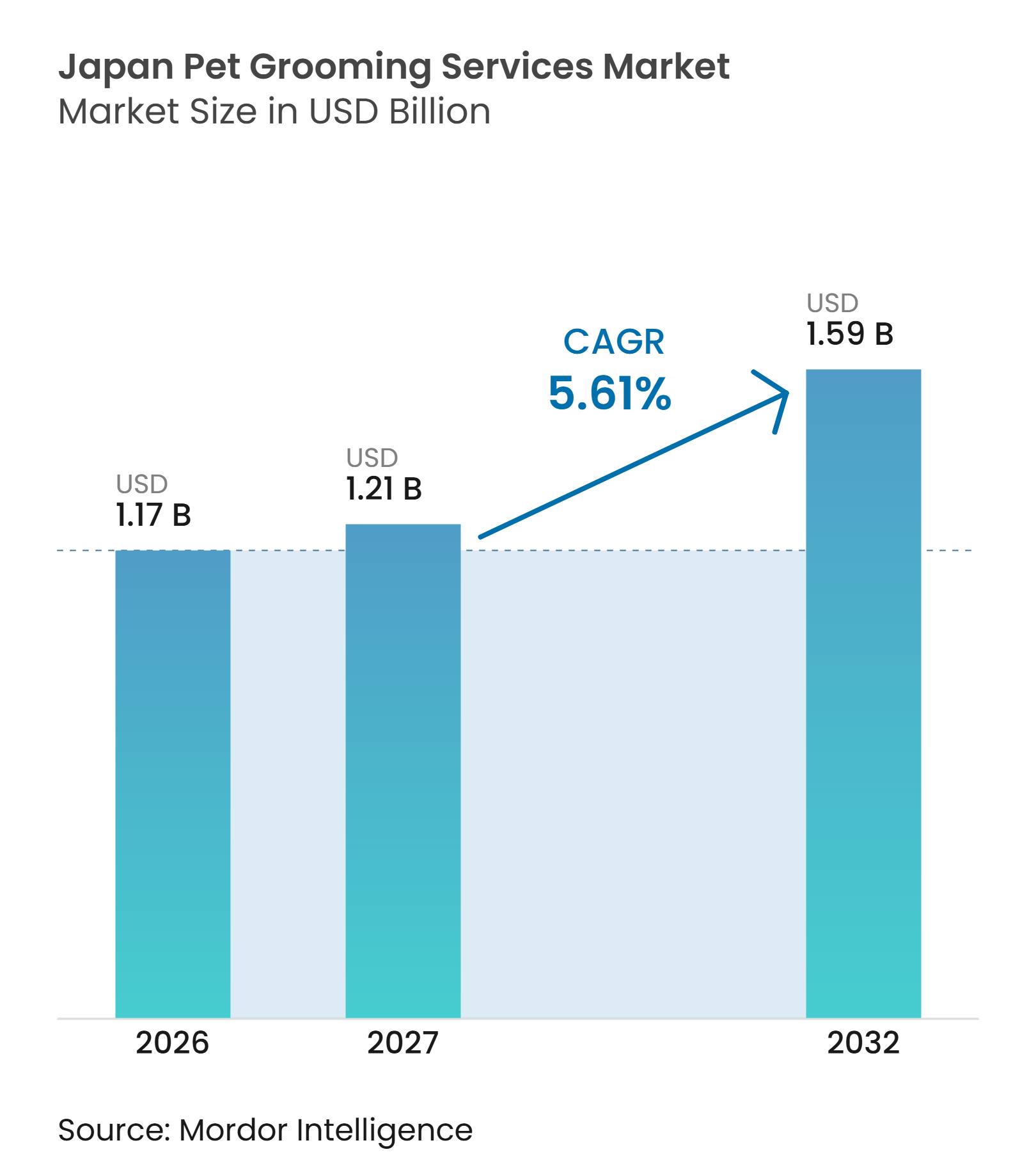
| Base Year Market Size (2026) | USD 1.17 Billion |
| Market Size (2027) | USD 1.21 Billion |
| Market Size (2032) | USD 1.59 Billion |
| Growth Rate (2027 - 2032) | 5.61 % |
| Market Concentration | Low |
Major Players *Disclaimer: Major Players sorted in no particular order Image © Mordor Intelligence. Reuse requires attribution under CC BY 4.0. | |
Japan Pet Grooming Services Market Analysis by Mordor Intelligence
The Japan pet grooming services market size was valued at USD 1.17 billion in 2026 and is estimated to grow from USD 1.21 billion in 2027 to reach USD 1.59 billion by 2032, at a CAGR of 5.61% during the forecast period (2027-2032). Growth in the Japan pet grooming services market depends more on spending per existing pet than on new pet ownership, as the dog population has declined while household spending on pet care has remained resilient. Japan had 6.82 million dogs and 8.847 million cats in 2025, and the combined pet population exceeded the country’s 13.6 million children aged under 15[1]. In 2025, dog-owning households spent JPY 18,041 (USD 115.50) per month on pet-related categories, while cat-owning households spent JPY 11,865 (USD 75.96). This spending pattern supports demand for recurring coat care, health-oriented services, and convenient booking formats. Operators are expanding services through veterinary partnerships, pet retail integration, and cat-specific facilities, creating additional ways to serve owners without relying on higher pet ownership rates.
Key Report Takeaways
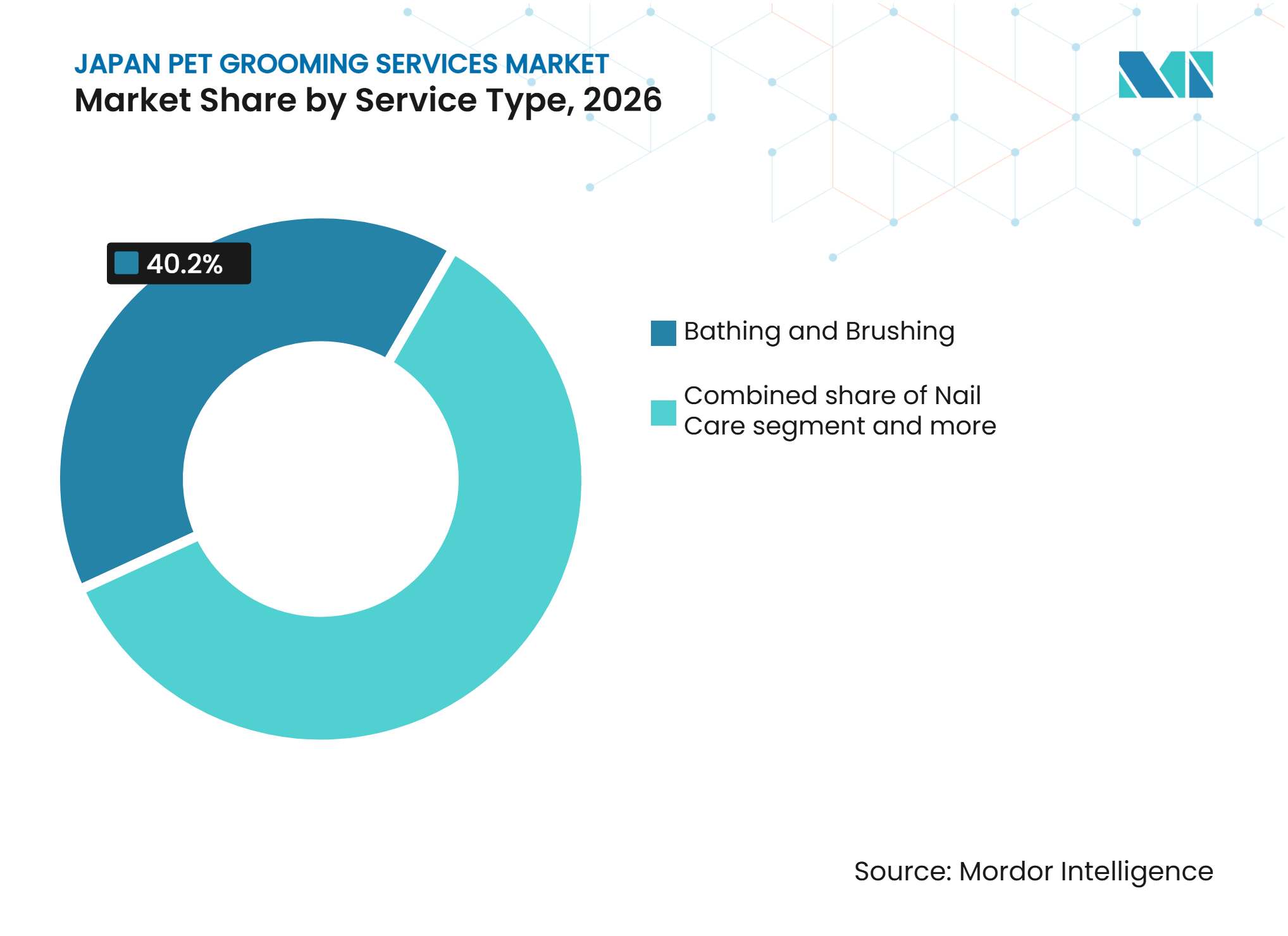
- By service type, Bathing and Brushing accounted for 40.20% of the Japan pet grooming services market share in 2026, while Specialized Skin, Coat, and Spa Treatments are projected to grow at a 6.20% CAGR through 2032.
- By pet type, Dogs accounted for 92.10% of the Japan pet grooming services market share in 2026, while Cats are projected to grow at a 7.10% CAGR through 2032.
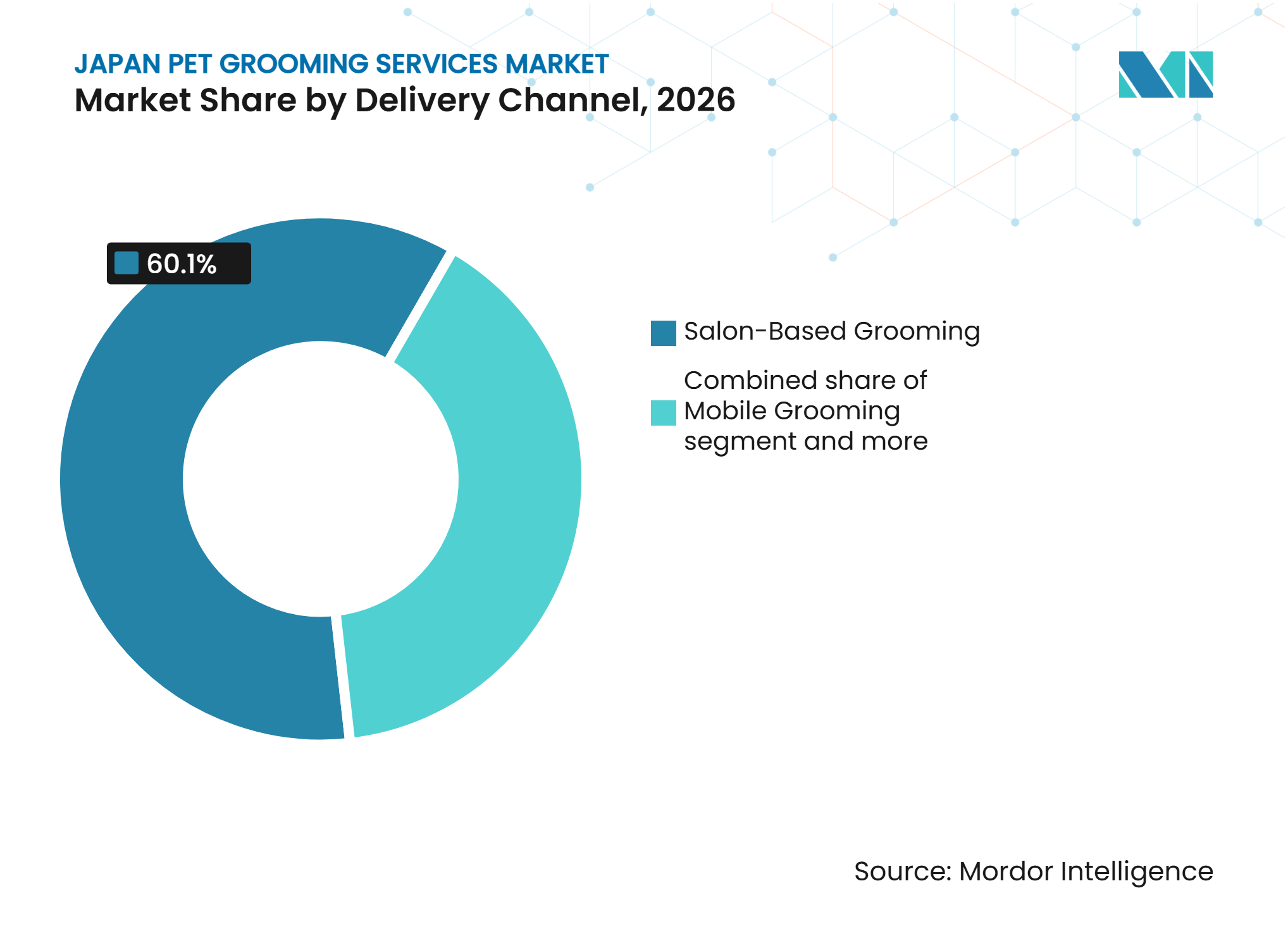
- By delivery channel, Salon-Based Grooming accounted for 60.10% of the Japan pet grooming services market share in 2026, while At-Home Grooming is projected to grow at a 6.90% CAGR through 2032.
- By region, Kanto accounted for 41.30% of the Japan pet grooming services market share in 2026 and is projected to grow at a 5.90% CAGR through 2032.
Note: Market numbers in this report are based on Mordor Intelligence's proprietary estimation framework, which combines nine months of actuals with Q4 projections for base year 2026.
Market Trends and Insights
Drivers Impact Analysis of Japan Pet Grooming Services Market*
| Driver | (~) % Impact on CAGR Forecast | Geographic Relevance | Impact Timeline |
|---|---|---|---|
| Demand for Regular Coat Maintenance Among Popular Small and Long-Haired Dog Breeds | +1.2% | National, with high concentration in Kanto and Kansai urban cores | Short term (≤ 2 years) |
| Rising Need for Grooming Services for Aging Companion Animals | +1.0% | National, with early gains in Kanto, Kansai, and suburban areas of Chubu | Medium term (2-4 years) |
| Growing Demand for Premium Styling and Breed-Specific Grooming | +0.9% | Urban metropolitan areas including Tokyo, Osaka, and Nagoya | Medium term (2-4 years) |
| Expansion of Grooming Services Across Pet Salons and Veterinary Facilities | +0.8% | National, with spillover from Kanto and Kansai to regional cities | Medium term (2-4 years) |
| Increasing Grooming Costs Supporting Higher Revenue per Appointment | +0.6% | National | Short term (≤ 2 years) |
| Growth in Registered Pet-Service Businesses and Local Grooming Availability | +0.5% | National, with suburban and secondary cities gaining | Long term (≥ 4 years) |
| Source: Mordor Intelligence | |||
Demand for Regular Coat Maintenance Among Popular Small and Long-Haired Dog Breeds
Breed composition remains a source of recurring demand in the Japan pet grooming services market. According to J-Net21, the Small and Medium Enterprise Agency’s grooming start-up guide, toy poodles held the position of Japan’s most popular dog breed for 15 consecutive years and accounted for nearly 20% of dogs kept[2]. Their continuously growing coats require regular trimming, supporting repeat salon visits even when dog ownership remains stable. Indoor living also increases owners’ focus on coat cleanliness and hygiene. Professional salons benefit from this demand because regular grooming requires specialized tools and handling skills that many households may not have. Demand is particularly strong in urban Kanto and Kansai, where small-breed ownership, apartment living, and access to professional grooming salons are concentrated.
Rising Need for Grooming Services for Aging Companion Animals
The aging companion-animal population is changing the grooming services pet owners seek in the Japan pet grooming services market. Older pets often require gentler handling, shorter sessions, and more frequent monitoring than younger animals. This trend creates opportunities for operators that combine grooming with health checks and veterinary support. In March 2025, AEON PET introduced Medical Care Grooming at PETEMO Kitera Plaza Aobadai for pets aged 14 years and older, including health monitoring before and after grooming[3]. The Ministry of the Environment’s animal welfare framework requires commercial businesses to properly manage animals in their care, increasing the need for documented safety practices for vulnerable pets (Ministry of the Environment, Japan). Kanto, Kansai, and suburban areas of Chubu are likely to experience early adoption because these areas have more integrated pet-care formats and a larger base of users of higher-value services.
Growing Demand for Premium Styling and Breed-Specific Grooming
Specialized styling supports higher revenue per appointment in the Japan pet grooming services market. Dog-owning households spent JPY 18,041 (USD 115.50) per month on pet-related categories in 2025, indicating capacity to spend on discretionary care alongside essential services. Breed-standard styling, Asian-style cuts, and specialized coat treatments can command fees above standard grooming sessions when owners seek specific aesthetics or expert handling. Operators also increase service value through add-ons, including dental care, aromatherapy rinses, carbonated-water baths, and coat treatments. These preferences are particularly evident in Tokyo, Osaka, and Nagoya, where salons combine styling services with wellness-oriented care. Operators need to maintain consistent service quality and transparent hygiene practices rather than rely on discount-driven customer acquisition.
Expansion of Grooming Services Across Pet Salons and Veterinary Facilities
Grooming services are increasingly available within broader pet-care facilities rather than exclusively through standalone salons. As of April 2025, AEON PET operated 171 grooming salons and hotel locations, 195 pet-supply stores, and 52 animal hospitals. This network model enables operators to link grooming appointments with retail purchases, veterinary visits, and boarding services. Coo&RIKU opened an integrated pet-lifestyle store at FKD Interpark in Utsunomiya in August 2025, featuring a trimming salon, pet hotel, and veterinary clinic at one location. Integrated facilities can benefit aging pets by providing access to clinical support during grooming appointments when needed. The model is expanding from the Kanto and Kansai regions into regional cities, although local operators continue to account for a significant share of routine neighborhood demand.
Restraints Impact Analysis of Japan Pet Grooming Services Market*
| Restraint | (~) % Impact on CAGR Forecast | Geographic Relevance | Impact Timeline |
|---|---|---|---|
| Declining Long-Term Dog Ownership and a Limited New-Pet Pipeline | -0.8% | National, with the greatest effect in rural prefectures and aging regions including Hokkaido and Tohoku | Long term (≥ 4 years) |
| Shortage of Skilled Groomers and Difficulty Retaining Trained Staff | -0.7% | National, acute in secondary cities and suburban zones | Medium term (2-4 years) |
| Rising Grooming Fees and Price Sensitivity Among Pet Owners | -0.5% | National, with higher sensitivity outside Kanto and Kansai | Short term (≤ 2 years) |
| High Operating Costs and Limited Space for Grooming Salons in Dense Urban Areas | -0.4% | Urban Kanto and Kansai, particularly Tokyo and central Osaka | Medium term (2-4 years) |
| Source: Mordor Intelligence | |||
Declining Long-Term Dog Ownership and a Limited New-Pet Pipeline
The Japan pet grooming services market faces a long-term volume constraint because dog ownership has not expanded. The country had 6.82 million dogs in 2025, while cat ownership reached 8.847 million, highlighting the need for service formats that cater to both cats and dogs[4]. The association also reported that 75.2% of households did not own a pet in 2025. A smaller base of new dog owners’ limits operators’ ability to rely solely on new household adoption for growth. Higher spending by existing pet owners can support revenue growth but may not fully offset the volume benefits of an expanding pet population. This constraint is likely to be more pronounced in rural and aging prefectures, where demographic pressures are greater and service networks are less developed.
Shortage of Skilled Groomers and Difficulty Retaining Trained Staff
A shortage of skilled groomers limits the number of appointments salons can offer. According to J-Net21, the public small-business support guide, the Japan Kennel Club qualification system uses a five-level technical framework but has no mandatory legal status. Consequently, service quality can vary among operators and locations. J-Net21 also identifies compensation and career advancement as ongoing barriers to attracting and retaining trimmers. Salons respond through nomination fees, commissions, and specialized service add-ons, but these measures do not fully address retention challenges. The issue is particularly acute in suburban and secondary-city markets, where small teams can quickly constrain service capacity.
*Our forecasts treat driver/restraint impacts as directional, not additive. The impact forecasts reflect baseline growth, mix effects, and variable interactions.
Consumer Preferences & Spending Patterns
Japanese pet owners prioritize trust, convenience, hygiene, and groomer handling skills because grooming involves repeat visits and direct contact with pets. Average grooming fees rose from JPY 6,131 (USD 39.25) in 2019 to JPY 6,989 (USD 44.74) in 2024, a 14% increase, highlighting the need for transparent pricing and clear service value. Broader pet-related household spending data from the Japan Pet Food Association does not represent grooming-specific expenditure. Salons can improve retention through convenient locations, clear service menus, predictable appointments, and consistent service quality rather than discounts.
Rising pet-care expenditure and limited grooming-salon adoption shape demand. Anicom’s 2024 spending survey reported average annual expenditure of JPY 414,159 (USD 2,651.43) per dog-owning household and JPY 178,418 (USD 1,142.23) per cat-owning household, up 22.3% and 5.4% year on year, respectively. A separate J-Net21 survey of 1,000 respondents found that 7.0% currently used pet salons, while 9.9% expressed future usage intent. Higher pet-care spending does not necessarily increase grooming demand. Salons can support growth by communicating hygiene benefits, offering transparent service packages, and attracting owners who groom pets at home.
Service Market Performance Intelligence
Japan’s average pet-grooming charge was JPY 6,989 (USD 44.74) per visit in 2024, providing a benchmark for salon pricing. Coo&RIKU’s published grooming tariffs differentiated prices by breed and treatment, reflecting variations in coat-maintenance requirements and labor time. This pricing structure created opportunities for salons to increase revenue through specialized trimming and de-matting services, provided they disclosed fees upfront. Regular appointments also helped owners maintain pets’ coat condition while supporting predictable salon demand.
PIXIS launched its GrooMe! mobile-grooming matching platform in July 2025 and reported more than 1,000 members, an 89% repeat rate, and 91% average customer satisfaction within six months. Mynavi Corporation introduced a salon-facing version of HugWag in October 2025, featuring groomer profiles to improve owner–salon matching. These developments highlighted the importance of digital discovery and trust-building for independent salons. However, repeat bookings depend on groomers’ availability and consistent service quality, not platform visibility alone.
Japan Pet Grooming Services Market Segment Analysis
By Service Type:
Recurring Basics Anchor Revenue, Treatments Define GrowthBathing and Brushing accounted for 40.20% of the Japan pet grooming services market share in 2026. Small and long-haired dog breeds drive recurring demand for these services. Regular bathing and brushing support skin hygiene, coat condition, and loose-hair removal in indoor environments. Hair Cutting and Styling is another major service area, as owners seek breed-appropriate maintenance and appearance. Nail Care and Ear, Eye, and Oral Hygiene are common add-ons, often included in full-grooming packages. These services support routine salon visits and cash flow.
Specialized Skin, Coat, and Spa Treatments are projected to grow at a 6.20% CAGR through 2032, the highest among service types. This category includes therapeutic bathing, medicated shampoos, dermatological rinses, and wellness-focused coat treatments. Aging pets and preventive-care preferences support demand. The Japan Pet Food Association’s 2025 survey reflects increased recurring pet-care spending. These services require trained staff and suitable facilities. The Act on Welfare and Management of Animals reinforces the need for structured service settings.



By Pet Type:
Dogs Dominate, Cats Represent the Structural OpportunityDogs accounted for a 92.10% share of the Japan pet grooming services market in 2026, driven by the high grooming needs of the country’s small, indoor-living dog population. Japan had 6.82 million dogs in 2025, including breeds requiring professional coat care every one to two months. Repeat visits support service revenue despite limited dog population growth. Professional salons provide the equipment and expertise needed for coat trimming and hygiene care. Dogs will remain the main source of recurring grooming demand.
Cats are projected to grow at a 7.10% CAGR through 2032, making them the fastest-growing pet type. Japan had 8.847 million cats in 2025, creating a sizable customer base for feline grooming services. Cat grooming requires quiet settings, specialized handling, and stress-reduction methods. AEON PET piloted dedicated cat-grooming services across 15 stores in November 2024. Birds, small mammals, and other pets represent a smaller, stable service segment, typically served by specialist boutiques. Cat-focused infrastructure presents the main opportunity beyond dog grooming.
By Delivery Channel:
Salons Led, At-Home Services Redefine ConvenienceSalon-Based Grooming accounted for a 60.10% share of the Japan pet grooming services market in 2026. Fixed salons provide specialized equipment, drying areas, and professional environments for breed-specific and complex grooming. Customers use appointment-based care and can access multiple services in one visit. Integrated facilities combine grooming with retail, hotel, and veterinary services. AEON PET’s network links grooming appointments with other pet-related purchases and services. Salon-based providers remain important for recurring basic grooming and specialized treatments.
At-Home Grooming is projected to grow at a 6.90% CAGR through 2032, the fastest among delivery channels. It serves dual-income households, elderly pet owners, and customers unable to transport pets to salons. PIXIS launched GrooMe! in July 2025, connecting customers with mobile trimming services in Tokyo’s 23 wards, Kanagawa, and Saitama. Mobile and at-home services improve access in suburban areas and provide familiar settings for pets sensitive to travel. Growth depends on trained groomers, safe transportation, and sound operating practices.

Geography Analysis
Kanto accounted for 41.30% of Japan's pet grooming services market revenue in 2026 and is forecast to grow at a CAGR of 5.90% through 2032. Its concentration of single-person and dual-income households supports demand for convenient, scheduled pet care. The region also has an established network of pet retailers, veterinary clinics, and grooming providers. AEON PET opened PETEMO Kitera Plaza Aobadai in Kanagawa in March 2025 and introduced Medical Care Grooming for pets aged 14 years and above. GrooMe! operates in Tokyo's 23 wards, Kanagawa, and Saitama, reflecting the development of mobile matching models in dense urban areas.
National animal welfare regulations support providers that demonstrate safe handling and well-managed facilities. Kansai remains a key urban demand center, supported by Osaka's commercial base and diverse providers. Independent salons benefit from demand for proximity, specialist skills, and trusted groomer relationships. Osaka and Kyoto support specialized styling, while commuter areas generate demand for routine maintenance. Integrated models link grooming with retail, boarding, and clinical care. Cat-specific services may gain attention as operators expand feline-focused infrastructure. National standards for first-category animal handling businesses provide a compliance baseline. Chubu combines suburban demand with Nagoya's organized pet-care base. AEON PET renovated PETEMO mozoWonderCity in April 2025, adding cat-specific grooming capacity. Hokkaido, Tohoku, and smaller regional communities may rely on local, at-home, and mobile services to reduce travel requirements.
Service Provider Network & Expansion Intelligence
Japan’s pet grooming network comprises integrated chains and independent salons. AEON PET operates 150 grooming salons, 191 pet supply stores, and 42 animal hospitals, enabling cross-service referrals and access to complementary pet care services. The Japan Pet Salon Association lists 1,158 member stores nationwide, highlighting the role of independent operators. This structure allows chains to use retail and veterinary networks, while smaller salons compete through neighborhood access and specialized grooming services.
Japanese grooming chain Eyes Dog reported 20 company-owned and franchised salons across eight prefectures in October 2026 and sought additional franchise partners, including veterinary clinic operators and existing business owners. This model can reduce reliance on standalone premises and expand coverage through local partnerships. For independent salons, franchising offers a route to broader reach, although consistent service quality across locations remains essential.
Competitive Landscape
Market Concentration
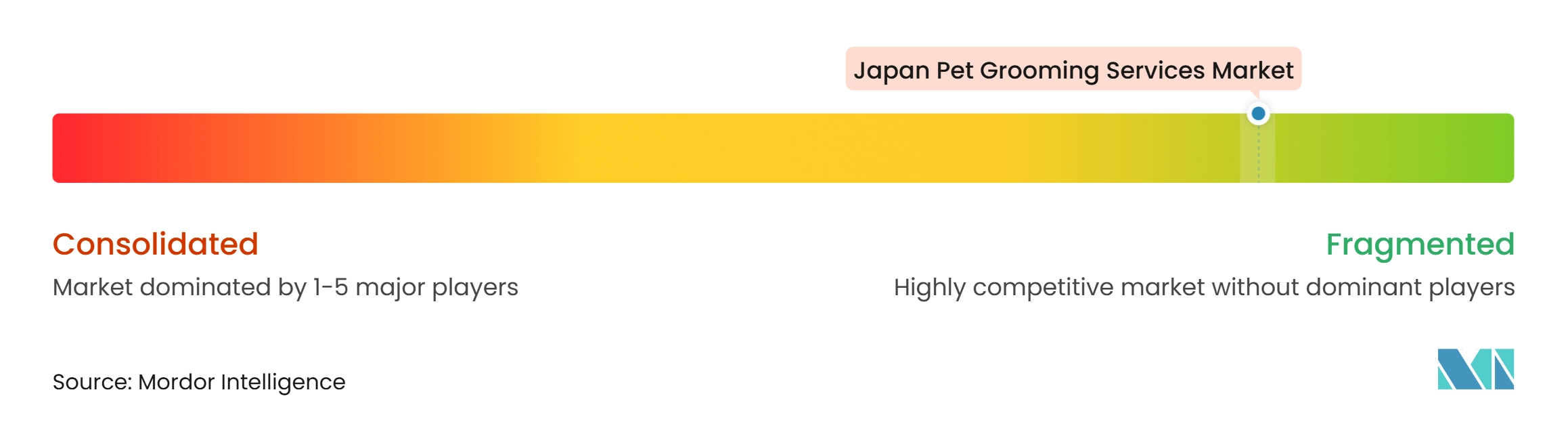
Japan’s pet grooming services market remains highly fragmented, with no operator holding a dominant nationwide revenue share. AEON PET, Coo&RIKU, AHB, Amigo, and Cainz compete through service coverage, geographic reach, and operating formats rather than a common price-led model. AEON PET combines grooming, veterinary care, and retail services through 171 grooming salons and hotel locations and 52 animal hospitals. In May 2025, it opened A-LOVE by PETEMO Urayasu Horie, its first franchise grooming salon. This model enables independent trimmers to operate under an established brand and service methodology. Its S-Grooming approach emphasizes handling, sanitation, and stress reduction.
Coo&RIKU competes through an extensive physical footprint and integrated services. In August 2025, it opened a facility at FKD Interpark in Utsunomiya, combining a trimming salon, pet hotel, and veterinary clinic. The company publishes breed-specific trimming prices, providing clear information on service scope and fees. Mid-sized operators, including P’s-first, Haruz, and THE DOG COMPANY focus on specialized formats, luxury positioning, or boutique services. Local specialists can retain customers through breeding expertise, relationships with individual trimmers, service quality, and convenient access.
Digital tools also influence competition. Mynavi Corporation’s HugWag enables businesses to display trimmer profiles and improve matching with pet owners, while PIXIS’s GrooMe! supports mobile grooming discovery and repeat use. Registration and animal-management standards set by the Ministry of the Environment create compliance requirements for operators. Medically supervised senior grooming, digital subscription packages, and suburban mobile grooming remain areas for differentiation. In this fragmented market, execution in these areas can matter more than national scale.
Japan Pet Grooming Services Industry Leaders
-
AEON PET Co., Ltd.
-
Coo&RIKU Co., Ltd.
-
AHB Co., Ltd.
-
Kohnan Shoji Co., Ltd.
-
Cainz Corporation
- *Disclaimer: Major Players sorted in no particular order
Japan Pet Grooming Services Market Companies Covered in this Report
- AEON PET Co., Ltd.
- Coo&RIKU Co., Ltd.
- AHB Co., Ltd.
- Kohnan Shoji Co., Ltd.
- Cainz Corporation
- Amigo Co., Ltd.
- Joyful Honda Co., Ltd.
- Petland Co., Ltd.
- P's-first Co., Ltd.
- Haruz Corporation Co., Ltd.
- THE DOG COMPANY Inc.
- I One Co., Ltd.
- LOVE WOOF Holdings Co., Ltd.
- G&P Nomura Co., Ltd.
- Hospitality & Partners Inc.
- Sopra Ginza Co., Ltd.
- Kowa Pets Co., Ltd.
- Tezukayama Houndcom Co., Ltd.
- Japan Pet Hotel Association Co., Ltd.
- Amour Co., Ltd.
Recent Industry Developments in Japan Pet Grooming Services Market
- November 2026: Coo&RIKU selected UNIPET’s Artificial Intelligence (AI)-enabled booking and customer-management system for rollout across all its grooming operations after a nearly two-year trial. Four pilot stores recorded 316 additional monthly bookings combined, indicating potential to improve appointment scheduling and grooming capacity.
- October 2026: One Co., Ltd. (Eyes Dog) operates approximately 20 company-owned and franchised salons across eight prefectures in Japan and continues to seek franchise partners. Its expansion model includes salons within veterinary clinics and other existing businesses, supporting wider geographic coverage through established premises.
- August 2025: Coo&RIKU opened a new integrated pet-lifestyle store at FKD Interpark in Utsunomiya, Tochigi, featuring a trimming salon, pet hotel, and veterinary clinic on a single site, extending the chain’s full-service model into a regional city.
- May 2025: AEON PET Co., Ltd. launched A-LOVE (byPETEMO) Urayasu Horie as the brand’s first franchise grooming salon, directly supporting the company’s stated goal of enabling independent trimmers to run grooming businesses under an established brand and methodology.
Japan Pet Grooming Services Market Report Scope
The Japan pet grooming services market report analyzes professional grooming services for pets across Japan. The market is segmented by service type, pet type, delivery channel, and region. The study examines key drivers, including regular coat maintenance for popular small and long-haired dog breeds, grooming needs of aging companion animals, demand for premium styling and breed-specific services, expansion across pet salons and veterinary facilities, rising grooming costs, and growth in registered pet-service businesses. It also assesses restraints such as declining long-term dog ownership, a limited new-pet pipeline, shortages of skilled groomers, price sensitivity, high operating costs, and limited salon space in dense urban areas. The report evaluates service-provider networks, geographic expansion, service pricing, customer acquisition, marketing costs, consumer preferences, service adoption, and spending patterns. It provides market size and growth forecasts, competitive landscape analysis, market concentration, market share assessment, strategic developments, and profiles of leading grooming service providers. It also explores opportunities in specialized grooming for senior pets and those with sensitive skin, subscription-based grooming packages, repeat-service programs, and other unmet customer needs. Market estimates and forecasts are presented in value (USD) across all covered segments.
Segmentation Overview
Key Questions Answered in the Report
What is the projected value of Japan pet grooming services by 2032?
The Japan pet grooming services market is projected to reach USD 1.59 billion by 2032, growing at a 5.61% CAGR from 2027 to 2032.
Which service category leads pet grooming revenue in Japan?
Bathing and Brushing led the Japan Pet Grooming Services Market with a 40.20% revenue share in 2026, driven by recurring coat-maintenance needs and repeat grooming visits.
Why are cat grooming services expanding in Japan?
Cats are the fastest-growing pet type at a 7.10% CAGR through 2032, and operators are adding quieter spaces and specialist handling for Japan’s 8.847 million cats in 2025.
What is driving at-home grooming adoption in Japan?
At-Home Grooming is projected to grow at a 6.90% CAGR through 2032 because it serves busy, elderly, and travel-constrained owners.
Which region leads in grooming demand and growth?
Kanto accounted for 41.30% of revenue in 2026 and is projected to grow at a 5.90% CAGR through 2032, supported by dense urban demand and integrated providers.
How fragmented is the competitive environment?
The market remains highly fragmented, with no operator holding a dominant nationwide revenue share, while chains and local specialists compete across many formats.