
Japan Hydraulic Presses Market Size and Share
Market Overview
| Study Period | 2020 - 2031 |
|---|---|
| Forecast Data Period | 2026 - 2031 |
| Base Year Market Size (2025) | USD 267.80 Million |
| Market Size (2026) | USD 276.30 Million |
| Market Size (2031) | USD 323.5 Million |
| Growth Rate (2026 - 2031) | 3.20 % |
| Market Concentration | Medium |
Major Players *Disclaimer: Major Players sorted in no particular order Image © Mordor Intelligence. Reuse requires attribution under CC BY 4.0. | |
Japan Hydraulic Presses Market Analysis by Mordor Intelligence
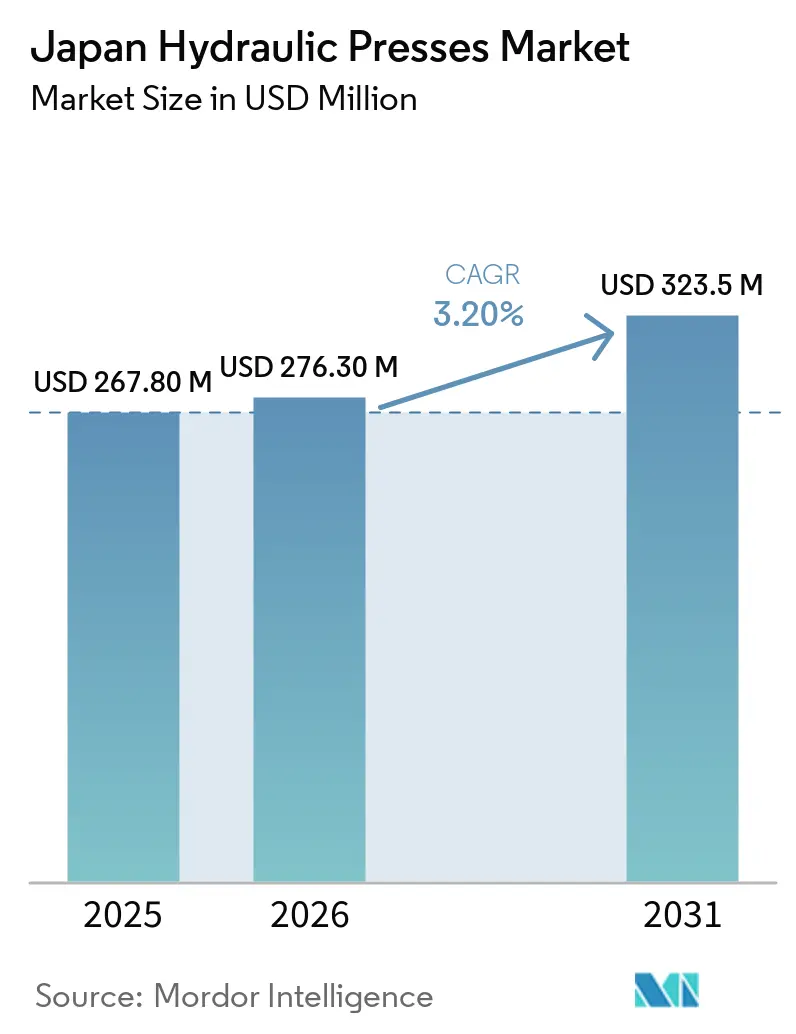
The Japan Hydraulic Presses Market size is projected to be USD 267.80 million in 2025, USD 276.30 million in 2026, and reach USD 323.5 million by 2031, growing at a CAGR of 3.20% from 2026 to 2031.
Demand is moving toward precision work for batteries, lightweight materials, and complex industrial parts, instead of higher volumes of conventional stamping. Automotive electrification, defense procurement, and replacement of aging equipment are sustaining orders despite long approval processes for capital purchases. Demand is also being supported by manufacturers seeking greater flexibility in low-to-medium-volume production, particularly for specialized components that require high forming accuracy, repeatability, and controlled force application. The increasing use of aluminum, high-strength steels, composites, and other lightweight materials is further creating opportunities for presses capable of handling different material characteristics without compromising dimensional accuracy. Equipment suppliers are responding with dedicated battery-case machines, connected controls, and retrofit packages that reduce energy use and improve safety compliance. Modernization programs are becoming particularly relevant for Japan's mature manufacturing base, where older hydraulic presses require upgrades to controls, monitoring systems, energy-efficiency components, and safety systems rather than complete replacement. This creates a secondary demand opportunity for retrofit and refurbishment services alongside new equipment sales.
Key Report Takeaways
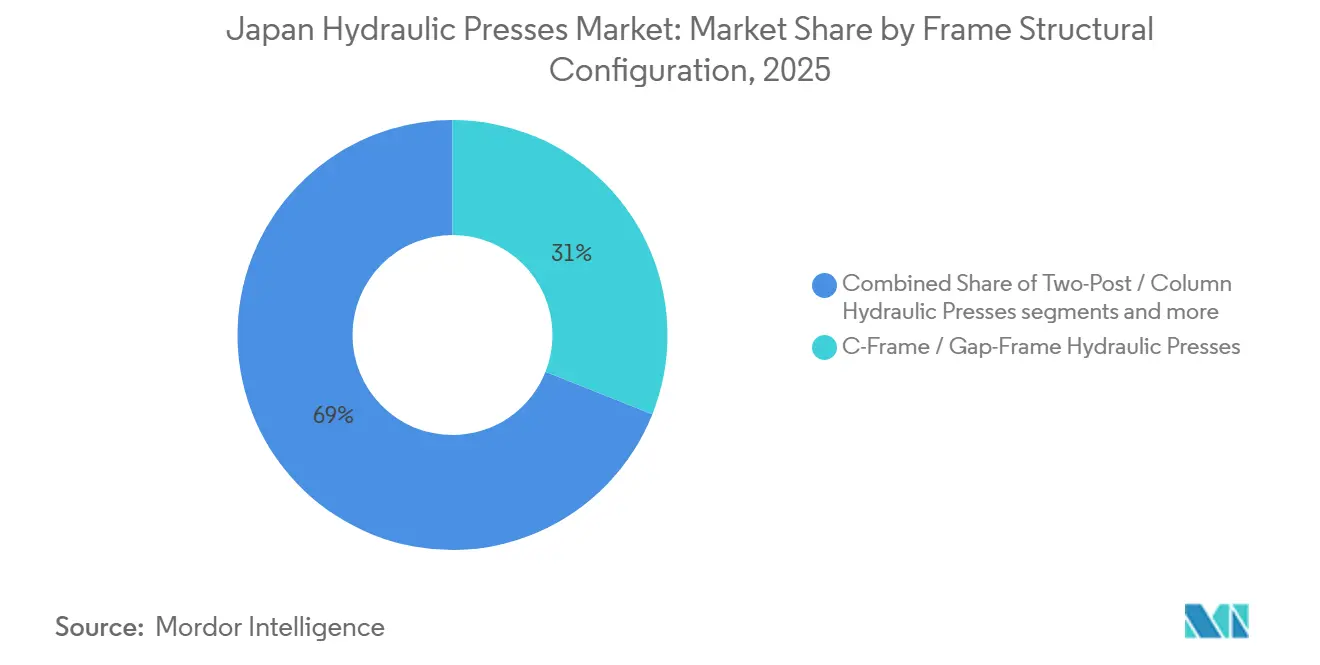
- By frame configuration, C-frame or gap-frame hydraulic presses held 31% of Japan hydraulic presses market share in 2025, while four-post or four-column hydraulic presses are forecast to grow at a 5.1% CAGR through 2031.
- By tonnage, the 101-500-ton class held 34% of the Japan hydraulic presses market size in 2025, while presses above 2,000 tons are forecast to grow at a 5.8% CAGR through 2031.
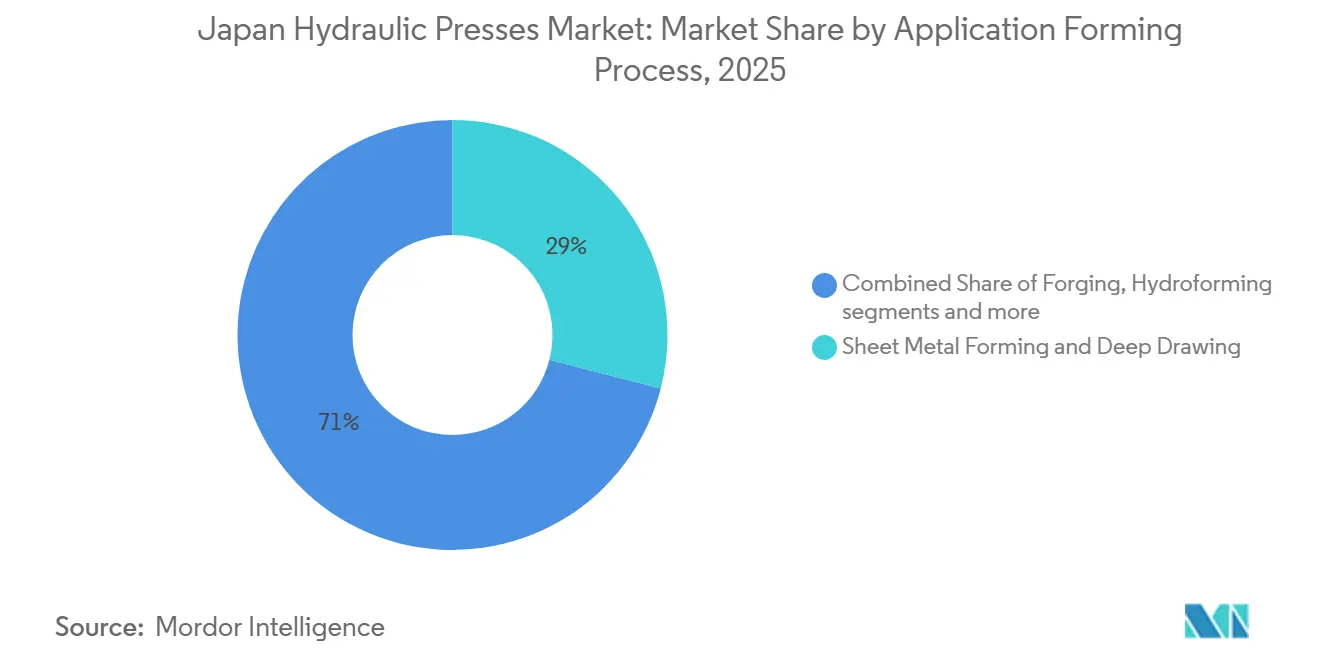
- By application, sheet metal forming and deep drawing held 29% share in 2025, while compression molding is forecast to grow at a 5.6% CAGR through 2031.
- By end-use industry, automotive and transportation held 34% share in 2025, while electrical and electronics is forecast to grow at a 5.4% CAGR through 2031.
Note: Market size and forecast figures in this report are generated using Mordor Intelligence’s proprietary estimation framework, updated with the latest available data and insights as of January 2026.
Japan Hydraulic Presses Market Trends and Insights
Drivers Impact Analysis*
| Driver | (~) % Impact on CAGR Forecast | Geographic Relevance | Impact Timeline |
|---|---|---|---|
| Electric-Vehicle Battery Case and Battery Component Forming | +1.0% | Chubu, Kyushu, and the national battery supply chain | Short term (≤ 2 years) |
| Automation, Robotics, and Connected Press Adoption | +0.8% | National, with earlier adoption in Kanto and Chubu | Medium term (2-4 years) |
| Aerospace, Defense, Shipbuilding, and Energy-Equipment Investment | +0.6% | Kansai, the Nagoya aerospace corridor, and Yokohama | Medium term (2-4 years) |
| Brownfield Press Replacement for Energy, Safety, and Controls Obsolescence | +0.5% | National, particularly Chubu, Kansai, and Kanto industrial zones | Medium term (2-4 years) |
| Precision Forming for Advanced and Lightweight Materials | +0.4% | Nagoya, Kansai, and Hokuriku composite-material areas | Long term (≥ 4 years) |
| Localized Tooling, Die, and Process Validation Networks | +0.3% | National, with clusters in Osaka, Nagoya, and Hiroshima | Long term (≥ 4 years) |
| Source: Mordor Intelligence | |||
Electric-Vehicle Battery Case and Battery Component Forming
Battery case production has become a central source of demand for deep-drawing equipment in the Japan hydraulic presses market. AIDA ENGINEERING introduced the DIS-1600 for cylindrical storage battery cases and the DPH Former for prismatic cases in June 2025. Mazda signed an agreement in September 2025 to build its Iwakuni battery module-pack plant, which targets an annual capacity of 10GWh. Nissan also committed JPY 153.3 billion (USD 1.02 billion) to an LFP battery factory in Kitakyushu, with construction beginning in fiscal year 2025 and operations planned for fiscal year 2028. Several battery projects moving into construction at the same time can concentrate orders for forming lines and place greater planning demands on equipment and tooling suppliers.
Automation, Robotics, and Connected Press Adoption
Japan has positioned automation and AI-enabled robotics as a response to manufacturing productivity gaps caused by a smaller working-age population. The Japan Robot Association reported shipments of 211,139 robots in 2025, up 16.4% from 2024, while export growth reached 28.2%. For press users, robotic handling requires controls that can coordinate the press with loading, unloading, and safety functions. AIDA’s A-1Y Hand-in-Die Collaborative Robot, launched in July 2025, was designed to work with existing general-purpose presses. This creates a practical route for factories that need automation but cannot justify replacing an entire press line. The Japan hydraulic presses market can therefore benefit from controls and automation upgrades as well as sales of new equipment.
Aerospace, Defense, Shipbuilding, and Energy-Equipment Investment
Defense and aerospace programs support demand for high-force forming equipment used for structural metal parts. Japan approved a fiscal year 2026 defense budget of JPY 9.04 trillion (USD 58 billion), as part of its multiyear defense capability program. The program sustains domestic production of aerospace and naval equipment that requires forging and heavy forming operations. These requirements favor hydraulic systems in applications that need controlled ram speed, long dwell time, or high force. Heavy presses can support hull-block work, bulkhead fabrication, and aerospace structural forging. Demand from these projects is likely to remain distinct from the shorter equipment cycles found in general manufacturing.
Brownfield Press Replacement for Energy, Safety, and Controls Obsolescence
A substantial portion of Japan’s installed hydraulic press base dates from the 2003-2010 industrial expansion. Equipment from that period now requires major work on seals, electronics, and safety systems, or replacement. The Ministry of the Environment’s 2025 SHIFT program supports factory projects that reduce carbon dioxide emissions by at least 15%, with funding caps of up to JPY 500 million (USD 3.34 million) per project.[1]Ministry of the Environment Japan, “FY2025 SHIFT Program, Factory and Business Site CO2 Reduction Acceleration Initiative,” Ministry of the Environment Japan, env.go.jp. Kawasaki Heavy Industries’ KESV servo-inverter system controls hydraulic-pump motor speed during non-pressing periods and has documented annual savings of 1,367 kWh per unit. These programs make energy audits and hydraulic modernization a viable offering alongside full-machine replacement. Suppliers that combine hardware, controls, and service can establish longer relationships with plant operators.
Restraints Impact Analysis*
| Restraint | (~) % Impact on CAGR Forecast | Geographic Relevance | Impact Timeline |
|---|---|---|---|
| High Capital Cost and Extended Investment Approval Cycles | -0.6% | National, especially SMEs in Chubu, Kansai, and regional industrial zones | Medium term (2-4 years) |
| Competition from Mechanical, Electric, Servo, and Alternative Forming Technologies | -0.5% | National, especially mid-tonnage sheet metal and electronics applications | Long term (≥ 4 years) |
| Shortage of Hydraulic, Controls, Programming and Commissioning Specialists | -0.4% | National, most acute in Hokuriku, Tohoku, and regional manufacturing areas | Medium term (2-4 years) |
| Imported Component Dependence and Cross-Border Service Delays | -0.3% | National, including hydraulic valves, seals, and precision sensors | Medium term (2-4 years) |
| Source: Mordor Intelligence | |||
High Capital Cost and Extended Investment Approval Cycles
Hydraulic press purchases are closely reviewed in manufacturing budgets, particularly among small and medium-sized enterprises. A standard 250-ton hydraulic fine-blanking press from a leading domestic supplier is priced at JPY 60 million (USD 0.40 million) to JPY 90 million (USD 0.60 million), while servo-hydraulic or IIoT-equipped versions can exceed JPY 150 million (USD 1 million). Japan Finance Corporation found that machinery and equipment represented 57.3% of planned SME investment in 2025, although firms remained cautious about their overall commitments. Many buyers wait for subsidy decisions before releasing orders, which makes demand uneven. Periodic inspection and safety-device certification also add time to procurement and replacement projects under Japan’s industrial safety requirements. The Japan hydraulic presses market is therefore exposed to delayed decisions even when factories recognize the need to upgrade equipment.
Competition from Mechanical, Electric, Servo, and Alternative Forming Technologies
Servo and direct-drive mechanical presses now address many forming tasks that previously favored conventional hydraulic equipment. AIDA has described a broad transition toward high-efficiency electric drives in large machinery and has developed servo press lines alongside its hydraulic offerings. The Japan Forming Machinery Association’s MF Eco Machine Registry includes energy-efficient forming equipment, including servo and servo-hydraulic designs.[2]Japan Forming Machinery Association, “MF Eco Machine Registry,” Japan Forming Machinery Association, j-fma.or.jp. METI’s 2025 machine parts and tooling vision also supports the adoption of new manufacturing technologies under the Green Transformation agenda. Hydraulic presses remain suited to hydroforming, hot forming, thick-plate straightening, and high-tonnage forging. However, the Japan hydraulic presses market must compete more directly for standard sheet-metal and electronics applications.
*Our forecasts treat driver/restraint impacts as directional, not additive. The impact forecasts reflect baseline growth, mix effects, and variable interactions.
Segment Analysis
By Frame / Structural Configuration: C-Frame Versatility Meets Four-Post Precision Requirements
C-frame presses held 31% of Japan hydraulic presses market share in 2025, making them the largest structural configuration. They serve broad mid-market stamping, assembly, and general-purpose work. Their open-throat layout and compact footprint suit electronics, plastics, and light-assembly operations. Users value quick die changes and flexible use across several shifts. H-frame and straight-side machines formed the next major revenue group for forging, blanking, and deep drawing. Automotive buyers favor their frame rigidity and ram parallelism for heavier-duty work.
Four-post and four-column machines are forecast to grow at a 5.1% CAGR through 2031, the fastest rate among structural configurations. Their design supports battery-case forming and composite molding, where even pressure over larger bolster areas is important. Platen parallelism matters more in these processes than the access flexibility of a C-frame. Two-post and benchtop presses continued to serve prototype rooms, maintenance areas, and small-batch specialty fabricators. These smaller formats are less exposed to broad investment cycles and provide a stable baseline demand. Safety obligations under the Industrial Safety and Health Act apply across the configuration range and add compliance cost to each equipment type.



By Tonnage / Press Force: Mid-Range Demand Remains Broad While Ultra-Heavy Presses Expand
The 101-500-ton class held 34% share of the Japan hydraulic presses market in 2025 because it serves automotive stamping, medium forging, and industrial assembly. Established tooling, die sets, and automation interfaces reduce the ownership cost of these widely used systems. The up-to-100-ton category retained steady volumes from electronics, medical devices, and precision instruments. Compact footprints and fast cycling are more important than high press force in these applications. Presses rated from 501 tons to 2,000 tons serve structural automotive work, shipbuilding, and heavy forging.
Above-2,000-ton equipment is forecast to grow at a 5.8% CAGR through 2031, the fastest rate among tonnage classes. Naval structures, landing gear, and large energy equipment require substantial forming force. These purchases are usually linked to long-term program commitments and specialized engineering requirements. JIS B 6411-3:2025 updated safety requirements for hydraulic presses in March 2025 and aligns with ISO 16092-3.[3]Japanese Industrial Standards Committee, “JIS B 6411-3:2025, Machine Tools Safety, Presses, Part 3, Safety Requirements for Hydraulic Presses,” Japanese Industrial Standards Committee, jisc.go.jp. The standard raises engineering expectations across all capacity bands. Older systems that cannot be upgraded economically may be replaced sooner, which supports demand in the highest-force categories.
By Application / Forming Process: Sheet Metal Work Provides the Base While Compression Molding Gains Use
Sheet metal forming and deep drawing held 29% share of the Japan hydraulic presses market in 2025, making it the largest application base. Automotive stamping and electronics enclosure production support use across several frames and force ranges. Body panels, battery-case lids, heat shields, and structural brackets contribute to a diverse workload. Forging represented the next major source of revenue, particularly for drivetrain and landing-gear components. Hydraulic control of speed and dwell time remains valuable for these demanding parts.
Compression molding is forecast to grow at a 5.6% CAGR through 2031, the fastest rate among forming processes. Aerospace and automotive programs adopted carbon-fiber-reinforced thermoplastic structures. NEDO supports work on high-rate CFRP molding processes for future aircraft production. Hydraulic compression presses can provide programmable dwell periods and multistage pressure profiles for those processes. Hydroforming also supported body structures and fuel-cell bipolar plates. Powder compaction and ceramic pressing remained a resilient specialty area connected to advanced materials and electronics.
By End-Use Industry: Automotive Leads Demand While Electrical and Electronics Advance Fastest
Automotive and transportation held 34% share of the Japan hydraulic presses market in 2025, making it the largest end-use sector. It uses press capacity for body panels, structural components, and cylindrical or prismatic battery cases. Toyota, Honda, Mazda, Nissan, and their supplier networks support a recurring procurement cycle. Electrification is changing the equipment required within that established production base. Electrical and electronics was the fastest-growing end-use category, driven by battery cases, fuel-cell separator plates, and semiconductor packaging components.
Electrical and electronics is forecast to grow at a 5.4% CAGR through 2031, the fastest rate among end-use industries. Aerospace and defense also require heavy forming for aircraft, missiles, and naval structures. JAMCO and Kawasaki Heavy Industries received the 2024 SAMPE Japan Product and Technology Award for thermoplastic CFRP fuselage skin-stringer technology in September 2025. Industrial machinery, plastics and composites, power equipment, rail, and marine applications provide a lower-cyclical baseline demand. Powder metallurgy and advanced materials remain high-specification niches where precision hydraulic presses compete with isostatic pressing systems.
Geography Analysis
Chubu held the largest regional position in the Japan hydraulic presses market because Aichi and the Toyota production cluster contain a dense base of stamping, forging, and assembly operations. The region is adding battery-case lines and lighter structural-component presses as electric vehicle platforms expand. Some new equipment supplements legacy internal-combustion body-panel production, while other investment replaces existing capacity. A dense tooling and die base can shorten validation cycles for new installations. METI identifies continuity in these industrial ecosystems as a national priority for higher-value manufacturing.
Kansai represented a major demand center for heavy industry, shipbuilding, and chemical-process equipment. Kobe supports large installations for heavy forging and ship-component fabrication. Daikin Industries, headquartered in Osaka, supplies servo-hydraulic power units and energy-saving drive systems to press manufacturers across Japan. This makes Kansai important to the component supply chain as well as equipment users. JIS B 6411-3:2025 creates consistent lifecycle safety expectations across its industrial base.
Kyushu was the fastest-growing regional demand node as battery investment gathered around Kitakyushu and the wider southern manufacturing corridor. Nissan’s JPY 153.3 billion (USD 1.02 billion), LFP battery project requires cell-case forming equipment as construction proceeds. Kanto supports precision instruments, electronics, research, and advanced-materials development. Hokuriku adds demand from Komatsu Ltd. Kanazawa operations and a concentrated base of precision-machining SMEs. Together, these regions extend the Japan hydraulic presses market beyond the automotive-led Chubu corridor.
Competitive Landscape
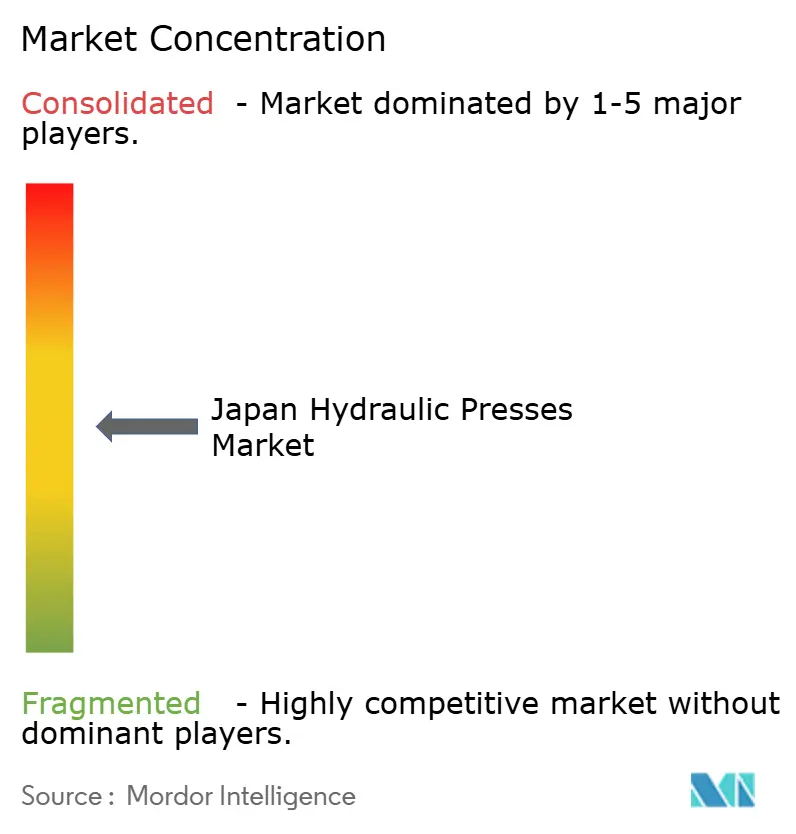
Japan's hydraulic presses market exhibits a medium level of market concentration. Japan’s domestic OEM base includes Komatsu Ltd., AIDA ENGINEERING, Amino Corporation, AMADA, and Mitsubishi Heavy Industries Machine Tool. These companies compete on controls, energy performance, application engineering, and service coverage. Their domestic service networks matter in projects that need timely commissioning and continuing support. Their process references remain relevant where specialized applications justify more complex support arrangements.
AIDA introduced dedicated DIS and DPH battery-case forming systems in June 2025, showing how suppliers are designing machines around defined cell formats. It also launched the A-1Y collaborative robot in July 2025 for factories that want automation with existing presses. Kawasaki’s KESV system illustrates the separate opportunity in energy-saving upgrades for installed hydraulic equipment. Retrofit work can pair energy monitoring with hardware modernization and planned service. This approach can increase switching costs when buyers later assess a full equipment replacement.
Open opportunities remain in modernization of older machines, battery-component forming, and connected maintenance services. These areas bring equipment suppliers closer to plant operations through condition monitoring and scheduled support. Competition remains stronger in standardized press categories where alternative technologies can meet customer requirements. Suppliers that address safety updates and energy performance can provide a clearer reason to replace older assets.
Japan Hydraulic Presses Industry Leaders
Komatsu Ltd.
AIDA ENGINEERING, LTD.
Kojima Iron Works Co., Ltd.
SANKI SEIKO CO., LTD.
Amino Corporation
- *Disclaimer: Major Players sorted in no particular order

Recent Industry Developments
- December 2025: Japan's Cabinet approved a record FY2026 defense budget of JPY 9.04 trillion, or USD 58 billion, the fourteenth consecutive record and the fourth year of a five-year buildup program, sustaining procurement of domestically manufactured aerospace and naval equipment that relies on heavy hydraulic forging and forming presses.
- September 2025: Mazda signed a formal construction agreement with Yamaguchi Prefecture and Iwakuni City for the Iwakuni Plant, a new cylindrical lithium-ion battery pack facility targeting 10GWh annual capacity, construction commenced in November 2025, generating procurement demand for battery-case deep-drawing and assembly presses.
- July 2025: AIDA ENGINEERING launched the A-1Y Hand-in-Die Collaborative Robot, designed to replace human operators in single-strike forming operations by loading material, triggering press cycles, and extracting formed parts, offering press OEM-integrated automation to plants that have not invested in dedicated robotic lines.
- June 2025: AIDA ENGINEERING launched the DIS Former, Model DIS-1600, for high-speed cylindrical storage battery case forming, incorporating an SN value 1.7 times higher than conventional presses and a mechanically synchronized transfer feeder, and the DPH Former for prismatic battery case forming, both dedicated systems targeting the expanding EV and stationary-storage cell-case market.


Japan Hydraulic Presses Market Report Scope
| C-Frame / Gap-Frame Hydraulic Presses |
| H-Frame / Straight-Side / Gib-Guided Hydraulic Presses |
| Four-Post / Four-Column Hydraulic Presses |
| Two-Post / Column Hydraulic Presses |
| Benchtop / Workshop Hydraulic Presses |
| Other Specialized Hydraulic Press Configurations |
| Up to 100 Tons |
| 101–500 Tons |
| 501–1,000 Tons |
| 1,001–2,000 Tons |
| Above 2,000 Tons |
| Sheet Metal Forming and Deep Drawing |
| Forging |
| Bending and Straightening |
| Punching, Blanking and Coining |
| Compression Molding |
| Powder Compaction |
| Hydroforming |
| Assembly, Press-Fitting and General Pressing |
| Other Specialized Applications |
| Automotive and Transportation |
| Aerospace and Defense |
| Industrial Machinery and General Manufacturing |
| Electrical and Electronics |
| Plastics, Rubber and Composites |
| Construction and Heavy Equipment |
| Energy and Power Equipment |
| Rail and Marine |
| Powder Metallurgy, Ceramics and Advanced Materials |
| Other End-Use Industries |
| By Frame / Structural Configuration | C-Frame / Gap-Frame Hydraulic Presses |
| H-Frame / Straight-Side / Gib-Guided Hydraulic Presses | |
| Four-Post / Four-Column Hydraulic Presses | |
| Two-Post / Column Hydraulic Presses | |
| Benchtop / Workshop Hydraulic Presses | |
| Other Specialized Hydraulic Press Configurations | |
| By Tonnage / Press Force | Up to 100 Tons |
| 101–500 Tons | |
| 501–1,000 Tons | |
| 1,001–2,000 Tons | |
| Above 2,000 Tons | |
| By Application / Forming Process | Sheet Metal Forming and Deep Drawing |
| Forging | |
| Bending and Straightening | |
| Punching, Blanking and Coining | |
| Compression Molding | |
| Powder Compaction | |
| Hydroforming | |
| Assembly, Press-Fitting and General Pressing | |
| Other Specialized Applications | |
| By End-Use Industry | Automotive and Transportation |
| Aerospace and Defense | |
| Industrial Machinery and General Manufacturing | |
| Electrical and Electronics | |
| Plastics, Rubber and Composites | |
| Construction and Heavy Equipment | |
| Energy and Power Equipment | |
| Rail and Marine | |
| Powder Metallurgy, Ceramics and Advanced Materials | |
| Other End-Use Industries |


Key Questions Answered in the Report
What is the projected value of the Japan hydraulic presses market by 2031?
The Japan hydraulic presses market is forecast to reach USD 323.5 million by 2031, expanding at a 3.2% CAGR from 2026.
Which applications are increasing the demand for hydraulic presses in Japan?
Battery-case forming, composite compression molding, heavy forging, hydroforming, and fuel-cell component production are in increasing demand.
Why is Kyushu becoming important for hydraulic press suppliers?
Nissan’s planned LFP battery factory in Kitakyushu is creating demand for cell-case forming equipment in the region.
What limits new hydraulic press purchases in Japan?
High equipment costs, extended approval processes, safety compliance requirements, and alternative forming technologies can delay purchases.
How are suppliers responding to workforce shortages?
Suppliers are offering robots, connected controls, and retrofit systems that reduce manual handling and support automated press operations.
Which equipment category is growing fastest by press force?
Presses above 2,000 tons are the fastest-growing force category because heavy naval, aerospace, and energy applications need high forming capacity.
Page last updated on:





