
Japan Fixed Wireless Access Market Size and Share
Market Overview
| Study Period | 2020 - 2031 |
|---|---|
| Forecast Data Period | 2026 - 2031 |
| Base Year Market Size (2025) | USD 2.71 Billion |
| Market Size (2026) | USD 3.13 Billion |
| Market Size (2031) | USD 6.10 Billion |
| Growth Rate (2026 - 2031) | 14.28 % |
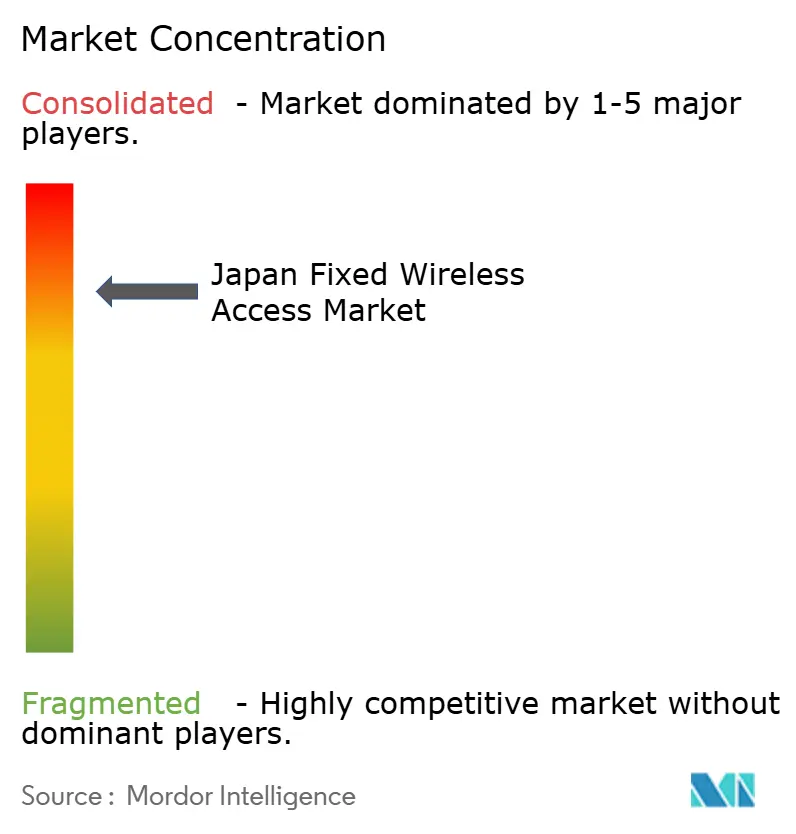
| Market Concentration | High |
Major Players *Disclaimer: Major Players sorted in no particular order Image © Mordor Intelligence. Reuse requires attribution under CC BY 4.0. | |
Japan Fixed Wireless Access Market Analysis by Mordor Intelligence
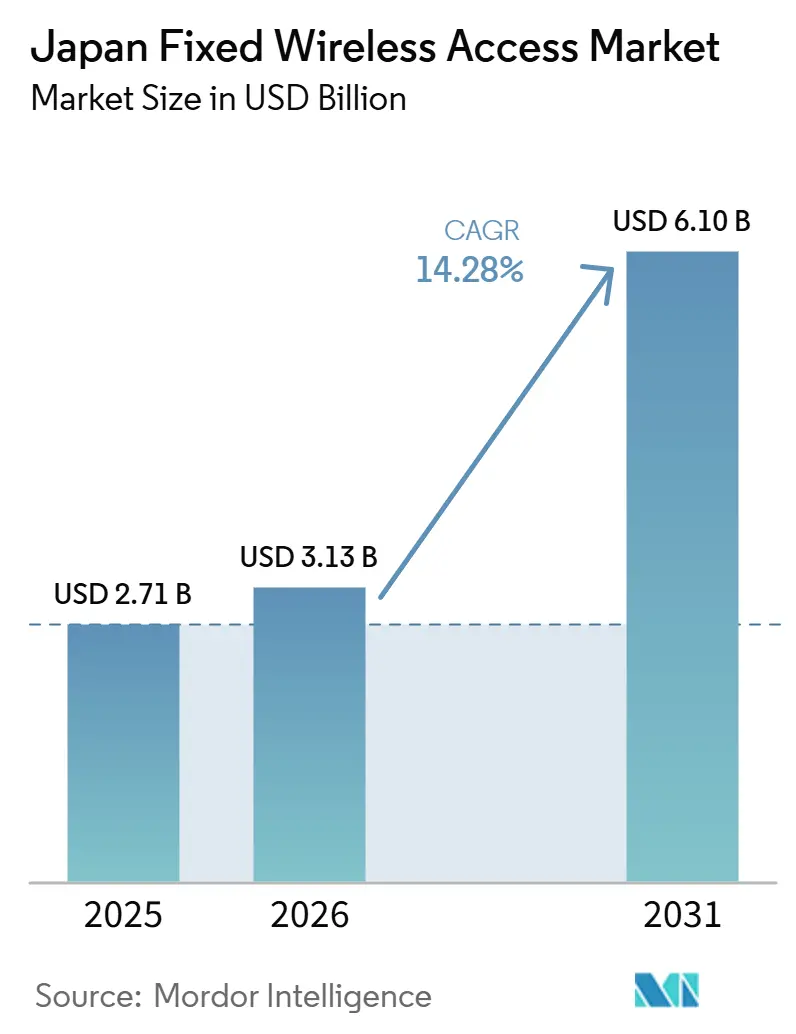
The Japan fixed wireless access market size was valued at USD 2.71 billion in 2025 and is projected to reach USD 6.10 billion by 2031, growing at a CAGR of 14.28% from 2026 to 2031. The Japan fixed wireless access market has moved beyond its earlier role as a fallback option for locations where fiber could not be installed, and it is now becoming a more deliberate part of the country’s broadband mix. This shift is supported by broader 5G Standalone readiness, lower customer-premises equipment costs, and steady adoption of plug-and-play wireless broadband for both homes and small businesses. The market is also benefiting from the way operators now position fixed wireless access as a flexible service for rapid activation, backup connectivity, and easier setup in buildings where installation work is difficult or slow. At the same time, competition remains disciplined because the service layer is centered on 4 national mobile operators that also control much of the network and device stack. Growth prospects remain strong, though fiber price pressure and spectrum limitations still limit how far the Japan fixed wireless access market can expand into premium residential use cases.
Key Report Takeaways
- By type, hardware accounted for 25.98% of revenue in 2025, while services are projected to expand at a 14.76% CAGR through 2031.
- By application, residential held 67.88% of the Japan fixed wireless access market share in 2025, while government and public safety are projected to expand at a 15.41% CAGR through 2031.
- By frequency band, Sub-6 GHz accounted for 53.22% of revenue in 2025, while mmWave is projected to expand at a 14.99% CAGR through 2031.
- By deployment mode, indoor CPE held 61.22% of revenue in 2025, while self-install window-mount CPE is projected to expand at a 15.88% CAGR through 2031.
Note: Market size and forecast figures in this report are generated using Mordor Intelligence’s proprietary estimation framework, updated with the latest available data and insights as of January 2026.
Japan Fixed Wireless Access Market Trends and Insights
Drivers Impact Analysis*
| DRIVER | (~) % IMPACT ON CAGR FORECAST | GEOGRAPHIC RELEVANCE | IMPACT TIMELINE |
|---|---|---|---|
| 5G Standalone Rollout Expanding FWA Performance Headroom | +3.5% | National, concentrated in Tokyo, Osaka, and Nagoya metro areas | Short term (≤ 2 years) |
| Fiber Saturation in Dense Markets: Opening A Backup and Second Line Use Case | +2.8% | Urban cores, Tokyo 23 wards, Osaka, Yokohama, Nagoya | Medium term (2-4 years) |
| SME Demand for Rapid Deploy, Failover Connectivity | +2.2% | National, with early gains in the Kanto and Kansai commercial districts | Medium term (2-4 years) |
| Japan Digital Infrastructure Push Supporting Non-Fiber Last-Mile Options | +1.8% | Rural and semi-urban prefectures, islands, and mountainous zones | Long term (≥ 4 years) |
| Self-Install CPE and Reduce Truck Rolls Improving Economics | +1.3% | National, primarily residential multi-family housing | Short term (≤ 2 years) |
| Power-Efficient Wireless Access Supporting Operator Sustainability Goals | +0.7% | National, spill-over to Okinawa and Hokkaido regional deployments | Long term (≥ 4 years) |
| Source: Mordor Intelligence | |||
5G Standalone Rollout Expanding FWA Performance Headroom
The strongest growth support for the Japan fixed wireless access market comes from the shift toward more capable 5G Standalone networks. Ericsson’s 2026 outlook placed Japan among the stronger FWA markets because high 5G maturity and speed-based tariff design are now moving together rather than separately.[1]Ericsson, “FWA Outlook,” Ericsson, ericsson.com SoftBank and Ericsson also validated 5 network slices on a commercial 5G Standalone network at Suzuka Circuit, and one of those use cases relied on mmWave backhaul for public Wi-Fi in a fixed wireless access setting. That kind of network behavior matters because FWA performance in busy urban environments depends less on peak headline speeds alone and more on consistency, latency handling, and the ability to maintain service quality as traffic rises. The Japan fixed wireless access market is therefore gaining room for more differentiated service plans, especially where operators want to charge more for higher reliability, faster setup, or business continuity use cases. As 5G Standalone capabilities become more visible in live networks, the market gains a stronger basis for speed- and quality-tiered offers rather than simple replacement broadband plans.
Fiber Saturation in Dense Markets Opening a Backup and Second Line Use Case
A second major support for the Japan fixed wireless access market is that dense urban areas already have deep fixed broadband penetration, which changes how wireless broadband is sold. KDDI’s December 2025 launch of a Wi-Fi 7 home gateway for au Hikari 10 Gbps and 5 Gbps services shows how advanced the fixed environment already is in Japanese homes with premium fiber access. In that setting, FWA does not always need to beat fiber on speed to win demand, because it can serve as a second line, a faster activation option, or a practical answer in buildings where wiring control sits with landlords or building associations. SoftBank’s Air Terminal 6 launch also shows that operators continue to invest in home FWA hardware even as fiber remains strong, indicating that both technologies are now being positioned for different access priorities rather than a simple winner-takes-all outcome.[2]SoftBank Corp., “BizCell,” SoftBank Corp., softbank.jp This is why the Japan fixed wireless access market keeps finding room in urban cores where conventional fiber competition is already intense. The growth path is less about universal fiber substitution and more about backup, flexibility, and easier onboarding in settings where installation friction still matters.
SME Demand for Rapid Deploy, Failover Connectivity
Small and medium enterprises are carving out a distinct commercial lane in the Japan fixed wireless access market because they often need connectivity faster than fixed-line provisioning can deliver. SoftBank’s BizCell service was designed for sites such as factories, warehouses, buildings, tunnels, mountainous areas, and construction zones where standard communications infrastructure is weak or missing. The same announcement said the service can reduce installation costs to 1/3 of traditional methods and shorten deployment to a minimum of 3 months, highlighting why rapid setup has clear value in enterprise environments. This commercial logic supports managed access packages, failover links, and temporary-site connectivity in a way that is less exposed to mass residential price pressure. The Japan fixed wireless access market is therefore finding stronger monetization headroom in business accounts than in basic home broadband plans. That pattern also helps explain why the services side of the market is growing faster than the device side.
Japan Digital Infrastructure Push Supporting Non-Fiber Last-Mile Options
Policy and spectrum actions are also helping the Japan fixed wireless access market preserve a long runway outside the largest metropolitan areas. Japan’s Ministry of Internal Affairs and Communications approved SoftBank’s establishment plan for 5G specified base stations in the 4.9 GHz band in December 2024, which shows continued state support for expanding wireless capacity as part of the national communications framework. SoftBank’s BizCell service further shows how operators are aligning with that policy direction by extending mobile communications to sites where conventional broadband lines are difficult to install, including islands and mountainous areas. This matters because non-fiber last-mile options become more important when the cost and time needed for fixed-line rollout are high relative to local demand density. The Japan fixed wireless access market thus gains not only from household adoption in cities but also from its role in serving harder-to-reach geographies and operationally difficult sites. That broader addressable footprint should remain relevant throughout the forecast period, even if the largest revenue pools stay urban.
Restraints Impact Analysis*
| RESTRAINT | (~) % IMPACT ON CAGR FORECAST | GEOGRAPHIC RELEVANCE | IMPACT TIMELINE |
|---|---|---|---|
| Spectrum Availability and Mid-Band Contiguity Constraints | -2.1% | National, all major urban markets | Medium term (2-4 years) |
| Fiber Price Pressure Limiting Residential FWA Premiums | -1.5% | Urban Japan, Tokyo, Osaka, Yokohama, Nagoya | Short term (≤ 2 years) |
| Dense Urban Interference and Building Penetration Challenges | -1.0% | High-density urban areas, Tokyo 23 wards, Osaka, Sapporo | Medium term (2-4 years) |
| Weather Sensitivity for Higher Band Deployments | -0.6% | Hokkaido, Tohoku, Okinawa, typhoon-prone coastal prefectures | Long term (≥ 4 years) |
| Source: Mordor Intelligence | |||
Spectrum Availability and Mid-Band Contiguity Constraints
The clearest technical restraint on the Japan fixed wireless access market is that spectrum improvements have not fully eliminated performance bottlenecks in dense areas. MIC’s 2024 approval in the 4.9 GHz band added capacity for SoftBank, but it did not resolve the broader need for deeper contiguous bandwidth across the high-demand parts of the 5G access layer. KDDI and NTT DOCOMO’s shared mmWave repeater project in 2026 also underscores the significant engineering effort still required to extend high-band coverage efficiently in real urban environments.[3]KDDI, “KDDI and NTT DOCOMO Develop Shared Repeater to Efficiently Expand Millimeter-Wave Coverage,” KDDI News Room, newsroom.kddi.com When operators still need shared repeaters, denser relay structures, and careful coverage design, scaling premium, high-throughput FWA becomes slower and more capital-intensive. The Japan fixed wireless access market can keep growing on Sub-6 GHz, but the path toward more fiber-like multi-gigabit performance remains narrower than the demand narrative suggests. This limitation matters most in dense buildings where usage demand is high, and signal conditions are hardest to optimize.
Fiber Price Pressure Limiting Residential FWA Premiums
The other major brake on the Japan fixed wireless access market is the strength of incumbent fiber alternatives in residential broadband. KDDI’s Wi-Fi 7 gateway rollout for high-speed au Hikari services shows that fixed-line providers are continuing to raise the performance benchmark in home connectivity rather than defending older offers.[4]KDDI Corporation, “au Hikari Provides Wi-Fi 7-Compatible Home Gateway HGW-BL4000HM,” au, au.com SoftBank’s Air Terminal 6 strengthened the wireless offer on the device side, but even that launch confirmed that operators still need better in-home hardware and pricing support to compete for demanding households.[5]SoftBank Corp., “SoftBank Announces Air Terminal 6 Wi-Fi 7-Compatible Home Router,” SoftBank Corp., softbank.jp Where fiber is already established, FWA often wins on convenience, flexibility, or ease of installation rather than clear speed leadership. That makes it harder for operators to sustain a wide price premium in the mainstream residential acquisition market. The Japan fixed wireless access market therefore has stronger margin potential in business continuity and managed service use cases than in purely price-led home broadband switching.
*Our forecasts treat driver/restraint impacts as directional, not additive. The impact forecasts reflect baseline growth, mix effects, and variable interactions.
Segment Analysis
By Type: Services Outpace Devices as Monetization Shifts Toward Managed Connectivity
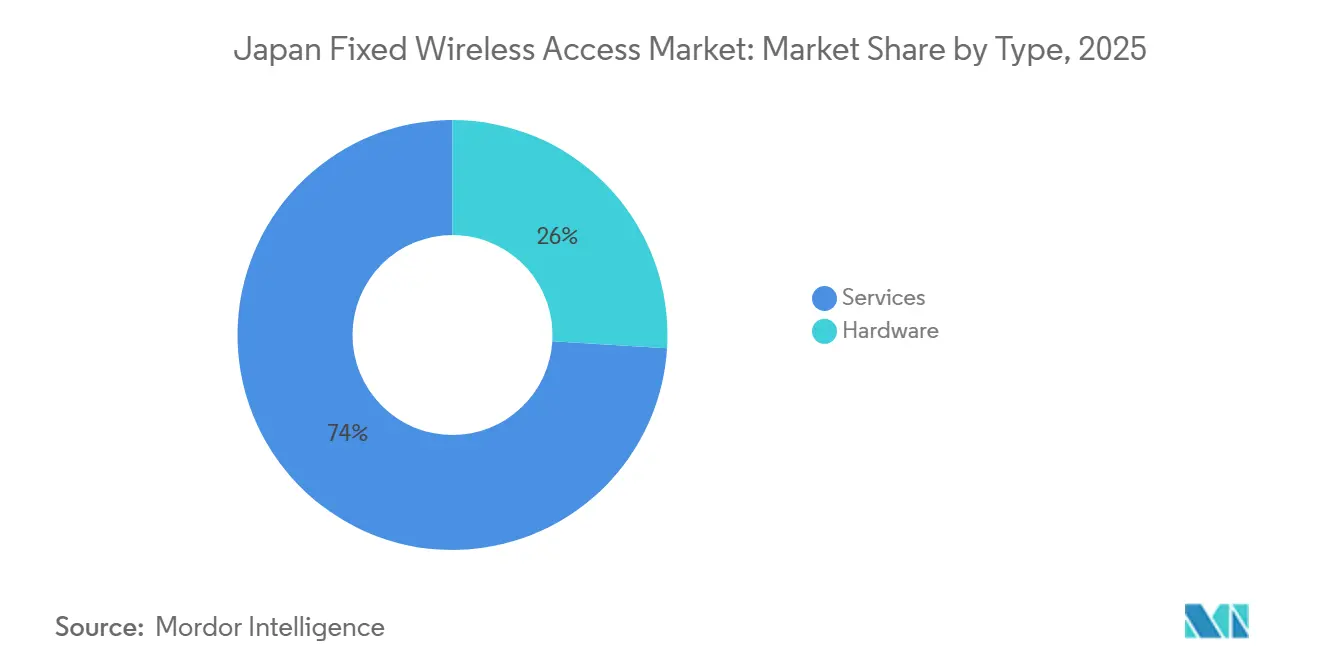
Hardware accounted for 25.98% of market revenue in 2025, while services are projected to expand at a 14.76% CAGR from 2026 to 2031. That split shows that the Japan fixed wireless access market is led more by recurring access value than by one-time device sales. Operators still need hardware innovation because modem, router, and gateway upgrades directly influence customer satisfaction and network efficiency. SoftBank launched Air Terminal 6 in late 2024 as the first Wi-Fi 7-compatible home router offered by a domestic mobile network operator in Japan. KDDI followed with the HGW-BL4000HM gateway for high-speed home connectivity in December 2025, which kept pressure on the device benchmark for access performance inside Japanese homes.
The faster expansion of services reflects where operators can add more value through faster activation, support, quality assurance, and enterprise continuity. This is why the Japan fixed wireless access market keeps moving toward service-led pricing rather than hardware-led differentiation. SoftBank’s BizCell is a good example because it frames wireless access as a practical communications environment for business and field locations rather than only a consumer router offer. In the Japan fixed wireless access industry, that model supports higher-value contracts because customers are buying uptime, rapid deployment, and operational coverage rather than just a device. The device layer still matters, but it is increasingly a tool for reducing activation friction and improving plan retention rather than the main source of revenue growth.


By Application: Residential Stays Largest While Government and Public Safety Expand Faster
Residential held 67.88% of the Japan fixed wireless access market share in 2025, while government and public safety are projected to expand at a 15.41% CAGR through 2031. The residential base is large because plug-and-play wireless routers suit renters, temporary residents, and households that prefer not to wait for installation. That position gives Japan's fixed wireless access market a durable consumer foundation, even though the service still faces strong fiber competition in many urban neighborhoods. SoftBank’s Air Terminal 6 launch shows how seriously operators continue to invest in the home access proposition through better Wi-Fi standards and improved in-home performance. The residential segment is therefore likely to remain the volume anchor even if its growth rate normalizes as penetration rises.
Government and public safety are expanding faster because communication continuity matters more in disaster response, event operations, and difficult terrain. SoftBank’s BizCell service directly targets many of these requirements by supporting communications in tunnels, mountainous areas, and remote worksites where fixed infrastructure is limited. The Japan fixed wireless access market also benefits here, as the operational need is not only internet access but also resilience and the speed of restoration. That gives public-facing and emergency-sensitive deployments a stronger case for managed wireless solutions than ordinary household broadband. In the Japan fixed wireless access industry, this application mix should keep revenue growth tilted toward services that support continuity, temporary coverage, and mission-sensitive operations.
By Frequency Band: Sub-6 GHz Holds the Base While mmWave Builds a Targeted Expansion Path
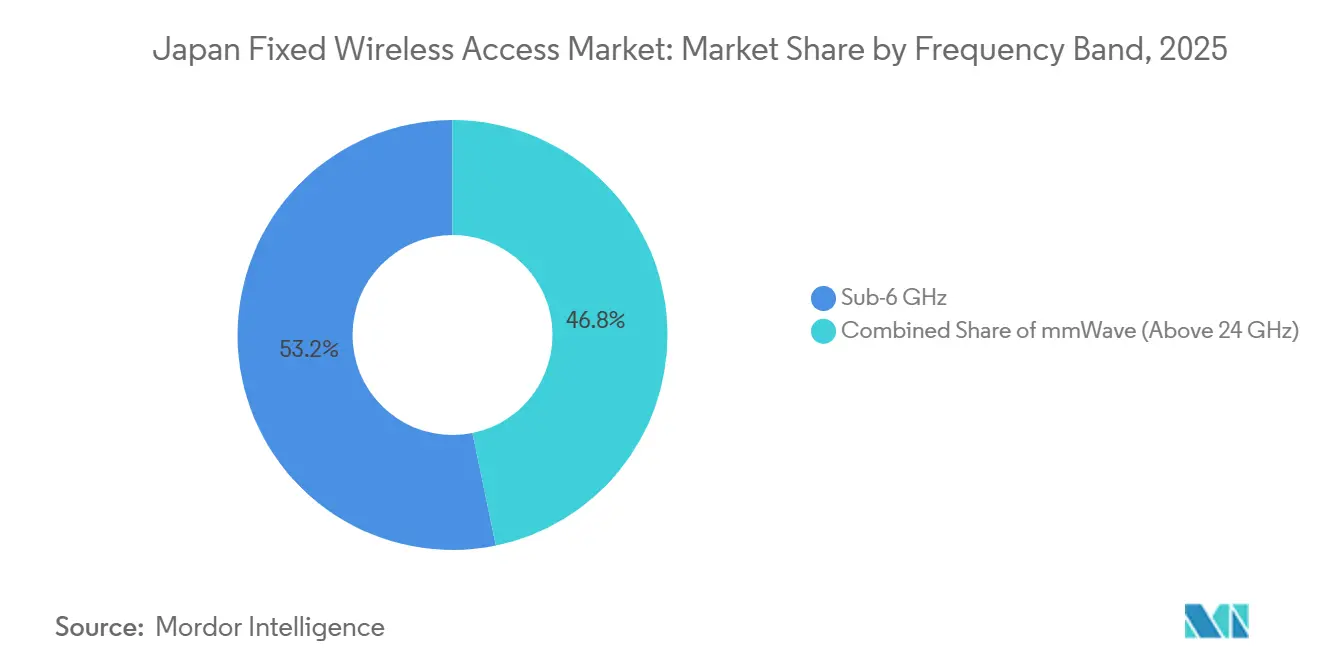
Sub-6 GHz accounted for 53.22% of revenue in 2025, and mmWave is projected to expand at a 14.99% CAGR through 2031. Sub-6 GHz remains the base layer because it offers a better balance of range, building penetration, and usable performance for the Japan fixed wireless access market. That matters in a country where many customers live or work in concrete mid-rise and high-rise buildings that degrade signal quality. Ericsson’s 2026 FWA outlook emphasized that strong 5G mid-band population coverage is a defining trait of successful 5G FWA markets, and Japan fits that pattern closely. The current revenue mix, therefore, reflects commercial reality, as Sub-6 GHz can be scaled more broadly and with less site-level complexity than mmWave.
mmWave is still the fastest-growing band because it offers a path to higher capacity in targeted locations where performance intensity is highest. The SoftBank and Ericsson trial at Suzuka Circuit showed that mmWave-backed use cases can work on a commercial 5G Standalone network when the radio environment is engineered correctly. KDDI and NTT DOCOMO’s shared-repeater initiative also shows that mmWave expansion is advancing through infrastructure-sharing tactics rather than through a simple macro-layer rollout alone. For the Japan fixed wireless access market, this means mmWave should grow fastest where capacity pressure, venue traffic, or enterprise demand justifies the extra deployment effort. The band will likely remain selective in coverage, but it should become more important in premium and specialized use cases over time.

By Deployment Mode: Indoor CPE Leads Today While Window-Mount Devices Gain Momentum
Indoor CPE accounted for 61.22% of revenue in 2025, reflecting how strongly the Japan fixed wireless access market depends on ease of setup. Indoor routers meet the needs of urban homes by eliminating installation visits, reducing customer effort, and enabling faster service activation. SoftBank’s Air Terminal 6 fits this logic well because it was designed as a home router with Wi-Fi 7 capability and automatic use of available mobile bands. That format keeps indoor CPE central to mass-market deployment because the product works within existing room layouts and operator fulfillment models. The installed base advantage should keep indoor CPE in the lead even as newer form factors improve.
Self-install window-mount CPE is projected to expand at a 15.88% CAGR from 2026 to 2031 because it addresses signal loss more directly than standard indoor placement. The Japan fixed wireless access market benefits from that format in buildings where street-facing orientation and reduced wall interference can improve link quality without requiring full outdoor installation. This makes window-mount solutions especially relevant as operators try to extract better performance from upper Sub-6 GHz and future high-band deployments. The same trend also supports outdoor and specialist access units in enterprise or temporary-use cases where performance certainty matters more than a simple consumer setup path. In the Japan fixed wireless access industry, deployment mode innovation is therefore less about replacing indoor routers and more about widening the number of buildings and use cases that can achieve acceptable wireless performance.
Geography Analysis
Urban prefectures remain the largest revenue base for the Japan fixed wireless access market because they combine high demand density, mature mobile coverage, and a large stock of apartments, offices, and mixed-use buildings. Tokyo, Osaka, Kanagawa, and Aichi continue to shape the market's commercial center because operators can acquire customers there at scale and bundle wireless broadband with broader mobile ecosystems. In these areas, demand often comes from flexible activation needs rather than from a simple lack of fixed access. That is why the Japan fixed wireless access market keeps growing even in places where fiber is already well established. SoftBank’s Air Terminal 6 and similar home router offerings show that urban competition is increasingly built around device quality, ecosystem fit, and self-install convenience rather than just basic coverage claims.
Rural and semi-urban Japan exhibit different demand patterns because the case for wireless access is more often tied to coverage practicality and deployment economics. SoftBank’s BizCell makes this visible because it was built for factories, warehouses, mountainous zones, tunnels, and other areas where traditional communications infrastructure is weak or difficult to extend. MIC’s approval of additional 4.9 GHz base station deployment also supports the broader policy direction of keeping wireless capacity expansion active across the national network footprint. These conditions give Japan's fixed wireless access market a wider role in prefectures where fiber economics are less attractive or where site readiness remains uneven.
Island- and disaster-sensitive locations add another layer of geographic demand, as resilience matters as much as throughput. Temporary worksites, public events, remote facilities, and exposed coastal or mountainous sites all need communications options that can be activated without lengthy civil work. That is one reason the Japan fixed wireless access market continues to attract interest from public agencies and organizations that value service restoration and continuity. Shared repeater development by KDDI and NTT DOCOMO also points to a more practical approach for extending higher-performance wireless service into difficult high-traffic zones without fully duplicating infrastructure. Geography, therefore, does not divide the market into strong and weak zones as much as it divides it into different economic use cases, with metro flexibility, rural practicality, and resilience needs all supporting demand.
Competitive Landscape
The Japan fixed wireless access market is organized around 4 national mobile operators, NTT DOCOMO, KDDI, SoftBank, and Rakuten Mobile, and that structure gives the service layer a moderate to high level of concentration. These operators not only sell plans, but they also shape the customer relationship through branded routers, bundled mobile discounts, and direct control over 5G network assets. That combination gives incumbents a structural advantage in acquisition cost, plan design, and device-channel coordination. The Japan fixed wireless access market therefore remains difficult for outside service challengers to enter at scale, even though the equipment layer is more open. Competition is active, but it is mostly a contest among large incumbents rather than a broad field of independent service providers.
Recent strategic moves show that competition is now centered on network quality and capacity architecture as much as on price. Rakuten Mobile and 1Finity announced the large-scale deployment of Open RAN massive MIMO radios in 2026 to expand 5G Sub-6 coverage and capacity across Japan, thereby supporting faster, more reliable access performance. SoftBank and Ericsson used a live commercial setting at Suzuka Circuit to validate 5 simultaneous 5G use cases, including a fixed wireless access application that relied on mmWave backhaul. KDDI and NTT DOCOMO also moved forward with shared repeater development for mmWave, signaling that future FWA performance may increasingly depend on collaboration at the infrastructure edge rather than on isolated network buildouts.
Device strategy remains another important competitive lever, as service experience in the home depends heavily on the router and gateway layers. SoftBank’s Air Terminal 6 launch brought Wi-Fi 7 to its consumer FWA offering, while KDDI advanced its in-home access benchmark with the HGW-BL4000HM gateway for high-speed broadband users. SoftBank’s June 2026 decision to raise the Air Terminal 6 device price while maintaining an effectively zero-cost structure through longer discounts also shows how tightly operators manage hardware economics to defend adoption momentum. The Japanese fixed wireless access market is likely to stay competitive in execution, but it is not structurally open, because scale, spectrum, branded devices, and subscriber ecosystems remain concentrated in the hands of a few national players. That makes share shifts possible within the leading group, while keeping the outer edge of the field relatively narrow.
Japan Fixed Wireless Access Industry Leaders
NTT DOCOMO, INC.
KDDI CORPORATION
SoftBank Corp.
Rakuten Mobile, Inc.
Internet Initiative Japan Inc.
- *Disclaimer: Major Players sorted in no particular order

Recent Industry Developments
- June 2026: SoftBank and Ericsson completed a joint field trial at the FIA Formula 1 Suzuka Circuit, demonstrating 5 simultaneous 5G Standalone network slices, including mmWave communication, on a single commercial network, validating the performance headroom that 5G Standalone and mmWave jointly provide for high-density FWA deployments.
- May 2026: KDDI and NTT DOCOMO, in cooperation with Kyocera, announced the successful development and upcoming field testing of a shared mmWave repeater at Ueno Park, Tokyo, aimed at reducing infrastructure costs for mmWave FWA area expansion.
- February 2026: Rakuten Mobile and 1Finity, a Fujitsu company, announced the large-scale deployment of Open RAN Massive MIMO radios using Qualcomm Dragonwing QRU100 platforms across Rakuten Mobile’s cloud-native network, strengthening FWA capacity and coverage across Japan.
- January 2026: SoftBank demonstrated 6G effectiveness in the 7 GHz centimeter-wave band, following outdoor trials in Tokyo’s Ginza district that began in June 2025 with Nokia base stations, with findings showing lower attenuation than mmWave and signaling that 7 GHz could become a future access band in the 6G era.


Japan Fixed Wireless Access Market Report Scope
The Japan Fixed Wireless Access Market Report is Segmented by Type (Hardware [Consumer Premise Equipment and Access Units] and Services), Application (Residential, Commercial, Industrial, and Government and Public Safety), Frequency Band (Sub-6 GHz, mmWave (Above 24 GHz), and Unlicensed/Shared CBRS), and Deployment Mode (Indoor CPE, Outdoor CPE, and Self-Install Window-Mount CPE). The Market Forecasts are Provided in Terms of Value (USD).
| Hardware | Consumer Premise Equipment (CPE) |
| Access Units (Femto and Picocells) | |
| Services |
| Residential |
| Commercial |
| Industrial |
| Government and Public Safety |
| Sub-6 GHz |
| mmWave (Above 24 GHz) |
| Unlicensed / Shared CBRS |
| Indoor CPE |
| Outdoor CPE |
| Self-Install Window-Mount CPE |
| By Type | Hardware | Consumer Premise Equipment (CPE) |
| Access Units (Femto and Picocells) | ||
| Services | ||
| By Application | Residential | |
| Commercial | ||
| Industrial | ||
| Government and Public Safety | ||
| By Frequency Band | Sub-6 GHz | |
| mmWave (Above 24 GHz) | ||
| Unlicensed / Shared CBRS | ||
| By Deployment Mode | Indoor CPE | |
| Outdoor CPE | ||
| Self-Install Window-Mount CPE |


Key Questions Answered in the Report
What is the 2031 revenue outlook for Japan's fixed wireless access?
The Japan fixed wireless access market is projected to reach USD 6.10 billion by 2031, up from USD 2.71 billion in 2025, with a 14.28% CAGR from 2026 to 2031.
Which application generates the most revenue in Japan's fixed wireless access?
Residential is the largest application segment, with 67.88% revenue share in 2025, supported by plug-and-play home routers and the growing adoption of easy self-install.
Which application is expanding the fastest in Japan?
Government and public safety is the fastest-growing application, with a projected 15.41% CAGR through 2031, driven by continuity and resilience needs.
Why does Sub-6 GHz still lead over mmWave in Japan?
Sub-6 GHz accounted for 53.22% of revenue in 2025 because it offers wider coverage and better building penetration, which are critical in Japan's dense urban housing stock.
What is the biggest growth driver for service providers in this space?
5G Standalone rollout is the strongest driver because it improves service consistency and supports more differentiated FWA plans for homes and business users.
Where do operators have the strongest monetization opportunity?
Business continuity, managed connectivity, and rapid-deployment SME use cases offer stronger pricing support than mass residential plans, which face heavier fiber competition.
Page last updated on:





