
Japan Enterprise Content Management (ECM) Market Size and Share
Market Overview
| Study Period | 2020 - 2031 |
|---|---|
| Forecast Data Period | 2026 - 2031 |
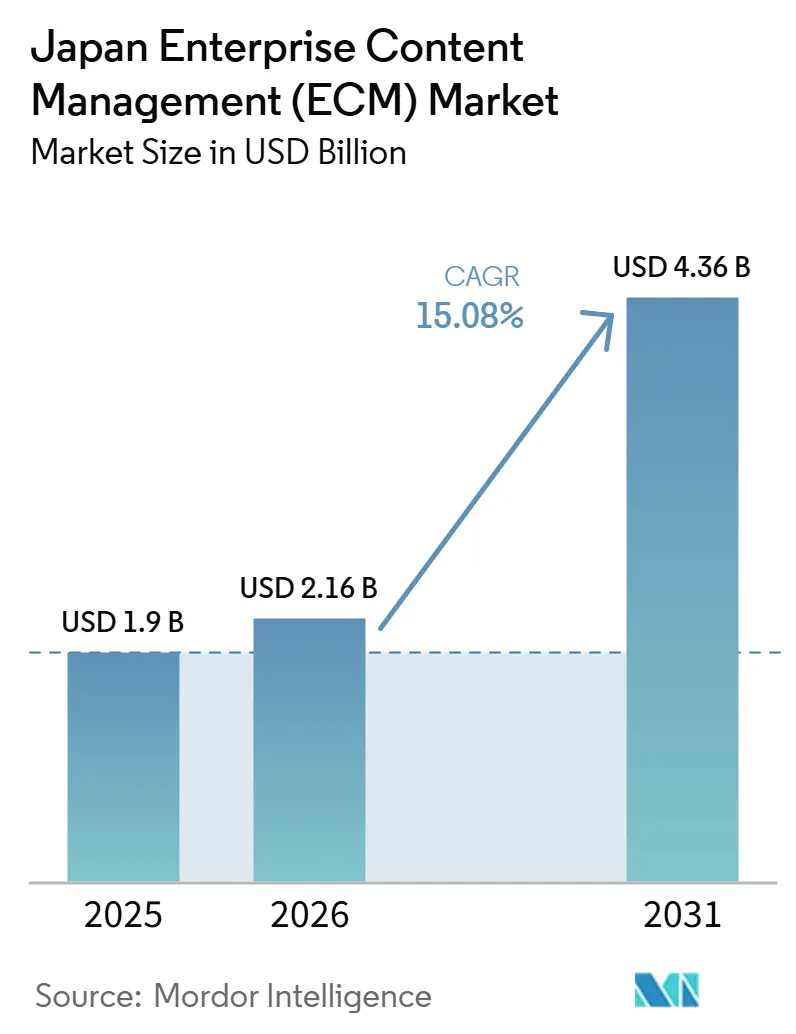
| Base Year Market Size (2025) | USD 1.9 Billion |
| Market Size (2026) | USD 2.16 Billion |
| Market Size (2031) | USD 4.36 Billion |
| Growth Rate (2026 - 2031) | 15.08% CAGR |
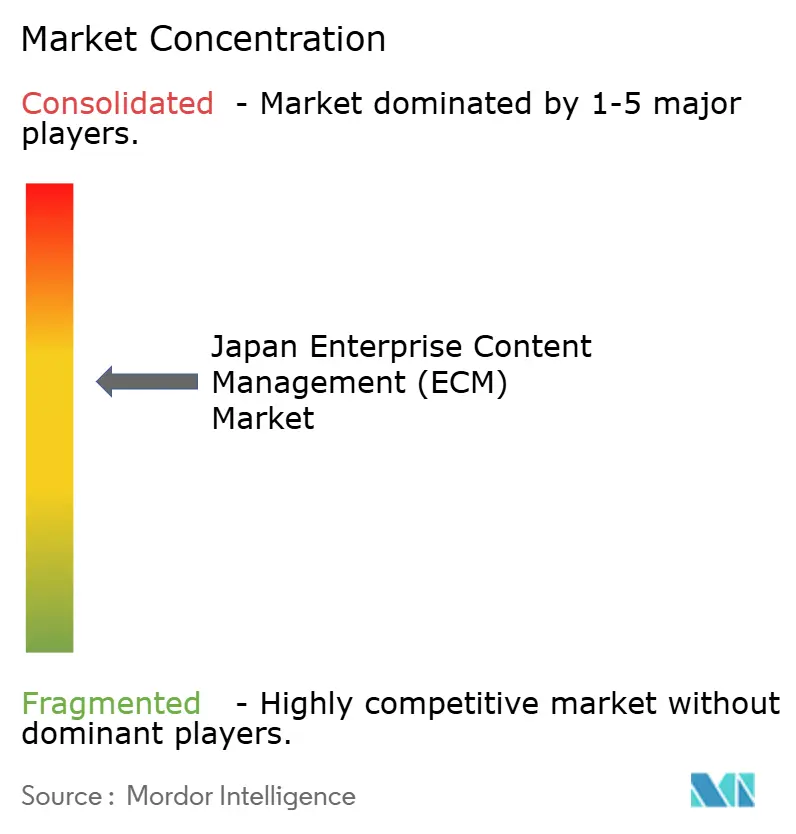
| Market Concentration | Medium |
Major Players *Disclaimer: Major Players sorted in no particular order Image © Mordor Intelligence. Reuse requires attribution under CC BY 4.0. | |
Japan Enterprise Content Management (ECM) Market Analysis by Mordor Intelligence
The Japan enterprise content management (ECM) market size was valued at USD 1.90 billion in 2025, USD 2.16 billion in 2026, and is forecast to reach USD 4.36 billion by 2031, at a CAGR of 15.08% from 2026 to 2031. The pace of expansion reflects a structural shift in enterprise software spending, because governed content platforms are moving from delayed modernization projects to active buying priorities. METI’s long-running Digital Cliff warning pushed many companies to revisit legacy systems, and that pressure intensified as digital transformation programs in 2026 placed greater emphasis on AI-ready content environments. Demand is also rising because companies need searchable records, stronger audit trails, and smoother document access across hybrid work settings. The market is now moving beyond simple digitization, as buyers increasingly want workflow control, automation, and content intelligence within a single platform. Competition is also broadening, because vendors that support Japanese-language document complexity and regulated deployment models are finding more room outside the largest enterprise accounts.
Key Report Takeaways
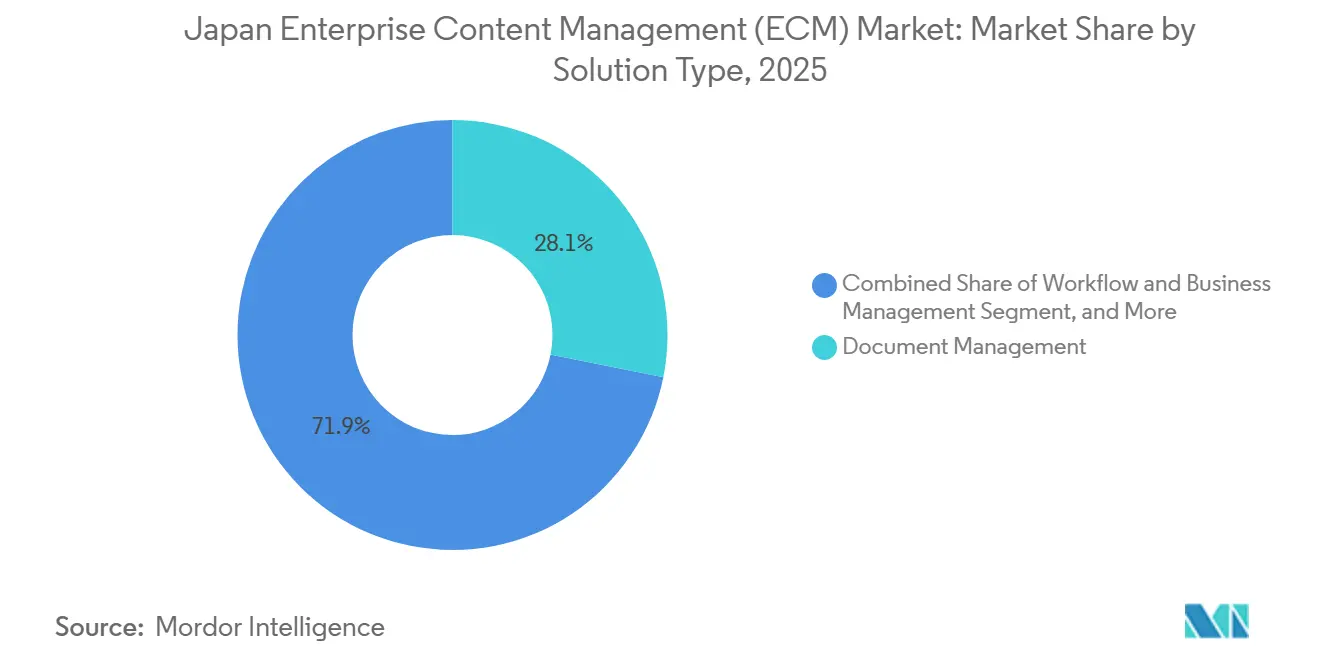
- By solution type, Document Management held 28.14% of the Japanese enterprise content management (ECM) market in 2025, while Workflow and Business Process Management are projected to expand at a 17.62% CAGR through 2031.
- By deployment mode, cloud accounted for 75.41% of the Japanese enterprise content management (ECM) market share in 2025 and is projected to expand at a 18.24% CAGR through 2031.
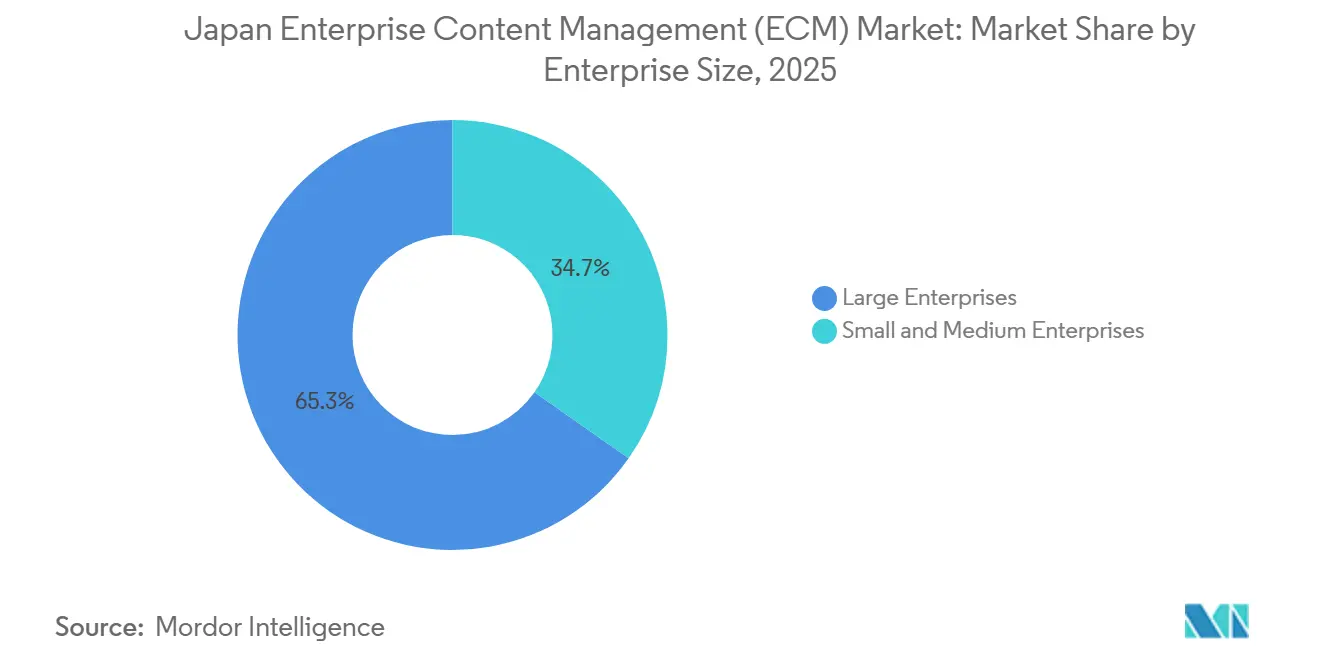
- By enterprise size, large enterprises held 65.28% share in 2025, while SMEs are projected to expand at a 17.83% CAGR through 2031.
- By end-user industry, BFSI accounted for 24.53% share in 2025, while healthcare is projected to expand at an 18.41% CAGR through 2031.
Note: Market size and forecast figures in this report are generated using Mordor Intelligence’s proprietary estimation framework, updated with the latest available data and insights as of January 2026.
Japan Enterprise Content Management (ECM) Market Trends and Insights
Drivers Impact Analysis*
| Driver | (~) % Impact on CAGR Forecast | Geographic Relevance | Impact Timeline |
|---|---|---|---|
| AI-Assisted Document Classification and Retrieval in Japanese Workflows | +4.2% | National, with early deployment concentrated in Tokyo, Osaka, and Nagoya | Short term (≤ 2 years) |
| Shift From Legacy File Servers to Governed Content Platforms | +3.5% | National, strongest in Kanto and Kansai enterprise centers | Medium term (2-4 years) |
| Cloud Migration of Enterprise Records for Hybrid Work | +3.1% | National, with public cloud qualification centered in Tokyo | Medium term (2-4 years) |
| Electronic Book Preservation and Audit Readiness Pressure | +2.4% | National, across industries and business sizes | Short term (≤ 2 years) |
| SAP And ERP Integration Demand for Unified Content Visibility | +1.5% | Strong among large manufacturing enterprises across Japan | Medium term (2-4 years) |
| Multilingual Content Governance for Regional Operations | +0.8% | Asia-Pacific, with coordination hubs in Tokyo, Osaka, and Singapore | Long term (≥ 4 years) |
| Source: Mordor Intelligence | |||
AI-Assisted Document Classification and Retrieval in Japanese Workflows
The Japan enterprise content management (ECM) market is benefiting from the fact that Japanese business documents are difficult to manage with standard OCR alone, because they often mix kanji, hiragana, katakana, romaji, tables, stamps, and handwritten notes.[1]NTT Group, “NTT’s LLM Tsuzumi 2 Updated, Achieving World-Class Performance in Processing Japanese Business Documents,” NTT Group, group.ntt NTT released the updated tsuzumi 2 model in May 2026, and the company said it improved its understanding of Japanese business documents with complex layouts through image-based comprehension. That change matters because it raises the value of ECM tools that can classify, summarize, and retrieve content with greater precision, rather than just storing files. Sumitomo Electric Information Systems said RakuRaku Document Plus surpassed 1,000 enterprise customers by March 2026, supported by AI chat, document summarization, and translation functions. AXLBIT launched SAIS InDocs in June 2026 and said it plans to widen AI agent coverage across back-office document workflows over the next 2 years. As a result, the Japan enterprise content management (ECM) market is moving toward vendor competition based on Japanese-language content intelligence as much as on repository breadth.[2]AXLBIT Inc., “SAIS InDocs AI Agent Service For Back-Office Document Workflows Launches,” IZA, iza.ne.jp
Shift from Legacy File Servers to Governed Content Platforms
The Japan enterprise content management (ECM) market is also gaining support from the move away from long-used file servers that no longer fit audit, access, and governance needs. IPA’s digital transformation material continued to highlight the Digital Cliff problem, which kept attention on the operational and financial risks tied to legacy IT environments after 2025. METI’s 2026 DX Brand selection reinforced the same direction, because recognized companies were closely linked to AI-led digital transformation and stronger data use across business functions. This is an encouraging platform replacement, because enterprises want permission mapping, metadata continuity, and defensible audit records during migration rather than simple file transfer. Springer’s 2026 study on SME digital transformation in Japan also described legacy systems as both a major cost barrier and a major opportunity area for modernization vendors. The result is that the Japan enterprise content management (ECM) market is drawing demand from organizations that now see governed content platforms as a compliance and productivity tool, not just a storage upgrade.
Cloud Migration of Enterprise Records for Hybrid Work
The Japan enterprise content management (ECM) market is gaining momentum from broader cloud investment, as Japan’s cloud services market continues to see projected growth.[3]U.S. Commercial Service, “Japan, Cloud Computing, Country Commercial Guide,” Trade.gov, trade.gov The same source said hybrid cloud adoption among Japanese enterprises is rising, which creates a stronger need for unified content oversight across multiple environments. Kyndryl completed Megmilk Snow Brand’s workflow modernization in March 2026 using ServiceNow, which showed how Japanese manufacturers are reducing fragmented approval and request processes on cloud-native platforms. Japan’s Digital Agency also standardized rigorous cloud qualification through its government cloud framework, which set a higher baseline for vendor screening in terms of security, resilience, and operational control. That is shortening shortlists for qualified providers and pushing less prepared vendors aside in larger accounts. Because of this, the Japan enterprise content management (ECM) market is seeing cloud adoption expand in step with a stronger demand for traceability, policy control, and cross-environment search.[4]Digital Agency, “Activity Report Of Digital Agency,” Digital Agency Japan, digital.go.jp
Electronic Book Preservation and Audit Readiness Pressure
The Japan enterprise content management (ECM) market is also supported by compliance pressure around electronic records, especially where searchable retention and controlled audit trails are now a routine expectation for corporate document systems. Hitachi Solutions continued to position Katsubun Contents Lifecycle Manager around compliance with the Electronic Bookkeeping Act and updated the platform in June 2026 with stronger document lifecycle support. NX Wanbishi Archives also highlighted JIIMA certifications for WAN-RECORD Plus under amended standards for electronic transactions, scanner storage, and electronic documents. Those product moves show that compliance capability is not a side feature, because buyers are actively screening for record integrity, access control, and retention defensibility. This matters across large companies and smaller firms alike, because the compliance burden spreads beyond a few highly regulated verticals. In practical terms, the Japan enterprise content management (ECM) market is gaining a firm floor of demand from organizations that need formal records governance, whether or not they are pursuing broader automation.
Restraints Impact Analysis*
| Restraint | (~) % Impact on CAGR Forecast | Geographic Relevance | Impact Timeline |
|---|---|---|---|
| Complex Migration From Long-Retained On-Premises Archives | -2.8% | National, especially within dense enterprise clusters in Kanto | Long term (≥ 4 years) |
| Data Residency and Compliance Constraints on Cloud Workflows | -2.1% | National, with higher sensitivity in BFSI and government | Medium term (2-4 years) |
| Integration Burden with Fragmented Line-Of-Business Applications | -1.6% | National | Medium term (2-4 years) |
| Shortage Of ECM Architects and Content Governance Specialists | -1.2% | National, most visible outside Tokyo | Long term (≥ 4 years) |
| Source: Mordor Intelligence | |||
Complex Migration From Long-Retained On-Premises Archives
The Japan enterprise content management (ECM) market still faces a major drag from the difficulty of migrating legacy archives from long-established on-premises environments. Many enterprises built document estates over the years of local customization, making metadata cleanup, permission mapping, and legal continuity difficult to standardize. Springer’s 2026 work on Japanese SME transformation described legacy IT as a major cost barrier, and the same issue applies even more strongly in large enterprises with heavier document histories. Migration can also leave index structures and lookup habits split across old and new systems, weakening the governance gains the platform change was meant to deliver. Vendors that combine consulting, migration planning, and compliance-aware transfer tools are therefore in a better position than providers that treat migration as a light implementation task. This means the Japan enterprise content management (ECM) market can grow quickly, but large conversions still take time because archive complexity is built into the installed base.
Data Residency and Compliance Constraints On Cloud Workflows
The Japan enterprise content management (ECM) market also slows when buyers must examine where sensitive content sits and how it is handled across different cloud environments. This is especially relevant in banking, insurance, healthcare, and public-sector settings, where procurement teams review infrastructure locations, operational controls, and response commitments in detail. Japan’s Digital Agency has kept cloud qualification standards visible through its public framework, thereby raising the evidence threshold for vendors seeking access to sensitive accounts. NTT’s May 2026 release of tsuzumi 2 for on-premises and private cloud use also showed that a meaningful share of Japanese enterprise content still needs controlled deployment models. These checks lengthen sales cycles and favor vendors that can support sovereign, private, or hybrid architectures with clear governance controls. For that reason, the Japanese enterprise content management (ECM) market does not move at the same pace across all industries, even when overall demand remains strong.
*Our forecasts treat driver/restraint impacts as directional, not additive. The impact forecasts reflect baseline growth, mix effects, and variable interactions.
Segment Analysis
By Solution Type: Workflow Automation Builds On Core Document Control
Document Management held 28.14% of the Japan enterprise content management (ECM) market share in 2025, which shows that many buyers still began with capture, storage, and retrieval needs before moving into deeper automation. Workflow and Business Process Management is projected to expand at a 17.62% CAGR through 2031, indicating the next stage of spending as organizations connect document flows to approvals and operational tasks. Records Management remains important because retention rules and audit demands still shape buying criteria across many enterprise accounts. NX Wanbishi Archives added a generative AI function to WAN-RECORD Plus in 2026, and the company said it can automatically extract, classify, and sort document attributes for high-volume record operations.
Case Management is gaining traction in banking, financial services, and insurance, as well as government settings, where claims, applications, and regulatory matters follow repeatable but document-heavy paths. Digital Asset Management and Web Content Management remain smaller parts of the mix, but they are staying active as e-commerce and media digitization continue to expand document and content needs. Sumitomo Electric Information Systems released RakuRaku Document Plus Ver. 6.9 in February 2026 with stronger AI-OCR for handwritten text and broader generative AI integration, including Gemini alongside existing ChatGPT connectivity. That product direction shows how solution categories in the Japan enterprise content management (ECM) industry are converging around AI support rather than remaining fully separate stacks. Vendors that attach classification, summarization, and search intelligence to core repositories are therefore gaining a stronger competitive position than those centered only on storage efficiency.



By Deployment Mode: Cloud Leads While Hybrid Becomes More Strategic
Cloud accounted for 75.41% of the Japan enterprise content management (ECM) market in 2025, reflecting the impact of hybrid work, cloud-first modernization, and the infrastructure needs of AI-enabled content platforms. Box Japan said its platform was used by around 22,000 companies in Japan, including 85% of Nikkei 225 companies, and that Mitsubishi UFJ Trust and Banking Corporation adopted Box in March 2026 as an AI-ready content management foundation for centralizing unstructured data. The broader cloud backdrop also remains favorable, as Japan’s cloud services market was projected at USD 33.53 billion in 2026, with a 15.7% growth rate. That broader investment cycle helps explain why cloud deployment already dominates the Japan enterprise content management (ECM) market.
On-premises deployment still matters in regulated industries and in organizations that manage sensitive, long-tenure archives with strict control requirements. Hybrid deployment is becoming increasingly important as many enterprises seek to run active workflows in the cloud while keeping selected archives and restricted records in controlled environments. NTT’s updated tsuzumi 2 was designed for on-premises and private cloud use, which confirms that public cloud will not fit every document environment in Japan. This keeps demand high for vendors that can support unified metadata, search, and audit continuity across both local and cloud repositories. In practice, the strongest providers in the Japan enterprise content management (ECM) market are those that treat cloud leadership and hybrid governance as complementary rather than opposing models.
By Enterprise Size: Large Enterprises Hold Revenue While SMEs Expand Faster
Large enterprises held 65.28% of the Japan enterprise content management (ECM) market in 2025, reflecting higher document volumes, greater compliance demands, and deeper integration with ERP and process systems. Domestic system integrators such as NTT DATA, Fujitsu, and Hitachi Solutions have long relationships with major enterprise clients, which gives them an advantage in complex deployments and migration programs. Fujitsu reported FY2025 consolidated revenue of JPY 3.6 trillion (USD 23.7 billion), and the company remained Japan’s top digital services provider by market share, underscoring the scale of incumbent implementation strength in enterprise content infrastructure. Fujitsu’s October 2025 work with SEKISUI CHEMICAL and SAP Japan also demonstrated how large manufacturers are modernizing their content and process environments together as part of a broader ERP transformation program.
SMEs are projected to expand at a 17.83% CAGR through 2031, making them the fastest-growing segment of the Japan enterprise content management (ECM) market. Sumitomo Electric Information Systems said in June 2026 that its service was registered under METI’s SME digitalization and AI adoption subsidy framework, which lowers the effective entry barrier for cloud document management tools. SaaS delivery is also helping smaller firms avoid the staffing and infrastructure burden that often slowed older ECM deployments. This is widening the addressable base beyond organizations that could justify large custom projects. As subsidy support, compliance-ready cloud tools, and Japanese-language AI features become more accessible, SMEs are likely to account for a larger share of new customer additions.
By End-User Industry: BFSI Leads While Healthcare Advances Fastest
BFSI accounted for 24.53% of the Japan enterprise content management (ECM) market in 2025, reflecting the sector’s heavy reliance on policy documents, internal rules, customer files, and audit-ready records. Healthcare is projected to expand at an 18.41% CAGR through 2031, supported by Japan’s medical digital transformation agenda and the need to manage clinical documents, consent records, and imaging-related content alongside structured health data. In healthcare settings, basic file storage is usually not enough, because document access, retention control, and role-based security matter as much as digitization itself. This makes healthcare one of the clearest growth paths for vendors that can combine content governance with sensitive workflow support.
BFSI demand remains anchored in retrieval speed and compliance precision. Kirayaka Bank adopted Helpfeel’s AI search system in June 2026 to search across 10,000 pages of internal regulations and directives, which showed how document intelligence can improve internal compliance work. Japan Digital Design also provided Mitsubishi UFJ Bank with a generative AI and RAG-based document search system that supported audit-ready procedural search within a 3-month development cycle. Government and public sector demand continues to follow document control and digitalization priorities set by national reform programs. Manufacturing, IT and telecommunications, retail, media and entertainment, education, and energy and utilities each add distinct demand streams, with manufacturing closely tied to ERP integration and retail more closely tied to catalog, transaction, and compliance documentation needs.
Geography Analysis
The region remained its main demand center because Tokyo and nearby prefectures concentrate headquarters, large financial institutions, and central government functions. METI’s April 2026 DX Brand program again highlighted the region’s weight, as many recognized companies headquartered in Kanto were active in AI-led digital transformation. The region also sees earlier deployment of AI-enabled ECM and cloud-native content platforms because vendor ecosystems are deepest there. Box Japan’s penetration among large, listed companies and the strong presence of enterprise cloud screening frameworks make Kanto the first stop for many large-account strategies. For that reason, pricing pressure and feature competition tend to appear in Kanto before they spread to the rest of the Japan enterprise content management (ECM) market.
Japan’s broader cloud services market was projected at USD 33.53 billion in 2026, and infrastructure growth is helping Kansai and Chubu expand their roles in enterprise content modernization. Kansai remains the second major cluster because Osaka, Kyoto, and Hyogo combine manufacturing, pharmaceuticals, and regional financial institutions that often follow Kanto-led adoption patterns with a delay. Chubu has a different profile because demand there is closely linked to automotive manufacturing and to the digitization of supplier networks rather than to stand-alone document projects. Japan Business Systems launched its SAP Business Technology Platform Implementation Support Service in May 2025, reflecting the need to connect content, integration, and ERP consistency across hybrid environments common in manufacturing-heavy regions. This gives vendors with strong ERP and workflow integration capabilities a clearer entry route into the Japan enterprise content management (ECM) market outside the Tokyo-centered corporate base.
The Japan enterprise content management (ECM) market is also opening up further in regional cities beyond the three major metropolitan areas, especially in public-sector and SME demand pools. Japan’s Digital Agency has kept prefectural and municipal digitalization in focus, which supports document modernization needs that do not depend on the same procurement cycles seen in Tokyo or Osaka. Dropbox Japan said in July 2026 that Kawakami in Okayama adopted its cloud content platform, reducing engineering drawing search time from more than 60 minutes to around 1 minute, demonstrating that regional manufacturing SMEs are now viable ECM buyers as well. As subsidy support and compliance-ready cloud tools spread further, regional demand should contribute more meaningfully to new account growth across the Japan enterprise content management (ECM) market.
Competitive Landscape
The Japan enterprise content management (ECM) market has a recognizable top tier, but it remains broad and competitive below that group. Global platform vendors such as Microsoft, IBM, Box, and OpenText compete alongside domestic providers such as NTT DATA, Hitachi Solutions, Fujitsu, and Ricoh. That creates a two-level structure in which international platforms provide scalable content ecosystems, while Japanese integrators and document specialists provide implementation depth, client relationships, and local compliance knowledge. The strongest positions are usually built where platform capability and local delivery strength meet. This is why the Japan enterprise content management (ECM) market does not favor a single vendor model across all buyer groups.
Several competitive moves in 2025 and 2026 show how vendors are trying to strengthen that position. Hitachi Solutions shipped Katsubun Contents Lifecycle Manager 14-01 in June 2026, extending support for the Electronic Bookkeeping Act and adding further AI-driven document management capabilities for enterprise clients. NTT’s tsuzumi 2 update in May 2026 strengthened the case for Japanese-language document intelligence in on-premises and private cloud environments, offering a meaningful advantage in sensitive deployments. Ricoh also advanced its Self-MoA document reading workflow for complex Japanese layouts, and the company tied that effort to its on-premises LLM starter kit strategy. Box continued to push intelligent content positioning through new automation and AI functions and through deeper enterprise relationships in Japan.
The competitive pattern is now centered on AI-enabled document understanding, ERP and workflow integration, and compliance-ready deployment. Vendors that offer only generic cloud storage have a weaker position when buyers want governed records, high-quality Japanese-language search, and migration support. The SME opportunity is also becoming more contested as subsidy-backed demand lowers the barrier for new customer acquisition. At the same time, vendors without local compliance readiness or flexible deployment models still face a harder qualification path in regulated accounts. As a result, the Japan enterprise content management (ECM) market is competitive at the top, increasingly active in the mid-market, and still open enough for specialized providers that solve language, governance, or integration gaps better than broader platform rivals.
Japan Enterprise Content Management (ECM) Industry Leaders
OpenText Corporation
Microsoft Corporation
IBM Corporation
Hyland Software, Inc.
Ricoh Company, Ltd.
- *Disclaimer: Major Players sorted in no particular order

Recent Industry Developments
- July 2026: Dropbox Japan announced the adoption of its enterprise cloud content management platform by Kawakami, a noodle machine manufacturer in Okayama Prefecture, the deployment manages engineering drawings and production instructions entirely in the cloud, reducing document search time from over 60 minutes to approximately 1 minute and demonstrating cloud ECM viability for regional manufacturing SMEs.
- June 2026: Hitachi Solutions shipped Katsubun Contents Lifecycle Manager 14-01, a JIIMA-certified enterprise content lifecycle management platform update, extending Electronic Bookkeeping Act compliance capabilities and AI-driven document management features for Japanese enterprise clients.
- May 2026: NTT released the tsuzumi 2 LLM update, achieving world-class performance on Japanese business documents with complex layouts and embedded tables.
- May 2026: Kyndryl completed modernization of Megmilk Snow Brand’s company-wide workflow system using ServiceNow, consolidating approval workflows, labor management, and core data requests onto a scalable cloud-native AI control tower platform, aligned with the manufacturer’s Next Design 2030 management plan.


Japan Enterprise Content Management (ECM) Market Report Scope
The Japan enterprise content management (ECM) market refers to the ecosystem of software solutions and services designed to systematically capture, manage, store, preserve, and deliver an organization's unstructured and structured content and documents within the country. This includes technologies such as document management, records management, workflow, business process management, case management, digital asset management, and web content management. Deployed on-premises, in the cloud, or in hybrid models, these solutions cater to organizations of all sizes across diverse industries in Japan, including BFSI, government, healthcare, IT, and manufacturing. Driven by the Japanese government's "Society 5.0" initiative, an aging workforce necessitating digital automation to counter labor shortages, and the growing need to comply with strict data protection regulations (such as the APPI), ECM solutions enable Japanese businesses to streamline complex administrative workflows, enhance enterprise-wide collaboration, ensure robust information governance, and transition from traditional paper-based processes to highly efficient, digitized operations.
The Japan Enterprise Content Management (ECM) Market Report is Segmented by Solution Type (Document Management, Records Management, Workflow and Business Process Management, Case Management, Digital Asset Management, Web Content Management, and Other Solutions), Deployment Mode (On-Premises, Cloud, and Hybrid), Enterprise Size (Small and Medium Enterprises, and Large Enterprises), and End-User Industry (BFSI, Government and Public Sector, Healthcare, IT and Telecommunications, Manufacturing, Retail, Media and Entertainment, Education, Energy and Utilities, and Other End-User Industries). The Market Forecasts are Provided in Terms of Value (USD).
| Document Management |
| Records Management |
| Workflow and Business Process Management |
| Case Management |
| Digital Asset Management |
| Web Content Management |
| Other Solutions |
| On-Premises |
| Cloud |
| Hybrid |
| Small and Medium Enterprises |
| Large Enterprises |
| BFSI |
| Government and Public Sector |
| Healthcare |
| IT and Telecommunications |
| Manufacturing |
| Retail |
| Media and Entertainment |
| Education |
| Energy and Utilities |
| Other End-User Industries |
| By Solution Type | Document Management |
| Records Management | |
| Workflow and Business Process Management | |
| Case Management | |
| Digital Asset Management | |
| Web Content Management | |
| Other Solutions | |
| By Deployment Mode | On-Premises |
| Cloud | |
| Hybrid | |
| By Enterprise Size | Small and Medium Enterprises |
| Large Enterprises | |
| By End-User Industry | BFSI |
| Government and Public Sector | |
| Healthcare | |
| IT and Telecommunications | |
| Manufacturing | |
| Retail | |
| Media and Entertainment | |
| Education | |
| Energy and Utilities | |
| Other End-User Industries |


Key Questions Answered in the Report
What is the size of the Japan enterprise content management (ECM) market in 2025 and by 2031?
The Japan enterprise content management (ECM) market size was valued at USD 1.90 billion in 2025, USD 2.16 billion in 2026, and is forecast to reach USD 4.36 billion by 2031, at a CAGR of 15.08% from 2026 to 2031.
Which solution category leads and which one is growing the fastest?
Document Management led with 28.14% share in 2025, while Workflow and Business Process Management is projected to post the fastest growth at a 17.62% CAGR through 2031.
Why is cloud deployment dominant in Japan?
Cloud led with 75.41% share in 2025 because hybrid work, enterprise cloud investment, and AI-enabled content tools all favor scalable and centrally governed platforms.
Why are large enterprises still the main revenue base?
Large enterprises held 65.28% share in 2025 because they manage heavier document volumes, tougher compliance needs, and more complex ERP-linked workflows than smaller firms.
Which end-user group is expanding the fastest?
Healthcare is projected to grow at an 18.41% CAGR through 2031 as providers digitize clinical records and need stronger control over unstructured medical content.
What is changing vendor competition in this space?
Competition is shifting toward Japanese-language document intelligence, compliance-ready deployment, and ERP integration, rather than basic storage capacity alone.
Page last updated on:






