
Italy Premium Goods Logistics Market Size and Share
Market Overview
| Study Period | 2020 - 2031 |
|---|---|
| Forecast Data Period | 2026 - 2031 |
| Base Year Market Size (2025) | USD 0.97 Billion |
| Market Size (2026) | USD 1.01 Billion |
| Market Size (2031) | USD 1.20 Billion |
| Growth Rate (2026 - 2031) | 3.63 % |
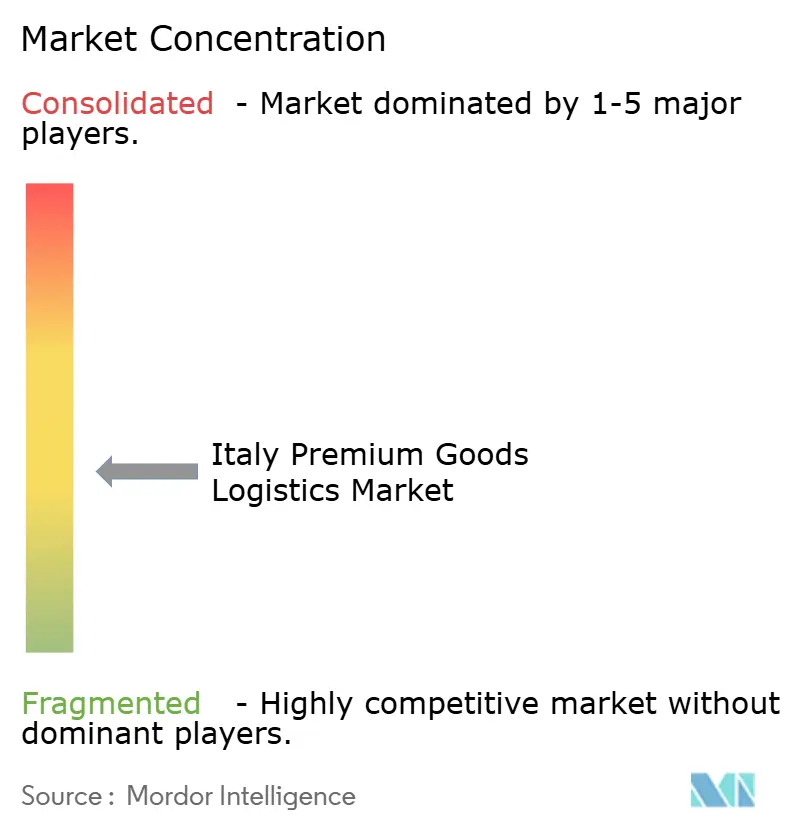
| Market Concentration | Medium |
Major Players *Disclaimer: Major Players sorted in no particular order Image © Mordor Intelligence. Reuse requires attribution under CC BY 4.0. | |
Italy Premium Goods Logistics Market Analysis by Mordor Intelligence
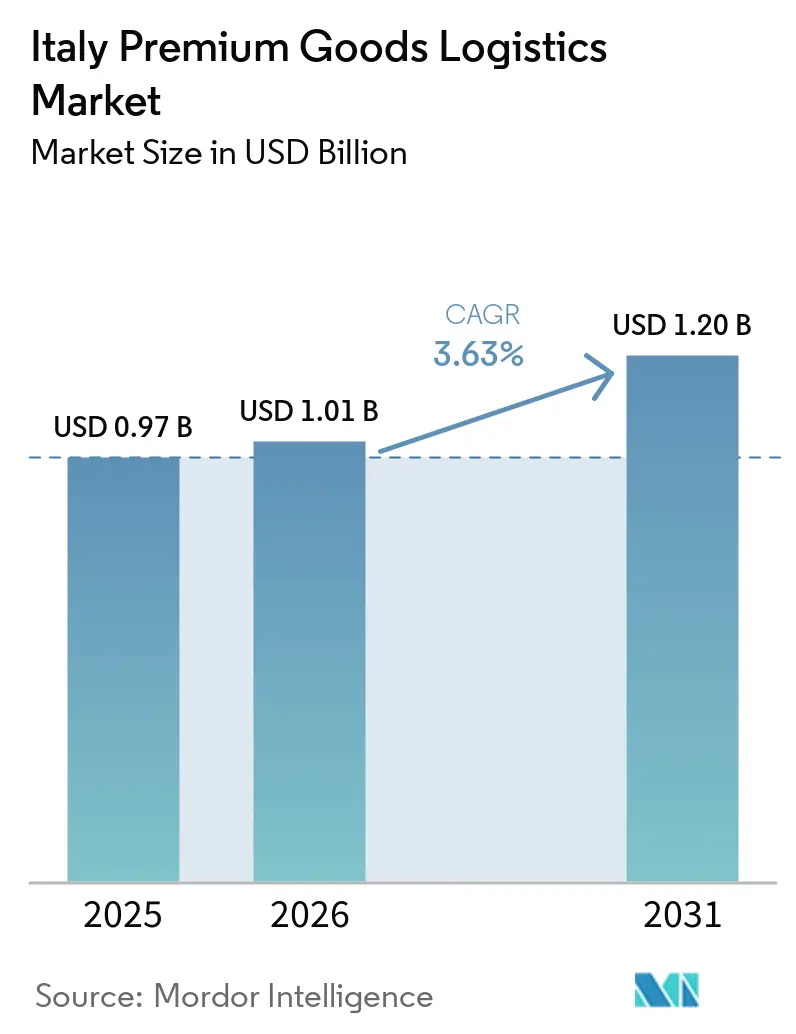
The Italy premium goods logistics market size was valued at USD 0.97 billion in 2025 and is estimated to grow from 1.01 billion in 2026 to reach 1.20 billion by 2031, at a CAGR of 3.63% during the forecast period (2026-2031).
Italy’s luxury export base supported recurring demand for secure transport, specialist storage, and documented handling across domestic and export flows. The Italy premium goods logistics market benefited from production clusters in Lombardy, Tuscany, and the Veneto, where brands required close coordination between factories, warehouses, and retail channels. Reshoring by luxury groups continued to shift logistics activity toward Italy, with Kering’s Piedmont hub supporting the relocation of fashion logistics flows from Switzerland and strengthening Italy’s role as a direct export and distribution base. This trend reduced Switzerland’s role as an intermediary hub for Italian fashion exports, while Piedmont’s growing international apparel and leather shipments indicate increasing concentration of luxury-goods logistics and supply-chain activity within Italy. Providers competed through traceability, security, and value-added services rather than freight rates, while higher operating costs reflected dedicated security procedures, specialized insurance, and tailored handling standards.[1]Air Traffic Data, Executive Summary,” Italian Civil Aviation Authority, enac.gov.it
Key Report Takeaways
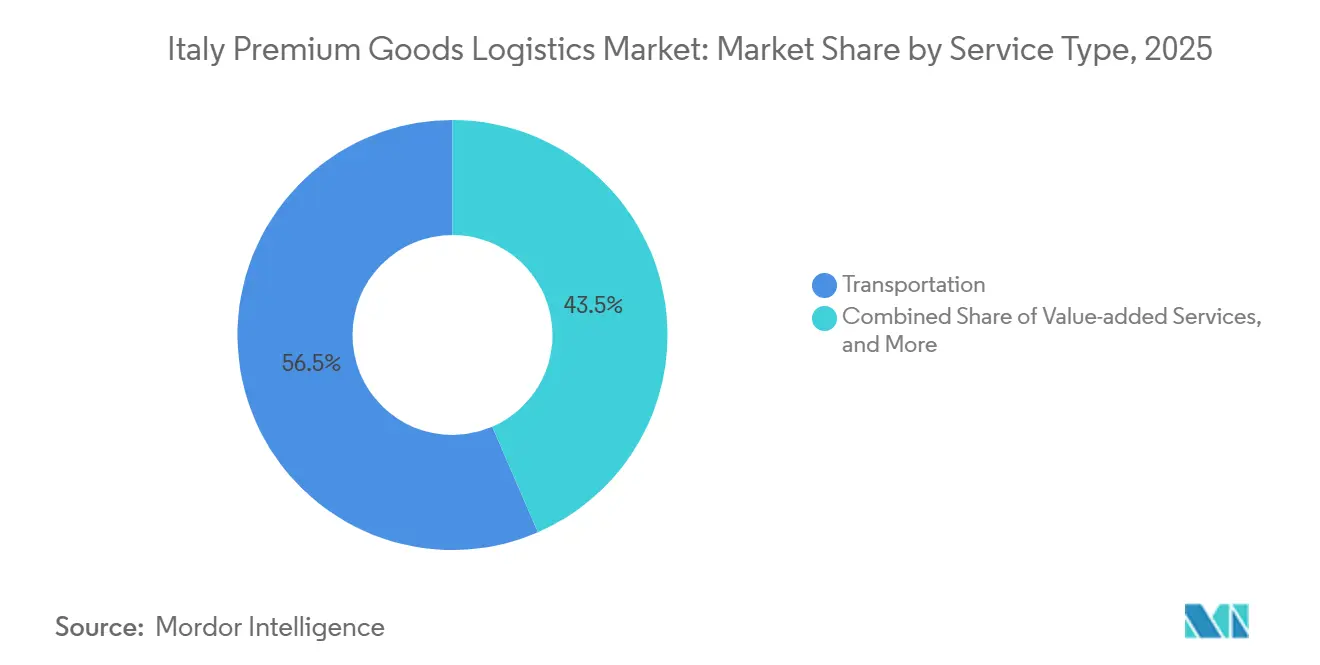
- By service, transportation held 56.50% of the Italy premium goods logistics market share in 2025, while value-added Services and others recorded the highest projected CAGR at 4.37% through 2031.
- By goods type, luxury fashion, and accessories held 39.55% of the Italy premium goods logistics market size in 2025, while watches and jewelry recorded the highest projected CAGR at 4.15% through 2031.
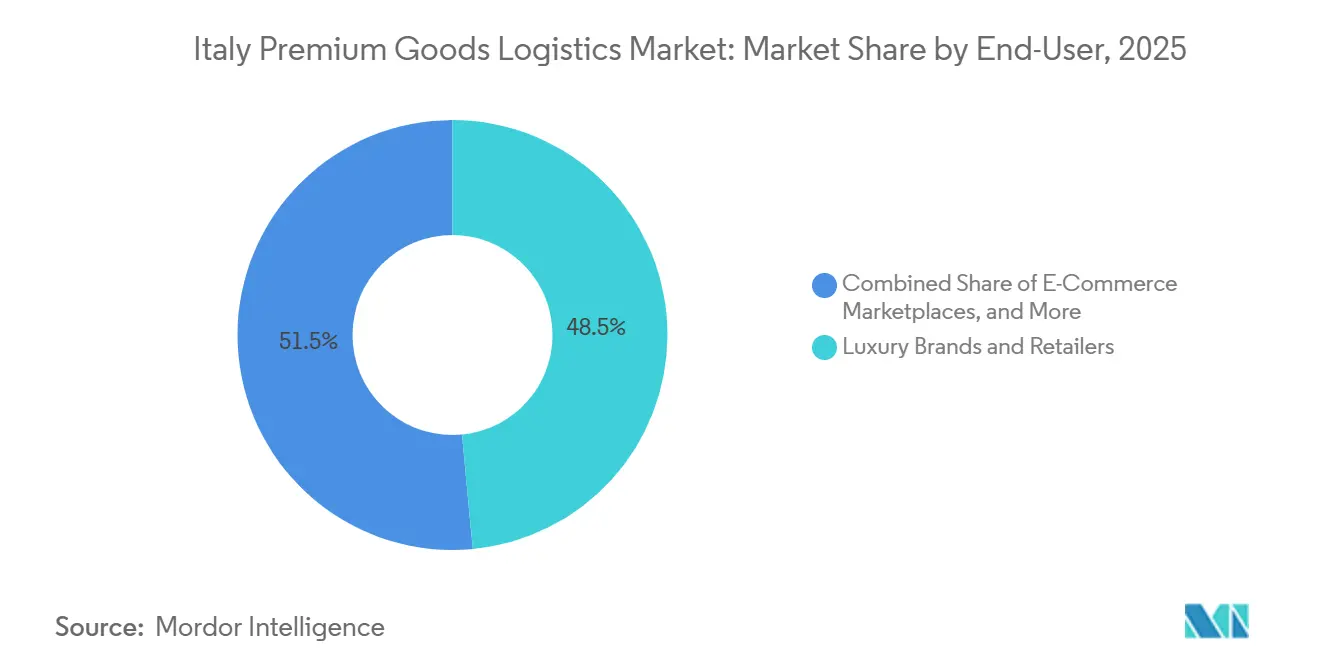
- By end user, luxury brands and retailers held 48.50% of the Italy premium goods logistics market share in 2025, while e-commerce marketplaces recorded the highest projected CAGR at 5.35% through 2031.
- By destination, domestic shipments held 55.00% of the Italy premium goods logistics market size in 2025 volumes, while international shipments recorded the highest projected CAGR at 4.10% through 2031.
Note: Market size and forecast figures in this report are generated using Mordor Intelligence’s proprietary estimation framework, updated with the latest available data and insights as of January 2026.
Italy Premium Goods Logistics Market Trends and Insights
Drivers Impact Analysis*
| Driver | (~) % Impact on CAGR Forecast | Geographic Relevance | Impact Timeline |
|---|---|---|---|
| Luxury E-Commerce Fulfillment and Same-Day Delivery | +1.2% | National, concentrated in Milan, Florence, and Rome metropolitan corridors | Short term (≤ 2 years) |
| Cross-Border Premium Shopping Flows Through Incheon | +0.6% | National, with primary exit through Milan Malpensa and Venice Marco Polo air cargo hubs | Medium term (2-4 years) |
| Temperature-Controlled and Tamper-Evident Handling | +0.5% | National, with early gains in Lombardy cold-chain nodes near Malpensa | Medium term (2-4 years) |
| End-to-End Chain-of-Custody Visibility | +0.4% | Global, with supply-chain anchors in Northern Italy luxury manufacturing districts | Medium term (2-4 years) |
| Reverse Logistics for Returns, Repairs, and Authentication | +0.3% | National, with spillover into EU e-commerce return corridors | Short term (≤ 2 years) |
| Appointment-Based White-Glove Delivery | +0.3% | National, concentrated in Rome, Milan, and Venice high-net-worth residential areas | Long term (≥ 4 years) |
| Source: Mordor Intelligence | |||
Growth of Luxury E-Commerce Fulfillment and Same-Day Delivery Demand
Luxury e-commerce increased the need for faster and more closely managed fulfillment in Italy. Direct-to-consumer orders required accurate stock visibility, secure packing, and reliable delivery windows. GXO Logistics renewed its Versace partnership in January 2025 and continued to manage omnichannel fulfillment from warehouses in Bellinzago Novarese and Novara. The sites handled 2.4 million pieces annually and used RFID, hanging-garment sorters, and 3D sortation systems that could triple peak-season throughput. This level of fixed infrastructure supported long-term capacity near premium brands and raised the operational standard for newer providers. The Italy premium goods logistics market, therefore, rewarded operators that could combine fashion handling with consistent omnichannel fulfillment.
Rising Cross-Border Premium Shopping Flows Through Incheon Gateway
Italian luxury brands served customers through stores, online channels, and travel retail locations across Asia. This pattern created outbound replenishment needs from Italian distribution centers and inbound flows for authenticated returns. Milan Malpensa and Venice Marco Polo provided relevant air cargo connections for these higher-value shipments. Cross-border demand required providers to coordinate time-sensitive transport, customs documentation, and secure transfer procedures. The flow also widened the role of Italian facilities beyond domestic boutique replenishment. The Italy premium goods logistics market gained from this activity, where operators maintained dependable links between Italian production districts and international air gateways.
Expansion of Temperature-Controlled and Tamper-Evident Handling Standards
Controlled conditions became more relevant for cosmetics, fragrances, fine wines, spirits, and selected premium accessories. These products required stable storage conditions and records that supported product integrity. Italian premium shippers also required tamper-evident handling across storage and transport. The resulting work extended beyond standard warehousing because providers needed documented processes for each movement. Facilities near Milan Malpensa were positioned to serve products that moved through air cargo channels and needed specialized storage. The Italy premium goods logistics market consequently created room for operators that combined environmental controls with secure inventory practices.
Brand Demand for End-to-End Chain-of-Custody Visibility
Counterfeit activity increased the importance of continuous documentation for luxury shipments. Between July 2024 and June 2025, Italy’s Customs and Monopolies Agency seized 4.4 million items in more than 6,000 proceedings.[2]“Carte in Regola Contro i Falsi, Anti-Counterfeiting Activity Results July 2024-June 2025,” ADM, adm.gov.it Clothing and fashion accessories accounted for more than 860,000 pieces and ranked as the second-most-seized category. Brands responded by seeking unbroken records from production through final delivery. RFID-enabled warehouse systems and customs documentation helped logistics operators show control over each transfer. The Italy premium goods logistics market favored specialists who could connect physical security with reliable shipment data.
Restraints Impact Analysis*
| Restraint | (~) % Impact on CAGR Forecast | Geographic Relevance | Impact Timeline |
|---|---|---|---|
| Security, Insurance, and Compliance Cost Per Shipment | -0.7% | National, with the highest incident concentration in Lombardy road corridors | Short term (≤ 2 years) |
| Limited Scale Economics in Fragmented Premium Brand Networks | -0.5% | National, concentrated in Northern Italy luxury manufacturing districts | Medium term (2-4 years) |
| Customs Delays and Documentation Complexity | -0.4% | Asia-Pacific-bound and United States-bound international corridors, Malpensa and Genoa customs points | Medium term (2-4 years) |
| Shortage of Specialized High-Value Cargo Handling Talent | -0.3% | National, most acute in Southern Italy and secondary manufacturing towns | Long term (≥ 4 years) |
| Source: Mordor Intelligence | |||
High Security, Insurance, and Compliance Cost Per Shipment
Cargo theft created a material operating challenge for Italian premium supply chains. Clothing and apparel ranked as the second-most-targeted commodity in Italy in the cargo-theft report prepared by TT Club and BSI. Incidents were concentrated in Lombardy, which also served as a central logistics area for luxury production and distribution. Secure movements often required armored vehicles, GPS geo-fencing, trained personnel, and dedicated high-value cargo procedures. These measures increased the cost per shipment and added complexity for brands with time-sensitive requirements. Smaller brands faced particular pressure because dedicated secure transport did not offer the cost structure of standard parcel delivery.
Limited Scale Economics in Fragmented Premium Brand Networks
Italy’s premium production base remained dispersed across local manufacturing clusters. More than 37,000 textile and apparel companies operated in 2025, according to Confindustria Moda’s reported annual data. Lombardy, Tuscany, the Veneto, and Campania each retained distinct production and logistics relationships. A provider serving several brands across these areas needed to adapt security rules, packaging methods, insurance tiers, and authentication workflows for individual customers. This limited the use of shared linehaul, pooled storage, and standardized sorting systems. The Italy premium goods logistics industry, therefore, retained a structural cost disadvantage relative to mass-market parcel logistics.
*Our forecasts treat driver/restraint impacts as directional, not additive. The impact forecasts reflect baseline growth, mix effects, and variable interactions.
Segment Analysis
By Service: Transportation Led the Market While Value-Added Work Expanded Faster
Transportation accounted for 56.50% of the Italy premium goods logistics market share in 2025. Road freight linked manufacturing areas in Lombardy, Tuscany, and the Veneto with domestic boutiques and European distribution centers. Air freight handled watches, jewelry, and limited-edition fashion where speed and security were especially important. Milan Malpensa handled EUR 60.7 billion (USD 65.6 billion) in import-export trade flows in 2025, and represented 4.9% of Italy’s total international trade. Road transport continued to support domestic business-to-business restocking and boutique replenishment. Rail, sea, and inland waterway services held narrower roles for fine art and larger wine movements.
Value-added services and others recorded the fastest projected CAGR at 4.37% from 2026 to 2031. Brands purchased RFID tagging, garment repair, authentication screening, digital product passport support, and white-glove delivery alongside freight services. These activities created recurring per-unit work and were less exposed to standard freight-rate movements. Returns and unsold inventory also required careful sorting, inspection, and rework before resale or other secondary channels. Providers with secure rework capacity could serve these flows without separating handling from documentation. This part of the Italy premium goods logistics market expanded as brands placed more operational steps within specialist logistics contracts. The work covered preparation before shipment, control during storage, and checks after an item returned. It also linked physical handling with records that brands could use for product-level tracking. These requirements made specialist service capabilities relevant across several premium goods categories.



By Goods Type: Fashion and Accessories Led, While Watches and Jewelry Grew Faster
Luxury fashion and accessories held 39.55% of the Italy premium goods logistics market size in 2025. Italy’s fashion production and export position supported frequent replenishment, secure transport, and garment-specific storage. Each movement required providers to manage products that varied by collection, retail channel, and delivery timing. This category also linked factory dispatches with wholesale deliveries, boutique replenishment, and direct customer orders. Moncler announced a EUR 80 million (USD 86 million) expansion of the ALS Luxury Logistics hub at Castel San Giovanni in June 2025. The project targeted a capacity of more than 15 million processed pieces annually by 2028. Warehousing for this category used climate controls, continuous monitoring, restricted access, and inventory systems suited to insured goods. These features reflected the need to preserve product condition from receipt through dispatch. Operators also needed to separate inventory while maintaining efficient stock movement. This category continued to provide a broad base of activity for specialist logistics providers.
Watches and jewelry recorded the highest projected CAGR at 4.15% from 2026 to 2031. High unit values made secure custody, authentication, and rapid air transport central to the service design. Malpensa Customs and the Guardia di Finanza intensified joint anti-smuggling activity from January 2026. Their June 2026 operation seized counterfeit watches and accessories valued at more than EUR 2.4 million (USD 2.6 million). Providers needed to protect these shipments during handovers, storage, and transport. fine art and collectibles required controlled crating and provenance documentation. premium spirits and wine required bonded storage and temperature management. Consumer electronics, cosmetics, and fragrances each required dedicated packaging standards. The Italy premium goods logistics market served these categories through tailored procedures rather than a single handling model. This mix widened the operational capabilities expected from specialist providers.
By End User: Brands Held the Largest Position While Marketplaces Expanded Faster
Luxury brands and retailers held 48.50% of the Italy premium goods logistics market share in 2025. They directly sourced multi-year contracts that combined transport, storage, and specialized support services. Brand-led networks needed reliable handling for boutiques, wholesale customers, repair flows, and returns. Several groups concentrated logistics within group-level infrastructure and relied on selected specialist providers. This arrangement strengthened contract continuity for operators with established fashion and luxury capabilities. It also gave brands greater control over service standards, inventory treatment, and the timing of retail replenishment. Selected providers became part of the distribution design rather than acting only as transport suppliers. Art galleries and auction houses, airports and duty-free operators, and corporate gifting and concierge services required separate combinations of provenance control, bonded inventory, and responsive dispatch.
E-commerce marketplaces recorded the fastest projected CAGR at 5.35% from 2026 to 2031. Italian luxury e-commerce penetration reached 68% in 2025, below the reported levels in the United Kingdom and France. This gap supported further digital order activity within Italy. It also increased the importance of efficient returns processes because online luxury purchases required product inspection before inventory could be offered again. Providers managed those steps alongside delivery preparation and stock control. Marketplace operators needed real-time inventory data, authentication lanes for returns, and rapid grading of returned items. These requirements favored providers that had integrated warehouse and shipment systems. The Italy premium goods logistics market, therefore, saw higher demand for technology-supported reverse logistics alongside outbound order fulfillment.
By Destination: Domestic Movements Led While International Movements Grew Faster
Domestic shipments accounted for 55.00% of 2025 volumes in the Italy premium goods logistics market size. Italy had 12,659 post offices in 2025 and retained dense retail networks in Milan, Rome, and Florence. Branded boutiques and multi-brand retailers required regular replenishment and appointment-based final delivery. Poste Italiane delivered 349 million parcels during 2025, which reflected the scale of the national parcel network. Premium movements differed from standard parcels because they required more secure custody and more specific delivery procedures. Domestic demand helped providers maintain daily activity close to urban retail centers.
International shipments recorded the faster projected CAGR at 4.10% from 2026 to 2031. Exports to the United States, Germany, France, and Asian markets supported demand for air and road connections from Italian production areas. Made in Italy exports increased 3.5% in the first 10 months of 2025, while Malpensa Cargo City supported fashion, mechanical, and furnishings flows. International operators needed to manage customs processes, secure transfers, and destination-specific documentation. Changes in tariffs and trade conditions could affect shipment volumes and timing for premium goods. The Italy premium goods logistics market consequently depended on both reliable gateway capacity and experienced customs support.
Geography Analysis
Northern Italy led the Italy premium goods logistics market because Lombardy, Piedmont, and the Veneto formed a concentrated manufacturing base for fashion, accessories, and hard luxury. Milan Malpensa handled 63% of national air cargo volumes and 759,400 tons of cargo in 2025. The airport’s trade flows totaled EUR 60.7 billion (USD 65.6 billion) and represented 4.9% of Italy’s international trade. Lombardy’s road network linked Malpensa with Biella, Vigevano, and the Castel San Giovanni-Piacenza corridor. These connections supported secure warehousing, customs activity, and frequent replenishment for branded retail. Northern locations also attracted investment in automation and bonded high-security capacity.
Central Italy formed the second most significant area for the Italy premium goods logistics market, with Tuscany anchoring leather goods production. Italian leather goods turnover reached EUR 11.4 billion (USD 12.3 billion) in 2025.[3]Assopellettieri, “Leather Goods, 2025 Closes in Negative Territory, Annual Turnover at EUR 11.4 Billion,” MIPEL Industry Statistics, mipel.com Exports reached EUR 5.7 billion (USD 6.2 billion) and were concentrated around Florentine production areas. Rome supported premium final delivery for affluent residential customers and luxury boutiques around Via Condotti. Rhenus Logistics opened the Riano 2 hub near Rome in October 2025, adding more than 5,600 m² of directly managed space. The expansion showed how operators extended direct service beyond their Northern Italy networks.
Southern Italy and the Islands remained smaller within the Italy premium goods logistics market because specialist coverage had been limited by infrastructure gaps and higher per-shipment costs. Fercam opened operational sites in Bari and Campobasso during 2025, extending its footprint into Adriatic and inland southern areas. National logistics investment also improved multimodal options for premium shippers. Italian ports handled 9.35 million TEUs in 2025, increasing 8.3%. The wider port network supported more choices for premium wine, spirits, and selected high-value shipments. Providers still needed to balance coverage gains against security requirements and transport costs. Smaller locations required the same careful handling expected by premium brands, even when shipment volumes did not support the density found in Northern Italy. This left service coverage dependent on the ability to combine local access with dedicated operational processes.
Competitive Landscape
The Italy premium goods logistics market remained moderately fragmented, with global groups managing major branded accounts and Italian specialists maintaining significant regional and niche positions. DHL Supply Chain, GXO Logistics, Kuehne + Nagel, CEVA Logistics, and Geodis served branded customers through long-term contracts and technology-supported models. Arcese Group, Savino Del Bene, Fercam, and ALS Luxury Logistics competed through local knowledge, operational flexibility, and familiarity with Italian customs processes. GXO used RFID-enabled facilities, 3D sortation, and robotic systems within its European fashion logistics network. DHL Supply Chain Italia invested EUR 16 million (USD 17 million) annually in automation, collaborative robotics, and a logistics control tower in Lodi. These investments made it harder for smaller providers to offer similar capacity across large networks.
Italian specialists retained a role where customers valued dedicated service and detailed regulatory knowledge. Savino Del Bene shipped 852,000 TEU by sea and 92,500 tons by air in 2025. It generated EUR 2.9 billion (USD 3.13 billion) in revenue during that year. In May 2026, Savino Del Bene acquired Maritima Sureste Shipping, Marítima Sureste Spain, and Transportes Gaypemar in Spain. The acquisition added intermodal, rail, and in-house transport capabilities along the Murcia-Almeria-Algeciras corridor. This strengthened its European network for Italian exporters supplying Iberian retail destinations.
Ferrari Group operated a specialized network in 64 countries for watch and jewelry logistics, including armored vehicles and vault warehousing. In August 2026, it launched FG SecurePort at Amsterdam-Schiphol Airport to provide specialized ground handling and traceable storage for high-value air freight. The move extended its integrated model to a major European air cargo hub. Kuehne+Nagel and Mondadori Group also inaugurated a 40,000 m² LEED Gold-certified fulfillment center in Mantua during July 2026.[4]“Regulation EU 2024/1781 on Ecodesign for Sustainable Products,” Official Journal of the European Union, eur-lex.europa.eu
Italy Premium Goods Logistics Industry Leaders
Poste Italiane
DHL Group
Kuehne+Nagel
CMA CGM Group
DSV A/S
- *Disclaimer: Major Players sorted in no particular order

Recent Industry Developments
- August 2026: Ferrari Group launched operations of FG SecurePort, a wholly owned subsidiary established in late 2025, at Amsterdam-Schiphol Airport, providing specialized ground handling and fully traceable storage services for high-value luxury air freight shipments. The move extends the Italian-origin specialist's vertically integrated model to one of Europe's primary air cargo hubs, serving Italian luxury exporters with secure transit across the Schiphol interchange.
- June 2026: Kuehne+Nagel and Mondadori Group inaugurated a 40,000 square meters LEED Gold-certified fulfillment center in San Giorgio Bigarello, Mantua, consolidating operations previously spread across three locations, with full operations commencing in June 2026.
- June 2026: GXO Logistics opened a new distribution center in Ferentino, Frosinone province, to support Action's expansion across Central and Southern Italy. The gas-free facility features photovoltaic panels and smart consumption monitoring, extending GXO's direct management footprint in Lazio.
- May 2026: Savino Del Bene acquired three Murcia-based companies of Grupo Marítima Sureste, Marítima Sureste Shipping, Marítima Sureste Spain, and Transportes Gaypemar, consolidating its position in the Murcia-Almeria-Algeciras corridor and integrating intermodal, rail, and in-house transport capabilities.


Italy Premium Goods Logistics Market Report Scope
| Transportation | Road |
| Rail | |
| Air | |
| Sea and Inland Waterways | |
| Warehousing and Storage | |
| Value-added Services |
| Luxury Fashion and Accessories |
| Watches and Jewelry |
| Consumer Electronics |
| Cosmetics and Fragrances |
| Fine Art and Collectibles |
| Premium Spirits and Wine |
| Other Premium Goods |
| Luxury Brands and Retailers |
| E-commerce Marketplaces |
| Art Galleries and Auction Houses |
| Airports and Duty-Free Operators |
| Corporate Gifting and Concierge Services |
| Others |
| Domestic |
| International |
| By Service | Transportation | Road |
| Rail | ||
| Air | ||
| Sea and Inland Waterways | ||
| Warehousing and Storage | ||
| Value-added Services | ||
| By Goods Type | Luxury Fashion and Accessories | |
| Watches and Jewelry | ||
| Consumer Electronics | ||
| Cosmetics and Fragrances | ||
| Fine Art and Collectibles | ||
| Premium Spirits and Wine | ||
| Other Premium Goods | ||
| By End User | Luxury Brands and Retailers | |
| E-commerce Marketplaces | ||
| Art Galleries and Auction Houses | ||
| Airports and Duty-Free Operators | ||
| Corporate Gifting and Concierge Services | ||
| Others | ||
| By Destination | Domestic | |
| International |


Key Questions Answered in the Report
What is the 2026 value of Italy premium goods logistics?
The 2026 value stood at USD 1.01 billion, with the forecast reaching USD 1.20 billion by 2031.
Which service led premium logistics activity in Italy?
Transportation led with a 56.50% share in 2025, supported by road and air links from key manufacturing districts.
Which goods category grew fastest through 2031?
Watches and jewelry recorded the highest projected CAGR at 4.15% between 2026 and 2031.
Which end user expanded fastest in Italy?
E-commerce marketplaces recorded the highest projected CAGR at 5.35% through 2031.
Why is Northern Italy central to premium logistics?
Northern Italy combined luxury production districts with Malpensa, which handled 63% of national air cargo volumes in 2025.
What services do premium brands seek from logistics providers?
Brands seek secure transport, traceable storage, RFID support, authentication, returns processing, and white-glove delivery.
Page last updated on:





