
Italy Enterprise Content Management Market Size and Share
Market Overview
| Study Period | 2020 - 2031 |
|---|---|
| Forecast Data Period | 2026 - 2031 |
| Base Year Market Size (2025) | USD 1.22 Billion |
| Market Size (2026) | USD 1.38 Billion |
| Market Size (2031) | USD 2.63 Billion |
| Growth Rate (2026 - 2031) | 13.78% CAGR |
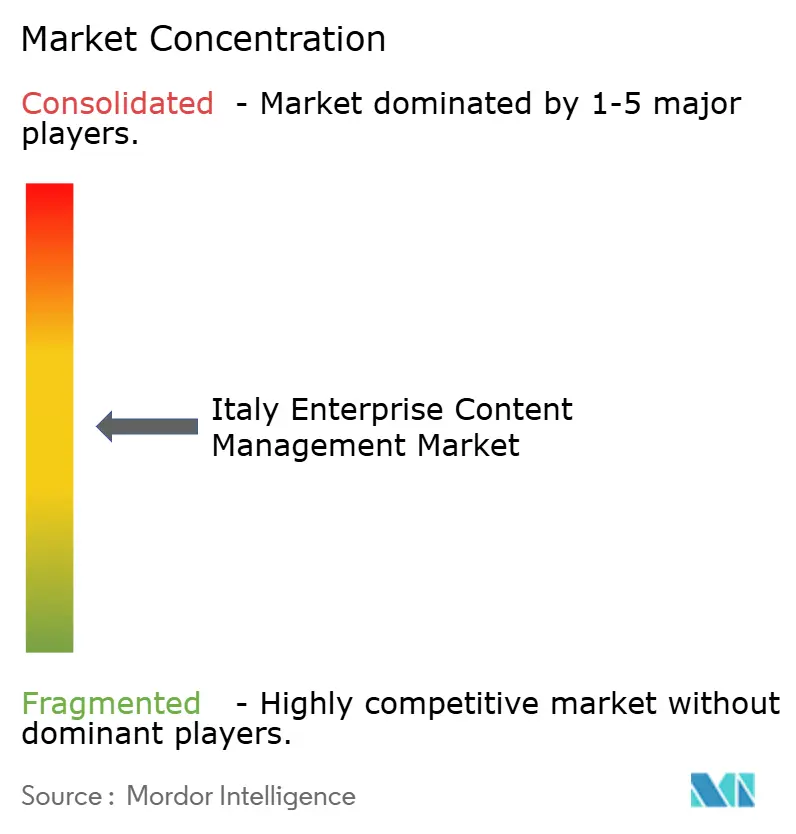
| Market Concentration | Medium |
Major Players *Disclaimer: Major Players sorted in no particular order Image © Mordor Intelligence. Reuse requires attribution under CC BY 4.0. | |
Italy Enterprise Content Management Market Analysis by Mordor Intelligence
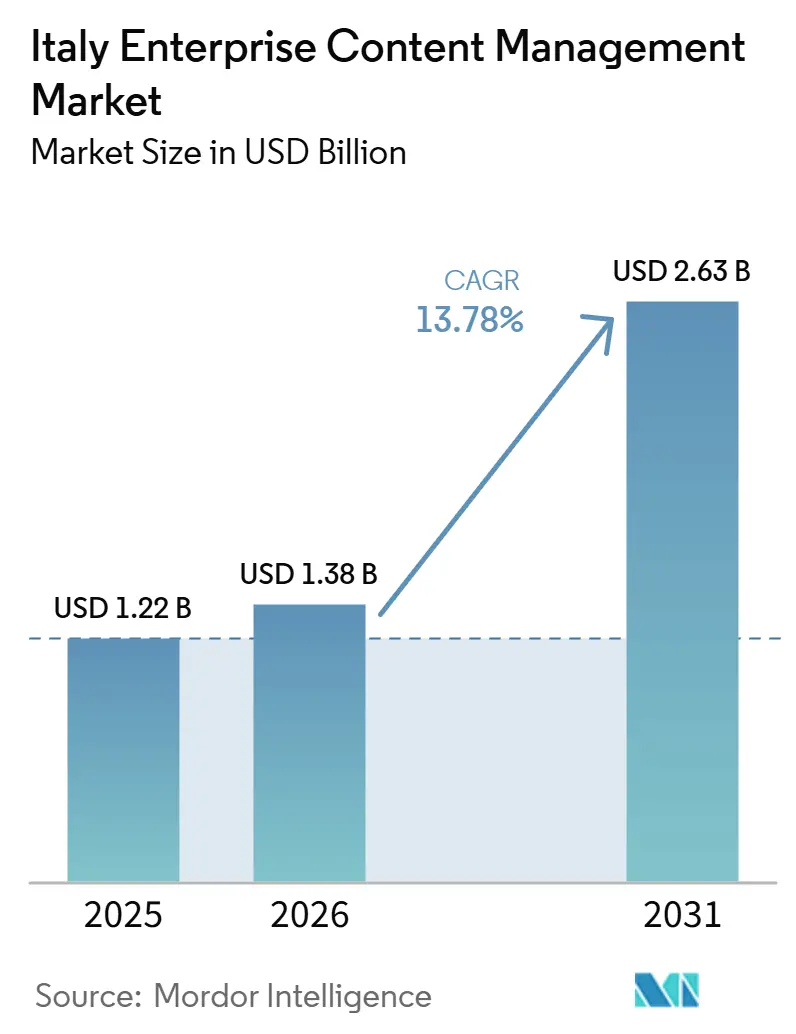
The Italy enterprise content management market size is expected to increase from USD 1.22 billion in 2025 to USD 1.38 billion in 2026 and reach USD 2.63 billion by 2031, growing at a CAGR of 13.78% over 2026-2031. The Italy enterprise content management market is expanding as enterprises replace fragmented repositories with governed platforms that connect documents, records, workflows, and business systems in one environment. A major reason for this demand is that Italy’s long-running e-invoicing regime already pushed many organizations to build document processing routines, so broader platform upgrades now look like a practical next step instead of a first digital move. The market is also benefiting from stronger cloud readiness, rising interest in AI-enabled search, and tighter compliance needs across banking, public administration, and healthcare. Competition is centered on vendors that can combine governance, automation, and AI within the same platform, because buyers increasingly want fewer systems and clearer accountability. This keeps the 2026-2028 buying cycle focused on platform consolidation, regulated workflow control, and upgrades that can handle both legacy archives and new digital content.
Key Report Takeaways
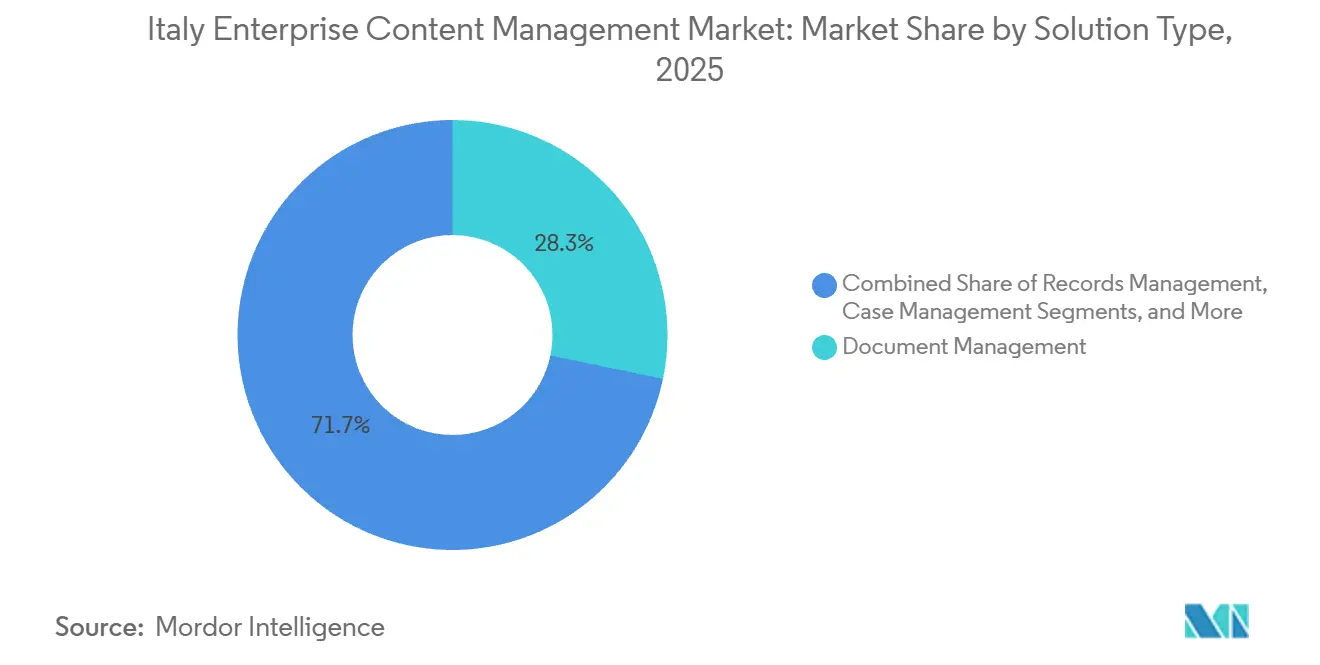
- By solution type, document management led with a 28.27% share in 2025, while workflow and business process management is projected to expand at a 15.03% CAGR through 2031.
- By deployment mode, cloud held 73.14% of the Italy enterprise content management market in 2025, while hybrid is expected to record the highest CAGR at 15.68% through 2031.
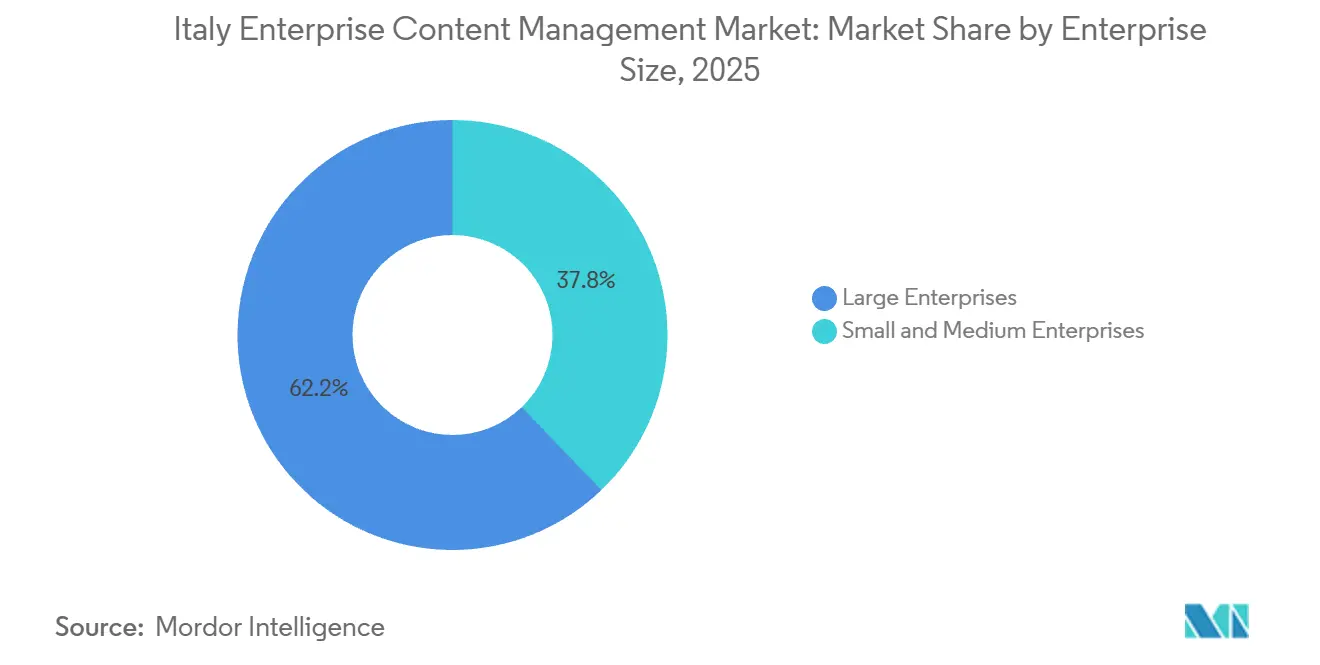
- By enterprise size, large enterprises accounted for 62.18% of the Italy enterprise content management market in 2025, while SMEs are projected to grow at a 14.57% CAGR through 2031.
- By end-user industry, BFSI captured 23.46% share in 2025, while healthcare and lifesciences is forecast to advance at a 15.92% CAGR through 2031.
Note: Market size and forecast figures in this report are generated using Mordor Intelligence’s proprietary estimation framework, updated with the latest available data and insights as of January 2026.
Italy Enterprise Content Management Market Trends and Insights
Drivers Impact Analysis*
| Driver | (~) % Impact on CAGR Forecast | Geographic Relevance | Impact Timeline |
|---|---|---|---|
| Accelerated Paperless Compliance in Regulated Italian Workflows | +3.2% | National, concentrated in Milan financial corridor and Rome public administration cluster | Short term (≤ 2 years) |
| Rising Demand for AI-Assisted Search and Retrieval | +2.6% | National, early concentration in large-enterprise hubs in Lombardy, Emilia-Romagna, and Veneto | Medium term (2-4 years) |
| Expansion of Cloud-Native Content Governance | +2.1% | National, highest uptake in North-West Italy, with spillover to Central Italy | Short term (≤ 2 years) |
| Modernization of Public Sector and Healthcare Records | +1.8% | National, led by Rome public administration cluster and regional health authority hubs | Medium term (2-4 years) |
| Sovereign Cloud and Data Residency Preference | +1.2% | National, strongest in regulated industries and public administration | Medium term (2-4 years) |
| Need for Embedded Compliance Evidence Trails in Contract-Heavy Industries | +0.9% | National, concentrated in Lombardy and North-East Italy | Long term (≥ 4 years) |
| Source: Mordor Intelligence | |||
Accelerated Paperless Compliance in Regulated Italian Workflows
The Italy enterprise content management market is receiving direct support from binding rules on digital documents across public administration and regulated workflows. Italy’s Codice dell’Amministrazione Digitale and AgID guidance require public entities to formalize document management processes, assign records responsibility, and maintain compliant preservation methods for digital records. AgID’s 2024-2026 planning framework set a target for full adoption of document management manuals and designated records officers across public administration by 2025, which pushed organizations toward structured platform investments rather than isolated tools.[1]Agenzia per l'Italia Digitale, “Piano Triennale per l'Informatica nella Pubblica Amministrazione 2024-2026,” agid.gov.it The compliance burden became more immediate when AgID carried out a formal questionnaire-based monitoring exercise in late 2025, making the state of readiness more visible across the public sector. This matters because buyers in the Italy enterprise content management market are not only reacting to internal efficiency goals, they are also responding to deadlines and oversight. That combination keeps procurement moving even when broader IT budgets remain selective.
Rising Demand For AI-Assisted Search and Retrieval
The Italy enterprise content management market is also gaining momentum from demand for faster search, retrieval, and interpretation of unstructured content. AI adoption among Italian enterprises reached 16.4% in 2025, up from 8% in 2024, which shows that readiness for AI-enabled business tools is building quickly. In document-heavy environments, the appeal of AI is practical because staff need quicker access to contracts, records, and archived files without depending on years of manual tagging. This is changing how the Italy enterprise content management market is evaluated, because search quality and governed automation now influence buying decisions as much as storage and archive features. Vendors that place AI inside controlled workflows are in a better position than those offering separate tools, since buyers want auditability and oversight built into the same environment. The result is a market where AI is moving from an optional enhancement to a core reason for platform renewal.
Expansion of Cloud-Native Content Governance
The Italy enterprise content management market is benefiting from a cloud base that is stronger than many peer markets in Europe. Cloud adoption among Italian enterprises with 10 or more employees reached 68.1% in 2025, well above the EU average of 46.7%. Once cloud became normal infrastructure, buyer attention shifted from basic hosting toward governance, retention, workflow control, and compliant access across departments. That shift aligns closely with the value of cloud-native content platforms, which can manage active content flows without relying on local hardware. AgID’s cloud-first direction for public administration also supports this transition, because public entities now need controlled digital environments that can scale across agencies and use cases. As a result, the Italy enterprise content management market is moving beyond cloud adoption itself and into a phase where governance on top of cloud infrastructure drives new spending.
Modernization of Public Sector and Healthcare Records
The Italy enterprise content management market is seeing sustained demand from public records modernization and the digital restructuring of healthcare documentation. AGENAS described the Ecosistema Dati Sanitari as a strategic national health data initiative, and its rollout has raised the need for platforms that can capture, route, preserve, and exchange records under defined rules. Healthcare demand is reinforced by the FSE 2.0 push, which has increased the operational need to feed clinical documentation into connected national and regional systems. The growing digital healthcare spending creates a split in the Italy enterprise content management market, because large regional health bodies need enterprise-grade records control, while smaller facilities often need lighter and faster subscription-based tools. Public administration adds another layer of demand, since records management is no longer a narrow archive issue and is now part of broader service modernization.
Restraints Impact Analysis*
| Restraint | (~) % Impact on CAGR Forecast | Geographic Relevance | Impact Timeline |
|---|---|---|---|
| Legacy Archive Migration Complexity in Public and Mid-Market Enterprises | -1.5% | National, most acute in Southern Italy public administration and mid-market manufacturing belts | Medium term (2-4 years) |
| High Integration Cost With ERP, ERP-Adjacent, and Legacy Line-Of-Business Systems | -1.1% | National, strongest in Lombardy and Veneto manufacturing and BFSI clusters | Medium term (2-4 years) |
| Security and Privacy Concerns Around Unstructured Content in Hybrid Environments | -0.7% | National, heightened in sectors handling sensitive data | Short term (≤ 2 years) |
| Shortage of ECM-Skilled Administrators and Content Governance Specialists | -0.5% | National, most acute in public administration and smaller manufacturing enterprises | Long term (≥ 4 years) |
| Source: Mordor Intelligence | |||
Legacy Archive Migration Complexity in Public and Mid-Market Enterprises
The Italy enterprise content management market still faces a major drag from the difficulty of moving large paper archives and proprietary digital records into modern systems. Many public bodies and mid-sized firms hold decentralized records that were created without consistent metadata, which makes classification and migration slow. The work is not limited to scanning, because organizations also need validation, format handling, and proof that digitized records remain legally reliable. AgID’s preservation framework adds another layer of rigor, since compliant digital conservation must follow formal rules rather than ad hoc storage practices. This delays the point at which a new platform starts generating full operational value. It also extends decision cycles in the Italy enterprise content management market because buyers often need migration clarity before they commit to a larger rollout.
High Integration Cost With ERP, ERP-Adjacent, And Legacy Line-Of-Business Systems
The Italy enterprise content management market is also constrained by the cost and effort of integration with core business applications. Italian enterprises in manufacturing and BFSI often run mixed technology estates where ERP, line-of-business software, and local legacy applications all need to exchange documents and metadata. In these settings, connector work, workflow mapping, and testing can become as important as the platform license itself. This issue is more serious for mid-market firms because they usually have less internal integration capacity and less tolerance for long deployment schedules. It also gives an advantage to ERP-native document functions when buyers place lower integration risk ahead of broader ECM depth. That dynamic can narrow the near-term addressable space for specialist vendors, even when the need for stronger content governance is clear.
*Our forecasts treat driver/restraint impacts as directional, not additive. The impact forecasts reflect baseline growth, mix effects, and variable interactions.
Segment Analysis
By Solution Type: Document Management Anchors Revenue While Workflow And BPM Lift New Demand
Document management held the largest share of the Italy enterprise content management market at 28.27% in 2025, and it accounted for 28.27% of the Italy enterprise content management market share in that year. Its lead came from long-running digitization and archiving activity across BFSI, manufacturing, and public administration, where large document volumes built a steady installed base. The segment remains central because many buyers still need stronger control over classification, retention, and retrieval before they extend into more advanced automation. Records management also remains important, since audit exposure, legal retention rules, and information governance needs keep demand tied to disciplined lifecycle control. Web content management and adjacent repository tools continue to support organizations that need to coordinate internal and external content from one governed environment.
Workflow and BPM is projected to grow at 15.03% CAGR through 2031, which makes it the most dynamic solution area in the Italy enterprise content management market. That pace shows a clear shift from passive storage toward active handling of approvals, regulatory reporting, contract routing, and service workflows. In the Italy enterprise content management industry, this changes the way platform value is judged because buyers increasingly want operational movement around documents, not only archive depth. Case management is gaining relevance in legal, insurance, and public administration settings where processes involve multiple participants and rule-based actions. Digital asset management is also finding room in sectors that manage broad content libraries across commercial channels. Together, these changes show that the Italy enterprise content management market is broadening from a repository-centered model into a workflow-centered one.



By Deployment Mode: Cloud Leads Spending, While Hybrid Defines the Transition Path
Cloud deployment dominated with a 73.14% share in 2025, and it represented 73.14% share of the Italy enterprise content management market size in that year. That lead reflects the speed at which Italian organizations moved content infrastructure away from dedicated on-premises hardware and into more flexible service environments. Enterprises with strong digital operations now treat cloud delivery as the default option for new document workflows, collaborative access, and cross-site governance. This is especially visible where organizations need faster deployment, simpler updates, and lower infrastructure management burdens. The cloud model also fits the wider move toward subscription-led procurement and faster functional expansion.
Hybrid deployment is forecast to grow at 15.68% CAGR through 2031, which makes it the highest-growth deployment model in the Italy enterprise content management market. The reason is practical, since many organizations cannot retire large on-premises archives immediately, even while they launch new digital processes in cloud environments. This creates a transition model where active content and workflow layers move first, while historical or highly sensitive records remain in controlled repositories. In the Italy enterprise content management industry, that blended architecture is particularly relevant for buyers with legal admissibility concerns, retention obligations, or internal data handling rules. On-premises systems, therefore, continue to play a selective role instead of disappearing outright. Vendors that can manage this coexistence are better placed to win complex accounts where change must happen in stages.
By Enterprise Size: Large Enterprises Hold the Base While SMEs Add the Fastest Growth
Large enterprises held 62.18% share in 2025, giving them the leading position in the Italy enterprise content management market. Their lead reflects earlier investment in compliance systems, stronger IT budgets, and higher readiness to connect document platforms with enterprise applications. Large organizations also moved faster into cloud usage, which created a stronger starting point for ECM renewals and expansion. Banca d’Italia found that Italian firms with more than 500 employees showed cloud adoption of around 65% in 2024, well ahead of smaller cohorts.[2]Banca d'Italia, “Embracing the Digital Transition, The Adoption of Cloud Computing and AI by Italian Firms,” bancaditalia.it That stronger digital base explains why global platform vendors remain firmly established in the upper tier. Many of these large buyers are now entering upgrade cycles where AI-enabled retrieval and governed automation matter more than first-time platform selection.
SMEs are projected to grow at 14.57% CAGR through 2031, making them the fastest-moving enterprise-size segment in the Italy enterprise content management market. The opportunity is large because smaller firms often still manage contracts, customer files, and operational records through fragmented folders, email chains, and local storage. As cloud access becomes more common, the gap between enterprise-grade needs and actual document practices is becoming harder to ignore. This makes modular and easier-to-deploy offerings more relevant for smaller organizations that want measurable improvement without long implementation programs. In the Italy enterprise content management industry, the SME shift is important because it expands demand beyond the early-mover base that has long supported revenue. The main barrier is not need, but the balance between integration effort, skills availability, and platform simplicity.
By End-User Industry: BFSI Holds the Largest Share, While Healthcare and Lifesciences Expand the Fastest
BFSI held the largest end-user share at 23.46% in 2025, which kept it at the center of the Italy enterprise content management market. Banking and insurance buyers need consistent traceability, controlled retention, and reliable access to contracts, records, and compliance material. That requirement keeps document governance tied closely to risk management and regulatory control. The sector also tends to favor vendors with strong audit, security, and integration credentials, which supports established global providers. Insurance and banking processes remain document-heavy even after years of digitization, so demand is still active rather than saturated. This is why BFSI continues to set the operational baseline for platform requirements in the market.
Healthcare and lifesciences is forecast to grow at 15.92% CAGR through 2031, which makes it the fastest-growing end-user segment in the Italy enterprise content management market. The growth is closely linked to national health data initiatives and the wider push to connect clinical records across facilities and administrative levels. Digital health spending and remaining implementation gaps show that the sector is still in an active build-out phase rather than a steady-state one. Procurement is also split across regional authorities, integrators, hospitals, and accredited private facilities, which creates several buying patterns within one end-user group. Government and public administration remains another major demand center because document control is tied directly to formal compliance obligations. Manufacturing, IT and telecom, retail and e-commerce, education, media, and utilities add breadth to the customer base, but they approach the market through more specific operational problems.
Geography Analysis
The Italy enterprise content management market ranked third in European ECM spend in 2025, behind Germany and the United Kingdom, and it is expanding faster than both markets based on the user-supplied draft. This position reflects a combination of public sector modernization and private enterprise cloud upgrading rather than a single source of demand. Italy’s enterprise cloud adoption rate reached 68.1% in 2025, which gave the country a stronger infrastructure base for digital content platforms than several large European peers.[3]European Commission, “Digital Decade Progress Report 2026 - Italy Country Data,” assets.innovazione.gov.it The country’s e-invoicing framework also matters because it built routine document-processing discipline across many businesses before broader ECM investment accelerated. That earlier operating shift reduces some of the adoption friction that appears in markets where digital document control is still newer. The Italy enterprise content management market, therefore stands out in Europe because cloud readiness, compliance pressure, and workflow familiarity are all rising at the same time.
Lombardy holds the leading private sector position within the Italy enterprise content management market, especially around Milan’s financial district and nearby industrial zones. Demand in this region is supported by BFSI headquarters, export-oriented manufacturers, professional services firms, and a higher concentration of large enterprises. Lazio, centered on Rome, remains the main public administration cluster because national ministries, state agencies, and supervisory bodies drive document governance programs under formal digital transition requirements. The North-East cluster, including Veneto and Emilia-Romagna, is also strengthening as manufacturers upgrade engineering records, quality files, and compliance documentation for European trade and product obligations. Southern Italy and the islands remain less advanced in private sector penetration, but public sector digitalization is helping reduce that gap over time. This means geographic demand is concentrated, but it is not static.
Regulatory geography also shapes the Italy enterprise content management market in a distinct way. AgID’s role under eIDAS gives Italy a practical enforcement channel that affects banks, insurers, notaries, and public entities using signed and time-stamped digital records. The eIDAS 2.0 compliance timetable triggered a technical upgrade cycle for electronic archiving and qualified trust services in 2026. Intesa stated in January 2026 that it was ready to deliver qualified e-archiving services aligned with the new framework, which shows how regulatory deadlines are translating into commercial action. The EU AI Act is adding another procurement filter because organizations choosing AI-enabled platforms now need stronger transparency, oversight, and audit support. This compliance setting makes the geography of demand less about simple regional IT spending and more about where legal, public, and regulated workflows are most concentrated.
Competitive Landscape
The Italy enterprise content management market is moderately concentrated at the enterprise tier, where OpenText Corporation, Hyland Software, IBM Corporation, Microsoft Corporation, and SAP SE hold a meaningful share of large-account contract activity according to the user-supplied draft. Competition among these vendors is no longer driven only by repository depth, because buyers now compare AI readiness, governance strength, and integration quality more closely. IBM moved this discussion forward in June 2026 when it launched IBM Content Cortex Essentials Edition, positioning its content stack for agentic automation and governed use of unstructured enterprise data.[4]IBM Corporation, “A New Era of Agentic Content Automation Has Arrived with IBM Content Cortex Essentials Edition,” community.ibm.com Hyland also sharpened its position in 2026 through new AI platform releases, after reporting a 220% surge in Content Innovation Cloud customer adoption in Q4 2025. These moves show that the Italy enterprise content management market is now rewarding vendors that can turn governed content into an active operating layer for automation. Large enterprises are therefore evaluating suppliers less as archive vendors and more as workflow and AI infrastructure partners.
The Italy enterprise content management market also has a strong regional and mid-market layer that prevents full concentration. Vendors such as DocuWare, M-Files, SER Group, Fabasoft, SB Italia, Intesa, ARXivar, and smeup remain relevant because they target specific vertical needs, faster deployment paths, or local compliance expectations. M-Files strengthened its position in 2026 with new industry solutions and AI agents that extend document management into context-aware workflow execution. Intesa also used its qualified trust service position to align with eIDAS 2.0 archiving needs, which is important in a market where legal validity and preservation standards matter directly.[5]Intesa, “Intesa, a Kyndryl Company, Ready to Deliver Qualified e-Archiving Services Compliant with eIDAS 2.0,” intesa.it This tier stays competitive because many buyers still want stronger local alignment, especially in public administration, compliance-heavy workflows, and mid-sized organizations. It also means that global vendors do not control every part of the demand curve.
Several white spaces remain open inside the Italy enterprise content management market. Notarial document management, healthcare records integration tied to national health initiatives, and SME-grade platforms with built-in Italian legal archiving remain less fully served than core enterprise accounts. Another change is that interoperability is becoming more important as AI agents start to work across multiple systems rather than inside a single repository. M-Files has already pointed to Model Context Protocol support in its AI agent direction, which reflects this broader shift toward cross-system interaction. As this develops, differentiation is likely to move further toward controlled automation, trusted context, and regulatory fit. That keeps the market moderately consolidated at the top, while preserving meaningful room for specialists and local providers.
Italy Enterprise Content Management Industry Leaders
OpenText Corporation
Hyland Software, Inc.
Microsoft Corporation
Siav S.p.A.
IBM Corporation
- *Disclaimer: Major Players sorted in no particular order

Recent Industry Developments
- June 2026: IBM launched IBM Content Cortex Essentials Edition, the evolution of IBM FileNet Content Manager, repositioning its ECM portfolio toward agentic content automation at enterprise scale. The platform enables AI agents to govern, activate, and process unstructured content, targeting organizations building agentic enterprise architectures with a foundation of enterprise-grade content security and lifecycle management.
- June 2026: Hyland launched its next wave of AI platform innovations, including the Enterprise Context Engine, a continuously updating data model that adds structure to unstructured data, and the Enterprise Agent Mesh, a set of specialized agents automating document-processing workflows across corporate departments including customer service, accounting, and sales. Healthcare and banking industry ontologies were planned for release in Q3 2026.
- April 2026: M-Files launched three purpose-built vertical applications, M-Files for Tax Advisory, M-Files for Quality, and M-Files for Contracts, extending its context-first document management platform with industry-specific workflow templates and governance frameworks targeting professional services firms and quality-managed manufacturing environments.
- January 2026: Intesa (a Kyndryl Company), one of Italy's leading qualified trust service providers, announced readiness to deliver Qualified e-Archiving services compliant with the eIDAS 2.0 framework, leveraging CEN/TS 18170:2025 standard alignment. The announcement positioned Intesa ahead of the May 2026 compliance deadline for qualified trust service providers operating under the updated EU regulatory framework.


Italy Enterprise Content Management Market Report Scope
The Italy enterprise content management market comprises software platforms and related services that enable organizations to capture, create, manage, store, secure, govern, and distribute enterprise content and business documents throughout their lifecycle. The market includes document management, records management, workflow and business process management, case management, digital asset management, web content management, and other content-centric solutions delivered through cloud, on-premises, and hybrid deployment models. Market estimates represent revenue generated from enterprise content management software licenses, subscriptions, maintenance, implementation, consulting, integration, training, and managed services within Italy.
The Italy Enterprise Content Management Market Report is Segmented by Solution Type (Document Management, Records Management, Workflow and Business Process Management, Case Management, Digital Asset Management, Web Content Management, and Other Solutions), Deployment Mode (On-Premises, Cloud, and Hybrid), Enterprise Size (Small and Medium Enterprises, and Large Enterprises), and End-user Industry (BFSI, Government and Public Administration, Healthcare and Lifesciences, IT and Telecommunications, Industrial Manufacturing, Retail and E-Commerce, Media and Entertainment, Education, Energy and Utilities, and Other End-user Industries). The Market Forecasts are Provided in Terms of Value (USD).
| Document Management |
| Records Management |
| Workflow and Business Process Management |
| Case Management |
| Digital Asset Management |
| Web Content Management |
| Other Solutions |
| On-Premises |
| Cloud |
| Hybrid |
| Small and Medium Enterprises |
| Large Enterprises |
| BFSI |
| Government and Public Administration |
| Healthcare and Lifesciences |
| IT and Telecommunications |
| Industrial Manufacturing |
| Retail and E-Commerce |
| Media and Entertainment |
| Education |
| Energy and Utilities |
| Other End-User Industries |
| By Solution Type | Document Management |
| Records Management | |
| Workflow and Business Process Management | |
| Case Management | |
| Digital Asset Management | |
| Web Content Management | |
| Other Solutions | |
| By Deployment Mode | On-Premises |
| Cloud | |
| Hybrid | |
| By Enterprise Size | Small and Medium Enterprises |
| Large Enterprises | |
| By End-User Industry | BFSI |
| Government and Public Administration | |
| Healthcare and Lifesciences | |
| IT and Telecommunications | |
| Industrial Manufacturing | |
| Retail and E-Commerce | |
| Media and Entertainment | |
| Education | |
| Energy and Utilities | |
| Other End-User Industries |


Key Questions Answered in the Report
What is the current and forecast value of the Italy enterprise content management sector?
The Italy enterprise content management market was valued at USD 1.22 billion in 2025, stands at USD 1.38 billion in 2026, and is forecast to reach USD 2.63 billion by 2031 at a 13.78% CAGR.
Which solution area leads spending in Italy?
Document management led with a 28.27% share in 2025, showing that archive control, retrieval, and lifecycle handling still anchor buyer spending.
Which deployment model is growing the fastest in Italy?
Hybrid deployment is forecast to expand at a 15.68% CAGR through 2031, because many organizations are shifting active workflows to cloud while retaining legacy or sensitive archives in controlled repositories.
Which end-user group creates the largest demand?
BFSI held the largest end-user share at 23.46% in 2025 due to strong traceability, retention, and compliance needs across banking and insurance operations.
Why is healthcare becoming a high-growth area for ECM platforms in Italy?
Healthcare and lifesciences is projected to grow at a 15.92% CAGR through 2031, supported by national health data initiatives, FSE-related documentation flows, and ongoing digitalization gaps in care facilities.
What is shaping vendor competition in 2026?
Competition is increasingly centered on AI-ready workflows, governed automation, cloud-based control, and compliance support, with IBM, Hyland, M-Files, and Intesa all making visible product or regulatory moves in 2026.
Page last updated on:






