
IT Governance Frameworks Training Market Size and Share
Market Overview
| Study Period | 2020 - 2031 |
|---|---|
| Market Size (2026) | USD 1.44 Billion |
| Market Size (2031) | USD 3.04 Billion |
| Growth Rate (2026 - 2031) | 16.12% CAGR |
| Fastest Growing Market | Asia-Pacific |
| Largest Market | North America |
| Market Concentration | Medium |
Major Players *Disclaimer: Major Players sorted in no particular order Image © Mordor Intelligence. Reuse requires attribution under CC BY 4.0. | |
IT Governance Frameworks Training Market Analysis by Mordor Intelligence
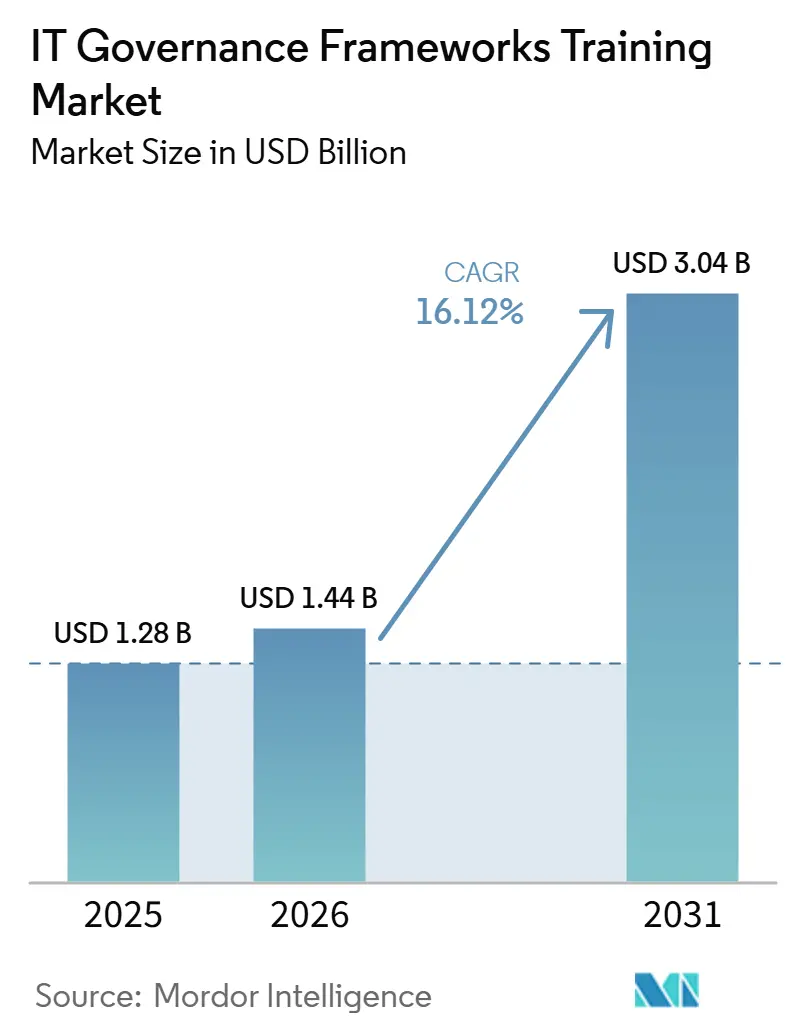
The IT Governance Frameworks Training Market size is expected to increase from USD 1.28 billion in 2025 to USD 1.44 billion in 2026 and reach USD 3.04 billion by 2031, growing at a CAGR of 16.12% over 2026-2031. The IT Governance Frameworks Training Market is expanding as boardrooms now face direct accountability for technology risk, which has moved governance education into recurring compliance budgets. Enterprises are also dealing with greater cloud use, AI-led process changes, and broader digital estates, which have increased demand for people who can guide oversight, controls, and decision rights across complex technology environments. The gap between fast-moving enterprise technology programs and the governance capability of oversight teams continues to support sustained training demand across regulated and digitally intensive sectors. Competitive activity is increasingly split between framework owners that control credentials and training providers that compete on delivery, instructor quality, and enterprise account reach. The IT Governance Frameworks Training Market also has room to grow in smaller organizations as supply chain compliance pressure, lower-cost digital learning formats, and broader regulatory reach pull governance training into companies that historically spent little on formal frameworks.
Key Report Takeaways
- By training type, Certification Preparation Courses led with a 32.41% share in the IT Governance Frameworks Training Market 2025, while Role-Based Practitioner Training is projected to expand at a 19.24% CAGR through 2031.
- By delivery mode, Instructor-Led Training held the largest share at 36.82% in 2025, while Blended Learning is projected to grow at an 18.73% CAGR through 2031.
- By enterprise size, Large Enterprises accounted for 64.18% of the IT Governance Frameworks Training Market in 2025, while Small and Medium Enterprises are projected to advance at an 18.42% CAGR through 2031.
- By end user, IT and Telecommunication captured a 24.63% share in 2025, while Healthcare and Life Sciences are projected to expand at a 19.86% CAGR through 2031.
- By geography, North America led the IT Governance Frameworks Training Market 2025 with a 34.72% share, while Asia-Pacific is projected to grow at an 18.91% CAGR through 2031.
Note: Market size and forecast figures in this report are generated using Mordor Intelligence’s proprietary estimation framework, updated with the latest available data and insights as of January 2026.
Global IT Governance Frameworks Training Market Trends and Insights
Drivers Impact Analysis*
| Driver | (~) % Impact on CAGR Forecast | Geographic Relevance | Impact Timeline |
|---|---|---|---|
| Rising Demand for COBIT and ISO/IEC 38500 Capability Building | +2.8% | Global, with core gains in North America, Europe, and Asia-Pacific | Short term (≤ 2 years) |
| Intensifying Board-Level Accountability for Technology Governance | +2.5% | EU primary, with spillover to North America and Asia-Pacific | Short term (≤ 2 years) |
| Growing Enterprise Spend on Role-Based Governance Upskilling | +2.1% | Global, strongest in North America and Western Europe | Medium term (2-4 years) |
| Expansion of Regulated Digital Transformation Programs | +2.0% | Asia-Pacific, Middle East and Africa, Europe | Medium term (2-4 years) |
| Embedded Training Demand from IT Operating Model Standardization Programs | +1.7% | North America and Europe primarily | Medium term (2-4 years) |
| Vendor-Neutral Governance Skills Outpacing Framework-Specific Cert Prep Demand | +1.4% | Global, concentrated in North America and Asia-Pacific enterprise accounts | Long term (≥ 4 years) |
| Source: Mordor Intelligence | |||
Rising Demand for COBIT and ISO/IEC 38500 Capability Building
The IT Governance Frameworks Training Market continues to benefit from strong demand for COBIT 2019 and ISO/IEC 38500 capability-building as enterprises seek recognized frameworks to guide oversight and accountability. COBIT 2019 remains central to operational governance programs because many organizations use it as the control and audit backbone for transformation work. ISO/IEC 38500 is gaining parallel traction at the executive layer because it speaks directly to how boards evaluate, direct, and monitor technology responsibilities. A notable buying pattern is that enterprises often train delivery and assurance teams on COBIT while placing senior leaders into ISO/IEC 38500 programs, which lifts training spend within the same account. Japan strengthened this direction when JIS Q 38500, its domestic equivalent of ISO/IEC 38500, was updated to include 11 expanded IT governance principles that explicitly address AI governance.[1]Japanese Standards Association, “JIS Q 38500 IT Governance Standard Update,” Japanese Standards Association, jsa.or.jp ISACA also widened the relevance of governance certification preparation when it launched ITAF 5th Edition in February 2026, extending the framework to AI and ML, cloud, and continuous assurance across its global community.
Intensifying Board-Level Accountability for Technology Governance
The IT Governance Frameworks Training Market is being reshaped by rules that place the responsibility for technology governance directly on boards and senior management. The Digital Operational Resilience Act became applicable on January 17, 2025, and requires management bodies of financial entities to maintain knowledge and skills that match the ICT risks under their control. NIS2 also introduced personal accountability for board members of essential entities, turning governance training into a legal risk management tool rather than a discretionary learning purchase. This change matters because compliance reviews increasingly depend on documented evidence of ongoing training, not just policy statements or nominal role definitions. The effect extends beyond the directly regulated entity, as suppliers and service partners often feel the same pressure as compliance programs move through the wider chain. As a result, the IT Governance Frameworks Training Market is seeing demand anchored by regulated buyers that can validate provider credibility and influence adoption across adjacent customer groups.
Growing Enterprise Spend on Role-Based Governance Upskilling
The IT Governance Frameworks Training Market is also advancing as enterprise buyers move from one-time credential purchases toward role-based governance upskilling across operating teams. This approach fits organizations that want defined decision rights and accountability structures across IT, risk, compliance, and audit functions, rather than isolated certification holders. It also changes the budget logic because role-based programs are often funded across several business lines, making them less exposed to a narrow HR training freeze. The greatest appeal is practical fit, since governance leads, IT auditors, and risk officers need learning that aligns with their daily responsibilities, not just exam objectives. Learning Tree International reinforced this direction in August 2025, expanding its position as an ISACA-authorized provider across CGEIT, CISA, CISM, and new AI-related certifications.[2]Learning Tree International, “Learning Tree International Announces New ISACA AI Certifications and Elite+ Partnership,” PR Newswire, prnewswire.com The strong projected growth for Role-Based Practitioner Training shows that the IT Governance Frameworks Training Market is moving toward repeatable cohort learning rather than a purely exam-centered model.
Expansion of Regulated Digital Transformation Programs
The IT Governance Frameworks Training Market is gaining support from government-led digital transformation programs that increasingly require governance capability as part of implementation. This is important because the spending path often runs through program execution and compliance requirements rather than through discretionary learning budgets. In India and Saudi Arabia, large public digital initiatives have increased demand for organizations and vendors that can demonstrate governance readiness as part of broader technology modernization efforts.[3]PECB, “PECB Signs a Partnership Agreement with Center For Governance,” PECB, pecb.com Providers have responded by expanding local delivery infrastructure, making formal training more accessible in markets that previously had limited authorized coverage. PECB expanded its authorized network into Saudi Arabia in September 2025 and into South Africa and Nigeria in 2026, showing how suppliers are positioning ahead of policy-driven demand in the Middle East and Africa. This spread of authorized partnerships supports the IT Governance Frameworks Training Market by turning national policy ambition into local training capacity and enterprise enrollment.[4]PECB, “PECB Signs a Partnership Agreement with Trivante Training,” PECB, pecb.com
Restraints Impact Analysis*
| Restraint | (~) % Impact on CAGR Forecast | Geographic Relevance | Impact Timeline |
|---|---|---|---|
| Limited Awareness of Formal IT Governance Credentials Outside Large Enterprises | -1.2% | Asia-Pacific emerging markets, Middle East and Africa, South America | Long term (≥ 4 years) |
| Fragmented Buying Across HR, IT, Risk, and Compliance Budgets | -1.0% | Global | Medium term (2-4 years) |
| Shortage of Qualified Instructors with Practical Governance Delivery Experience | -0.8% | Middle East and Africa, Asia-Pacific emerging markets, South America | Long term (≥ 4 years) |
| Low Renewal Urgency for Mature Practitioners After Initial Certification | -0.6% | North America and Europe, mature credentialing markets | Medium term (2-4 years) |
| Source: Mordor Intelligence | |||
Limited Awareness of Formal IT Governance Credentials Outside Large Enterprises
The IT Governance Frameworks Training Market still faces an awareness gap outside large enterprises, especially among decision-makers who treat governance training as interchangeable with broader security awareness programs. That misunderstanding reduces demand because buyers fail to distinguish between commodity awareness modules and training that builds decision structures, control oversight, and board accountability. The problem is more visible in smaller firms and emerging markets where fewer peers can point to direct outcomes from formal governance credentials. Research on applying COBIT 2019 to SME digital transformation identified a persistent gap between the framework’s relevance to smaller enterprises and its actual adoption in that segment. A separate 2026 study on Indian SMEs linked stronger IT governance maturity to better firm performance, suggesting that evidence exists but has not yet translated into broad buyer understanding. Until certification bodies and providers invest more heavily in SME-oriented education, the IT Governance Frameworks Training Market is likely to remain underpenetrated at the SME level.
Fragmented Buying Across HR, IT, Risk, and Compliance Budgets
Fragmented buying patterns inside enterprise customers also constrain the IT Governance Frameworks Training Market. Governance training frequently sits across several internal owners: HR funds learning; IT funds technical capability; risk and compliance funds governance programs; and legal may back executive education. That structure creates long approval cycles and makes it harder for providers to position a single integrated curriculum within one budget line. It also raises the cost of sale because projects can stall after early interest when internal functions debate ownership rather than value. Providers that align pricing and packaging to meet separate stakeholder needs are better placed to convert demand than those offering a single undifferentiated enterprise bundle. Even where governance gaps are clear, the IT Governance Frameworks Training Market can lose near-term revenue when customer organizations are not set up to quickly buy cross-functional training.
*Our forecasts treat driver/restraint impacts as directional, not additive. The impact forecasts reflect baseline growth, mix effects, and variable interactions.
Segment Analysis
By Training Type: Role-Based Formats Challenge Certification Prep Dominance
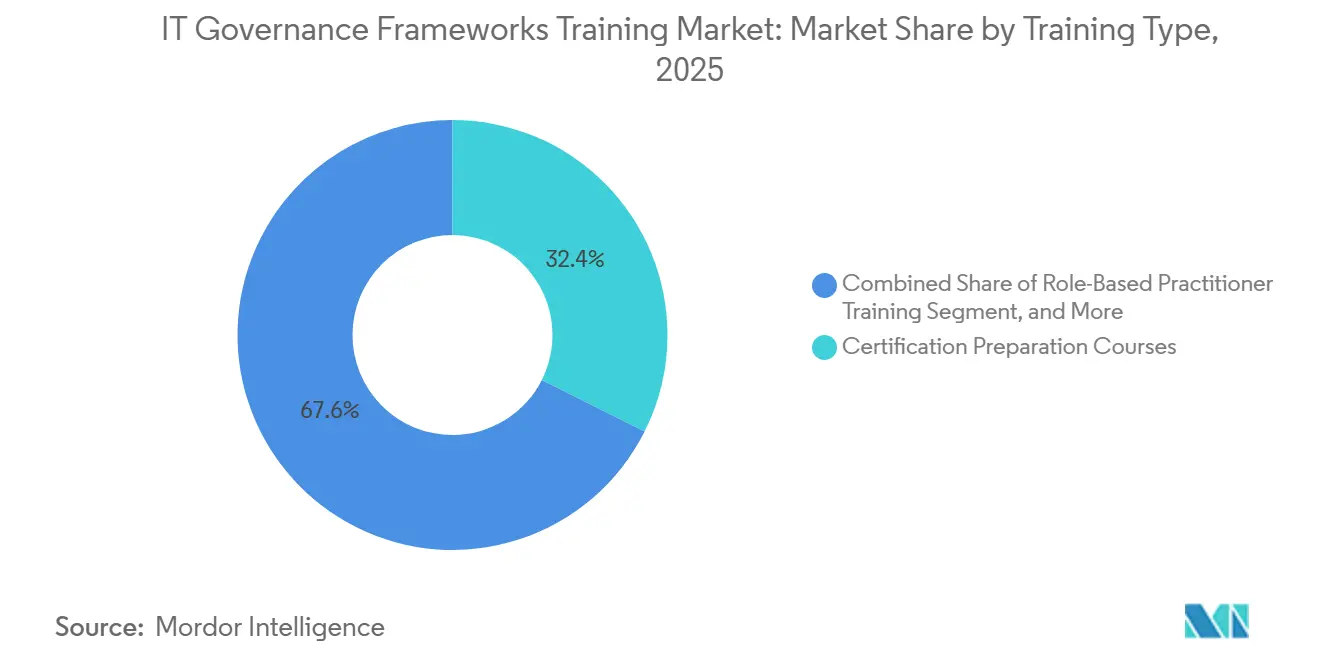
Certification Preparation Courses accounted for 32.41% of the IT Governance Frameworks Training market in 2025, making them the largest training type. This lead reflected continued demand for recognized credentials, especially COBIT 2019 and CGEIT, among professionals working in audit, governance, advisory, and enterprise risk roles. ISACA’s February 2026 launch of the ITAF 5th Edition gave the segment another boost by expanding governance and assurance coverage to include AI and ML, cloud, agile auditing, and continuous assurance, creating a new upgrade cycle for learners and employers. CGEIT remains important because it signals enterprise-wide governance capability rather than narrow technical expertise, which keeps it relevant in leadership and advisory hiring. Framework Implementation Workshops address a different buyer need, as these programs are usually purchased by organizations that already have credential holders and now need guidance on deploying governance structures. Executive and Board Governance Programs remain smaller in revenue terms, yet they are becoming more strategic as regulated sectors place direct responsibility for technology oversight on management bodies.
Role-Based Practitioner Training is projected to grow at a 19.24% CAGR through 2031, making it the fastest-growing training type in the IT Governance Frameworks Training Market. This shift shows that many enterprise buyers now want governance-capable teams built around role design instead of one-time exam success for individual learners. The commercial value is clear because role-based programs can generate recurring enrollment as job scopes change and governance responsibilities spread across functions. That makes them structurally different from certification preparation, which is often purchased once per person for a specific credential cycle. Learning Tree International’s 2025 expansion across ISACA-authorized programs, including advanced and role-specific governance content, reflected the growing need for training architectures that match real organizational roles. As more organizations finish their first wave of governance certification adoption and turn toward applied implementation, the IT Governance Frameworks Training Market is likely to see role-based formats claim a larger share of future spending.



By Delivery Mode: ILT Retains The Revenue Share While Blended Learning Resets Expectations
Instructor-Led Training held 36.82% of the IT Governance Frameworks Training market share in 2025, making it the leading delivery mode in the IT Governance Frameworks Training Market. Enterprise buyers still favor live facilitation in governance settings because discussion, interpretation, and contextual judgment matter more here than in many purely technical learning modules. The format also benefits from the nature of major governance exams, since candidates often prefer structured coaching when preparing for proctored assessments built around scenario-based questions. That helped preserve strong demand for instructor-led formats even as digital access widened across regions. Virtual Live Training absorbed part of the volume that once belonged to in-person classes because distributed teams wanted live interaction without travel costs. Self-Paced E-Learning remained important for renewal credits, modular learning, and early-stage learners who wanted targeted content without committing to a full program.
Blended Learning is projected to expand at a 18.73% CAGR from 2026 to 2031, making it the fastest-growing delivery format in the IT Governance Frameworks Training Market. Buyers are choosing it because it combines the rigor of instructor-led sessions with the convenience of self-paced study and stronger performance visibility across learner groups. Framework owners are also supporting this shift through product design and course architecture. PeopleCert’s launch of ITIL Version 5 in February 2026 included an AI Governance publication and updated pathways that support blended and self-paced progression, which shows how major credential owners are extending learning beyond a single classroom event. This format is especially useful for enterprise customers who want ongoing refresh, better completion tracking, and more flexible scheduling for teams spread across functions and geographies. As a result, the IT Governance Frameworks Training Market is shifting toward delivery models that support continuous governance capability rather than isolated training events.
By Enterprise Size: Large Enterprise Dominance Persists As SME Growth Accelerates
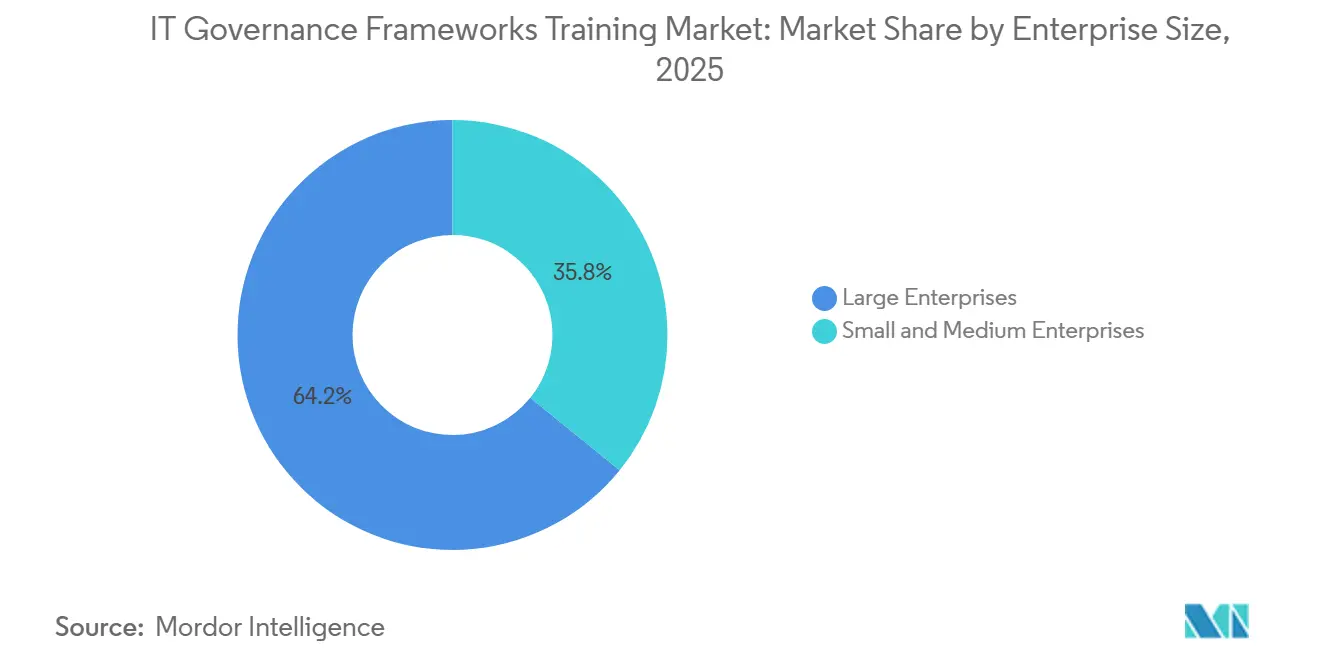
Large Enterprises held a 64.18% share in 2025, making them the dominant buyers in the IT Governance Frameworks Training Market. Their lead came from established learning teams, multi-year vendor contracts, and the scale of governance programs needed to support complex technology estates. Global banks, major technology firms, and large public bodies remain central customers because they operate in control environments that justify the structured deployment of COBIT and ISO/IEC 38500. These organizations also support higher-value contracts through custom curriculum design, larger cohorts, and longer delivery periods. The concentration of experienced governance professionals within large firms reinforces this pattern, since the CGEIT credential itself requires significant governance-related experience. Large organizations also create secondary demand by requiring suppliers and service partners to demonstrate governance credentials, which drives awareness and spending outward to smaller customer groups.
Small and Medium Enterprises are projected to grow at a 18.42% CAGR through 2031, making them the fastest-growing segment in the IT Governance Frameworks Training Market. Several forces support that trend, including supply chain compliance pressure from large customers, lower entry costs for online and blended training, and broader regulatory reach into smaller businesses within critical ecosystems. The evidence base is improving as well, with a 2026 study on Indian SMEs linking structured governance maturity and digital transformation strategy to better firm performance. Even so, the segment remains less mature than the large-enterprise tier because awareness, budget structures, and credential familiarity remain uneven. Providers that can package modular programs for smaller cohorts and explain business value in practical terms are likely to find receptive demand. This means the IT Governance Frameworks Training Market is still led by large accounts today, yet a larger share of new growth is likely to come from smaller organizations moving into formal governance programs for the first time.
By End User: IT And Telecommunication Anchors Demand As Healthcare Scales Governance Capabilities
IT and Telecommunication led with a 24.63% share in 2025, which placed it at the center of the IT Governance Frameworks Training Market by end user. The sector sits closest to the frameworks themselves because it designs, runs, and monitors the digital infrastructure that governance models seek to control. Telecom operators and technology service providers often manage hybrid networks, cloud platforms, service assurance processes, and distributed delivery environments, creating layered demand for governance capabilities. That demand spans certification preparation, implementation support, and role-based training for audit, risk, and operations staff. BFSI remains another major end-user group because governance learning is closely tied to compliance, internal audit depth, and dense populations of CISA and CGEIT credential holders. Industrial Manufacturing, Retail, and E-Commerce are also becoming more relevant as operational technology oversight and omni-channel governance needs expand.
Healthcare and Life Sciences is projected to grow at a 19.86% CAGR through 2031, which makes it the fastest-growing end-user segment in the IT Governance Frameworks Training Market. The growth case rests on the need to govern health data, connected medical devices, and cloud-hosted record systems through more formal oversight and training structures. The HHS Office for Civil Rights updated Security Rule compliance materials in 2026 and clarified expectations, tying them more closely to documented role-based governance training linked to organizational risk analysis. Government and Administration, Education and Research Institutions, and Energy and Utilities continue to support steady demand by combining public modernization programs with sector-specific control expectations. Media and Entertainment remains smaller, yet it is emerging as platform operators formalize governance around digital asset management and distribution systems. The spread of demand across these verticals shows that the IT Governance Frameworks Training Market has moved beyond a narrow IT-professional niche and into a broader cross-sector capability need.
Geography Analysis
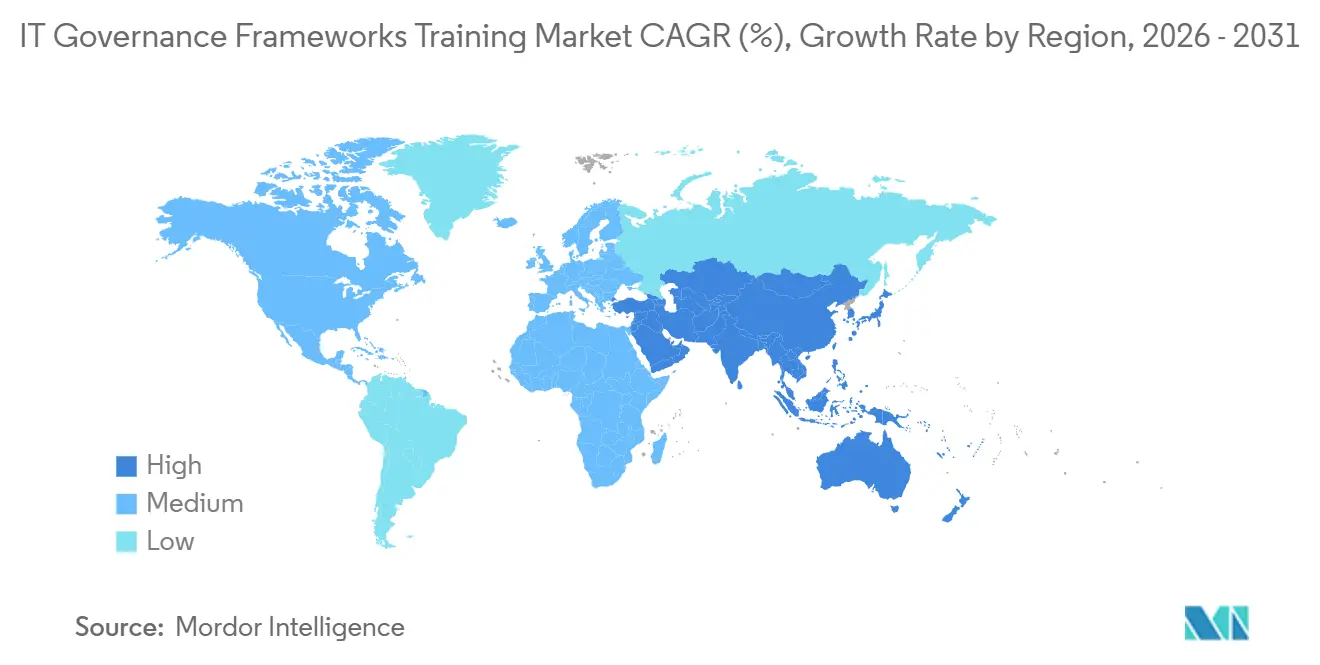
North America accounted for 34.72% of the IT Governance Frameworks Training market in 2025, making it the largest regional segment. The region benefits from a dense base of credentialed professionals, mature governance structures, and strong access to authorized training organizations across the United States and Canada. Demand is further reinforced by the presence of leading framework owners and a large installed base of regulated and digitally complex enterprises. ISACA’s December 2025 authorization as the exclusive assessor and instructor certification organization for the U.S. defense supply chain’s CMMC program materially widened the addressable governance-adjacent training base. The United States also gained sector-specific support from the 2026 HIPAA Security Rule compliance updates, which strengthened the need for documented role-based governance training in healthcare settings.
Europe remained the second-largest regional market for IT Governance Frameworks Training because the regulatory environment made governance education a practical compliance requirement. DORA created direct management body obligations for ICT risk knowledge from January 2025, while NIS2 extended board accountability across essential entities in all EU member states. Germany, the United Kingdom, and France remain the leading national markets, and Germany also benefits from a parallel governance ecosystem around BSI and ISO-aligned programs. PECB strengthened regional delivery in March 2026 through its partnership with CTG GmbH in Germany, which added localized access to governance and compliance courses.
Asia-Pacific is projected to expand at a 18.91% CAGR from 2026 to 2031, making it the fastest-growing geography in the IT Governance Frameworks Training Market. The region is supported by national digital transformation programs, rising professional demand for governance credentials, and a growing local training base across India, China, Japan, South Korea, and Southeast Asia. Japan added momentum when its JIS Q 38500 framework update incorporated broader AI governance provisions, which strengthened local alignment with formal governance training demand. India also advanced the talent pipeline when IIT Bombay and Simplilearn launched a 24-month online Post Graduate Diploma in Digital Governance in June 2026. China continues to demonstrate greater enterprise governance maturity through active CGEIT credential activity and the availability of COBIT-related training. South America remains smaller but is gaining relevance as enterprises align with international governance expectations to serve multinational customers. The Middle East and Africa are also moving up as Saudi Arabia, the UAE, Nigeria, and South Africa build more authorized training capacity tied to governance and compliance programs.

Competitive Landscape
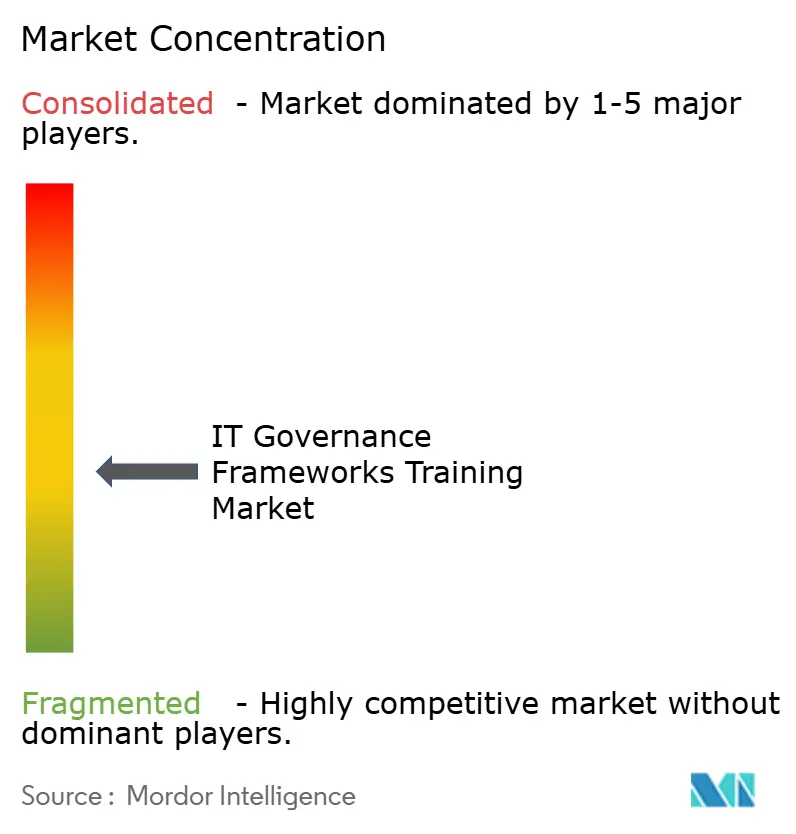
The IT Governance Frameworks Training Market in 2026 has a two-tier structure, with framework-owning bodies holding strategic control while a broad field of delivery providers competes beneath them. ISACA and PeopleCert sit in the upper tier because they control widely recognized frameworks, exams, and credential pathways that shape customer demand. That creates pricing power at the content and credential level even when course delivery remains contested. The lower tier is far more fragmented, with authorized providers differentiating through instruction quality, enterprise relationships, learning analytics, and regional reach. This structure means the IT Governance Frameworks Training Market does not behave like a simple training category because the most important competitive advantage often comes from framework ownership rather than classroom scale.
ISACA holds a strong position because it combines framework stewardship with credentialing authority across COBIT, CGEIT, CISA, and related assurance pathways. Its February 2026 launch of ITAF 5th Edition gave it a strategic way to refresh relevance and stimulate new preparation demand tied to AI and ML, cloud, and continuous assurance. PeopleCert used a similar playbook in February 2026 when it launched ITIL Version 5 with a dedicated AI Governance publication and updated certification routes. These moves show how major framework owners can reset demand by updating standards and forcing the market to respond with new studies and bridging activity.
In the delivery layer, competition is shifting away from simple geographic presence toward measurable outcomes, deeper catalog depth, and the ability to serve multiple governance frameworks within a single client account. Providers that can combine COBIT, ISO/IEC 38500, ITIL, and AI governance content are better positioned when enterprise customers want one learning partner rather than several niche vendors. PECB’s 2025 and 2026 partnership expansion in Saudi Arabia, Germany, South Africa, and Nigeria shows how suppliers are building local delivery networks before regulation and enterprise demand fully mature. University and provider partnerships are also emerging as a differentiator because they create a broader pipeline of governance-capable talent rather than only short-cycle certification buyers. The IT Governance Frameworks Training Market, therefore, remains strategically concentrated at the top and operationally fragmented in delivery, with future gains likely favoring providers that can align credential authority, local reach, and enterprise-ready learning design.
IT Governance Frameworks Training Industry Leaders
PeopleCert
ISACA
AXELOS
APMG International
PECB
- *Disclaimer: Major Players sorted in no particular order

Recent Industry Developments
- July 2026: Simplilearn launched SkillUp, an AI-first skilling library serving over 6 million learners, offering governance and compliance programs alongside AI and cybersecurity certifications within a single enterprise learning platform; the launch positions Simplilearn to deliver IT governance training at scale through a subscription model integrated with corporate L&D stacks.
- July 2026: Simplilearn partnered with Virginia Tech to launch a Professional Certificate Program in AI-Powered Cybersecurity, extending the company's governance-adjacent portfolio to cover AI risk management and cybersecurity governance competencies critical to enterprise IT governance frameworks.
- June 2026: IIT Bombay partnered with Simplilearn to launch a 24-month online Post Graduate Diploma in Digital Governance, with inaugural sessions commencing August 2026; the program targets working professionals in technology, policy, and consulting, representing a significant expansion of academic-led IT governance education in India.
- June 2026: PECB signed an authorized training partnership with SecureOps Solutions Ltd in Nigeria, enabling distribution of ISO governance, cybersecurity, and GRC certification training courses across the Nigerian market, reflecting PECB's accelerating expansion into sub-Saharan Africa.


Global IT Governance Frameworks Training Market Report Scope
The IT governance frameworks training market comprises educational programs and services that equip IT professionals, management executives, and board members with the knowledge and skills to effectively implement, manage, and oversee IT governance within organizations. This encompasses a wide array of training types, including certification preparation courses for globally recognized frameworks (such as COBIT, ITIL, and ISO/IEC 38500), hands-on implementation workshops, role-based practitioner training, and strategic executive governance programs. Delivered through various modalities such as instructor-led training, virtual live sessions, self-paced e-learning, and blended formats, these training services cater to organizations of all sizes across diverse industries, including BFSI, healthcare, IT, and government. The primary objective of these training programs is to help organizations align their IT strategies with overarching business goals, optimize IT resource management, ensure strict regulatory and compliance adherence, mitigate IT-related risks, and establish clear accountability structures for information and technology assets.
The IT Governance Frameworks Training Market Report is Segmented by Training Type (Certification Preparation Courses, Framework Implementation Workshops, Executive and Board Governance Programs, and Role-Based Practitioner Training), Delivery Mode (Instructor-Led Training, Virtual Live Training, Self-Paced E-Learning, and Blended Learning), Enterprise Size (Large Enterprises and Small and Medium Enterprises), End User (IT and Telecommunication, BFSI, Healthcare and Life Sciences, Retail and E-Commerce, Industrial Manufacturing, Education and Research Institutions, Media and Entertainment, Government and Administration, Energy and Utilities, and Other End-User Industries), and Geography. The Market Forecasts are Provided in Terms of Value (USD).
| Certification Preparation Courses |
| Framework Implementation Workshops |
| Executive and Board Governance Programs |
| Role-Based Practitioner Training |
| Instructor-Led Training |
| Virtual Live Training |
| Self-Paced E-Learning |
| Blended Learning |
| Large Enterprises |
| Small and Medium Enterprises |
| IT and Telecommunication |
| BFSI |
| Healthcare and Life Sciences |
| Retail and E-Commerce |
| Industrial Manufacturing |
| Education and Research Institutions |
| Media and Entertainment |
| Government and administration |
| Energy and Utilities |
| Other end-user industries |
| North America | United States | |
| Canada | ||
| Mexico | ||
| South America | Brazil | |
| Argentina | ||
| Rest of South America | ||
| Europe | Germany | |
| United Kingdom | ||
| France | ||
| Russia | ||
| Spain | ||
| Rest of Europe | ||
| Asia-Pacific | China | |
| Japan | ||
| India | ||
| South Korea | ||
| Southeast Asia | ||
| Rest of Asia-Pacific | ||
| Middle East and Africa | Middle East | Saudi Arabia |
| United Arab Emirates | ||
| Rest of Middle East | ||
| Africa | South Africa | |
| Nigeria | ||
| Rest of Africa | ||
| By Training Type | Certification Preparation Courses | ||
| Framework Implementation Workshops | |||
| Executive and Board Governance Programs | |||
| Role-Based Practitioner Training | |||
| By Delivery Mode | Instructor-Led Training | ||
| Virtual Live Training | |||
| Self-Paced E-Learning | |||
| Blended Learning | |||
| By Enterprise Size | Large Enterprises | ||
| Small and Medium Enterprises | |||
| By End User | IT and Telecommunication | ||
| BFSI | |||
| Healthcare and Life Sciences | |||
| Retail and E-Commerce | |||
| Industrial Manufacturing | |||
| Education and Research Institutions | |||
| Media and Entertainment | |||
| Government and administration | |||
| Energy and Utilities | |||
| Other end-user industries | |||
| By Geography | North America | United States | |
| Canada | |||
| Mexico | |||
| South America | Brazil | ||
| Argentina | |||
| Rest of South America | |||
| Europe | Germany | ||
| United Kingdom | |||
| France | |||
| Russia | |||
| Spain | |||
| Rest of Europe | |||
| Asia-Pacific | China | ||
| Japan | |||
| India | |||
| South Korea | |||
| Southeast Asia | |||
| Rest of Asia-Pacific | |||
| Middle East and Africa | Middle East | Saudi Arabia | |
| United Arab Emirates | |||
| Rest of Middle East | |||
| Africa | South Africa | ||
| Nigeria | |||
| Rest of Africa | |||


Key Questions Answered in the Report
What is the projected size of the IT Governance Frameworks Training Market by 2031?
The IT Governance Frameworks Training Market is projected to reach USD 3.04 billion by 2031, rising from USD 1.44 billion in 2026 at a CAGR of 16.12% over 2026-2031.
Which training type leads revenue in the IT Governance Frameworks Training Market?
Certification Preparation Courses led the IT Governance Frameworks Training Market with a 32.41% share in 2025, supported by continued demand for COBIT 2019 and CGEIT-related learning.
Which delivery mode is growing fastest in IT Governance Frameworks Training programs?
Blended Learning is projected to grow the fastest at an 18.73% CAGR through 2031 because enterprises want live instruction, self-paced access, and better learning analytics in one format.
Why is board-level demand increasing for IT Governance Frameworks Training?
Direct regulatory accountability is a major reason. DORA and NIS2 have pushed governance training into executive and board agendas by linking technology oversight to legal and supervisory expectations.
Which region offers the strongest growth prospects for the IT Governance Frameworks Training Market?
Asia-Pacific offers the strongest growth outlook, with a projected 18.91% CAGR from 2026 to 2031, supported by national digital transformation programs and expanding professional training pipelines.
Which end-user group is expanding fastest in IT Governance Frameworks Training?
Healthcare and Life Sciences is the fastest-growing end-user segment, with a projected 19.86% CAGR through 2031, driven by stronger governance needs for health data, connected devices, and cloud-based records.
Page last updated on:






