
IT and Telecommunications Enterprise Content Management (ECM) Market Size and Share
Market Overview
| Study Period | 2020 - 2031 |
|---|---|
| Market Size (2026) | USD 5.01 Billion |
| Market Size (2031) | USD 8.38 Billion |
| Growth Rate (2026 - 2031) | 10.84% CAGR |
| Fastest Growing Market | Asia-Pacific |
| Largest Market | North America |
| Market Concentration | Medium |
Major Players *Disclaimer: Major Players sorted in no particular order Image © Mordor Intelligence. Reuse requires attribution under CC BY 4.0. | |
IT and Telecommunications Enterprise Content Management (ECM) Market Analysis by Mordor Intelligence
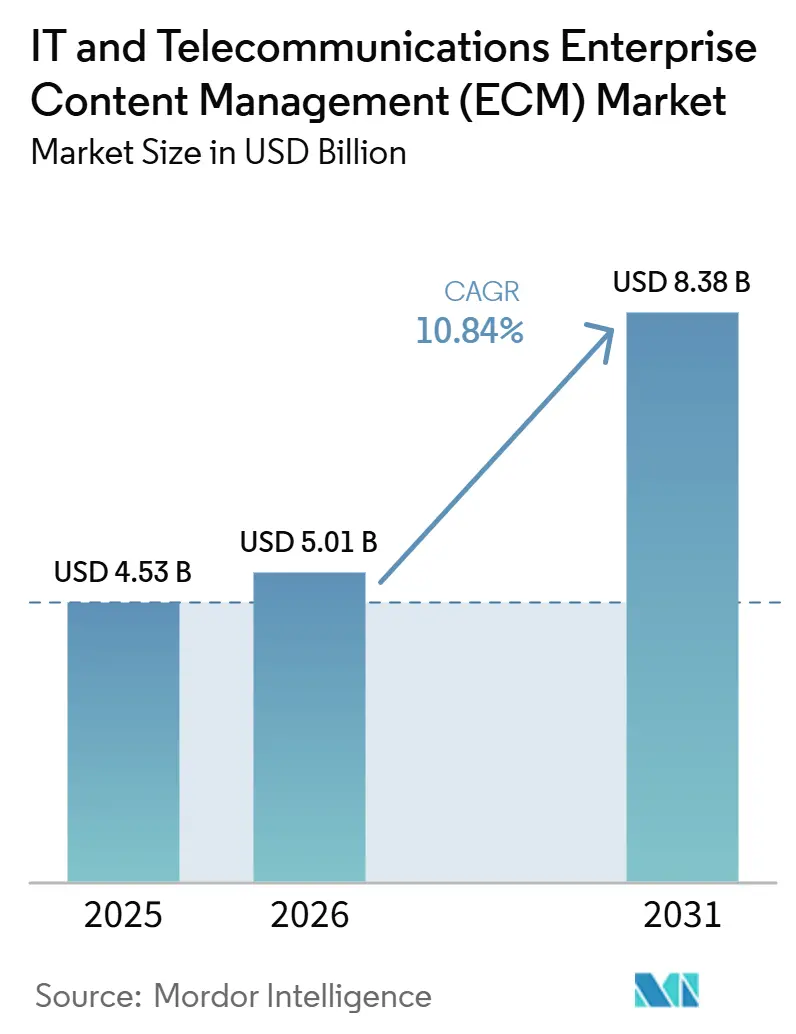
The IT and telecommunications enterprise content management (ECM) market size was valued at USD 4.53 billion in 2025 and estimated to grow from USD 5.01 billion in 2026 to reach USD 8.38 billion by 2031, at a CAGR of 10.84% during the forecast period (2026-2031). Growth is rising as telecom operators replace siloed document repositories with cloud-based platforms that sit inside day-to-day workflows. Investment in content systems is moving in step with 5G, fiber, and edge buildouts, because those programs create large volumes of technical, regulatory, and field records that must stay accessible for many years. Vendor competition is moving away from basic storage and toward AI-led classification, search, and workflow automation that can act on content as it moves through service and network processes. Operators are also favoring platforms that connect cleanly with operating and support systems, since content now needs to move with provisioning, compliance, and maintenance activity instead of sitting in separate archives. Deployment speed still faces pressure from complex legacy integration work and from data residency rules that require country-specific governance models across regulated telecom environments.
Key Report Takeaways
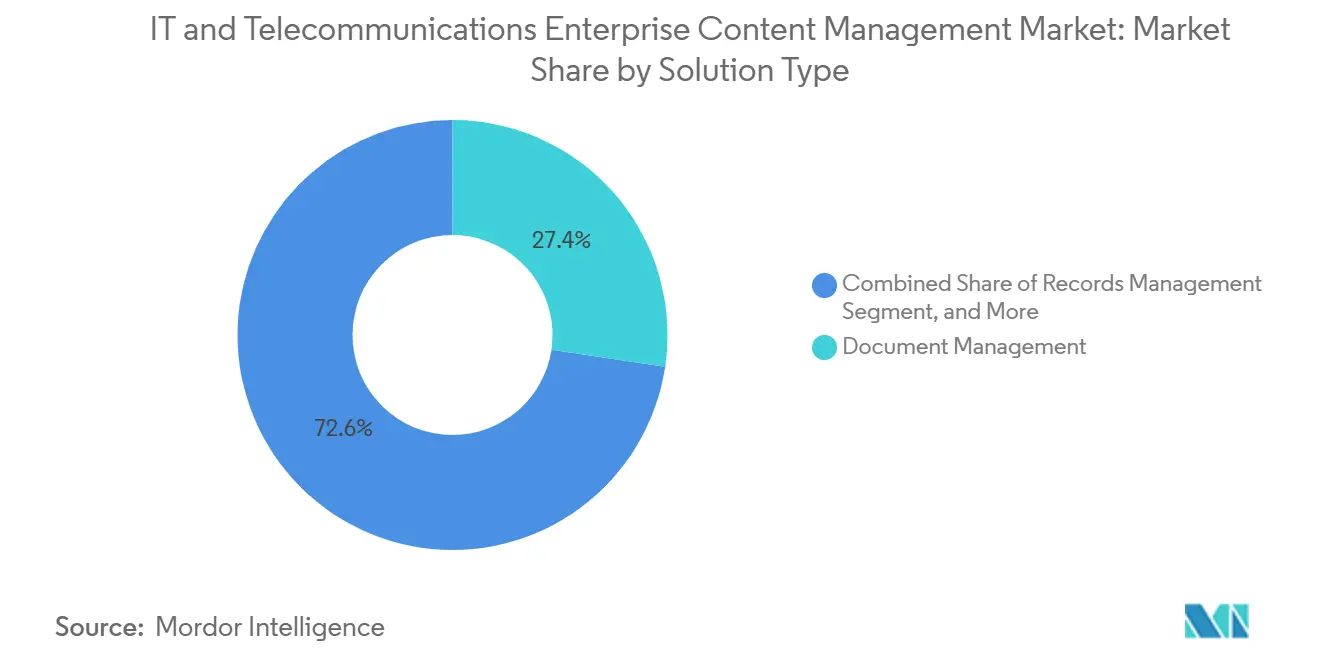
- By solution type, document management led with 27.36% share in the IT and telecommunications enterprise content management (ECM) market in 2025, while workflow and business process management is projected to expand at a 16.98% CAGR through 2031.
- By deployment mode, cloud held 76.81% share in 2025, and it is also expected to record the highest CAGR at 15.67% through 2031.
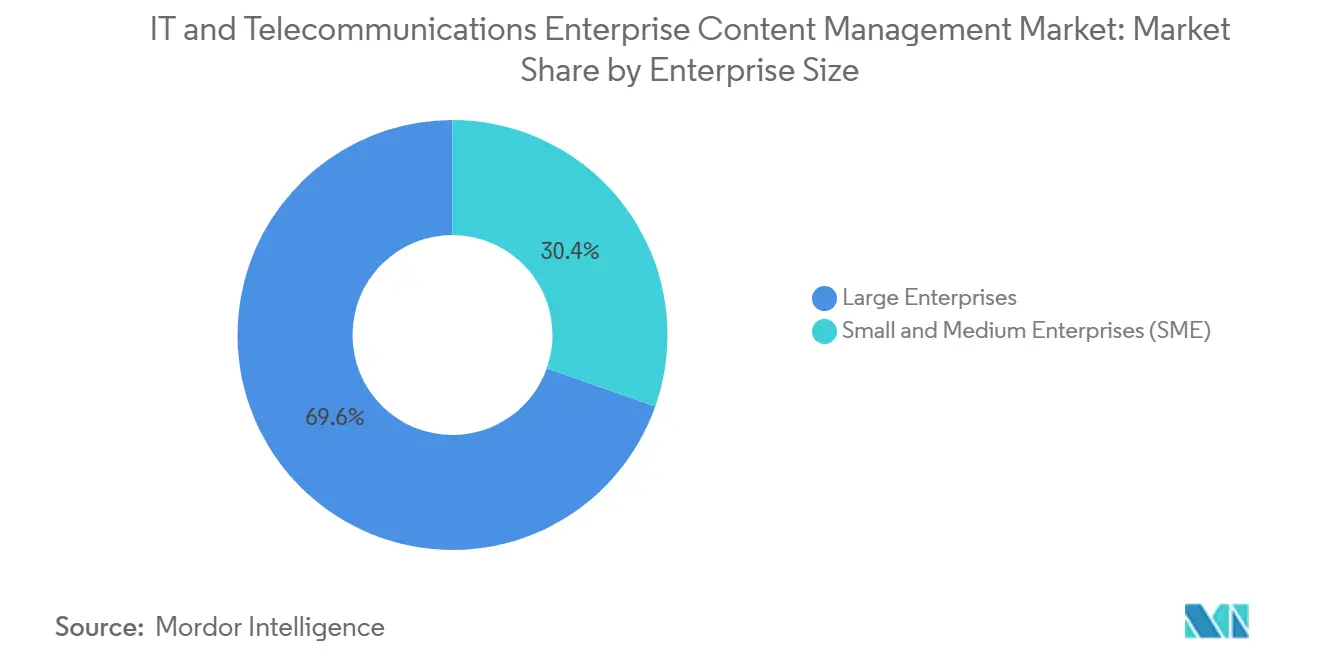
- By enterprise size, large enterprises accounted for 69.61% share in 2025, while SMEs are projected to advance at a 16.02% CAGR through 2031.
- By geography, North America held 36.72% of the IT and telecommunications enterprise content management (ECM) market share in 2025, while Asia-Pacific is projected to grow at a 14.59% CAGR through 2031.
Note: Market size and forecast figures in this report are generated using Mordor Intelligence’s proprietary estimation framework, updated with the latest available data and insights as of January 2026.
Global IT and Telecommunications Enterprise Content Management (ECM) Market Trends and Insights
Drivers Impact Analysis*
| DRIVER | (~) % IMPACT ON CAGR FORECAST | GEOGRAPHIC RELEVANCE | IMPACT TIMELINE |
|---|---|---|---|
| Rapid Shift to Zero-Touch Content Operations in Telecom Networks | +2.8% | Global | Medium term (2-4 years) |
| Migration of Legacy ECM Repositories Into Cloud-Native Collaboration Stacks | +2.5% | Global, with APAC accelerating | Long term (≥ 4 years) |
| AI-Driven Metadata Extraction and Intelligent Search Adoption | +2.1% | Global, concentrated in North America and Europe | Medium term (2-4 years) |
| Expansion of 5G, Fiber, and Edge Infrastructure Documentation Workflows | +1.4% | APAC and North America, spill-over to MEA | Medium term (2-4 years) |
| Escalating Compliance Burden Across Cross-Border Telecom Records | +1.0% | Europe and APAC core | Long term (≥ 4 years) |
| Need for Unified Customer, Partner, and Field-Service Content Access | +0.8% | Global | Short term (≤ 2 years) |
| Source: Mordor Intelligence | |||
Rapid Shift to Zero-Touch Content Operations in Telecom Networks
Telecom operators are reorganizing content operations around automated flows that create, route, classify, and archive records with less manual work. In live telecom environments, these records are tied to provisioning events, service changes, network incidents, and compliance checks, so the content layer has to move at the same pace as the operating workflow. As more service processes become event-driven, the IT and telecommunications enterprise content management (ECM) market is moving toward platforms that can respond to triggers from telecom systems instead of acting as passive storage tools. One NZ reduced mobile provisioning time from 10 days to under 10 minutes after deploying UiPath Maestro, which shows how fast telecom workflow automation is moving from pilot programs into core operations.[1]UiPath, “One NZ Sets New Telco Industry Benchmark With UiPath,” UiPath Newsroom, uipath.com This shift supports stronger demand in the IT and telecommunications enterprise content management (ECM) market for workflow tools that can keep documents, records, and service actions inside the same operating loop.
Migration of Legacy ECM Repositories into Cloud-Native Collaboration Stacks
Many operators still carry older repositories that were built before cloud delivery became normal, and those platforms are now being replaced by cloud-native content environments. The main issue in these programs is not only moving files, but also preserving the business context that links content to telecom workflows after migration. In the IT and telecommunications enterprise content management (ECM) market, this makes migration tooling a buying factor because operators do not want cloud archives that hold documents but lose the operational meaning attached to them. Telefónica Germany moved 4G and 5G voice services for its first 100,000 customers to a cloud-native platform by Q1 2026, which illustrates the broader shift toward cloud operating models that also raises the need for aligned content migration.[2]Mavenir, “Telefónica Germany Migrates 4G/5G Voice Services of First 100K Customers to Mavenir Cloud-Native IMS Technology,” Mavenir, mavenir.com OpenText added stronger migration support in its Content Management CE 26.2 release in June 2026, which shows that vendors in the IT and telecommunications enterprise content management (ECM) market now treat migration assistance as part of the product, not as a side service.
AI-Driven Metadata Extraction and Intelligent Search Adoption
Telecom documents are difficult to process with generic models because they mix technical drawings, regulatory files, field images, service records, and network terminology in the same environment. That is pushing the IT and telecommunications enterprise content management (ECM) market toward platforms that can extract context from telecom-specific content rather than only indexing file names and folders. According to Hyland, customer adoption of its Content Innovation Cloud rose 220% in Q4 2025, which points to strong interest in AI-led content services that can classify and activate information at scale. OpenText released AI-to-AI integration between Content Aviator and Microsoft Copilot in March 2026, allowing users to surface governed content inside Microsoft Teams, Word, Excel, and PowerPoint without switching applications. As these tools improve, the IT and telecommunications enterprise content management (ECM) market is placing more value on search quality, context retention, and actionability than on repository scale alone.
Expansion of 5G, Fiber, and Edge Infrastructure Documentation Workflows
Every new telecom site, fiber node, and edge facility generates a chain of permits, engineering approvals, inspection images, maintenance schedules, and acceptance records. Those documents have to remain searchable over long asset lives, which steadily widens the operational role of the IT and telecommunications enterprise content management (ECM) market. The volume challenge is rising because network programs now move faster and span more contractors, more field teams, and more regulatory touchpoints than older telecom rollouts did. Telefónica Germany's migration of live 4G and 5G voice services to cloud-native infrastructure demonstrates how network modernization is progressing in parallel with the need for stronger content controls over technical operations. In the IT and telecommunications enterprise content management (ECM) market, this creates sustained demand for workflow-led platforms that can organize infrastructure records as part of deployment and maintenance activity rather than after the fact.
Restraints Impact Analysis*
| RESTRAINT | (~) % IMPACT ON CAGR FORECAST | GEOGRAPHIC RELEVANCE | IMPACT TIMELINE |
|---|---|---|---|
| Complex Integration With Legacy OSS, BSS, and Network Inventory Systems | -1.4% | Global | Long term (≥ 4 years) |
| Data Residency and Sovereignty Constraints Across Regulated Markets | -1.0% | Europe, APAC, MEA | Long term (≥ 4 years) |
| Content Governance Gaps Across Distributed Telco Partner Ecosystems | -0.6% | Global | Medium term (2-4 years) |
| High Change-Management Load for Large, Multi-Region Telecom Enterprises | -0.4% | Global | Long term (≥ 4 years) |
| Source: Mordor Intelligence | |||
Complex Integration With Legacy OSS, BSS, and Network Inventory Systems
The biggest obstacle in the IT and telecommunications enterprise content management (ECM) market remains the large integration surface between content platforms and older telecom operating systems. Many OSS and BSS environments still use proprietary data models, so a new content platform can end up functioning as a separate layer rather than as an embedded function within telecom operations. That creates governance risk because the same service event can have records in more than 1 place with no clean audit path between them. This is one reason large enterprises still move cautiously, even though they held 69.61% revenue share in 2025, since the cost and timing of system coordination often stretch well beyond the initial software decision. OpenText's SAP S/4HANA Cloud Public Edition certification in November 2025 reflects how validated interoperability is becoming a practical requirement for vendors trying to shorten deployment cycles in the IT and telecommunications enterprise content management (ECM) market.
Data Residency and Sovereignty Constraints Across Regulated Markets
Telecom operators manage subscriber records, billing files, identity information, and network configuration content that fall under strict national and regional controls. That makes the IT and telecommunications enterprise content management (ECM) market harder to standardize globally, because operators often cannot place all content in 1 shared instance across countries. Instead, they need separate content stores, access rules, encryption controls, and audit settings for each jurisdiction that applies to their records. Google Cloud described how Deutsche Telekom built a sovereign data platform to meet German and EU requirements inside a cloud-native architecture, which shows how much engineering work sits behind compliant telecom deployments. Hyland's June 2026 expansion of its Content Innovation Cloud into the AWS Asia-Pacific Sydney Region also shows how vendors in the IT and telecommunications enterprise content management (ECM) market are responding with region-specific deployment options rather than 1 global design.
*Our forecasts treat driver/restraint impacts as directional, not additive. The impact forecasts reflect baseline growth, mix effects, and variable interactions.
Segment Analysis
By Solution Type: Document Management Holds The Largest Base While Workflow Automation Gains Strategic Weight
Document management accounted for 27.36% of the IT and telecommunications enterprise content management (ECM) market size in 2025, which kept it as the largest solution category by revenue. Its position still reflects the sheer volume of technical files, regulatory submissions, field records, and internal operating documents created by telecom carriers every day. In the IT and telecommunications enterprise content management (ECM) market, that scale keeps document management central even as operator priorities move toward automation and operational integration. The segment also benefits from the long retention life of telecom records, since many assets and compliance files must remain accessible well beyond the initial service or build cycle.
The nature of that demand is changing because a growing share of telecom content is now generated by systems rather than by manual users. This means the IT and telecommunications enterprise content management (ECM) market increasingly rewards document platforms that can ingest, tag, and route machine-created files at operating speed. Workflow and business process management is projected to grow at a 16.98% CAGR through 2031, which shows that operators are directing new spending toward content tools that sit inside service provisioning, order handling, and issue resolution processes. OpenText's June 2026 Content Management CE 26.2 release added agentic actions for document management, metadata support, and records handling, which shows how vendors are turning basic repository functions into workflow-led operating tools. Records management, case management, digital asset management, and web content management still hold defined roles in the IT and telecommunications enterprise content management (ECM) market, but they serve narrower use cases than the large core demand tied to document control and process automation.



By Deployment Mode: Cloud Leadership Reflects Operating Design More Than Hosting Preference
Cloud deployment held 76.81% share in 2025 and is also projected to grow at a 15.67% CAGR through 2031, which makes it both the largest and the fastest-growing deployment mode. This pattern shows that the IT and telecommunications enterprise content management (ECM) market is still in an active migration cycle rather than in a mature cloud plateau. The remaining on-premises and hybrid base is tied more to regulatory constraints, legacy integration limits, and existing contract structures than to any broad preference for local infrastructure. In the telecom enterprise content management industry, cloud has become the default architecture because telecom operators want elastic capacity, faster rollout, and better alignment with broader network modernization programs.
Hybrid deployment remains important, but it works more as a transition path than as a fixed end state for most carriers. Many operators that describe their environments as hybrid are still moving core content functions into cloud layers while keeping selected repositories or records in place for compliance or system dependency reasons. One NZ's June 2026 deployment of UiPath Maestro shows how cloud-native orchestration can compress telecom process times and strengthen the case for cloud-aligned content and workflow stacks. Hyland's Microsoft Azure partnership and its AWS expansion in Asia-Pacific show that vendors are increasingly selling through hyperscaler channels so operators can buy content platforms through existing cloud commitments.[3]Hyland, “Hyland Collaborates With Microsoft to Power the Agentic Enterprise With the Content Innovation Cloud on Microsoft Azure,” PR Newswire, prnewswire.com OpenText's June 2026 migration enhancements also reflect how the IT and telecommunications enterprise content management (ECM) market is trying to reduce the friction that has slowed older repository transitions.
By Enterprise Size: Large Carriers Keep Revenue Control While SMEs Drive the Faster Adoption Cycle
Large enterprises held 69.61% of the IT and telecommunications enterprise content management (ECM) market share in 2025, which reflects the scale of their document, compliance, and field-service workloads. Large carriers operate across more functions, more vendors, and more regions, so they naturally generate the largest content volumes in the IT and telecommunications enterprise content management (ECM) market. They also carry the heaviest integration burden because their content programs have to connect with older OSS, BSS, ERP, and inventory environments that were built over many years. This creates a slower deployment cycle even when spending capacity is strong, which is why large operators still dominate revenue but do not set the pace for growth.
SMEs are projected to expand at a 16.02% CAGR through 2031, supported by SaaS delivery models that lower upfront cost and shorten rollout time. In the telecom enterprise content management industry, that shift opens the market to smaller carriers, regional internet service providers, and MVNOs that need compliance-grade content control without the overhead of custom infrastructure. M-Files deepened its Microsoft collaboration in March 2026 and became the first document management system to use SharePoint Embedded, which shows how vendors are reducing complexity for smaller organizations that already work inside Microsoft environments.[4]M-Files, “M-Files Deepens Its Strategic Collaboration With Microsoft, Unveiling New Experiences for Microsoft 365 Copilot and Microsoft 365 Copilot Agent Builder,” GlobeNewswire, globenewswire.com The IT and telecommunications enterprise content management (ECM) market is also seeing SME adoption rise because record-keeping obligations apply across operator sizes, which means smaller telecom firms still need auditable, searchable, and governed content environments even if their subscriber bases are far below those of Tier-1 carriers.
Geography Analysis
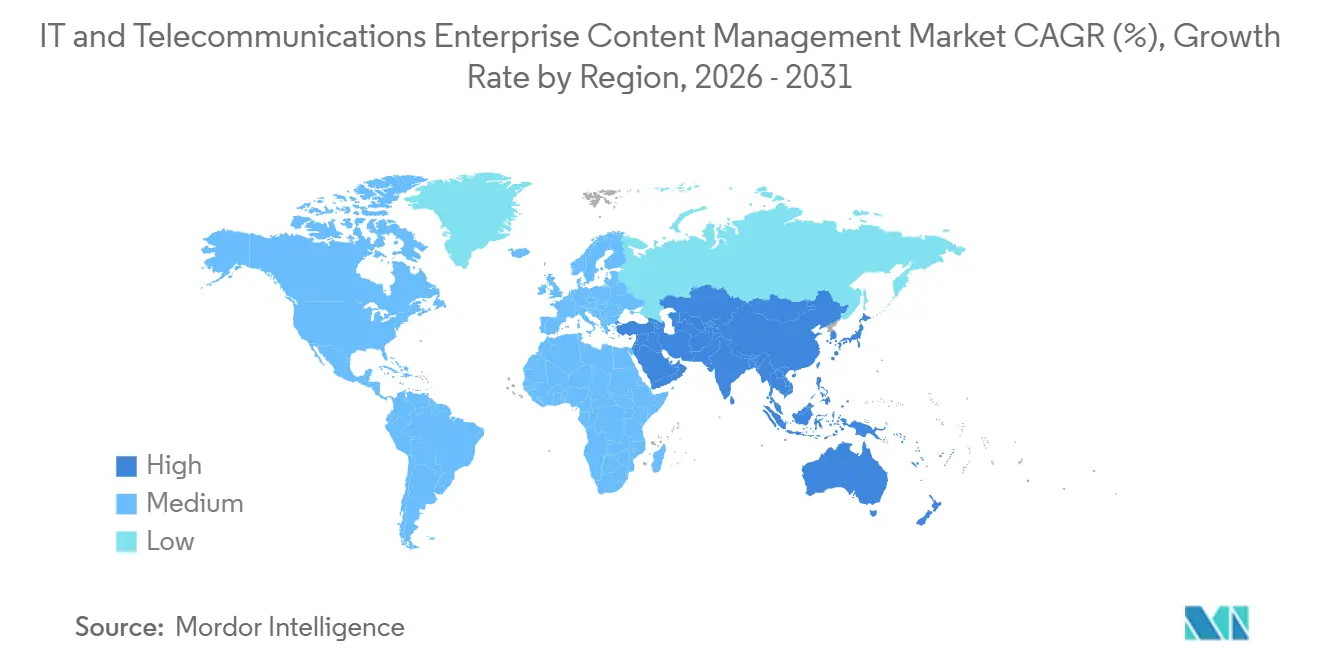
North America accounted for 36.72% of the IT and telecommunications enterprise content management (ECM) market size in 2025, which kept it as the largest regional base. The region benefits from mature digital programs at major U.S. and Canadian carriers, where content platforms are already tied to broader operating and support system modernization work. In the IT and telecommunications enterprise content management (ECM) market, North America also shows a clear shift toward governance layers that work with Microsoft 365 environments instead of competing against them for everyday collaboration. Europe presents a different demand profile because content control is shaped heavily by regulatory obligations, auditability, and jurisdiction-level records handling. The EU Data Act, which entered into force in January 2024 and applies from September 2025, adds to the already strict operating environment created by GDPR and national telecom data rules, which supports durable demand for high-governance content platforms.
Asia-Pacific is projected to grow at a 14.59% CAGR through 2031, making it the fastest-growing region in the IT and telecommunications enterprise content management (ECM) market. Operators across India, China, Southeast Asia, and other regulated markets are dealing with stricter localization and privacy requirements while also expanding digital service and network programs at pace. GSMA's June 2025 Asia-Pacific roundtable described DICT service expansion as a core part of carrier transformation, which supports the wider role of governed content and workflow systems in telecom operating models.[5]GSMA Asia-Pacific, “Asia-Pacific Embraces a New Wave of Digital Intelligence as 5G + AI Take Center Stage,” GSMA, gsma.com Hyland expanded its Content Innovation Cloud into the AWS Asia-Pacific Sydney Region in June 2026, which signals that vendors see the IT and telecommunications enterprise content management (ECM) market in APAC as both urgent and regulation-sensitive.
South America remains smaller than North America and Asia-Pacific, but the IT and telecommunications enterprise content management (ECM) market is gaining relevance there as operators modernize records, service, and fiber rollout workflows. Brazil stands out because higher privacy and records standards are raising the need for stronger governance around telecom documentation. The Middle East and Africa still represent a smaller revenue pool in the IT and telecommunications enterprise content management (ECM) market, though the region has clear demand pockets tied to sovereign cloud programs, national digital infrastructure, and government-linked telecom operations. Africa remains earlier in adoption, with spending concentrated more heavily in larger operators and public-sector aligned entities, while future expansion is likely to depend strongly on cloud models that make deployment practical for smaller telecom providers.

Competitive Landscape
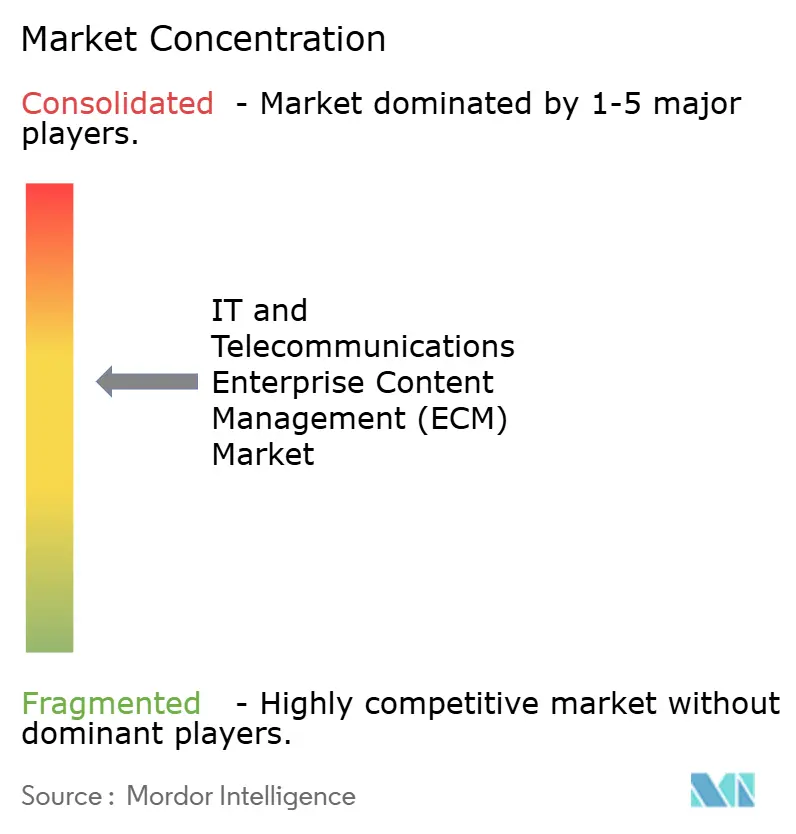
The IT and telecommunications enterprise content management (ECM) market shows moderate consolidation at the top end and a fragmented field below that. Microsoft, OpenText, IBM, Oracle, and SAP hold important contract positions because they already sit inside wider enterprise software estates used by telecom operators. At the same time, the IT and telecommunications enterprise content management (ECM) market remains open to specialized vendors such as Hyland, M-Files, Box, Newgen, DocuWare, and Zoho, especially where buyers want stronger workflow depth, cloud-native delivery, or industry-focused functionality. Storage alone is no longer enough to stand out, because most buyers now expect basic cloud repository capability as a starting point. In the IT and telecommunications enterprise content management (ECM) market, the real differentiation point in 2025 and 2026 is whether a platform can classify, surface, and act on content through AI-led workflows without adding operating friction.
Hyland's June 2026 partnership with Microsoft Azure and its June 2026 expansion with AWS in Asia-Pacific show how distribution through hyperscaler ecosystems has become a competitive lever in the IT and telecommunications enterprise content management (ECM) market. Those moves matter because telecom buyers often prefer to use existing cloud commitments instead of opening separate procurement tracks for each software layer. OpenText gained another advantage in November 2025 when its core content management for SAP solutions received certification for SAP S/4HANA Cloud Public Edition, which strengthens its position where telecom operators already rely on SAP-led business environments. M-Files also sharpened its position by extending Microsoft 365 integration in 2026, which gives it a simpler entry route for telecom organizations that want governance inside existing collaboration workflows.
White space in the IT and telecommunications enterprise content management (ECM) market remains meaningful in telecom field operations, sovereign-ready content architecture, and lighter packaging for MVNOs and smaller regional service providers. Vendors that can handle offline records, site-level permits, inspection photos, and asset acceptance files in edge conditions still have room to grow. The IT and telecommunications enterprise content management (ECM) market also leaves room for platforms that can apply jurisdiction-aware routing by design rather than through heavy custom work after purchase. OpenText's June 2026 CE 26.2 release, which introduced agentic actions for document, user, metadata, and records management, suggests that future competition in the IT and telecommunications enterprise content management (ECM) market will center on how far content systems can operate as active workflow layers rather than passive archives.
IT and Telecommunications Enterprise Content Management (ECM) Industry Leaders
OpenText Corporation
Hyland Software, Inc.
Box, Inc.
M-Files Corporation
Laserfiche, Inc.
- *Disclaimer: Major Players sorted in no particular order

Recent Industry Developments
- June 2026: Hyland announced a strategic partnership with Microsoft to bring its Content Innovation Cloud to Microsoft Azure, enabling customers to procure Hyland solutions through the Microsoft Marketplace using existing Azure cloud commitments. The partnership specifically targets data residency flexibility and geographic reach for regulated industries, including telecom operators, expanding Hyland's multicloud strategy.
- June 2026: Hyland expanded its AI-native Content Innovation Cloud across the Asia-Pacific region through an enhanced collaboration with AWS, deploying on the AWS Asia-Pacific (Sydney) Region. This expansion targets highly regulated, content-heavy industries in APAC requiring governed, AI-ready content management with lower latency and data sovereignty compliance.
- June 2026: OpenText released Content Management CE 26.2, introducing the platform's first agentic capabilities within its Content Aviator assistant. Natural language commands can now autonomously perform document management operations, move, copy, rename, delete, as well as user management, metadata assistance, and records management actions including placing documents on legal hold.
- June 2026: One NZ, a New Zealand telecommunications operator, deployed UiPath Maestro, a cloud-native workflow orchestration platform, reducing mobile provisioning times from 10 days to under 10 minutes. The deployment is being extended into finance, risk, fraud, and complex IT workflows, establishing a benchmark for end-to-end process automation in the ANZ telecom sector.
- March 2026: M-Files deepened its strategic collaboration with Microsoft, launching new native experiences for Microsoft 365 Copilot and Microsoft 365 Copilot Agent Builder. M-Files became the first document management system to leverage SharePoint Embedded, enabling more accurate, AI-powered content delivery directly within Microsoft 365 workflows.


Global IT and Telecommunications Enterprise Content Management (ECM) Market Report Scope
The IT and telecommunications enterprise content management market comprises platforms and solutions that enable IT and telecom enterprises to capture, store, manage, organize, and securely access digital content across business functions. These systems support the centralized management of technical documentation, customer records, compliance data, service workflows, and marketing assets in a scalable environment. The market addresses enterprises’ need to improve regulatory compliance, operational efficiency, omnichannel customer engagement, and AI-powered automation, helping IT and telecom providers streamline processes, reduce costs, and deliver consistent experiences across digital and physical service channels.
The IT and Telecommunications Enterprise Content Management Market Report is Segmented by Solution Type (Document Management, Records Management, Workflow and Business Process Management, Case Management, Digital Asset Management, Web Content Management, and Other Solutions), Deployment Mode (On-Premises, Cloud, and Hybrid), Enterprise Size (Small and Medium Enterprises (SME), and Large Enterprises), and Geography (North America, South America, Europe, Asia-Pacific, and Middle East and Africa). The Market Forecasts are Provided in Terms of Value (USD).
| Document Management |
| Records Management |
| Workflow and Business Process Management |
| Case Management |
| Digital Asset Management |
| Web Content Management |
| Other Solutions |
| On-Premises |
| Cloud |
| Hybrid |
| Small and Medium Enterprises (SME) |
| Large Enterprises |
| North America | United States | |
| Canada | ||
| Mexico | ||
| South America | Brazil | |
| Argentina | ||
| Rest of South America | ||
| Europe | United Kingdom | |
| Germany | ||
| France | ||
| Rest of Europe | ||
| Asia-Pacific | China | |
| Japan | ||
| India | ||
| South Korea | ||
| Australia | ||
| Rest of Asia-Pacific | ||
| Middle East and Africa | Middle East | United Arab Emirates |
| Saudi Arabia | ||
| Rest of Middle East | ||
| Africa | South Africa | |
| Kenya | ||
| Rest of Africa | ||
| By Solution Type | Document Management | ||
| Records Management | |||
| Workflow and Business Process Management | |||
| Case Management | |||
| Digital Asset Management | |||
| Web Content Management | |||
| Other Solutions | |||
| By Deployment Mode | On-Premises | ||
| Cloud | |||
| Hybrid | |||
| By Enterprise Size | Small and Medium Enterprises (SME) | ||
| Large Enterprises | |||
| By Geography | North America | United States | |
| Canada | |||
| Mexico | |||
| South America | Brazil | ||
| Argentina | |||
| Rest of South America | |||
| Europe | United Kingdom | ||
| Germany | |||
| France | |||
| Rest of Europe | |||
| Asia-Pacific | China | ||
| Japan | |||
| India | |||
| South Korea | |||
| Australia | |||
| Rest of Asia-Pacific | |||
| Middle East and Africa | Middle East | United Arab Emirates | |
| Saudi Arabia | |||
| Rest of Middle East | |||
| Africa | South Africa | ||
| Kenya | |||
| Rest of Africa | |||


Key Questions Answered in the Report
What is the current size and outlook for the IT and telecommunications enterprise content management (ECM) market?
The IT and telecommunications enterprise content management (ECM) market was valued at USD 4.53 billion in 2025, stands at USD 5.01 billion in 2026, and is forecast to reach USD 8.38 billion by 2031 at a 10.84% CAGR.
Which solution category leads telecom enterprise content management demand?
Document management led with 27.36% share in 2025 because operators handle large volumes of technical files, field records, and regulatory documents every day.
Which deployment model is growing fastest in telecom content platforms?
Cloud is both the largest and the fastest-growing deployment mode, with 76.81% share in 2025 and a projected 15.67% CAGR through 2031.
Why are telecom operators investing more in workflow-led content systems?
Operators want content tools that move with provisioning, compliance, and service workflows. That is why workflow and business process management is projected to grow at a 16.98% CAGR through 2031.
Which customer group is driving the next phase of adoption?
Large enterprises still lead revenue with 69.61% share, but SMEs are growing faster at a 16.02% CAGR because SaaS delivery lowers cost and shortens deployment time.
Which region is expanding the fastest through 2031?
Asia-Pacific is the fastest-growing region with a 14.59% CAGR, supported by telecom digitization, localization rules, and rising demand for governed cloud content platforms.
Page last updated on:






