
Isobutyric Acid Market Size and Share
Market Overview
| Study Period | 2021 - 2031 |
|---|---|
| Market Size (2026) | USD 228.16 Million |
| Market Size (2031) | USD 325.27 Million |
| Growth Rate (2026 - 2031) | 7.35 % |
| Fastest Growing Market | Asia-Pacific |
| Largest Market | North America |
| Market Concentration | Low |
Major Players *Disclaimer: Major Players sorted in no particular order Image © Mordor Intelligence. Reuse requires attribution under CC BY 4.0. | |
Isobutyric Acid Market Analysis by Mordor Intelligence
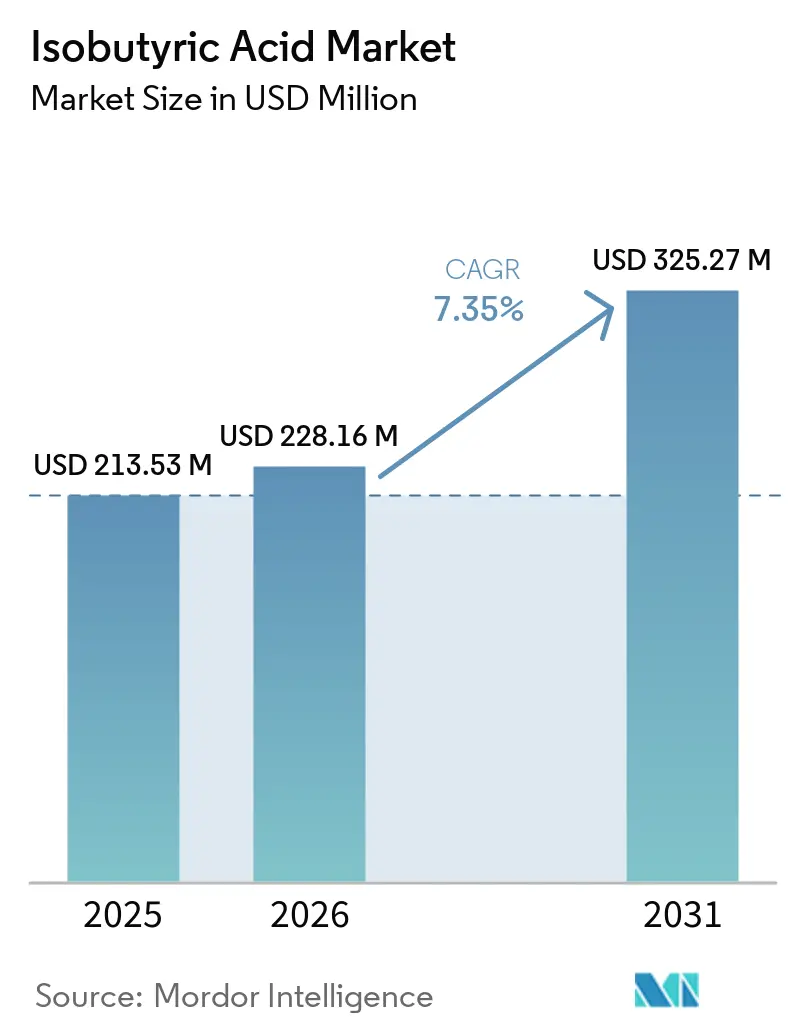
The global isobutyric acid market size was valued at USD 213.53 million in 2025 and is estimated to grow from USD 228.16 million in 2026 to USD 325.27 million by 2031, at a CAGR of 7.35% during the forecast period (2026-2031). The isobutyric acid market is driven by demand from pharmaceutical synthesis, animal nutrition, and specialty ester production. As a branched C4 chemical intermediate, isobutyric acid is used in the production of drug ingredients, organic acid feed additives, and flavor and fragrance formulations. Pharmaceutical outsourcing in India and China is expanding the regional customer base for higher-purity materials. Producers are balancing economies of scale in synthetic production routes with requirements for lower-carbon alternatives and improved supply chain traceability. Feedstock availability, transportation regulations, and the cost differential between renewable and synthetic materials remain key constraints on the isobutyric acid market.
Key Report Takeaways
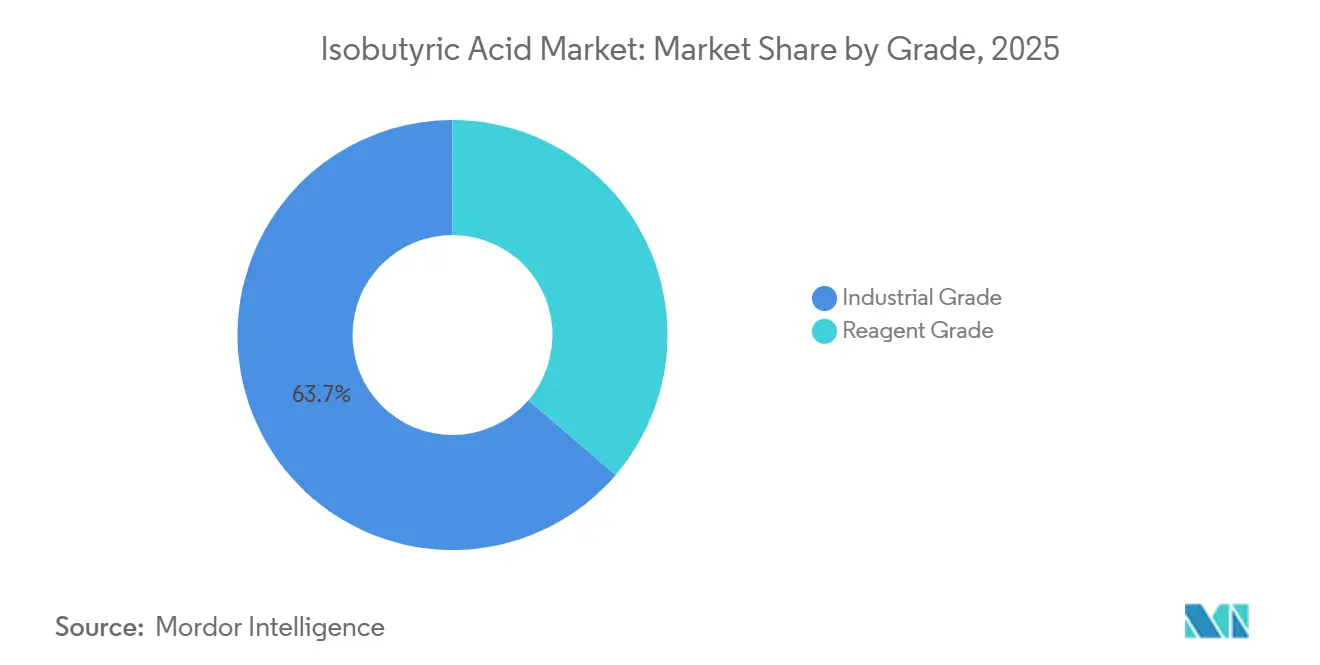
- By grade, industrial grade accounted for 63.71% of the isobutyric acid market share in 2025, and the same segment is forecast to grow at a 7.63% CAGR through 2031.
- By purity, material with more than 98% purity accounted for 70.05% of the isobutyric acid market share in 2025 and is projected to expand at a 7.82% CAGR through 2031.
- By type, synthetic material held 78.52% of the isobutyric acid market share in 2025, while renewable material is forecast to record the highest CAGR at 8.06% through 2031.
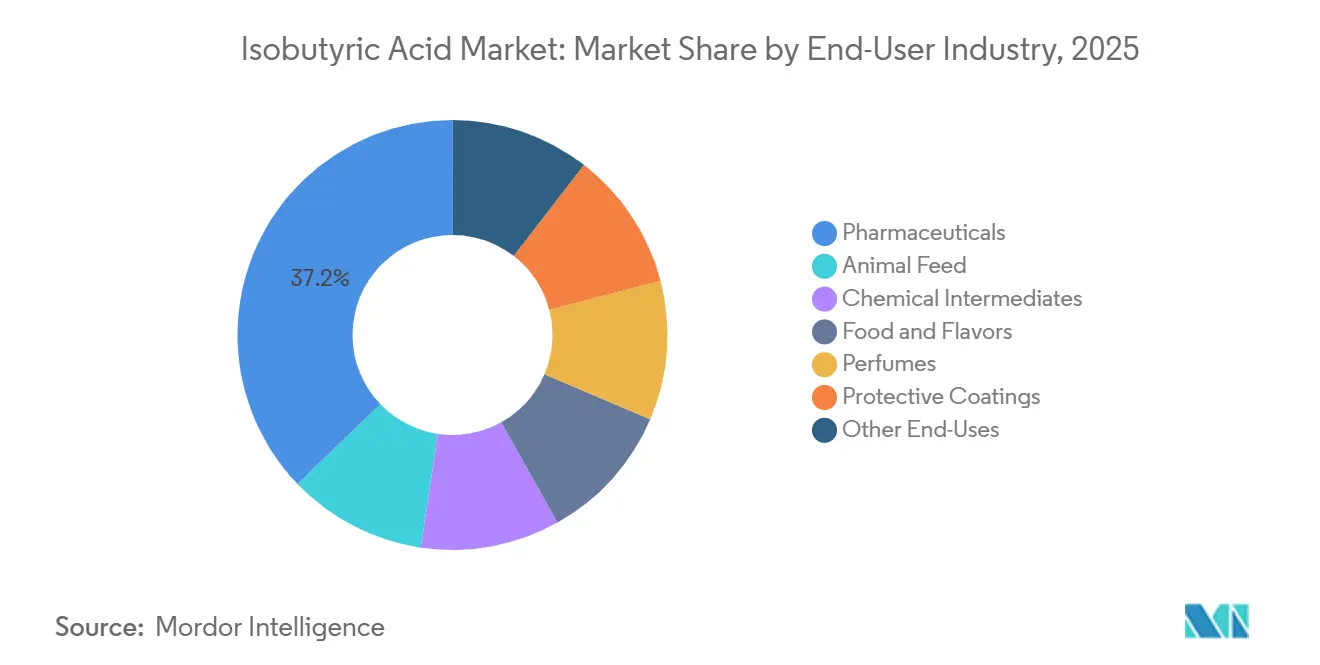
- By end-user industry, pharmaceuticals held 37.18% of the isobutyric acid market share in 2025, while animal feed is projected to grow at the highest CAGR of 8.64% through 2031.
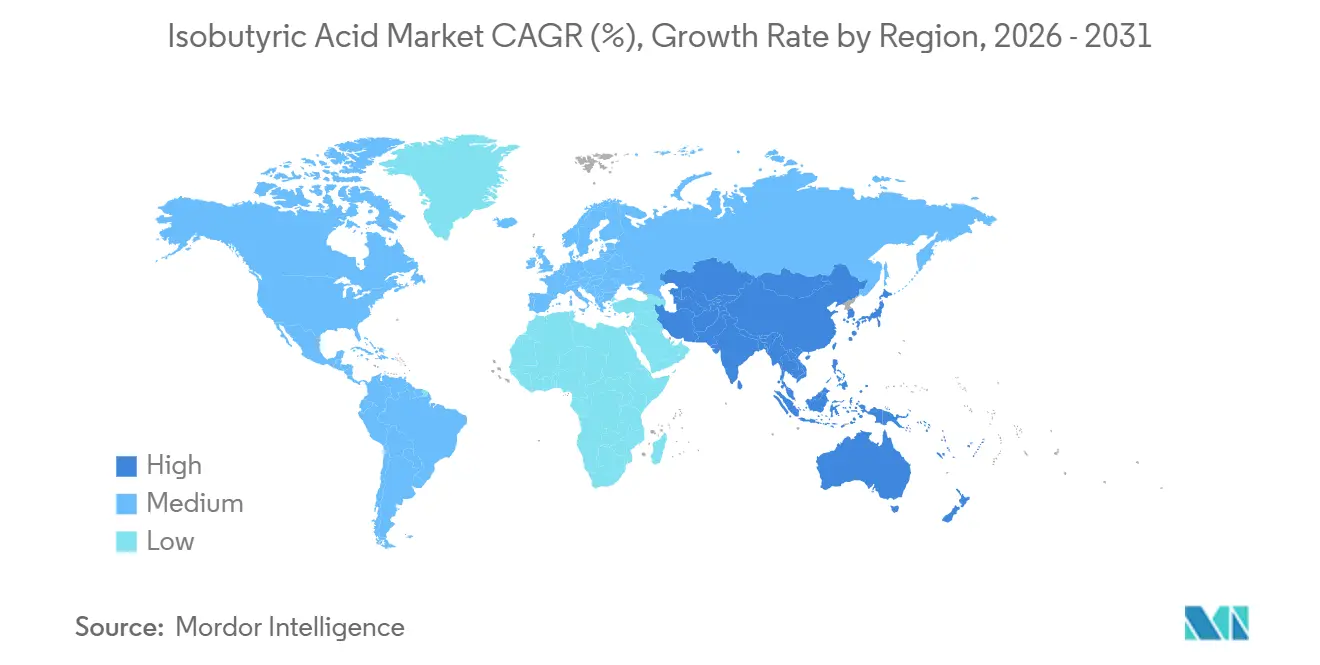
- By geography, North America held 34.27% of the isobutyric acid market share in 2025, while Asia-Pacific is forecast to grow at the highest CAGR of 8.17% through 2031.
Note: Market size and forecast figures in this report are generated using Mordor Intelligence’s proprietary estimation framework, updated with the latest available data and insights as of January 2026.
Global Isobutyric Acid Market Trends and Insights
Drivers Impact Analysis*
| Drivers | (~) % Impact on CAGR Forecast | Geographic Relevance | Impact Timeline |
|---|---|---|---|
| Expansion of Pharmaceutical and Specialty-Chemical Intermediates | +2.0% | Global, North America, and Asia-Pacific lead | Medium term (2-4 years) |
| Rising Animal-Feed Functional Additive Demand | +1.6% | Global, Asia-Pacific core with spillover to South America and Europe | Short term (≤ 2 years) |
| Growth in Food, Flavor, and Fragrance Ester Applications | +0.9% | Europe and North America, with Asia-Pacific uptake | Long term (≥ 4 years) |
| Shift Toward Renewable and Low-Carbon Organic Acids | +0.7% | Europe led with spillover to North America | Medium term (2-4 years) |
| CO2-to-Isobutyric-Acid Bioconversion Advances | +0.3% | Europe and North America research centers | Long term (≥ 4 years) |
| Source: Mordor Intelligence | |||
Expansion of Pharmaceutical and Specialty-Chemical Intermediates
The pharmaceutical sector uses high-purity isobutyric acid as a C4 intermediate in the synthesis of active pharmaceutical ingredients (APIs). Manufacturers use the material to produce anti-inflammatory drugs, analgesics, and anticonvulsants, as well as in excipient formulations and drug stabilization. Global prescription medicine spending reached USD 1.7 trillion in 2025, driven by oncology, immunology, and diabetes therapies. Contract manufacturing activity in India and China drives regional demand at a rate exceeding overall pharmaceutical spending growth. Requirements from the European Directorate for the Quality of Medicines & HealthCare (EDQM) and the United States Pharmacopeia support procuring materials with purity levels above 98%. These requirements increase the importance of quality standards and supplier qualification in the isobutyric acid market.
Rising Animal-Feed Functional Additive Demand
Restrictions on antibiotic growth promoters are expanding the use of isobutyric acid and its salts from preservative applications to livestock feed additive formulations. Commission Implementing Regulation (EU) 2025/2186 renewed the authorization of propionic acid, sodium propionate, and ammonium propionate as feed additives for terrestrial animal species. This regulatory direction supports the use of organic acids as functional alternatives in animal feed programs. Isobutyric acid can reduce gut pH, disrupt pathogenic bacterial membranes, and improve feed conversion in swine and poultry applications. Demand growth depends on herd size and the timing of antibiotic restrictions. Consequently, European and Southeast Asian markets present growth opportunities for the isobutyric acid market.
Growth in Food, Flavor, and Fragrance Ester Applications
Isobutyric acid serves as a feedstock for ethyl isobutyrate, isobutyl isobutyrate, and benzyl isobutyrate, which are used in fruity and dairy flavor formulations. Food, beverage, and personal care manufacturers use these esters to develop complex flavor and fragrance profiles. Demand is expanding beyond established flavor houses in North America and Europe as packaged food consumption increases in China, India, and ASEAN markets. This broader customer base supports the procurement of ester intermediates for premium product formulations. Scientific reviews by the Joint FAO/WHO Expert Committee on Food Additives support the continued evaluation and use of food flavoring substances under applicable conditions of use. The isobutyric acid market benefits as manufacturers seek consistent quality for food and flavor applications.
Shift Toward Renewable and Low-Carbon Organic Acids
Renewable isobutyric acid is attracting interest because it can diversify feedstock sources and support lower-carbon chemical sourcing. AFYREN produces bio-based short- and medium-chain fatty acids for applications including flavors, fragrances, nutrition, and chemical intermediates. The company reported continuous industrial production at AFYREN NEOXY in 2025 and continued its production ramp-up in 2026. Renewable materials are gaining acceptance in flavor, fragrance, cosmetics, and pharmaceutical applications, where natural-origin claims can support higher purchase prices.
Restraints Impact Analysis*
| Restraints | (~) % Impact on CAGR Forecast | Geographic Relevance | Impact Timeline |
|---|---|---|---|
| Propylene and Petrochemical Feedstock Price Volatility | -1.0% | Global, particularly Asia-Pacific and Europe | Short term (≤ 2 years) |
| Corrosive-Handling, Storage, and Transport Requirements | -0.6% | Global | Medium term (2-4 years) |
| Limited Bio-Based Scale and Cost Parity | -0.5% | Europe and North America | Long term (≥ 4 years) |
| Source: Mordor Intelligence | |||
Propylene and Petrochemical Feedstock Price Volatility
Synthetic production relies on propylene as a primary carbon feedstock, exposing producers to petrochemical price cycles. Propylene prices weakened in October 2025 due to lower crude oil prices and reduced polypropylene demand, before supply disruptions increased upstream cost pressures in 2026. Producers with exposure to propane dehydrogenation, particularly in China, are sensitive to propane supply disruptions and Middle East logistics conditions. Integrated naphtha cracker operators have a different cost profile, resulting in regional variations in feedstock exposure. This divergence can widen the gap between Chinese export prices and European contract prices. Consequently, supply agreements with fixed prices may become more difficult to maintain in the isobutyric acid market.
Corrosive-Handling, Storage, and Bio-Based Cost Requirements
Isobutyric acid is classified as UN 2529, a Class 3 flammable liquid with a subsidiary corrosive risk classification of Class 8, and it requires specific transportation and safety controls[1]International Labour Organization, “ICSC 0903: Isobutyric Acid, International Chemical Safety Card,” ILO Chemical Safety, chemicalsafety.ilo.org.. Packing Group III labeling, fire-protected storage, separation from strong bases, and segregation from food and feed products increase distribution requirements. These conditions increase logistics costs and limit smaller distributors' ability to serve their customer base. In Europe, Registration, Evaluation, Authorization and Restriction of Chemicals (REACH) restrictions and industrial emissions requirements impose reporting and compliance obligations on producers. At the same time, renewable production incurs higher costs than propylene-based synthesis at production levels ranging from hundreds to low-thousands of tons. These combined requirements support larger integrated suppliers and constrain the adoption of renewable materials in the isobutyric acid market.
*Our forecasts treat driver/restraint impacts as directional, not additive. The impact forecasts reflect baseline growth, mix effects, and variable interactions.
Segment Analysis
By Grade: Industrial Applications Drive Structural Demand
Industrial grade held 63.71% of the isobutyric acid market share in 2025 and is projected to expand at a CAGR of 7.63% from 2026 to 2031. Its position reflects demand from ester production, coating intermediates, animal nutrition, and chemical synthesis. This application-based approach limits exposure to weaknesses in any single customer segment. Industrial-grade specifications also support large-scale procurement for coatings and chemical intermediate applications. Supply chains in China and Europe often link industrial-grade and reagent-grade production; therefore, tighter industrial-grade supply can also affect availability for laboratory customers.
EU industrial emissions requirements are increasing the operating cost base for European producers. This cost differential may give Chinese suppliers an advantage in non-regulated markets, where landed cost is the primary purchasing criterion. Reagent grade is used in laboratories, pharmaceutical synthesis, and reference-standard applications. Tokyo Chemical Industry, FUJIFILM Wako Pure Chemical, and Shanghai Aladdin Biochemical Technology supply certified products for these applications. Although the reagent-grade category has a smaller revenue base, it generates higher margins for specialty distributors. Expanding generic drug pipelines in India and China are increasing demand beyond academic and research customers in the isobutyric acid industry.



By Purity: High-Purity Demand Accelerates on Pharmaceutical and Ester Requirements
Material with more than 98% purity accounted for 70.05% of the isobutyric acid market share in 2025 and is forecast to grow at a CAGR of 7.82% through 2031. This rate exceeds the overall market forecast because pharmaceutical buyers and premium ester producers require tighter purity thresholds. Higher-purity material can reduce residual impurities in finished drug formulations and flavor esters. Lower rejection risk has become a measurable procurement consideration. Pharmaceutical and food customers often establish purity requirements through qualification audits and product testing, thereby strengthening supplier relationships in the isobutyric acid market.
The less-than-98%-purity tier serves cost-sensitive applications in coatings, plasticizers, and agricultural chemicals. Producers in Shandong, Zhejiang, and Jiangsu leverage feedstock integration and lower production costs to serve this segment. Broader technical tolerances enable buyers to prioritize price in these applications. Margin pressure is encouraging some producers to shift toward higher-purity specifications. This transition may reduce the cost advantage associated with a commodity-based position while maintaining a distinct role for high-purity material in the isobutyric acid industry.
By Type: Synthetic Leadership Faces Renewable Competition
Synthetic material held 78.52% of the isobutyric acid market share in 2025. Its position reflects the established cost structure of propylene-based oxo synthesis and production capacity across North America, Europe, and China. OXEA’s facility in Oberhausen and Eastman’s operations in Kingsport, Tennessee, support supply within the synthetic category. Existing infrastructure provides buyers with supply availability and specification consistency. Chinese export capacity for industrial-grade synthetic materials is expanding, which may gradually put pressure on pricing in the isobutyric acid market.
Renewable material is projected to grow at a CAGR of 8.06% from 2026 to 2031. AFYREN NEOXY reached 40% of nominal capacity on several occasions by mid-2026 following process optimization work. This operating progress may reduce the perceived technology risk for downstream buyers. Lygos holds USDA BioPreferred certification for bio-based isobutyric acid, providing an additional U.S.-based supply option for certified procurement channels. Renewable material continues to command a price premium at current production levels. Consequently, its near-term customer base is concentrated in the flavor, fragrance, cosmetics, and pharmaceutical sectors, which can support sustainability-led purchasing decisions.
By End-User Industry: Animal Feed Has the Fastest Growth Rate
Animal feed is projected to grow at a CAGR of 8.64% from 2026 to 2031, the fastest rate among end-user segments. Livestock producers in Asia-Pacific, South America, and Europe are replacing antibiotic growth promoters with organic acid formulations. Isobutyric acid and calcium isobutyrate can reduce intestinal pH in monogastric animals, creating conditions less conducive to pathogens in weaned piglets and broiler chickens. This application also supports feed-conversion objectives. Regulatory activity supports the role of the isobutyric acid market in animal nutrition.
Pharmaceuticals accounted for 37.18% of the isobutyric acid market share in 2025, as the material is used in the synthesis of active pharmaceutical ingredients and excipients. Prescription medicine spending reached USD 1.7 trillion in 2025, supporting demand for pharmaceutical-grade chemical inputs. Chemical intermediates remain an important outlet for ester solvents used in coatings and plasticizers. Food and flavor applications benefit from demand for clean-label products and rising consumption of processed foods in emerging economies. Perfumes and protective coatings provide additional demand through personal care and infrastructure-related applications. Perstorp’s ProPhorce SR range demonstrates the use of glycerol butyrate esters for controlled delivery in animal nutrition.
Geography Analysis
North America accounted for 34.27% of the global isobutyric acid market share in 2025. The United States serves as a production and consumption market. Eastman Chemical Company operates manufacturing sites in Kingsport, Tennessee, and Longview, Texas, supporting the regional supply base. Pharmaceutical manufacturing and flavor and fragrance applications drive demand for premium-grade material. USDA support for renewable chemicals creates opportunities for bio-based variants. Lygos’ USDA BioPreferred-certified material can access federal procurement channels unavailable in all regions.
Asia-Pacific is projected to grow at a CAGR of 8.17% from 2026 to 2031. China combines production capacity with consumption, while demand for pharmaceutical intermediates is increasing in India. Production is concentrated in Shandong, Zhejiang, and Jiangsu, where producers access propylene from propane dehydrogenation and steam-cracking complexes. Generic drug manufacturing in Hyderabad and Ahmedabad supports the use of high-purity material. Japan and South Korea require high-specification grades for flavor, fragrance, and electronic chemical formulations. Demand from ASEAN countries for livestock production and processed foods is increasing, supporting the regional isobutyric acid market.
Europe holds the second-largest regional market position, supported by the pharmaceutical, flavor, and fragrance industries in Germany, France, the United Kingdom, and Benelux. OXEA, which rebranded from OQ Chemicals in May 2025, operates a production site in Oberhausen, Germany, that isn'tavailableOXEA, “Corporate Newsroom, Recent Corporate Announcements,” OXEA, oxea.com.. The region’s transition away from antibiotic growth promoters supports the adoption of organic acids among poultry and swine producers. AFYREN’s Saint-Avold biorefinery provides European buyers with a regional source of bio-based acids. Brazil, Argentina, and Saudi Arabia represent smaller demand centers for livestock applications, agricultural chemicals, and specialty chemicals. These emerging markets are projected to contribute more during the later years of the forecast period.

Competitive Landscape
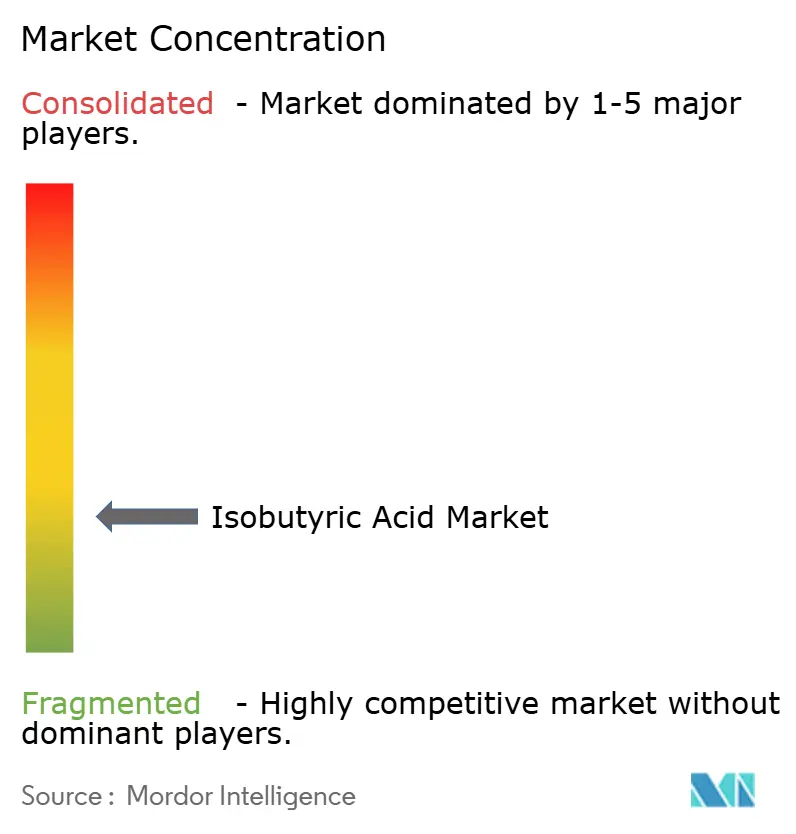
The isobutyric acid market is fragmented. OXEA, Eastman Chemical Company, and Perstorp Holding AB account for a share of production capacity in Western markets. Jiangsu Dynamic Chemical, Nanjing Chemical Material Corp., Weifang Qiyi Chemical, and Yufeng International Group supply quantities across Asia and other emerging markets. Perstorp acquired OQ Chemicals Nederland B.V. in December 2024, consolidating the Amsterdam esters plant’s assets, technology, and employees under a single owner. The transaction expanded Perstorp’s specialty chemicals and sustainable solutions portfolio. OXEA confirmed a final investment decision for a capacity expansion at its Bay City, Texas, facility in July 2026.
Competition focuses on high-purity products for pharmaceutical and reagent customers and cost leadership for industrial and feed applications. AFYREN and Lygos represent a third competitive position based on bio-based supply, sustainability credentials, and natural-origin claims. AFYREN acquired full ownership of AFYREN NEOXY in March 2026, providing direct control over the Saint-Avold biorefinery and its scale-up plans. Patent activity related to recombinant microbial production methods indicates continued technological competition in fermentation-based production routes. Snowco serves natural flavor-grade applications, while Tokyo Chemical Industry and FUJIFILM Wako serve laboratory reagent applications. These niche suppliers operate in specialized segments but do not compete with large producers on production scale.
Pharmaceutical-grade renewable material for clean-label excipient formulations remains a limited opportunity for major suppliers. However, it may become more relevant for specialty fermentation companies as capacity expands. In May 2026, OXEA and Air Liquide extended their operational partnership at Oberhausen for 12 years, supporting industrial gas availability at the site. AFYREN reported its first commercial revenue in 2025, based on the production of 400 tons of bio-based acids and sales to nine customers. These developments show that established synthetic suppliers are investing in operational continuity and capacity expansion, while renewable suppliers are establishing commercial production capabilities. The isobutyric acid market supports differentiated competition; however, the supply structure is not highly fragmented.
Isobutyric Acid Industry Leaders
OQ Chemicals GmbH
Eastman Chemical Company
AFYREN
Sasol
Tokyo Chemical Industry Co., Ltd.
- *Disclaimer: Major Players sorted in no particular order

Recent Industry Developments
- July 2026: OXEA (formerly OQ Chemicals) confirmed a final investment decision for a capacity expansion at its Bay City, Texas, manufacturing site. The expansion increases North American production capacity and supports demand from pharmaceutical intermediate and coatings customers in the region.
- May 2026: OXEA and Air Liquide extended their operational partnership at the Oberhausen, Germany, site for an additional 12 years. The agreement secures the supply of industrial gases for carboxylic acid and oxo-chemical manufacturing, supporting production continuity at the European isobutyric acid manufacturing site.


Global Isobutyric Acid Market Report Scope
Isobutyric acid is a colorless carboxylic acid that remains in liquid form under standard conditions. It has an odor commonly associated with rancid butter and serves as an intermediate in chemical manufacturing applications.
The isobutyric acid market is segmented by grade, purity, type, end-user industry, and geography. By grade, the market is segmented into reagent grade and industrial grade. By purity, the market is segmented into more than 98% and less than 98%. By type, the market is segmented into synthetic isobutyric acid and renewable isobutyric acid. By end-user industry, the market is segmented into animal feed, chemical intermediates, food and flavors, pharmaceuticals, perfumes, protective coatings, and other end-uses. The report also covers market size and forecasts for isobutyric acid across 15 countries in major regions. The market sizes and forecasts are provided in terms of value (USD).
| Reagent Grade |
| Industrial Grade |
| More Than 98% |
| Less Than 98% |
| Synthetic Isobutyric Acid |
| Renewable Isobutyric Acid |
| Animal Feed |
| Chemical Intermediates |
| Food and Flavors |
| Pharmaceuticals |
| Perfumes |
| Protective Coatings |
| Other End-Uses |
| Asia-Pacific | China |
| India | |
| Japan | |
| South Korea | |
| ASEAN Countries | |
| Rest of Asia-Pacific | |
| North America | United States |
| Canada | |
| Mexico | |
| Europe | Germany |
| United Kingdom | |
| France | |
| Italy | |
| NORDIC Countries | |
| Rest of Europe | |
| South America | Brazil |
| Argentina | |
| Rest of South America | |
| Middle East and Africa | Saudi Arabia |
| South Africa | |
| Rest of Middle East and Africa |
| By Grade | Reagent Grade | |
| Industrial Grade | ||
| By Purity | More Than 98% | |
| Less Than 98% | ||
| By Type | Synthetic Isobutyric Acid | |
| Renewable Isobutyric Acid | ||
| By End-User Industry | Animal Feed | |
| Chemical Intermediates | ||
| Food and Flavors | ||
| Pharmaceuticals | ||
| Perfumes | ||
| Protective Coatings | ||
| Other End-Uses | ||
| By Geography | Asia-Pacific | China |
| India | ||
| Japan | ||
| South Korea | ||
| ASEAN Countries | ||
| Rest of Asia-Pacific | ||
| North America | United States | |
| Canada | ||
| Mexico | ||
| Europe | Germany | |
| United Kingdom | ||
| France | ||
| Italy | ||
| NORDIC Countries | ||
| Rest of Europe | ||
| South America | Brazil | |
| Argentina | ||
| Rest of South America | ||
| Middle East and Africa | Saudi Arabia | |
| South Africa | ||
| Rest of Middle East and Africa | ||


Key Questions Answered in the Report
What is current market size of Isobutyric Acid Market Market?
The global isobutyric acid market size was valued at USD 213.53 million in 2025 and is estimated to grow from USD 228.16 million in 2026 to USD 325.27 million by 2031, at a CAGR of 7.35% during the forecast period (2026-2031).
Which grade has the largest share?
Industrial-grade held 63.71% in 2025 due to its use in ester production, coatings, feed, and chemical synthesis.
Which end-user application is growing fastest?
Animal feed is projected to expand at 8.64% CAGR through 2031 as organic acids replace antibiotic growth promoters.
Which region is growing fastest?
Asia-Pacific is forecast to grow at an 8.17% CAGR through 2031, supported by China’s production base and India’s pharmaceutical demand.
Page last updated on:





