
Ionic Coupling Reagents Market Size and Share
Market Overview
| Study Period | 2021 - 2031 |
|---|---|
| Market Size (2026) | USD 185.91 Million |
| Market Size (2031) | USD 222.73 Million |
| Growth Rate (2026 - 2031) | 3.68 % |
| Fastest Growing Market | Asia-Pacific |
| Largest Market | North America |
| Market Concentration | Medium |
Major Players *Disclaimer: Major Players sorted in no particular order Image © Mordor Intelligence. Reuse requires attribution under CC BY 4.0. | |
Ionic Coupling Reagents Market Analysis by Mordor Intelligence
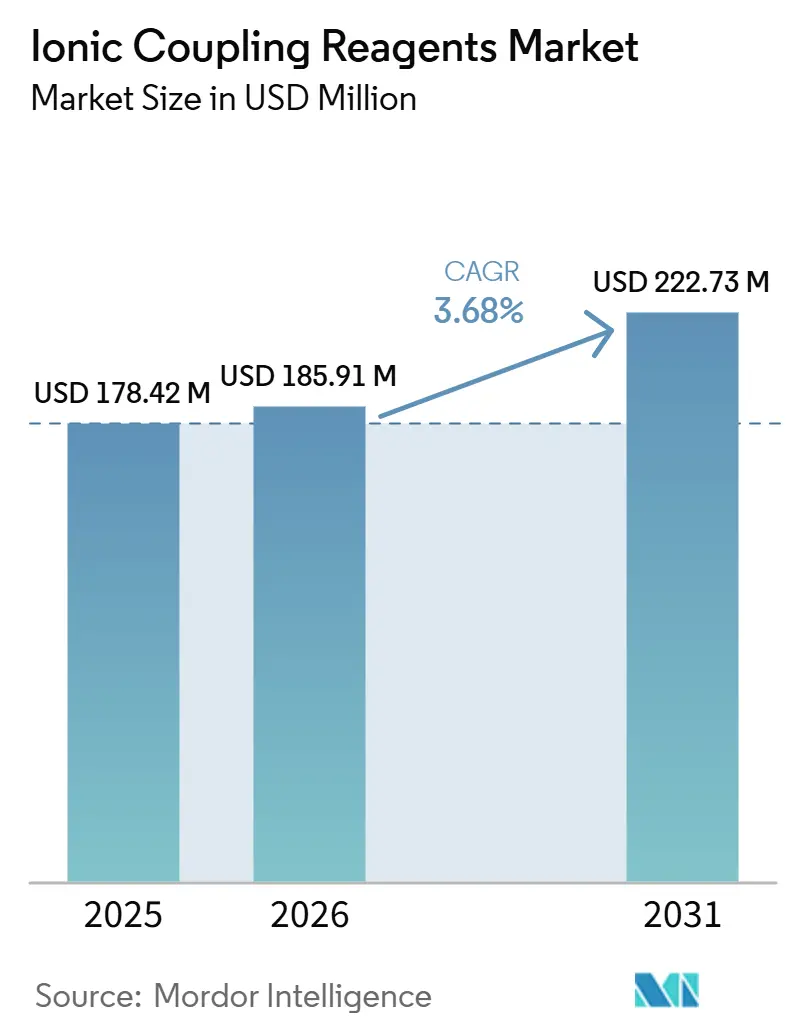
The Ionic Coupling Reagents Market size was valued at USD 178.42 million in 2025 and is estimated to grow from USD 185.91 million in 2026 to reach USD 222.73 million by 2031, at a CAGR of 3.68% during the forecast period (2026-2031). The ionic coupling reagents market is growing from a stable base, with the demand mix shifting as peptide manufacturing operates at larger commercial volumes. Large-scale production of GLP-1 receptor agonists has increased throughput requirements in solid-phase peptide synthesis, driving demand for high-reactivity reagents that improve cycle efficiency and reduce purification losses. The market is also gaining support from oligonucleotide programs, particularly where linker attachment, conjugation, and related synthesis steps require pharmaceutical-grade performance. Competition remains shaped by documentation quality, supply consistency, Good Manufacturing Practice (GMP) readiness, and the ability to support audited pharmaceutical workflows, which continues to favor established suppliers over low-documentation alternatives. Despite this support, growth remains moderate, as high reagent costs, safety concerns around 1-Hydroxybenzotriazole (HOBt)-derived systems, and lower-cost carbodiimide options limit the expansion of premium products across all end uses.
Key Report Takeaways
- By product type, uronium and guanidinium reagents held 58.21% revenue share in 2025, while the same segment is forecast to expand at a 4.28% CAGR through 2031.
- By form, powder held 64.38% revenue share in 2025, while solution is projected to record the highest CAGR at 4.57% through 2031.
- By application, peptide synthesis accounted for 48.92% of revenue in 2025, while oligonucleotide synthesis is projected to advance at a 5.42% CAGR through 2031.
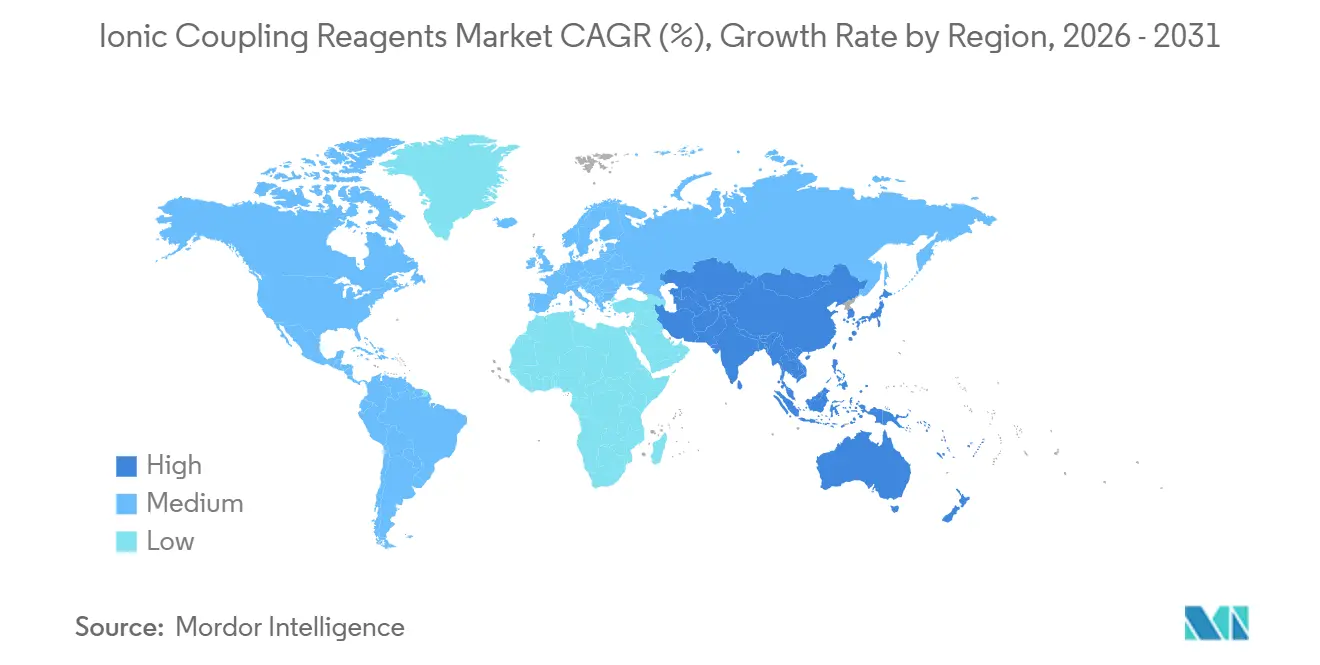
- By geography, North America held 37.11% of revenue in 2025, while Asia-Pacific is projected to grow at a 4.93% CAGR through 2031.
Note: Market size and forecast figures in this report are generated using Mordor Intelligence’s proprietary estimation framework, updated with the latest available data and insights as of January 2026.
Market Trends and Insights
Drivers Impact Analysis of Ionic Coupling Reagents Market*
| Drivers | (~) % Impact on CAGR Forecast | Geographic Relevance | Impact Timeline |
|---|---|---|---|
| Growing Demand for Peptide-Based Therapeutics | +0.8% | Global, concentrated in North America and Europe for commercial API | Short term (≤ 2 years) |
| Rising Development of Oligonucleotide-Based Drugs | +0.6% | Global, with APAC and North America as primary R&D hubs | Medium term (2-4 years) |
| Increasing Adoption of Automated SPPS Platforms | +0.4% | North America and Europe, with spillover to APAC manufacturing sites | Medium term (2-4 years) |
| Expansion of Pharmaceutical API Manufacturing Infrastructure | +0.3% | APAC core, especially China and India, with North America reshoring | Short term (≤ 2 years) |
| Growing Preference for Green and High-Efficiency Coupling Reagents | +0.3% | Europe and North America, emerging in APAC-regulated facilities | Long term (≥ 4 years) |
| Source: Mordor Intelligence | |||
Growing Demand for Peptide-Based Therapeutics
The ionic coupling reagents market is receiving direct support from the commercial success of Glucagon-Like Peptide-1 (GLP-1) receptor agonists, as these drugs have shifted peptide synthesis from project-scale to industrial-scale production. Solid-phase peptide synthesis (SPPS) for 30- to 40-amino-acid chains involves repeated coupling steps, and each additional cycle can reduce the final yield when reaction efficiency declines. This makes high-reactivity ionic systems valuable, as even small gains in each coupling step can lower impurity loads and reduce downstream purification work across large production runs. Bachem stated in 2025 that GLP-1 demand is pushing peptide manufacturing toward industrialized platform models, meaning reagent choice now matters across the full synthesis train rather than only in isolated development steps[1]Bachem Holding AG, “GLP-1 Demand: What It Means for Peptide Manufacturers,” Bachem Knowledge Center, bachem.com. The ionic coupling reagents market also benefits when new Contract Development and Manufacturing Organization (CDMO) peptide lines come online, as fresh equipment commissioning often creates a window for reagent requalification and possible vendor changes. Merck also highlighted in 2025 that biocatalytic peptide fragment coupling is gaining attention for complex Active Pharmaceutical Ingredient (API) synthesis, suggesting manufacturers are combining different synthesis routes while still relying on ionic reagents for standard coupling stages.
Rising Development of Oligonucleotide-Based Drugs
The ionic coupling reagents market is gaining a new layer of demand from nucleic acid therapeutics, extending beyond its traditional peptide-focused base. In oligonucleotide workflows, ionic coupling chemistry is used in GalNAc linker conjugation, solid-support derivatization, and peptide-oligonucleotide conjugate synthesis, where precise amide bond formation remains important. The global oligonucleotide synthesis market reached USD 4.31 billion in 2026, supporting the view that adjacent synthesis demand is becoming material for reagent suppliers. This shift is significant because approved and late-stage nucleic acid drugs have already pushed GMP expectations deeper into upstream chemistry, including the coupling reagents used in high-purity workflows. The ionic coupling reagents market therefore gains not only more demand from oligonucleotide programs but also tighter quality standards that favor premium suppliers already established in regulated peptide manufacturing. This dynamic is especially relevant for products used in GalNAc-conjugated siRNA and related modalities, where high purity expectations narrow the field of acceptable vendors.
Increasing Adoption of Automated SPPS Platforms
Automation is reshaping the ionic coupling reagents market, as modern SPPS platforms depend on tightly controlled reagent delivery rather than manual handling. Automated and continuous-flow systems require pre-dissolved reagents with stable concentration profiles, giving solution-format products a stronger role in both research and commercial settings. Suppliers that offer ready-to-use formulations, validated dissolution behavior, and workflow-specific packaging hold a practical advantage as peptide manufacturing becomes more instrument-driven. A 2026 paper in Green Chemistry showed that resonant acoustic mixing can enable solvent-less coupling in SPPS, pointing to future changes in reagent delivery while preserving the role of active ionic species. A 2025 Springer Nature paper also validated TBEC as a safer and greener coupling alternative for liraglutide synthesis in DMF-free systems, indicating that automation and greener chemistry are beginning to converge in applied process work. Thermo Fisher Scientific's 2026 investment in CDMO capabilities supports this trend, as broader digital and automation capacity will support more instrument-led synthesis in regulated manufacturing.
Expansion of Pharmaceutical API Manufacturing Infrastructure
The ionic coupling reagents market is also supported by broader pharmaceutical API capacity growth, as large production sites consume more reagent volume than research programs and tend to remain qualified for longer periods. When new plants, production lines, or cleanroom suites come online, reagent use expands not only in validation batches but also in routine manufacturing after approval. Thermo Fisher Scientific announced in April 2025 a USD 2 billion commitment to U.S. manufacturing and R&D over four years, including USD 1.5 billion in capital expenditures, to support higher pharmaceutical synthesis capacity and stronger demand for GMP-grade inputs. FUJIFILM Wako tripled GMP-compliant raw materials production capacity at its Osaka facility in May 2024, reinforcing Japan's position in high-specification reagent supply for pharmaceutical manufacturing. GL Biochem also advanced its Beidaihe R&D project in 2025, extending its footprint within China's peptide and reagent manufacturing network. India's Production Linked Incentive (PLI)-backed pharmaceutical expansion adds to this pattern, as more domestic peptide API work will require reliable sourcing of coupling reagents across development and commercial scales.
Restraints Impact Analysis of Ionic Coupling Reagents Market*
| Restraints | (~) % Impact on CAGR Forecast | Geographic Relevance | Impact Timeline |
|---|---|---|---|
| High Cost of Advanced Ionic Coupling Reagents | -0.3% | Global, most acute in price-sensitive APAC and Latin America markets | Short term (≤ 2 years) |
| Safety and Stability Concerns with HOBt-Based Reagents | -0.2% | Europe and North America, where transport and storage rules are stringent | Medium term (2-4 years) |
| Availability of Lower-Cost Alternative Coupling Systems | -0.2% | Global, particularly relevant for research-scale and non-pharmaceutical applications | Long term (≥ 4 years) |
| Source: Mordor Intelligence | |||
High Cost of Advanced Ionic Coupling Reagents
The ionic coupling reagents market faces a clear cost barrier, as high-purity HATU and COMU require more controlled production and tighter quality management than commodity alternatives. For GLP-1 and other peptide programs running at multi-kilogram or ton scale, reagent spend is one of the highest recurring consumable costs in a batch economics model. This leads procurement teams to compare premium ionic systems against less expensive options, even when premium products offer better coupling efficiency or lower impurity burden. Academic users and smaller biotech companies face this pressure more acutely, as limited budgets can push them toward carbodiimide-based substitutes despite lower performance in difficult sequences. The price gap between Chinese generic-grade suppliers and GMP-certified European or US sources can exceed 5-fold for the same nominal specification, which intensifies supplier qualification reviews in regulated accounts. As a result, the ionic coupling reagents market retains a quality premium in pharma, but cost sensitivity continues to limit broader adoption outside the most demanding synthesis settings.
Safety and Stability Challenges with HOBt-Derived Reagents
The ionic coupling reagents market also faces safety concerns, as several widely used systems contain 1-Hydroxybenzotriazole (HOBt) or related azabenzotriazole groups, which are classified as having an explosive risk. This affects storage, handling, transport, and waste procedures, increasing operating complexity at large pharmaceutical sites. Bachem stated in 2025 that TBTU, HBTU, and PyBOP contain potentially explosive HOBt, requiring larger synthesis operations to evaluate the full storage and waste profile before approving routine use. Luxembourg Bio Technologies has positioned COMU as a lower explosive-risk alternative with strong performance in epimerization-sensitive coupling, which explains the growing interest in safer alternatives. A 2025 Journal of Peptide Science paper also reported an occupational allergic sensitization risk associated with airborne HBTU exposure, adding a worker health dimension to the safety concern[2]Valentina Borghesani, “Uronium Peptide Coupling Agents, Another Case of Occupational Airborne Allergic Sensitization Induced by HBTU,” Journal of Peptide Science, doi.org. However, existing Standard Operating Procedures (SOPs) and revalidation costs slow the pace of switching, and the ionic coupling reagents market is therefore likely to change gradually rather than abruptly.
*Our forecasts treat driver/restraint impacts as directional, not additive. The impact forecasts reflect baseline growth, mix effects, and variable interactions.
Ionic Coupling Reagents Market Segment Analysis
By Product Type:
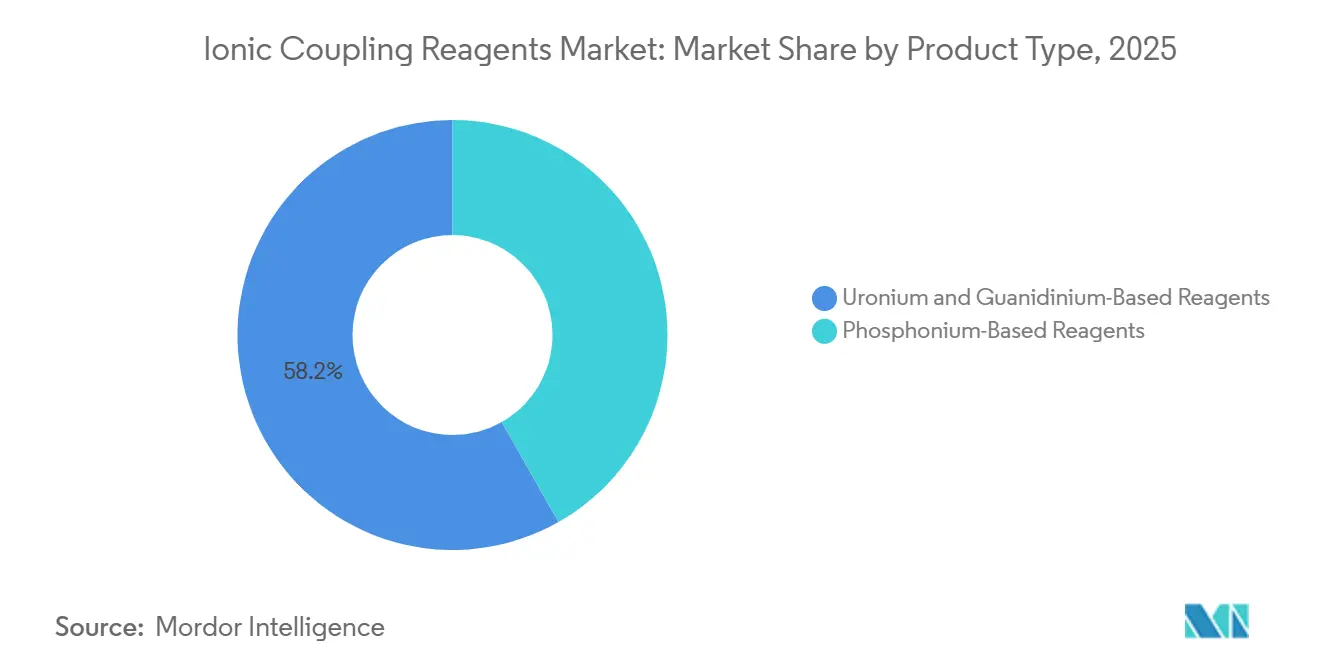
Uronium and Guanidinium Reagents Consolidate Dual Leadership in Volume and GrowthUronium and guanidinium reagents held 58.21% of the ionic coupling reagents market share in 2025, making this class the product leader across pharmaceutical and research demand. Their lead stems from long-standing use in solid-phase peptide synthesis (SPPS) workflows, where HATU and HBTU remain validated and widely available across catalog and manufacturing channels. These reagents are used for difficult couplings because they form highly reactive intermediates that support better yields across both standard and challenging peptide sequences. The ionic coupling reagents market continues to rely on this class as the default choice in regulated peptide synthesis, particularly where process reproducibility is as important as reaction speed. A notable shift is now visible within the category, as newer Good Manufacturing Practice (GMP) sites increasingly review the safety trade-offs of HOBt-containing materials during qualification. Luxembourg Bio Technologies has documented COMU as an Oxyma-based alternative with low racemization tendency and compatibility with microwave-assisted synthesis, which explains its growing acceptance in safety-conscious workflows.
This class is also forecast to grow at a 4.28% CAGR through 2031, which is notable for a segment that already holds the majority of revenue. This pattern reflects how closely the leading product class aligns with the fastest-growing commercial demand pools, especially high-specification pharmaceutical peptide manufacturing. TBTU and TOTU still retain a role in cost-sensitive research and custom synthesis, where sequence complexity is lower and premium performance is not always required. The ionic coupling reagents market therefore remains anchored by uronium and guanidinium systems, even as product preference gradually shifts from legacy HOBt-based options toward safer third-generation salts. Phosphonium reagents remain relevant for fragment condensation and solution-phase work, but they serve more specialized needs and face greater scrutiny in safety-sensitive accounts. Sigma-Aldrich's peptide coupling selection guide reflects this split, with PyBOP and PyAOP positioned for demanding couplings while remaining outside the broader volume base controlled by uronium systems.



By Form:
Powder Maintains Volume Lead as Solution Formats Scale With AutomationPowder accounted for 64.38% of the ionic coupling reagents market in 2025, maintaining its dominance across both research laboratories and regulated manufacturing lines. Its lead reflects storage stability, broad scale flexibility, and straightforward analytical verification against established quality standards. Pharmaceutical teams value powders because weight-based dosing supports traceability, which is useful in validation packages and routine batch documentation. The ionic coupling reagents market has therefore retained powder as the operational default, particularly where multiple suppliers must be qualified under common specifications. Standardized HATU and HBTU powder grades make vendor comparison more straightforward than many formulated solution systems, supporting procurement flexibility in regulated settings. GL Biochem has stated that its HBTU powder reaches 99.8% purity at scale, demonstrating the maturity of powder manufacturing even among high-volume Asian producers.
Solutions are projected to record a faster 4.57% CAGR through 2031, reflecting how automation is changing format demand in the ionic coupling reagents market. Automated SPPS and flow systems reduce tolerance for manual weighing errors and benefit from pre-dissolved reagents that maintain consistent concentration and dosing. Solution formats also reduce direct handling steps for HOBt-containing materials, providing a practical safety benefit in addition to workflow convenience. The ionic coupling reagents market is likely to see more supplier investment in pre-formulated cartridges and workflow-specific solutions as synthesis platforms become more digital and throughput-focused. A 2026 Green Chemistry paper on resonant acoustic mixing points to future delivery methods that could further expand the design space for solution or near-solution systems. Thermo Fisher Scientific serves both catalog demand and regulated synthesis workflows, enabling it to align reagent form more closely with instrument-driven production needs.
By Application:
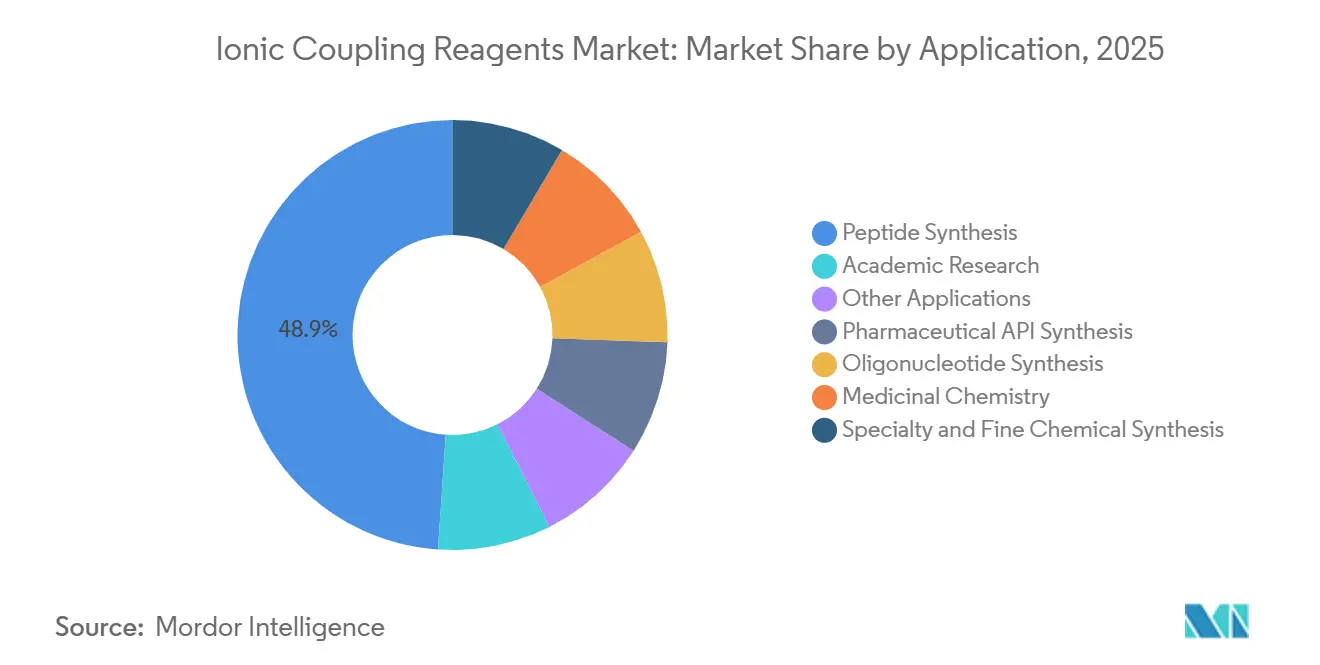
Oligonucleotide Synthesis Challenges, Peptide Synthesis in Growth TrajectoryPeptide synthesis accounted for 48.92% of the ionic coupling reagents market share in 2025, confirming its continued role as the primary demand driver across the full application mix. This lead is tied to research, process development, and commercial manufacturing needs that all depend on reliable coupling performance. Peptide-focused procurement also raises quality expectations for the broader ionic coupling reagents market, as suppliers serving regulated peptide programs must maintain robust documentation and consistent batch performance. Pharmaceutical API synthesis represents the next major layer of demand, particularly for peptidomimetics, macrocycles, and peptide-drug conjugates that require more controlled chemistry than is available in basic research programs. Medicinal chemistry and specialty fine chemicals also use a wide range of reagents, but these channels typically place greater emphasis on cost efficiency than on GMP documentation. Academic research remains an important customer base, with demand tied closely to public funding cycles and usually served by large catalog suppliers rather than narrow specialists.
Oligonucleotide synthesis is projected to expand at a 5.42% CAGR through 2031, making it the fastest-growing application in the ionic coupling reagents market. Its growth is driven by N-acetylgalactosamine (GalNAc) conjugation, RNA scaffold functionalization, and peptide-oligonucleotide conjugate work, where amide bond formation still requires dependable, high-purity chemistry. As more antisense, small interfering RNA (siRNA), and related nucleic acid programs advance, suppliers are being drawn toward products tailored for oligonucleotide-adjacent workflows rather than peptide workflows alone. The ionic coupling reagents market is therefore broadening in a way that does not displace peptide synthesis, but instead adds a second growth lane alongside it. This is significant because multimodal therapeutics are increasingly combining peptide and oligonucleotide chemistry within the same development program, thereby raising both reagent complexity and quality expectations. The result is a stronger role for suppliers that can support both peptide and nucleic acid manufacturing environments with comparable documentation depth and formulation quality.
Geography Analysis
North America Ionic Coupling Reagents Market
North America accounted for 37.11% of the ionic coupling reagents market in 2025, making it the largest regional contributor to global revenue. The United States drove most of this share, combining a dense pharmaceutical base with a large Contract Research Organization (CRO) and Contract Development and Manufacturing Organization (CDMO) network that required regulated-grade reagents. FDA GMP requirements, International Council for Harmonisation (ICH) Q11 expectations, and US hazardous-handling regulations supported premium product specifications and limited the use of low-documentation alternatives. Thermo Fisher Scientific's April 2025 commitment of USD 2 billion to US manufacturing and R&D reflected the priority suppliers placed on domestic pharmaceutical production capacity and related reagent demand. Canada added steady demand from academic and mid-scale pharmaceutical synthesis, while Mexico contributed through a growing generic manufacturing base that remained dependent on imports for high-specification inputs.
Europe Ionic Coupling Reagents Market
Europe held the second-largest regional position in the ionic coupling reagents market, supported by Germany, the United Kingdom, France, and Italy. The region benefited from strong pharmaceutical R&D, established specialty chemical capabilities, and a research ecosystem that consumed both standard and advanced coupling reagents. Europe also remained relevant in product innovation, with Iris Biotech and Luxembourg Bio Technologies contributing to specialized reagent development and safer alternatives. EU Registration, Evaluation, Authorisation and Restriction of Chemicals (REACH) regulations and growing concerns around benzotriazole-linked environmental and handling issues influenced procurement decisions, particularly at larger synthesis sites seeking safer alternatives. This pressure drove greater attention toward Oxyma-based systems across European regulated facilities, although existing installed processes continued to slow the pace of transition.
APAC, South America and MEA Ionic Coupling Reagents Market
Asia-Pacific is projected to grow at a 4.93% CAGR through 2031, the fastest rate across the ionic coupling reagents market, as China, India, Japan, and South Korea strengthen peptide and pharmaceutical chemistry capabilities. China stands out as both a growing demand center and an emerging supply base, with GL Biochem operating a 35,000-square-meter peptide reagent facility with an annual reagent output capacity of 100 metric tons. Japan remains relevant on the high-specification side, and FUJIFILM Wako's 2024 Osaka expansion supports its position in GMP-compliant raw materials. India is expanding under Production Linked Incentive (PLI) support and broader CDMO growth, which is expected to increase demand across research, development, and commercial procurement. South Korea is more advanced in peptide API scaling than in biologics, but its growing process chemistry capabilities are expected to expand regional demand over time. South America, the Middle East, and Africa remain smaller markets, with Brazil, Argentina, and Saudi Arabia representing the main forward-looking demand points.

Competitive Landscape
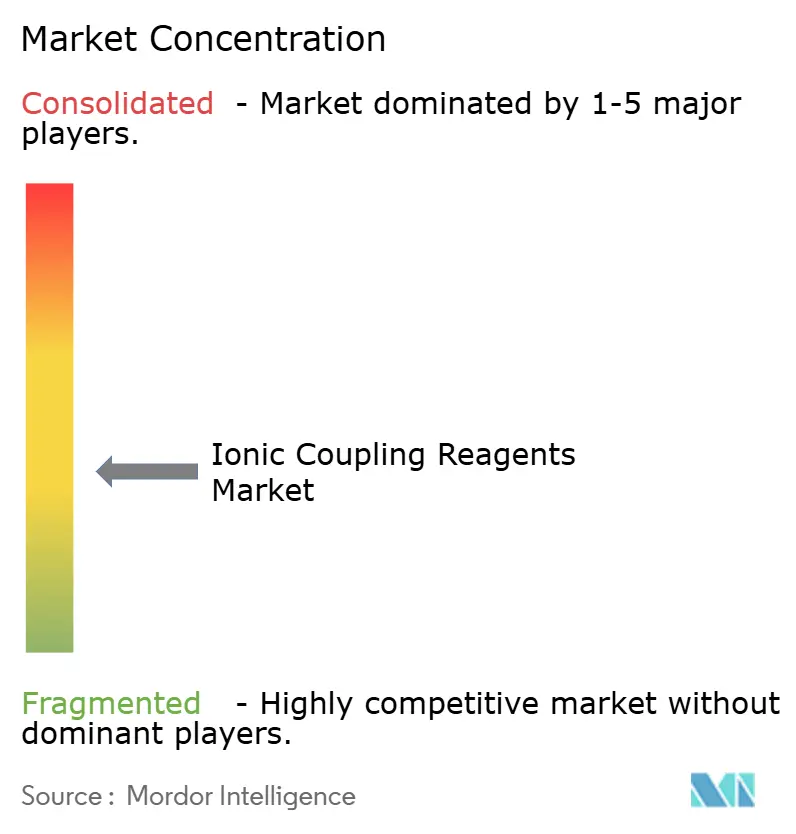
The ionic coupling reagents market is moderately fragmented, with Merck KGaA, Thermo Fisher Scientific, and GL Biochem anchoring the high-volume catalog segment, while Luxembourg Bio Technologies and Iris Biotech hold more specialized positions. Scale is important in this market because buyers require reliable documentation, consistent supply, and the ability to purchase both research and commercial volumes from the same supplier. This gives an advantage to larger suppliers with broad catalogs, audited manufacturing systems, and global distribution reach. Merck benefits from established peptide chemistry lines and brand recognition across regulated and research settings, while Thermo Fisher combines catalog breadth with deep ties to pharmaceutical services and CDMO operations. GL Biochem's Asian manufacturing presence supports its ability to compete on scale and availability, even as regulated buyers continue to scrutinize qualification depth. Luxembourg Bio Technologies holds a defensible position due to its intellectual property around COMU [1-[(1-(Cyano-2-ethoxy-2-oxoethylideneaminooxy)dimethylaminomorpholino)]uronium hexafluorophosphate], which directly addresses safety and racemization concerns in a distinct part of the ionic coupling reagents market.
Market leaders are investing beyond catalog expansion. Thermo Fisher's 2026 USD 1 billion CDMO investment plan reflects a strategy centered on manufacturing capability, digital infrastructure, and deeper integration with regulated customer workflows. GL Biochem's Beidaihe project milestone in 2025 represented another form of positioning, where regional manufacturing and R&D scale supported both domestic demand and export ambitions. FUJIFILM Wako's Osaka expansion reinforced high-specification reagent capacity in Japan rather than competing on broad catalog volume alone. These moves indicate that competition is increasingly shaped by manufacturability, compliance support, and supply assurance rather than list price. The ionic coupling reagents market therefore rewards suppliers that can connect product chemistry with full operational reliability in pharmaceutical production.
Opportunities remain in the ionic coupling reagents market, particularly for GMP-certified phosphonium systems suited to oligonucleotide-related coupling and for large-scale alternatives with stronger safety profiles. This white space exists because peptide-oriented uronium products are relatively mature, while some adjacent use cases remain less standardized and underserved. Newer entrants can compete by offering faster delivery, specialized portfolios, or safer chemistries, but entering regulated North American and European supply chains remains difficult. Supplier qualification barriers are high, as pharmaceutical customers require audited production, process consistency, and strong technical support before approving a new source. Enamine's 2026 partnerships in fragment-based discovery illustrate how some companies are differentiating by integrating with research workflows and data-driven discovery tools rather than relying solely on commodity supply. Even so, the ionic coupling reagents market continues to favor suppliers that can demonstrate quality and continuity at scale, which keeps fragmentation below what might otherwise be expected in a small-value specialty chemistry segment.
Ionic Coupling Reagents Industry Leaders
Merck KGaA
Thermo Fisher Scientific Inc.
Carl Roth GmbH + Co. KG
Tokyo Chemical Industry Co., Ltd.
Chem-Impex
- *Disclaimer: Major Players sorted in no particular order
Ionic Coupling Reagents Market Companies Covered in this Report
- AAPPTec
- Biosolve Chimie
- BLD Pharmatech Ltd.
- Carl Roth GmbH + Co. KG
- Chem-Impex
- Enamine Ltd.
- Fluorochem Ltd.
- FUJIFILM Wako Pure Chemical Corporation
- GL Biochem (Shanghai) Ltd.
- Iris Biotech GmbH
- Luxembourg Bio Technologies Ltd.
- Merck KGaA
- Santa Cruz Biotechnology, Inc.
- Suzhou Highfine Biotech Co., Ltd.
- Thermo Fisher Scientific Inc.
- Tokyo Chemical Industry Co., Ltd.

Recent Industry Developments in Ionic Coupling Reagents Market
- June 2026: Merck KGaA agreed to acquire Bio-Techne Corporation for USD 11.3 billion. The transaction is expected to strengthen Merck KGaA's Process Solutions unit by expanding its presence in higher-value reagents, advanced analytics, and cell and gene therapy workflows, reinforcing the company's reagent supply capabilities for pharmaceutical synthesis programs.
- April 2025: Thermo Fisher Scientific committed USD 2 billion to US manufacturing and R&D investment over four years, comprising USD 1.5 billion in capital expenditures and USD 500 million in R&D, to expand manufacturing operations and support customers facing supply chain constraints and reshoring requirements. This commitment supports expanded capacity for pharmaceutical synthesis reagents and raw materials at US facilities.


Global Ionic Coupling Reagents Market Report Scope
Ionic coupling reagents are specialized chemical compounds used in organic synthesis that contain charged, ionic groups. They facilitate the joining of two molecules, such as amino acids, by forming a highly reactive intermediate that enables efficient bond formation with minimal waste.
The ionic coupling reagents market is segmented by product type, form, application, and geography. By product type, the market is segmented into uronium and guanidinium-based reagents and phosphonium-based reagents. By form, the market is segmented into powder and solution. By application, the market is segmented into peptide synthesis, pharmaceutical API synthesis, oligonucleotide synthesis, medicinal chemistry, specialty and fine chemical synthesis, academic research, and other applications. The report also covers market size and forecasts for ionic coupling reagents across 16 countries in major regions. The market sizes and forecasts are provided in terms of value (USD).
| Uronium and Guanidinium-Based Reagents |
| Phosphonium-Based Reagents |
| Powder |
| Solution |
| Peptide Synthesis |
| Pharmaceutical API Synthesis |
| Oligonucleotide Synthesis |
| Medicinal Chemistry |
| Specialty and Fine Chemical Synthesis |
| Academic Research |
| Other Applications |
| Asia-Pacific | China |
| India | |
| Japan | |
| South Korea | |
| Rest of Asia-Pacific | |
| North America | United States |
| Canada | |
| Mexico | |
| Europe | Germany |
| United Kingdom | |
| France | |
| Italy | |
| Russia | |
| Rest of Europe | |
| South America | Brazil |
| Argentina | |
| Rest of South America | |
| Middle-East and Africa | Saudi Arabia |
| South Africa | |
| Rest of Middle-East and Africa |
| By Product Type | Uronium and Guanidinium-Based Reagents | |
| Phosphonium-Based Reagents | ||
| By Form | Powder | |
| Solution | ||
| By Application | Peptide Synthesis | |
| Pharmaceutical API Synthesis | ||
| Oligonucleotide Synthesis | ||
| Medicinal Chemistry | ||
| Specialty and Fine Chemical Synthesis | ||
| Academic Research | ||
| Other Applications | ||
| By Geography | Asia-Pacific | China |
| India | ||
| Japan | ||
| South Korea | ||
| Rest of Asia-Pacific | ||
| North America | United States | |
| Canada | ||
| Mexico | ||
| Europe | Germany | |
| United Kingdom | ||
| France | ||
| Italy | ||
| Russia | ||
| Rest of Europe | ||
| South America | Brazil | |
| Argentina | ||
| Rest of South America | ||
| Middle-East and Africa | Saudi Arabia | |
| South Africa | ||
| Rest of Middle-East and Africa | ||


Key Questions Answered in the Report
What is current market size of Ionic Coupling Reagents Market?
The Ionic Coupling Reagents Market size was valued at USD 178.42 million in 2025 and is estimated to grow from USD 185.91 million in 2026 to reach USD 222.73 million by 2031, at a CAGR of 3.68% during the forecast period (2026-2031).
Which product type leads to revenue in this space?
Uronium and guanidinium reagents led with 58.21% revenue share in 2025 and are also projected to post the fastest product-type growth at a 4.28% CAGR through 2031.
Why does peptide synthesis remain the largest application?
Peptide synthesis accounted for 48.92% of revenue in 2025, as it remains the primary demand base across research, process development, and commercial API production.
Which application is growing the fastest?
Oligonucleotide synthesis is projected to expand at a 5.42% CAGR through 2031, supported by antisense, siRNA, N-Acetylgalactosamine (GalNAc)-conjugated therapeutics, and related conjugation chemistry needs.
Page last updated on:





