
Ionic Condensation Reagents Market Size and Share
Market Overview
| Study Period | 2021 - 2031 |
|---|---|
| Market Size (2026) | USD 310.26 Million |
| Market Size (2031) | USD 480.45 Million |
| Growth Rate (2026 - 2031) | 9.14 % |
| Fastest Growing Market | Asia-Pacific |
| Largest Market | North America |
| Market Concentration | Medium |
Major Players *Disclaimer: Major Players sorted in no particular order Image © Mordor Intelligence. Reuse requires attribution under CC BY 4.0. | |
Ionic Condensation Reagents Market Analysis by Mordor Intelligence
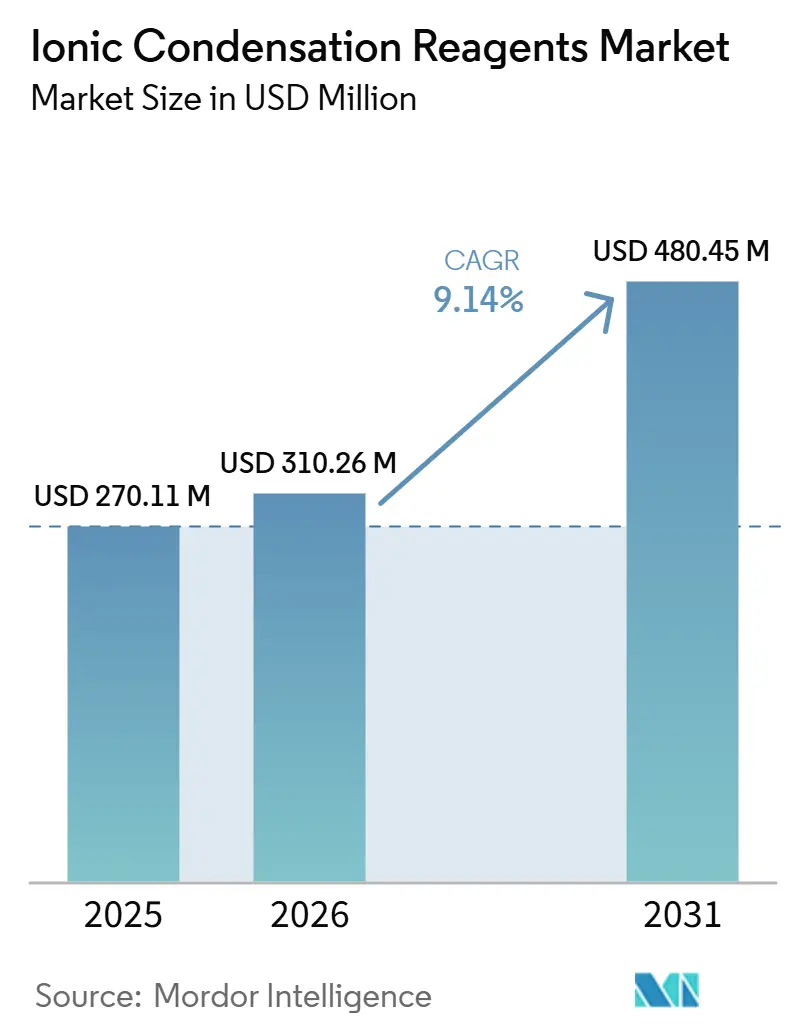
The Ionic Condensation Reagents Market size is expected to grow from USD 270.11 million in 2025 to USD 310.26 million in 2026 and is forecast to reach USD 480.45 million by 2031 at 9.14% CAGR over 2026-2031. The ion-type condensation reagent market is expanding as regulated peptide manufacturing increasingly emphasizes coupling efficiency, racemization control, and batch purity, particularly in long peptide sequences, where small yield losses can compound across multiple synthesis steps. The Phase 3 therapeutic peptide pipeline grew from 39 to 69 active projects between 2020 and 2025, with anti-obesity peptides accounting for a large share of that increase, keeping procurement demand firm for high-performance reagents used in commercial peptide programs. The market is also benefiting from the wider adoption of automated solid-phase peptide synthesis systems, which depend on reproducible reagent performance, clean dissolution, and validated handling conditions at commercial-grade manufacturing sites. Competitive positioning in the market is increasingly shaped by product format, purity grade, and the depth of regulatory documentation that suppliers can provide to pharmaceutical customers operating across North America and Europe. At the same time, the market faces higher operating costs due to storage, transport, and workplace safety requirements, as several widely used reagents pose sensitization or shock-sensitivity concerns, thereby increasing compliance requirements across the supply chain.
Key Report Takeaways
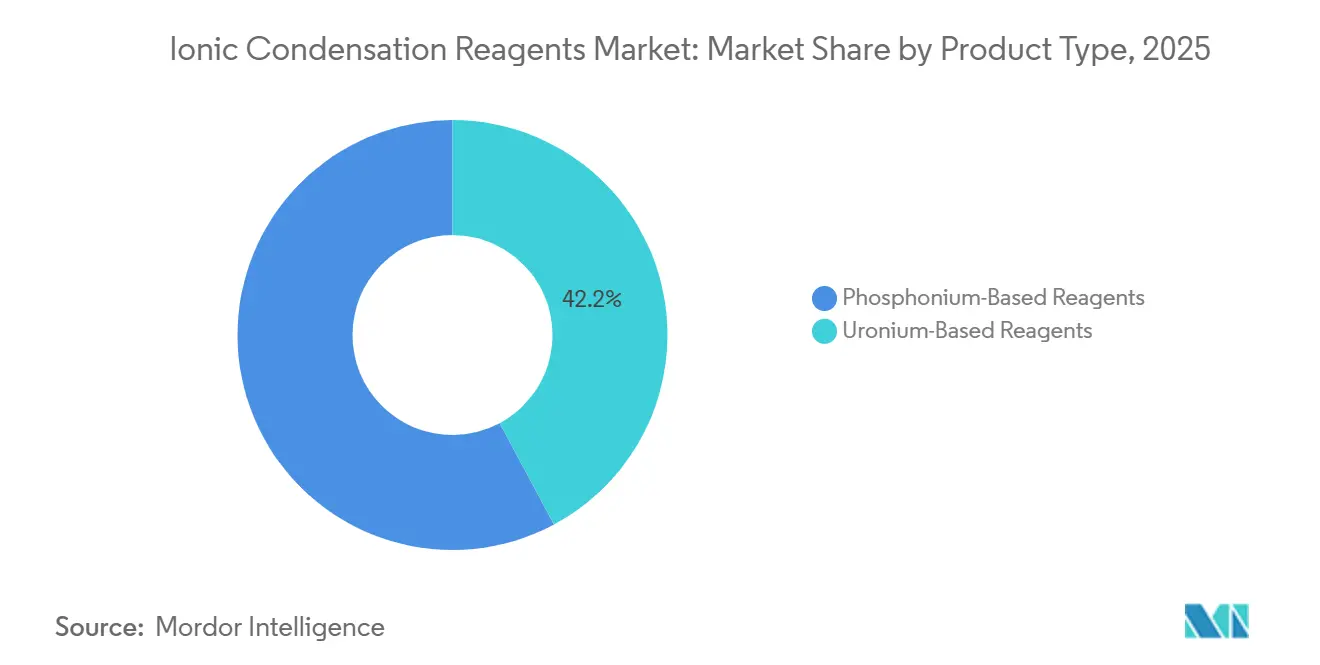
- By product type, uronium-based reagents held 42.17% of the ionic condensation reagents market in 2025, while phosphonium-based reagents are projected to record the fastest growth at a 9.81% CAGR through 2031.
- By form, powder retained 68.35% of the ionic condensation reagents market in 2025, while solution is forecast to expand at a 9.84% CAGR through 2031.
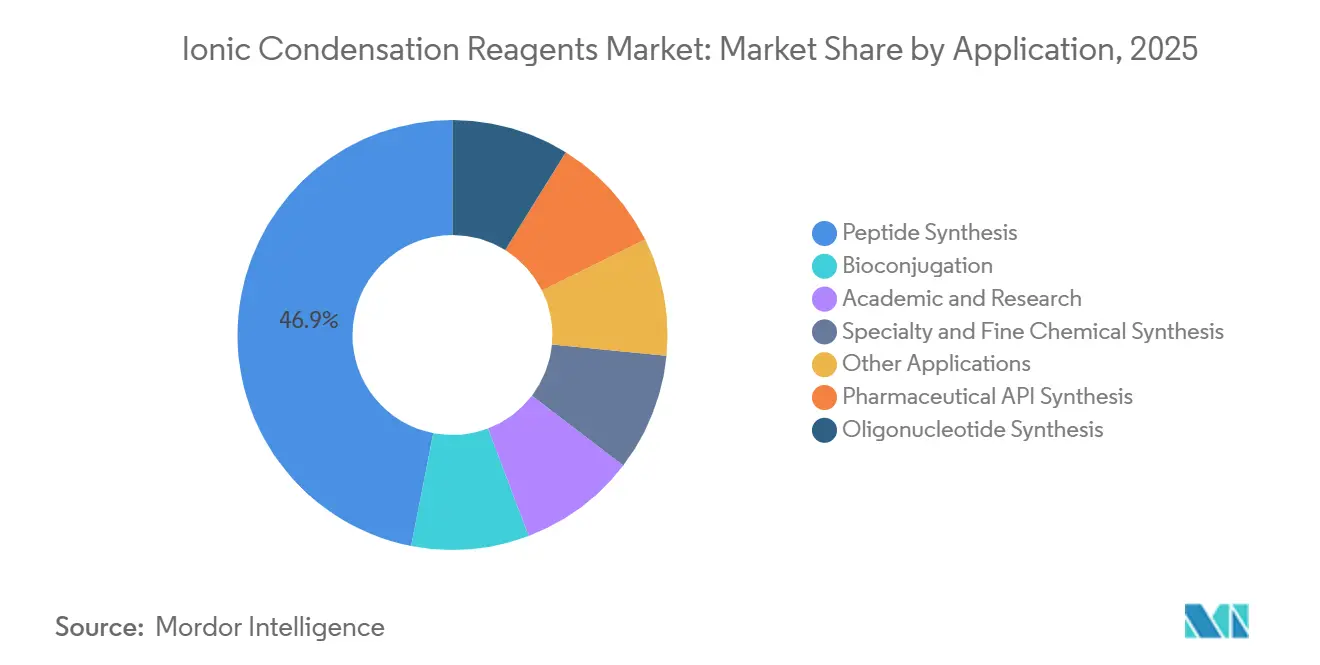
- By application, peptide synthesis accounted for 46.92% of the ionic condensation reagents market in 2025, while bioconjugation is forecast to expand at a 10.26% CAGR through 2031.
- By geography, North America held 48.68% of the ionic condensation reagents market share in 2025, while Asia-Pacific is projected to post the highest CAGR at 10.11% through 2031.
Note: Market size and forecast figures in this report are generated using Mordor Intelligence’s proprietary estimation framework, updated with the latest available data and insights as of January 2026.
Global Ionic Condensation Reagents Market Trends and Insights
Drivers Impact Analysis*
| Drivers | (~) % Impact on CAGR Forecast | Geographic Relevance | Impact Timeline |
|---|---|---|---|
| Rising demand for high-efficiency peptide bond formation reagents | +3.0% | Global, concentrated in North America and Europe | Short term (≤ 2 years) |
| Increasing production of pharmaceutical Active Pharmaceutical Ingredients (APIs) needing racemization-controlled amid bond formation | +2.0% | North America and Europe, extending to the Asia-Pacific | Medium term (2-4 years) |
| Growing adoption of solid-phase peptide synthesis at Good Manufacturing Practice (GMP) scale | +1.6% | Global, with North America leading adoption intensity | Short term (≤ 2 years) |
| Expansion of pharmaceutical and Contract Development and Manufacturing Organization (CDMO) capacity for complex peptide biologics | +1.2% | North America, Europe, China | Medium term (2-4 years) |
| Growing preference for ion-type over carbodiimide systems in high-purity pharmaceutical use | +0.8% | Global | Long term (≥ 4 years) |
| Source: Mordor Intelligence | |||
Rising Demand for High-Efficiency Peptide Bond Formation Reagents
The ionic condensation reagents market is closely tied to therapeutic peptide development, as the commercial need for reliable coupling chemistry increases as peptide pipelines move from clinical work into full-scale manufacturing. The global Phase 3 therapeutic peptide pipeline nearly doubled from 39 to 69 active projects between 2020 and 2025, with anti-obesity peptides and Glucagon-Like Peptide-1 (GLP-1) receptor agonists accounting for a significant portion of that growth[1]Bachem Holding AG, “J.P. Morgan Healthcare Conference Presentation,” Bachem, bachem.com. Long GLP-1 analogs often require more than 30 residues, meaning a small difference in stepwise yield can affect final purity, reprocessing needs, and regulatory outcomes across an entire batch. This pressure is shifting buyer preference toward premium coupling systems, particularly where sterically hindered residues make lower racemization performance more valuable than unit price savings. As more late-stage peptide programs enter commercial supply, the ionic condensation reagents market is expected to see steady demand from customers who cannot substitute lower-performance alternatives without increasing process risk.
Increasing Production of Pharmaceutical APIs Using Ion-Type Coupling Chemistry
The ion-type condensation reagent market extends beyond peptide synthesis, as these reagents also support small-molecule and specialty active pharmaceutical ingredient (API) production, where amide-bond quality directly affects process outcomes. Phosphonium-based coupling chemistry, including PyBOP, has been documented in the synthesis of Lutetium-177 prostate-specific membrane antigen (PSMA)-617 radioligand therapy intermediates, and similar coupling approaches are used in kinase inhibitor scaffold assembly and other sensitive pharmaceutical routes. Bachem invested CHF 332.6 million (USD 365.9 million) across its global site network and plans capital expenditures above CHF 400 million (USD 440 million) in 2026, including the commercial ramp of Building K in Bubendorf, following late 2025 regulatory clearance. Investment at this scale typically leads to multiyear procurement planning, which supports more stable ordering patterns for validated coupling reagents compared to short-cycle spot buying. As regulated API manufacturing expands across peptide and non-peptide chemistries, the ionic condensation reagents market is gaining a broader demand base beyond its traditional association with peptides.
Growing Adoption of Solid-Phase Peptide Synthesis
The ionic condensation reagents market is benefiting from the broader adoption of solid-phase peptide synthesis, as commercial manufacturers require equipment-compatible reagents that perform consistently in automated and increasingly enclosed production lines. Bachem reported that automated solid-phase peptide synthesis platforms can achieve 95% stepwise yields for sequences up to 200 residues at kilogram scale under current good manufacturing practice (cGMP) conditions, while continuous flow versions are moving into commercial trials with solvent recovery approaching 80%. In these systems, coupling agents such as HATU, HBTU, and PyBOP are preferred because they dissolve cleanly and maintain reactivity in the solvent environments required by automated process equipment. The rise of these platforms is also shifting the market toward solution formats, as premeasured liquid feeds reduce weighing variability, lower airborne exposure risk, and support better operator control during commercial runs. Suppliers that can offer validated solution kits, defined activity windows, and strong storage documentation are positioned to capture a larger share of the ionic condensation reagents market as automated synthesis capacity expands.
Expansion of Pharmaceutical and CDMO Manufacturing Capacity
The ionic condensation reagents market is further supported by the expansion of peptide and advanced pharmaceutical manufacturing capacity at contract development and manufacturing organizations (CDMOs) and integrated drug producers. CordenPharma generated EUR 960 million (USD 1.0 billion) in 2025 sales and announced a strategic investment of above EUR 1 billion (USD 1.1 billion) over three years, centered on a greenfield Basel-region facility valued at above EUR 500 million (USD 550 million). In May 2026, the company acquired AmbioPharm, adding sites in South Carolina and Shanghai and extending its peptide API network across three continents. Capacity additions of this type typically involve long-term supply planning for raw materials, which favors engagement with reagent suppliers that already meet commercial regulatory and documentation requirements. As more peptide-focused manufacturing assets come online, the ionic condensation reagents market is expected to benefit from larger and more structured procurement programs.
Restraints Impact Analysis*
| Restraints | (~) % Impact on CAGR Forecast | Geographic Relevance | Impact Timeline |
|---|---|---|---|
| High Cost of Advanced Coupling Reagents | -1.4% | Asia-Pacific, Rest of World | Medium term (2-4 years) |
| Moisture Sensitivity and Specialized Storage Requirements | -0.9% | Global | Short term (≤ 2 years) |
| Competition from carbodiimide alternatives in cost-constrained research and generic use | -0.7% | Global | Long term (≥ 4 years) |
| Environmental and safety classification concerns tied to allergenicity and explosive potential | -0.5% | North America and Europe | Medium term (2-4 years) |
| Source: Mordor Intelligence | |||
High Cost of Advanced Coupling Reagents
The ionic condensation reagents market faces resistance in price-sensitive settings, as advanced reagents such as premium-grade HATU cost materially more than carbodiimide alternatives such as DIC or DCC. This price gap is most visible in generic drug manufacturing, academic research, and smaller-scale synthesis programs, where purchase decisions are driven by immediate reagent budgets rather than downstream purification savings. The economic trade-off shifts at higher commercial volumes, since a 1-point gain in stepwise coupling yield in long-chain GLP-1 peptide production can reduce overall batch cost by 3.5% to 4.2% through lower rework and purification requirements. Many buyers outside high-volume regulated manufacturing find it difficult to justify premium pricing when their production scale is too small to capture these process savings consistently. As a result, the ionic condensation reagents market remains stronger in commercial and late-stage pharmaceutical production than in budget-constrained research or generic manufacturing environments.
Moisture Sensitivity and Specialized Storage Requirements
The ionic condensation reagents market poses handling challenges, as several products require careful storage and transport controls to maintain performance over time. ChemPep states that HATU requires cold-chain storage at -20 °C under desiccated conditions to maintain full activity beyond 12 months, and improper handling can release fluoride ions from the hexafluorophosphate counterion, disrupting downstream chemistry steps. The safety profile adds further complexity, as HATU, HBTU, HCTU, and PyBOP have been flagged by the ACS Green Chemistry Institute Pharmaceutical Roundtable for sensitization and shock sensitivity concerns that require stronger hazard controls. A 2024 Journal of Peptide Science case report documented the progression of allergic sensitization following airborne HBTU exposure in a manufacturing setting, reinforcing the case for enclosed handling and pre-prepared solutions rather than open-powder use[2]V. Borghesani et al., “Uronium Peptide Coupling Agents, Another Case of Occupational Airborne Allergic Sensitization Induced by HBTU,” Journal of Peptide Science, ncbi.nlm.nih.gov. These requirements raise compliance costs and reduce handling flexibility across distributed sites, limiting broader penetration of the ionic condensation reagents market outside well-equipped, regulated facilities.
*Our forecasts treat driver/restraint impacts as directional, not additive. The impact forecasts reflect baseline growth, mix effects, and variable interactions.
Segment Analysis
By Product Type: Uronium Systems Hold the Core Base While Phosphonium Reagents Grow Faster
Uronium-based reagents accounted for 42.17% of the ionic condensation reagents market in 2025, keeping this category at the center of commercial demand as the primary chemistry for Fmoc-based peptide synthesis programs. HATU and HBTU are deeply embedded in regulated manufacturing workflows, and HATU is often preferred where steric hindrance and impurity control make low racemization behavior more valuable than lower reagent cost. HCTU continues to serve customers who require a more balanced cost and performance profile, particularly where process requirements do not justify the premium associated with HATU. COMU has also attracted attention in automated synthesis settings due to improved stability in DMF and reduced guanidinium side-product formation in high-throughput workflows. TBTU still plays a role in fragment condensation, but its HOBt-linked structure raises the same safety concerns as other older reagent systems.
Phosphonium-based reagents are projected to grow at a 9.81% CAGR through 2031, making this group the fastest-growing product category in the ionic condensation reagents market. PyBOP has become a standard phosphonium reagent in many workflows because it avoids the formation of hexamethylphosphoramide during coupling, a major drawback of older BOP chemistry. PyAOP is used in peptide cyclization work and suits constrained structural targets, while PyBroP remains useful for N-methylated amino acid couplings where standard uronium systems lose efficiency. Growth in this category is also supported by demand from bioconjugation and radioligand applications, where phosphonium chemistries are valued for precise bond formation in specialized process settings. The product mix indicates that the ionic condensation reagents market is expanding not only through larger peptide volumes but also through broader use cases that favor differentiated phosphonium performance.



By Form: Powder Retains the Installed Base While Solution Formats Gain Operational Relevance
Powder held 68.35% of the ionic condensation reagents market in 2025, reflecting the fact that most regulated facilities continue to buy, transport, and store large reagent volumes using established desiccated packaging and batch dispensing routines. Powder remains attractive because freight economics are favorable at scale, packaging is familiar to procurement teams, and regulated sites already have standard procedures for weighing and charging materials into synthesis systems. Academic laboratories and smaller research users also continue to prefer powder because it supports low-volume purchases and longer storage under standard cold room or freezer conditions. Large shipments from Asian producers to Western contract manufacturers are still conducted mainly in powder form, reinforcing the procurement base that supports this segment. These practical advantages indicate that powder should remain the leading format across much of the ionic condensation reagents market during the forecast period.
Solution formats are expected to grow at a 9.84% CAGR through 2031, reflecting changes in operational requirements as commercial peptide synthesis becomes more automated and enclosed. Modern Good Manufacturing Practice peptide synthesizers rely on premeasured liquid feeds to eliminate manual weighing steps, improve repeatability, and reduce airborne exposure during routine production campaigns. A 2024 Journal of Peptide Science report on O-(benzotriazol-1-yl)-N,N,N′,N′-tetramethyluronium hexafluorophosphate (HBTU) sensitization supports this shift by linking powder handling to occupational health risks in the production environment. Solution formats therefore offer more than convenience; they support safer operations, better process control, and stronger documentation for regulated facilities that require stable commercial workflows. Other forms, such as immobilized or polymer-supported formats, remain at an early stage but represent a long-term option for future continuous flow systems where easier separation and potential reagent recycling may be valued.
By Application: Peptide Synthesis Drives Current Demand While Bioconjugation Expands the Fastest
Peptide synthesis accounted for 46.92% of the ionic condensation reagents market in 2025, making it the largest application segment. Each commercial batch requires multiple coupling cycles, resulting in steady reagent consumption. Demand is supported by GLP-1 active ingredient production, insulin analog programs, oncology peptides, and antiviral peptide work, all of which depend on reliable coupling performance across long and often sensitive sequences. This segment also benefits from clearer purchasing visibility than several smaller applications, as commercial peptide plants typically operate within planned production schedules and validated material lists. Pharmaceutical active ingredient synthesis is the next major use case, where ionic reagents support racemization-sensitive amide formation in select small-molecule routes, radioligand intermediates, and specialty pharmaceutical chemistry. Oligonucleotide synthesis, academic and research activity, and specialty and fine chemistry remain important demand pools that broaden the reach of the ionic condensation reagents market beyond peptide applications.
Bioconjugation is projected to grow at a 10.26% CAGR through 2031, making it the fastest-growing application and an important contributor to the ionic condensation reagents market share of higher-value phosphonium products. This growth is tied to antibody drug conjugates, radioligand conjugates, and peptide antibody fusion constructs, where controlled amide bond formation and high purity grades are important to final product quality. PyBOP has been documented in the synthesis route for the Lutetium-177 Prostate-Specific Membrane Antigen (PSMA)-617 radioligand intermediate, indicating that these reagents are embedded in specialized therapeutic manufacturing rather than limited to research use. As more conjugation programs advance through clinical and commercial stages, buyers are placing greater weight on impurity profiles, batch consistency, and documentation that supports precise process control. This shift gives suppliers room to grow through differentiated grades and regulatory support, which is why this application represents the upper growth band for the ionic condensation reagents market.
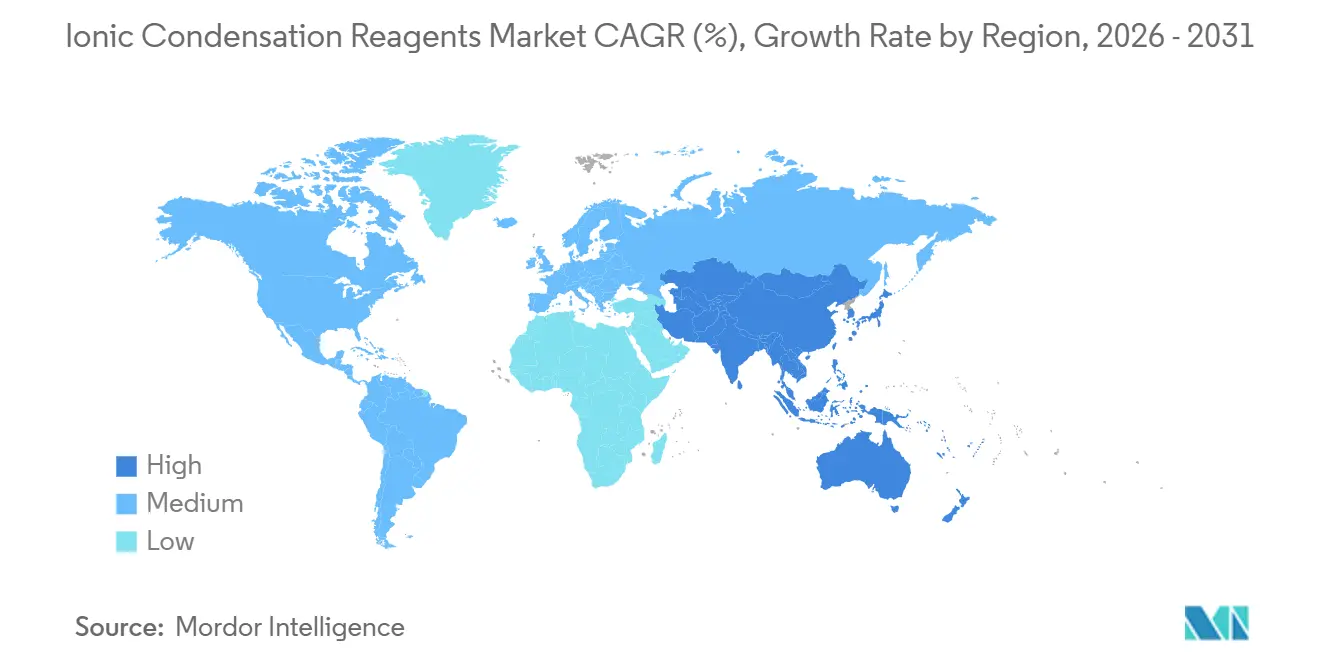
Geography Analysis
North America accounted for 48.68% of the ionic condensation reagents market in 2025. This position reflects the region's concentration of peptide drug originators, commercial synthesis capacity, and strict quality systems for regulated procurement. The region hosts a large share of current good manufacturing practice peptide production, which keeps validated reagent sourcing central to both commercial and late-stage clinical programs. Bachem's U.S. manufacturing footprint in Vista and Torrance supports this position, and the company committed USD 250 million to capacity expansion at those two sites over 2026-2030. North America also remains a demanding market for supplier documentation, as procurement teams expect consistency across quality files, handling controls, and delivery performance for commercial operations.
Asia-Pacific is projected to record the fastest CAGR of 10.11% through 2031 in the ionic condensation reagents market, driven by expanding peptide manufacturing investment and rising adoption of advanced synthesis capabilities. China stands out as local producers increase capacity and domestic pharmaceutical programs generate stronger internal demand for high-performance coupling reagents. Japan, South Korea, and India are contributing through equipment integration, greenfield expansion, and upgrades at established active pharmaceutical ingredient sites that are moving toward higher-value manufacturing. The region is significant not only as a demand center, but also as a supply base that can influence pricing, lead times, and format availability across the wider ionic condensation reagents market. This balance between expanding consumption and growing local production is likely to shape competitive behavior across the forecast period.
Europe remains a key innovation and regulatory anchor in the ionic condensation reagents market, supported by the presence of Bachem in Switzerland, IRIS BIOTECH in Germany, Luxembourg Bio Technologies, and CordenPharma's European manufacturing network. The region maintains high standards for documentation on impurity control and active substance chemistry, which keeps reagent quality specifications under close review across procurement channels. This environment favors suppliers that can combine strong technical performance with stable regulatory support and well-controlled storage practices. Rest of World markets currently contribute limited demand, but pharmaceutical manufacturing programs in countries such as Brazil and Gulf Cooperation Council member states are building a base that could support more visible demand later in the forecast period.

Competitive Landscape
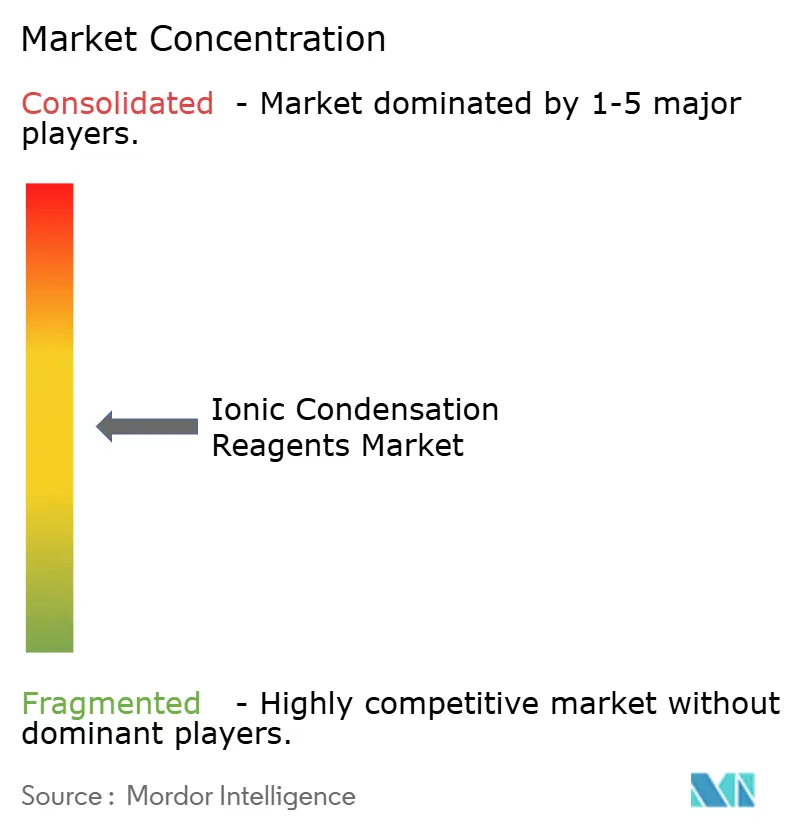
The ionic condensation reagents market is moderately fragmented. In premium pharmaceutical grades, Merck KGaA (through Novabiochem), Thermo Fisher Scientific, and other established specialists compete on broad portfolios, documentation strength, and the ability to serve multiple regulatory regions. The wider market remains fragmented across research and specialty accounts, where regional distributors and smaller chemical manufacturers compete through grade flexibility, low minimum order sizes, and shorter delivery windows. This split means concentration is significantly higher at the top end of regulated demand than across the full customer base. It also means supplier advantage depends less on catalog breadth and more on whether a company can support commercial manufacturing without quality or handling disruption.
Strategic differentiation in the ionic condensation reagents market is increasingly built around safer product design, higher purity options, and stronger regulatory support for complex applications. Veranova's 2025 white paper illustrates how suppliers are responding to safety concerns through Oxyma-based phosphonium alternatives such as PyOxP and PyOxB, which are designed to suppress racemization and improve solubility without the HOBt-linked explosive risk associated with older systems. Bachem's expansion of peptide manufacturing capacity in the United States reflects a similar strategic direction, as larger, regulated production networks support deeper, longer-term reagent purchasing programs. CordenPharma's 2025 Basel investment plan and its 2026 AmbioPharm acquisition provide another example, as both moves expand peptide active pharmaceutical ingredient (API) capacity and strengthen procurement demand for validated coupling inputs across multiple continents. Additionally, some suppliers are developing ready-to-use solution kits and enclosed packaging, which directly address allergenicity and handling concerns raised in the safety literature and support premium pricing in regulated accounts.
The most attractive opportunities in the ionic condensation reagents market lie in operationally differentiated offerings rather than basic powder supply. Ready-to-use Good Manufacturing Practice (GMP) solution kits represent one such area, as they align with automated peptide synthesis lines that require lower exposure risk and tighter batch control. Low-dust packaging and enclosed transfer formats represent another area, given that sensitization concerns influence how large production sites evaluate supplier suitability. A third area is conjugation-grade phosphonium chemistry supported by batch-specific impurity profiles, as specialized therapeutic programs generate higher documentation expectations than standard research-grade supply can meet.
Ionic Condensation Reagents Industry Leaders
Merck KGaA
Thermo Fisher Scientific Inc.
Bachem Inc.
Biosynth
IRIS BIOTECH GMBH
- *Disclaimer: Major Players sorted in no particular order

Recent Industry Developments
- May 2026: CordenPharma acquired AmbioPharm, a US-headquartered peptide API CDMO with sites in North Augusta, South Carolina, and Shanghai. The acquisition expanded CordenPharma's network to three continents, adding SPPS, liquid-phase, and hybrid synthesis capacity alongside purification and lyophilization infrastructure, increasing long-term procurement commitments for ionic condensation reagents at commercial scale.
- April 2025: Granules India Limited acquired Swiss-based CDMO Senn Chemicals AG, extending its capabilities into liquid-phase and solid-phase peptide synthesis and strengthening its GLP-1 API manufacturing platform, internalizing high-volume coupling reagent procurement into its commercial peptide supply chain.


Global Ionic Condensation Reagents Market Report Scope
Ionic condensation reagents are compounds used in organic synthesis to facilitate reactions where two molecules combine to form a larger molecule while eliminating a small by-product (such as water). These reagents drive ionic mechanisms, such as enolate attacks, to form new carbon-carbon or carbon-nitrogen bonds.
The ionic condensation reagents market is segmented by product type, form, application, and geography. By product type, the market is segmented into uronium-based reagents and phosphonium-based reagents. By product type, the market is segmented into powder, solution, and other forms. By product type, the market is segmented into peptide synthesis, pharmaceutical api synthesis, oligonucleotide synthesis, bioconjugation, academic and research, specialty and fine chemical synthesis, and other applications. The report also covers market size and forecasts for ionic condensation reagents across 11 countries in major regions. The market sizes and forecasts are provided in terms of value (USD).
| Uronium-Based Reagents | HATU |
| HBTU | |
| TBTU | |
| COMU | |
| HCTU | |
| Other Uronium-Based Reagents | |
| Phosphonium-Based Reagents | PyBOP |
| BOP | |
| PyAOP | |
| PyBroP | |
| Other Phosphonium-Based Reagents |
| Powder |
| Solution |
| Other Forms |
| Peptide Synthesis |
| Pharmaceutical API Synthesis |
| Oligonucleotide Synthesis |
| Bioconjugation |
| Academic and Research |
| Specialty and Fine Chemical Synthesis |
| Other Applications |
| Asia-Pacific | China |
| India | |
| Japan | |
| South Korea | |
| Rest of Asia-Pacific | |
| North America | United States |
| Canada | |
| Europe | Germany |
| United Kingdom | |
| France | |
| Italy | |
| Russia | |
| Rest of Europe | |
| Rest of the World | South America |
| Middle-East and Africa |
| By Product Type | Uronium-Based Reagents | HATU |
| HBTU | ||
| TBTU | ||
| COMU | ||
| HCTU | ||
| Other Uronium-Based Reagents | ||
| Phosphonium-Based Reagents | PyBOP | |
| BOP | ||
| PyAOP | ||
| PyBroP | ||
| Other Phosphonium-Based Reagents | ||
| By Form | Powder | |
| Solution | ||
| Other Forms | ||
| By Application | Peptide Synthesis | |
| Pharmaceutical API Synthesis | ||
| Oligonucleotide Synthesis | ||
| Bioconjugation | ||
| Academic and Research | ||
| Specialty and Fine Chemical Synthesis | ||
| Other Applications | ||
| By Geography | Asia-Pacific | China |
| India | ||
| Japan | ||
| South Korea | ||
| Rest of Asia-Pacific | ||
| North America | United States | |
| Canada | ||
| Europe | Germany | |
| United Kingdom | ||
| France | ||
| Italy | ||
| Russia | ||
| Rest of Europe | ||
| Rest of the World | South America | |
| Middle-East and Africa | ||


Key Questions Answered in the Report
What is current market size of Ionic Condensation Reagents Market?
The Ionic Condensation Reagents Market size is expected to grow from USD 270.11 million in 2025 to USD 310.26 million in 2026 and is forecast to reach USD 480.45 million by 2031 at 9.14% CAGR over 2026-2031.
Which product category is currently driving revenue?
Uronium-based reagents led with a 42.17% share in 2025, as HATU and HBTU remain central to regulated Fmoc-based peptide synthesis workflows.
Which application is growing the fastest?
Bioconjugation is projected to grow at a 10.26% CAGR through 2031, supported by rising research into antibody-drug conjugates, radioligand conjugates, and related targeted therapies.
Why is North America still the largest regional contributor?
North America held 48.68% share in 2025 because it combines peptide drug originators, commercial synthesis capacity, and strict current good manufacturing practice procurement standards.
Page last updated on:





