
Intent Data Software Market Size and Share
Market Overview
| Study Period | 2020 - 2031 |
|---|---|
| Market Size (2026) | USD 4.75 Billion |
| Market Size (2031) | USD 10.31 Billion |
| Growth Rate (2026 - 2031) | 16.84 % |
| Fastest Growing Market | Asia-Pacific |
| Largest Market | North America |
| Market Concentration | Medium |
Major Players *Disclaimer: Major Players sorted in no particular order Image © Mordor Intelligence. Reuse requires attribution under CC BY 4.0. | |
Intent Data Software Market Analysis by Mordor Intelligence
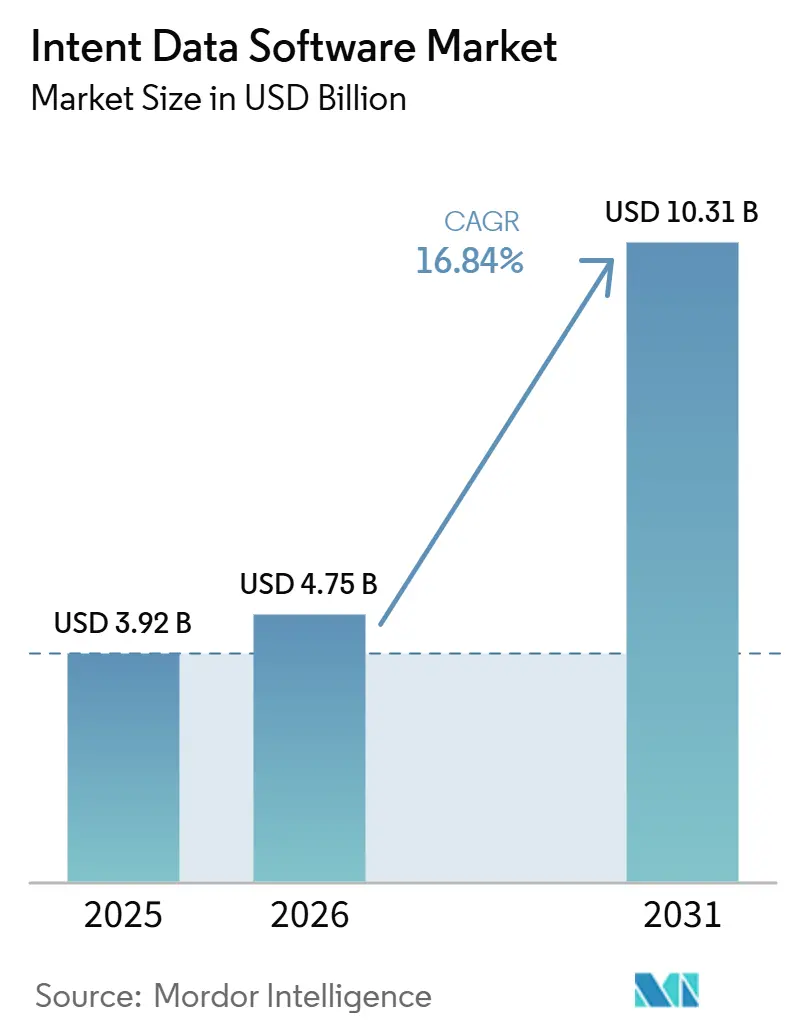
The intent data software market size is expected to increase from USD 3.92 billion in 2025 to USD 4.75 billion in 2026 and reach USD 10.31 billion by 2031, growing at a CAGR of 16.84% over 2026-2031. The intent data software market is expanding as B2B revenue teams move away from static lead lists toward continuously refreshed buying signals that reflect each account's position in an active purchase cycle. The category is also becoming more central to revenue operations because intent intelligence is now embedded in CRM platforms, marketing automation systems, and AI-based workflow tools, rather than used as a separate analytics layer. This change shortens the time between signal detection and action, which improves the practical value of the data for sales and marketing teams. Competition is rising as vendors try to differentiate on signal quality, depth of publisher networks, explainable scoring logic, and tighter workflow integration. Growth remains strong, but the intent data software market still faces pressure from false positives, privacy obligations, and integration friction across fragmented sales and marketing technology stacks.
Key Report Takeaways
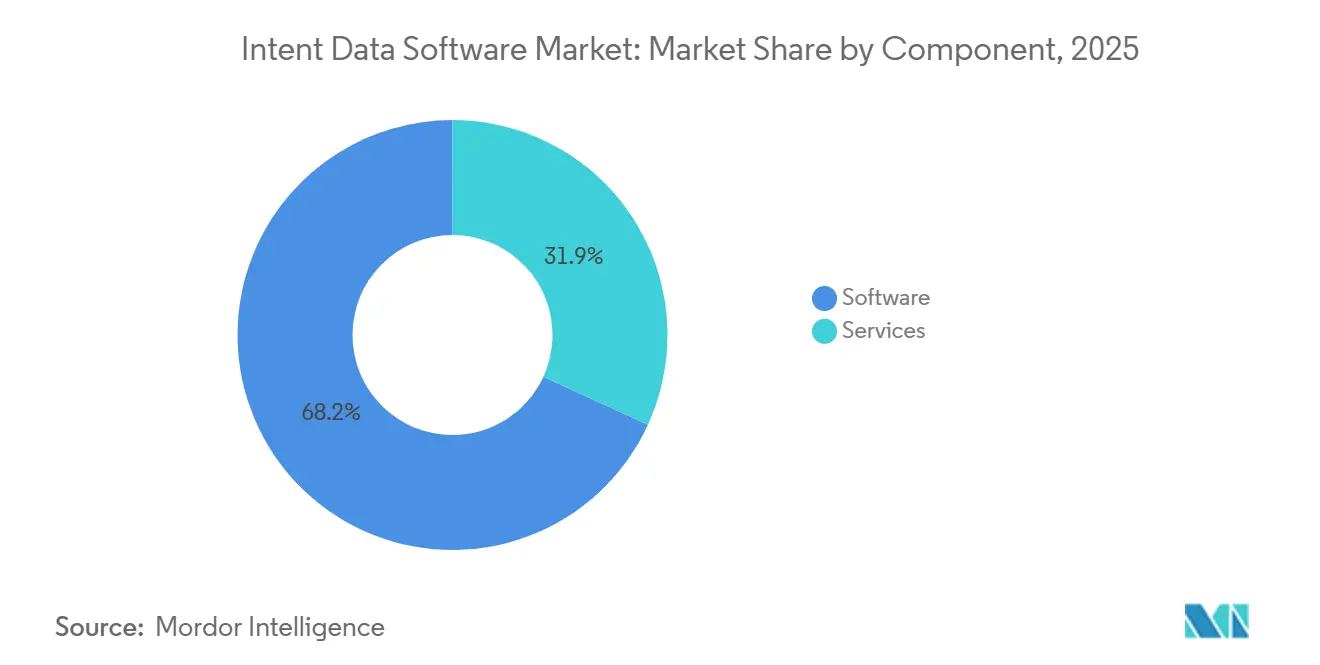
- By component, software held 68.15% of the intent data software market revenue in 2025, while services are projected to expand at a 19.77% CAGR through 2031.
- By deployment mode, cloud-based platforms held 71.33% of the intent data software market in 2025 and are projected to expand at a 19.04% CAGR through 2031.
- By application, lead intelligence and opportunity identification accounted for 61.59% of the intent data software market revenue in 2025, while account-based marketing is projected to expand at an 18.67% CAGR through 2031.
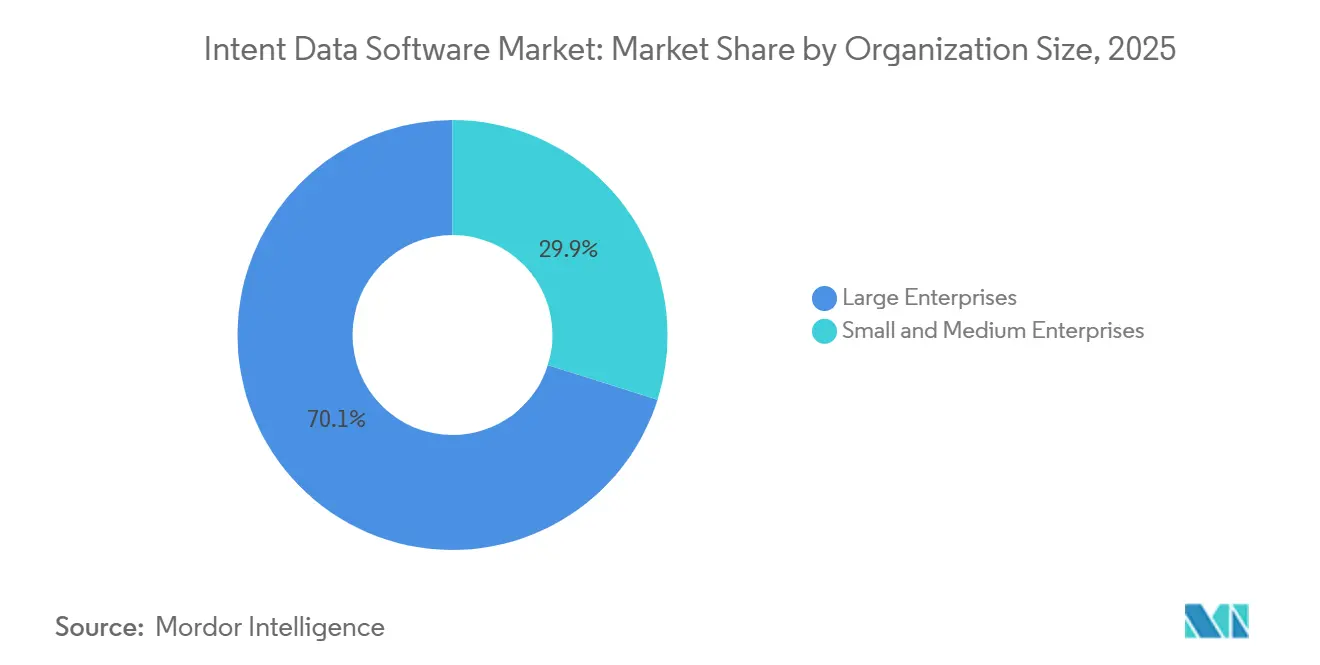
- By organization size, large enterprises held 70.14% of the intent data software market revenue in 2025, while small and medium enterprises are projected to expand at a 19.45% CAGR through 2031.
- By end user industry, information technology and telecommunications accounted for 30.12% of revenue in 2025, while healthcare and life sciences are projected to expand at a 17.92% CAGR through 2031.
- By geography, North America accounted for 37.41% of the intent data software market revenue in 2025, while Asia-Pacific is projected to expand at a 18.30% CAGR through 2031.
Note: Market size and forecast figures in this report are generated using Mordor Intelligence’s proprietary estimation framework, updated with the latest available data and insights as of January 2026.
Global Intent Data Software Market Trends and Insights
Drivers Impact Analysis*
| Driver | (~) % Impact on CAGR Forecast | Geographic Relevance | Impact Timeline |
|---|---|---|---|
| Rising Adoption of AI-Driven Buyer Signal Scoring | +4.8% | Global, with concentrated impact in North America and Western Europe | Short term (≤ 2 years) |
| Expansion of Account-Based Marketing Programs | +3.6% | Global, with acceleration in APAC, particularly China, India, and South Korea | Short term (≤ 2 years) |
| Need for Real-Time Sales and Marketing Orchestration | +2.9% | North America and EU, with early-stage spillover to APAC core markets | Medium term (2-4 years) |
| Growth of First-Party Intent Capture Across Digital Touchpoints | +2.4% | Global, strongest in Europe where third-party cookie restrictions are most advanced | Medium term (2-4 years) |
| Demand for Verticalized Intent Models in Complex Buying Committees | +1.5% | North America and Europe, with early adoption in Australia and South Korea | Long term (≥ 4 years) |
| Vendor Consolidation Toward Outcome-Based Revenue Platforms | +1.1% | Global, primarily in enterprise-grade markets in North America and Europe | Long term (≥ 4 years) |
| Source: Mordor Intelligence | |||
Rising Adoption of AI-Driven Buyer Signal Scoring
AI-based signal scoring has moved from a useful feature to a core requirement in the intent data software market. Buyers now expect platforms to process large volumes of behavioral activity and translate them into clear buying-stage classifications that sales teams can act on quickly. The strongest vendors are no longer judged only on whether they can flag an account as active, because buyers also want to understand why the score changed and which behaviors drove the shift. This is making explainability more important in enterprise evaluations, especially when multiple teams need to trust the same account prioritization model. 6sense stated that accounts prioritized as 6sense Qualified Accounts delivered 29% higher opportunity values and 33% larger deal sizes than non-qualified accounts across the Q2 2025 to Q1 2026 period.[1]6sense, “6sense Launches MCP Server, Bringing Proprietary GTM Intelligence Into Any AI Agent,” 6sense Newsroom, 6sense.com The intent data software market is therefore moving toward platforms that can connect scoring accuracy with measurable commercial outcomes while still keeping the logic understandable to users.
Expansion of Account-Based Marketing Programs
The expansion of account-based marketing programs is changing how the intent data software market is bought, deployed, and measured. Buyers increasingly want one environment where account signals, audience activation, outreach planning, and campaign coordination can work together without heavy manual handoffs. This shifts spending away from isolated intent feeds and toward platforms that can support a broader revenue motion across marketing and sales teams. It also changes the internal buying case, because intent data is easier to justify when it supports coordinated account planning rather than a single, narrow lead qualification task. In this setting, the intent data software market benefits when buyers treat account-based marketing as an operating model rather than a single-campaign approach. That pattern supports larger contracts, deeper platform usage, and more pressure on vendors to integrate activation features directly into the core workflow.
Need For Real-Time Sales and Marketing Orchestration
The need for real-time orchestration is becoming a major force in the intent data software market. Buyers do not want signals that arrive too late to change outreach, budget allocation, or account messaging. They want systems that can take a new account behavior and move it into sales and marketing action with minimal delay. Demandbase introduced Demandbase AI in April 2026 with context intelligence, MCP-based workflow integration, and a broader position as a pipeline engine for modern go-to-market teams. That kind of release shows how the intent data software market is shifting from passive analytics toward coordinated execution across outreach, site experience, and pipeline planning. As more vendors align signal delivery with AI agents and workflow tools, speed of action is becoming almost as important as signal depth.
Growth of First-Party Intent Capture across Digital Touchpoints
The growth of first-party intent capture is changing the balance of the intent data software market. Enterprises are placing greater value on signals from their own websites, CRM systems, product usage environments, and direct engagement channels because these signals are easier to connect to known accounts. This reduces dependence on third-party data alone and helps buyers cross-check external topic activity against direct behavior. It also changes vendor positioning, because providers with strong first-party intelligence layers can offer a more complete view of the buying motion. Zoom announced in July 2026 that it would acquire Common Room to unify CRM, product, marketing, and engagement signals into person-level buyer intelligence that can be activated through AI agents. That move reflects how the intent data software market is putting more weight on direct signal ownership and continuous refresh rather than on third-party feed scale alone.
Restraints Impact Analysis*
| Restraint | (~) % Impact on CAGR Forecast | Geographic Relevance | Impact Timeline |
|---|---|---|---|
| Intent Signal Noise and False Positive Risk | -1.7% | Global, most acute in markets with lower buyer digital footprints, including South America and Africa | Short term (≤ 2 years) |
| Privacy, Consent, and Data Governance Constraints | -1.4% | Europe and California most impacted, with spillover to Canada, Brazil, South Korea, and Australia | Medium term (2-4 years) |
| Integration Complexity Across CRM, MAP, and CDP Stacks | -0.8% | Global, most limiting in SME and mid-market segments with fragmented technology stacks | Medium term (2-4 years) |
| Attribution Difficulty In Long And Multi-Stakeholder Buying Cycles | -0.5% | North America and Europe, particularly in enterprise software and financial services verticals | Long term (≥ 4 years) |
| Source: Mordor Intelligence | |||
Intent Signal Noise and False Positive Risk
False positives remain one of the clearest risks in the intent data software market. When a platform identifies an account as active without sufficient evidence, sales teams can waste time on outreach that does not align with real buyer interest. The problem is not only inefficiency; repeated low-quality outreach can weaken account trust before a serious buying conversation begins. This matters even more in enterprise segments, where each account is high-value, and buying groups often involve many stakeholders. The intent data software market, therefore, rewards vendors that can prove signal quality against a buyer's own account list during early pilots and onboarding cycles. Buyers are becoming less willing to assume that all signal sources are equally reliable, and that is raising the standard for proof of value.
Privacy, Consent, and Data Governance Constraints
Privacy, consent, and governance requirements are also slowing parts of the intent data software market. Buyers need clearer visibility into where data comes from, how it is processed, and which controls apply when signals are scored and activated across systems. This is especially important when contact-level behaviors are linked to automated decision support in sales and marketing workflows. As a result, procurement teams increasingly review certifications, data processing terms, and sub-processor transparency before moving a platform into production. The intent data software market is feeling this pressure most strongly in regions and sectors where privacy expectations are already embedded in enterprise software buying. Vendors that cannot show a clear compliance structure often face longer evaluation cycles, more legal review, and lower trust during renewal decisions.
*Our forecasts treat driver/restraint impacts as directional, not additive. The impact forecasts reflect baseline growth, mix effects, and variable interactions.
Segment Analysis
By Component: Services Growth Challenges Software's Revenue Lead
Software accounted for 68.15% of revenue in 2025, making it the largest component of the intent data software market. That position reflects the shift from basic data feeds to integrated software environments that combine signal collection, account scoring, activation, and measurement into a single operating layer. Buyers increasingly prefer a single platform because it reduces workflow friction among marketing, sales, and revenue operations teams that all act on the same account signals. This also increases the average contract value, since customers are paying for a broader execution system rather than a narrow intent file or an isolated topic feed. The software layer has become more central as vendors connect intent intelligence to CRM tools, marketing automation systems, and AI agent workflows that need live signal access.
Services are projected to expand at a 19.77% CAGR through 2031, making them the fastest-growing component of the intent data software market. Growth is being supported by organizations that have bought a platform but still need help with implementation, scoring design, campaign activation, and workflow alignment. Many buyers can purchase intent tools faster than they can build the internal operating model needed to use them well, which creates steady demand for support services. This is especially evident when companies move from a pilot use case to an enterprise rollout spanning multiple teams, geographies, and systems. In practice, services often determine whether an initial deployment reaches full commercial value or remains underused.


By Deployment Mode: Cloud Deployment Reshapes Activation Economics
Cloud-based deployment accounted for 71.33% of revenue in 2025 and is projected to grow at a 19.04% CAGR through 2031. This means cloud is both the largest and the fastest-growing deployment model in the intent data software market. The pattern reflects a category that still has room for migration as buyers move away from older hybrid and on-premises setups. Cloud deployment fits the technical needs of the category because real-time signal processing, AI-assisted scoring, and workflow orchestration depend on fast, always-available data exchange. It also fits procurement behavior, since buyers want frequent updates and lower infrastructure management burdens rather than local system maintenance.
On-premises deployment remains relevant in the intent data software market even though its share is smaller. Its role is strongest in regulated environments where data residency, security reviews, or internal policies make full public cloud adoption difficult. Financial institutions, government-adjacent technology buyers, and some healthcare organizations still value private control over where sensitive data sits and how it moves. These buyers often turn to private cloud or hybrid models that preserve stricter governance while still allowing intent-driven workflows. That keeps a durable, high-value niche in place for vendors that can support more controlled deployment options.
By Application: ABM Momentum Reshapes the Application Mix
Lead intelligence and opportunity identification accounted for 61.59% of application revenue in 2025, making it the largest use case in the intent data software market. This leadership reflects the fact that many organizations first adopt intent tools to identify which accounts deserve sales attention and which opportunities are becoming more active. The use case is widely accepted across sales development, demand generation, and revenue operations because the value is easier to explain and measure. It also serves as a practical entry point, as buyers can start with prioritization and add adjacent workflows as internal trust improves. That gives the category a stable foundation, as the first purchase decision often begins with lead intelligence before expanding into broader orchestration.
Account-based marketing is projected to expand at an 18.67% CAGR through 2031, making it the fastest-growing application in the intent data software market. Growth is being driven by the move from signal monitoring toward coordinated action across advertising, email, content, and sales outreach. Buyers want platforms that do more than show account activity, because they also want guided or automated plays that respond to changing account behavior. This makes ABM more complex than lead prioritization, but it also makes the software harder to replace once the workflow is embedded. The application is therefore becoming a major driver of contract depth and platform stickiness.
By Organization Size: SMEs Challenge Large Enterprise Dominance
Large enterprises accounted for 70.14% of revenue in 2025, giving them the leading position in the intent data software market. Their scale matters because large organizations can absorb six-figure annual contracts, support dedicated revenue operations teams, and manage complex data integration programs. They also have enough account volume and buying complexity to justify more advanced use cases such as predictive buying-stage modeling, multi-touch attribution, and AI-assisted account workflows. This makes enterprise customers the main testing ground for deeper product capabilities and more demanding commercial requirements. As a result, many of the strongest product standards in the category still come from large-enterprise expectations.
Small and medium enterprises are projected to expand at a 19.45% CAGR through 2031, making them the fastest-growing organization segment in the intent data software market. Vendors are targeting this growth with mid-market pricing, lighter implementation models, and self-serve onboarding that reduce the barrier to first purchase. These customers often want a faster time-to-value and fewer technical dependencies than large enterprises. That changes product design because smaller teams need clear workflows, minimal setup burden, and early, visible proof of impact. The category is therefore opening to a wider buyer base, even though enterprise accounts still contribute the most current revenue.
By End User Industry: Healthcare Disrupts IT's Revenue Stronghold
Information technology and telecommunications accounted for 30.12% of revenue in 2025, which made it the largest end-user vertical in the intent data software market. This leadership reflects the sector's early adoption of account-based marketing, revenue operations, and integrated commercial technology stacks. IT and telecom buyers usually have clearer attribution frameworks than many other sectors, enabling them to connect account signals more directly to pipeline and sales outcomes. They also create demand from both sides of the ecosystem because many of these companies use the tools while also building adjacent systems that intent platforms integrate with. That combination has kept the sector central to product design, vendor strategy, and early adoption patterns.
Healthcare and life sciences are projected to expand at a 17.92% CAGR through 2031, making it the fastest-growing vertical in the intent data software market. Growth is being supported by pharmaceutical and health technology companies that are moving from broad outreach toward more precise engagement with healthcare professionals and procurement committees. This changes product requirements because the signal model must reflect clinical and commercial behavior rather than solely generic business research. Doceree launched Clinical Intent Signals in June 2026 as a real-time clinical intent layer for omnichannel healthcare marketing that works across EHRs, medical journals, and point-of-care platforms. That release shows how verticalized intelligence models are becoming increasingly relevant as healthcare buyers demand signals that align with their decision pathways.
Geography Analysis
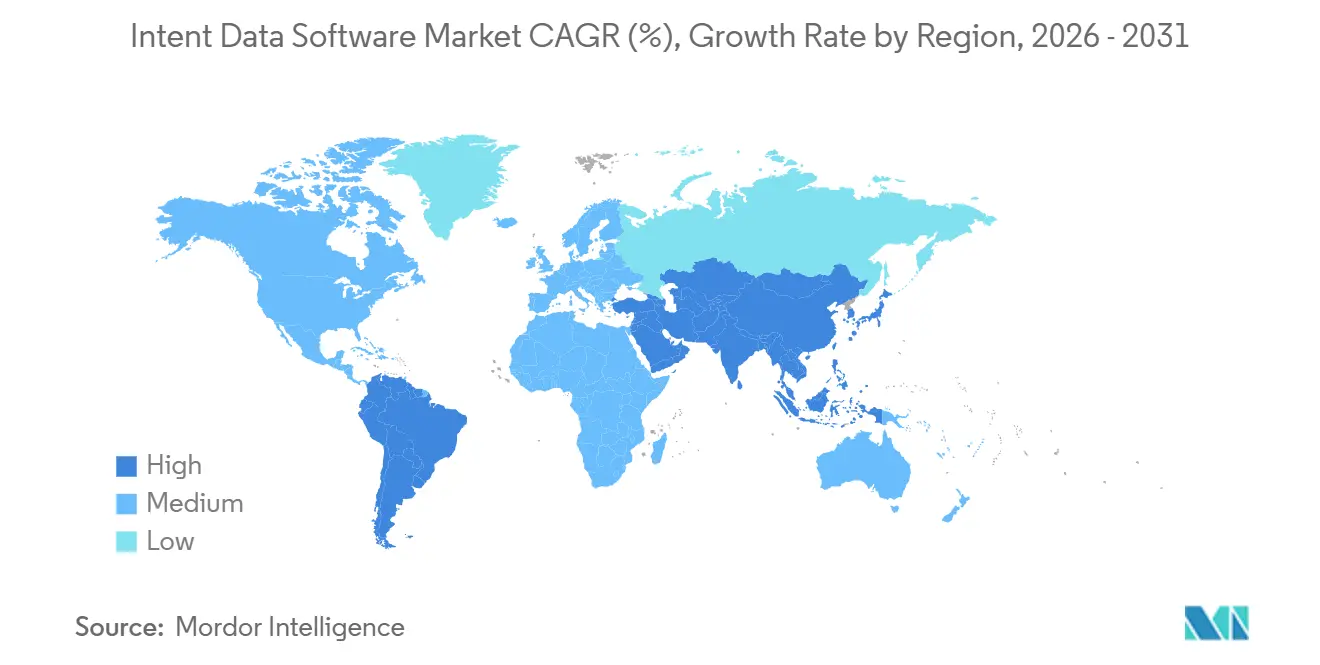
North America accounted for 37.41% of revenue in 2025, giving the region the largest share of the intent data software market. This 37.41% position represented the leading share of the intent data software market because the region has the most mature account-based marketing environment, high SaaS adoption, and a dense base of B2B technology vendors. The United States remains the anchor market because CRM, marketing automation, and revenue operations tools are deeply embedded across enterprise selling motions. ZoomInfo revised its full-year 2026 revenue guidance to USD 1.18-1.20 billion, reflecting a commercial environment shaped by customer rationalization and platform consolidation.[2]ZoomInfo Technologies Inc., “Form 10-Q Quarterly Report,” SEC Filing via last10k.com, last10k.com The North American intent data software market, therefore, remains the most developed region, but its growth path is increasingly tied to platform replacement, workflow depth, and proof of contribution rather than simple first-time adoption.
Asia-Pacific is projected to expand at a 18.30% CAGR through 2031, making it the fastest-growing regional segment in the intent data software market. The region is not only following North America with a time lag, but also adopting mobile-first selling, multilingual engagement, and fast-moving commercial cycles in technology-led markets. India, South Korea, China, and Southeast Asia are key demand centers as enterprises digitize their sales and marketing processes and seek better account-prioritization tools. Japan and South Korea also highlight the importance of language precision and local compliance expectations, which can create gaps for global vendors that rely too heavily on English-language models. Australia and New Zealand are closer to mature Western buying patterns, but buyer expectations still include greater attention to breach response and data-handling discipline.
Europe remains a substantial part of the intent data software market, supported by Germany, the United Kingdom, and France. The region benefits from established enterprise software buying processes and a meaningful installed base of account-based marketing programs, but evaluations can move more slowly because buyers are cautious about data handling and automated scoring practices. The United Kingdom continues to show solid independent demand, while continental Europe creates room for regional alternatives that can compete with United States-based platforms on local fit. Expandi Limited acquired Kompass in March 2026 to create a larger independent European B2B data, media, and AI-powered marketing platform that combines firmographic intelligence with media-based behavioral signals and purchase intent data. South America, the Middle East, and Africa remain smaller regional markets, but they are becoming more visible as enterprise digitization, sovereign technology investment, and regional B2B software adoption continue to widen the addressable base.

Competitive Landscape
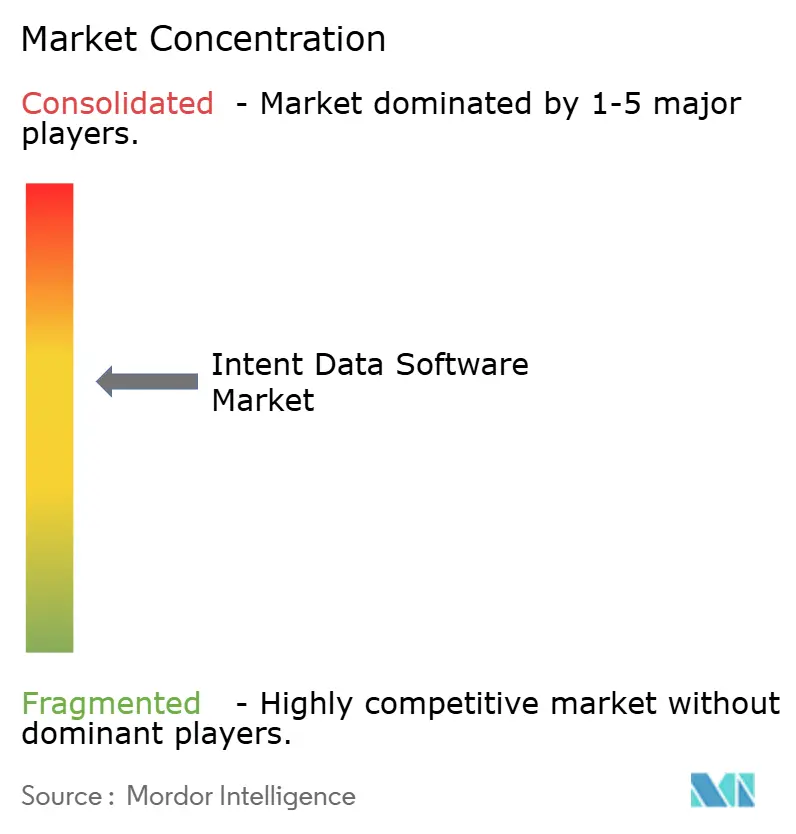
The intent data software market is moderately consolidated at the top, but it remains fragmented across the middle and lower tiers. A small set of vendors, including 6sense, Bombora, Demandbase, and ZoomInfo, wields significant influence in enterprise buying because they have the broadest commercial reach and the deepest integration into go-to-market workflows. Their positions are not identical: some compete as full-stack account-based marketing platforms, while others provide intent as one layer within a broader revenue data environment. This creates a market where product boundaries overlap, but vendor identities remain shaped by distinct operating models. The result is a competitive field where leadership comes from both scale and workflow relevance rather than from raw data access alone.
The strategic moves made in 2026 show where the intent data software market is heading. Demandbase introduced Demandbase AI in April 2026 with context intelligence, AI workflow integration, and a stronger pipeline execution position for go-to-market teams. 6sense launched its MCP Server in open beta in July 2026, enabling predictive buying stages, account qualification status, and keyword intent to be called from MCP-compatible AI agents without custom integration.[3]6sense, “6sense Launches MCP Server, Bringing Proprietary GTM Intelligence Into Any AI Agent,” 6sense Newsroom, 6sense.com Zoom also announced a deal to acquire Common Room in July 2026, extending buyer intelligence into a person-level AI-enabled layer that links product, CRM, marketing, and engagement signals.
These moves show that the intent data software market is increasingly focused on AI interoperability, signal explainability, and depth of first-party data. They also show that competition is shifting away from standalone dashboards toward systems that enable action within the tools revenue teams already use every day. Smaller players such as Cognism, Dealfront, Madison Logic, and NetLine Corporation still have room to compete through regional focus, content syndication-led models, and narrower specialization. A notable open space remains in regulated verticals, where no single vendor has clearly established a dominant purpose-built intent model for sectors such as healthcare, financial services, or industrial manufacturing. That combination of strong top-tier vendors and broad niche competition keeps the intent data software market active, differentiated, and difficult for any single provider to dominate.
Intent Data Software Industry Leaders
Demandbase, Inc.
Madison Logic, Inc.
Leadspace, Inc.
NetLine Corporation
Clearbit, Inc.
- *Disclaimer: Major Players sorted in no particular order

Recent Industry Developments
- July 2026: 6sense launched the 6sense MCP Server in open beta, making its Signalverse GTM intelligence, including predictive buying stages, 6sense Qualified Account status, and keyword intent, natively callable from any MCP-compatible AI agent (Claude, ChatGPT, Agentforce, Writer) without custom integration. The company cited that accounts prioritized as 6QAs delivered 29% higher opportunity values and 33% larger deal sizes versus non-6QA accounts across the Q2 2025-Q1 2026 period. General availability is planned for August 2026.
- July 2026: Zoom Communications (NASDAQ: ZM) announced a definitive agreement to acquire Common Room, an AI-native GTM intelligence platform that converts fragmented first-party CRM, product, marketing, and engagement signals into person-level buyer intelligence activated through AI agents (RoomieAI). The deal extends Zoom Revenue Accelerator upstream into pre-call buyer intelligence, eliminating a key point-solution gap for revenue teams.
- June 2026: Doceree launched Clinical Intent Signals (CIS), described as the healthcare industry's first commercially available intelligence layer for detecting real-time clinical intent across omnichannel campaigns. CIS activates across EHRs, medical journals, and point-of-care platforms, enabling life science marketers to engage HCPs at the precise moment clinical decision-making is forming. The product became available through the Daily Command Marketplace on July 14, 2026.
- April 2026: Demandbase debuted Demandbase AI at its annual GO London customer conference, positioning it as a "pipeline engine" for modern GTM teams. The platform introduced Context Intelligence for signal-to-pipeline mapping, LLM workflow integration via MCP with ChatGPT, Claude, and Gemini, and a Site Customization Agent. Demandbase stated it is the only vendor named a Leader in both The Forrester Wave: Marketing and Sales Data Providers for B2B, Q1 2026 and The Forrester Wave: Revenue Marketing Platforms for B2B, Q1 2026.


Global Intent Data Software Market Report Scope
The Intent Data Software Market comprises software platforms and associated services that enable organizations to identify, collect, analyze, and activate buyer intent signals derived from digital interactions, online research, content consumption patterns, and behavioral data across multiple channels. These solutions offer capabilities such as lead intelligence, account identification, account-based marketing (ABM), sales and revenue intelligence, customer experience personalization, and risk and compliance intelligence. Organizations use these solutions to improve prospect targeting, accelerate sales cycles, enhance marketing effectiveness, optimize customer engagement, and support data-driven decision-making. The increasing adoption of account-based strategies drives the market, as does the growing demand for predictive analytics, rising investments in data-driven sales and marketing technologies, and the need to identify high-intent buyers in increasingly complex B2B purchasing environments.
The Intent Data Software Market Report is Segmented by Component (Software and Services), Deployment Mode (Cloud and On-Premises), Application (Lead Intelligence and Opportunity Identification, Account-Based Marketing [ABM], Sales and Revenue Intelligence, Customer Experience and Personalization, and Risk, Compliance and Fraud Intelligence), Organization Size (Large Enterprises, and Small and Medium Enterprises), End User Industry (Information Technology and Telecommunications, Banking, Financial Services, and Insurance [BFSI], Retail and E-commerce, Media and Entertainment, Healthcare and Life Sciences, Industrial Manufacturing, and Other End User Industries), and Geography (North America, South America, Europe, Asia-Pacific, Middle East, and Africa). The Market Forecasts are Provided in Terms of Value (USD).
| Software |
| Services |
| Cloud |
| On-Premises |
| Lead Intelligence and Opportunity Identification |
| Account-Based Marketing (ABM) |
| Sales and Revenue Intelligence |
| Customer Experience and Personalization |
| Risk, Compliance and Fraud Intelligence |
| Large Enterprises |
| Small and Medium Enterprises |
| Information Technology and Telecommunications |
| Banking, Financial Services, and Insurance (BFSI) |
| Retail and E-commerce |
| Media and Entertainment |
| Healthcare and Life Sciences |
| Industrial Manufacturing |
| Other End User Industries |
| North America | United States |
| Canada | |
| Mexico | |
| South America | Brazil |
| Argentina | |
| Rest of South America | |
| Europe | Germany |
| United Kingdom | |
| France | |
| Italy | |
| Spain | |
| Russia | |
| Rest of Europe | |
| Asia-Pacific | China |
| Japan | |
| India | |
| South Korea | |
| Australia and New Zealand | |
| Rest of Asia-Pacific | |
| Middle East | Saudi Arabia |
| United Arab Emirates | |
| Turkey | |
| Rest of Middle East | |
| Africa | South Africa |
| Nigeria | |
| Rest of Africa |
| By Component | Software | |
| Services | ||
| By Deployment Mode | Cloud | |
| On-Premises | ||
| By Application | Lead Intelligence and Opportunity Identification | |
| Account-Based Marketing (ABM) | ||
| Sales and Revenue Intelligence | ||
| Customer Experience and Personalization | ||
| Risk, Compliance and Fraud Intelligence | ||
| By Organization Size | Large Enterprises | |
| Small and Medium Enterprises | ||
| By End User Industry | Information Technology and Telecommunications | |
| Banking, Financial Services, and Insurance (BFSI) | ||
| Retail and E-commerce | ||
| Media and Entertainment | ||
| Healthcare and Life Sciences | ||
| Industrial Manufacturing | ||
| Other End User Industries | ||
| By Geography | North America | United States |
| Canada | ||
| Mexico | ||
| South America | Brazil | |
| Argentina | ||
| Rest of South America | ||
| Europe | Germany | |
| United Kingdom | ||
| France | ||
| Italy | ||
| Spain | ||
| Russia | ||
| Rest of Europe | ||
| Asia-Pacific | China | |
| Japan | ||
| India | ||
| South Korea | ||
| Australia and New Zealand | ||
| Rest of Asia-Pacific | ||
| Middle East | Saudi Arabia | |
| United Arab Emirates | ||
| Turkey | ||
| Rest of Middle East | ||
| Africa | South Africa | |
| Nigeria | ||
| Rest of Africa | ||


Key Questions Answered in the Report
What is the current and future size outlook for the intent data software market?
The intent data software market was valued at USD 3.92 billion in 2025, stands at USD 4.75 billion in 2026, and is forecast to reach USD 10.31 billion by 2031 at a 16.84% CAGR.
Which region leads revenue generation in this category?
North America led with 37.41% of revenue in 2025 because of its mature account-based marketing ecosystem, strong SaaS adoption, and dense base of B2B technology vendors.
Which region is expanding the fastest through 2031?
Asia-Pacific is projected to grow at an 18.30% CAGR through 2031, supported by enterprise digitization, mobile-first selling, and rising demand for localized account prioritization tools.
Why is cloud deployment so dominant in this space?
Cloud-based deployment held 71.33% of revenue in 2025 and is also the fastest-growing model because it supports real-time signal processing, faster updates, and easier AI workflow integration.
Which application is growing the fastest?
Account-based marketing is projected to expand at an 18.67% CAGR through 2031 as buyers move from signal viewing toward coordinated action across advertising, content, email, and sales outreach.
Which customer groups are creating the next wave of growth?
Small and medium enterprises are projected to grow at a 19.45% CAGR, while healthcare and life sciences is expected to grow at 17.92%, showing that newer buyer groups are widening demand beyond the traditional enterprise IT base.
Page last updated on:





