
Integrally Geared Centrifugal Compressor Market Size and Share
Market Overview
| Study Period | 2022 - 2032 |
|---|---|
| Market Size (2027) | USD 1.53 Billion |
| Market Size (2032) | USD 2.01 Billion |
| Growth Rate (2027 - 2032) | 5.55 % |
| Fastest Growing Market | Asia-Pacific |
| Largest Market | North America |
| Market Concentration | Medium |
Major Players *Disclaimer: Major Players sorted in no particular order Image © Mordor Intelligence. Reuse requires attribution under CC BY 4.0. | |
Integrally Geared Centrifugal Compressor Market Analysis by Mordor Intelligence
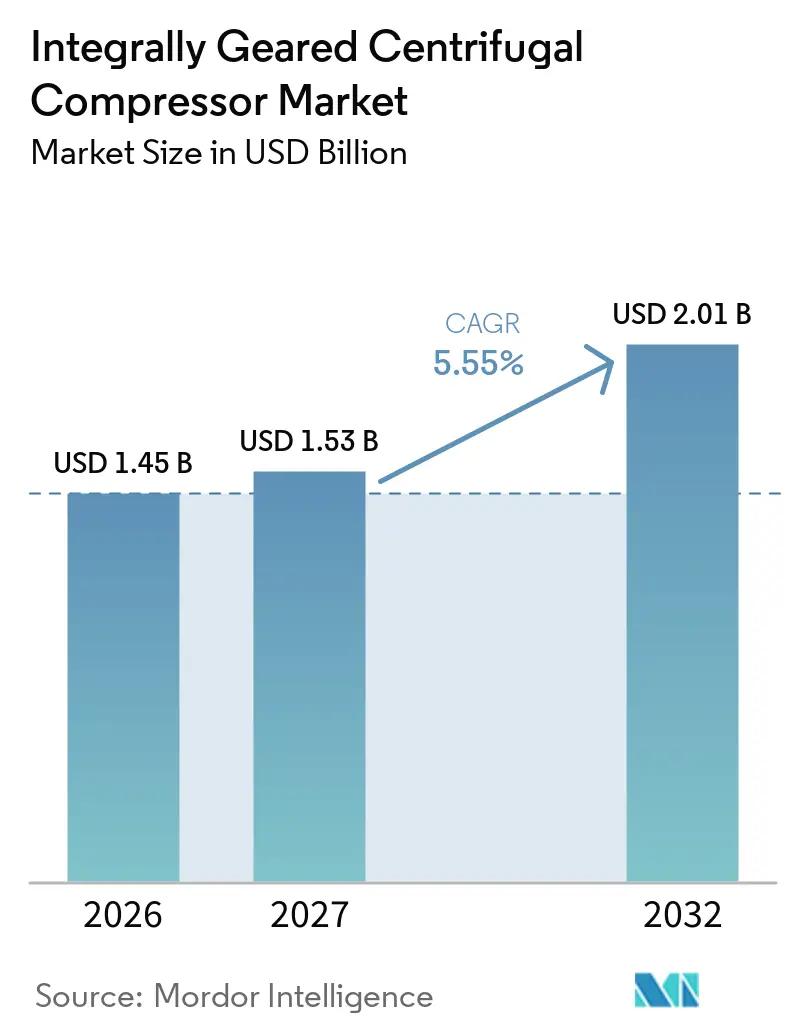
The Integrally Geared Centrifugal Compressor Market size is expected to increase from USD 1.45 billion in 2026 to USD 1.53 billion in 2027 and reach USD 2.01 billion by 2032, growing at a CAGR of 5.55% over 2027-2032. Demand is supported by investment in hydrocarbon processing, industrial gases, and lower-carbon infrastructure. A single casing can combine multiple impeller stages, each operating at a suitable speed, with cooling between stages. This arrangement supports efficient compression in high-flow process applications. Large projects in air separation, carbon capture, and petrochemicals are therefore important sources of equipment orders. Service revenue from the installed base can provide some stability when orders for new projects fluctuate.
Key Report Takeaways
- By product type, custom-made compressors held 57.3% of the integrally geared centrifugal compressor market share in 2026 and are forecast to grow at a 5.8% CAGR through 2032.
- By stage type, multi-stage compressors held 62.5% of the integrally geared centrifugal compressor market share in 2026 and are forecast to grow at a 6.6% CAGR through 2032.
- By end-use industry, oil and gas held 39.7% of revenue in 2026, while chemicals and petrochemicals are forecast to grow at a 6.8% CAGR through 2032.
- By geography, North America held 33.6% of revenue in 2026, while Asia-Pacific is forecast to grow at a 6.2% CAGR through 2032.
Note: Market numbers in this report are based on Mordor Intelligence's proprietary estimation framework, which combines nine months of actuals with Q4 projections for base year 2026.
Market Trends and Insights
Drivers Impact Analysis of Integrally Geared Centrifugal Compressor Market*
| Driver | (~) % Impact on CAGR Forecast | Geographic Relevance | Impact Timeline |
|---|---|---|---|
| Industrial Demand for Energy-Efficient Multi-Stage Compression | +1.2% | Global, with concentration in United States, China, Germany, and Saudi Arabia | Medium term (2-4 years) |
| Expansion of Air Separation and Industrial Gas Capacity | +1.0% | Asia-Pacific and North America core, with spillover to Europe and Middle East and Africa | Medium term (2-4 years) |
| CCUS, Hydrogen, and Low-Carbon Gas Infrastructure | +0.9% | North America and Europe leading, with Asia-Pacific expanding from 2027 | Long term (≥ 4 years) |
| Standardized Skid Packages for Brownfield and Modular Projects | +0.6% | Global, with early gains in United States, China, India, and United Arab Emirates | Short term (≤ 2 years) |
| Digital Compressor Control and Performance Monitoring | +0.5% | North America, Germany, Japan, and South Korea | Medium term (2-4 years) |
| Multi-Service Compression in Space-Constrained Plants | +0.4% | Global, with concentration in United States, China, Germany, Saudi Arabia, and United Arab Emirates | Short term (≤ 2 years) |
| Source: Mordor Intelligence | |||
Industrial Demand for Energy-Efficient Multi-Stage Compression
Operators are replacing less efficient single-shaft and reciprocating equipment in processed applications where power consumption materially affects operating cost. The integrally geared centrifugal compressor market benefits because individual impellers can run at aerodynamically suitable speeds through separate gear ratios. An American Society of Mechanical Engineers (ASME) paper reports that adjustable inlet guide vanes, variable diffusers, and anti-surge controls can improve part-load operation for integrally geared units.[1] Intercooling between stages also reduces the work required for compression in suitable duties. Air separation plants operating continuously at high throughput are particularly sensitive to these operating-cost considerations. The resulting preference is strongest where buyers assess equipment over its full operating life rather than only its purchase price.
Expansion of Air Separation and Industrial Gas Capacity
Air separation units require large flows of compressed air and can require several compressor duties within one project. Air Liquide announced a potential investment of up to USD 850 million for four modular air separation units in Baytown, Texas, to supply ExxonMobil’s low-carbon hydrogen project.[2] The company also announced a USD 200 million modernization of an air separation unit in Louisiana that supplies Dow. In Germany, Air Liquide plans to invest more than EUR 250 million in three air separation units for the semiconductor sector, with operations expected in 2027. Messer started construction of a USD 70 million air separation unit in Berryville, Arkansas, in January 2025.[3] These projects can support demand for main air, booster, and product-gas compressor trains.
Carbon Capture, Utilization, and Storage (CCUS), Hydrogen, and Low-Carbon Gas Infrastructure
Carbon capture projects require continuous compression of carbon dioxide at high flow rates and pressures. Baker Hughes booked a contract in the first quarter of 2025 to supply 3 carbon dioxide centrifugal compressor trains for Eni’s Liverpool Bay carbon capture and storage project.[4] Everllence was contracted to supply 5 compressor trains for the Net Zero Teesside Power and Northern Endurance Partnership projects in the United Kingdom. The equipment includes integrally geared units handling wet carbon dioxide before downstream high-pressure compression. The Zhengning carbon capture project in China began operations in September 2025 with an 8-stage integrally geared carbon dioxide compressor. Kawasaki also began construction of a centrifugal hydrogen compressor demonstration facility for hydrogen liquefaction plants in 2025.
Digital Compressor Control and Performance Monitoring
Anti-surge systems, inlet guide vane scheduling, digital twins, and performance monitoring are becoming a more common part of new compressor packages. The Everllence equipment for the Net Zero Teesside project includes digital twins, virtual sensors, and machine-learning functions that use live operating data. These functions allow operators to compare measured performance with model predictions during operation. Remote monitoring can support performance guarantees for plants operating several compressor trains. It can also shift service activity toward continuous monitoring and planned interventions rather than only time-based overhauls. Suppliers with reliable control and service capabilities can therefore strengthen their position with installed-based customers.
Restraints Impact Analysis of Integrally Geared Centrifugal Compressor Market*
| Restraint | (~) % Impact on CAGR Forecast | Geographic Relevance | Impact Timeline |
|---|---|---|---|
| High Seal Count for Complex Process-Gas Services | -0.8% | Global, with concentration in United States, Germany, Saudi Arabia, and China | Long term (≥ 4 years) |
| Narrower Stable Operating Window and Surge-Management Complexity | -0.7% | Global, with acute relevance in United States, Germany, Japan, and China | Long term (≥ 4 years) |
| Precision Gear, Bearing, and Impeller Supply-Chain Exposure | -0.6% | Germany, Japan, United States, China, and India | Medium term (2-4 years) |
| High Capital Cost for Low or Variable Load Profiles | -0.6% | United States, Canada, Germany, Australia, and Brazil | Short term (≤ 2 years) |
| Source: Mordor Intelligence | |||
High Seal Count for Complex Process-Gas Services
Each impeller stage requires a sealing arrangement suited to the gas, pressure, and operating conditions. A multi-stage machine can therefore have a larger seal inventory than a simpler compression configuration. Corrosive, toxic, or sour-gas services require individual sealing systems to be qualified, monitored, and replaced according to gas chemistry. Seal flush systems and nitrogen purging can also consume utilities while the compressor is on standby. These lifecycle requirements can reduce the advantage of integrally geared equipment in difficult-gas applications. Some buyers may instead select hermetically sealed motor-compressor units or axial compressors when those designs better fit the process duty.
Narrower Stable Operating Window and Surge-Management Complexity
The multi-shaft and multi-impeller arrangement requires each active stage to remain within a stable operating range. Rapid load changes, process upsetting, start-up sequences, and shutdowns require coordinated anti-surge controls and fast recycle valves. Feed composition and flow can vary in carbon capture and gas-processing services, which increases the need to monitor multiple surge margins. The control system can add engineering, commissioning, and training requirements at the project stage. Advanced control packages can reduce the operating challenge, but they do not remove the need for experienced commissioning and plant operations teams. This burden can be more significant in regions with limited turbomachinery expertise.
*Our forecasts treat driver/restraint impacts as directional, not additive. The impact forecasts reflect baseline growth, mix effects, and variable interactions.
Integrally Geared Centrifugal Compressor Market Segment Analysis
By Product Type:
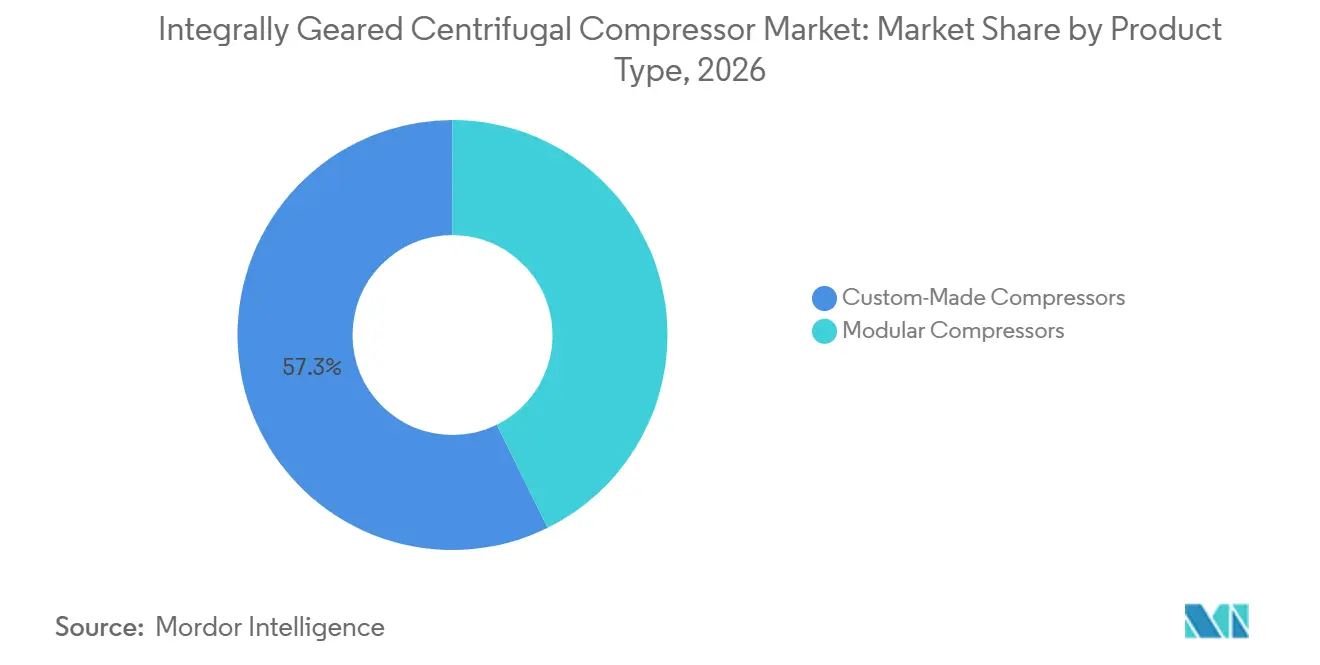
Custom Engineering Leads, While Modular Packages Gain RelevanceCustom-made compressors accounted for 57.3% of the integrally geared centrifugal compressor market share in 2026. Their position reflects the need to match gas composition, pressure ratio, intercooler duty, and space limits for a specific installation. Atlas Copco describes its gas and process compressor portfolio as engineered to order under American Petroleum Institute (API) 617 and API 672 specifications. The company states that its configurations can include up to 8 stages in one casing. Custom equipment can meet nonstandard pressure profiles, site requirements, and project performance guarantees.
Modular compressors are relevant for brownfield retrofits and carbon capture projects seeking shorter delivery periods and lower site engineering needs. Their limits become clearer when process conditions fall outside the standard operating envelope. A unit that does not match the duty can impose an efficiency loss over its operating life. Air separation and chemical processing plants are especially sensitive to this tradeoff because compression power is a major operating cost. The integrally geared centrifugal compressor industry therefore retains room for both approaches, with custom engineering favored for complex and high-value process duties.

By Stage Type:
Multi-Stage Designs Serve Higher-Pressure Process DutiesMulti-stage compressors held 62.5% of the integrally geared centrifugal compressor market share in 2026. Their lead reflects demand from air separation, carbon capture, and large process-gas services that require pressure ratios beyond the practical range of a single stage. The American Society of Mechanical Engineers (ASME) paper describes integrally geared designs with up to 10 stages connected through a central bullgear. This arrangement supports staged pressure increases while allowing individual impellers to operate at different speeds.
The multi-stage segment is forecast to advance at a 6.6% CAGR through 2032. Carbon capture, hydrogen, and petrochemical projects are directing demand toward equipment with more stages and more complex controls. Single-stage compressors continue to serve low-pressure plant air, refrigerant, and selected gas-injection duties. Buyers must consider the full process requirement, including part-load performance and expected feed variation. This application mix supports the continued leadership of multi-stage equipment in the integrally geared centrifugal compressor market.
By End-Use Industry:
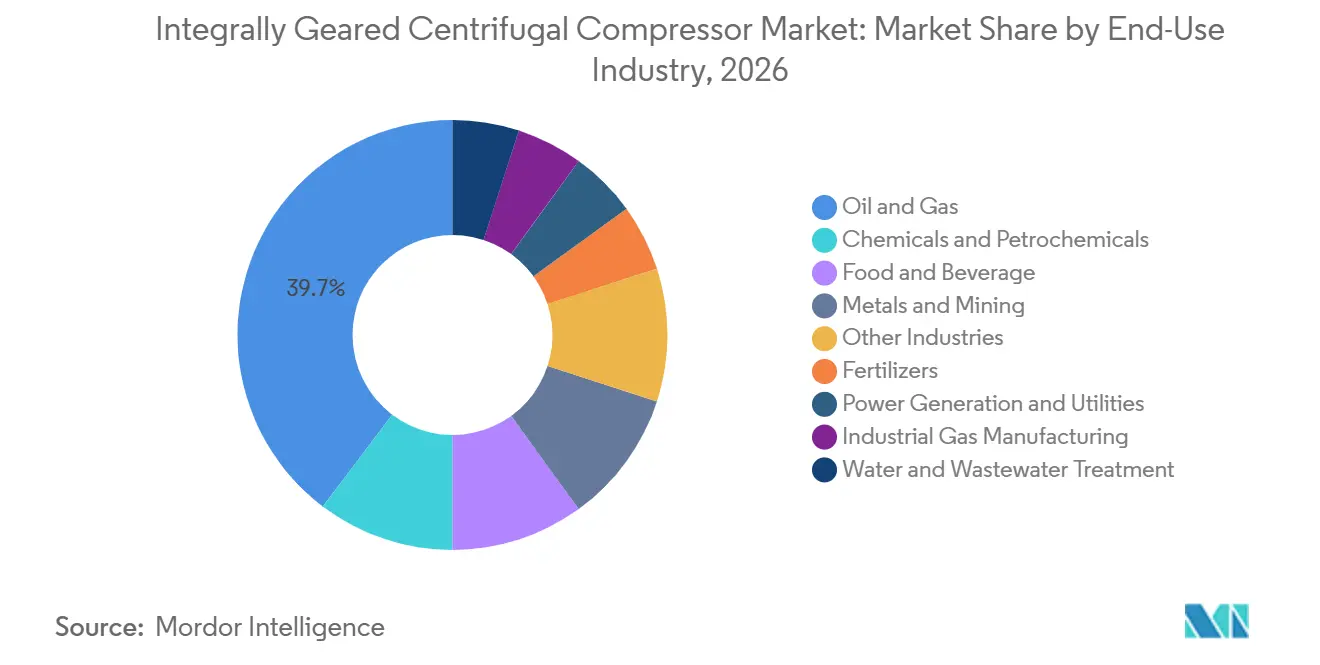
Oil and Gas Holds the Largest Position, While Chemicals and Petrochemicals Grow FasterOil and gas held 39.7% of the integrally geared centrifugal compressor market size in 2026. Demand comes from upstream gas processing, liquefied natural gas liquefaction, refinery hydrogen recycle, offshore compression, and related gas-handling services. These applications frequently require large machines with specific materials, control systems, and documented performance. Carbon capture investments associated with gas processing can add another compression requirement for some projects. The installed base also creates service and retrofits demand after the initial equipment delivery.
Chemicals and petrochemicals are forecast to grow at a 6.8% CAGR through 2032. New ethylene, methanol, ammonia, and specialty chemical plants can require compressor trains for feed gas, refrigerant, and product gas. The integrally geared centrifugal compressor industry serves these duties where high throughput and staged compression are necessary. ISO 10439 and API 617 Part 3 influence machine selection, giving suppliers with auditable compliance records as an advantage. Industrial gas manufacturing, power generation, and fertilizers also have visible project pipelines linked to air separation and ammonia capacity additions.
Geography Analysis
North America Integrally Geared Centrifugal Compressor Market
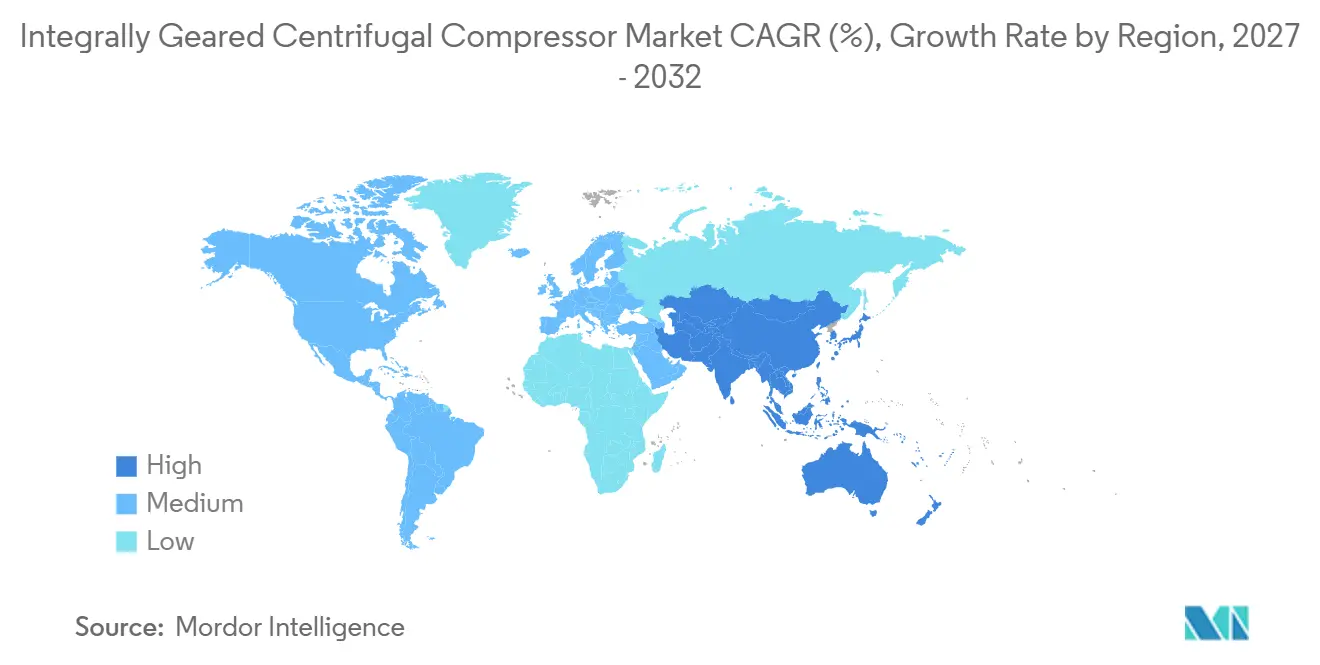
North America held 33.6% of the integrally geared centrifugal compressor market share in 2026. The region has a large installed base across liquefied natural gas facilities, refineries, gas processing plants, and industrial gas sites. The United States is adding air separation, export, petrochemical, and carbon capture capacity at the same time. Air Liquide’s planned Baytown project is one example of the industrial gas investment supporting this activity. Canada contributes through oil sands and carbon capture projects, while Mexico adds petrochemical and refining activity.
APAC Integrally Geared Centrifugal Compressor Market
Asia-Pacific is forecast to grow at a 6.2% CAGR through 2032, the highest regional rate. China supports demand through industrial gas expansion for chemical, steel, and semiconductor applications. The Zhengning project shows that Chinese suppliers are developing domestic carbon dioxide compression capability. India is a fast-growing submarket, and Air Liquide announced a second Gujarat air separation unit with production capacity of 200 tons per day. Japan and South Korea add demand from liquefied natural gas, hydrogen, and advanced petrochemical facilities.
Europe, South America and Middle East Integrally Geared Centrifugal Compressor Market
Europe has mature replacement demand in Germany, the United Kingdom, France, and the Netherlands, alongside carbon capture and hydrogen infrastructure demand. Everllence’s award for the United Kingdom East Coast Cluster reflects this need for carbon dioxide compression equipment. Russia faces sanctions and equipment-access limits, while South America and the Middle East are supported by oil and gas, gas processing, and petrochemical activity.
Competitive Landscape
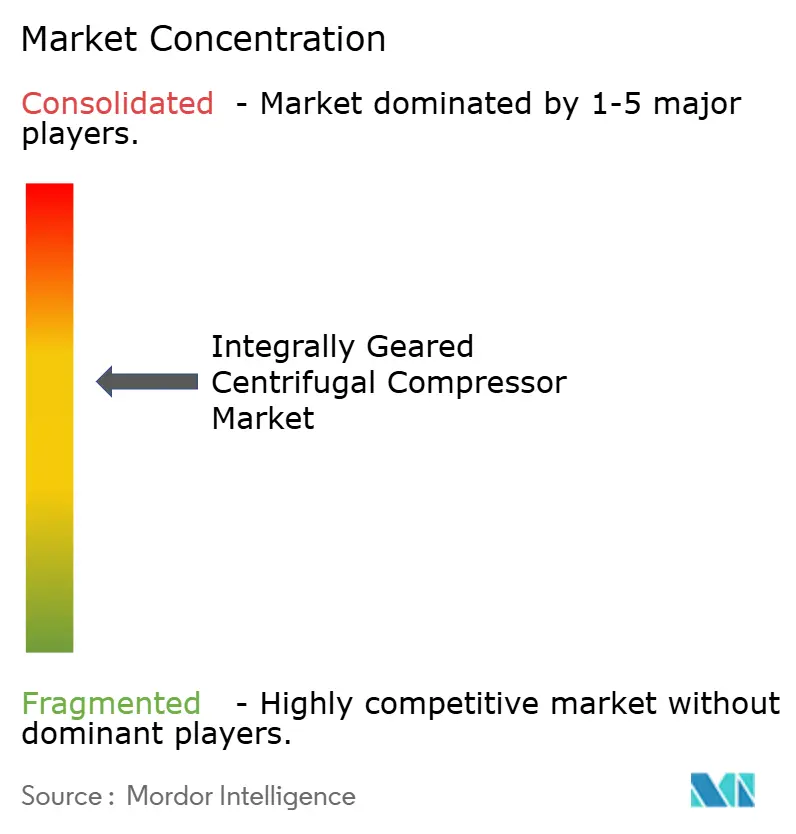
The integrally geared centrifugal compressor market is moderately concentrated, with Atlas Copco AB, Siemens Energy AG, MAN Energy Solutions SE, Ingersoll Rand Inc., and Baker Hughes Company estimated to hold a combined 62% of 2026 revenue. Competition depends on engineering capability, product range, American Petroleum Institute (API) compliance, service coverage, and control-system expertise. Buyers assess price, performance guarantees, and the supplier’s ability to support equipment over its operating life. The largest suppliers have installed bases that can support recurring parts, maintenance, and retrofit work. Regional and application-focused suppliers compete for the remaining demand.
Atlas Copco has expanded its Voorheesville, New York, facility to scale production of large integrally geared centrifugal compressors and turboexpanders for oil and gas, carbon capture, hydrogen, and air separation applications. The company also cited the acquisition of ABC Compressors in its 2025 results as a measure to strengthen its hydrogen and carbon dioxide compression position. Baker Hughes secured the Liverpool Bay contract for 3 carbon dioxide compressor trains. Everllence supplied equipment for 2 United Kingdom carbon capture projects with digital tools in its packages. These moves show leading suppliers building positions in carbon management and digitally supported services.
Ingersoll Rand reported 2025 Industrial Technologies and Services revenue of USD 1.672 billion, up 11%, and disclosed the acquisition of Termomeccanica Industrial and Adicomp for USD 193.7 million in 2025. The acquisition extends its presence in natural-gas and renewable-gas compression. API 617 and API 672 certification remain important barriers in projects requiring audited performance verification. Opportunities remain in digital performance services and modular carbon capture packages for mid-sized emitters.
Integrally Geared Centrifugal Compressor Industry Leaders
-
Atlas Copco AB
-
Siemens Energy AG
-
MAN Energy Solutions SE
-
Ingersoll Rand Inc.
-
Baker Hughes Company
- *Disclaimer: Major Players sorted in no particular order
Integrally Geared Centrifugal Compressor Market Companies Covered in this Report
- Aerzener Maschinenfabrik GmbH (AERZEN)
- Atlas Copco AB
- Baker Hughes Company
- Boldrocchi S.r.l.
- BORSIG GmbH
- Burckhardt Compression AG
- Ebara Corporation
- FS-Elliott Co., LLC
- Hanwha Power Systems Co., Ltd.
- Howden Group
- IHI Corporation
- Ingersoll Rand Inc.
- Kawasaki Heavy Industries, Ltd.
- Kirloskar Pneumatic Company Limited
- Kobe Steel, Ltd. (KOBELCO)
- MAN Energy Solutions SE
- Mitsubishi Heavy Industries, Ltd.
- Mitsui E&S Machinery Co., Ltd.
- Siemens Energy AG
- Sundyne, LLC
Recent Industry Developments in Integrally Geared Centrifugal Compressor Market
- September 2025: China Huaneng's 1.5 million ton/year CCUS demonstration project at the Zhengning power plant commenced operations, featuring the country's first eight-stage integrally geared CO₂ compressor developed by Shenyang Blower Group, 20% lighter and 10% more efficient than conventional single-shaft equivalents, saving 10 kWh per ton of CO₂ compressed.
- September 2025: Everllence was contracted to supply 5 centrifugal compressor trains, including 2 integrally geared RG-type units, for the United Kingdom East Coast Cluster CCS projects. The project supports compression of more than 370,000 kg/hour of CO₂ and includes digital twin and machine-learning functions in the integrally geared units.
- June 2025: Baker Hughes announced that it had booked a contract in the first quarter of 2025 from Saipem to supply 3 CO₂ centrifugal compressor trains with electric motors and a Lufkin Gears gearbox for Eni's Liverpool Bay CCS project in the United Kingdom.
- June 2025: Kobe Steel announced a JPY 3 billion investment in the expansion of Kobelco Industrial Machinery India’s Gujarat facility, including new production equipment for non-standard compressors.
Global Integrally Geared Centrifugal Compressor Market Report Scope
An integrally geared centrifugal compressor (IGCC) is a multi-shaft dynamic compressor in which a central drive gear (the bull gear) powers multiple smaller pinion shafts, with each pinion shaft driving one or two overhung compressor impellers at its own optimized speed.
The global integrally geared centrifugal compressor market is segmented by product type, stage type, end-use industry, and geography. By product type, the market is segmented into modular compressors and custom-made compressors. By stage type, the market is segmented into single-stage and multi-stage compressors. By end-use industry, the market is segmented into oil and gas, chemicals and petrochemicals, fertilizers, power generation and utilities, industrial gas manufacturing, water and wastewater treatment, food and beverage, metals and mining, and other industries. The report also covers the market size and forecasts for the global integrally geared centrifugal compressor market across 29 countries in key regions. For each segment, the market sizing and forecasts have been provided on the basis of value (USD).
Segmentation Overview
| Modular Compressors |
| Custom-Made Compressors |
| Single-Stage Compressors |
| Multi-Stage Compressors |
| Oil and Gas |
| Chemicals and Petrochemicals |
| Fertilizers |
| Power Generation and Utilities |
| Industrial Gas Manufacturing |
| Water and Wastewater Treatment |
| Food and Beverage |
| Metals and Mining |
| Other Industries |
| North America | United States |
| Canada | |
| Mexico | |
| Europe | Germany |
| France | |
| Italy | |
| Spain | |
| United Kingdom | |
| Poland | |
| Netherlands | |
| Russia | |
| Rest of Europe | |
| Asia-Pacific | China |
| India | |
| Japan | |
| South Korea | |
| Australia | |
| Indonesia | |
| Malaysia | |
| Thailand | |
| Philippines | |
| Rest of Asia-Pacific | |
| South America | Brazil |
| Argentina | |
| Colombia | |
| Rest of South America | |
| Middle East and Africa | Saudi Arabia |
| United Arab Emirates | |
| South Africa | |
| Kenya | |
| Egypt | |
| Nigeria | |
| Rest of Middle East and Africa |
| By Product Type | Modular Compressors | |
| Custom-Made Compressors | ||
| By Stage Type | Single-Stage Compressors | |
| Multi-Stage Compressors | ||
| By End-Use Industry | Oil and Gas | |
| Chemicals and Petrochemicals | ||
| Fertilizers | ||
| Power Generation and Utilities | ||
| Industrial Gas Manufacturing | ||
| Water and Wastewater Treatment | ||
| Food and Beverage | ||
| Metals and Mining | ||
| Other Industries | ||
| By Geography | North America | United States |
| Canada | ||
| Mexico | ||
| Europe | Germany | |
| France | ||
| Italy | ||
| Spain | ||
| United Kingdom | ||
| Poland | ||
| Netherlands | ||
| Russia | ||
| Rest of Europe | ||
| Asia-Pacific | China | |
| India | ||
| Japan | ||
| South Korea | ||
| Australia | ||
| Indonesia | ||
| Malaysia | ||
| Thailand | ||
| Philippines | ||
| Rest of Asia-Pacific | ||
| South America | Brazil | |
| Argentina | ||
| Colombia | ||
| Rest of South America | ||
| Middle East and Africa | Saudi Arabia | |
| United Arab Emirates | ||
| South Africa | ||
| Kenya | ||
| Egypt | ||
| Nigeria | ||
| Rest of Middle East and Africa | ||
Key Questions Answered in the Report
How large is the integrally geared centrifugal compressor market in 2026?
The integrally geared centrifugal compressor market size is USD 1.45 billion in 2026 and is forecast to reach USD 2.01 billion by 2032 at a 5.55% CAGR.
Which product type has the largest revenue share?
Custom-made compressors held 57.3% of revenue in 2026 because many process duties require site-specific pressure, gas, and space specifications. They are particularly relevant where process conditions do not fit the defined operating range of a standard package.
Why do multi-stage compressors lead this equipment category?
Multi-stage compressors held 62.5% of revenue in 2026 and suit high-pressure duties in air separation, carbon capture, and process-gas applications. Their configuration supports staged pressure increases and can allow impellers to run at different speeds.
Which end-use sector leads demand for these compressors?
Oil and gas held 39.7% of revenue in 2026, supported by gas processing, liquefied natural gas, refinery, and offshore applications. The segment also benefits from service and retrofit requirements across its installed base.
Which region is expected to grow the fastest through 2032?
Asia-Pacific is forecast to grow at a 6.2% CAGR through 2032, supported by industrial gas expansion and carbon capture development. China, India, Japan, and South Korea each support demand through different industrial gas, energy, and process plant investments.
How concentrated is the supplier base?
The top 5 suppliers are estimated to hold 62% of 2026 revenue, which indicates a moderately concentrated supplier base. Competition still includes regional and application-focused companies that can pursue specialized contracts and local service work.