
Infant Formula Market Size and Share
Market Overview
| Study Period | 2022 - 2032 |
|---|---|
| Market Size (2027) | USD 54.52 Billion |
| Market Size (2032) | USD 66.05 Billion |
| Growth Rate (2027 - 2032) | 3.91 % |
| Fastest Growing Market | North America |
| Largest Market | Asia-Pacific |
| Market Concentration | Low |
Major Players *Disclaimer: Major Players sorted in no particular order Image © Mordor Intelligence. Reuse requires attribution under CC BY 4.0. | |
Infant Formula Market Analysis by Mordor Intelligence
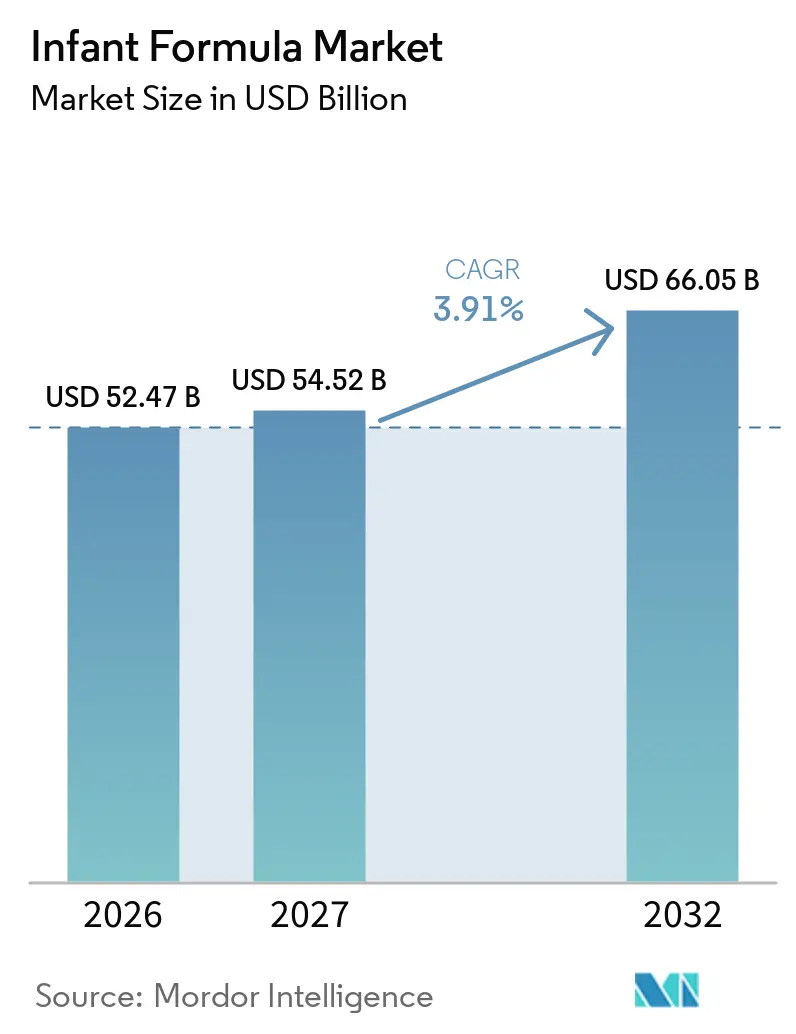
The infant formula market size is projected to expand from USD 52.47 billion in 2026 to USD 54.52 billion in 2027, to USD 66.05 billion by 2032, registering a CAGR of 3.91% between 2027 and 2032. The infant formula market is growing in value even where births are declining, because many parents are spending more per child on premium and functional products. Maternal employment continues to support demand for convenient feeding options, especially in urban households. In 2025, 73.90% of U.S. mothers with children under 18 were in the labor force, and the rate was 68.00% for mothers with children under 6[1]. Product development is shifting competition toward clinical support, ingredient quality, and product safety. Regulatory scrutiny and changing rules for digital promotion may limit how brands communicate product benefits.
Key Report Takeaways
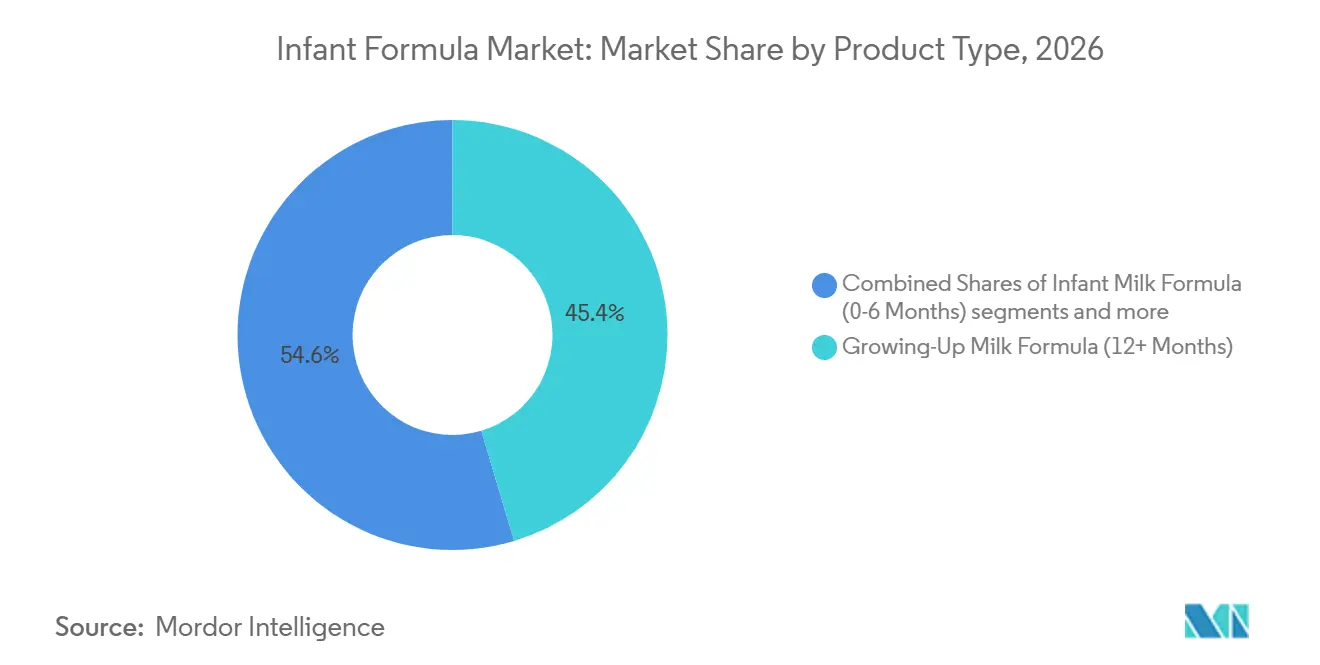
- By type, Growing-Up Milk Formula accounted for 45.36% of the infant formula market share in 2026 and is projected to grow at a 5.35% CAGR through 2032.
- By category, Premium Formula held 56.48% of the infant formula market size in 2026 and is forecast to expand at a 4.59% CAGR through 2032.
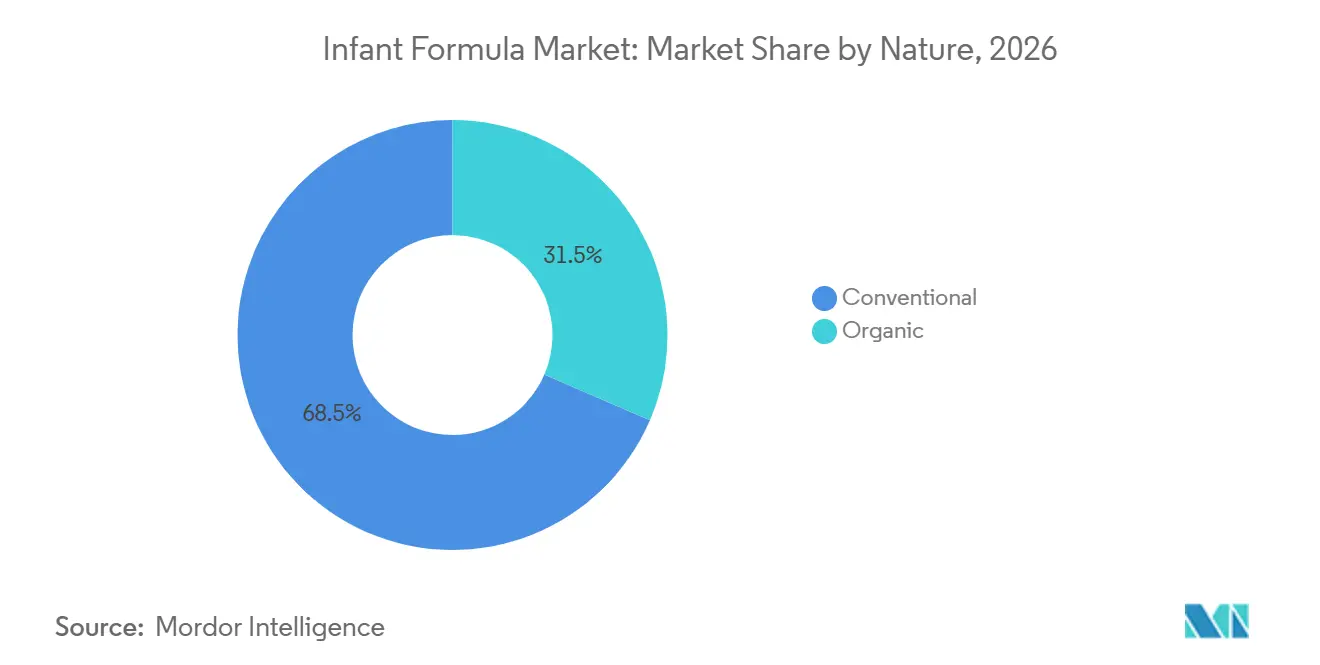
- By nature, Conventional Formula held a 68.52% revenue share in 2026, while Organic Formula is forecast to record a 6.11% CAGR through 2032.
- By form, Powder Formula accounted for 72.37% revenue share in 2026, while Liquid Formula is projected to grow at a 5.24% CAGR through 2032.
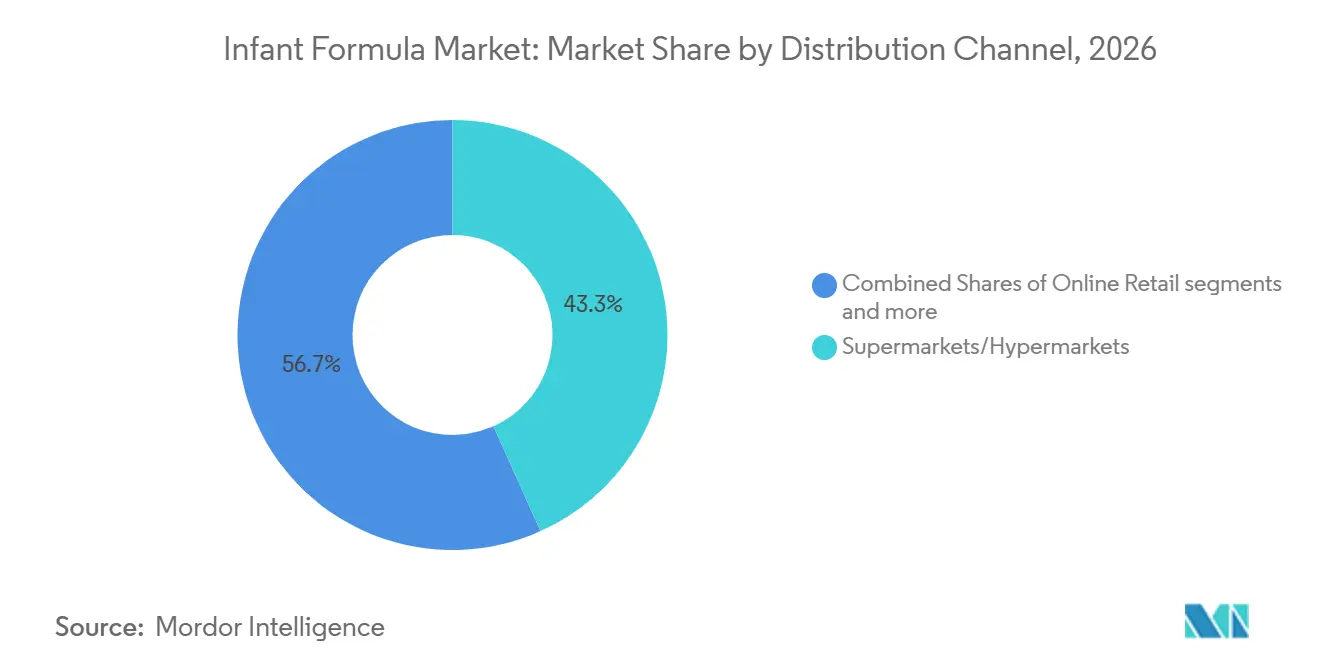
- By distribution channel, Supermarkets and Hypermarkets held a 43.28% revenue share in 2026, while Online Retail is forecast to grow at a 6.14% CAGR through 2032.
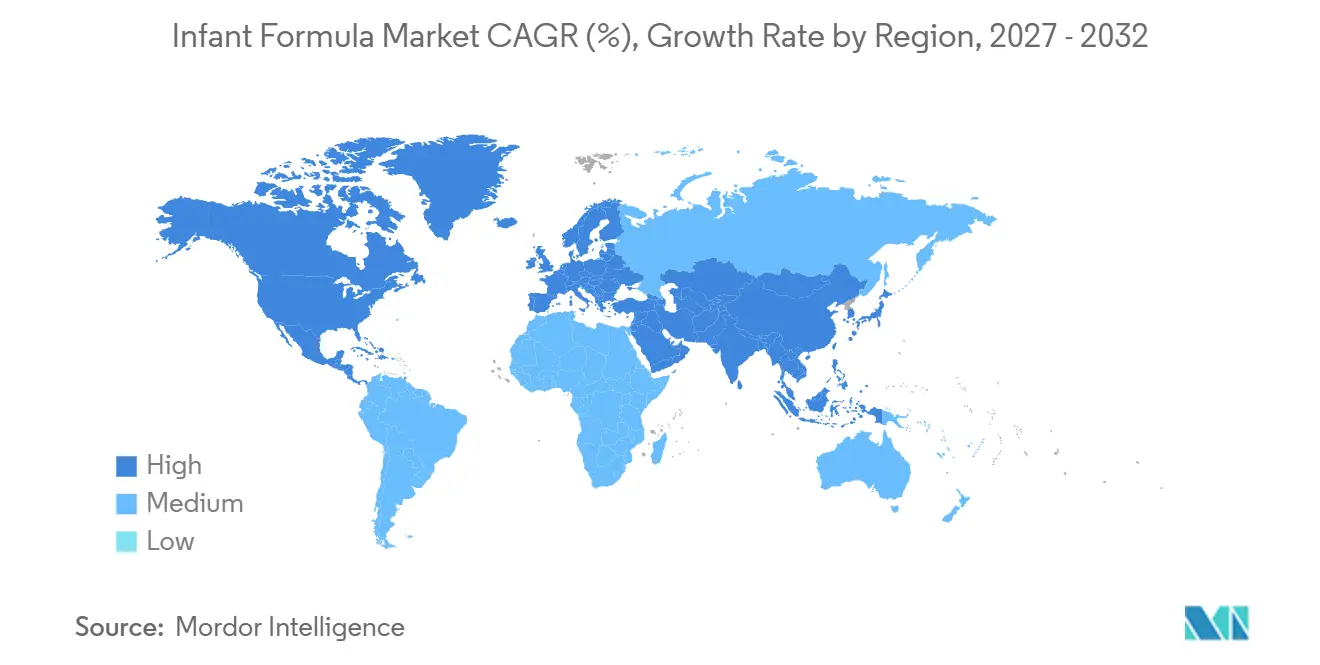
- By geography, Asia-Pacific accounted for 47.62% revenue share in 2026, while North America is forecast to grow at a 5.27% CAGR through 2032.
Note: Market numbers in this report are based on Mordor Intelligence's proprietary estimation framework, which combines nine months of actuals with Q4 projections for base year 2026.
Global Infant Formula Market Trends and Insights
Drivers Impact Analysis*
| Driver | (~) % Impact on CAGR Forecasts | Geographic Relevance | Impact Timeline |
|---|---|---|---|
| Rising awareness of infant nutrition and development | +0.5% | Global, concentrated in Asia-Pacific and North America | Medium term (2-4 years) |
| Increasing demand for specialized and functional infant formula | +0.7% | Global, led by China, Germany, and the United States | Long term (≥ 4 years) |
| Growing adoption of convenient and ready-to-feed products | +0.5% | North America, Western Europe, and Tier 1 Chinese cities | Short term (≤ 2 years) |
| Increasing demand for lactose-free and hypoallergenic formulas | +0.4% | North America, the European Union, Australia, and Japan | Medium term (2-4 years) |
| Product innovation and advances in infant formula composition | +0.6% | Global, with research centered in Europe, the United States, and China | Long term (≥ 4 years) |
| Increasing participation of women in the workforce | +0.7% | Global, with strong relevance in Asia-Pacific, the Middle East, Africa, and South America | Medium term (2-4 years) |
| Source: Mordor Intelligence | |||
Increasing Participation of Women in the Workforce
Maternal employment remains a durable driver for the infant formula market because it increases the need for flexible feeding routines. In 2025, 68.00% of U.S. mothers with children under 6 were in the labor force. This group has a close connection with the use of prepared feeding products when time away from home is limited. In large Chinese cities, more than 52% of mothers returned to work within 6 months of giving birth, which shortens exclusive breastfeeding periods. Workforce participation in India supports formula uptake in Tier 2 cities as modern retail expands. Ready-to-feed and liquid options can carry a 30% to 40% price premium, which supports value growth when formula volumes remain stable.
Product Innovation and Advances in Infant Formula Composition
Ingredient development is making clinical evidence more important in the infant formula market. A 2025 trial reported that a formula with 7 HMO types, bovine milk oligosaccharides, and B. infantis supported age-appropriate growth and improved gut-comfort outcomes within 19 days. Nestlé introduced Wyeth Illuma as its first HMO-containing liquid formula in Mainland China. Danone launched formulas containing 5 HMO types and Bifidobacterium breve M-16, supported by evidence on infant body mass index outcomes. The expansion of evidence around HMOs, GOS, MFGM, and synbiotic blends is raising the standard for new product development. Tighter rules on health claims can limit the ways companies translate clinical evidence into consumer communications, particularly in Europe.
Increasing Demand for Specialized and Functional Infant Formula
Specialty products support the infant formula market because they address feeding needs that are less easily met by standard products. These products include hypoallergenic, lactose-free, anti-reflux, and preterm formulas. The U.S. Food and Drug Administration requires a formula labeled hypoallergenic to demonstrate tolerance in at least 90% of confirmed allergy cases with 95% confidence[2]. Nestlé Health Science reported 98.40% tolerance for Althéra HMO and Alfaré HMO in peer-reviewed trials. Cow’s milk protein allergy affects an estimated 2% to 3% of infants globally and maintains clinical demand for extensively hydrolyzed formulas. Specialized nutrition creates higher margins and can strengthen repeat purchasing when a clinician has guided the product choice.
Rising Awareness of Infant Nutrition and Development
Parents are paying closer attention to ingredients and nutritional composition when choosing products in the infant formula market. The supplied 2025 survey of 6,800 mothers across 14 countries reported healthy growth as the leading purchase criterion for 61% of respondents. Nutritional composition ranked ahead of organic certification and sustainability claims in the same research. Awareness of alpha-lactalbumin, whey protein hydrolysate, and MFGM is particularly visible in China and other Asian markets. The change gives greater value to transparent labels and substantiated product information. It also increases reputational exposure when a product issue or a negative online discussion raises questions about safety or ingredient quality.
Restraints Impact Analysis*
| Restraint | (~) % Impact on CAGR Forecasts | Geographic Relevance | Impact Timeline |
|---|---|---|---|
| Increasing preference for breastfeeding | -0.5% | Global, with strong relevance in Northern Europe, Southeast Asia, and Sub-Saharan Africa | Long term (≥ 4 years) |
| Stringent regulations governing infant formula composition and marketing | -0.4% | Global, with active oversight in the European Union, China, and the United States | Medium term (2-4 years) |
| Product recalls and concerns regarding contamination | -0.3% | North America and Europe | Short term (≤ 2 years) |
| Volatility in the prices of dairy ingredients and other raw materials | -0.4% | Global, with strong exposure in European and Oceania-sourced supply chains | Short term (≤ 2 years) |
| Source: Mordor Intelligence | |||
Increasing Preference for Breastfeeding
Breastfeeding promotion can limit demand growth in the infant formula market, particularly in countries with strong public health programs. The 2025 Global Breastfeeding Scorecard reported a 44:1 return on investment from breastfeeding support through health-care savings and productivity gains[3]. In May 2025, the World Health Assembly renewed the global nutrition plan through 2030 and asked member states to address digital promotion of breast-milk substitutes. The policy direction is relevant in countries working toward the World Health Organization target of 60% exclusive breastfeeding during the first 6 months. A 2025 study found that breastfeeding increased among some formula-dependent U.S. households during constrained formula availability, showing that part of demand can shift. This may reduce digital customer acquisition opportunities in places where breastfeeding promotion and online retail are both expanding.
Stringent Regulations Governing Infant Formula Composition and Marketing
Regulatory requirements can slow launches and raise compliance costs across the infant formula market. The FDA launched Operation Stork Speed on March 18, 2025, to strengthen supply resilience, expand testing, review nutrient requirements, and support new manufacturers. In May 2025, the Federal Register opened a 90-day request for information on nutrient standards and concentration limits. FDA priorities for 2026 include contaminant exposure data for lead, arsenic, cadmium, and PFAS, as well as work on a modernized nutrient framework. China’s national standard shows how reformulation can disrupt sales when compliance is delayed. In Europe, the ban on health claims for infant formula prevents companies from presenting HMO or probiotic benefits on packaging, which limits product differentiation.
*Our forecasts treat driver/restraint impacts as directional, not additive. The impact forecasts reflect baseline growth, mix effects, and variable interactions.
Segment Analysis
By Type: Growing-Up Milk Leads in Both Scale and Momentum
Growing-Up Milk Formula held 45.36% of value in 2026 and is projected to grow at a 5.35% CAGR through 2032. This gives the segment the leading position by current value and forecast growth. The product extends the relationship between nutrition brands and families beyond the first birthday. It is commonly presented as a nutritional option for toddlers rather than as a substitute for milk. The segment also operates under lighter marketing restrictions than Stage 1 and Stage 2 formulas.
Infant Milk Formula for ages 0 to 6 months remains central to early brand selection in the infant formula industry. It also carries the highest clinical scrutiny and recall exposure because it serves the youngest infants. Follow-Up Milk Formula for ages 6 to 12 months has lower demand in countries where solid foods are introduced early. Japan and Germany are examples of markets with established weaning practices that can compress demand for this stage. Specialty formulas have the highest unit margins across product types and receive substantial research and development attention.

By Category: Premium Formula Shows a Structural Value Shift
Premium Formula held 56.48% of value in 2026 and is forecast to grow at a 4.59% CAGR through 2032. Its position reflects spending on products associated with ingredient quality and clinical support. Higher household income has been an important factor in China’s movement toward premium products. China’s premium segment continues to benefit from the association between higher-value products and clinical ingredient quality. New standard compliance has also made speed of reformulation important for competing brands.
Standard Formula remains important in price-sensitive parts of South Asia, Southeast Asia, and Sub-Saharan Africa. It gives first-time users access to products at lower price points. Therapeutic formulas remain small by volume but have more stable demand when selected through health-care professionals. This clinical route supports repeat buying and raises switching barriers. Mid-tier brands face a harder position between Standard and Premium offerings.
By Nature: Organic Formula Gains Pace Beyond Its Current Base
Conventional Formula accounted for 68.52% of value in 2026, reflecting its affordability and broad availability. The segment benefits from established dairy supply chains and familiarity among caregivers. It has a particularly strong role in emerging economies where price remains a major purchase consideration. Conventional products also have wider distribution in markets with limited organic dairy supply. These factors support their leading revenue position.
Organic Formula is projected to grow at a 6.11% CAGR through 2032, making it the faster-growing natural category. U.S. organic baby food and formula sales increased 8.80% in 2025. Bobbie launched USDA Organic Whole Milk Infant Formula in April 2025 and expanded into Costco in November 2025 and Target in April 2026. This route shows how direct-to-consumer brands can build distribution beyond specialty retail. Organic growth will remain more concentrated in higher-income groups because affordability limits wider adoption.
By Form: Powder Retains Scale While Liquid Adds Value
Powder Formula held 72.37% of value in 2026, making it the leading format by a large margin. Its lower cost per serving remains important in households that manage feeding budgets closely. Long shelf life supports distribution across markets with uneven refrigeration access. Caregivers are familiar with powder preparation, which maintains demand in many emerging markets. These features continue to support the format’s central role in the infant formula market.
Liquid Formula is projected to grow at a 5.24% CAGR through 2032. Demand is strongest in higher-income urban areas where convenience can justify a 30% to 40% per-feeding premium. Nestlé used its HMO-containing Wyeth Illuma liquid product to reinforce premium positioning in Mainland China. Whole-milk recipes from Bobbie and ByHeart are also supporting product development across powder and liquid formats. These recipes retain naturally occurring cholesterol and MFGM structures associated with infant brain development support. The convenience benefit is likely to remain strongest among working parents who need a product with little preparation time.
By Distribution Channel: Supermarkets Hold Scale While Online Retail Changes Discovery
Supermarkets and Hypermarkets accounted for 43.28% of distribution value in 2026. Physical stores allow parents to compare packaging and products directly. Shelf placement also supports trust in a product category where safety is important. Pharmacies and drug stores play a different role by serving parents who follow a health-care recommendation. This can create strong repeat purchasing because families rarely change a formula without clinical guidance.
Online Retail is forecast to grow at a 6.14% CAGR through 2032. Digital channels increasingly support product discovery and repeat purchasing for the infant formula market. Bubs Australia reported a 22% revenue increase in fiscal 2025 from its Online-to-Offline approach in China, reaching 1,300 stores across 93 cities. Online channels can make entry into new locations more efficient when supported by physical retail. They can also increase reputational risk because a negative review campaign may spread quickly on a concentrated platform.
Geography Analysis
Asia-Pacific held 47.62% of the infant formula market size in 2026, making it the largest regional market. China remains the largest national market in the region, while India, Vietnam, Japan, and South Korea follow different demand paths. Urbanization and middle-class expansion continue to support higher-value product demand in China. China’s national standard makes compliance speed an important competitive factor. Growth in the region depends on premiumization in mature markets and wider access to packaged nutrition in developing markets.
North America is projected to grow at a 5.27% CAGR through 2032. Operation Stork Speed gives the region added attention because it seeks to diversify U.S. supply and strengthen safety oversight. Supply reliability, domestic production, and brand trust remain important concerns for parents. Canada and Mexico add regional demand, with Mexico partly supplied through U.S. channels.
Europe faces lower volume growth because births in the region declined 3.30%. Premiumization and organic-certified products from brands such as HiPP and Kendamil partly offset this pressure. South America is attracting new investment, and Nestlé announced a CHF 94.00 million infant formula facility in Ituiutaba, Brazil, as part of CHF 310.00 million in nutrition and health investment through 2028. The Middle East and Africa benefit from younger populations and urbanization, with the United Arab Emirates and Saudi Arabia serving as premium entry points. Nigeria offers volume potential as modern retail expands.
Competitive Landscape
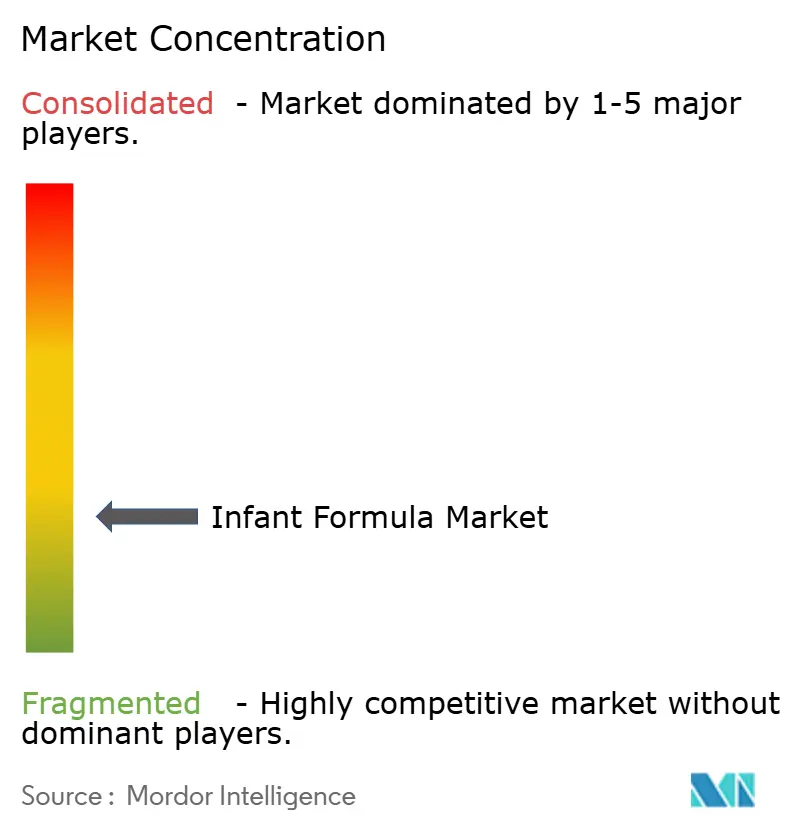
The infant formula market has a low market concentration because Nestlé, Danone, Abbott, Mead Johnson, Yili, China Feihe, and other regional brands compete across a broad group of markets. The largest multinational companies use clinical research, premium portfolio breadth, and supply capacity to compete. Nestlé, Danone, and Abbott with Mead Johnson form the leading global group. Chinese manufacturers such as Yili, China Feihe, and Ausnutria benefit from local regulatory alignment and domestic consumer trust. Competition in the infant formula market is shaped by local compliance as well as global scale.
Feihe offered incentives of CNY 10,000 to CNY 100,000 per child in Hohhot as part of its local consumer strategy. Yili launched Pro-Kido in Hong Kong in May 2025 and cited a 64% reduction in infant bronchitis cases. These actions show the value companies place on locally relevant programs and evidence-led claims. Bobbie represents a different competitive approach in the United States, using supply-chain transparency, USDA Organic certification, and owned manufacturing. Its national Costco expansion in November 2025 placed an organic formula in thousands of additional retail doors.
The infant formula market has room for products that combine substantiated clinical support with transparent sourcing at premium price points outside North America and China. Reckitt’s strategic review of Mead Johnson Nutrition could change the U.S. competitive structure if ownership changes. The company has continued to invest in research, including a 5-year collaboration with Mass General Brigham that began in January 2026. Digital education must comply with expanded World Health Organization rules on the digital marketing of breast-milk substitutes.
Infant Formula Industry Leaders
-
Nestlé S.A.
-
Danone S.A.
-
Abbott Laboratories
-
Yili Group
-
Reckitt Benckiser Group PLC
- *Disclaimer: Major Players sorted in no particular order
Recent Industry Developments
- August 2026: Abbott launched Similac 360 Total Care Made With Whole Milk in the United States. The product is a ready-to-feed liquid infant formula combining whole milk with five human milk oligosaccharides (HMOs).
- March 2026: Little Spoon entered the infant formula market, with its Organic Grass-Fed Whole Milk Infant Formula. The product launch expanded the company's portfolio into infant nutrition, emphasizing organic ingredients, product safety, and transparency. The company also highlighted independent batch testing for more than 500 potential toxins and contaminants and plans to disclose batch-level testing results.
- February 2026: Munchkin announced its entry into the infant formula market with two products: Munchkin Infant Formula Original and Munchkin Infant Formula Made with Organic Milk. The formulations feature a patented blend of proteins, fats, and carbohydrates designed to more closely resemble breast milk. The organic variant uses USDA-certified organic milk sourced from New Zealand.
- February 2025: Kabrita launched its goat milk-based infant formula in Canada for babies aged 0–12 months after receiving approval from Health Canada. Available in 400 g and 800 g canisters, the formula contains 25 vitamins and minerals, DHA, ARA, and prebiotics. The launch expanded Kabrita’s infant nutrition portfolio in the Canadian market.
Global Infant Formula Market Report Scope
The infant formula market is segmented by type into infant milk formula (0–6 months), follow-up milk formula (6–12 months), growing-up milk formula (12+ months), and specialty formulas. By category, the market is divided into standard, premium, and therapeutic products. By nature, the market is classified into conventional and organic formulas, while by form, it is segmented into powder and liquid. By distribution channel, the market is categorized into supermarkets/hypermarkets, pharmacies and drug stores, online retail stores, and other distribution channels. Geographically, the market covers North America, Europe, Asia-Pacific, South America, and the Middle East and Africa. The market sizing has been done in value terms in USD for all the abovementioned segments.
| Infant Milk Formula (0-6 Months) |
| Follow-Up Milk Formula (6-12 Months) |
| Growing-Up Milk Formula (12+ Months) |
| Specialty Formulas |
| Standard |
| Premium |
| Therapeutic |
| Conventional |
| Organic |
| Powder |
| Liquid |
| Supermarkets/Hypermarkets |
| Pharmacies and Drug Stores |
| Online Retail Stores |
| Other Distribution Channels |
| North America | United States |
| Canada | |
| Mexico | |
| Rest of North America | |
| Europe | Germany |
| United Kingdom | |
| France | |
| Italy | |
| Spain | |
| Netherlands | |
| Sweden | |
| Poland | |
| Belgium | |
| Rest of Europe | |
| Asia-Pacific | China |
| India | |
| Japan | |
| Australia | |
| South Korea | |
| Vietnam | |
| Indonesia | |
| Rest of Asia-Pacific | |
| South America | Brazil |
| Argentina | |
| Chile | |
| Peru | |
| Colombia | |
| Rest of South America | |
| Middle East and Africa | United Arab Emirates |
| Saudi Arabia | |
| South Africa | |
| Nigeria | |
| Rest of Middle East and Africa |
| By Type | Infant Milk Formula (0-6 Months) | |
| Follow-Up Milk Formula (6-12 Months) | ||
| Growing-Up Milk Formula (12+ Months) | ||
| Specialty Formulas | ||
| By Category | Standard | |
| Premium | ||
| Therapeutic | ||
| By Nature | Conventional | |
| Organic | ||
| By Form | Powder | |
| Liquid | ||
| By Distribution Channels | Supermarkets/Hypermarkets | |
| Pharmacies and Drug Stores | ||
| Online Retail Stores | ||
| Other Distribution Channels | ||
| By Geography | North America | United States |
| Canada | ||
| Mexico | ||
| Rest of North America | ||
| Europe | Germany | |
| United Kingdom | ||
| France | ||
| Italy | ||
| Spain | ||
| Netherlands | ||
| Sweden | ||
| Poland | ||
| Belgium | ||
| Rest of Europe | ||
| Asia-Pacific | China | |
| India | ||
| Japan | ||
| Australia | ||
| South Korea | ||
| Vietnam | ||
| Indonesia | ||
| Rest of Asia-Pacific | ||
| South America | Brazil | |
| Argentina | ||
| Chile | ||
| Peru | ||
| Colombia | ||
| Rest of South America | ||
| Middle East and Africa | United Arab Emirates | |
| Saudi Arabia | ||
| South Africa | ||
| Nigeria | ||
| Rest of Middle East and Africa | ||
Key Questions Answered in the Report
What is the forecast growth rate for infant formula through 2032?
The infant formula market is projected to grow at a 3.91% CAGR from 2027 to 2032, reaching USD 66.05 billion.
Which infant formula type is growing the fastest?
Growing-Up Milk Formula is projected to grow at a 5.35% CAGR through 2032 and held 45.36% of value in 2026.
Why is premium infant formula important?
Premium Formula held 56.48% of value in 2026, reflecting demand for ingredient quality, clinical support, and functional benefits.
What is driving demand for organic infant formula?
Organic Formula is projected to grow at a 6.11% CAGR through 2032, supported by interest in certified ingredients and wider retail availability.