
Industrial Fans Market Size and Share
Market Overview
| Study Period | 2021 - 2031 |
|---|---|
| Market Size (2026) | USD 7.24 Billion |
| Market Size (2031) | USD 9.31 Billion |
| Growth Rate (2026 - 2031) | 5.15 % |
| Fastest Growing Market | Asia-Pacific |
| Largest Market | Asia-Pacific |
| Market Concentration | Medium |
Major Players *Disclaimer: Major Players sorted in no particular order Image © Mordor Intelligence. Reuse requires attribution under CC BY 4.0. | |
Industrial Fans Market Analysis by Mordor Intelligence
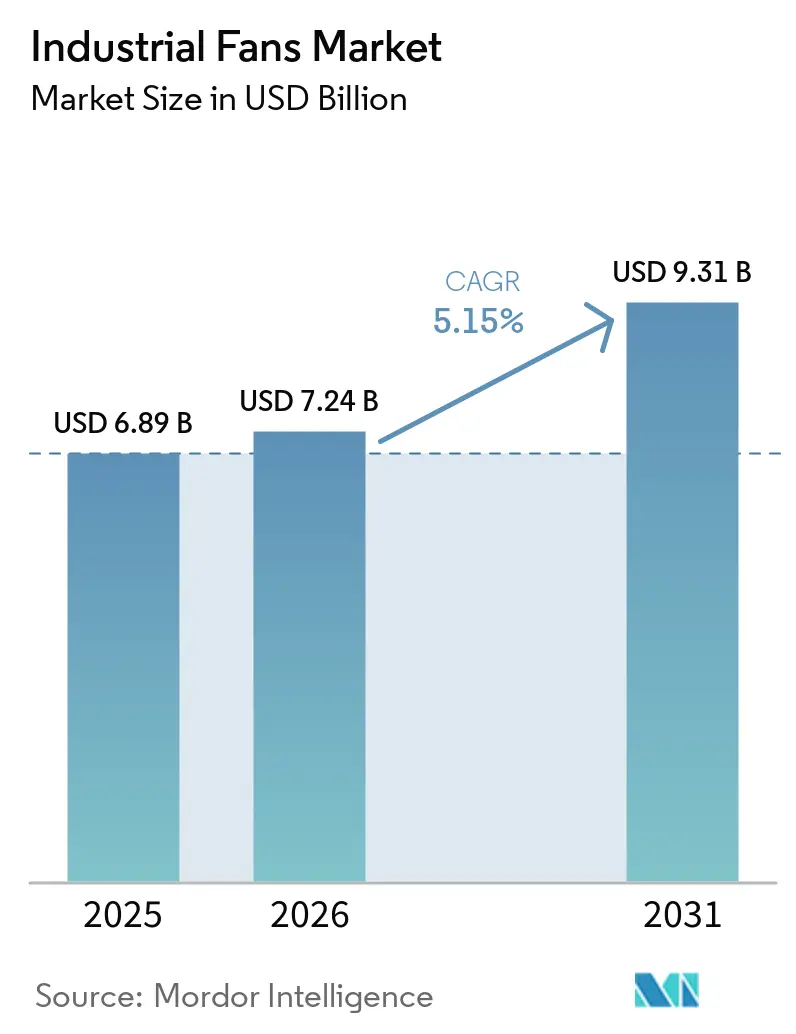
The Industrial Fans Market size is projected to expand from USD 6.89 billion in 2025 and USD 7.24 billion in 2026 to USD 9.31 billion by 2031, at a CAGR of 5.15% during 2026–2031. The industrial fans market is supported by investment in manufacturing, mining, cement, power, and process facilities, where ventilation and process-air equipment are necessary for daily operations. Energy rules are creating a replacement cycle in Europe, while new factories and infrastructure projects support installations in the Asia-Pacific. Buyers are also placing more value on operating efficiency, system monitoring, and service support when replacing equipment. The industrial fans market benefits from its broad end-user base, which helps limit the effect of weakness in any one capital-intensive sector. Technology suppliers are responding through acquisitions, regional manufacturing investment, and products suited to data-center cooling and industrial automation.
Key Report Takeaways
- By fan type, centrifugal fans held 57.2% of the industrial fans market share in 2025, while mixed flow fans are projected to grow at a 6.4% CAGR through 2031.
- By application, ventilation accounted for 41.5% of global revenue in 2025, while dust collection is projected to grow at a 5.9% CAGR through 2031.
- By end user, manufacturing held 27.3% of global revenue in 2025, while water and wastewater treatment is projected to grow at a 6.8% CAGR through 2031.
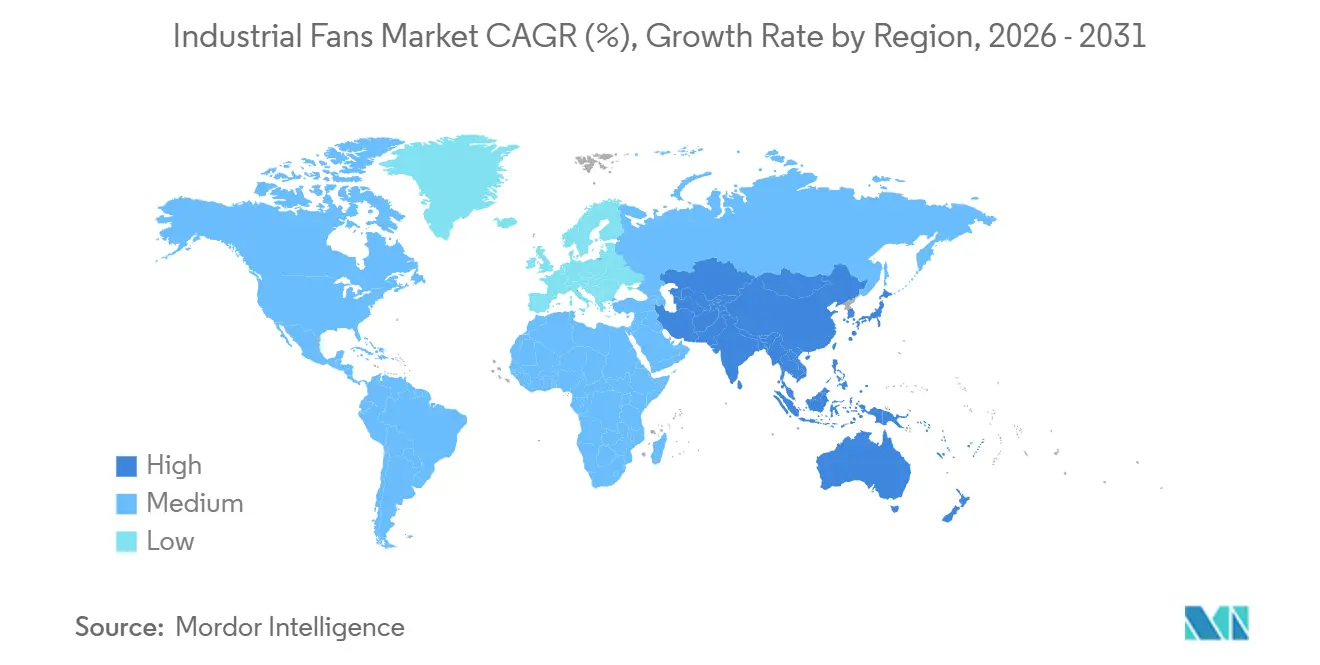
- By geography, Asia-Pacific accounted for 43.1% of global revenue in 2025 and is projected to expand at a 7.1% CAGR through 2031.
Note: Market size and forecast figures in this report are generated using Mordor Intelligence’s proprietary estimation framework, updated with the latest available data and insights as of January 2026.
Global Industrial Fans Market Trends and Insights
Drivers Impact Analysis*
| Driver | (~) % Impact on CAGR Forecast | Geographic Relevance | Impact Timeline |
|---|---|---|---|
| Industrial Energy-Efficiency Mandates | +1.20% | Global; acute near-term enforcement in EU, accelerating uptake in APAC | Medium term (2–4 years) |
| Industrialization and Manufacturing Expansion in Emerging Economies | +1.30% | APAC core (India, Vietnam, Indonesia), spill-over to MEA and South America | Long term (≥ 4 years) |
| Air-Quality, Worker-Safety, and Emissions Compliance | +0.80% | North America, EU, APAC (China, India) | Medium term (2–4 years) |
| Smart Ventilation and Industrial Automation Adoption | +0.70% | Global; early leadership in North America and EU, accelerating in APAC | Medium term (2–4 years) |
| Retrofit Demand from Electrification and Variable-Speed Drive Upgrades | +0.60% | EU, North America, with growing activity in APAC industrial corridors | Medium term (2–4 years) |
| Fan-System Optimization for Process Heat and Dust-Load Variability | +0.40% | APAC, MEA, South America (process-intensive industries) | Long term (≥ 4 years) |
| Source: Mordor Intelligence | |||
Industrial Energy-Efficiency Mandates
Energy regulations are becoming a central factor in industrial fan procurement and replacement planning. EU Ecodesign Regulation EU/2024/1834 applies from July 24, 2026, to fans in the 125 W to 500 kW range[1]. The regulation sets updated efficiency requirements, requires part-load performance information, and includes repairability provisions. The European Commission stated that the rules could reduce electricity use from industrial fans in the European Union by 31 TWh annually by 2030 and deliver EUR 4 billion in annual business savings. Manufacturers now need reliable performance documentation, which favors suppliers that can support product selection, compliance records, and aftermarket parts. The industrial fans market, therefore, has a clearer replacement path in Europe as users assess older units against new operating and documentation requirements.
Air Quality, Worker Safety, and Emissions Compliance
Air-quality and worker-safety requirements support demand for dust extraction, exhaust, and process ventilation equipment. Mining, cement, chemical, and metals facilities need fan systems that manage dust-laden air and support safer operating conditions. The industrial fans market gains from these needs because upgrades are often tied to compliance deadlines rather than optional capacity expansion. Centrifugal equipment remains important in these settings because it is suited to high static pressure, variable process loads, and difficult air streams. In the United States, the cited silica rule strengthens the case for improved mine ventilation and dust-control systems. This regulatory need also supports replacement demand where installed equipment cannot meet the required airflow, filtration, or extraction performance.
Smart Ventilation and Industrial Automation Adoption
Connected fan systems are moving ventilation from a fixed utility function toward a monitored process function. Vibration monitoring, airflow sensing, and predictive-maintenance alerts can help operators identify performance issues before they interrupt production. A 10% reduction in fan speed can reduce power draw by 27% under the fan affinity relationship cited in the source material. Danfoss states that its FC 102 variable frequency drive uses pressure sensor data to adjust air-handling-unit fan output to actual demand[2]. Such controls can provide a clearer operating case for equipment upgrades, especially where airflow demand changes during the day. The industrial fans market also gains from a larger service opportunity as suppliers offer monitoring, maintenance, and performance support alongside hardware.
Retrofit Demand from Electrification and Variable-Speed Drive Upgrades
Electrification programs are encouraging facilities to review motor fleets and related fan assemblies. Many existing installations were designed for constant-speed, full-load operation, even when the real airflow requirement varies. Variable frequency drives and direct-drive electronically commutated fans can reduce power use when a process does not require full-speed operation. The source material noted that fan and pump retrofit payback periods can fall below 3 years in suitable applications. Cement, power generation, and pulp and paper sites are relevant because their fans often operate continuously at changing duty levels. This pattern supports the industrial fans market by bringing forward replacement decisions for equipment that remains mechanically functional but is inefficient to operate.
Restraints Impact Analysis*
| Restraint | (~) % Impact on CAGR Forecast | Geographic Relevance | Impact Timeline |
|---|---|---|---|
| High Initial Cost of Advanced Fan Systems and Installation | -0.90% | Global; most acute in price-sensitive markets of South and Southeast Asia, South America | Short to medium term (≤ 4 years) |
| Raw-Material Price Volatility and Supply Risk | -0.60% | Global; US and EU most exposed given tariff-driven cost escalation in steel and aluminium | Short term (≤ 2 years) |
| Harsh-Environment Fouling and Maintenance Downtime | -0.40% | APAC, MEA, South America (mining, cement, high-dust environments) | Long term (≥ 4 years) |
| Performance Trade-offs from Noise, Explosion-Proofing, and Space Constraints | -0.30% | North America, EU (regulated pharmaceutical, chemical, food and beverage sites) | Long term (≥ 4 years) |
| Source: Mordor Intelligence | |||
High Initial Cost of Advanced Fan Systems and Installation
Advanced systems with variable frequency drives, sensors, and electronically commutated motors require more upfront capital than conventional induction-motor alternatives. The expense can delay replacement decisions at smaller industrial facilities, even when operating savings support the business case. The issue is especially material for explosion-proof and corrosion-resistant models used in chemical, petrochemical, and offshore settings. These designs require specialized materials and certifications, which increase equipment and installation costs. Financing arrangements for energy-efficiency projects can reduce this barrier, but their availability remains uneven across regions. The industrial fans market can therefore face slower adoption of premium systems where users focus on initial purchase price rather than total operating cost.
Raw-Material Price Volatility and Supply Risk
Steel, aluminum, and copper are important inputs for housings, impellers, blades, and motors. Changes in material prices can compress manufacturer margins and make project quotations harder to hold over long procurement cycles. Reuters reported that anticipated United States tariff changes in 2025 raised concern over metal input costs for manufacturers. Supply disruptions can have similar effects when producers rely heavily on a limited number of sourcing locations. Manufacturers with suppliers in multiple regions can manage these risks more effectively than companies dependent on a single source. The industrial fans market may therefore see uneven pricing and longer purchase decisions when metal costs or trade rules change quickly.
*Our forecasts treat driver/restraint impacts as directional, not additive. The impact forecasts reflect baseline growth, mix effects, and variable interactions.
Segment Analysis
By Fan Type: Centrifugal Fans Retain Broad Process Demand While Mixed Flow Fans Gain Data-Center Use
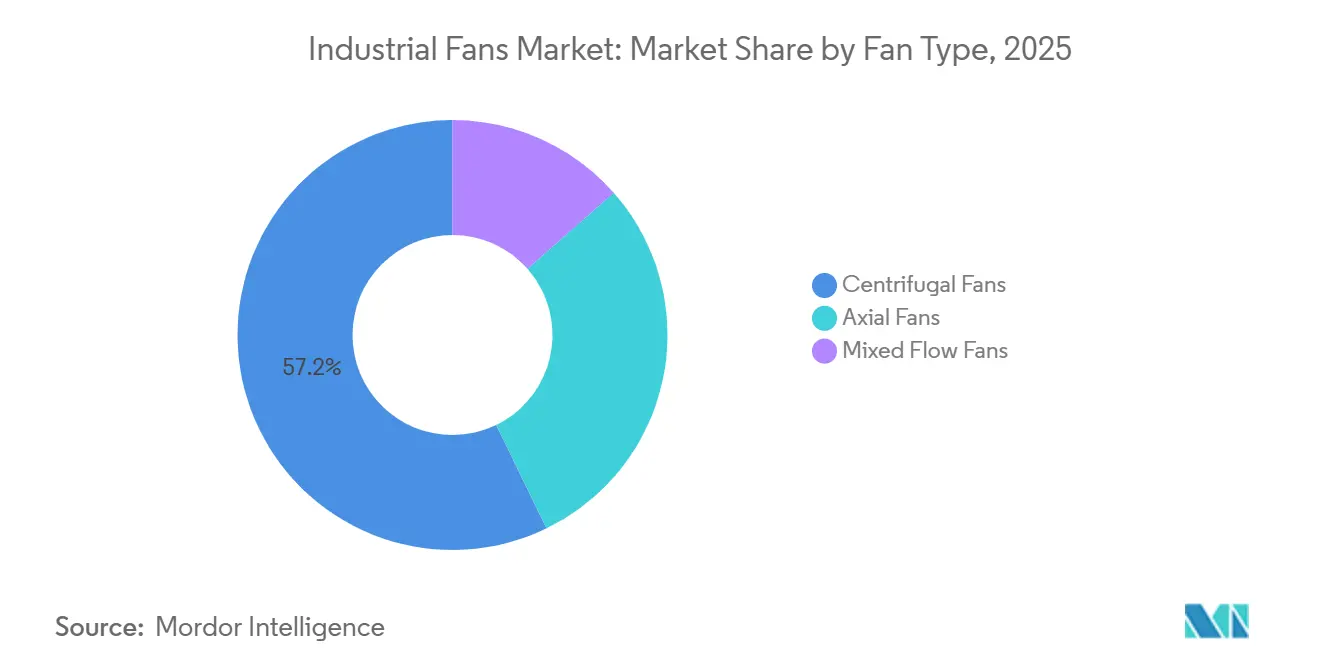
Centrifugal fans accounted for 57.2% of the industrial fans market in 2025. Their position reflects use in high-pressure, dust-laden, and high-temperature applications, including cement kiln induced-draft systems, chemical scrubber exhausts, and boiler forced-draft circuits. World Cement identifies dust load, high temperature, and process variation as key challenges for cement-plant fans[3]. These conditions require equipment that can maintain performance under demanding operating requirements. The industrial fans market continues to rely on centrifugal designs where simpler alternatives cannot meet the required pressure or process conditions.
Axial fans remain useful for lower-pressure, high-volume duties such as mine ventilation, cooling towers, and large-area air supply, while price competition remains strong in standard product categories. Mixed flow fans are the fastest-growing fan type, with the industrial fans market size for this segment forecast to grow at a 6.4% CAGR through 2031. They combine high volumetric flow with moderate pressure rise, which suits hot-aisle containment and other data-center cooling layouts. ebm-papst is developing motor-integrated fan products for data-center cooling applications and is expanding production capacity in India[4]. New European efficiency requirements also favor fan designs that perform well at part load and work with variable-speed control.

By Application: Ventilation Supports Installed Demand While Dust Collection Gains from Compliance Needs
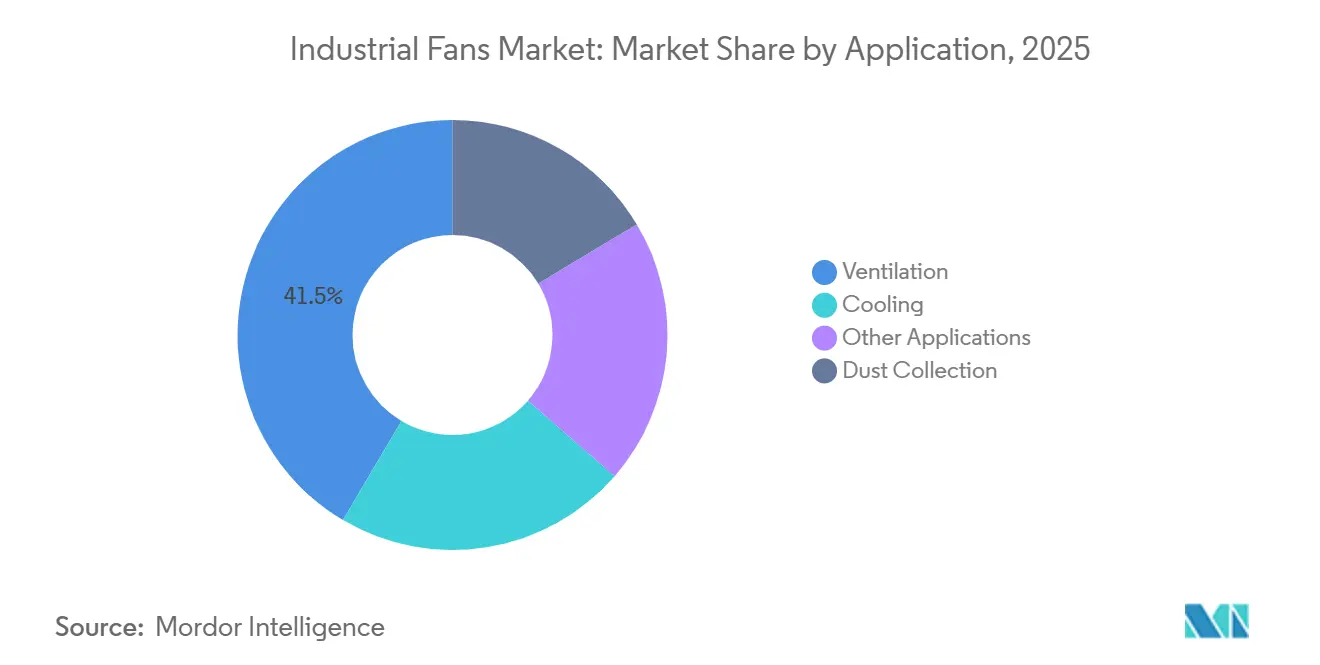
Ventilation retained 41.5% of the global industrial fans market in 2025. Its large role reflects the need to supply and exhaust air across manufacturing, process, mining, and commercial-industrial facilities, where occupational health and safety requirements make core ventilation a continuing operating requirement. Cooling is the second-largest application, with demand from data centers, power generation, and food processing. These uses require dependable thermal management and, in some cases, redundancy and remote diagnostics. The industrial fans market is supported by this mix of essential ventilation and cooling duties across varied facility types.
Dust collection is the fastest-growing application and is projected to advance at a 5.9% CAGR through 2031. The segment is supported by demand for process exhaust and particle-control equipment in mining, cement, and metals operations, where legacy systems may not provide the required airflow or pressure. Process air supply and pneumatic conveying provide additional demand, although they represent a more stable portion of application use. Dust collection demand is supported by a need for reliable operation under difficult air conditions. This demand is less dependent on discretionary spending because ventilation and extraction are linked to safe process operation.
By End User: Manufacturing Leads While Water and Wastewater Treatment Expands Faster
Manufacturing held 27.3% of the industrial fans market in 2025. Factory construction and capacity additions require both axial and centrifugal equipment across different process conditions, including automotive, electronics, textile, pharmaceutical, and general manufacturing facilities. Manufacturing demand is also spread across multiple countries rather than concentrated in a single industrial center. This breadth helps the industrial fans market maintain demand across a wide set of factory investments. It also supports both original equipment sales and replacements as installed equipment ages.
Water and wastewater treatment is the fastest-growing end-user category, forecast to grow at a 6.8% CAGR through 2031. Aeration is an important energy use within treatment operations, which increases interest in efficient fans and blowers. Utilities have a practical reason to assess energy use and equipment reliability when planning upgrades, especially where aeration systems operate continuously. Mining, cement, metals and steel remain important process-intensive end users, while food and beverage and pharmaceutical facilities need specialized hygienic or cleanroom ventilation. This range of users gives the industrial fans market a diversified demand base rather than reliance on one end-use sector.
Geography Analysis
Asia-Pacific held 43.1% of the industrial fans market share in 2025 and is forecast to grow at a 7.1% CAGR through 2031. The region combines a large industrial base with new manufacturing and infrastructure activity, and China supports volume demand through cement, steel, chemical, and manufacturing operations. India adds demand from cement, steel, power, pharmaceutical, and chemical projects. Vietnam, Indonesia, and Thailand also receive manufacturing investment across electronics, food processing, and textiles. The industrial fans market in Asia-Pacific, therefore, includes both first-time installations and upgrades of older systems.
North America is the second-largest regional market. Its demand is supported by retrofit and aftermarket activity in established industrial facilities, including cooling tower and air-cooled heat-exchanger applications in petrochemical refining and power generation. Howden began production at a North American blade facility in 2026, indicating a commitment to regional supply for these customer groups. Europe is characterized by compliance-led replacement activity under the Ecodesign framework. The industrial fans market size in Europe benefits as operators consider fan efficiency, part-load performance, product documentation, and parts availability in replacement planning.
South America and the Middle East and Africa are smaller regional opportunities, but they remain relevant to suppliers serving process industries. Brazil supports demand through pulp and paper, mining, and food processing, while Chile and Argentina add mining-related requirements, and Saudi Arabia and the United Arab Emirates are developing petrochemical, refinery, desalination, factory, and infrastructure projects, and Systemair stated that its Saudi Arabia factory became operational in late 2025, supporting its local position in the region. South Africa, Morocco, and Egypt provide African demand through mining and expanding manufacturing activity. The industrial fans market in these areas depends heavily on local service capability, product fit for harsh conditions, and access to regional supply.
Competitive Landscape
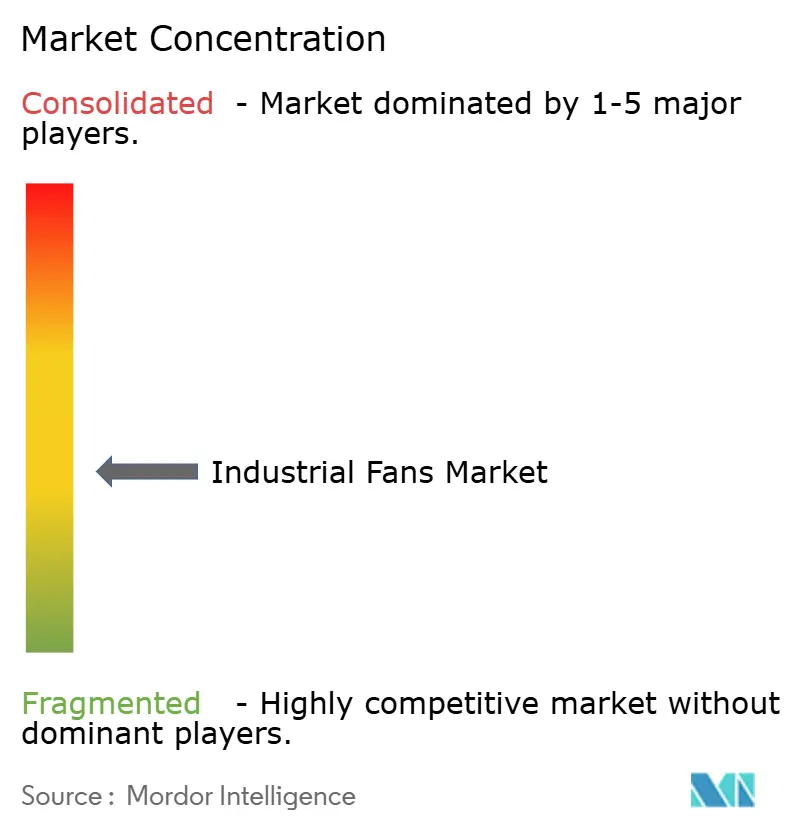
The industrial fans market is moderately fragmented, with global manufacturers and regional specialists serving different fan types, applications, and end users. Engineering capability, custom fabrication, and application knowledge are important in large axial and centrifugal systems, while competition is broader in commercial and light-industrial equipment with more standardized products. The industrial fans market has seen consolidation as larger groups acquire air-handling businesses with established customer bases. Samsung Electronics completed its EUR 1.5 billion acquisition of FläktGroup in November 2025. Baker Hughes completed the acquisition of Chart Industries in 2026, bringing Howden's industrial fan business into its Energy Technology segment.
Manufacturers are also adding capacity in regions where industrial demand is expanding. ebm-papst began building a Chennai facility in April 2025, with a first-phase investment of EUR 36 million and a plan to increase Indian production capacity. Ziehl-Abegg announced EUR 90 million in additional investment for machinery, tools, and capacity in Europe, North America, and Asia in January 2026. The industrial fans market rewards suppliers that combine efficiency performance, local manufacturing, and after-sales support, as customers give more attention to energy use and maintenance needs. Compliance documentation can also favor companies that have the technical resources to meet European product requirements.
Targeted acquisitions are another way to expand regional coverage. Systemair acquired NADI Airtechnics in India in August 2025 and Temspec in Canada in July 2026, expanding product and customer coverage without requiring entirely new operating platforms. TLT-Turbo Africa introduced its SMART Fan for mining, aimed at real-time underground ventilation management, while the industrial fans market still has room for service-led growth in Africa and South Asia, where field-service networks are less developed.
Industrial Fans Industry Leaders
-
Greenheck Fan Corporation
-
Systemair AB
-
Chart Industries, Inc.
-
ebm-papst Group
-
Twin City Fan Companies, Ltd.
- *Disclaimer: Major Players sorted in no particular order
Recent Industry Developments
- July 2026: Baker Hughes completed its acquisition of Chart Industries, which encompasses Howden, a manufacturer of large industrial fans and compressors for heavy industry and energy applications. Howden operates as a standalone business unit within Baker Hughes' Energy Technology segment, maintaining its leadership team and commercial focus. Its fan and compressor portfolio serves heavy industrial and energy applications where equipment reliability and technical service are material customer requirements. The deal places Howden's industrial fan portfolio alongside Baker Hughes' global oilfield services network, opening cross-selling potential in upstream energy ventilation and process air applications.
- July 2026: Systemair AB acquired Temspec Incorporated, a Mississauga, Canada-based designer and manufacturer of decentralized HVAC equipment, effective July 23, 2026. The deal integrates Temspec, which employs 90 people and posted revenue of CAD 29 million in its most recent fiscal year, into Systemair's North American operations. It also gives Systemair a specialized, decentralized HVAC product line for the Canadian school-building segment. The acquisition brought Systemair's combined North American workforce to 645 employees and positioned the company as a leading Canadian ventilation supplier for school buildings.
- July 2026: EU Ecodesign Regulation EU/2024/1834 officially took effect on July 24, 2026, replacing the 2011 regime and covering standalone industrial fans in the 125 W to 500 kW range. The regulation requires updated efficiency thresholds, part-load performance data, and repairability requirements. It also changes the information that manufacturers, system integrators, and buyers must use in product selection and compliance review. The European Commission estimated that the regulation could cut European Union electricity consumption from industrial fans by 31 TWh each year by 2030, with EUR 4 billion in annual savings for businesses.
- June 2026: Ziehl-Abegg announced EUR 90 million in additional investment in machinery, tooling, and production capacity across facilities in Europe, North America, and Asia. The investment responds to demand from data-center applications and building heat-pump retrofits. The company said the capacity program covers facilities in Europe, North America, and Asia, which reflects the geographic breadth of the applications it serves. It described capacity constraints linked to high demand and reported that several German facilities and its Chinese plant were operating three shifts when the investment was announced.
Global Industrial Fans Market Report Scope
Industrial fans are mechanical air-moving devices designed to generate high volumes of airflow or pressure for industrial, commercial, and infrastructure applications. They are used to ventilate facilities, cool equipment, remove dust and fumes, dry materials, transport air or gases, and maintain safe and efficient operating conditions. Industrial fans are engineered to operate continuously in demanding environments and are available in various configurations, including axial fans, centrifugal fans, and mixed-flow fans, depending on airflow, pressure, and application requirements.
The Global Industrial Fans Market is segmented by fan type, application, end user, and geography. By fan type, the market is segmented into axial fans, centrifugal fans, and mixed flow fans. By application, the market is segmented into ventilation, cooling, dust collection, and other applications. By end user, the market is segmented into manufacturing, mining, cement, power, chemicals, oil and gas, metals, food and beverage, pharmaceuticals, water and wastewater, and other end-user industries. The report also covers the market size and forecasts for the global industrial fans market across 26 countries in key regions. For each segment, the market sizing and forecasts have been provided on the basis of value (USD).
| Axial Fans |
| Centrifugal Fans |
| Mixed Flow Fans |
| Ventilation |
| Cooling |
| Dust Collection |
| Other Applications |
| Manufacturing |
| Mining and Minerals |
| Cement |
| Power Generation |
| Chemicals and Petrochemicals |
| Oil and Gas |
| Metals and Steel |
| Food and Beverage |
| Pulp and Paper |
| Pharmaceuticals |
| Water and Wastewater Treatment |
| Other End-Use Industries |
| North America | United States |
| Canada | |
| Mexico | |
| Europe | Germany |
| France | |
| Italy | |
| Spain | |
| United Kingdom | |
| Poland | |
| Russia | |
| Rest of Europe | |
| Asia-Pacific | China |
| India | |
| Japan | |
| South Korea | |
| Australia | |
| Indonesia | |
| Vietnam | |
| Thailand | |
| Rest of Asia-Pacific | |
| South America | Brazil |
| Argentina | |
| Chile | |
| Rest of South America | |
| Middle East and Africa | Saudi Arabia |
| United Arab Emirates | |
| Egypt | |
| South Africa | |
| Morocco | |
| Rest of Middle East and Africa |
| By Fan Type | Axial Fans | |
| Centrifugal Fans | ||
| Mixed Flow Fans | ||
| By Application | Ventilation | |
| Cooling | ||
| Dust Collection | ||
| Other Applications | ||
| By End User | Manufacturing | |
| Mining and Minerals | ||
| Cement | ||
| Power Generation | ||
| Chemicals and Petrochemicals | ||
| Oil and Gas | ||
| Metals and Steel | ||
| Food and Beverage | ||
| Pulp and Paper | ||
| Pharmaceuticals | ||
| Water and Wastewater Treatment | ||
| Other End-Use Industries | ||
| By Geography | North America | United States |
| Canada | ||
| Mexico | ||
| Europe | Germany | |
| France | ||
| Italy | ||
| Spain | ||
| United Kingdom | ||
| Poland | ||
| Russia | ||
| Rest of Europe | ||
| Asia-Pacific | China | |
| India | ||
| Japan | ||
| South Korea | ||
| Australia | ||
| Indonesia | ||
| Vietnam | ||
| Thailand | ||
| Rest of Asia-Pacific | ||
| South America | Brazil | |
| Argentina | ||
| Chile | ||
| Rest of South America | ||
| Middle East and Africa | Saudi Arabia | |
| United Arab Emirates | ||
| Egypt | ||
| South Africa | ||
| Morocco | ||
| Rest of Middle East and Africa | ||
Key Questions Answered in the Report
What is the projected value of the industrial fans market by 2031?
The industrial fans market is forecast to reach USD 9.31 billion by 2031, from USD 7.24 billion in 2026, at a 5.15% CAGR.
Which fan type leads global demand?
Centrifugal fans led with 57.2% share in 2025 because they serve high-pressure, dust-laden, and high-temperature process applications, including cement, chemical, and boiler systems.
Which application is growing fastest?
Dust collection is forecast to grow at a 5.9% CAGR through 2031, supported by process safety and air-quality needs in mining, cement, metals, and other dust-intensive operations.
Which end user is expected to grow fastest?
Water and wastewater treatment is forecast to grow at a 6.8% CAGR through 2031, supported by the need for reliable and efficient aeration systems in municipal and industrial treatment operations.
Which region has the largest industrial fan demand?
Asia-Pacific held 43.1% share in 2025 and is forecast to grow at a 7.1% CAGR through 2031.
How are efficiency regulations affecting fan purchases?
The EU rules effective in 2026 require updated efficiency and part-load information for covered products, which encourages operators to evaluate older fan systems for replacement and gives buyers more usable product-comparison data.