
Commercial Fans Market Size and Share
Market Overview
| Study Period | 2021 - 2031 |
|---|---|
| Market Size (2026) | USD 10.29 Billion |
| Market Size (2031) | USD 13.41 Billion |
| Growth Rate (2026 - 2031) | 5.44 % |
| Fastest Growing Market | Middle East and Africa |
| Largest Market | Asia-Pacific |
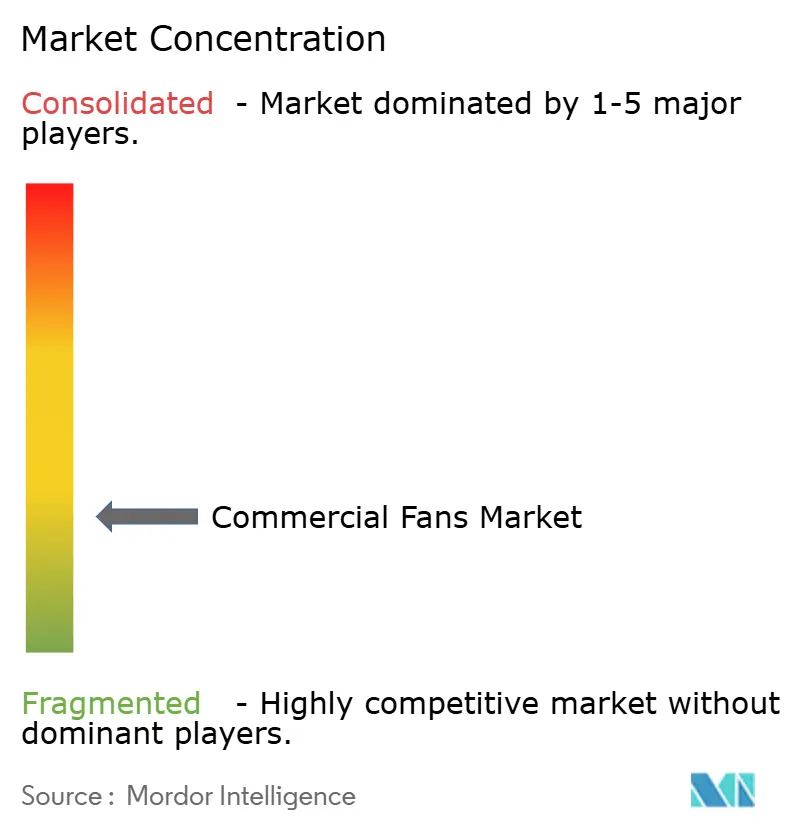
| Market Concentration | Low |
Major Players *Disclaimer: Major Players sorted in no particular order Image © Mordor Intelligence. Reuse requires attribution under CC BY 4.0. | |
Commercial Fans Market Analysis by Mordor Intelligence
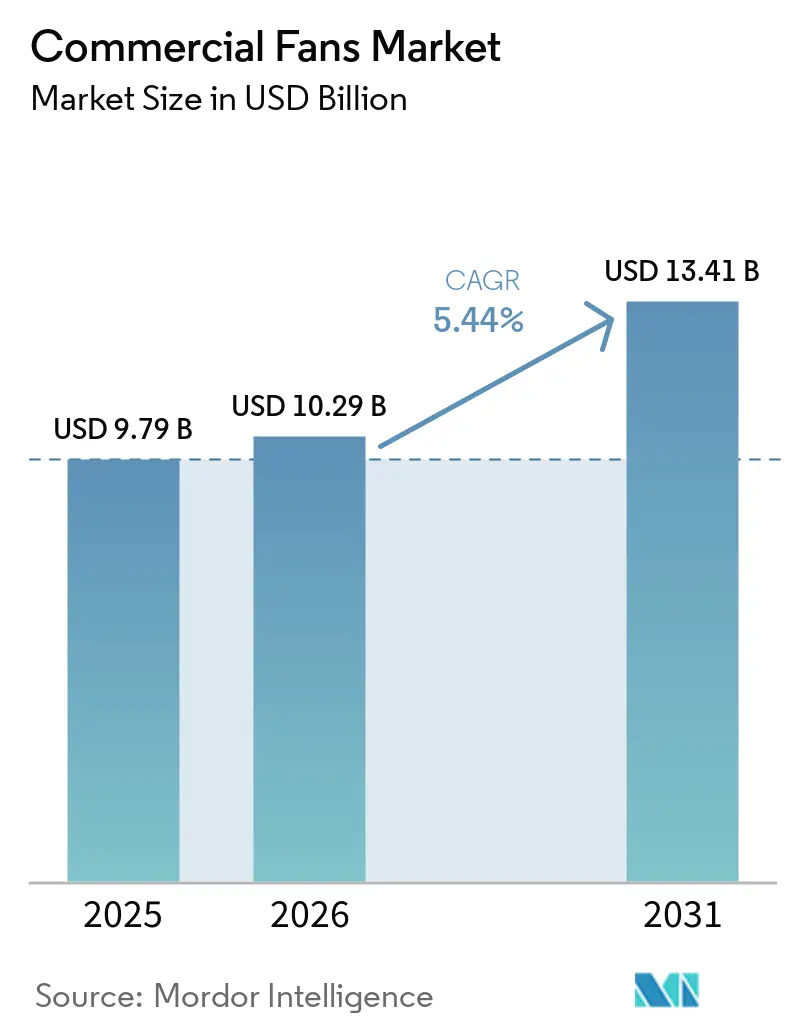
The Commercial Fans Market size is expected to grow from USD 9.79 billion in 2025 to USD 10.29 billion in 2026 and is forecast to reach USD 13.41 billion by 2031 at 5.44% CAGR over 2026-2031. Data center construction, energy rules, and commercial building retrofits support demand for the commercial fans market, while warehouse expansion adds a further equipment need in large operational facilities. Indoor air quality requirements have made airflow performance and compliance more important in purchase decisions throughout the commercial fans market, especially in buildings where ventilation directly affects tenant comfort and facility standards. EC motors and variable-speed controls make older equipment easier to identify as inefficient during energy audits, allowing buyers to compare performance with a clearer operating-cost basis. This increases replacement activity and supports higher-value products in the commercial fans market. Integrated HVAC designs can reduce demand for standalone equipment in some premium new buildings, although they also raise the importance of connected controls and energy performance in the remaining commercial fans market opportunities.
Key Report Takeaways
- By fan type, axial fans held 42.4% of the commercial fans market share in 2025, while mixed-flow fans are projected to grow at a 5.7% CAGR through 2031.
- By application, HVAC and air conditioning accounted for 37.8% of the commercial fans market size in 2025, while cooling and air circulation are projected to grow at a 6.1% CAGR through 2031.
- By end user, office buildings held 20.6% of the commercial fans market share in 2025, while data centers are projected to grow at a 9.6% CAGR through 2031.
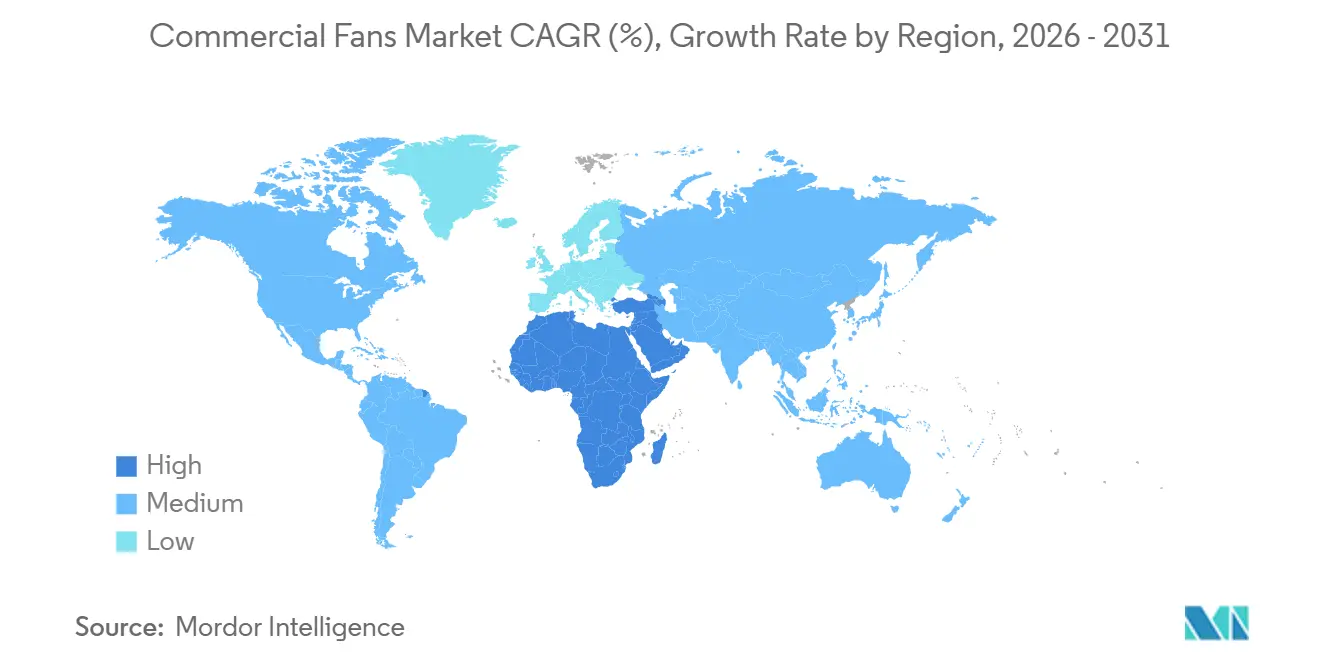
- By geography, Asia-Pacific held 42.1% of the commercial fans market in 2025, while the Middle East and Africa are projected to expand at a 5.9% CAGR through 2031.
Note: Market size and forecast figures in this report are generated using Mordor Intelligence’s proprietary estimation framework, updated with the latest available data and insights as of January 2026.
Market Trends and Insights
Drivers Impact Analysis of Commercial Fans Market*
| Driver | (~) % Impact on CAGR Forecast | Geographic Relevance | Impact Timeline |
|---|---|---|---|
| Expansion of Data Center and AI Cooling Infrastructure | +1.80% | Global - concentrated in North America, APAC, and MEA giga-project corridors | Short term (≤ 2 years) |
| Commercial Building Ventilation and HVAC Retrofit Demand | +0.90% | North America & Europe (aging stock); APAC as secondary | Medium term (2–4 years) |
| Energy-Efficiency and Indoor-Air-Quality Regulations | +0.70% | Europe (ErP2026 primary); North America (FEI/ASHRAE); APAC spill-over | Medium term (2–4 years) |
| Industrialization and Expansion of Warehouses and Distribution Centers | +0.60% | Global - highest intensity in North America, China, India, and Poland | Short to medium term |
| Modular Fan-Wall Adoption in Brownfield Air-Handling Units | +0.50% | North America & Europe (dense aging AHU base) | Medium to long term |
| Fan-Energy-Index-Based Procurement and Digital Performance Verification | +0.40% | North America (FEI mandates); early gains in EU-aligned markets | Long term (≥ 4 years) |
| Source: Mordor Intelligence | |||
Data Center and AI Cooling Infrastructure
Nearly 100 GW of data center capacity is expected to be added globally between 2026 and 2030, which supports a 14% CAGR for the sector. This construction pipeline raises demand for precision EC fans in computer room air-handling units and server-room exhaust systems, particularly in facilities that need dependable thermal control around dense computing equipment. Air cooling remains widely used below 30 kW per rack, which keeps fan demand relevant as liquid cooling expands and allows suppliers to serve both established and upgrading facilities. AI clusters operating above 40 kW per rack also need air-assist equipment before full liquid-cooling retrofits are completed, extending the role of fan systems during an intermediate stage of infrastructure change. Ziehl-Abegg announced an additional EUR 90 million investment, equivalent to USD 103.5 million, in European, U.S., and Asian capacity in June 2026 and identified AI data centers as a key driver. Tight construction capacity in data center projects can favor suppliers that can provide certified products, dependable lead times, and equipment suited to different cooling configurations.
Commercial Building Ventilation and HVAC Retrofit Demand
The commercial fans market benefits from retrofit demand because installed ventilation equipment has a different replacement cycle from new construction and cannot always be deferred when performance or compliance falls short. HVAC systems accounted for 35% to 50% of commercial building energy use, while hospitals and hotels can reach 70%. Standard 62.1-2025 added humidity control, demand-controlled ventilation, and updated exhaust-airflow requirements, which can prompt upgrades where those provisions are adopted, and local codes refer to the standard. Existing buildings also need better ventilation to remain attractive to tenants and comply with current operating expectations, even when broader office demand is weak. Efficient fans can lower operating costs where owners directly pay electricity bills and can document the benefits of lower electricity use. Split incentives can slow upgrades where tenants pay energy costs under legacy leases, especially in multi-tenant properties with limited capital budgets.
Energy Efficiency and Indoor Air Quality Regulations
Regulatory change gives the commercial fans market a replacement driver that is less tied to building starts and is more closely connected to the installed base of noncompliant equipment. EU Ecodesign Regulation 2024/1834 took effect on July 24, 2026, and applies to fans with motor input power from 125 W to 500 kW[1]. The rules require revised efficiency thresholds, part-load information, and spare-parts provisions, which change both product design and the information available to purchasers. The European Commission expects the measure to cut industrial-fan electricity use by 31 TWh each year by 2030 and save consumers and businesses EUR 4 billion annually. In North America, the Fan Energy Index has been incorporated into ASHRAE 90.1 since 2019 and the International Energy Conservation Code since 2021, with 400 project-level occurrences reported in 2024[2]. Certified performance can therefore influence product selection in the commercial fans market and strengthen the position of suppliers able to meet specification requirements.
Warehouses, Modular Fan Walls, and Digital Verification
Warehouse construction, supply-chain changes, and automated distribution facilities support demand for large-format circulation and exhaust equipment in the commercial fans market. These sites have added heat loads from conveyors, robotic picking, and charging equipment, which require active ventilation rather than relying only on building infiltration or conventional comfort systems. High-volume, low-speed fans are widely used in facilities larger than 50,000 square feet, and a redesigned Greenheck model achieved Ceiling Fan Energy Index results up to 83% above minimum U.S. Department of Energy requirements. Modular fan walls can also suit brownfield air-handling units where access, redundancy, and staged replacement matter to operators. Fan Energy Index procurement and digital performance checks can make inefficient products less competitive over time because purchasing teams can compare documented operating performance. These practices are likely to matter most where building owners have mature energy reporting processes and use operating data to support investment decisions.
Restraints Impact Analysis of Commercial Fans Market*
| Restraint | (~) % Impact on CAGR Forecast | Geographic Relevance | Impact Timeline |
|---|---|---|---|
| High Upfront Cost of Advanced Energy-Efficient Fan Systems | -0.80% | Global - most acute in price-sensitive emerging markets | Short to medium term |
| Availability of Integrated HVAC and Alternative Air-Movement Technologies | -0.50% | North America & Europe (high VRF/chilled-beam penetration in premium new build) | Medium to long term |
| Structural and Clearance Constraints for High-Volume Low-Speed Fan Retrofits | -0.30% | North America & Europe (dense urban commercial stock with low ceiling clearances) | Medium term (2–4 years) |
| Rare-Earth Magnet and Specialty-Alloy Supply Exposure | -0.40% | Global - most acute in North America and Europe dependent on non-China sourcing | Short term (≤ 2 years) |
| Source: Mordor Intelligence | |||
High Upfront Cost of Advanced Energy-Efficient Fan Systems
EC-motor fans can cost 30% to 60% more than induction-motor alternatives at purchase, creating an immediate barrier even when the operating cost is favorable. This price gap limits adoption by smaller owners and buyers focused on initial budgets, particularly in markets where capital approvals are separated from energy management. Utility rebates can offset 20% to 30% of qualifying upgrade costs, but access varies by location, and program administration can be difficult for operators without dedicated energy teams. Legacy lease structures weaken the owner's incentive when tenants bear electricity costs, leaving the buyer without a direct share of the potential savings. Differences in electricity tariffs also make a common procurement case harder to prepare across countries and building portfolios. Low structural clearances can further limit high-volume, low-speed fan retrofits in older urban buildings, even where operating economics support an upgrade.
Availability of Integrated HVAC and Alternative Air-Movement Technologies
Variable refrigerant flow, chilled beams, and dedicated outdoor-air systems can reduce standalone fan content in premium buildings because air volumes are managed through the larger HVAC design. These systems manage air volumes through integrated equipment rather than supplemental fan arrays, which changes the mix of products purchased for a new project. Fan-coil units with embedded EC motors can also serve applications once addressed by standalone centrifugal or axial units. The effect is strongest in new offices and hospitality projects where systems are selected early in the design process and are often supplied as an integrated package. Bundled HVAC contracts can restrict aftermarket access for specialist fan suppliers and make it harder to separate fan purchases from wider system decisions. Rare-earth magnets remain a separate supply concern because China accounted for 90% of permanent magnet production, and export licensing restrictions disrupted supply chains in 2025.
*Our forecasts treat driver/restraint impacts as directional, not additive. The impact forecasts reflect baseline growth, mix effects, and variable interactions.
Commercial Fans Market Segment Analysis
By Fan Type:
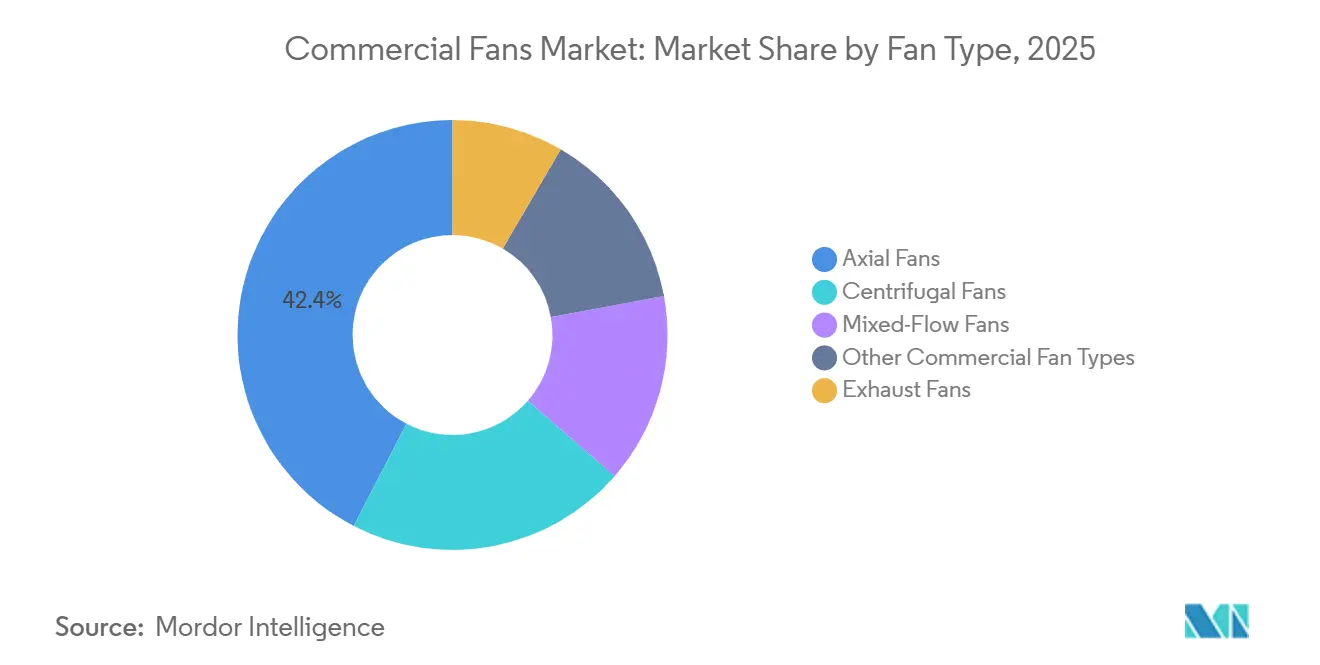
Axial Fans Lead, Mixed-Flow Technology Closes the GapAxial fans held 42.4% of the commercial fans market in 2025. Their cost and performance suit low-to-medium static-pressure work in HVAC distribution, rooftop exhaust, and warehouse circulation, where broad deployment supports repeat replacement demand. Centrifugal fans remain important in ducted systems that need higher pressure and a stable operating profile. Their larger footprint and energy use face greater scrutiny as building rules tighten and operators compare full operating costs. Exhaust fans retain a stable role because kitchens, hospitals, and similar settings must meet ventilation requirements, even when other commercial applications are more exposed to construction cycles.
Mixed-flow fans are projected to grow at a 5.7% CAGR through 2031. Their design combines high axial airflow with centrifugal pressure capability, offering a useful option between conventional axial and centrifugal designs. This makes them suitable for compact data center cooling racks, low-height duct runs, and rooftop systems with limited installation space. Greenheck introduced its RSQ direct-drive rooftop fan with mixed-flow technology in December 2025, with performance up to 27,100 cfm and AMCA licenses for FEI, air, and sound performance[3]. Further work on clearance-flow-control shrouds points to continued efforts to improve pressure rise and reduce sound, narrowing the gap with centrifugal products in applications where space and acoustic performance are important.

By Application:
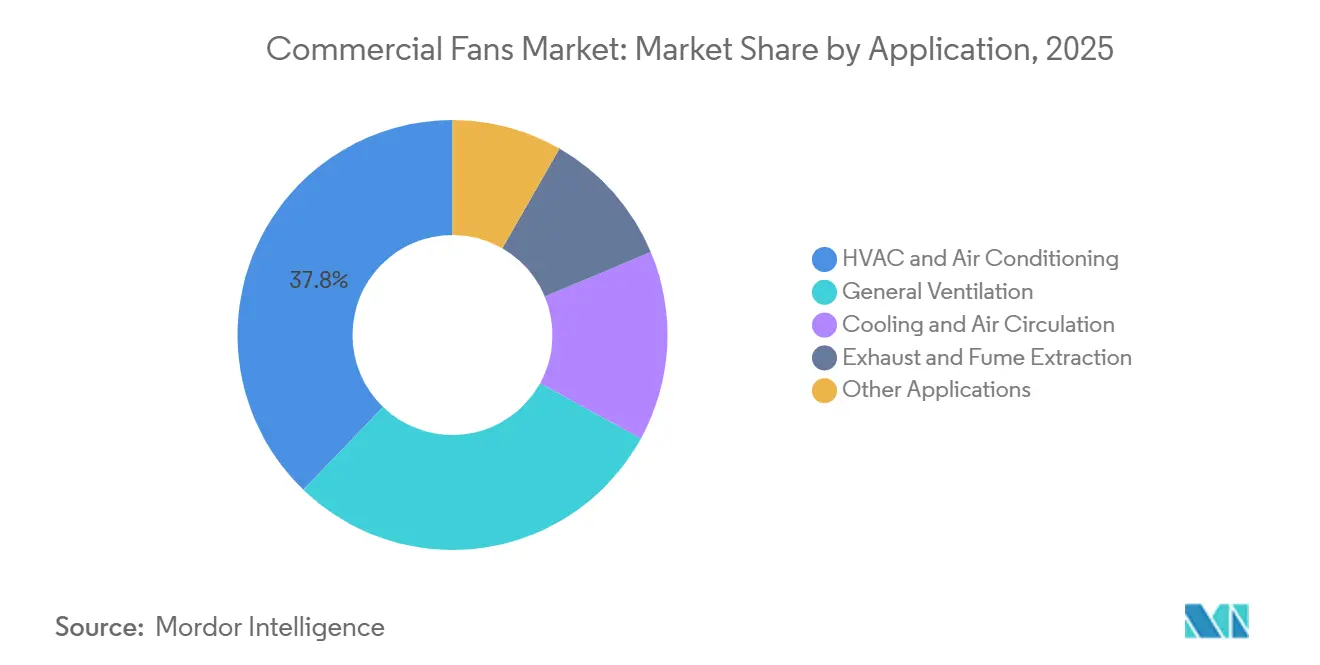
HVAC Anchors the Base, Cooling Demand AcceleratesHVAC and air conditioning accounted for 37.8% of the commercial fans market size in 2025. It is used across commercial building types regardless of climate or occupancy, which gives the application a broad and stable installed base. General ventilation provides stable replacement demand because building codes require fresh-air exchange in routine commercial operations. Exhaust and fume extraction remain essential in healthcare, laboratories, and food service, where ventilation performance is directly connected to operating requirements. Process cooling, pressurization, and specialized air movement make up the remaining applications and address more specific building or process needs.
Cooling and air circulation is expected to grow at a 6.1% CAGR through 2031. Higher ambient temperatures and denser data center loads support this demand, as more sites need active heat management and controllable airflow. Global space-cooling energy demand is rising close to 4% annually to 2035 under current policies. BACnet and Modbus connections for demand-responsive speed control are becoming a standard requirement for cooling-oriented equipment because building operators want performance data alongside energy control. Systemair reported next-generation axial fans that use up to 21% less energy, showing why lifecycle operating costs are increasingly visible in equipment selection[4].
By End User:
Office Buildings Dominate Installed Base, Data Centers Define Incremental GrowthOffice buildings held 20.6% of the commercial fans market in 2025, supported by their large installed base and the need for regular ventilation upgrades. Retail centers, hotels, restaurants, hospitals, schools, warehouses, data centers, and transport facilities each have distinct airflow needs, usage patterns, and maintenance requirements. Healthcare and pharmaceutical settings create higher-value opportunities for HEPA-compatible and pressure-controlled systems because airflow quality and redundancy are important. Schools and transport infrastructure often replace equipment through public capital programs, which can make timing less dependent on private building activity. Warehouses require circulation and heat management that differ from office ventilation, particularly where automation and charging equipment add heat loads.
Data centers are projected to expand at a 9.6% CAGR through 2031, more than twice the overall rate. This demand is linked to the need for thermal management in AI-ready facilities, where equipment density and continuous operation increase cooling requirements. Warehouses and distribution centers are the second-fastest-growing end-user group, supported by logistics automation, commercial construction, and supply-chain changes. Hospitals and healthcare sites maintain mid-single-digit growth because of air-quality investment, facility modernization, and non-discretionary ventilation requirements. Digital controls can give operators performance data for maintenance planning and energy reporting, which increases the value of connected equipment in these settings.
Geography Analysis
APAC Commercial Fans Market
Asia-Pacific held 42.1% of the commercial fans market in 2025. China combines manufacturing, warehousing, commercial real estate, and a growing hyperscale data center pipeline, creating demand across several major fan applications. Air-based cooling accounted for 60% of regional data center cooling revenue in 2025, which sustains demand for computer room air-handling and precision-cooling equipment. India, Vietnam, Indonesia, and Thailand add demand through urban development and early-stage data center construction, expanding the regional need for commercial ventilation equipment. Japan and South Korea support high-specification replacement demand under energy-efficiency requirements, where variable-speed EC systems are relevant.
Europe and the Americas Commercial Fans Market
North America and Europe form the technology leadership base for the commercial fans market. North American data center construction and aging commercial buildings support both new installations and retrofits, while specification work places a high value on tested product performance. Europe entered a compliance-led replacement cycle when Regulation 2024/1834 became enforceable in July 2026. Germany, France, the United Kingdom, and Poland are important European markets by volume, with Poland also gaining relevance as a data center and logistics location. Brazil and Chile provide growth from commercial construction in large cities and food-processing ventilation, although infrastructure and currency conditions limit the pace.
MEA Commercial Fans Market
Middle East and Africa are projected to grow at a 5.9% CAGR through 2031. Saudi Arabia and the United Arab Emirates are adding data centers, airport capacity, hospitality properties, and mixed-use projects, which support higher-capacity ventilation demand. Extreme heat creates demand for equipment with reliable continuous operation and stronger thermal performance. South Africa and Egypt are secondary demand centers for healthcare and retail HVAC investment. Gulf specifications often require IP-rated housings, high-temperature motor windings, and corrosion-resistant coatings, which can support higher unit values and distinguish regional product requirements.
Competitive Landscape
The commercial fans market is fragmented, with no supplier leading every product category and geography. ebm-papst has a strong position in EC motors and smart fans, while its Air Technology activity benefited from data center demand. Its NEXAIRA platform supports AI-enabled, demand-driven control, which illustrates the growing link between hardware and operating data. Greenheck and Twin City Fan are established in North American specification channels. AMCA certification of FEI, air, and sound performance is a meaningful procurement requirement in these projects.
Suppliers increasingly compete through controls, operating data, and verified energy performance. Many installed fans are not connected, which limits airflow adjustment, maintenance planning, and energy-savings documentation for building operators. BACnet, Modbus, and cloud-ready controllers can help suppliers add monitoring services to equipment sales and support a closer operating relationship with customers. FläktGroup is linking its FläktEdge controls with Samsung SmartThings Pro and b.IoT platforms. The company also targets 95% environmental product declaration coverage by 2026, bringing lifecycle information into its commercial offer.
Chinese manufacturers, including Zhejiang Shangfeng and Zhejiang Yilida, increase price competition in volume applications. Their presence is more limited in projects that require deep AMCA certification and proven EU compliance, where test history and documentation are central to the specification process. Systemair reported a 10% absolute reduction in Scope 1 and 2 emissions in its FY2025/26 statement, which reflects the growing role of sustainability criteria in some purchasing decisions. Ziehl-Abegg's USD 103.5 million capacity investment is another response to growing demand for data center and building ventilation products
Commercial Fans Industry Leaders
-
Greenheck Fan Corporation
-
ebm-papst Group
-
Systemair AB
-
FläktGroup Holding GmbH
-
Howden Group Ltd
- *Disclaimer: Major Players sorted in no particular order
Commercial Fans Market Companies Covered in this Report
- Air Systems Components, Inc.
- Carrier Global Corporation
- Cincinnati Fan
- Daikin Industries, Ltd.
- ebm-papst Group
- FläktGroup Holding GmbH
- Greenheck Fan Corporation
- Howden Group Ltd
- Johnson Controls International plc
- Loren Cook Company
- Munters Group AB
- New York Blower Company
- Rosenberg Ventilatoren GmbH
- Soler & Palau Ventilation Group
- Systemair AB
- Trane Technologies plc
- Twin City Fan Companies, Ltd.
- Vent-Axia
- Zhejiang Shangfeng Industrial Group Co., Ltd.
- Zhejiang Yilida Ventilator Co., Ltd.
Recent Industry Developments in Commercial Fans Market
- July 2026: EU Ecodesign Regulation 2024/1834 for industrial fans became enforceable, replacing the 2011 regulation. It covers fans with motor input power from 125 W to 500 kW in commercial buildings, with revised efficiency thresholds, part-load performance disclosure, and spare-parts availability requirements.
- June 2026: Ziehl-Abegg announced an additional EUR 90 million investment, equivalent to USD 103.5 million, in machinery, tooling, and production capacity across European, U.S., and Asian sites, with AI data center fan demand and building ventilation growth cited as primary drivers. U.S. facilities have operated three-shift round-the-clock production, and the China plant entered three-shift operation in autumn 2025.
- May 2026: Eurovent, AMCA Europe, and EVIA published the second edition of their joint FAQ guide on Regulation 2024/1834, clarifying product information, part-load information, and spare-part definitions for manufacturers.
- February 2026: Trane Technologies launched next-generation commercial HVAC products with advanced electrified heating and smarter building operations systems, increasing system-level competition with standalone fan vendors.
Global Commercial Fans Market Report Scope
Commercial fans are mechanical air-moving devices designed to provide ventilation, air circulation, cooling, and air extraction in commercial and non-residential buildings. They use rotating blades or impellers driven by electric motors to move air through open spaces or duct systems. Commercial fans are commonly used in offices, retail stores, restaurants, hotels, warehouses, hospitals, schools, and other commercial facilities to maintain indoor air quality, remove heat, moisture, odors, smoke, and airborne contaminants, and improve thermal comfort.
The Global Commercial Fans Market is segmented by fan type, application, end user, and geography. By fan type, the market is segmented into axial, centrifugal, mixed-flow, exhaust, and other types. By application, the market is segmented into HVAC, general ventilation, cooling and air circulation, fume extraction, and other applications. By end user, the market is segmented into offices, retail, hotels, restaurants, healthcare, education, and other end users. The report also covers the market size and forecasts for the global commercial fans market across 26 countries in key regions. For each segment, the market sizing and forecasts have been provided on the basis of value (USD).
Segmentation Overview
| Axial Fans |
| Centrifugal Fans |
| Mixed-Flow Fans |
| Exhaust Fans |
| Other Commercial Fan Types |
| General Ventilation |
| HVAC and Air Conditioning |
| Cooling and Air Circulation |
| Exhaust and Fume Extraction |
| Other Applications |
| Office Buildings |
| Retail and Shopping Centers |
| Hotels and Hospitality |
| Restaurants and Commercial Kitchens |
| Hospitals and Healthcare Facilities |
| Educational Institutions |
| Warehouses and Distribution Centers |
| Data Centers |
| Transportation Infrastructure |
| Other Commercial Facilities |
| North America | United States |
| Canada | |
| Mexico | |
| Europe | Germany |
| France | |
| Italy | |
| Spain | |
| United Kingdom | |
| Poland | |
| Russia | |
| Rest of Europe | |
| Asia-Pacific | China |
| India | |
| Japan | |
| South Korea | |
| Australia | |
| Indonesia | |
| Vietnam | |
| Thailand | |
| Rest of Asia-Pacific | |
| South America | Brazil |
| Argentina | |
| Chile | |
| Rest of South America | |
| Middle East and Africa | Saudi Arabia |
| United Arab Emirates | |
| Egypt | |
| South Africa | |
| Morocco | |
| Rest of Middle East and Africa |
| By Fan Type | Axial Fans | |
| Centrifugal Fans | ||
| Mixed-Flow Fans | ||
| Exhaust Fans | ||
| Other Commercial Fan Types | ||
| By Application | General Ventilation | |
| HVAC and Air Conditioning | ||
| Cooling and Air Circulation | ||
| Exhaust and Fume Extraction | ||
| Other Applications | ||
| By End User | Office Buildings | |
| Retail and Shopping Centers | ||
| Hotels and Hospitality | ||
| Restaurants and Commercial Kitchens | ||
| Hospitals and Healthcare Facilities | ||
| Educational Institutions | ||
| Warehouses and Distribution Centers | ||
| Data Centers | ||
| Transportation Infrastructure | ||
| Other Commercial Facilities | ||
| By Geography | North America | United States |
| Canada | ||
| Mexico | ||
| Europe | Germany | |
| France | ||
| Italy | ||
| Spain | ||
| United Kingdom | ||
| Poland | ||
| Russia | ||
| Rest of Europe | ||
| Asia-Pacific | China | |
| India | ||
| Japan | ||
| South Korea | ||
| Australia | ||
| Indonesia | ||
| Vietnam | ||
| Thailand | ||
| Rest of Asia-Pacific | ||
| South America | Brazil | |
| Argentina | ||
| Chile | ||
| Rest of South America | ||
| Middle East and Africa | Saudi Arabia | |
| United Arab Emirates | ||
| Egypt | ||
| South Africa | ||
| Morocco | ||
| Rest of Middle East and Africa | ||
Key Questions Answered in the Report
What is the projected value of commercial fans in 2031?
The commercial fans market is projected to reach USD 13.41 billion by 2031, from USD 10.29 billion in 2026. The forecast reflects demand from data centers, building retrofits, and equipment replacement under efficiency requirements.
What is driving demand for commercial fans?
Data center construction, HVAC retrofits, energy-efficiency rules, and indoor air quality requirements are supporting demand. Warehouses and automated distribution facilities also need circulation and exhaust systems for operational heat loads.
Which fan type has the largest share?
Axial fans held 42.4% of revenue in 2025 because they serve HVAC distribution, rooftop exhaust, and warehouse circulation. Their broad use in low-to-medium static-pressure applications gives them a wide commercial installed base.
Which application is growing fastest?
Cooling and air circulation is projected to grow at a 6.1% CAGR through 2031, supported by heat management and data center density. Digital controls also help operators adjust fan speed to changing cooling and ventilation needs.
Which end user has the highest growth rate?
Data centers are projected to grow at a 9.6% CAGR through 2031 because AI-ready facilities need thermal management. The commercial fans market serves this demand through computer room air-handling, exhaust, and air-assist applications.