
Size and Share of Industrial and Commercial Fan Market For HVAC Applications
Market Overview
| Study Period | 2021 - 2031 |
|---|---|
| Market Size (2026) | USD 6.25 Billion |
| Market Size (2031) | USD 8.05 Billion |
| Growth Rate (2026 - 2031) | 5.19 % |
| Fastest Growing Market | Middle East and Africa |
| Largest Market | Asia-Pacific |
| Market Concentration | Medium |
Major Players *Disclaimer: Major Players sorted in no particular order Image © Mordor Intelligence. Reuse requires attribution under CC BY 4.0. | |
Analysis of Industrial and Commercial Fan Market For HVAC Applications by Mordor Intelligence
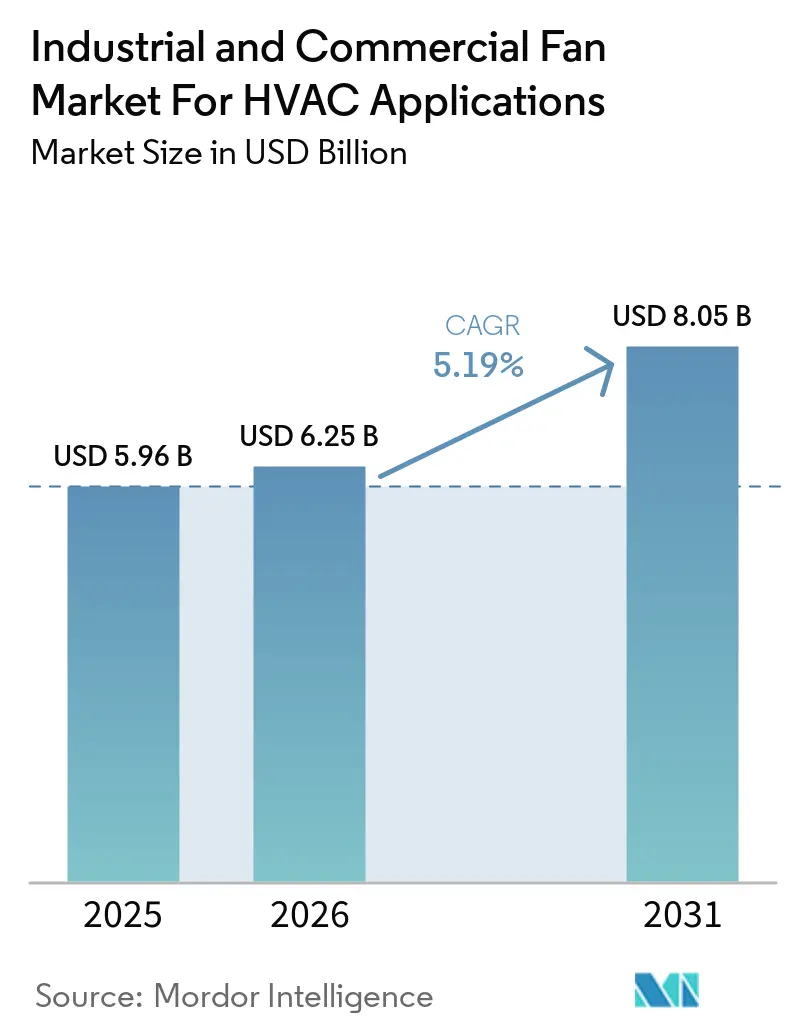
The Industrial and Commercial Fan Market For HVAC Applications Industry size is expected to grow from USD 5.96 billion in 2025 to USD 6.25 billion in 2026 and is forecast to reach USD 8.05 billion by 2031 at 5.19% CAGR over 2026-2031. Building energy rules are making efficient air movement a required part of commercial and industrial upgrades, rather than an optional improvement. The EU Ecodesign Regulation (EU) 2024/1834 took full effect on July 24, 2026, setting new system-level efficiency requirements for industrial fans with motor input power from 125 W to 500 kW. Data center construction is also supporting demand for higher-duty airflow equipment, especially fan-wall and precision-cooling systems. Suppliers are responding through EC-motor integration, connected speed controls, product specialization, and acquisitions that strengthen access to regional specifications and manufacturing. Higher initial system costs and a limited pool of commissioning specialists continue to slow adoption in projects with constrained capital budgets.
Key Report Takeaways
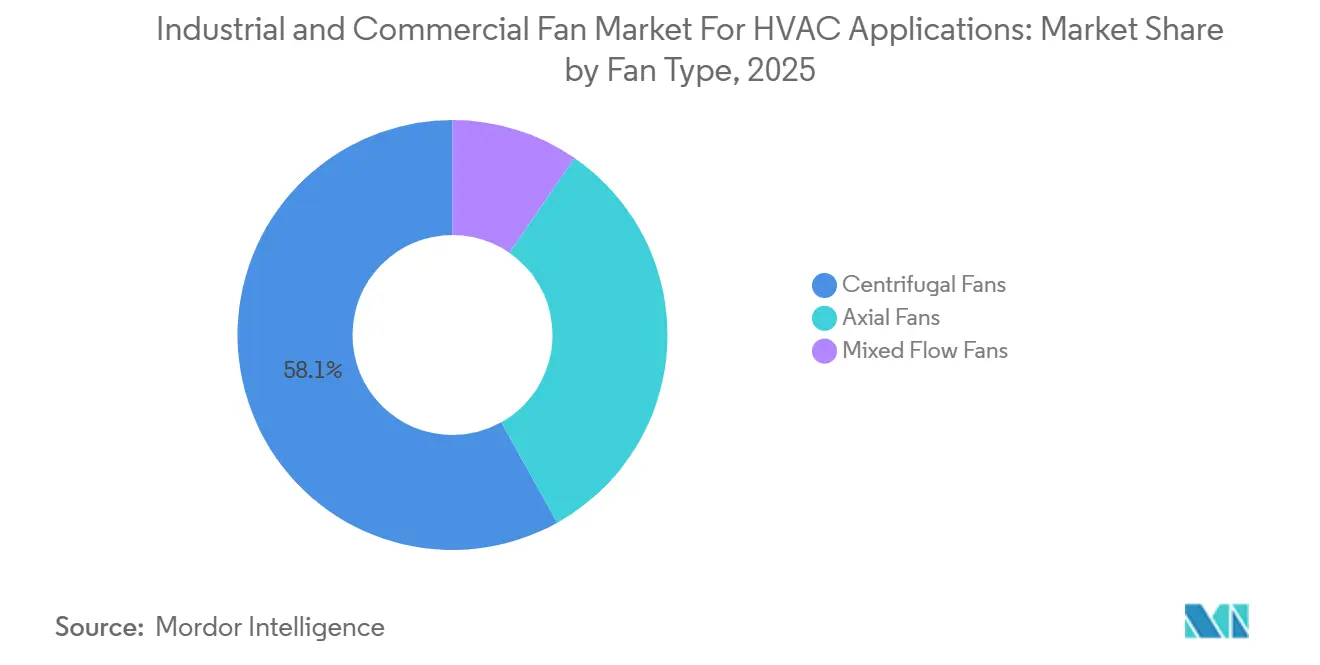
- By fan type, centrifugal fans held 58.1% of the industrial fans for HVAC market share in 2025, while mixed flow fans are forecast to grow at a 6.2% CAGR through 2031.
- By HVAC application, ventilation accounted for 56.2% in 2025 and is projected to expand at a 5.6% CAGR through 2031.
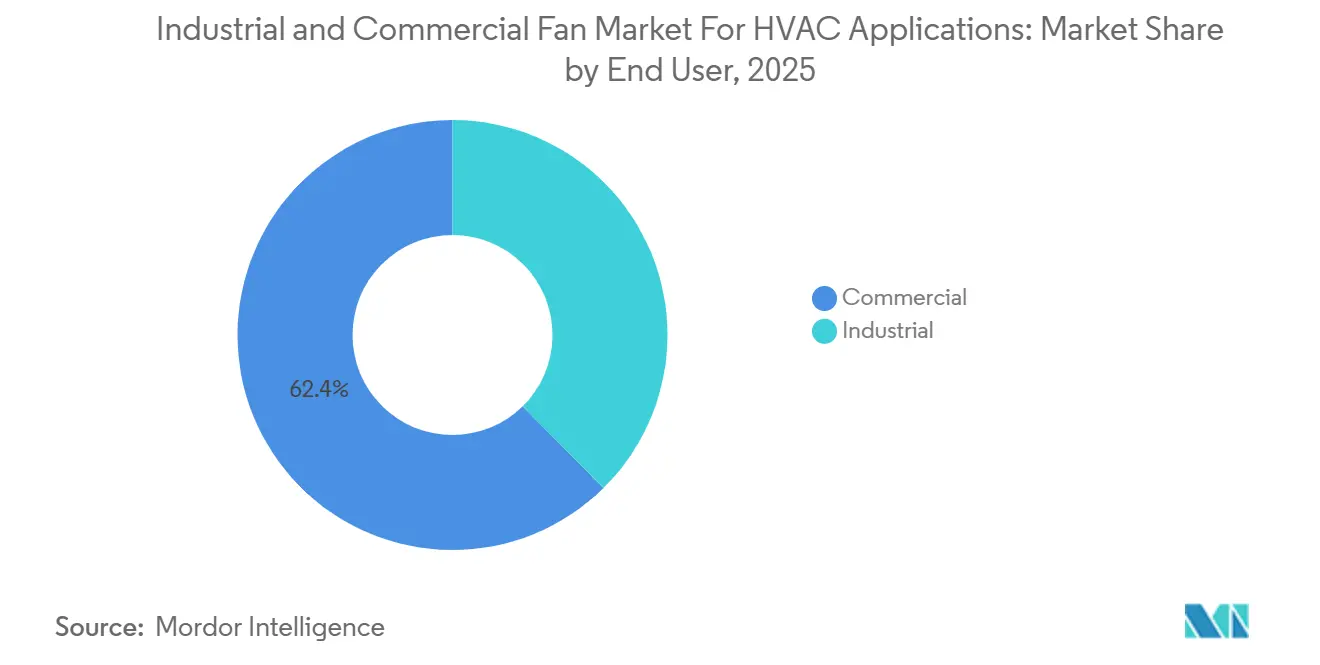
- By end user, commercial buildings held 62.4% of the industrial fans for HVAC market share in 2025, while the same segment is forecast to grow at a 5.3% CAGR through 2031.
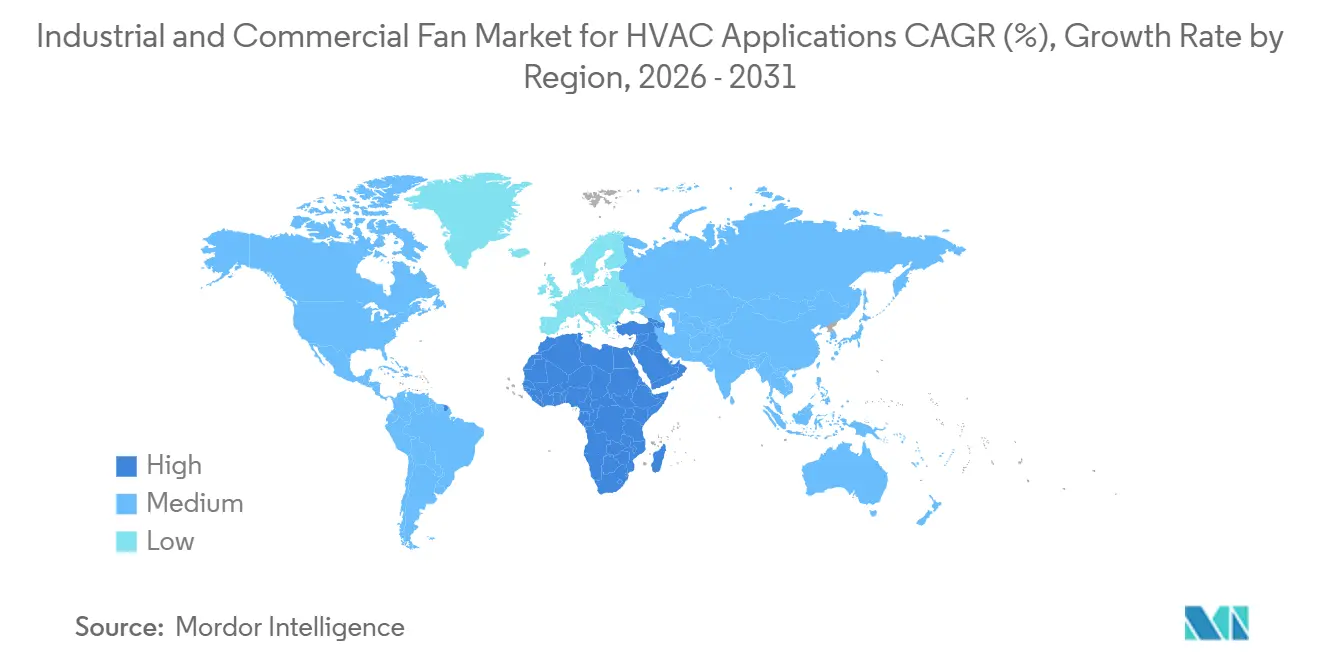
- By geography, Asia-Pacific accounted for 33.4% of revenue in 2025, while the Middle East and Africa is forecast to grow at a 5.8% CAGR through 2031.
Note: Market size and forecast figures in this report are generated using Mordor Intelligence’s proprietary estimation framework, updated with the latest available data and insights as of January 2026.
Market Trends and Insights
Drivers Impact Analysis of Industrial and Commercial Fan Market For HVAC Applications*
| Driver | (~) % Impact on CAGR Forecast | Geographic Relevance | Impact Timeline |
|---|---|---|---|
| Energy-Efficient HVAC Modernization | +1.40% | Global; strongest in EU and North America | Medium term (2-4 years) |
| Data Center and AI Infrastructure Cooling Demand | +1.20% | North America, APAC hyperscale corridors, EU | Short term (≤ 2 years) |
| Indoor Air Quality and Ventilation Compliance | +0.80% | Global; early adoption in North America and Western Europe | Medium term (2-4 years) |
| Industrial Automation and Process-Cooling Expansion | +0.60% | APAC manufacturing corridors, South and East Europe | Medium term (2-4 years) |
| Fan-Wall Adoption in High-Density Facilities | +0.70% | North America, EU, Singapore, Japan | Short term (≤ 2 years) |
| Lifecycle Energy Savings from EC Motors and Variable-Speed Operation | +0.50% | Global | Long term (≥ 4 years) |
| Source: Mordor Intelligence | |||
Energy-Efficient HVAC Modernization
Building decarbonization policies are moving the industrial fans for the HVAC market toward compliance-led replacement activity across commercial and industrial sites. Regulation (EU) 2024/1834 assesses the full fan assembly, including the motor, impeller, and stator, instead of treating its components as separate efficiency items[1]. This approach can disqualify older AC-motor centrifugal fans that met earlier component-based requirements but do not meet the full-system test. The European Commission expects the rules to lower electricity use from industrial fans by 31 TWh annually by 2030 against a no-policy baseline and to deliver EUR 4 billion in annual savings. Integrated EC-motor modules are well-positioned because their operating efficiency aligns with the direction of the regulation. The 2025 amendment and the May 2026 FAQ guide from Eurovent, AMCA, and EVIA clarified technical and transition issues for procurement teams[2].
Data Center and AI Infrastructure Cooling Demand
Data center development has created a high-performance source of demand for industrial fans for the HVAC market. Hyperscale operators require CRAH and fan-wall systems that can operate continuously at static pressures above 2.5 mm H₂O, which limits the role of commodity products. These requirements favor suppliers that can provide qualified systems across a broad product range and support large project orders. Large technology companies' investment in AI infrastructure is sustaining demand for precision cooling and higher-duty airflow systems. Grid capacity constraints could delay some planned data center projects, concentrating near-term demand in locations with stronger power availability.
Indoor Air Quality and Ventilation Compliance
Updated indoor air quality requirements are increasing the role of active ventilation controls in industrial fans for the HVAC market. ASHRAE published the 2025 edition of Standard 62.1 in November 2025 with 28 addenda to the 2022 edition[3]. The update includes a 65% maximum occupied-space relative humidity limit, emergency ventilation control sequences, and revised outdoor-air separation calculations. These operating conditions favor variable-speed fans with humidity sensing and demand-based controls over fixed-speed units. Standard 62.1 is used in LEED requirements and referenced by the International Mechanical Code, which extends its influence across U.S. building work. Developers in India, Saudi Arabia, and Southeast Asia also use green-building specifications that can bring these requirements into procurement before comparable local codes take effect.
Fan-Wall Adoption in High-Density Facilities
Fan-wall systems are changing airflow design in dense facilities and are a near-term opportunity for industrial fans in the HVAC market. These modular EC-fan arrays can remove the need for a raised-floor plenum and allow airflow to change with rack density. Their use turns fan procurement into larger project-specific orders instead of smaller replacement purchases. ebm-papst presented the RadiFlow 630 for CRAH, air-handling, and fan-wall applications at MCE Milano in March 2026. The company stated that the product can deliver up to 19% higher efficiency in operating conditions and 15% lower system energy use than prior configurations. Suppliers without dedicated fan-wall ranges may be excluded when hyperscale buyers select providers that can deliver complete prequalified systems.
Restraints Impact Analysis of Industrial and Commercial Fan Market For HVAC Applications*
| Restraint | (~) % Impact on CAGR Forecast | Geographic Relevance | Impact Timeline |
|---|---|---|---|
| High Upfront Cost of Advanced Fan Systems | -1.00% | Global; most pronounced in emerging markets | Medium term (2-4 years) |
| Maintenance and Skilled-Service Constraints | -0.60% | Global; acute in APAC emerging markets and MEA | Long term (≥ 4 years) |
| Retrofit Integration Complexity in Legacy HVAC Systems | -0.70% | Europe (Eastern/Southern), North America, mature APAC | Medium term (2-4 years) |
| Specification Fragmentation and Project-Level Customization | -0.30% | Global; notably in MEA and South America | Long term (≥ 4 years) |
| Source: Mordor Intelligence | |||
High Upfront Cost of Advanced Fan Systems
High capital costs remain a constraint on the industrial fans for the HVAC market, particularly where building owners focus on immediate procurement budgets. EC-motor systems with variable-speed drives and connected controls can cost 2 to 3 times more to install than comparable legacy AC-motor units. Their payback period in standard commercial buildings can range from 4 to 6 years, which many mid-sized owners may not accept under normal financing conditions. The difference is bigger in parts of the Middle East and South Asia where subsidized power prices reduce the financial value of energy savings. Energy-performance contracts and fan-as-a-service models address part of the barrier, but their adoption remains concentrated in Western Europe and North America. Compliance requirements in Europe and the United States can overcome this constraint, while markets without similar rules must rely on a voluntary business case and face a shortage of skilled service and commissioning capacity.
Retrofit Integration Complexity in Legacy HVAC Systems
Legacy-system integration slows replacement activity in the industrial fans for HVAC market across mature building stocks. Around two-thirds of commercial floor space in Europe and North America was built before 2000, often with ducts and mounts designed for fixed-speed centrifugal or axial fans. Replacing these units with mixed-flow or EC-motor plug fans can require duct changes, control-system programming, and structural work. This additional work can account for 30% to 40% of the project budget beyond the fan itself. Older building management systems can also require a full upgrade or costly bridging equipment to work with current variable-speed controls. The EU Energy Performance of Buildings Directive recast provides a route for renovation of poorly performing commercial buildings, although implementation will take years, and local project capacity remains uneven.
*Our forecasts treat driver/restraint impacts as directional, not additive. The impact forecasts reflect baseline growth, mix effects, and variable interactions.
Industrial and Commercial Fan Market For HVAC Applications Segment Analysis
By Fan Type:
Mixed Flow Fans Gain Ground in EC-Motor-Driven HVAC ArchitecturesCentrifugal fans accounted for 58.1% of the industrial fans for the HVAC market size in 2025 because they can provide high static pressure and fit the narrow duct layouts common in older commercial and industrial buildings. Existing duct systems were designed around centrifugal performance curves, which makes a full system change costly, even when the fan is due for replacement. This installed-base effect supports centrifugal fan volumes in the near and medium term. Axial fans remain suited to high-volume, low-pressure work in roof ventilation, parking structures, and tunnel extraction because of their compact direct-drive design.
Mixed flow fans are forecast to grow at 6.2% through 2031, making them the fastest-growing fan type in the industrial fans for HVAC market. They combine axial-style airflow volume with centrifugal-style static-pressure capability. Pairing these impellers with EC motors can preserve efficiency at 30% to 50% of rated speed and reduce part-load energy use. Greenheck introduced its RSQ hooded rooftop fan with mixed-flow wheel technology in September 2024, with AMCA licensing for Fan Energy Index, air, and sound performance[4]. AMCA credentials are increasingly included in data center and commercial renovation specifications, which raises qualification requirements for new suppliers.

By HVAC Application:
Ventilation Consolidates Leadership Across Share and Growth RateVentilation held 56.2% of the industrial fans for the HVAC market size in 2025 and is forecast to grow at 5.6% through 2031. This combination reflects several linked requirements, including indoor air quality, building decarbonization, and data center airflow management. The 2025 edition of ASHRAE Standard 62.1 requires humidity controls and emergency ventilation sequences that need active fan control. The 65% humidity limit supports the use of sensor-integrated, variable-speed fan systems in commercial renovations.
LEED requirements linked to Standard 62.1 help spread these specifications through India, the United Arab Emirates, and Southeast Asia before local codes change. Within the industrial fans for HVAC market, air-conditioning applications continue to have a substantial installed base in commercial property and process industries where cooling and humidity management share infrastructure. Heating is the smallest of the 3 application groups as heat pumps and electric-resistance systems increasingly replace fan-coil heating in new commercial construction. Ventilation, therefore, remains the main multi-function application for suppliers developing platforms for demand-controlled ventilation. Equipment that meets the Indoor Air Quality Procedure is positioned to benefit as building managers place more emphasis on controllable outdoor-air delivery.
By End User:
Commercial Segment Leads in Both Scale and Forward MomentumCommercial buildings represented 62.4% in 2025 and are projected to grow at a 5.3% CAGR through 2031. The segment covers offices, logistics warehouses, retail centers, health care facilities, and data centers. Each setting has different technical needs, from quiet low-vibration office fans to continuous-duty, high-static-pressure CRAH equipment. The commercial installed base also has a high concentration of assets entering their equipment replacement period.
For the industrial fans for the HVAC market, many commercial properties in North America and Western Europe entered service from 1990 to 2005 and are now within a 20 to 30-year equipment replacement window. This concentrates renovation demand over a limited number of years. Industrial users deploy centrifugal and axial equipment for manufacturing, chemical processing, and power generation, but long equipment life and engineer-led buying slow replacement rates. U.S. commercial building efficiency requirements and the EU Energy Performance of Buildings Directive recast set performance floors that affect commercial renovation specifications. Implementation of energy rules in Germany, France, and the United Kingdom is also supporting earlier replacement of lower-efficiency commercial fan systems.
Geography Analysis
APAC Industrial and Commercial Fan Market for HVAC Applications
Asia-Pacific held 33.4% of revenue in 2025. Its scale comes from urban development and manufacturing activity across several large economies. China is advancing commercial HVAC specifications through dual-carbon objectives and GB energy-efficiency standards, while India is a key regional growth area because of data center investment, Smart Cities Mission construction, and hotter summer conditions. Systemair completed its acquisition of Chennai-based NADI Airtechnics in August 2025, adding an Indian manufacturer of industrial blowers and railway fans to its portfolio.
APAC, North America and Europe Industrial and Commercial Fan Market for HVAC Applications
Japan and South Korea are mature markets with demanding requirements for digital, BACnet-compatible fan management in new commercial installations. North America and Europe are mature replacement markets where compliance-led retrofits offer more predictable demand than new construction. Regulation (EU) 2024/1834 is driving upgrades of fans from 125 W to 500 kW that do not meet revised efficiency thresholds. In North America, Fan Efficiency Index requirements and energy codes referring to ASHRAE 90.1 support a similar efficiency upgrade cycle. For the industrial fans for the HVAC market, hyperscale procurement became a high-value revenue source in both regions during 2025 and 2026, helping offset weaker residential HVAC volumes for broader suppliers.
MEA Industrial and Commercial Fan Market for HVAC Applications
The Middle East and Africa segment of the industrial fans for HVAC market is forecast to record a 5.8% CAGR through 2031, the fastest regional rate. State-backed infrastructure projects in Gulf Cooperation Council countries require precision airflow equipment for climate-sensitive buildings. District cooling growth in the United Arab Emirates and hospital projects in Dubai and Abu Dhabi support premium commercial HVAC demand. Saudi standards and United Arab Emirates energy-efficiency requirements also support replacement demand in existing commercial buildings. South Africa’s SANS 10400-XA requirements are progressively tightening building energy performance expectations, with commercial tenders in Johannesburg and Cape Town beginning to reference minimum fan efficiency standards.
Competitive Landscape
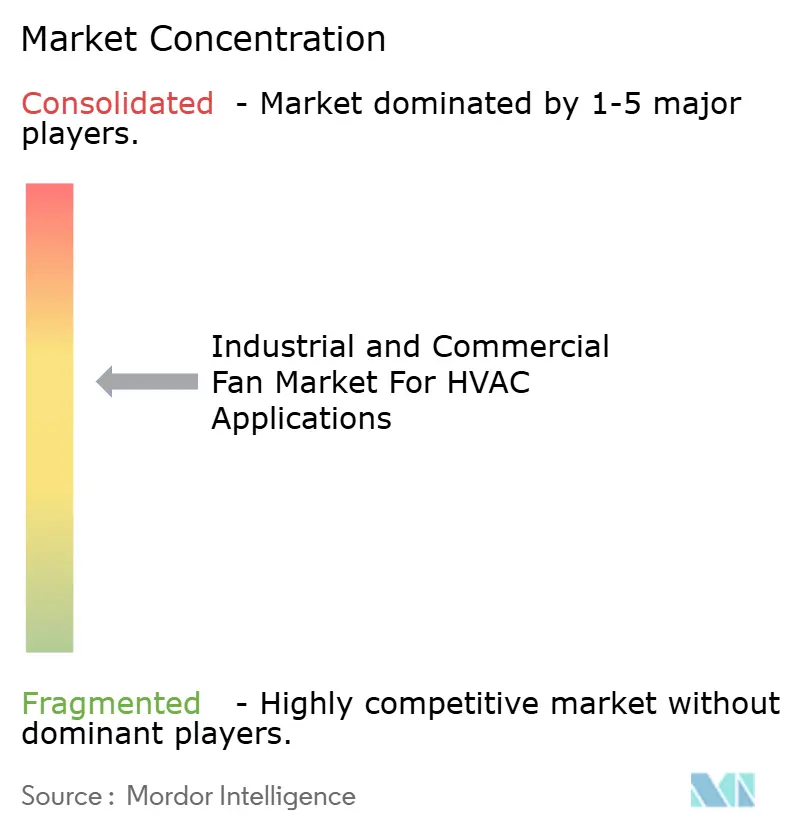
The industrial fans for the HVAC market have moderate concentration among suppliers of EC-motor-integrated systems for commercial and industrial use. ebm-papst Group, Ziehl-Abegg SE, Systemair AB, Greenheck Fan Corporation, and Regal Rexnord’s Nicotra Gebhardt brand hold leading positions in these applications. Samsung completed its acquisition of FläktGroup for EUR 1.5 billion in November 2025, bringing wider supply-chain resources and distribution capacity into the engineer-to-order segment. FläktGroup’s Woods Air Movement and SEMCO businesses provide Samsung with products for ventilation, fire safety, air handling, and flow management. Samsung also established FläktGroup Korea Co., Ltd. in May 2026 to support its Asia-Pacific data center HVAC position.
Competitive strategies in the industrial fans for the HVAC market differ across the leading group. ebm-papst is focusing on application-specific fan-wall and CRAH products for dense facilities. Systemair is expanding geographically through acquisitions, including NADI Airtechnics in India and Temspec Incorporated in Canada. Regal Rexnord is strengthening its data center air-movement position after securing USD 735 million in related orders as of the fourth quarter of 2025. These moves in the industrial fans for HVAC market show that scale, regional reach, and application engineering are becoming more important than broad commodity product coverage.
In the industrial fans for HVAC market, suppliers are using integrated EC controls to reduce component count and simplify equipment integration. Ziehl-Abegg has introduced IE5-rated EC external-rotor motors with integrated ECblue controls that combine motor and drive functions in a compact module. Connected variable-speed fan arrays also create a possible route for condition-monitoring services, although no listed supplier has established this model at commercial scale. Project-by-project design variation remains a significant entry barrier because smaller challengers may not have the engineering resources needed for custom specifications.
Leaders of Industrial and Commercial Fan Market For HVAC Applications
-
ebm-papst Group
-
Greenheck Fan Corporation
-
Systemair AB
-
FläktGroup Holding GmbH
-
Regal Rexnord Corporation
- *Disclaimer: Major Players sorted in no particular order
Industrial and Commercial Fan Market For HVAC Applications Companies Covered in this Report
- Aerovent, Inc.
- Chicago Blower Corporation
- Continental Fan Manufacturing Inc.
- ebm-papst Group
- FläktGroup Holding GmbH
- Greenheck Fan Corporation
- Hartzell Air Movement
- Howden Group Ltd.
- Kruger Ventilation Industries Pte Ltd
- Loren Cook Company
- New York Blower Company
- Regal Rexnord Corporation
- Rosenberg Ventilatoren GmbH
- Soler & Palau Ventilation Group
- Systemair AB
- Twin City Fan Companies, Ltd.
- Vent-Axia Group Limited
- Ziehl-Abegg SE
Recent Industry Developments in Industrial and Commercial Fan Market For HVAC Applications
- July 2026: Systemair AB acquires Temspec Incorporated, Canada. Completed July 23, 2026, the acquisition, generating revenues of EUR 18 million in FY 2024/25 with margins above Systemair’s target, gives the company a leading position in North American decentralized HVAC for schools and multi-story buildings. Temspec’s EC-motor backward-inclined impeller fan technology directly complements Systemair’s energy-efficient ventilation portfolio.
- July 2026: EU Ecodesign Regulation (EU) 2024/1834 enters full application. Replacing Regulation 327/2011, the regulation now imposes system-level efficiency thresholds on industrial fans with motor input power between 125 W and 500 kW placed on the EU market, with projected annual electricity savings of 8 TWh by 2030 relative to the prior regime and EUR 4 billion per year in cost savings.
- March 2026: ebm-papst showcases RadiFlow 630 at MCE Milano 2026. The diagonal impeller fan for CRAH, AHU, and fan-wall applications achieves up to 19% higher efficiency in real operating conditions and 15% lower system energy consumption versus prior configurations. It addresses compact installation and high-power-density requirements in data center cooling.
- November 2025: Samsung Electronics completes its EUR 1.5 billion acquisition of FläktGroup. The transaction includes Woods Air Movement, SEMCO, and SE-Elektronic in Samsung’s HVAC division and retains FläktGroup as an independent subsidiary. Samsung plans to use FläktGroup as a precision-cooling and smart-building platform for AI data centers globally.
Scope of Report on Industrial and Commercial Fan Market For HVAC Applications
The industrial and commercial fan market for HVAC applications covers fans designed and manufactured to provide airflow, ventilation, heating, cooling, air circulation, and exhaust functions in heating, ventilation, and air conditioning (HVAC) systems used across industrial and commercial buildings. These fans are critical components that ensure indoor air quality, thermal comfort, energy efficiency, and compliance with ventilation and environmental standards.
The Global Industrial and Commercial Fan Market for HVAC Applications is segmented by fan type, HVAC application, end user, and geography. By fan type, the market is segmented into axial fans, centrifugal fans, and mixed flow fans. By HVAC application, the market is segmented into ventilation, air conditioning, and heating. By end user, the market is segmented into commercial and industrial. The report also covers the market size and forecasts for the global industrial and commercial fan market for HVAC applications across 18 countries in key regions. For each segment, the market sizing and forecasts have been provided on the basis of value (USD).
Segmentation Overview
| Axial Fans |
| Centrifugal Fans |
| Mixed Flow Fans |
| Ventilation |
| Air Conditioning |
| Heating |
| Commercial |
| Industrial |
| North America | United States |
| Canada | |
| Mexico | |
| Europe | United Kingdom |
| Germany | |
| France | |
| Spain | |
| Nordic Countries | |
| Russia | |
| Rest of Europe | |
| Asia-Pacific | China |
| India | |
| Japan | |
| South Korea | |
| ASEAN Countries | |
| Rest of Asia-Pacific | |
| South America | Brazil |
| Argentina | |
| Colombia | |
| Rest of South America | |
| Middle East and Africa | Saudi Arabia |
| United Arab Emirates | |
| South Africa | |
| Rest of Middle East and Africa |
| By Fan Type | Axial Fans | |
| Centrifugal Fans | ||
| Mixed Flow Fans | ||
| By HVAC Application | Ventilation | |
| Air Conditioning | ||
| Heating | ||
| By End User | Commercial | |
| Industrial | ||
| By Geography | North America | United States |
| Canada | ||
| Mexico | ||
| Europe | United Kingdom | |
| Germany | ||
| France | ||
| Spain | ||
| Nordic Countries | ||
| Russia | ||
| Rest of Europe | ||
| Asia-Pacific | China | |
| India | ||
| Japan | ||
| South Korea | ||
| ASEAN Countries | ||
| Rest of Asia-Pacific | ||
| South America | Brazil | |
| Argentina | ||
| Colombia | ||
| Rest of South America | ||
| Middle East and Africa | Saudi Arabia | |
| United Arab Emirates | ||
| South Africa | ||
| Rest of Middle East and Africa | ||
Key Questions Answered in the Report
What is the forecast value of industrial fans for HVAC applications by 2031?
The industrial fans for HVAC market is forecast to reach USD 8.05 billion by 2031, from USD 6.25 billion in 2026, at a 5.19% CAGR.
Why is ventilation the largest application for industrial HVAC fans?
Ventilation held 56.2% in 2025 and is projected to grow at 5.6% through 2031 as indoor air quality and controllable outdoor-air requirements increase.
Which end users buy the most industrial and commercial HVAC fans?
Commercial buildings accounted for 62.4% in 2025 and are expected to grow at a 5.3% CAGR through 2031.
Which region will grow fastest through 2031?
The Middle East and Africa is forecast to grow at a 5.8% CAGR, supported by infrastructure investment and commercial cooling requirements.
How do efficiency regulations affect HVAC fan purchasing?
Regulation (EU) 2024/1834 requires system-level fan efficiency for relevant products placed on the EU market, which encourages replacement of lower-efficiency equipment.