
Industrial Energy Management Systems Market Size and Share
Market Overview
| Study Period | 2020 - 2031 |
|---|---|
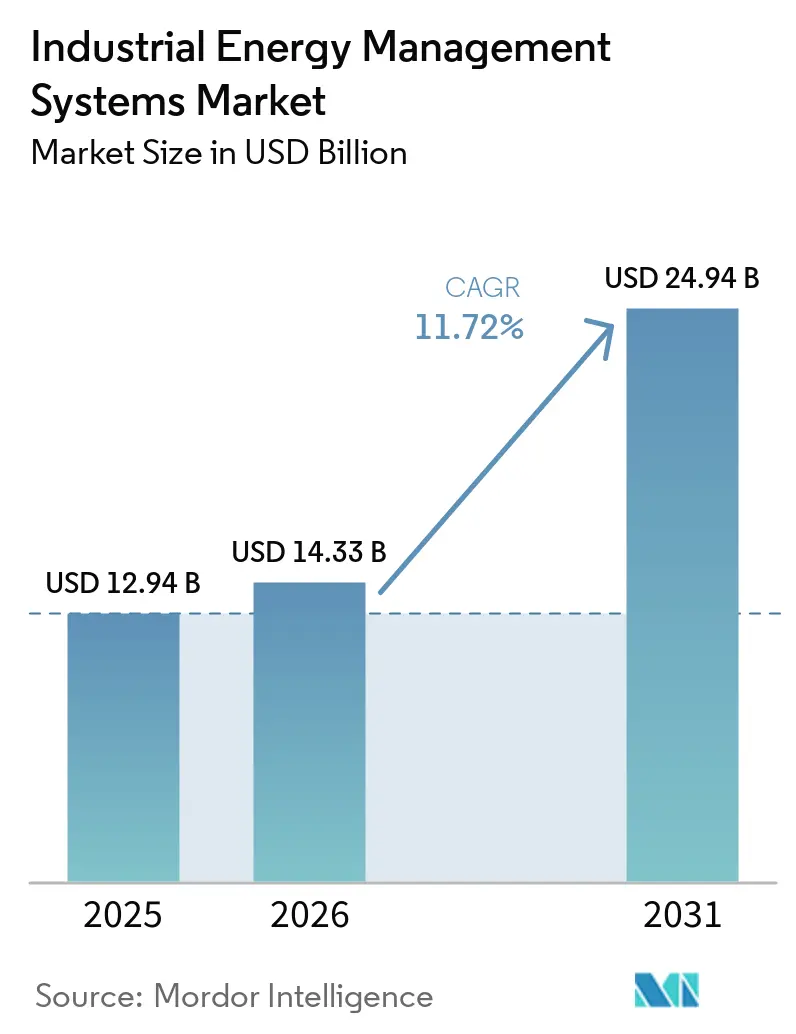
| Market Size (2026) | USD 14.33 Billion |
| Market Size (2031) | USD 24.94 Billion |
| Growth Rate (2026 - 2031) | 11.72 % |
| Fastest Growing Market | Asia-Pacific |
| Largest Market | Asia-Pacific |
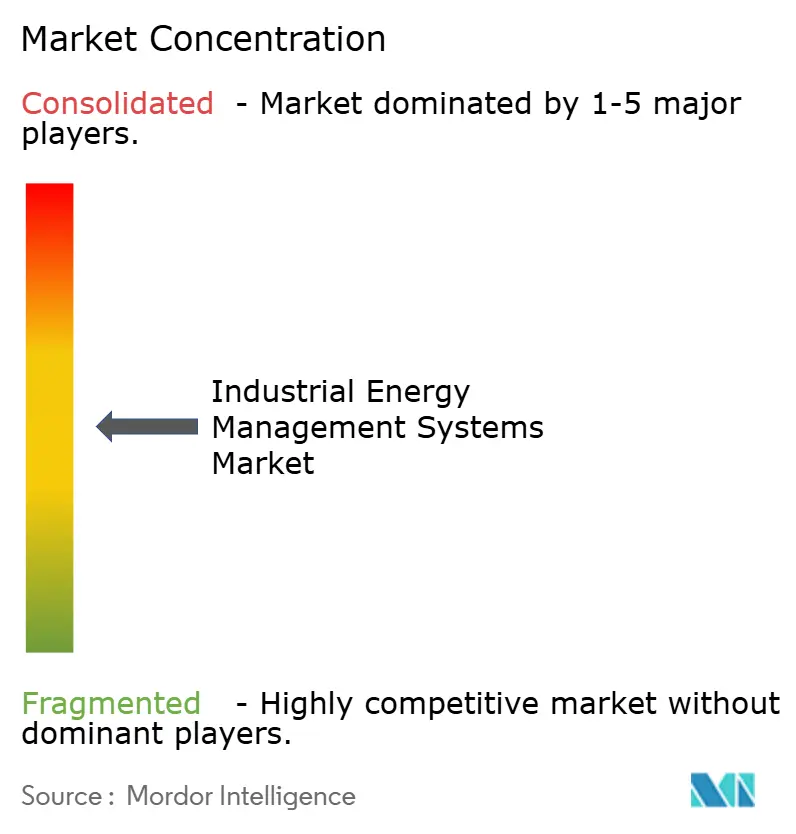
| Market Concentration | Medium |
Major Players *Disclaimer: Major Players sorted in no particular order Image © Mordor Intelligence. Reuse requires attribution under CC BY 4.0. | |
Industrial Energy Management Systems Market Analysis by Mordor Intelligence
The industrial energy management systems market size is expected to increase from USD 12.94 billion in 2025 to USD 14.33 billion in 2026 and reach USD 24.94 billion by 2031, expanding at a CAGR of 11.72% over 2026-2031. Industrial facilities are giving energy management a more central role as electrified heat, drive systems, and material handling add more variable loads to plant operations. Energy costs, peak-demand exposure, and stricter carbon reporting requirements are making continuous energy data more important for operating and compliance decisions. Software platforms are increasingly used to connect plant data with load scheduling, renewable generation, battery storage, and enterprise reporting requirements. Competition is centered on analytics, industrial data integration, cybersecurity, and the ability to manage complex sites without disrupting production.
Key Report Takeaways
- By component, software held 41.10% share of the industrial energy management systems market in 2025 and is projected to expand at a 13.42% CAGR through 2031.
- By deployment mode, on-premise held 58.11% share of the industrial energy management systems market in 2025, while cloud deployment is projected to expand at a 14.52% CAGR through 2031.
- By application, energy monitoring and metering accounted for 32.45% share of the industrial energy management systems market in 2025, while compliance and emissions reporting is projected to expand at a 12.89% CAGR through 2031.
- By end-user industry, oil and gas held an 18.10% share of the industrial energy management systems market in 2025, while electronics and semiconductors are projected to expand at a 13.67% CAGR through 2031.
- By geography, Asia-Pacific held 30.71% share of the industrial energy management systems market in 2025 and is projected to expand at a 13.44% CAGR through 2031.
Note: Market size and forecast figures in this report are generated using Mordor Intelligence’s proprietary estimation framework, updated with the latest available data and insights as of January 2026.
Market Trends and Insights
Drivers Impact Analysis of Industrial Energy Management Systems Market*
| Driver | (~) % Impact on CAGR Forecast | Geographic Relevance | Impact Timeline |
|---|---|---|---|
| AI-Enabled Predictive Optimization | +3.2% | Global, with early intensity in North America, Western Europe, and East Asia | Short term (≤ 2 years) |
| Industrial Electrification and Load Complexity | +2.5% | Global, with the highest impact in Europe, North America, and South Korea | Medium term (2-4 years) |
| Energy Price Volatility and Peak-Demand Charges | +1.8% | North America and Europe, with spillover to Asia-Pacific core markets and Middle East and Africa energy-intensive hubs | Short term (≤ 2 years) |
| Mandatory Energy and Carbon Reporting | +1.5% | European Union, United Kingdom, United States, Japan, South Korea, and expanding Southeast Asia | Medium term (2-4 years) |
| Renewable, Storage and Flexible-Load Integration | +1.2% | Asia-Pacific core markets, Germany, Spain, Australia, Middle East, and India | Medium term (2-4 years) |
| Industrial Reshoring and Digital Factory Investment | +0.9% | United States and continental Europe | Long term (≥ 4 years) |
| Source: Mordor Intelligence | |||
AI-Enabled Predictive Optimization Driving Real-Time Industrial Intelligence
Artificial intelligence is transforming industrial energy management systems from monitoring tools into systems that support real-time operational decisions. High-frequency sensor data can help identify changes in equipment energy use before conventional diagnostic processes detect the issue. This capability can help facilities address energy waste and unplanned downtime earlier. Emerson launched PACEdge version 3.0 in August 2026 with containerized analytics, vision applications, and industrial edge deployment capabilities that bring data from different operational technology environments into a unified layer.[1] The industrial energy management systems (IEMS) market is therefore placing greater value on software that links sensor data, models, and operating actions. Edge-based processing can also reduce the delay between detecting a load change and responding to it, which supports participation in fast demand-response programs.
Industrial Electrification and Load Complexity Requiring Advanced Energy Management
Electrified drive systems, process heating, and material handling are creating load patterns that conventional energy monitoring was not designed to manage. These processes can introduce harmonics, rapid changes in power, and nonlinear loads that affect plant demand and grid interactions. Research on high-resolution industrial energy data has documented the detailed consumption patterns that facilities must understand when managing such systems. A 2026 study of risk-based industrial load management found that combining distributed energy resources and energy storage improved financial outcomes in ancillary-services participation across risk preferences. Industrial operators are consequently treating electrification projects and energy management investments as connected decisions. The industrial energy management systems market benefits when facilities need software to schedule new electric loads without increasing tariff exposure.
Energy Price Volatility and Peak-Demand Charges Accelerating Adoption
Peak-demand charges are becoming a more important part of the energy cost case for industrial energy management systems. Facilities in deregulated markets can face materially higher costs when their highest demand coincides with stressed grid conditions. Automated coincident-peak avoidance can help a plant adjust flexible loads without reducing total production. This changes the value discussion from lowering total kilowatt-hour use to managing when energy is consumed. The industrial energy management systems (IEMS) market, therefore, presents an opportunity for manufacturers that need faster scheduling decisions across multiple shifts and production assets. This need is especially relevant for facilities that can move batch production, refrigeration, or other flexible processes outside peak periods.
Mandatory Energy and Carbon Reporting Strengthening Procurement Decisions
Compliance requirements are making energy management systems a necessary operating tool for many large industrial companies. The European Union Energy Efficiency Directive requires enterprises with average annual energy use above 23.6 GWh to implement an energy management system, including audits and ISO 50001-related obligations under the applicable timetable. Reporting requirements in major industrial jurisdictions are increasing the need for auditable facility-level energy and emissions data. The industrial energy management systems market is gaining support from compliance and operations teams because reports rely on consistent plant data. These deadlines can bring senior management approval forward even when energy prices alone would not have triggered a project. Compliance systems also reduce the manual reconciliation required to assemble recurring disclosures.
Restraints Impact Analysis of Industrial Energy Management Systems Market*
| Restraint | (~) % Impact on CAGR Forecast | Geographic Relevance | Impact Timeline |
|---|---|---|---|
| High Integration and Retrofit Costs | -1.8% | Global, most acute in South and Southeast Asia, Africa, and industrial small and medium-sized enterprise clusters in Eastern Europe | Long term (≥ 4 years) |
| Cybersecurity and Operational-Continuity Liability | -1.2% | Global, with higher sensitivity in oil and gas, chemicals, and critical infrastructure | Medium term (2-4 years) |
| Legacy Operational Technology and Information Technology Interoperability Gaps | -0.9% | Global, concentrated in brownfield heavy industry, including metals, pulp and paper, and legacy chemicals | Long term (≥ 4 years) |
| Shortage of Industrial Energy Management Skills | -0.7% | Global, most acute in emerging markets and regions with rapid industrial electrification | Long term (≥ 4 years) |
| Source: Mordor Intelligence | |||
High Integration and Retrofit Costs Limiting Brownfield Penetration
Integrating modern energy management software with legacy distributed control systems, supervisory control and data acquisition infrastructure, and proprietary meters can cost more than the initial software license. Older pulp and paper, primary metals, and petrochemical sites often require custom middleware, protocol gateways, and extensive commissioning. The challenge is greater for small and medium-sized industrial companies that cannot assign internal engineers to a multimonth project while maintaining production. Workforce constraints also add to the issue, as power-sector executives have identified talent shortages as a barrier to infrastructure modernization. Modular and cloud-native options can reduce some upfront complexity, but their recurring subscription costs remain difficult for some asset-heavy operators to accept. The industrial energy management systems market, therefore, faces different adoption conditions at large centralized sites and fragmented smaller portfolios.
Cybersecurity and Operational-Continuity Liability Slowing Connectivity Decisions
Connecting energy management software with plant controls increases the cyber risk associated with production infrastructure. Programmable logic controllers, distributed control systems, and remote terminal units were often deployed before current connectivity requirements became common. The IEC 62443 series provides security requirements for industrial automation and control systems, including guidance on security protection for systems in operation.[2] These standards are increasingly relevant when asset owners compare suppliers and integration approaches. Operators in oil and gas and chemicals may take a more cautious approach because a production interruption can carry substantial daily costs. This concern can slow growth in the industrial energy management systems market in high-value sectors, even when the operational savings case is clear.
*Our forecasts treat driver/restraint impacts as directional, not additive. The impact forecasts reflect baseline growth, mix effects, and variable interactions.
Industrial Energy Management Systems Market Segment Analysis
By Component:
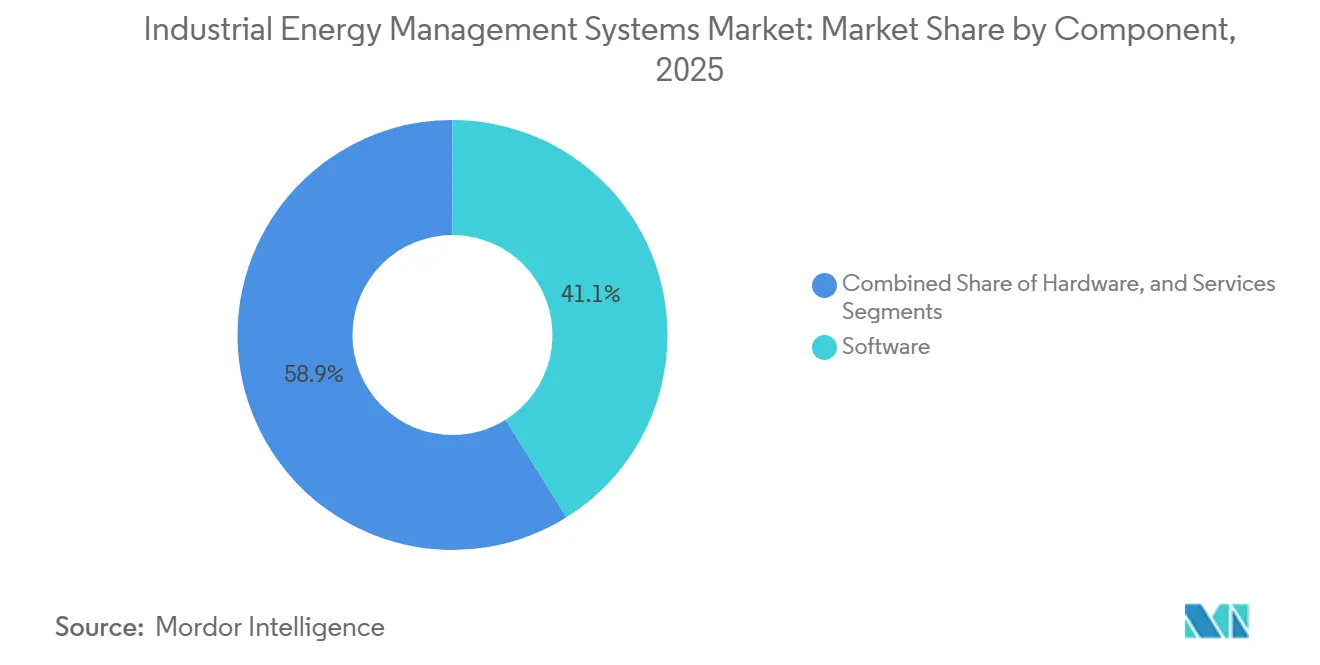
Software Leads As Analytics Requirements IncreaseSoftware accounted for 41.10% of the industrial energy management systems market in 2025 and is projected to grow at a 13.42% CAGR through 2031. The category has moved beyond basic data visualization toward operational analytics, digital twin integration, and cloud-enabled decision support. These capabilities help facilities connect energy data with process conditions and production schedules. Consequently, the industrial energy management systems industry is giving software a larger role in system purchasing decisions.
Hardware remains necessary because smart meters, power-quality analyzers, and communication gateways provide the underlying data. Its revenue potential is more limited because many devices face price pressure as specifications become more standardized. Services are still important for integration, commissioning, training, and managed energy programs. The industrial energy management systems market also depends on service providers that can configure systems around plant conditions. Sidenor described a 2025 project that combined online consumption monitoring with artificial intelligence models to support reductions in natural gas and electricity use, and CO₂-equivalent emissions, at its Basauri plant.[3] Rockwell Automation positions FactoryTalk Energy Manager to connect energy and production monitoring, reflecting the continued overlap between software capabilities and ongoing services support.

By Deployment Mode:
Cloud Expands While On-Premise Remains EstablishedOn-premise systems held 58.11% of the industrial energy management systems market share in 2025. The installed base is strongest in capital-intensive industries where operational technology is retained for long replacement cycles. Many operators also prefer local data control because plant information can be commercially sensitive. These considerations keep on-premise deployment central to operations in oil and gas, chemicals and petrochemicals, and defense-related manufacturing.
Cloud deployment is projected to expand at a 14.52% CAGR through 2031, the highest rate in this segmentation. New facilities and multi-site companies are using cloud platforms to consolidate energy views and update optimization models more easily. Hybrid architectures can maintain fast control loops at the plant edge while offloading analytics and enterprise reporting to the cloud. This approach supports the industrial energy management systems market by meeting both local control and enterprise reporting needs. Emerson released DeltaV Live Enterprise View in April 2026 to provide browser-based, read-only access to live control displays from enterprise cloud environments without changing the underlying control system. A 2026 brewery study also found that scheduling flexibility in industrial energy system design and dispatch models reduced electricity costs and improved the use of renewable energy.
By Application:
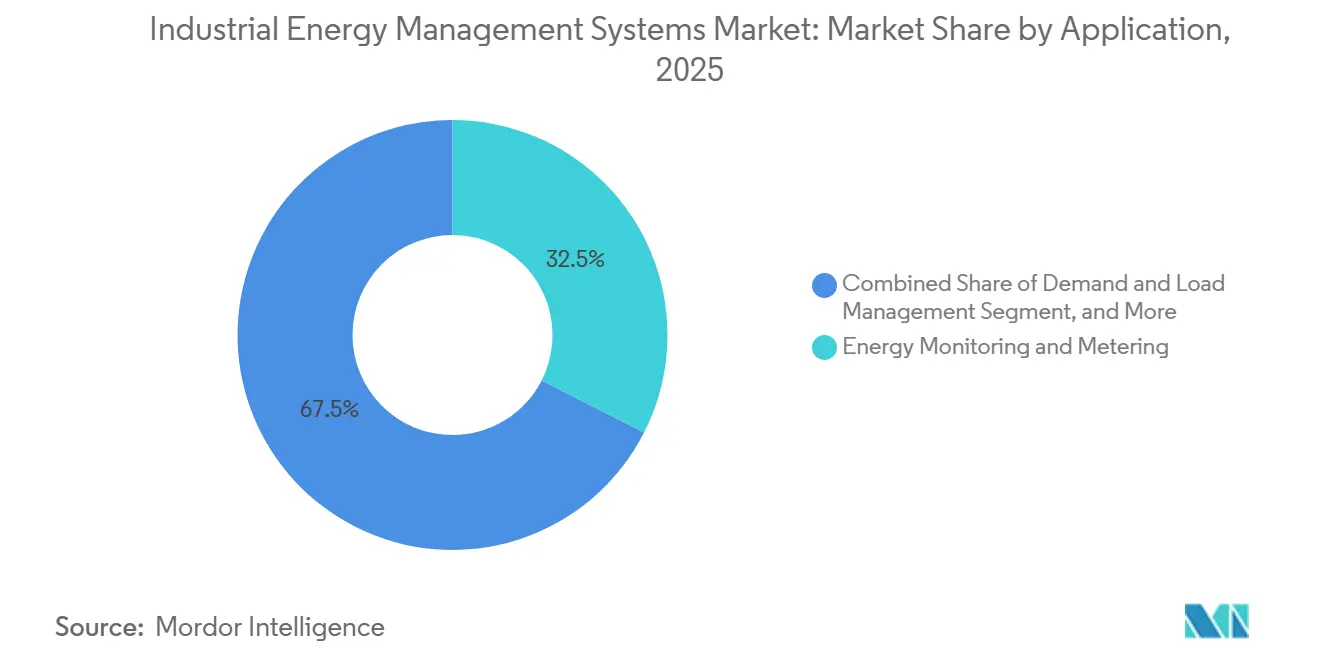
Monitoring Is Foundational While Compliance Reporting AdvancesEnergy monitoring and metering accounted for 32.45% of the industrial energy management systems market size in 2025. Metering supplies the plant data needed for demand management, process optimization, and emissions reporting. It is generally the starting point for organizations beginning a formal energy management program. Demand and load management follow because facilities need to control peak demand and time-of-use exposure.
Process and production energy optimization addresses energy use directly at machines and process areas. A 2025 factory study using photovoltaic and energy storage resources reported a 23.7% improvement in computational efficiency and a 7.6% reduction in power purchase costs. Compliance and emissions reporting is projected to expand at a 12.89% CAGR through 2031 as reporting becomes an automated data process rather than a periodic manual exercise. This requirement gives the industrial energy management systems market an additional route into facilities that already have basic metering. European and U.S. rules are directing investment toward monitoring infrastructure that supports reliable reporting. Predictive maintenance and energy benchmarking remain relevant as users broaden their system scope after the first deployment.
By End-User Industry:
Oil And Gas Leads While Semiconductor Demand RisesOil and gas accounted for 18.10% of the industrial energy management systems market in 2025. Its position reflects high energy use, extensive installed assets, and long-standing investment in digital plant management. Upstream, midstream, and downstream activities have distinct requirements across compression, refining, and other energy-intensive processes. This range of conditions supports demand for multilayer systems that combine energy measurement with operational management.
Chemicals and petrochemicals have similar infrastructure needs and face tighter CO₂ and NOₓ intensity requirements. Metals and mining, food and beverage, automotive, pharmaceuticals and life sciences, and pulp and paper also use energy systems to improve visibility and process scheduling. Electronics and semiconductor is projected to expand at a 13.67% CAGR through 2031 because advanced fabrication requires close management of cleanroom heating, ventilation, and air conditioning, diffusion furnaces, and ultrapure water systems. This demand gives the industrial energy management systems market exposure to new high-precision production capacity. Semiconductor producers are increasing their focus on energy management systems that can coordinate these interdependent loads. Pulp and paper producers are also using software for steam optimization and heat-recovery scheduling to protect margins in mature operations.
Geography Analysis
APAC Industrial Energy Management Systems Market
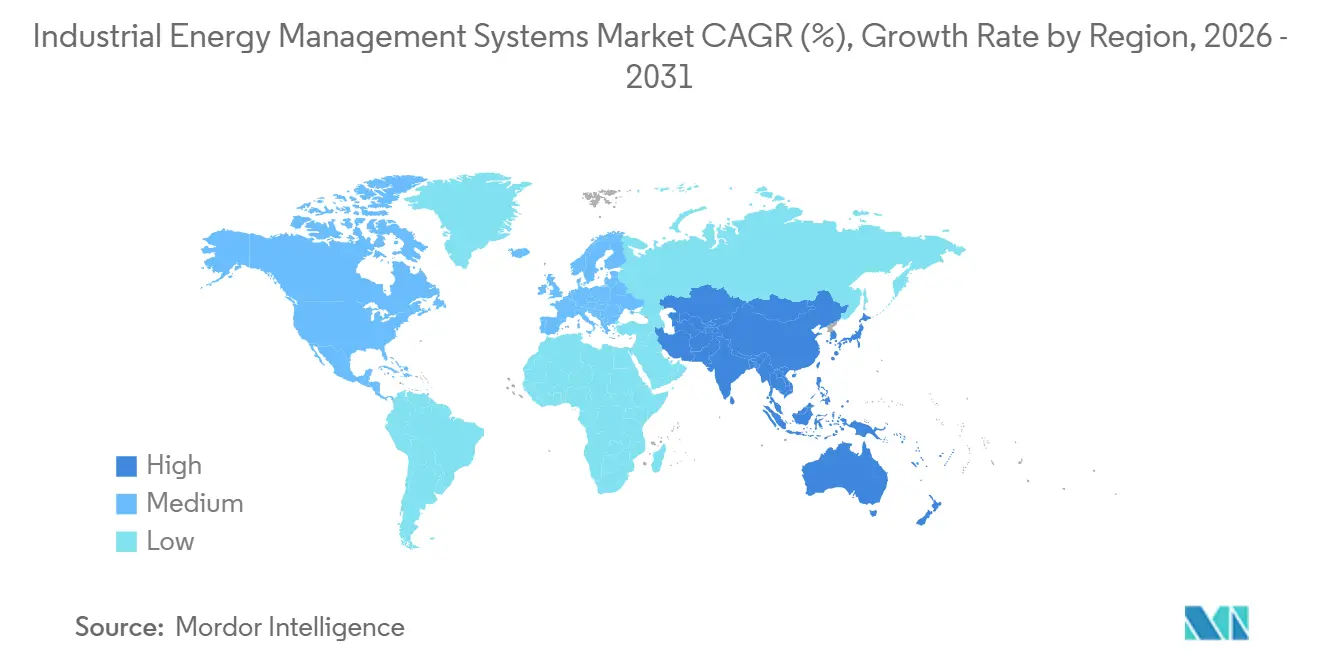
Asia-Pacific held 30.71% of the industrial energy management systems market share in 2025 and is projected to expand at a 13.44% CAGR through 2031. China is a major source of demand because energy-intensity objectives under the 14th Five-Year Plan require a 13.5% reduction in energy intensity per unit of gross domestic product. Japan requires designated energy-intensive facilities to submit energy management plans, which support formalized energy practices. India is also an important opportunity, with an ABB survey reporting 80% digital readiness for energy efficiency among Indian respondents compared with a 67% global average, while serving as a setting for artificial intelligence-led autonomous operations programs in industrial facilities. South Korean semiconductor fabs, battery plants, and electric vehicle component facilities are adding demand for precise energy optimization.
North America and Europe Industrial Energy Management Systems Market
North America and Europe form the next largest regional clusters, although their demand conditions differ. New facilities in battery manufacturing, semiconductor fabrication, and defense supply chains support North American investment. These greenfield sites can install energy management systems during commissioning rather than retrofitting them later, while Canada and Mexico offer further opportunities through manufacturing investment and nearshoring. In Europe, Germany, France, and the United Kingdom benefit from the implementation timetable for the European Union Energy Efficiency Directive.[4] The United Kingdom's Streamlined Energy and Carbon Reporting framework also supports demand for automated energy data collection in large companies.
MEA and South America Industrial Energy Management Systems Market
The Middle East and Africa are a smaller regional group but have high-value needs in petrochemicals, metals, mining, and other energy-intensive activities, especially in Saudi Arabia and the United Arab Emirates. South America has a divided opportunity, with Brazilian agribusiness and mineral processing more active than other national markets. Argentina and other South American markets face weaker demand because macroeconomic conditions and tariff structures can reduce incentives for efficiency investments. Nigeria and South Africa support demand in mining and process industries, although grid reliability issues can limit demand-response-led deployments in parts of Africa.
Competitive Landscape
Schneider Electric, Siemens, ABB, Honeywell, Emerson, and Rockwell Automation are among the most active global suppliers in the industrial energy management systems market. Their broad geographic reach and product portfolios span automation, power systems, plant software, and services. The industrial energy management systems market is increasingly focused on industrial data management, artificial intelligence, and cybersecurity rather than standalone hardware. Schneider Electric announced an agreement in June 2026 to acquire Cognite for USD 3.1 billion, with Cognite expected to be integrated into Schneider Electric's industrial automation business under Aveva.[5] The transaction reflects the strategic value placed on contextualized industrial data and artificial intelligence software.
ABB completed its acquisition of IPEC in Q1 2026 to add artificial intelligence-led electrical diagnostics capabilities for industrial and data center monitoring. Eaton invested USD 75 million in VoltServer in July 2026 to advance software-defined digital electricity distribution for industrial and data center customers. These moves show how power infrastructure and energy optimization are becoming more closely linked. Rockwell Automation also continues to place energy and production data in the same operating environment through its FactoryTalk portfolio. Suppliers with established control-system relationships can use their installed bases to extend energy services without requiring a full platform replacement.
Smaller cloud-first providers may find opportunities where large vendors have focused on major single-site industrial deployments. Multi-site portfolios need lower-cost systems that can provide consistent reporting without extensive local engineering. Automated reporting that connects plant measurements directly to Scope 1 and Scope 2 records is another important area, as manual data reconciliation remains difficult. AVEVA and IFS announced a May 2026 partnership to connect real-time operational data with maintenance, investment, and capital-planning workflows, while IEC 62443 alignment is becoming a supplier consideration for buyers seeking evidence that connected systems can meet operational cybersecurity expectations.
Industrial Energy Management Systems Industry Leaders
-
Schneider Electric SE
-
Siemens AG
-
ABB Ltd
-
Honeywell International Inc.
-
Rockwell Automation, Inc.
- *Disclaimer: Major Players sorted in no particular order
Industrial Energy Management Systems Market Companies Covered in this Report
- Schneider Electric SE
- Siemens AG
- ABB Ltd
- Honeywell International Inc.
- Rockwell Automation, Inc.
- Emerson Electric Co.
- Eaton Corporation plc
- Yokogawa Electric Corporation
- Mitsubishi Electric Corporation
- AVEVA Group Limited
- Azbil Corporation
- Fuji Electric Co., Ltd.
- Delta Electronics, Inc.
- Advantech Co., Ltd.
- General Electric Company
- Hitachi, Ltd.
- Panasonic Holdings Corporation
- Toshiba Corporation
- Itron Inc.
- ICONICS, Inc.
Recent Industry Developments in Industrial Energy Management Systems Market
- August 2026: Emerson Electric Co. launched PACEdge version 3.0, an IIoT software platform that aggregates siloed OT data across diverse industrial devices and deploys containerized AI analytics, vision applications, and operational dashboards at the industrial edge, targeting life sciences, oil and gas, food and beverage, and packaging sectors.
- July 2026: Eaton Corporation invested USD 75 million in VoltServer, establishing a strategic partnership to commercialize fault-managed, software-defined Digital Electricity power distribution architectures, advancing the convergence of intelligent power delivery with energy management optimization across industrial and data center customers.
- June 2026: Schneider Electric SE announced a definitive all-cash agreement to acquire Cognite, a leading provider of industrial data and AI software, for USD 3.1 billion. Upon completion, Cognite is expected to integrate with AVEVA within Schneider's industrial automation business, substantially expanding the combined platform's AI-powered data contextualization capabilities.
- June 2026: Rockwell Automation Inc. launched FactoryTalk Orchestration software at Automate 2026, a solution that coordinates material flow and production processes end-to-end using real-time production signals across OTTO autonomous mobile robots and Plex MES systems, enabling more energy-efficient and coordinated factory operations.
Global Industrial Energy Management Systems Market Report Scope
The industrial energy management systems (IEMS) market encompasses hardware, software, and associated services used by industrial facilities to monitor, measure, analyze, control, and optimize energy consumption across production processes, equipment, utilities, and facility-level operations. These systems support applications including energy monitoring and metering, demand and load management, process and production energy optimization, and compliance and emissions reporting. IEMS solutions may be deployed on-premise or through cloud-based environments and serve energy-intensive and manufacturing industries, including oil and gas, chemicals and petrochemicals, metals and mining, food and beverage, automotive, electronics and semiconductors, pharmaceuticals and life sciences, and pulp and paper.
The Industrial Energy Management Systems Report is Segmented by Component (Hardware, Software, and Services), Deployment Mode (On-Premise, and Cloud), Application (Energy Monitoring and Metering, Demand and Load Management, Process and Production Energy Optimization, Compliance and Emissions Reporting, and Other Applications), End-User Industry (Oil and Gas, Chemicals and Petrochemicals, Metals and Mining, Food and Beverage, Automotive, Electronics and Semiconductor, Pharmaceuticals and Life Sciences, Pulp and Paper, and Other End-User Industries), and Geography (North America, South America, Europe, Asia-Pacific, and Middle East and Africa). The Market Forecasts are Provided in Terms of Value (USD).
| Hardware |
| Software |
| Services |
| On-premise |
| Cloud |
| Energy Monitoring and Metering |
| Demand and Load Management |
| Process and Production Energy Optimization |
| Compliance and Emissions Reporting |
| Other Applications |
| Oil and Gas |
| Chemicals and Petrochemicals |
| Metals and Mining |
| Food and Beverage |
| Automotive |
| Electronics and Semiconductor |
| Pharmaceuticals and Life Sciences |
| Pulp and Paper |
| Other End-user Industries |
| North America | United States | |
| Canada | ||
| Mexico | ||
| South America | Brazil | |
| Argentina | ||
| Rest of South America | ||
| Europe | Germany | |
| United Kingdom | ||
| France | ||
| Italy | ||
| Spain | ||
| Rest of Europe | ||
| Asia-Pacific | China | |
| Japan | ||
| India | ||
| South Korea | ||
| Rest of Asia-Pacific | ||
| Middle East and Africa | Middle East | Saudi Arabia |
| United Arab Emirates | ||
| Turkey | ||
| Rest of the Middle East | ||
| Africa | South Africa | |
| Nigeria | ||
| Rest of Africa | ||
| By Component | Hardware | ||
| Software | |||
| Services | |||
| By Deployment Mode | On-premise | ||
| Cloud | |||
| By Application | Energy Monitoring and Metering | ||
| Demand and Load Management | |||
| Process and Production Energy Optimization | |||
| Compliance and Emissions Reporting | |||
| Other Applications | |||
| By End-User Industry | Oil and Gas | ||
| Chemicals and Petrochemicals | |||
| Metals and Mining | |||
| Food and Beverage | |||
| Automotive | |||
| Electronics and Semiconductor | |||
| Pharmaceuticals and Life Sciences | |||
| Pulp and Paper | |||
| Other End-user Industries | |||
| By Geography | North America | United States | |
| Canada | |||
| Mexico | |||
| South America | Brazil | ||
| Argentina | |||
| Rest of South America | |||
| Europe | Germany | ||
| United Kingdom | |||
| France | |||
| Italy | |||
| Spain | |||
| Rest of Europe | |||
| Asia-Pacific | China | ||
| Japan | |||
| India | |||
| South Korea | |||
| Rest of Asia-Pacific | |||
| Middle East and Africa | Middle East | Saudi Arabia | |
| United Arab Emirates | |||
| Turkey | |||
| Rest of the Middle East | |||
| Africa | South Africa | ||
| Nigeria | |||
| Rest of Africa | |||
Key Questions Answered in the Report
What is the industrial energy management systems market size?
The market was valued at USD 14.33 billion in 2026 and is forecast to reach USD 24.94 billion by 2031 at an 11.72% CAGR.
What is driving adoption of industrial energy management systems?
Electrified processes, peak-demand charges, renewable integration, and energy and carbon reporting requirements are increasing the need for plant-level energy data and control.
Which component leads demand for industrial energy management systems?
Software led with 41.10% share in 2025 and is projected to expand at a 13.42% CAGR through 2031.
Why are cloud energy management platforms gaining adoption?
Cloud deployment is projected to expand at a 14.52% CAGR because multi-site companies need consolidated dashboards, while hybrid systems keep time-sensitive control functions at the edge.
Which end-user sector is expanding fastest for industrial energy systems?
Electronics and semiconductor is projected to expand at a 13.67% CAGR through 2031 because advanced fabrication facilities have intensive and tightly controlled energy requirements.
Which region leads industrial energy management system demand?
Asia-Pacific led with 30.71% share in 2025 and is projected to expand at a 13.44% CAGR through 2031.