
Indoor Farming Robots Market Size and Share
Market Overview
| Study Period | 2022 - 2032 |
|---|---|
| Market Size (2027) | USD 501.36 Million |
| Market Size (2032) | USD 903.74 Million |
| Growth Rate (2027 - 2032) | 12.51 % |
| Fastest Growing Market | Asia-Pacific |
| Largest Market | North America |
| Market Concentration | Medium |
Major Players *Disclaimer: Major Players sorted in no particular order Image © Mordor Intelligence. Reuse requires attribution under CC BY 4.0. | |
Indoor Farming Robots Market Analysis by Mordor Intelligence
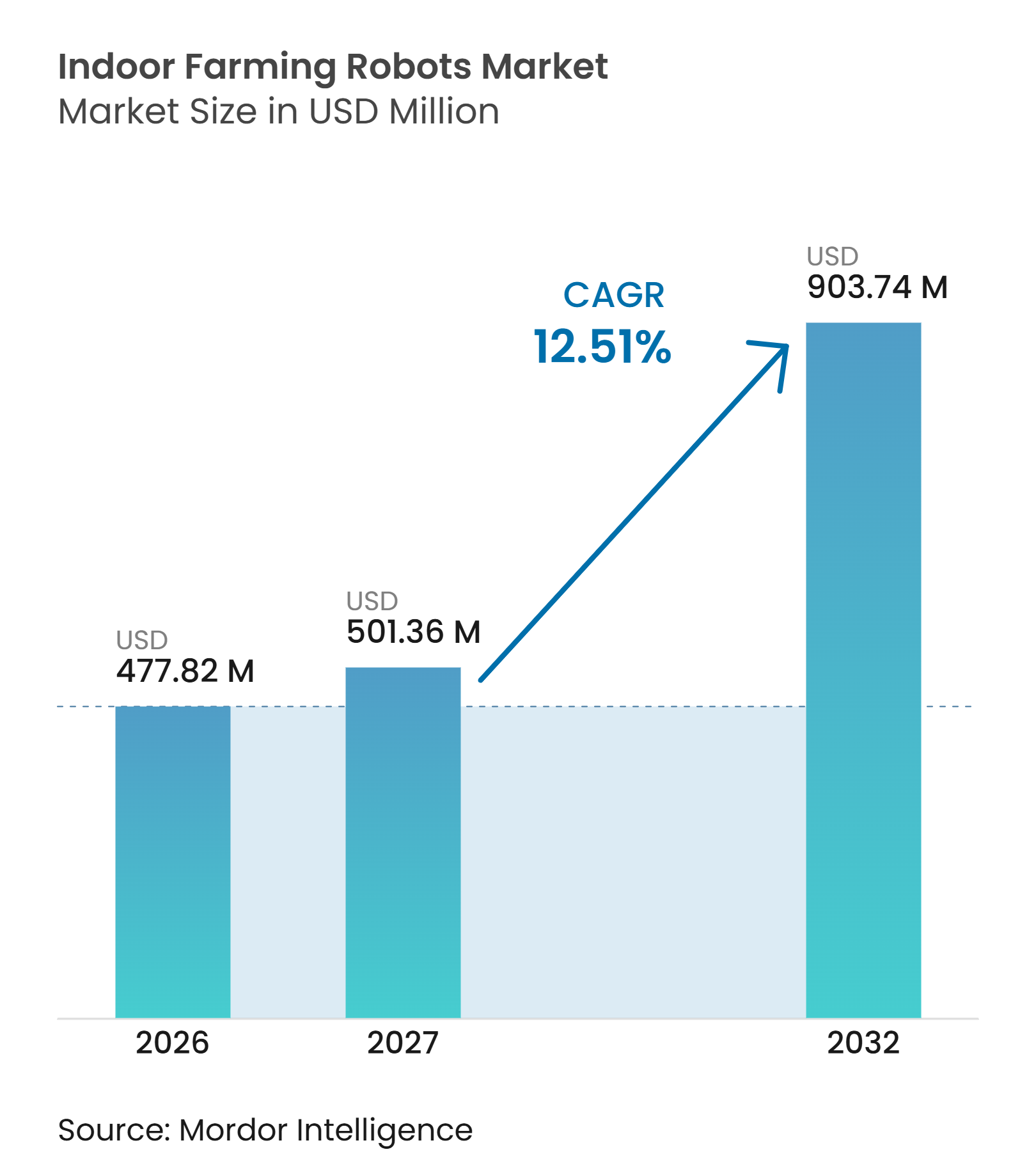
The indoor farming robots market size was valued at USD 477.82 million in 2026 and is projected to grow from USD 501.36 million in 2027 to USD 903.74 million by 2032, at a CAGR of 12.51% during the forecast period. High labor costs and persistent worker shortages are encouraging controlled-environment agriculture operators to adopt automated solutions for harvesting, monitoring, and material handling. Labor-intensive activities remain a major operational challenge for greenhouse and indoor farming businesses, driving demand for technologies that improve workforce productivity and operational consistency. New vertical farms and advanced greenhouses are increasingly incorporating robotic systems into facility planning and infrastructure development, creating opportunities for automation suppliers. Advancements in machine vision, sensor technologies, and crop data analytics are improving robots' ability to identify plant conditions and support precision-based farm management. The competitive landscape comprises specialized robotics developers and established automation companies that offer solutions for crop-specific harvesting, autonomous navigation, pollination, and greenhouse logistics, with differentiation based on technological capabilities, suitability for applications, and integration with existing farming infrastructure.
Key Report Takeaways
-
By robot type, harvesting and picking robots accounted for the largest 34.0% of the indoor farming robots market share in 2026, while monitoring and inspection robots are projected to grow at the fastest CAGR of 14.5% from 2027 to 2032.
-
By automation level, fully autonomous robots accounted for the largest share at 52.0% in 2026 and are projected to grow at the fastest CAGR of 12.9% from 2027 to 2032.
-
By application, harvesting and picking accounted for the largest share at 35.0% in 2026, while the indoor farming robots market size for crop monitoring and scouting is projected to grow at the fastest CAGR of 14.0% from 2027 to 2032.
-
By crop type, leafy greens accounted for the largest share at 40.0% in 2026, while strawberries and berries are projected to grow at the fastest CAGR of 15.0% from 2027 to 2032.
-
By indoor farming system, vertical farms accounted for the largest share at 39.0% in 2026, and aeroponic farms are projected to grow at the fastest CAGR of 13.5% from 2027 to 2032.
-
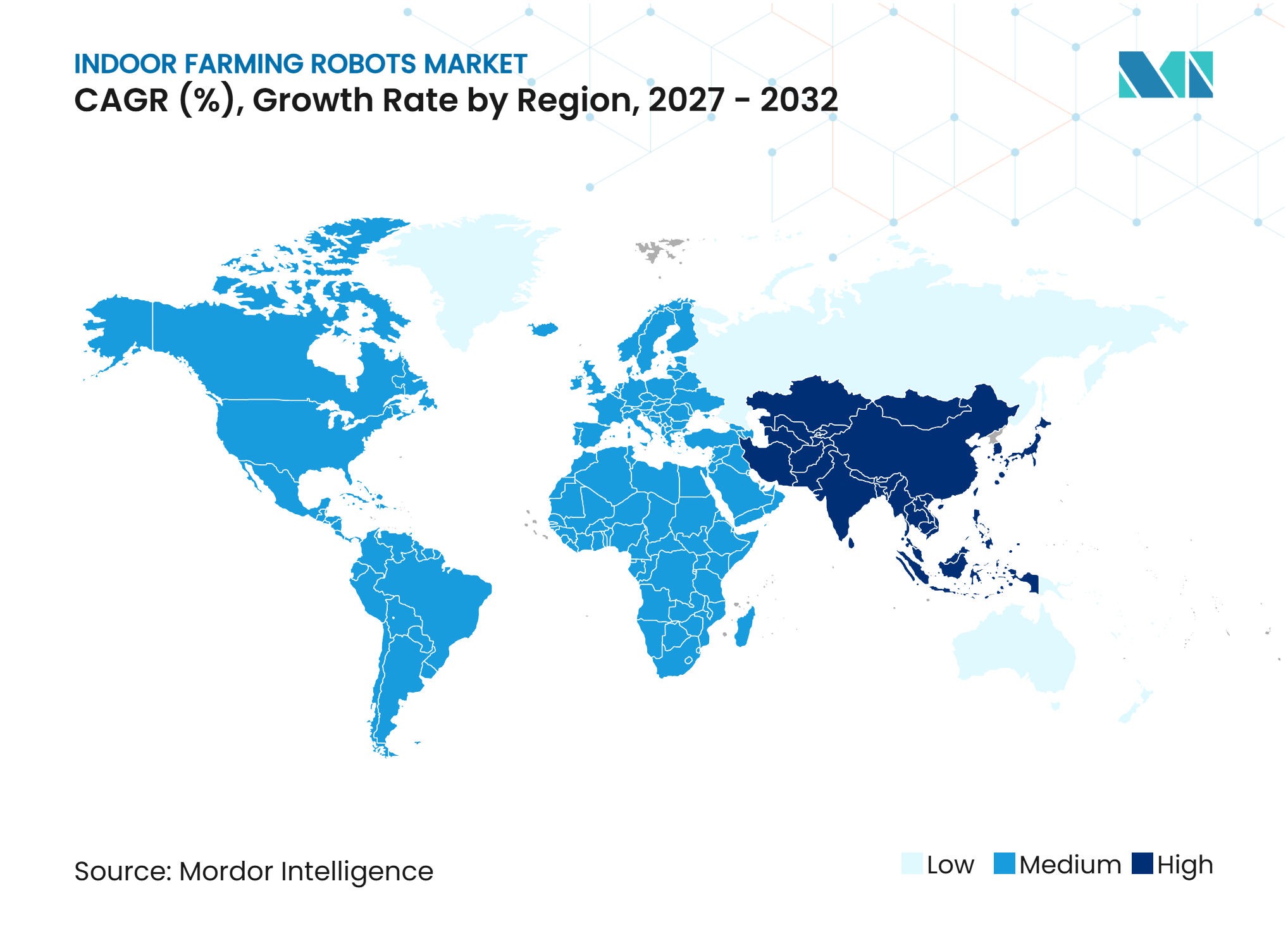
By geography, North America accounted for the largest share at 38.0% in 2026, while Asia-Pacific is projected to grow at the fastest CAGR of 15.5% from 2027 to 2032.
Note: Market numbers in this report are based on Mordor Intelligence's proprietary estimation framework, which combines nine months of actuals with Q4 projections for base year 2026.
Market Trends and Insights
Drivers Impact Analysis of Indoor Farming Robots Market*
| Driver | (~) % Impact on CAGR Forecast | Geographic Relevance | Impact Timeline |
|---|---|---|---|
| Agricultural Labor Shortages and Rising Wage Costs | +3.2% | Global, with greatest pressure in North America, the European Union, and Japan | Short term (≤ 2 years) |
| Demand for Year-Round Local Produce | +1.9% | North America, the Netherlands, Germany, and urban Asia-Pacific | Medium term (2-4 years) |
| Expansion of Vertical Farms and Advanced Greenhouses | +2.4% | North America, Asia-Pacific, and the Middle East | Medium term (2-4 years) |
| AI-Enabled Vision, Navigation, and Crop Analytics | +1.8% | Global, with early deployment in North America, the Netherlands, and Japan | Long term (≥ 4 years) |
| Crop-Specific Robotics for High-Value Delicate Produce | +1.4% | North America, Europe, and East Asia | Medium term (2-4 years) |
| Robotics-as-a-Service and Fleet-Based Automation Models | +1.1% | Global, with early penetration in North America and the European Union | Short term (≤ 2 years) |
| Source: Mordor Intelligence | |||
Agricultural Labor Shortages and Rising Wage Costs
Labor shortages and rising wage costs are encouraging growers to automate harvesting and crop-care tasks, supporting demand for indoor farming robots. The United States Bureau of Labor Statistics (BLS) reported a mean hourly wage of USD 17.96 for crop, nursery, and greenhouse farmworkers in 2025[1]. This cost pressure strengthens the case for robots that perform tasks consistently and reduce reliance on seasonal labor. In October 2025, AGRIST tested its AI-powered cucumber-harvesting robot at a hydroponic facility in Hokkaido, demonstrating how growers are evaluating automation for labor-intensive greenhouse work. Such trials reinforce the role of robotics as a workforce-support solution.
Demand for Year-Round Local Produce
Growing consumer demand for locally sourced produce is encouraging controlled-environment growers to maintain consistent, year-round production and supply. The International Food Information Council (IFIC) reported that 54.0% of Americans prioritize food that is consistently available locally (2025 Food and Health findings). This preference is prompting greenhouse and vertical farm operators to improve harvesting schedules, crop monitoring, and post-harvest handling. Indoor farming robots automate these activities, helping growers maintain operational consistency, meet regular delivery requirements, and support year-round supply of local produce.
AI-Enabled Vision, Navigation, and Crop Analytics
AI-enabled vision and navigation technologies are improving indoor farming robots' ability to identify crops, monitor plant conditions, and perform inspections with greater precision. Research published in Agronomy by the Multidisciplinary Digital Publishing Institute (MDPI) in 2025 reported an average tomato cluster-counting accuracy of 97.30% using a YOLOv8-based greenhouse inspection robot[2]. Such capabilities support automated yield estimation, maturity classification, and crop monitoring while reducing dependence on manual inspections. These advancements improve robotic capabilities and encourage adoption in precision-based greenhouse operations.
Crop-Specific Robotics for High-Value Delicate Produce
The development of crop-specific robots is expanding automation in indoor farming operations, particularly for delicate produce that requires precise harvesting and handling. According to the University of Essex (UoE), trials of its AI-powered strawberry-picking robot began at Wilkin and Sons' vertical farm in July 2025[3]. The robot uses machine learning and computer vision to identify ripe strawberries, determine picking requirements, and automate harvesting and packaging. These specialized capabilities address fruit-handling challenges, reduce dependence on manual harvesting, and encourage growers to adopt crop-specific robotic solutions, supporting the growth of the indoor farming robots market.
Restraints Impact Analysis of Indoor Farming Robots Market*
| Restraint | (~) % Impact on CAGR Forecast | Geographic Relevance | Impact Timeline |
|---|---|---|---|
| High Upfront Capital and Integration Costs | -1.8% | Global, especially emerging markets and smaller operators | Short term (≤ 2 years) |
| Uncertain Payback Under Volatile Indoor-Farm Economics | -1.1% | North America and Europe | Medium term (2-4 years) |
| Condensation and Humidity-Related Reliability Constraints | -0.7% | The Netherlands, Japan, and Southeast Asia | Medium term (2-4 years) |
| Limited Interoperability Across Farm Hardware and Software | -0.5% | Global, especially multi-vendor greenhouse operations | Long term (≥ 4 years) |
| Source: Mordor Intelligence | |||
High Upfront Capital and Integration Costs
High upfront investment requirements limit the adoption of indoor farming robots, particularly among growers with constrained capital budgets. A 2025 review in Frontiers in Sustainable Food Systems identifies equipment affordability, technical complexity, and integration requirements as key challenges in deploying robotic solutions for urban horticulture. Commercial vertical farms require substantial investment in infrastructure, mechanization, and software integration before robotic systems can be deployed. Retrofitting existing facilities further increases installation and customization costs, extending investment recovery periods. These financial barriers constrain the adoption of indoor farming robots and restrain market growth.
Condensation and Humidity-Related Reliability Constraints
High humidity and condensation in indoor farming environments can compromise the reliability of robotic systems by affecting cameras, sensors, electrical connections, and mechanical components. Moisture exposure can interfere with image recognition, navigation accuracy, and uninterrupted equipment operation, particularly in densely planted greenhouses. Robot manufacturers must therefore incorporate moisture-resistant enclosures, protective components, and preventive maintenance procedures, increasing equipment design and servicing requirements. These additional reliability considerations can raise deployment and maintenance costs for growers. As a result, environmental durability requirements and potential operational interruptions can restrict the adoption of indoor farming robots.
*Our forecasts treat driver/restraint impacts as directional, not additive. The impact forecasts reflect baseline growth, mix effects, and variable interactions.
Indoor Farming Robots Market Segment Analysis
By Robot Type:
Harvesting and Picking Robots Lead as Monitoring and Inspection Robots AccelerateHarvesting and picking robots accounted for the largest 34.0% of the indoor farming robots market share in 2026. This position reflects the need to automate repetitive crop removal while maintaining careful handling across greenhouse and vertical farm operations. These systems use machine vision, robotic arms, and crop-specific end effectors to identify mature produce and transfer it for packing. Tomato, cucumber, and berry growers can apply harvesting automation within growing rows, while leafy greens operations use related equipment for crop collection. Adoption depends on crop geometry, picking accuracy, throughput, and integration with downstream handling.
Monitoring and inspection robots are projected to grow at the fastest CAGR of 14.5% from 2027 to 2032. Their role is expanding as growers seek frequent, plant-level information without relying entirely on manual scouting. Mobile platforms equipped with cameras and sensors can inspect crop health, identify pest or disease indicators, and record changes across growing zones. These systems complement harvesting equipment by helping operators assess crop readiness and direct interventions. Their deployment is relevant across greenhouses and vertical farms, where consistent observation supports crop management and more informed production decisions.
By Automation Level:
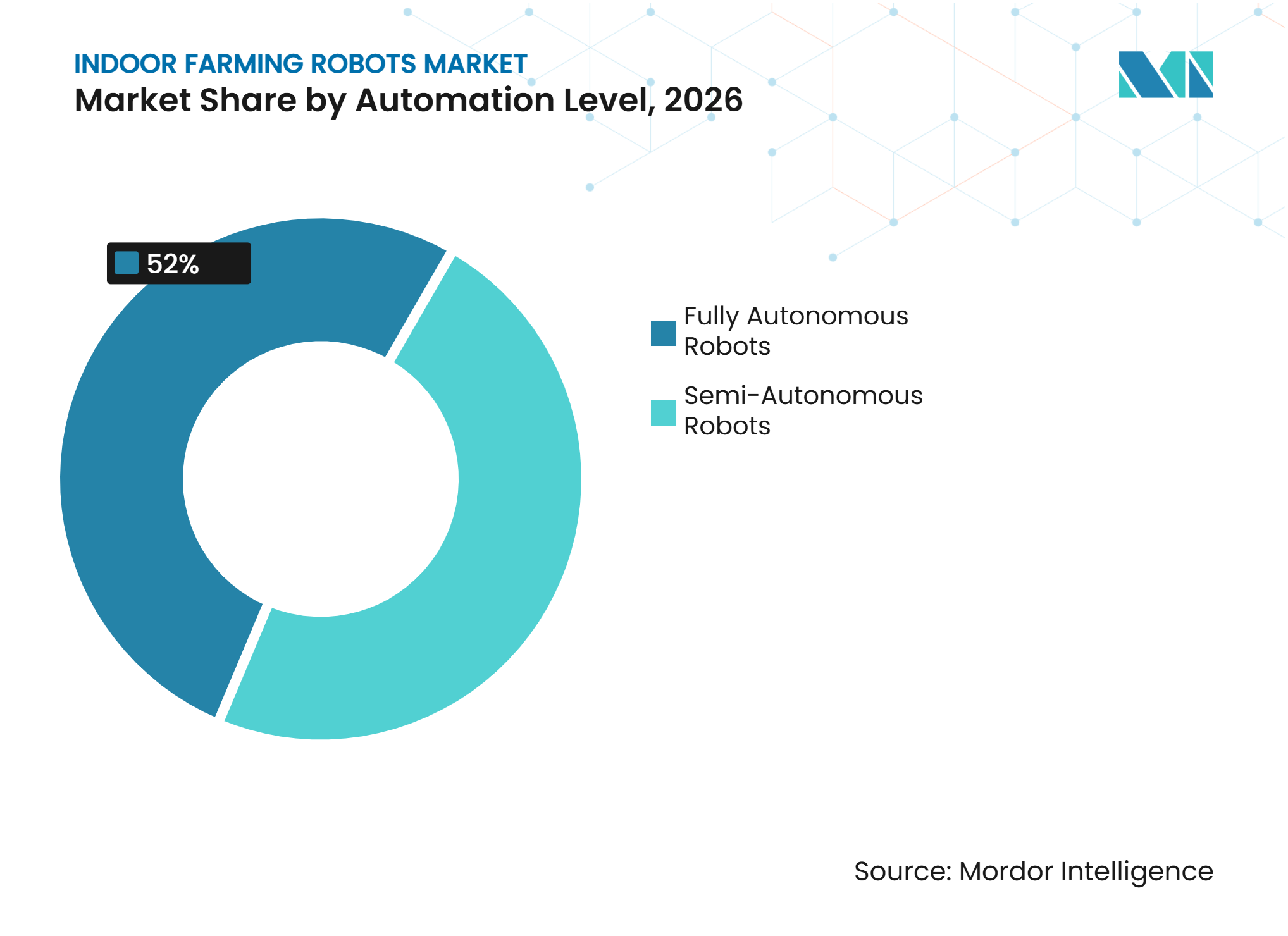
Fully Autonomous Robots Set the DirectionFully autonomous robots accounted for the largest share at 52.0% in 2026 and are projected to grow at the fastest CAGR of 12.9% from 2027 to 2032. This market position reflects growing interest in systems capable of navigating production facilities and performing assigned tasks with limited human intervention. These platforms integrate localization, machine vision, route planning, and task execution for harvesting, inspection, and internal transport. Their suitability depends on facility layout, crop arrangement, navigation reliability, and safe operation around staff and equipment. Growers evaluate these capabilities based on production requirements and workflow integration.
Semi-autonomous robots support indoor farming operations by combining automated functions with human supervision and intervention. These systems allow growers to automate selected activities while retaining control over tasks that require judgment, adjustments, or direct handling. Operations can involve automated navigation, crop monitoring, material movement, or harvesting assistance, with staff overseeing execution and managing exceptions. This approach suits facilities where layouts, crop arrangements, or existing equipment limit full automation. Semi-autonomous platforms also provide growers with the flexibility to introduce robotics gradually and integrate automated processes into established production workflows.



By Application:
Harvesting and Picking Scale While Crop Monitoring and Scouting ExpandsHarvesting and picking accounted for the largest share at 35.0% in 2026. This application addresses a recurring activity that requires crop identification, selective removal, and careful transfer after maturity. Robotic harvesters combine vision systems, gripping or cutting mechanisms, and navigation to operate among plants while limiting fruit damage. Their use is relevant to greenhouse tomatoes, cucumbers, strawberries, and other produce grown in controlled environments. Adoption depends on crop visibility, ripeness variation, plant structure, picking speed, and the ability to integrate harvesting with packing and material-handling processes.
Crop monitoring and scouting are projected to grow at a CAGR of 14.0% from 2027 to 2032. Growers are increasingly using mobile robots and vision-enabled platforms to collect plant-level information throughout production cycles. These systems can assess crop development, identify visible stress, and support early detection of pests or disease. Repeated observations also help operators compare conditions across growing zones and coordinate crop-care activities. Monitoring robots can work alongside harvesting systems, providing data to guide labor allocation, harvest timing, and facility management across vertical farms, hydroponic operations, and advanced greenhouses.
By Crop Type:
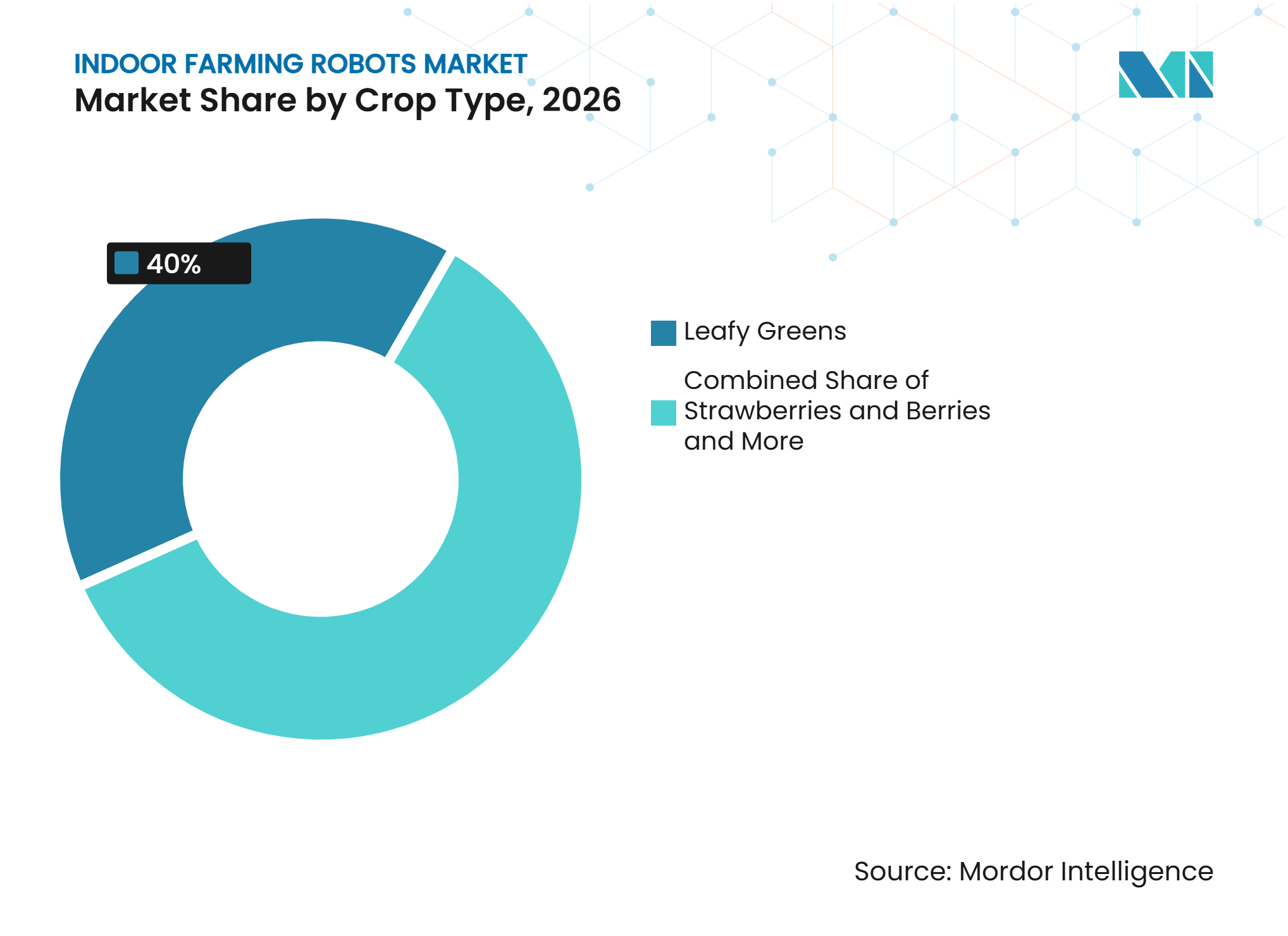
Leafy Greens Provide Scale While Strawberries and Berries Build MomentumLeafy greens accounted for the largest share at 40.0% in 2026. Their structured production methods and repeated crop cycles create opportunities for automation across seeding, tray movement, monitoring, and harvesting. Indoor farms producing lettuce and other leafy vegetables can organize crops in standardized channels or growing racks, supporting repeatable equipment movement and handling. However, robot configurations still need to accommodate differences in leaf structure, growing density, and harvest method. These operational characteristics shape demand for systems that connect crop handling with inspection, sanitation, and post-harvest workflows.
Strawberries and berries are projected to grow at the fastest CAGR of 15.0% from 2027 to 2032. Their delicate structure, variable ripeness, and growing patterns create specific requirements for robotic perception and handling. Harvesting platforms need to locate individual fruit, assess maturity, avoid nearby flowers and produce, and pick without causing damage. Research and commercial trials are advancing vision-guided picking and plant-level monitoring for protected berry production. These developments support specialized robotic applications in greenhouses and vertical farms, where growers seek consistent harvesting and careful handling across successive production cycles and harvesting conditions.

By Indoor Farming System:
Vertical Farms Establish Leads While Aeroponics Farms ExpandsVertical farms accounted for the largest share at 39.0% in 2026. Their enclosed layouts and planned infrastructure support the integration of mobile robots, automated handling equipment, and monitoring platforms. Operators can coordinate growing racks, crop transfer points, and robot routes as part of facility design, linking production activities with internal logistics. Automation requirements vary with crop selection, rack configuration, and the degree of mechanization. These facilities use robotics for tasks such as seeding, inspection, harvesting, and material movement, depending on their production model.
Aeroponic farms are projected to grow at the fastest CAGR of 13.5% from 2027 to 2032. Their growth prospects reflect the growing interest in soil-free cultivation systems that deliver water and nutrient solutions directly to plant roots through controlled misting. This growing method requires precise management of nutrient delivery, root exposure, humidity, and environmental conditions, creating opportunities for specialized robotic applications. Robots can support crop monitoring, plant inspection, system maintenance, and material handling within aeroponic facilities. Their integration can help operators coordinate cultivation activities, maintain production consistency, and manage labor-intensive processes across controlled growing environments.
Geography Analysis
North America
North America accounted for the largest share at 38.0% in 2026. Regional demand is supported by commercial greenhouses, vertical farming operators, and technology providers developing automated production systems. Growers are evaluating robots for harvesting, crop monitoring, internal transport, and other repetitive tasks that affect labor planning and product consistency. The United States and Canada have established controlled-environment agriculture activity, while Mexico's greenhouse production base provides additional application settings. Adoption across the region depends on investment capacity, crop economics, facility design, and the availability of service and maintenance support.
Asia-Pacific
Asia-Pacific is projected to grow at the fastest CAGR of 15.5% from 2027 to 2032. Regional growth is supported by smart agriculture initiatives, investment in plant factories, and demand for reliable domestic produce supply. Japan and South Korea are advancing greenhouse automation and robotics, while China is developing intelligent greenhouse and vertical farming facilities. Australia and Singapore are also exploring controlled-environment production models suited to urban and resource-constrained settings. These conditions create opportunities for harvesting, pollination, monitoring, and material-handling robots across different crop and facility configurations in several countries.
Europe, South America, Middle East, and Africa
Europe has an established greenhouse horticulture base, with the Netherlands, Germany, France, and the United Kingdom supporting demand for crop-handling and monitoring automation. The region's commercial greenhouse operations provide suitable environments for robotic harvesting, transplanting, crop inspection, and internal logistics. South America, the Middle East, and Africa present varied opportunities as greenhouse modernization and controlled-environment agriculture projects develop. Adoption across these regions depends on investment capacity, local climate requirements, infrastructure readiness, technical expertise, and the availability of maintenance support. These factors influence the pace and scale of indoor farming robot deployment across regional markets.
Competitive Landscape
Market Concentration
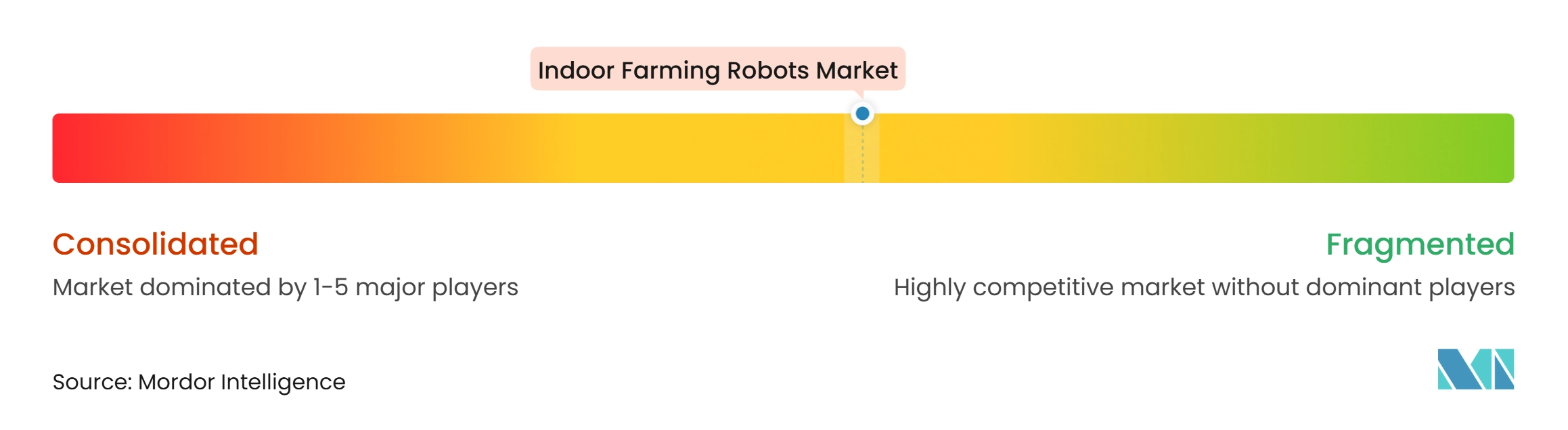
The indoor farming robots market is moderately fragmented in 2026, with major players including Javo B.V., Viscon Group B.V., DENSO Corporation, Saga Robotics AS, and MetoMotion Ltd. These companies address different operational needs, including plant handling, greenhouse scouting, automated harvesting, and crop-care operations. Their offerings vary in crop compatibility, autonomy, facility integration, and service models. Competitive positioning depends on the ability to deliver reliable systems that fit growers' workflows, demonstrate practical operating value, and adapt to the requirements of different controlled-environment production systems.
Competition is shaped by the breadth of each supplier's robotics portfolio and its ability to integrate equipment with greenhouse infrastructure. Javo B.V. focuses on plant and pot handling, while Viscon Group B.V. combines greenhouse automation with mobile scouting technology. DENSO Corporation brings industrial automation capabilities into horticultural production, and Saga Robotics AS develops autonomous platforms for crop treatment and monitoring. MetoMotion Ltd. focuses on robotic harvesting and packing in greenhouse environments. These distinct approaches allow suppliers to address different tasks across the production cycle rather than compete through a single standardized robot configuration.
Product specialization is an important competitive approach because indoor crops differ in structure, maturity patterns, handling sensitivity, and growing layouts. Suppliers must align machine vision, navigation, end effectors, and data systems with the crop and facility in which the robot operates. MetoMotion Ltd.'s GRoW platform illustrates this approach through an autonomous greenhouse robot that identifies ripe produce, harvests it with robotic arms, and packs it into boxes. Such crop-oriented designs demonstrate how integrated harvesting and post-harvest functions can differentiate suppliers as growers assess equipment fit, reliability, and compatibility with existing workflows.
Indoor Farming Robots Industry Leaders
-
Javo B.V.
-
Viscon Group B.V.
-
DENSO Corporation
-
Saga Robotics AS
-
MetoMotion Ltd.
- *Disclaimer: Major Players sorted in no particular order
Indoor Farming Robots Market Companies Covered in this Report
- Harvest Automation, Inc.
- MetoMotion Ltd.
- Organifarms GmbH
- Four Growers, Inc.
- Dogtooth Technologies Limited
- Javo B.V.
- Viscon Group B.V.
- Inaho Inc.
- TTA-ISO
- Saga Robotics AS
- Octiva B.V.
- DENSO Corporation
- Arugga AI Farming Ltd.
- 4AG Robotics Inc.
- Mycionics Inc.
Recent Industry Developments in Indoor Farming Robots Market
- October 2026: Biobest Group NV introduced Polly, an automated tomato pollination robot developed in collaboration with Arugga AI Farming Ltd. The commercial launch expanded Biobest's greenhouse technology portfolio with robotic pollination capabilities designed to support controlled-environment tomato production.
- June 2025: TTA-ISO launched HarvAI, an AI-powered tomato-harvesting robot. The system combines 3D navigation and vine tracking to identify ripe tomatoes, automate picking, and collect crop performance data in commercial greenhouse operations.
- May 2025: Octiva B.V. acquired Berkvens Greenhouse Mobility B.V., a manufacturer of greenhouse mobility equipment. The acquisition strengthened Octiva's greenhouse automation portfolio by integrating autonomous robotic technologies with mobility solutions for crop production and internal greenhouse logistics.
Global Indoor Farming Robots Market Report Scope
Indoor farming robots are automated machines designed to perform agricultural tasks in controlled growing environments, such as vertical farms and greenhouses. They are used for seeding, planting, harvesting, crop monitoring, pruning, sorting, and material handling, improving operational efficiency, precision, and labor productivity. The indoor farming robots market report is segmented by robot type (harvesting and picking robots, seeding and planting robots, monitoring and inspection robots, material handling and sorting robots, cutting and pruning robots, weeding and crop-care robots, robotic fodder systems, monitoring drones, cleaning robots, and other robot types), by automation level (semi-autonomous robots and fully autonomous robots), by application (planting and seeding, crop monitoring and scouting, harvesting and picking, pruning and cutting, material handling, sorting and packaging, and cleaning and sanitation), by crop type (leafy greens, herbs, strawberries and berries, tomatoes, cucumbers, other fruits and vegetables, floriculture crops, and fodder crops), by indoor farming system (vertical farms, greenhouses, hydroponic farms, aeroponic farms, aquaponic farms, and indoor plant nurseries), and by geography (North America, South America, Europe, Asia-Pacific, Middle East, and Africa). The market forecasts are provided in terms of value (USD).
Segmentation Overview
| Harvesting and Picking Robots |
| Seeding and Planting Robots |
| Monitoring and Inspection Robots |
| Material Handling and Sorting Robots |
| Cutting and Pruning Robots |
| Weeding and Crop-Care Robots |
| Robotic Fodder Systems |
| Monitoring Drones |
| Cleaning Robots |
| Other Robot Types |
| Semi-Autonomous Robots |
| Fully Autonomous Robots |
| Planting and Seeding |
| Crop Monitoring and Scouting |
| Harvesting and Picking |
| Pruning and Cutting |
| Material Handling |
| Sorting and Packaging |
| Cleaning and Sanitation |
| Leafy Greens |
| Herbs |
| Strawberries and Berries |
| Tomatoes |
| Cucumbers |
| Other Fruits and Vegetables |
| Floriculture Crops |
| Fodder Crops |
| Vertical Farms |
| Greenhouses |
| Hydroponic Farms |
| Aeroponic Farms |
| Aquaponic Farms |
| Indoor Plant Nurseries |
| North America | United States |
| Canada | |
| Mexico | |
| Rest of North America | |
| South America | Brazil |
| Argentina | |
| Chile | |
| Rest of South America | |
| Europe | Germany |
| United Kingdom | |
| France | |
| Netherlands | |
| Italy | |
| Spain | |
| Russia | |
| Rest of Europe | |
| Asia-Pacific | China |
| Japan | |
| India | |
| South Korea | |
| Australia | |
| Singapore | |
| Rest of Asia-Pacific | |
| Middle East | Saudi Arabia |
| United Arab Emirates | |
| Israel | |
| Turkey | |
| Rest of Middle East | |
| Africa | South Africa |
| Egypt | |
| Nigeria | |
| Kenya | |
| Rest of Africa |
| By Robot Type | Harvesting and Picking Robots | |
| Seeding and Planting Robots | ||
| Monitoring and Inspection Robots | ||
| Material Handling and Sorting Robots | ||
| Cutting and Pruning Robots | ||
| Weeding and Crop-Care Robots | ||
| Robotic Fodder Systems | ||
| Monitoring Drones | ||
| Cleaning Robots | ||
| Other Robot Types | ||
| By Automation Level | Semi-Autonomous Robots | |
| Fully Autonomous Robots | ||
| By Application | Planting and Seeding | |
| Crop Monitoring and Scouting | ||
| Harvesting and Picking | ||
| Pruning and Cutting | ||
| Material Handling | ||
| Sorting and Packaging | ||
| Cleaning and Sanitation | ||
| By Crop Type | Leafy Greens | |
| Herbs | ||
| Strawberries and Berries | ||
| Tomatoes | ||
| Cucumbers | ||
| Other Fruits and Vegetables | ||
| Floriculture Crops | ||
| Fodder Crops | ||
| By Indoor Farming System | Vertical Farms | |
| Greenhouses | ||
| Hydroponic Farms | ||
| Aeroponic Farms | ||
| Aquaponic Farms | ||
| Indoor Plant Nurseries | ||
| By Geography | North America | United States |
| Canada | ||
| Mexico | ||
| Rest of North America | ||
| South America | Brazil | |
| Argentina | ||
| Chile | ||
| Rest of South America | ||
| Europe | Germany | |
| United Kingdom | ||
| France | ||
| Netherlands | ||
| Italy | ||
| Spain | ||
| Russia | ||
| Rest of Europe | ||
| Asia-Pacific | China | |
| Japan | ||
| India | ||
| South Korea | ||
| Australia | ||
| Singapore | ||
| Rest of Asia-Pacific | ||
| Middle East | Saudi Arabia | |
| United Arab Emirates | ||
| Israel | ||
| Turkey | ||
| Rest of Middle East | ||
| Africa | South Africa | |
| Egypt | ||
| Nigeria | ||
| Kenya | ||
| Rest of Africa | ||
Key Questions Answered in the Report
What is the projected value of indoor farming robots by 2032?
The indoor farming robots market size is projected to grow by USD 903.74 million by 2032.
Which robot type has the largest share in indoor farms?
Harvesting and picking robots held the largest share at 34.0% in 2026.
Why are fully autonomous robots gaining adoption in indoor farms?
Fully autonomous robots held the largest share at 52.0% in 2026 and are projected to grow at a 12.9% CAGR from 2027 to 2032.
Which crop is most suitable for indoor farm robotics?
Leafy greens accounted for the largest share at 40.0% in 2026 because their production cycles and physical layout work well with tray handling and conveyor systems.