
Indoor Berry Farming Market Size and Share
Market Overview
| Study Period | 2022 - 2032 |
|---|---|
| Market Size (2027) | USD 2.65 Billion |
| Market Size (2032) | USD 6.67 Billion |
| Growth Rate (2027 - 2032) | 20.28 % |
| Fastest Growing Market | Asia-Pacific |
| Largest Market | North America |
| Market Concentration | Medium |
Major Players *Disclaimer: Major Players sorted in no particular order Image © Mordor Intelligence. Reuse requires attribution under CC BY 4.0. | |
Indoor Berry Farming Market Analysis by Mordor Intelligence
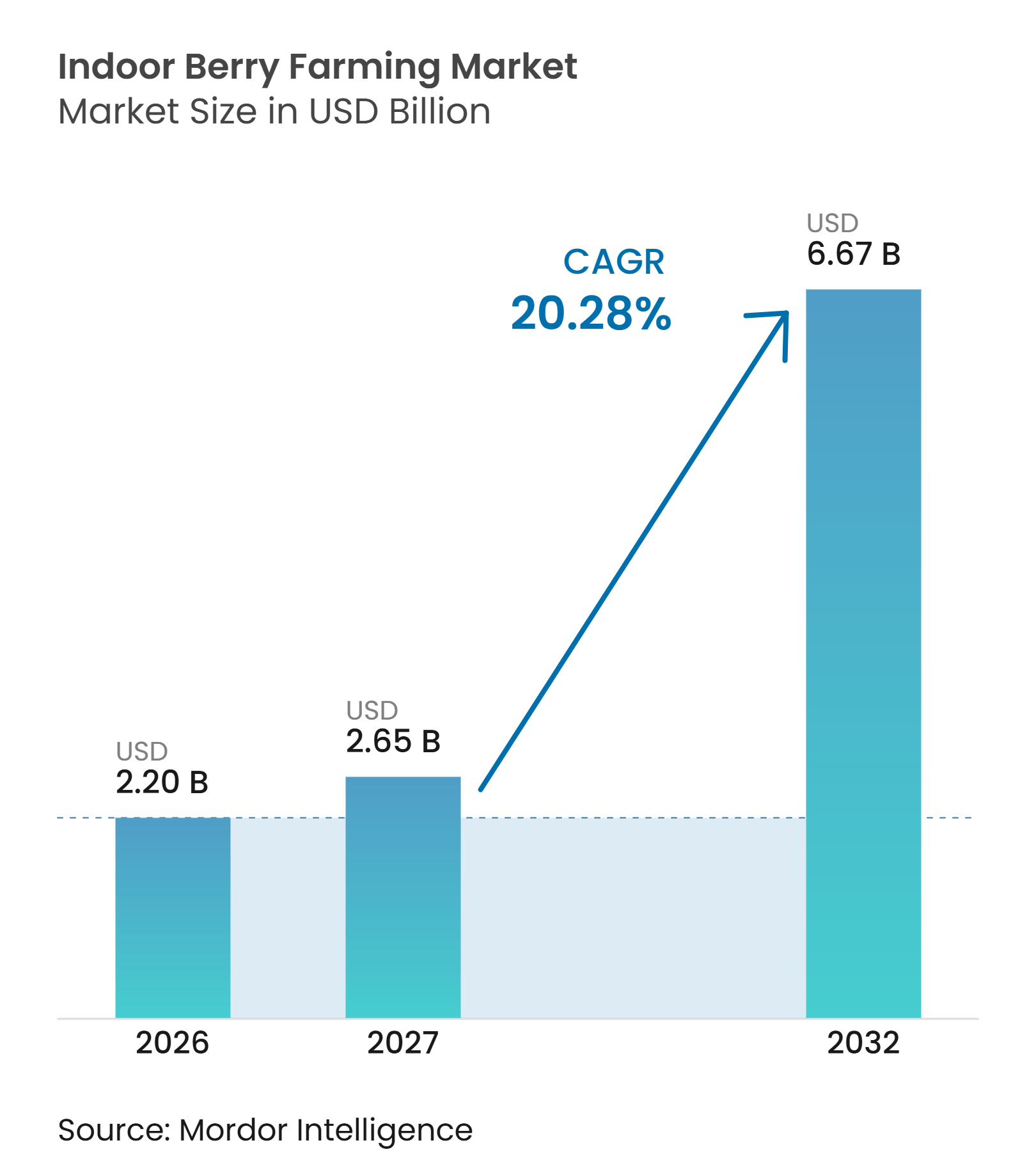
The indoor berry farming market was valued at USD 2.20 billion in 2026 and is forecast to grow from USD 2.65 billion in 2027 to USD 6.67 billion by 2032, at a CAGR of 20.28% from 2027 to 2032. Controlled production allows growers to supply premium berries when outdoor harvests are unavailable and imported fruit faces longer handling times, making freshness and predictable availability important commercial considerations. Strawberry production has advanced furthest into commercial operations because cultivars, growing protocols, and retail positioning are more established than they are for blueberries, raspberries, and blackberries. Larger farms are being paired with specialized genetics, automation, and retailer partnerships to improve production economics and deliver fruit to defined local customer areas. Electricity costs, pollination requirements, and the limited availability of indoor-adapted blueberry and blackberry cultivars remain material constraints that can delay wider crop diversification. In the near term, the indoor berry farming market depends on strawberry capacity, while newer berry categories require further crop and cultivar development before they can scale.
Key Report Takeaways
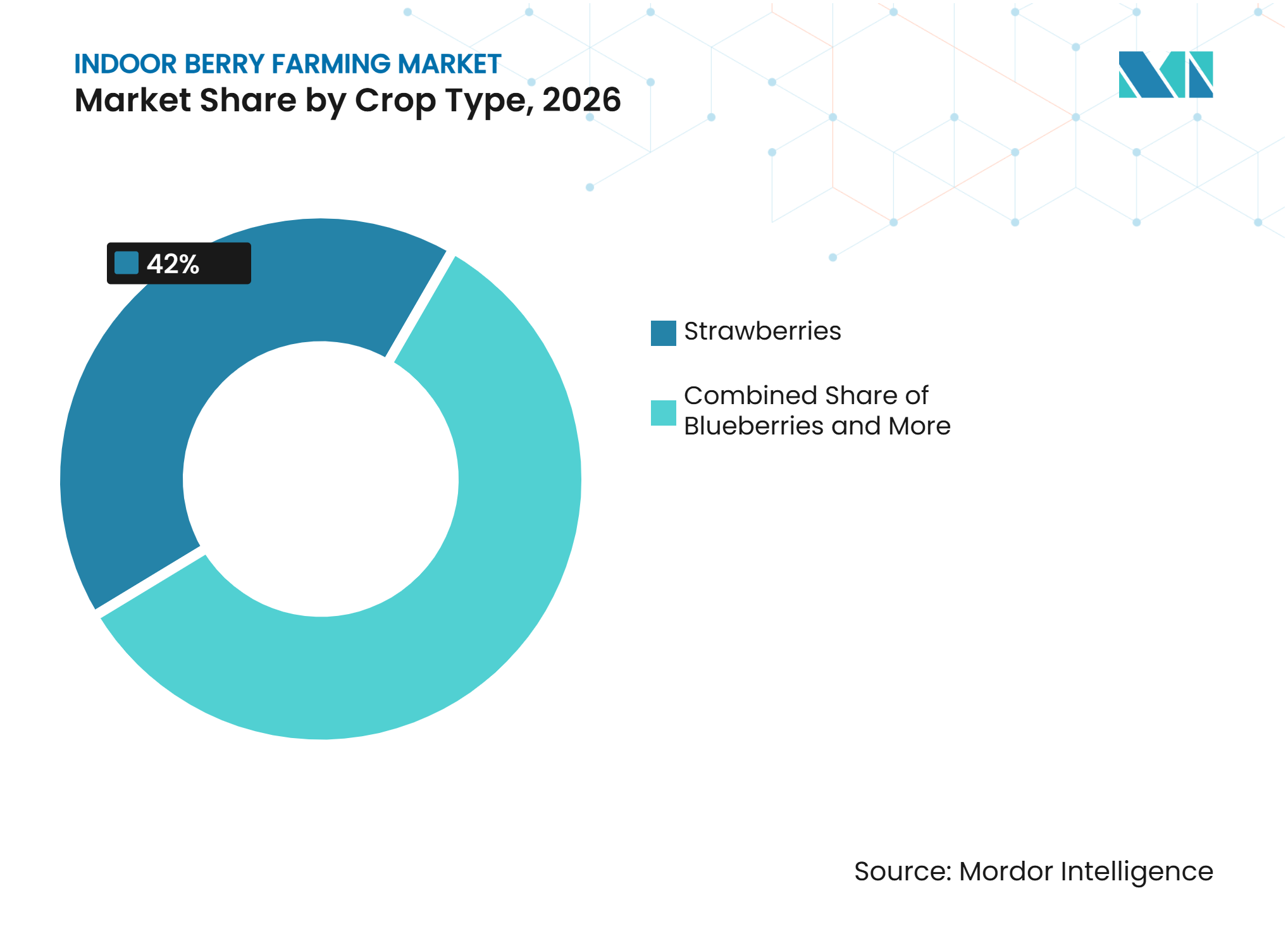
- By crop type, strawberries were the largest segment and held 42.0% of the indoor berry farming market share in 2026, while blueberries are the fastest-growing segment and are forecast to expand at a 24.0% CAGR between 2027 and 2032.
- By cultivation method, hydroponics was the largest segment and held 48.0% of the indoor berry farming market size in 2026, and it is also the fastest-growing segment and is forecast to expand at a 23.0% CAGR between 2027 and 2032.
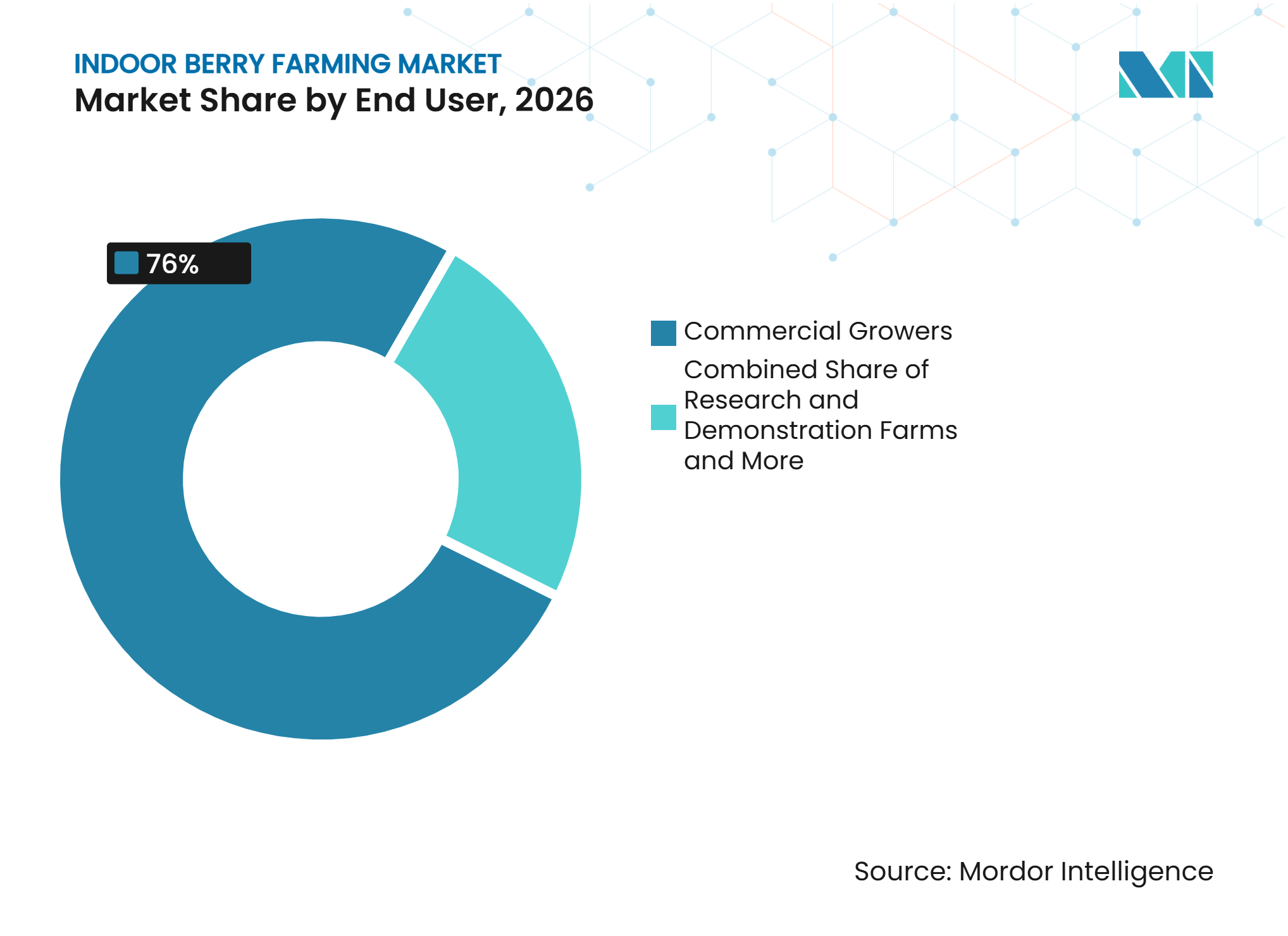
- By end user, commercial growers were the largest segment and held 76.0% of the market share in 2026, while research and demonstration farms are the fastest-growing segment and are forecast to expand at a 20.0% CAGR between 2027 and 2032.
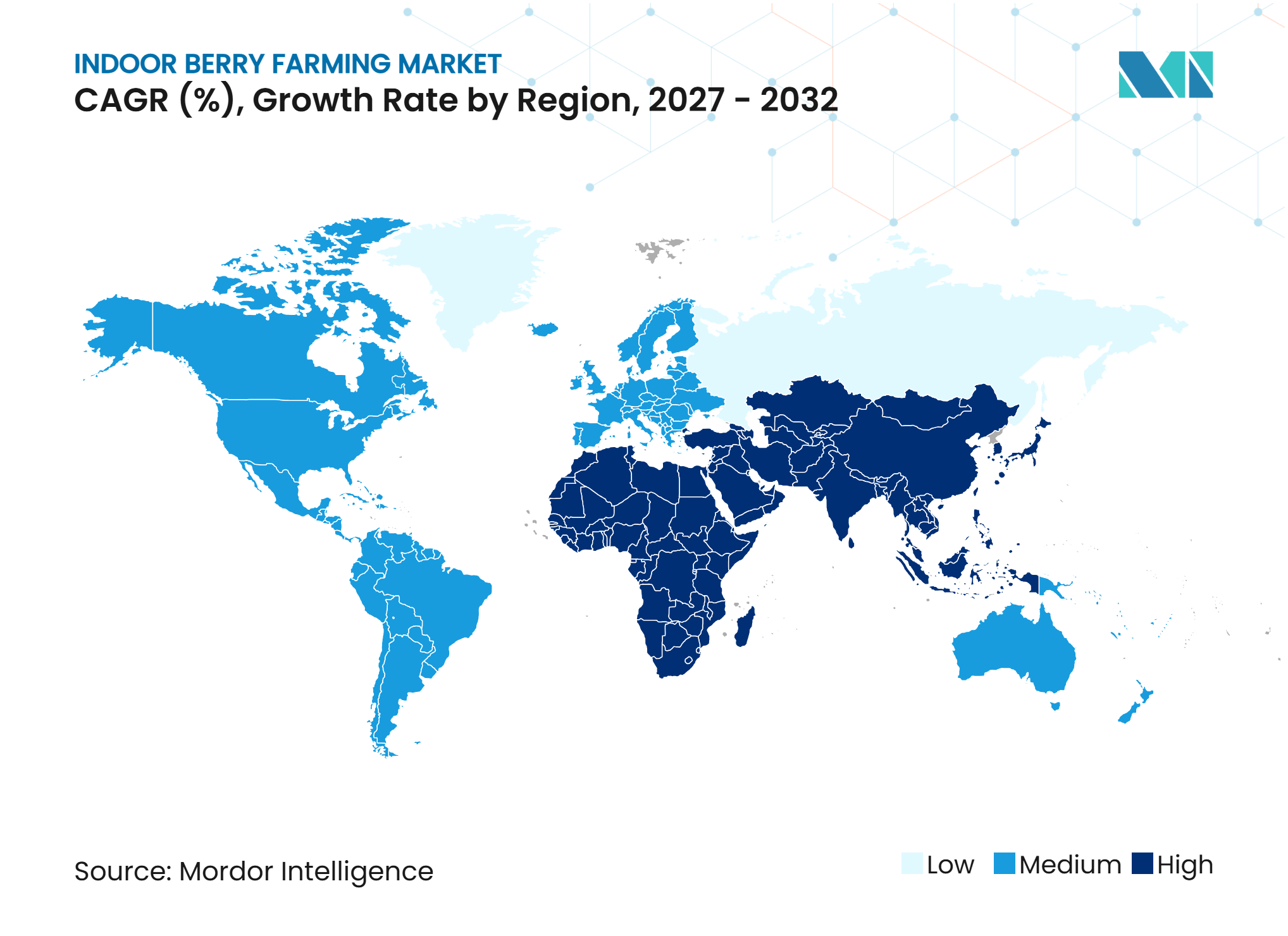
- By geography, North America was the largest region and held 39.0% of the market share in 2026, while Asia-Pacific is the fastest-growing region and is forecast to expand at a 24.0% CAGR between 2027 and 2032.
Note: Market numbers in this report are based on Mordor Intelligence's proprietary estimation framework, which combines nine months of actuals with Q4 projections for base year 2026.
Market Trends and Insights
Drivers Impact Analysis of Indoor Berry Farming Market*
| Driver | (~) % Impact on CAGR Forecast | Geographic Relevance | Impact Timeline |
|---|---|---|---|
| Year-Round Premium Berry Availability | +3.5% | Global, with highest intensity in North America and Europe | Short term (≤ 2 years) |
| Urban Freshness and Shorter Supply Chains | +2.8% | North America and Europe, with spillover into Asia-Pacific urban centers | Short term (≤ 2 years) |
| Higher Value Capture From Flavor-Differentiated Cultivars | +2.5% | North America, Japan, and South Korea | Medium term (2-4 years) |
| Water and Land Productivity Requirements | +2% | Middle East, arid Asia-Pacific areas, and water-stressed South America | Long term (≥ 4 years) |
| Indoor Berry Genetics and Crop Protocol Development | +2.2% | Global, with research leadership in North America, Europe, and Japan | Long term (≥ 4 years) |
| Retail Demand for Consistent Local Supply | +2.8% | North America and Europe, expanding to Gulf Cooperation Council (GCC) and Asia-Pacific premium retail | Medium term (2-4 years) |
| Source: Mordor Intelligence | |||
Year-Round Premium Berry Availability
Seasonal production and reliance on imported fruit create opportunities for indoor berry farming by enabling more consistent supply outside conventional growing windows. Outdoor strawberry and raspberry production in temperate regions is influenced by seasonal temperatures, daylight availability, and weather conditions, while imported berries often require extended transportation and refrigerated storage before reaching retailers. Indoor farms can control lighting, temperature, humidity, and nutrient delivery to support production across a broader portion of the year and schedule harvests to meet retail demand. A commercial example is the Driscoll's Plenty Sweet strawberry offering, produced through the partnership between Driscoll's and Plenty at a vertical farm in Richmond, Virginia. The offering targets consumers within approximately 150 miles of the facility, using local production and freshness as differentiating factors. By shortening the distance between production and consumption, indoor farming can help reduce transit time and improve the availability of premium berries in nearby markets. This ability to supply fruit beyond traditional seasonal windows and serve regional retailers with locally grown produce is supporting the development of the indoor berry farming market.
Urban Freshness and Shorter Supply Chains
The demand for fresher produce and more reliable local procurement is supporting the indoor berry farming market by encouraging production closer to major consumption centers. Berries are highly perishable, making transit time, temperature management, and handling important factors in maintaining product quality and shelf life. According to the United States Department of Agriculture's Economic Research Service report in 2024, approximately 8% of fresh strawberries are lost through spoilage and trimming, highlighting the importance of minimizing losses throughout the supply chain[1]. Indoor farms located near urban markets can shorten delivery routes, reduce dependence on long-distance transportation, and provide retailers with more direct access to locally harvested fruit. Plenty Unlimited Inc., in partnership with Driscoll's, operates a vertical strawberry farm in Richmond, Virginia, designed to produce more than 4 million pounds of strawberries annually in less than 40,000 square feet. The farm targets nearby markets, with Driscoll's Plenty Sweet strawberries intended for consumers within 150 miles of the facility. By reducing transportation distances and establishing closer relationships with retailers, indoor berry producers can improve supply-chain responsiveness and strengthen their appeal to buyers seeking consistent access to fresh produce.
Higher Value Capture From Flavor-Differentiated Cultivars
Indoor berry farming enables growers to manage lighting, temperature, and nutrient delivery more precisely, creating opportunities to differentiate strawberries through fruit quality, consistency, and production scheduling. These controlled conditions can help growers target specific quality characteristics across harvest cycles, supporting premium positioning in retail channels where consumers value sweetness, firmness, and consistent flavor. A 2025 study published in the Journal of Applied Botany and Food Quality found that an ever-bearing strawberry cultivar grown in a vertical indoor farming system achieved an annual yield of 15.2 kilograms of fresh fruit per square meter, with a high harvest index of up to 0.8 and a low proportion of non-marketable fruit[2]. The study demonstrates the potential of cultivar selection and controlled production to improve growing-space utilization and marketable output. By combining suitable strawberry varieties with precise environmental management, indoor growers can develop differentiated products and maintain more consistent supply across production cycles. This creates opportunities for premium pricing and repeat retail demand, strengthening the commercial potential of the indoor berry farming market.
Retail Demand for Consistent Local Supply
Retailers are increasingly seeking reliable supplies of fresh berries to reduce seasonal availability gaps, weather-related disruptions, and dependence on long-distance transportation. Indoor berry farming enables controlled production closer to consumption centers, supporting more consistent harvest schedules, product quality, and year-round availability. Partnerships between indoor growers and established berry companies can further strengthen market access by combining controlled-environment production with specialized genetics, established branding, and retail distribution networks. For example, the Driscoll’s–Plenty partnership combines Driscoll’s berry expertise and genetics with Plenty’s indoor farming capabilities to develop premium strawberries for retail markets. Such collaborations can provide indoor growers with clearer routes to market, support demand planning, and improve the commercial viability of new facilities as production scales. As retailers prioritize supply consistency and product quality, demand for locally produced indoor-grown berries is supporting the growth of the indoor berry farming market.
Restraints Impact Analysis of Indoor Berry Farming Market*
| Restraint | (~) % Impact on CAGR Forecast | Geographic Relevance | Impact Timeline |
|---|---|---|---|
| Electricity Intensity and Carbon Exposure | -2.8% | Global, most acute in Europe and high-tariff North American markets | Short term (≤ 2 years) |
| Pollination and Fruit-Set Complexity | -1.8% | Global, with highest operational risk in fully enclosed vertical farms | Medium term (2-4 years) |
| High Crop-Cycle Failure Cost | -1.2% | Global, with greater exposure where technical labor is limited | Medium term (2-4 years) |
| Limited Cultivar Fit for Indoor Production | -0.9% | Global, most pronounced in blueberry and caneberry programs | Long term (≥ 4 years) |
| Source: Mordor Intelligence | |||
Electricity Intensity and Carbon Exposure
High electricity consumption and exposure to fluctuating power tariffs remain key restraints on the indoor berry farming market, particularly for fully enclosed vertical farms that depend on artificial lighting and climate-control systems. A 2025 meta-analysis published in npj Sustainable Agriculture, covering 116 studies across 40 countries, examined the environmental performance of controlled-environment agriculture and highlighted the importance of energy consumption in assessing indoor production systems. The article published in Thermal Science and Engineering Progress in 2024 reported specific energy consumption of approximately 10–18 kilowatt-hours per kilogram for vertical farming of leafy crops[3]. Indoor strawberry and other fruiting-berry production can require extended lighting periods and carefully controlled temperature and humidity throughout the growing cycle. These requirements increase exposure to electricity prices and can raise production costs when energy tariffs increase, or low-carbon electricity is unavailable. Consequently, energy-intensive operations may face pressure on operating margins, particularly in regions with high power prices, making energy-efficient lighting, climate control, and access to reliable low-carbon electricity important factors in the commercial viability of indoor berry farms.
Pollination and Fruit-Set Complexity
Pollination management remains a technical challenge in the indoor berry farming market because fruiting crops such as strawberries require successful pollination to achieve consistent fruit set and marketable fruit quality. In fully enclosed facilities, growers must manage pollination alongside lighting, temperature, humidity, and other environmental conditions, adding complexity to production compared with leafy crops that do not require pollination. According to a 2025 Institute of Electrical and Electronics Engineers (IEEE) International Conference on Robotics and Automation paper, researchers developed a seven-degree-of-freedom robotic pollination system for strawberry vertical farms that used microscopic flower inspection to verify pollen transfer. The development highlights the technical requirements involved in automating pollination in controlled environments. For commercial indoor berry farms, ensuring reliable pollination across large growing areas can increase operational complexity and create challenges in maintaining consistent production outcomes.
*Our forecasts treat driver/restraint impacts as directional, not additive. The impact forecasts reflect baseline growth, mix effects, and variable interactions.
Indoor Berry Farming Market Segment Analysis
By Crop Type:
Strawberries Lead Revenue While Blueberries Have the Highest Growth RateStrawberries held 42.0% of the indoor berry farming market share in 2026. This position reflects a well-established cultivar library, workable indoor production protocols, and proven premium retail positioning. Strawberries benefit from relatively short production cycles and high consumer recognition, which supports consistent demand across retail channels. Oishii Farm Corporation's Amatelas Farm in New Jersey and Plenty Unlimited Inc.'s Richmond facility are large commercial examples that have helped establish performance benchmarks for other indoor berry crops. These facilities demonstrate that indoor strawberry production can achieve commercially viable yields and quality standards at scale.
Blueberries are forecast to grow at a 24.0% CAGR between 2027 and 2032, supported by consumer demand, premium retail pricing, and ongoing work on compact, indoor-adapted varieties. Raspberries and blackberries retain smaller market shares due to fruit fragility and less established scaled indoor production protocols. Specialty and exotic berries serve premium hospitality and functional food buyers. A 2025 Frontiers in Plant Science study found that substrate systems outperformed water-culture systems in hydroponic strawberry production across several yield and resource-efficiency measures. These findings provide cultivar-agnostic performance evidence that can inform capital allocation as growers evaluate different berry crops and production systems. Further market diversification is likely as similar operational evidence becomes available for blueberries and caneberries.



By Cultivation Method:
Hydroponics Leads While Aeroponics Builds a Distinct PositionHydroponics held 48.0% of the indoor berry farming market in 2026 and is forecast to grow at a 23.0% CAGR between 2027 and 2032. Its dominant position reflects technology maturity, lower capital requirements than some alternatives, and extensive data on strawberry root-zone management. Nutrient film technique and Dutch bucket systems are widely used configurations, offering growers established approaches to nutrient delivery and water management. Substrate-based soilless systems are gaining attention in Asian markets due to their ability to reduce disease-transmission risk in semi-closed recycling systems. Hydroponics remains the most established method for commercial berry production under controlled conditions.
Aeroponics offers a distinct approach through lower water use and root-zone conditions suitable for crops sensitive to waterlogging. AeroFarms Inc. reports that its aeroponic system uses 90% less water than field farming. Vertical farming uses stacked growing layers in enclosed facilities and continues to attract institutional capital, with Plenty's Richmond facility and Oishii's Amatelas Farm serving as commercial examples. The indoor berry farming market also includes aquaponics, primarily used in circular-economy and education-linked farms. Additionally, organic certification rules can determine whether certain soilless configurations qualify for organic-premium retail tiers in the United States and European Union.
By End User:
Commercial Growers Lead While Research Farms Expand FastestCommercial growers held 76.0% of the indoor berry farming market share in 2026. This concentration reflects revenue being centered in purpose-built farms that combine crop production with retail supply. Retail-owned farms represent a separate model used by supermarket groups seeking supply beyond outdoor seasons. Foodservice-integrated growers serve hospitality and restaurant customers that require consistent premium fruit for prepared food applications. Commercial operations remain central because their facilities are designed around production economics, distribution needs, and the ability to supply consistent volume to a defined customer base.
Research and demonstration farms are forecast to grow at a 20.0% CAGR between 2027 and 2032. Public and institutional spending supports crop-protocol development for blueberries and caneberries, which are at an earlier stage of controlled-environment development than strawberries. Simon Fraser University's 2025 collaboration with BeriTech Inc. has CAD 5 million (USD 3.7 million) in funding over three years. This work provides a pathway for emerging berry programs to build evidence before commercial deployment. The transition from research-stage work to commercial output expands the operating base of the indoor berry farming market in Asia-Pacific.

Geography Analysis
North America held 39.0% of the indoor berry farming market share in 2026, supported by investment in commercial indoor strawberry production and research into year-round berry cultivation. In the United States, Oishii Farm Corporation's Amatelas Farm in Phillipsburg, New Jersey, spans more than 237,500 square feet and combines vertical growing systems, robotics, and solar energy to support indoor berry production. Plenty Unlimited Inc. also opened its Richmond, Virginia, facility in September 2024, designed to produce more than 4 million pounds of strawberries annually in partnership with Driscoll's. In Canada, the Weston Family Foundation's Homegrown Innovation Challenge funded research led by Simon Fraser University and industry partner BeriTech Inc. to develop indoor blueberry production and expand trials to raspberries and blackberries. These commercial and research initiatives support the region's development of controlled-environment berry production systems and year-round supply capabilities.
Asia-Pacific is projected to be the fastest-growing regional market, with a CAGR of 24% between 2027 and 2032. Japan and South Korea have developed indoor farming capabilities, while China is investing in intelligent greenhouse systems for berry production. South Korea's NextOn reports that its indoor strawberry system can produce a first harvest within 45–50 days, compared with approximately 120 days under conventional protected cultivation, and supports more than 10 harvests annually. In China, an intelligent blueberry greenhouse in Qidong, Jiangsu, uses automated monitoring and environmental controls and can be managed by three full-time workers. These examples demonstrate regional investment in controlled-environment berry production, automation, and production-cycle optimization. The Middle East and Africa also present potential applications for controlled-environment agriculture, particularly where climate conditions and urban supply requirements encourage protected production, although comparable evidence on commercial indoor berry-farming scale in these regions remains limited.
Europe has an established controlled-environment agriculture base, including greenhouse expertise and emerging vertical strawberry production systems. Vertiberry BV, founded in Brussels, has developed controlled-environment strawberry production technology and operates a commercial production facility in Quebec, while offering systems and expertise to growers in North America and Europe. Energy efficiency remains an important consideration for European indoor farms, where artificial lighting and climate control contribute to operating costs. A 2025 Institute of Electrical and Electronics Engineers (IEEE) conference paper examining direct-current-grid LED lighting for indoor strawberry production reported an 8.5% reduction in installed lighting-system power. Such technical developments are relevant to indoor berry growers seeking to improve energy efficiency and manage operating costs, although the reported reduction should not be interpreted as an equivalent reduction in total farm energy consumption.
Competitive Landscape
Market Concentration
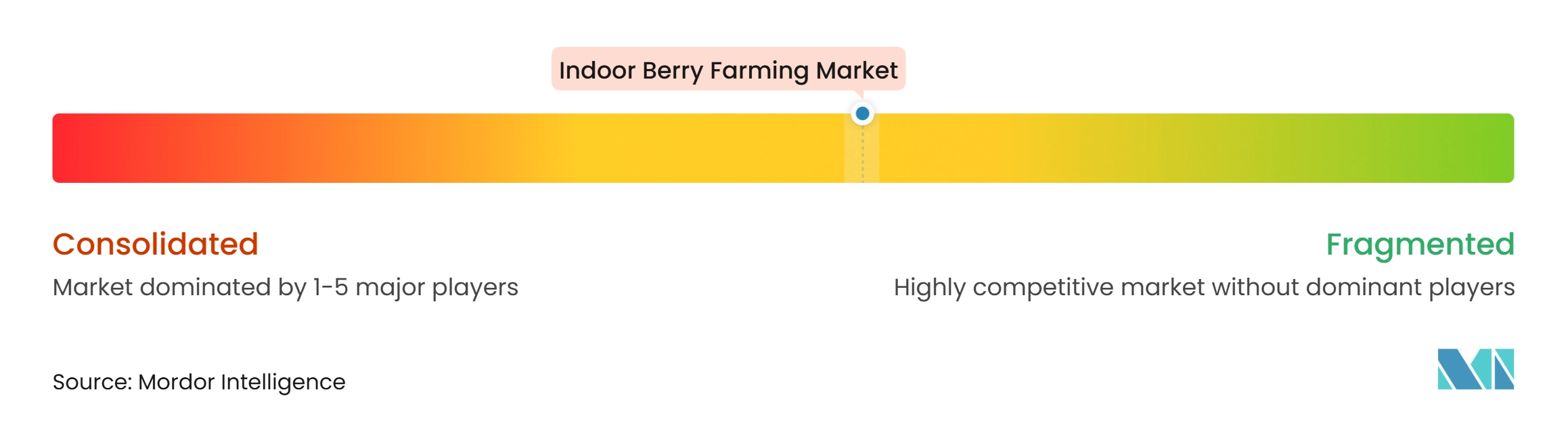
The indoor berry farming market was moderately concentrated in 2026, with the five leading operators accounting for a major share of the market. The indoor berry farming market features competition among specialized indoor fruit producers, technology-driven farming companies, and established berry businesses with expertise in genetics and retail distribution. Oishii Farm Corporation and Plenty Unlimited Inc. are among the most directly relevant players in commercial indoor strawberry production, competing through cultivation technology, fruit quality, production consistency, and retail positioning. Driscoll’s, Inc. complements this competitive landscape through proprietary berry genetics and its partnership with Plenty, combining crop-development expertise with indoor farming infrastructure. AeroFarms, Inc. operates in the adjacent vertical farming sector, with its commercial focus on microgreens rather than indoor berries. Bowery Farming Inc. was also associated with vertical farming and berry research, but reportedly ceased operations in November 2024 and should not be presented as an active competitor in 2026. The market's competitive structure is shaped by the capital required to establish controlled-environment facilities, develop crop-specific growing systems, and achieve commercially viable production costs.
Competitive differentiation increasingly depends on scaling production while maintaining fruit quality and controlling operating costs. In May 2026, Oishii Farm Corporation announced the first closing of a USD 150 million Series C financing round to expand production, broaden retail access, and advance its indoor farming technology. In August 2026, the company announced plans to begin producing and selling strawberries in Japan, extending its commercial activities beyond the United States. Plenty Unlimited Inc. completed its Chapter 11 restructuring in May 2025 and identified expansion of its Richmond, Virginia, strawberry farm and the sale of its vertical-farming technology for deployment at other locations as priorities. Its partnership with Driscoll’s combines Plenty's controlled-environment production systems with Driscoll's proprietary strawberry varieties and berry-market expertise. These developments illustrate how investment, technology commercialization, and collaboration between farming technology providers and established berry companies are shaping competitive strategies.
Operational efficiency, crop-specific research, and access to retail channels remain important to long-term competitive positioning. Oishii's investment in robotics and automation, Plenty's vertical-farming platform, and Driscoll's genetics expertise represent different approaches to improving consistency and commercial performance in indoor berry production. AeroFarms provides a relevant example of adjacent-sector competition in indoor-grown produce: in June 2026, an affiliate of Palm Ventures completed its acquisition of the company, followed by expanded product distribution and new microgreen launches. However, these developments relate to microgreens rather than berry production and should not be interpreted as direct evidence of growth in indoor berry farming. Overall, competitive success in the indoor berry farming market will depend on translating cultivation technology and crop expertise into consistent marketable yields, reliable retail supply, and viable operating economics. Companies pursuing expansion must balance investment in specialized infrastructure with the need to demonstrate repeatable commercial performance.
Indoor Berry Farming Industry Leaders
-
Oishii Farm Corporation
-
Plenty Unlimited Inc.
-
Bowery Farming Inc.
-
Driscoll’s, Inc.
-
AeroFarms, Inc.
- *Disclaimer: Major Players sorted in no particular order
Indoor Berry Farming Market Companies Covered in this Report
- Oishii Farm Corporation
- Plenty Unlimited Inc.
- Vertiberry Production Canada Inc. (Vertiberry BV)
- Pure Harvest Smart Farms Ltd.
- Fragaria Fruits Private Limited
- Mucci Farms Ltd. (Cox Enterprises, Inc.)
- Boem Berry Farms Ltd. (Cox Enterprises, Inc.)
- Mastronardi Produce Limited
- M2labo Bharat Private Limited (M2Labo Co., Ltd.)
- Spread Co., Ltd.
- Driscoll's, Inc.
Recent Industry Developments in Indoor Berry Farming Market
- August 2026: Oishii Farm Corporation opened its Open Innovation Center in Hamura, Tokyo, Japan. The facility brings together companies, research institutions, and public-sector organizations to advance controlled-environment farming technologies, including automation, sustainable production, and crop development.
- March 2026: Sumitomo Corporation entered into a capital and business alliance with HarvestX Inc. to advance AI-enabled automation solutions for controlled-environment farms. HarvestX develops robotic systems that identify strawberry flowers using cameras and three-dimensional image analysis before performing pollination automatically.
- March 2025: Oishii Farm acquired key intellectual property and selected technology-related assets from Tortuga AgTech on March 25, 2025, and brought members of its engineering team into Oishii. The transaction included AI models, robotics software, and hardware design capabilities developed for automated fruit harvesting. The integration is intended to improve harvesting automation and productivity in Oishii's indoor strawberry farming operations.
Global Indoor Berry Farming Market Report Scope
The indoor berry farming market comprises the cultivation of berries, including strawberries, blueberries, raspberries, and blackberries, in indoor or controlled-environment facilities. These systems use technologies such as vertical farming structures, hydroponics, artificial lighting, climate control, irrigation, and automated monitoring to regulate growing conditions, improve production consistency, and support year-round cultivation. The market includes commercially produced indoor berries supplied to retailers, food-service businesses, and consumers. It excludes conventional open-field berry cultivation, outdoor production without controlled-environment systems, berry processing and packaged food products, and standalone agricultural technology or genetics sales that are not directly attributable to indoor berry production.
The Indoor Berry Farming Market is Segmented by Crop Type (Strawberries, Blueberries, Raspberries, and More), by Cultivation Method (Vertical Farming, Hydroponics, Aeroponics, and More), by End User (Commercial Indoor Berry Growers, Retail-Owned Farms, and More), and by Geography (North America, South America, Africa, Asia-Pacific, and More). The Market Forecasts are Provided in Terms of Value (USD.
Segmentation Overview
| Strawberries |
| Blueberries |
| Raspberries |
| Blackberries |
| Specialty and Exotic Berries |
| Vertical Farming |
| Hydroponics |
| Aeroponics |
| Aquaponics |
| Substrate-Based Soilless Cultivation |
| Commercial Indoor Berry Growers |
| Retail-Owned Farms |
| Foodservice-Integrated Growers |
| Research and Demonstration Farms |
| North America | United States |
| Canada | |
| Mexico | |
| Rest of North America | |
| South America | Argentina |
| Brazil | |
| Chile | |
| Rest of South America | |
| Europe | Germany |
| United Kingdom | |
| France | |
| Spain | |
| Italy | |
| Russia | |
| Rest of Europe | |
| Asia-Pacific | China |
| Japan | |
| India | |
| Australia | |
| Singapore | |
| South Korea | |
| Rest of Asia-Pacific | |
| Middle East | Saudi Arabia |
| United Arab Emirates | |
| Turkey | |
| Rest of Middle East | |
| Africa | South Africa |
| Kenya | |
| Nigeria | |
| Rest of Africa |
| By Crop Type | Strawberries | |
| Blueberries | ||
| Raspberries | ||
| Blackberries | ||
| Specialty and Exotic Berries | ||
| By Cultivation Method | Vertical Farming | |
| Hydroponics | ||
| Aeroponics | ||
| Aquaponics | ||
| Substrate-Based Soilless Cultivation | ||
| By End User | Commercial Indoor Berry Growers | |
| Retail-Owned Farms | ||
| Foodservice-Integrated Growers | ||
| Research and Demonstration Farms | ||
| By Geography | North America | United States |
| Canada | ||
| Mexico | ||
| Rest of North America | ||
| South America | Argentina | |
| Brazil | ||
| Chile | ||
| Rest of South America | ||
| Europe | Germany | |
| United Kingdom | ||
| France | ||
| Spain | ||
| Italy | ||
| Russia | ||
| Rest of Europe | ||
| Asia-Pacific | China | |
| Japan | ||
| India | ||
| Australia | ||
| Singapore | ||
| South Korea | ||
| Rest of Asia-Pacific | ||
| Middle East | Saudi Arabia | |
| United Arab Emirates | ||
| Turkey | ||
| Rest of Middle East | ||
| Africa | South Africa | |
| Kenya | ||
| Nigeria | ||
| Rest of Africa | ||
Key Questions Answered in the Report
What is the size of the indoor berry farming market?
The indoor berry farming market was valued at USD 2.20 billion in 2026 and is forecast to grow from USD 2.65 billion in 2027 to USD 6.67 billion by 2032, at a CAGR of 20.28% from 2027 to 2032.
Which crop leads indoor production?
Strawberries held 42.0% of revenue in 2026 because they have more established cultivars, crop protocols, and retail positioning.
What cultivation method is most widely used for indoor berries?
Hydroponics held 48.0% of market share in 2026 because of its maturity and the depth of available data for strawberry root-zone management.
Which region has the greatest commercial base for indoor berries?
North America held 39.0% of the market share in 2026, supported by commercial strawberry farms and premium retail demand.