
Indonesia Roofing Market Size and Share
Market Overview
| Study Period | 2021 - 2032 |
|---|---|
| Forecast Data Period | 2027 - 2032 |
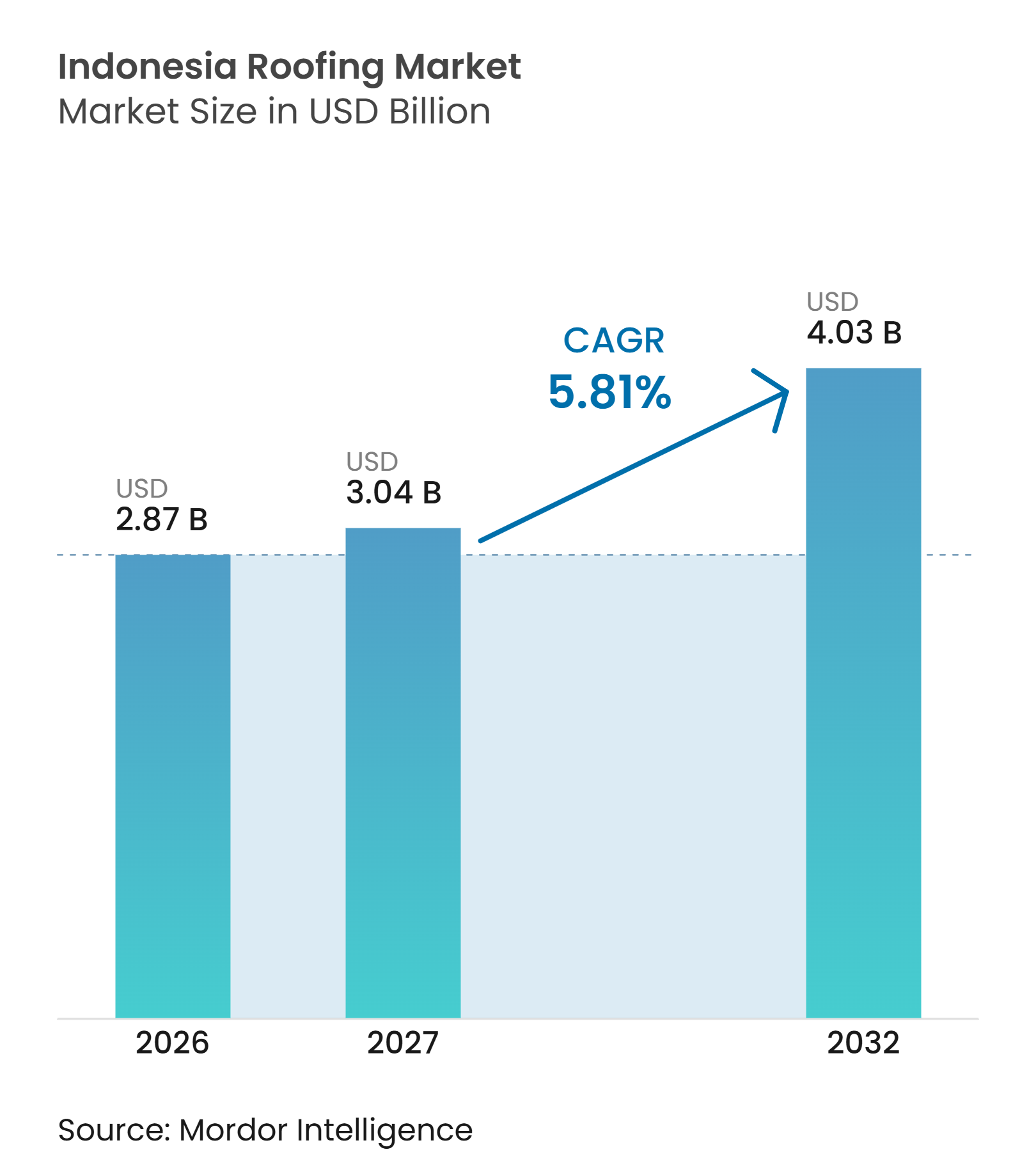
| Base Year Market Size (2026) | USD 2.87 Billion |
| Market Size (2027) | USD 3.04 Billion |
| Market Size (2032) | USD 4.03 Billion |
| Growth Rate (2027 - 2032) | 5.81 % |
| Market Concentration | Low |
Major Players *Disclaimer: Major Players sorted in no particular order Image © Mordor Intelligence. Reuse requires attribution under CC BY 4.0. | |
Indonesia Roofing Market Analysis by Mordor Intelligence
The Indonesia Roofing Market size was valued at USD 2.87 billion in 2026 and is estimated to grow from USD 3.04 billion in 2027 to reach USD 4.03 billion by 2032, at a CAGR of 5.81% during the forecast period (2027-2032).
Government housing delivery supports demand for new roofs and replacement materials across a wider set of provinces. The tile-replacement program also directs demand toward certified local products, while industrial construction expands the use of large-span metal systems. Rooftop solar installations create an additional need for durable, corrosion-resistant roof substrates in commercial and industrial projects. These demand sources reduce the Indonesia roofing market’s reliance on household construction alone. Suppliers that can meet product standards, manage distribution, and support installers are positioned to benefit from this broader demand base.
Key Report Takeaways
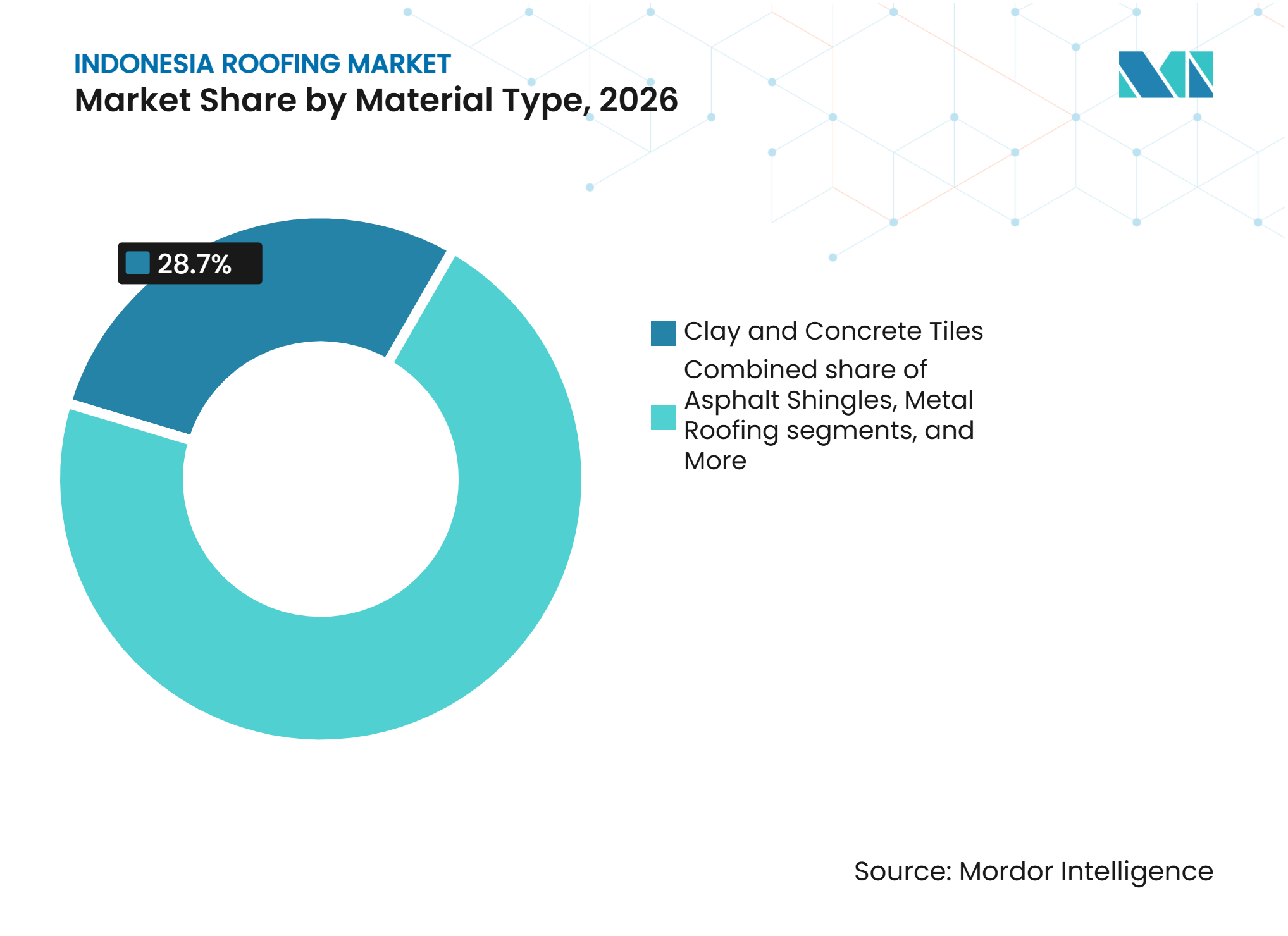
- By material type, clay and concrete tiles held 28.7% of the Indonesia roofing market share in 2026, while metal roofing is forecast to grow at a 6.55% CAGR through 2032.
- By construction type, new construction accounted for 68.6% of the Indonesia roofing market size in 2026, while reroofing / replacement is forecast to grow at a 6.31% CAGR through 2032.
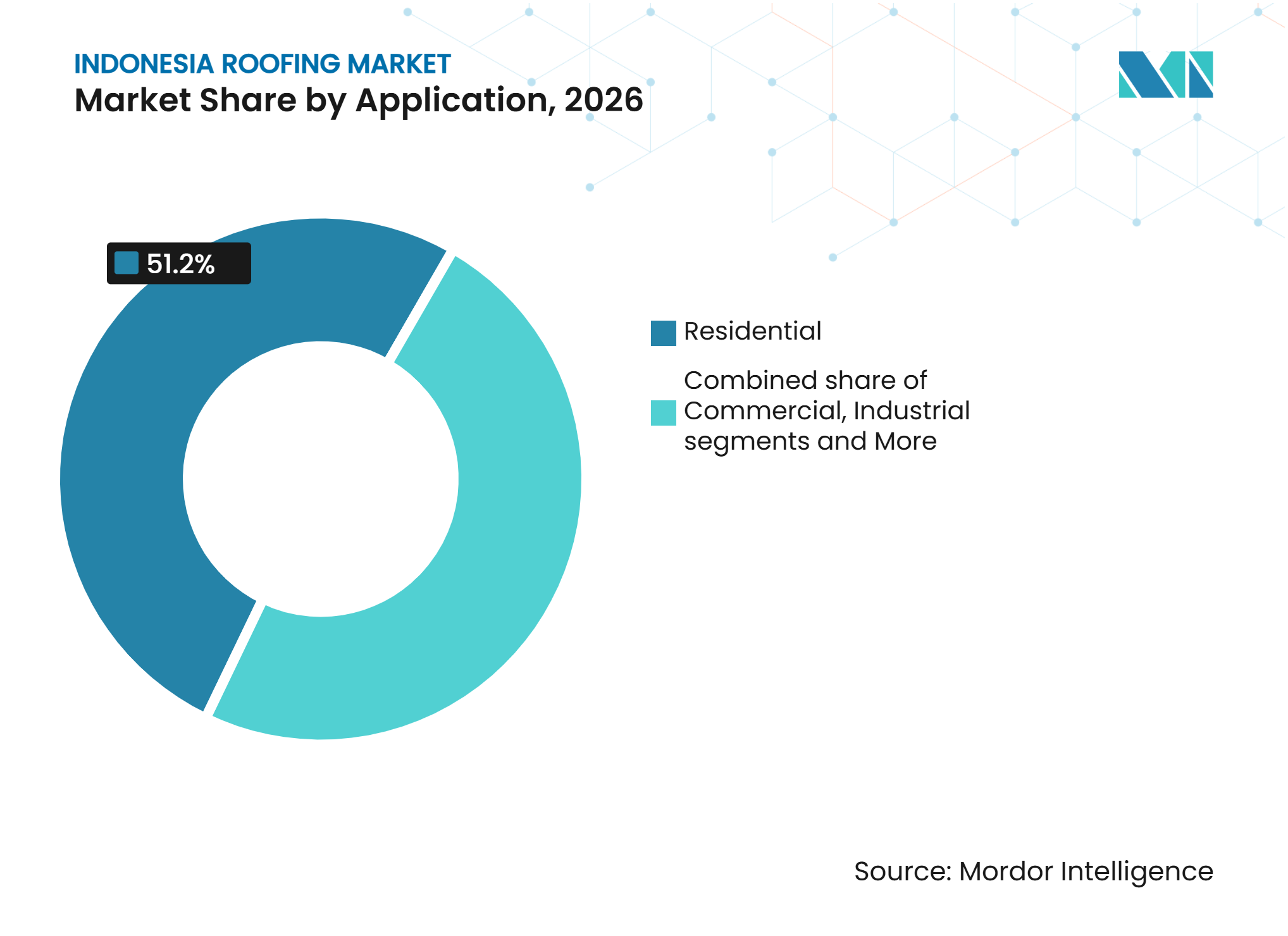
- By application, residential held 51.2% of the Indonesia roofing market in 2026, while commercial is forecast to grow at a 6.61% CAGR through 2032.
- By geography, Java held 55.6% of the Indonesia roofing market in 2026, while Kalimantan is forecast to grow at a 6.89% CAGR through 2032.
Note: Market numbers in this report are based on Mordor Intelligence's proprietary estimation framework, which combines nine months of actuals with Q4 projections for base year 2026.
Market Trends and Insights
Drivers Impact Analysis of Indonesia Roofing Market*
| Drivers | (~) % Impact on CAGR Forecast | Geographic Relevance | Impact Timeline |
|---|---|---|---|
| Three Million Homes Program supports affordable-home construction | +1.5% | National, with the greatest concentration in Java and expanding reach in Kalimantan, Sulawesi, and Sumatra | Short term (≤ 2 years) |
| Industrial estate and manufacturing expansion lifts demand for metal roofs and insulated panels | +0.9% | Java, including Bekasi, Karawang, and Subang, and expanding areas of Kalimantan | Medium term (2-4 years) |
| Gentengisasi promotes replacement of zinc roofs with clay tiles | +0.8% | National, initially concentrated in West Java and Central Java and extending to Jakarta and Bangka Belitung | Short term (≤ 2 years) |
| Rooftop solar adoption increases demand for compatible roofing systems | +0.6% | Java, with early commercial and industrial uptake in Sumatra and Kalimantan | Medium term (2-4 years) |
| Agribusiness infrastructure investment supports storage and processing facilities | +0.4% | National, especially Sumatra, Sulawesi, and East Java production areas | Medium term (2-4 years) |
| Demand for thermal comfort supports reflective and insulated materials | +0.3% | National, with stronger adoption in Java and premium housing clusters in Kalimantan | Long term (≥ 4 years) |
| Source: Mordor Intelligence | |||
Three Million Homes Program Supports Residential Roofing Demand
Indonesia’s Three Million Homes Program gives the Indonesia roofing market a direct source of demand from new housing and home improvement projects. The Ministry of Housing and Settlement Areas reported that 1,790,081 homes had been built or improved through October 15, 2026, under the program’s implementation channels[1]. The Bedah Rumah home-improvement component targets 400,000 homes in 2026 and is being extended to every regency and municipality, widening the geographic base for material demand. This structure gives roofing suppliers access to renovation activity in locations that have less private commercial construction. Housing Minister Regulation Number 6 of 2026 allows local material specifications, which can strengthen opportunities for regional tile and metal-roofing producers. The policy also limits the extent to which national demand must be met from a small group of production centers.
Industrial Estate Expansion Supports Metal Roofing Demand
Indonesia’s industrial-estate network reached 175 locations by the end of 2025, and investment increased 9.26% year over year[2]. Nine estates entered operation during 2025, including 4 outside Java, which broadens the demand base for industrial roof systems. Standard Factory Buildings use prefabricated components and large-span metal roofing because these facilities must be erected quickly and operate reliably. This construction pattern supports demand for profiled metal sheets, insulated roof panels, and compatible drainage systems. The Indonesia roofing market also benefits as developers require materials that can meet predictable installation schedules across factories, warehouses, and processing plants. Demand is strongest where owners seek standard building designs that can be repeated across sites.
Gentengisasi Encourages Clay and Concrete Tile Replacement
The national Gentengisasi program encourages the replacement of zinc roofs with clay tiles under the Gerakan Indonesia Aman, Sehat, Resik, Indah program. The Minister of Home Affairs stated that 57% of Indonesian homes use clay roof tiles, leaving a large base of homes with other roof types. Central Java launched its regional program in November 2026, with an initial requirement of 1.1 million tiles from local producers[3]. Compliance with the Indonesian National Standard (SNI), supported by testing from the relevant accredited institutions, provides a quality benchmark for suppliers participating in public procurement. The program therefore supports roof replacement while encouraging a more formal supply chain for small and medium-sized tile manufacturers. It also links local production capacity with a clearer public-procurement requirement.
Rooftop Solar Adoption Favors Compatible Roofing Systems
Rooftop solar development adds a distinct specification requirement for the Indonesia roofing market. The Ministry of Energy and Mineral Resources and PT PLN launched a 1.3-gigawatt rooftop solar initiative in 2026 as part of the national solar development agenda. Solar mounting systems need a stable and corrosion-resistant substrate that can remain compatible with panels designed for long service life. Galvalume-coated and standing-seam metal roofs are therefore relevant for commercial and industrial users that plan solar installations. A 2025 Indonesian study found that reflective coating reduced mean roof surface temperature by 6.5°C, supporting the case for roofs that combine solar compatibility with thermal performance. These requirements encourage suppliers to offer roof systems rather than only individual sheet products. Mounting compatibility, corrosion resistance, and heat management become connected purchasing considerations.
Restraints Impact Analysis of Indonesia Roofing Market*
| Restraints | (~) % Impact on CAGR Forecast | Geographic Relevance | Impact Timeline |
|---|---|---|---|
| Steel, aluminum, and other input-price volatility pressures supplier margins | -0.9% | National supply chain, with a strong effect on coated-steel producers in Java | Short term (≤ 2 years) |
| Residential price sensitivity limits uptake of premium roofing systems | -0.7% | National, especially rural and peri-urban housing markets | Medium term (2-4 years) |
| Inter-island transport and distribution costs raise delivered prices | -0.5% | Kalimantan, Sulawesi, and the Rest of Indonesia | Long term (≥ 4 years) |
| Limited availability of skilled installers constrains specialized-system adoption | -0.4% | National, with greater pressure in Kalimantan and Eastern Indonesia | Long term (≥ 4 years) |
| Source: Mordor Intelligence | |||
Input Price Volatility Pressures Manufacturer Margins
Steel and aluminum price movements remain a key constraint for the Indonesia roofing market because many roof products rely on imported or globally priced inputs. Suppliers face pressure when their material costs rise faster than the prices accepted by builders and household buyers. This is most acute in mass-market housing, where low-cost substitutes can quickly attract demand. Product compliance under SNI can add testing and quality-control costs for smaller suppliers. Manufacturers must balance price increases, production efficiency, and product quality to protect margins while remaining competitive. Firms with stronger procurement planning can respond more effectively when material costs change quickly.
Residential Price Sensitivity Limits Premium Product Adoption
Many residential buyers treat roofing as a basic construction purchase and place substantial weight on the initial price. This limits demand for insulated panels, thermal coatings, and other higher-value roofing systems even when the products provide better long-term performance. A 2025 study on cool roofs in Indonesia reported that initial cost remains a barrier despite potential energy savings. Gentengisasi helps qualifying households access better materials, but it does not fully address the wider mid-market. The Indonesia roofing market will need clearer value propositions and financing options to expand premium adoption beyond institutional and commercial buyers. Product suppliers also need to explain durability and thermal benefits in terms that household buyers can use.
*Our forecasts treat driver/restraint impacts as directional, not additive. The impact forecasts reflect baseline growth, mix effects, and variable interactions.
Indonesia Roofing Market Segment Analysis
By Material Type:
Clay and Concrete Tiles Retain the Largest PositionClay and concrete tiles held 28.7% of the Indonesia roofing market in 2026, making them the largest material category. The category benefits from longstanding residential preferences and from Gentengisasi, which channels public support toward replacing zinc roofs with clay tiles. SNI certification gives government buyers and households a visible quality reference for tile products. The 1.1 million-tile requirement for Central Java’s November 2026 program shows how regional procurement can support local production. Clay and concrete tiles are particularly relevant for household projects where appearance, local availability, and familiarity influence material selection. Their installed base also supports local contractors who understand conventional tile installation.
Metal roofing is forecast to record the fastest material-type CAGR of 6.55% through 2032. It is favored for factory buildings, warehouses, and commercial facilities because it can cover large spans and be installed within structured construction schedules. The Indonesia roofing industry also benefits from metal systems that can support rooftop photovoltaic, or PV, mounting arrangements. A 2026 engineering study at an industrial project in Pasuruan found that on-site roll forming for a long-span Galvalume roof reduced installation time by 35%. Suppliers will need to distinguish between cost-focused metal sheets and engineered systems that offer corrosion resistance, solar compatibility, and installation support. This distinction is more significant in projects where building owners expect documented performance over a long operating life.



By Construction Type:
New Construction Remains the Core Demand SourceNew construction accounted for a 68.6% share of the Indonesia roofing market in 2026. Its leading position reflects the housing backlog, publicly supported housing activity, and continuing development of commercial and industrial buildings. The Three Million Homes Program creates immediate material demand when homes are built or improved across provinces. New projects allow suppliers to influence roof choices early through developers, contractors, and architects. This makes design-stage engagement important for companies supplying tile, metal, and insulated systems. Suppliers that work with developers before procurement can better align materials with budgets, standards, and site conditions.
Reroofing / replacement is forecast to grow at a 6.31% CAGR through 2032. Demand comes from aging zinc roofs, broader home-renovation activity, and policy efforts to replace roofs with better-performing materials. The Bedah Rumah program creates a budget-supported channel for roof upgrades rather than leaving all replacement decisions to households. SNI requirements for roofing products can also guide replacement toward certified materials. For the Indonesia roofing industry, replacement demand offers a more regular source of activity because it depends on the installed base as well as new project starts. It also gives local distributors an opportunity to serve smaller projects that do not follow developer purchasing patterns.
By Application:
Residential Demand Provides the Largest BaseResidential held 51.2% of the Indonesia roofing market in 2026. The segment includes developer housing, self-built homes, government-supported improvements, and rural construction, which makes it broad but highly price-sensitive. The Three Million Homes Program has widened the number of areas receiving housing and renovation support in 2026. Tile products remain relevant where public programs and local suppliers are active, while lightweight metal sheets retain value in cost-sensitive locations. Residential suppliers need product tiers that balance affordability, quality compliance, and ease of installation. A simple choice of products can help buyers and installers identify the appropriate roof for each housing budget.
Commercial is forecast to be the fastest-growing application, with a CAGR of 6.61% through 2032. Warehouses, retail sites, hospitality properties, and mixed-use developments increase demand for large-span roofing and systems that can integrate insulation or solar equipment. The Indonesia roofing market can benefit where commercial owners prioritize energy performance, reliable installation, and long material life. Solar-compatible metal systems are especially relevant when commercial buildings pursue on-site generation. This application rewards suppliers that can provide technical specifications, contractor coordination, and performance documentation rather than only material supply. It also favors companies that can explain the interaction between the roof, insulation, drainage, and solar equipment.

Geography Analysis
Java
Java held 55.6% of the Indonesia roofing market in 2026, supported by its concentration of housing, manufacturing, and commercial construction. The island contains 59.4% of Indonesia’s 175 industrial estates, which creates recurring demand for factory and logistics roofs. Gentengisasi activity supports Java’s established tile cluster, including the preparation of 2.4 million SNI-certified tiles by producers in Majalengka for national distribution. The Indonesia roofing market share held by Java also reflects the island’s ability to supply certified products through existing manufacturing and distribution networks. SNI compliance and housing-ministry material provisions favor suppliers that can demonstrate consistent product quality.
Kalimantan
Kalimantan is forecast to grow at a CAGR of 6.89% through 2032, the strongest regional rate in the Indonesia roofing market. Construction associated with the Nusantara Capital City, or IKN, supports demand from government buildings, housing, commercial space, and related infrastructure. The IKN Authority reported USD 4 billion in cumulative public and private investment as of May 14, 2026. Commodity infrastructure for coal, palm oil, and mineral processing adds a separate base of industrial demand. Transport constraints remain important, so suppliers with regional stock and local contractor relationships have a practical advantage.
Sumatra, Sulawesi, and the Rest of Indonesia
Sumatra provides steady demand through housing, agribusiness, mining, and commodity-processing facilities. The planned construction of 100 modern rice warehouses supports roof demand in agricultural areas that need durable weather protection. Sulawesi benefits from nickel-processing investment and public infrastructure projects, which increase requirements for industrial and institutional roof systems. The rest of Indonesia remains more price-sensitive, and lightweight corrugated metal is often favored because it is easier to transport between islands. At the same time, better availability and freight control can expand growth potential.
Competitive Landscape
Market Concentration
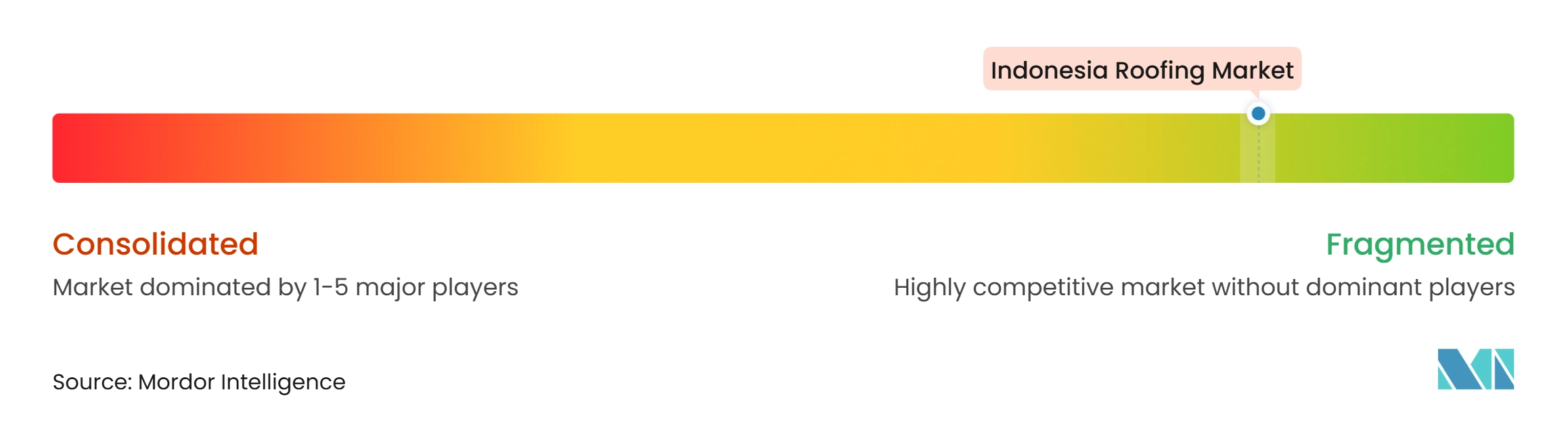
The Indonesia roofing market is fragmented, with domestic suppliers accounting for a significant share of sales and multinational companies maintaining a stronger presence in premium membranes, insulated panels, and specialized roofing systems. PT Impack Pratama Industri Tbk, also known as IMPC, reported 25.4% revenue growth in the first quarter of 2026 and continued to expand its export presence. PT NS BlueScope Lysaght Indonesia competes through COLORBOND and ZINCALUME roof products with corrosion-performance guarantees. Its approach focuses on architects and specifications, which supports early product selection in commercial and industrial projects. Price competition remains strongest in commodity sheet and basic residential categories.
Certification and technical performance are becoming stronger competitive factors as public programs and institutional projects demand more consistent product quality. SNI compliance can help manufacturers access government-linked tile and metal-roof procurement. NS BlueScope Lysaght Indonesia has used product workshops and architecture-focused activities to reach designers before project purchasing decisions are made. In January 2026, the company held an architectural product workshop in Yogyakarta for its COLORBOND XAL and ZINCALUME lines. This strategy supports differentiation in a market where many residential purchases remain driven by initial cost.
Integrated roofing solutions are gaining importance in Indonesia as housing programs and building upgrades increase demand for durable, locally supplied materials. The government’s Gentengisasi initiative is creating opportunities for domestic roof-tile producers, with 34 micro, small, and medium enterprises in Majalengka meeting durability requirements under the Indonesian National Standard and having capacity to produce 2.4 million certified tiles. Central Java launched the program in November 2026, with initial demand estimated at 1.1 million tiles. Manufacturers that combine reliable quality, climate-appropriate performance, and regional distribution are well placed to compete beyond price.
Indonesia Roofing Industry Leaders
-
PT Impack Pratama Industri Tbk
-
PT Krakatau Steel (Persero) Tbk
-
PT Tata Metal Lestari
-
PT BlueScope Lysaght Indonesia
-
PT NS BlueScope Indonesia
- *Disclaimer: Major Players sorted in no particular order
Indonesia Roofing Market Companies Covered in this Report
- PT Impack Pratama Industri Tbk
- PT Krakatau Steel (Persero) Tbk
- PT Tata Metal Lestari
- PT BlueScope Lysaght Indonesia
- PT NS BlueScope Indonesia
- PT Union Metal
- PT Sidoarjo Jaya
- PT Onduline Indonesia
- PT Sarana Central Bajatama Tbk
- PT Timur Mas Abadi
- PT M Class Industry
- PT Comtech Metalindo Terpadu
- PT Tatalogam Lestari
- PT Mulford Indonesia
- PT Alsynite Indonesia
- PT Insulated Panel Indonesia
- PT Mandiri Mulia Makmur Abadi
- Kingspan Group plc
- Sika AG
- SOPREMA Group
Recent Industry Developments in Indonesia Roofing Market
- October 2026: The Ministry of Housing and Settlement Areas reported that Program Tiga Juta Rumah reached a combined total of 1,790,081 housing units built or improved through October 15, 2026. Its Bedah Rumah component targets 400,000 homes and provides a direct source of demand for roofing materials.
- November 2026: Indonesia’s Ministry of Housing and Settlement Areas launched the distribution of 2.4 million clay roof tiles produced by 34 local micro, small, and medium enterprises (MSMEs) in Jatiwangi, Majalengka, West Java, on November 8, 2026. The shipment, involving approximately 600 trucks, will supply housing construction and renovation requirements across Indonesia. The government expects demand for Majalengka-produced tiles to increase to 3 million units ahead of the Indonesia ASRI 2027 movement, with Kebumen and Trenggalek identified as potential expansion locations.
- August 2026: The Ministry of Energy and Mineral Resources and PT PLN jointly launched a 1.3-gigawatt rooftop solar initiative as part of the national solar agenda. The initiative could support demand for Galvalume-coated and solar-compatible metal roofing systems in commercial and industrial buildings.
Indonesia Roofing Market Report Scope
Segmentation Overview
| Asphalt Shingles |
| Clay and Concrete Tiles |
| Metal Roofing |
| Bituminous / Modified Bitumen Membranes |
| Single-Ply Membranes (TPO, EPDM, and PVC) |
| Wood |
| Others |
| New Construction |
| Reroofing / Replacement |
| Residential |
| Commercial |
| Industrial |
| Institutional |
| Others |
| Java |
| Sumatra |
| Kalimantan |
| Sulawesi |
| Rest of Indonesia |
| By Material Type | Asphalt Shingles |
| Clay and Concrete Tiles | |
| Metal Roofing | |
| Bituminous / Modified Bitumen Membranes | |
| Single-Ply Membranes (TPO, EPDM, and PVC) | |
| Wood | |
| Others | |
| By Construction Type | New Construction |
| Reroofing / Replacement | |
| By Application | Residential |
| Commercial | |
| Industrial | |
| Institutional | |
| Others | |
| By Geography | Java |
| Sumatra | |
| Kalimantan | |
| Sulawesi | |
| Rest of Indonesia |
Key Questions Answered in the Report
What is the projected value of Indonesia roofing demand by 2032?
The Indonesia roofing market is forecast to reach USD 4.03 billion by 2032, growing at a 5.81% CAGR from 2027. Housing programs, industrial projects, and replacement activity contribute to the forecast.
Which roofing material has the largest position in Indonesia?
Clay and concrete tiles led material demand with a 28.7% share in 2026, supported by residential preferences and Gentengisasi. Certified local production is also relevant to public procurement programs.
Which material is expected to grow fastest through 2032?
Metal roofing is forecast to grow at a 6.55% CAGR, supported by industrial buildings, warehouses, and solar-compatible roof requirements. Large-span facilities favor systems that can be installed reliably.
What is driving residential roofing demand in Indonesia?
The Three Million Homes Program and its home-improvement activity support both new construction and replacement demand across the country. It also increases the geographic spread of material procurement.
Why is Kalimantan growing faster than other Indonesian regions?
Kalimantan is forecast to grow at a 6.89% CAGR because IKN development, housing activity, and commodity infrastructure expand building needs. Distribution capacity will influence which suppliers capture this demand.
What should roofing suppliers prioritize in Indonesia?
Suppliers should prioritize quality compliance, cost-effective distribution, installer training, and systems that support thermal performance or rooftop solar use. These capabilities help suppliers serve both public housing activity and more complex commercial projects. Practical service quality is important because roofing performance depends on both the material and the installation process.