
Market Overview
| Study Period | 2019 - 2030 |
|---|---|
| Forecast Data Period | 2025 - 2030 |
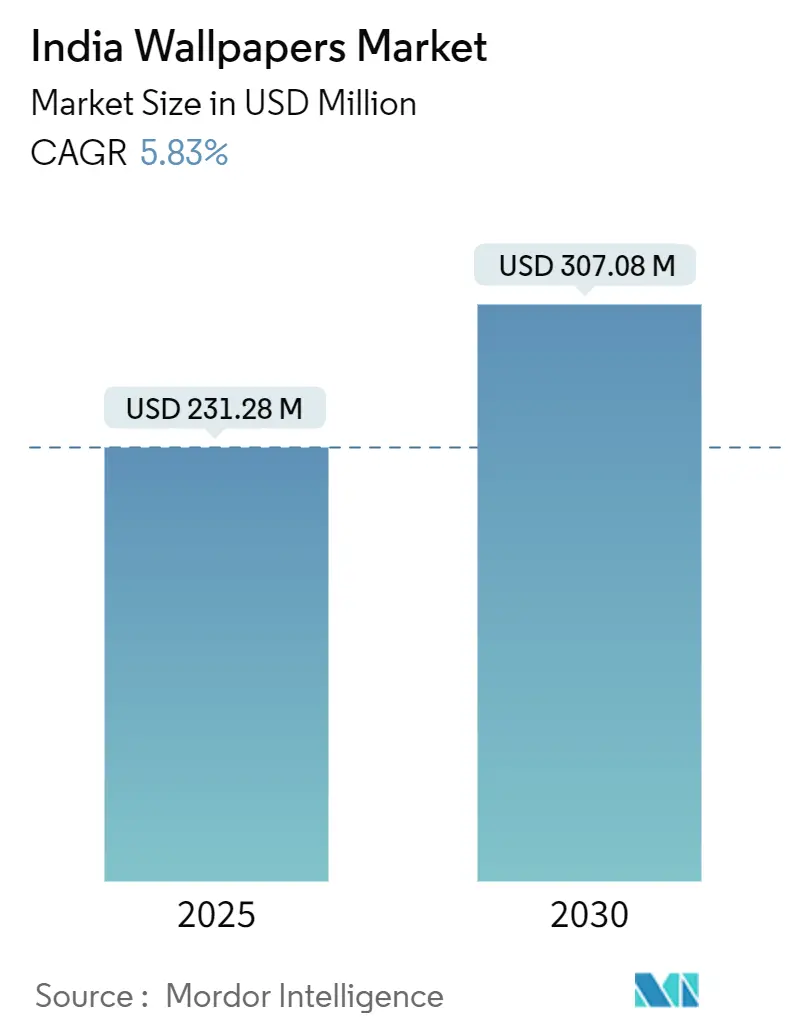
| Base Year Market Size (2025) | USD 231.28 Million |
| Market Size (2025) | USD 231.28 Million |
| Market Size (2030) | USD 307.08 Million |
| Growth Rate (2025 - 2030) | 5.83 % |
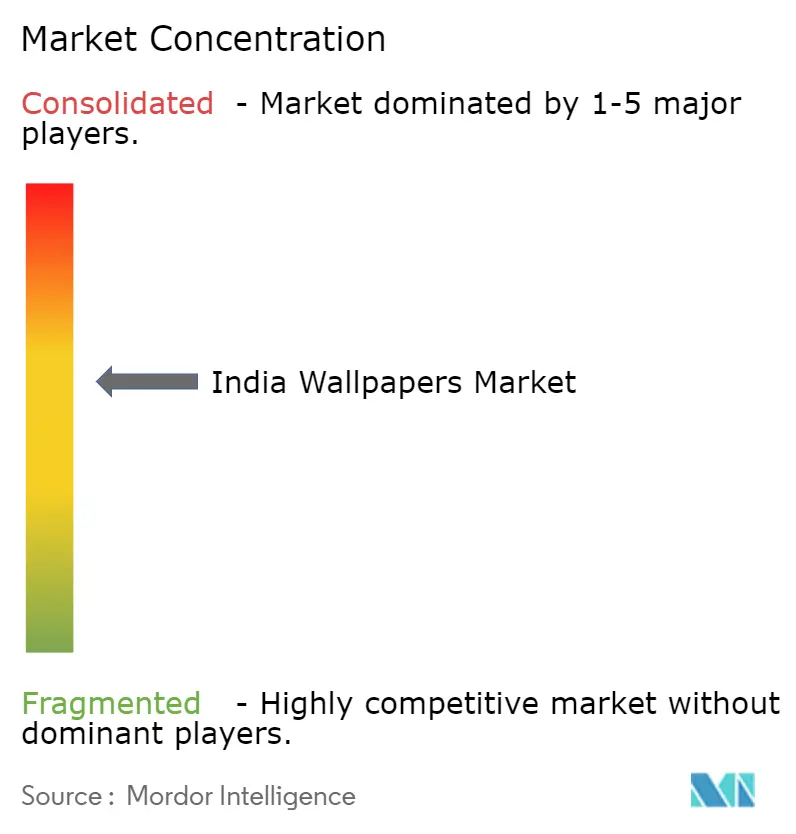
| Market Concentration | Medium |
Major Players *Disclaimer: Major Players sorted in no particular order Image © Mordor Intelligence. Reuse requires attribution under CC BY 4.0. | |
India Wallpapers Market Analysis by Mordor Intelligence
The India wallpapers market size accounted for USD 231.28 million in 2025 and is projected to reach USD 307.08 million by 2030, translating into a 5.83% CAGR. This trajectory rests on government housing subsidies, digital printing advances, and a demographic tilt toward décor-centric homes. Large infrastructure programs under Pradhan Mantri Awas Yojana and the Smart Cities Mission funnel new demand into interior finishing, while vinyl and non-woven substrates compete for share. Organized manufacturers widen distribution through omnichannel models, and technology upgrades such as peel-and-stick adhesives broaden the addressable renter base. Cost inflation tied to imported pulp and currency volatility tempers margins, yet scale benefits and product innovation sustain expansion momentum.
Key Report Takeaways
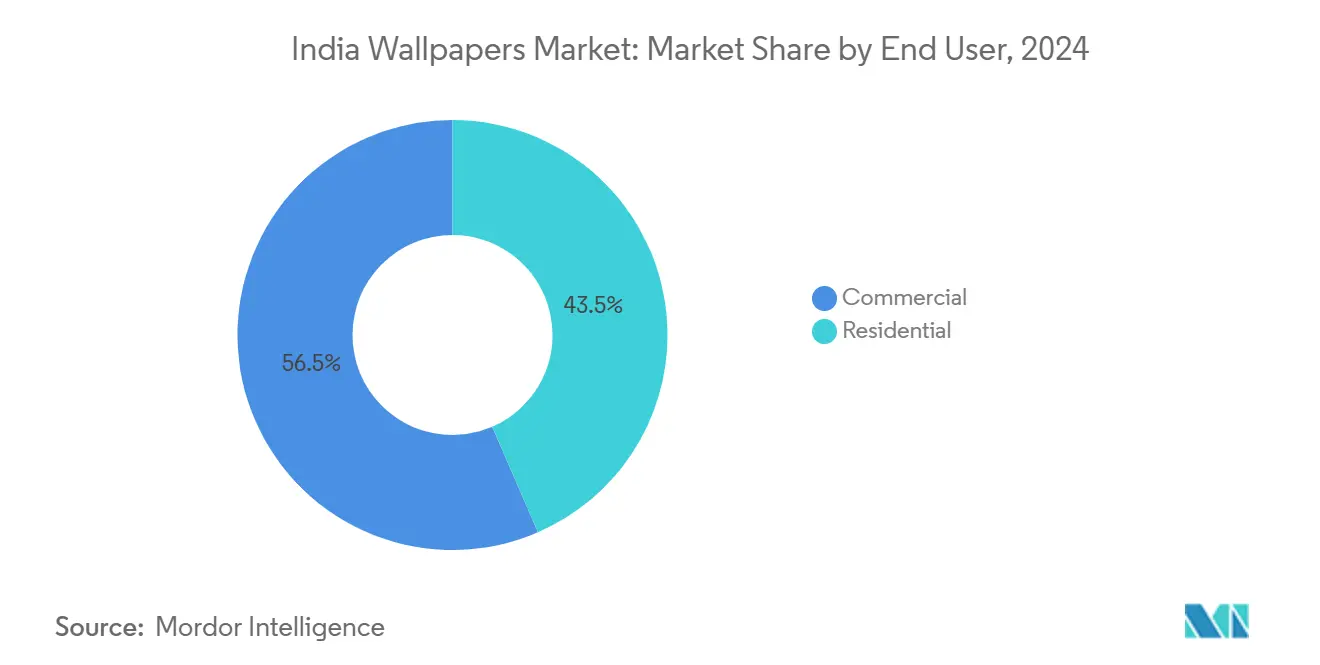
- By end-user category, commercial premises led with 56.51% of the India wallpapers market share in 2024, while residential demand is advancing at an 8.76% CAGR through 2030.
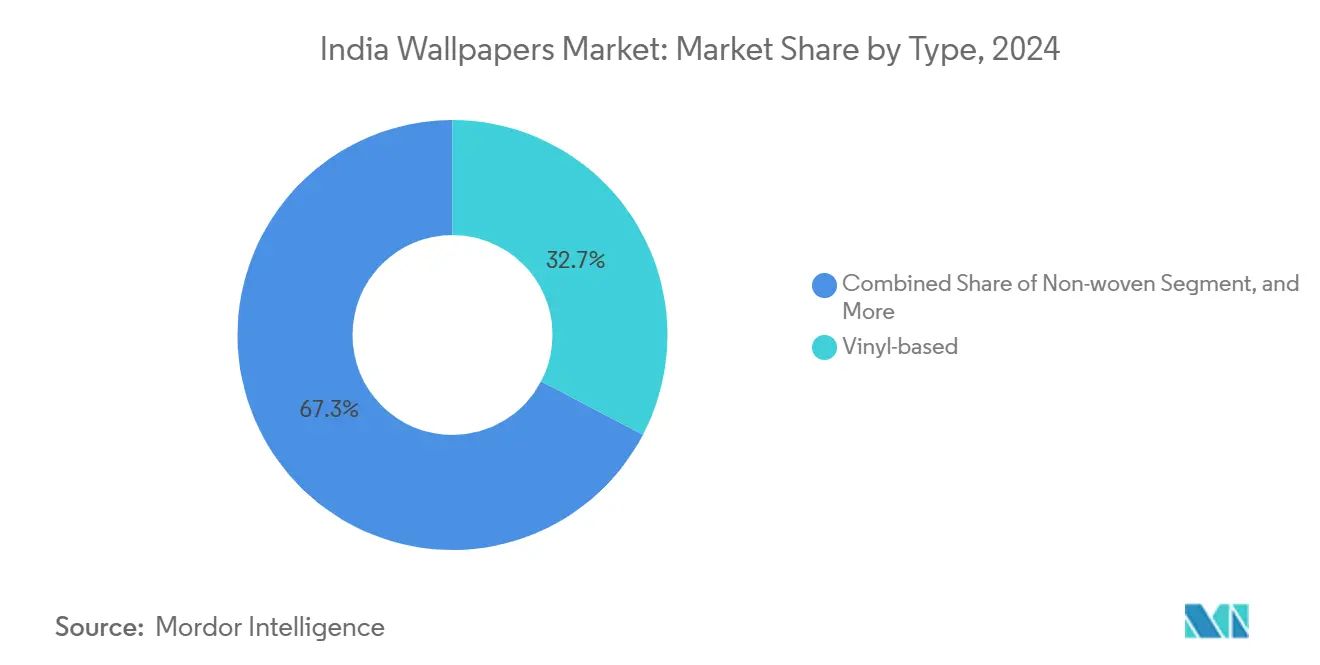
- By type, vinyl held 32.67% of the India wallpapers market size in 2024, whereas non-woven products recorded the fastest 9.11% CAGR to 2030.
- By distribution, retail outlets controlled 53.79% revenue in 2024; e-commerce is forecast to climb at an 8.12% CAGR over the same period.
- By print process, gravure captured 38.432% share in 2024, yet digital inkjet printing is growing at a 7.89% CAGR to 2030
Note: Market size and forecast figures in this report are generated using Mordor Intelligence’s proprietary estimation framework, updated with the latest available data and insights as of January 2026.
India Wallpapers Market Trends and Insights
Drivers Impact Analysis*
| Driver | (~) % Impact on CAGR Forecast | Geographic Relevance | Impact Timeline |
|---|---|---|---|
| Infrastructural boom and rising home-ownership | +2.1% | Tier-1 and tier-2 cities | Medium term (2-4 years) |
| Growing preference for wallpapers over paint | +1.8% | Urban and semi-urban markets | Long term (≥ 4 years) |
| Expansion of organised retail and e-commerce | +1.4% | Metros and tier-2 cities | Short term (≤ 2 years) |
| Disposable-income led premiumisation | +1.2% | Delhi NCR, Mumbai, Bangalore | Medium term (2-4 years) |
| Short-stay rental and co-living refurb demand | +0.8% | Metros and IT hubs | Short term (≤ 2 years) |
| Tenant-friendly peel-and-stick innovation | +0.6% | Urban rental clusters | Short term (≤ 2 years) |
| Source: Mordor Intelligence | |||
Infrastructural Boom and Rising Home-Ownership
The government cleared 3 crore new dwellings under PMAY, channelling USD 3.67 billion toward affordable housing that directly lifts wallpaper consumption.[1] Housing loans outstanding touched INR 33.53 lakh crore in 2024, signalling deeper mortgage penetration that fosters interior upgrades. Rural completions of 2.69 crore houses, 74% in women’s names, expand the aesthetic decision pool. A 6.8% annual increase in the Housing Price Index supports higher refurbishment budgets. Smart Cities Mission funds of INR 1.64 lakh crore across 8,000 projects add commercial opportunities in command centres and civic halls.
Growing Preference for Wallpapers Over Paint
Durability and design range give wallpapers an edge over traditional coatings in premium spaces. High-profile hospitality refurbishments such as the Maharaja Suite at Taj Mahal Delhi showcase bespoke murals that command premium tariffs.[2] Asian Paints’ ColourNext 2025 flagged “Spring Tune” as Wallpaper of the Year, confirming mainstream adoption.[3] HP Latex and other water-based digital systems enable custom short runs with low VOC emissions, matching rising sustainability expectations. Hotel projects emphasise handmade and regionally inspired motifs, reinforcing cultural resonance. Urban household expenditure climbed to INR 6,996 per capita in 2023-24, releasing discretionary funds for décor.
Expansion of Organised Retail and E-commerce
Franchised chains enlarge the organised footprint, while pure-play portals streamline discovery and fulfilment. iDecorwala.com set up 35 city franchises and targets INR 200 crore revenue via an online-offline mix. Asian Paints leverages a 55,000-dealer grid to place wallpapers next to paint SKUs. Marshalls, Elementto, and other import-led specialists diversify design catalogues and after-sales services. Self-adhesive products reduce dependency on installers, making e-commerce a viable primary channel. Visualisation tools help consumers preview patterns, widening appeal beyond décor enthusiasts.
Disposable-Income Led Premiumisation
Rising affluence fuels uptake of premium, eco-safe collections. Life n Colors’ “Suneherii” and WallKalakar’s toxin-free children’s range address design-plus-wellness expectations. Consumers gravitate to mural formats that convey personal narratives, often integrating Indian art forms. Waterproof, breathable, or antimicrobial layers add functional justification for higher price points. Digital presses facilitate exclusive collaborations between designers and manufacturers, shrinking time-to-launch and appealing to style-conscious buyers.
Restraints Impact Analysis*
| Restraint | (~) % Impact on CAGR Forecast | Geographic Relevance | Impact Timeline |
|---|---|---|---|
| Short Lifespan Under Heat and Humidity | -1.10% | India, particularly in coastal and high-humidity regions | Medium term (2-4 years) |
| Competition from Decorative Paints and Laminates | -1.00% | Nationwide, strongest in price-sensitive residential markets | Short term (≤ 2 years) |
| Import-driven Raw-material FX Volatility | -0.90% | Nationwide, affecting import-dependent wallpaper manufacturers and distributors | Short term (≤ 2 years) |
| Shortage of Certified Installers | -0.80% | India, particularly across Tier II and Tier III cities | Medium term (2-4 years) |
| Source: Mordor Intelligence | |||
Short Lifespan Under Heat and Humidity
Tropical moisture weakens adhesives and discolors many paper-based wallpapers, curbing adoption in coastal states. Non-woven options breathe better and dry faster, but adoption costs remain higher. Vinyl resists water yet restricts airflow, sparking indoor air-quality debates. UDC Homes’ waterproof “Memuraa” range tackles moisture ingress while preserving visual fidelity. R&D in polymer blends and primer systems continues to extend service life outside climate-controlled interiors.
Competition from Decorative Paints and Laminates
Paint majors defend shelf space with textured finishes that mimic patterns at a lower installed cost. Asian Paints’ decorative revenue reached INR 31,205 crore in FY 2023-24, showing entrenched scale.[4] Birla Opus entered the segment with plans for six plants, bundling paint and wallpaper SKUs under a unified brand. Laminates remain preferred in heavy-traffic areas thanks to scratch resilience and cleaning ease. Price-aware consumers weigh upfront cost, lifespan, and maintenance before shifting from paint.
*Our forecasts treat driver/restraint impacts as directional, not additive. The impact forecasts reflect baseline growth, mix effects, and variable interactions.
Segment Analysis
By Type: Non-woven Substrates Challenge Vinyl Dominance
Vinyl accounted for 32.67% of the India wallpapers market share in 2024, underpinned by water resistance suited to kitchens and baths. Non-woven products are expanding at a 9.11% CAGR as urban buyers seek breathable, eco-aligned interiors. The India wallpapers market size within non-wovens is forecast to accelerate once local converting lines add capacity. Non-woven fibers permit easier removal, lowering renovation downtime. Traditional paper and textile coverings keep niche appeal in heritage restorations and luxury villas. Eximus Wallpaper’s rotogravure output illustrates manufacturing precision that sustains premium status. Material compliance oversight by the Bureau of Indian Standards lifts consumer confidence and curbs sub-standard imports.
Innovations include VOC-free coatings and antimicrobial treatments responding to post-pandemic hygiene awareness. WallKalakar’s children-centric launch employs 100% non-toxic inks, a feature that resonates with urban parents. Consumers weigh lifecycle costs against upfront price, tilting preferences toward substrates promising durability without sacrificing indoor air quality.

By Distribution Channel: E-Commerce Disrupts Traditional Retail
Retail outlets retained 53.79% value share in 2024, reflecting the enduring need for tactile inspection and décor consultation. Yet the Indian wallpaper market registers an 8.12% CAGR online as consumers gain trust in digital visualization tools. Virtual room-preview software streamlines selection and reduces sample wastage. Self-adhesive SKUs travel well, overcoming prior logistics limitations. iDecorwala.com scales through a hub-and-spoke network where online orders are channel to regional franchisees for last-mile service. Asian Paints integrates e-commerce into its website, capturing cross-sell synergies with paint and furniture lines.
Unorganised mom-and-pop stores still dominate smaller towns, but organised chains promise quality and warranty, tempting upgrade buyers. The Indian wallpaper industry continues to invest in showroom formats that marry digital catalogs with sample walls, reducing inventory overhead yet satisfying consumer touchpoints.
By End User: Residential Growth Outpaces Commercial Scale
Commercial properties - hotels, offices, salons - contributed 56.51% revenue in 2024. High replacement cycles and brand-centric design keep spend elevated. However, the residential slice is growing faster at an 8.76% CAGR through 2030 as first-time homeowners seek personalization. The India wallpapers market size tied to apartments and standalone houses is climbing alongside rising mortgage uptake. Short-stay rentals specify peel-and-stick finishes to ease periodic refreshes. Health-care facilities demand anti-microbial surfaces, while salons favor moisture-tolerant vinyl. Taj Mahal Delhi’s Maharaja Suite underscores how bespoke murals differentiate premium hospitality.
Urban millennials treat walls as expression canvases, boosting demand for customized prints. Monthly consumption outlays show a steady uptick, supporting discretionary décor investments. Government housing subsidy beneficiaries in tier-2 clusters are also entering the upgrade cycle, especially after possession.
By Print Technology: Digital Innovation Challenges Gravure Tradition
Gravure held 38.432% of revenue in 2024, excelling at high-run consistency. Digital inkjet’s 7.89% CAGR reflects hunger for small-lot customization. The India wallpapers market size for digitally printed rolls is set to widen as cost-per-square-foot narrows. Canon–Fotoba UVgel workflows deliver white-ink layers and automated cutting, trimming downtime. Match Graphics’ RotaJet 138 installation demonstrates scale readiness, achieving 270 m/min output at photographic resolution.
Hybrid setups pair gravure grounds with inkjet overprints for metallic or textured finishes, blending economy with versatility. HP Latex, Epson Resin, and Brother UV platforms use greener chemistries, aligning with tightening indoor-air norms. Local OEMs explore retrofitting options to modernize legacy gravure lines, reducing capex barriers for incumbents.
Geography Analysis
Metropolitan clusters, such as Delhi NCR, Mumbai, Bangalore, and Chennai, anchor demand due to higher disposable incomes and global design exposure. The India wallpapers market size across these four metros accounts for the bulk of organised sales. Smart Cities Mission allocations of INR 1.64 lakh crore generate procurement for civic halls, command centres, and transit hubs. Coastal states like Kerala favour vinyl and waterproof non-wovens to combat humidity, while drier northern interiors lean toward textured papers. Cultural motifs shift from north to south: Mughal and Rajasthani patterns dominate in the Hindi belt, whereas minimalist and pastel themes prevail in the south.
Manufacturing footprints cluster near Mumbai and Gujarat, benefiting from proximity to ports and petrochemical feedstock. D’Decor’s four mills produce 120,000 meters daily, serving domestic and export orders. Gujarat’s Ahmedabad hub hosts vinyl converters targeting South Asian buyers. In the east, Kolkata’s dealer network markets price-segmented rolls ranging from INR 20 to INR 3,200, reflecting varied purchasing power.
Government-subsidized homes in rural regions present latent potential. Women homeowners influence finish choices, often opting for patterns that break monotony of basic paint. Online platforms circumvent limited rural retail density, yet installation support remains a hurdle. Climate and infrastructure disparities guide substrate selection; non-wovens and treated vinyls expand suitability across diverse microclimates.
Competitive Landscape
The India wallpapers market exhibits moderate concentration, with paint conglomerates and specialised converters competing on distribution reach and product novelty. Asian Paints and Berger leverage dealer ecosystems exceeding 55,000 outlets, bundling wallpapers with surface prep and paints. Marshalls Wallcoverings imports curated catalogues and anchors presence through exclusive showrooms, while Elementto promotes high-margin Italian collections.
Technological leadership confers advantage; Eximus Wallpaper’s early rotogravure adoption sets a benchmark for color depth and registration accuracy. Digital disruptors like iDecorwala.com tap e-commerce efficiencies and tie-ups with regional installers. Birla Opus’ entry signals capacity expansion and integrated décor strategies spanning paints and wallpapers.
Eco-friendly and renter-oriented formats emerge as white spaces. Brands that secure BIS certification ahead of mandated timelines enjoy smoother import clearances and retail acceptance. Larger players hedge pulp and FX risks through multi-source supply contracts, cushioning volatility better than small converters. Consolidation may gain pace as organised chains acquire regional wholesalers to strengthen after-sales capabilities.
India Wallpapers Industry Leaders
-
Marshalls Wallcoverings
-
Adornis Wallpapers
-
Asian Paints Ltd.
-
Berger Paints Ltd.
-
Life n Colors Private Limited
- *Disclaimer: Major Players sorted in no particular order
Recent Industry Developments
- April 2025: Asian Paints released ColourNext 2025, naming “Spring Tune” Wallpaper of the Year.
- April 2025: WallKalakar introduced India’s first eco-friendly, VOC-free children’s wallpapers.
- January 2025: tesa and Rasch rolled out a 40-design self-adhesive wallpaper collection for rapid DIY installation.
- November 2024: Match Graphics installed Asia’s first K&B RotaJet 138 for high-speed décor printing.
India Wallpapers Market Report Scope
The India Wallpapers Market Report is Segmented by Type (Vinyl-Based, Non-Woven, Paper/Traditional, and Fabric (Textile)), Distribution Channel (E-Commerce and Retail), End User (Residential and Commercial (including Hospitality, Corporate Offices, Salons and Spas, Hospitals, and Other Commercial Users)), and Print Technology (Gravure, Digital Inkjet, and Other Print Technologies). The Market Forecasts Are Provided in Terms of Value (USD).
By Type
| Vinyl-based |
| Non-woven |
| Paper / Traditional |
| Fabric (Textile) |
By Distribution Channel
| E-commerce |
| Retail |
By End User
| Residential | |
| Commercial | Hospitality |
| Corporate Offices | |
| Salons and Spas | |
| Hospitals | |
| Other Commercial Users |
By Print Technology
| Gravure |
| Digital Inkjet |
| Other Print Technology |
| By Type | Vinyl-based | |
| Non-woven | ||
| Paper / Traditional | ||
| Fabric (Textile) | ||
| By Distribution Channel | E-commerce | |
| Retail | ||
| By End User | Residential | |
| Commercial | Hospitality | |
| Corporate Offices | ||
| Salons and Spas | ||
| Hospitals | ||
| Other Commercial Users | ||
| By Print Technology | Gravure | |
| Digital Inkjet | ||
| Other Print Technology | ||
Key Questions Answered in the Report
What is the current size of the Indian wallpaper market?
The Indian wallpaper market size stands at USD 231.28 million in 2025.
How fast is demand from Indian homeowners growing?
Residential demand is expanding at an 8.76% CAGR through 2030, outpacing commercial growth.
Which substrate is gaining popularity over vinyl?
Non-woven wallpapers are recording a 9.11% CAGR due to breathability and eco alignment.
Why is digital printing important for wallpaper suppliers?
Digital inkjet offers mass customization and is rising at a 7.89% CAGR, eroding gravure dominance.
How big is online sales for Indian wallpapers?
E-commerce channels are growing at an 8.12% CAGR, supported by peel-and-stick innovations.
Which policy is driving construction-led wallpaper demand?
The Pradhan Mantri Awas Yojana and Smart Cities Mission funnel significant housing and civic projects, boosting wallpaper uptake.