
India Urban Micro-Warehousing Market Size and Share
Market Overview
| Study Period | 2020 - 2031 |
|---|---|
| Forecast Data Period | 2026 - 2031 |
| Base Year Market Size (2025) | USD 0.59 Billion |
| Market Size (2026) | USD 0.71 Billion |
| Market Size (2031) | USD 1.67 Billion |
| Growth Rate (2026 - 2031) | 18.63 % |
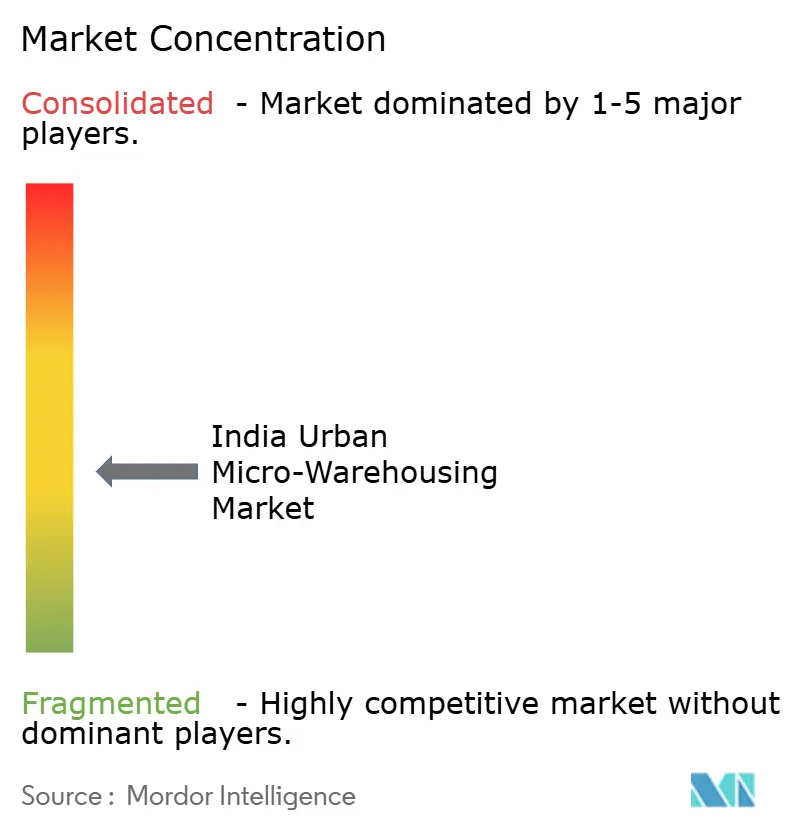
| Market Concentration | Medium |
Major Players *Disclaimer: Major Players sorted in no particular order Image © Mordor Intelligence. Reuse requires attribution under CC BY 4.0. | |
India Urban Micro-Warehousing Market Analysis by Mordor Intelligence
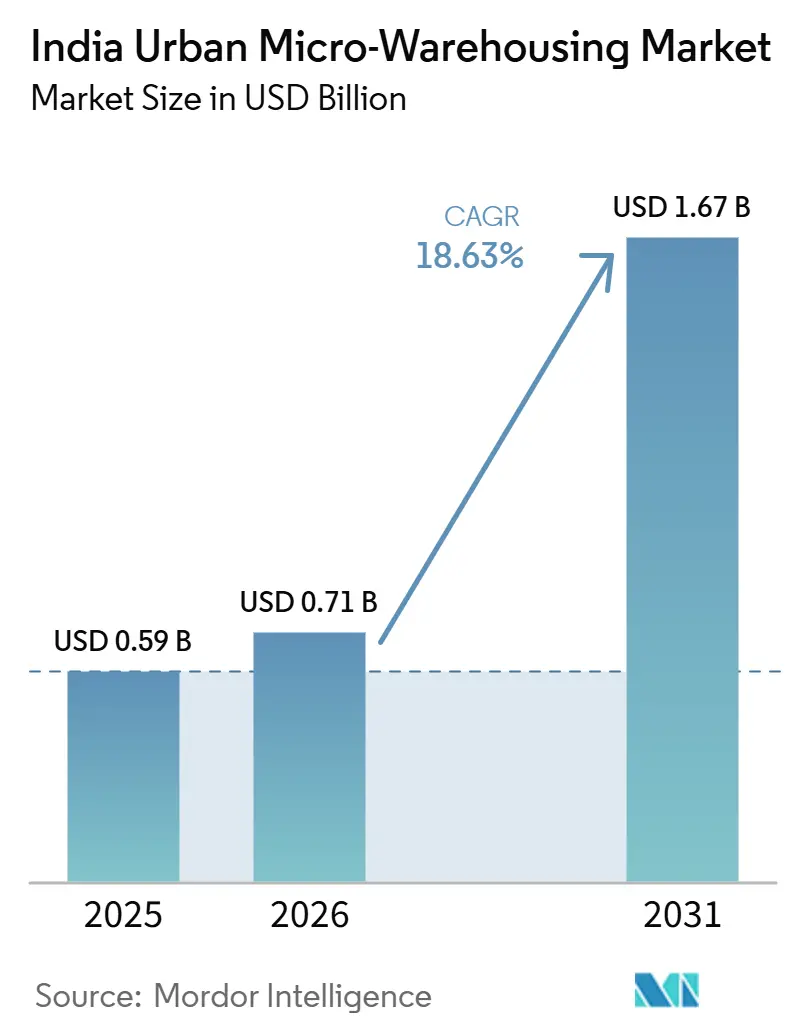
The India urban micro-warehousing market size was valued at USD 0.59 billion in 2025 and is expected to reach USD 0.71 billion in 2026 and reach USD 1.67 billion by 2031, growing at a CAGR of 18.63% over 2026-2031.
The India urban micro-warehousing market is expanding because delivery expectations in major cities now depend on inventory being placed very close to consumers, rather than in large peripheral warehouses alone. Quick commerce has become the clearest demand engine for the India urban micro-warehousing market, and the network build-out by large platforms is turning city-based fulfillment nodes into core logistics infrastructure rather than a niche retail format. The India urban micro-warehousing market is also attracting greater interest from 3PL operators and logistics technology providers, as multi-client fulfillment hubs can support both rapid grocery delivery and broader e-commerce flows from the same urban footprint.
Key Report Takeaways
- By facility type, dark store-based fulfillment accounted for 38.11% of India urban micro-warehousing market share in 2025, while MFC-based fulfillment is projected to grow at a 25.54% CAGR through 2031.
- By temperature type, non-temperature-controlled facilities accounted for 65.68% of India urban micro-warehousing market size in 2025, while temperature-controlled facilities are expected to expand at a 22.20% CAGR through 2031.
- By automation level, manual operations accounted for 54.37% of India urban micro-warehousing market share in 2025, while fully automated facilities are forecast to grow at a 27.50% CAGR through 2031.
- By end-use industry, quick commerce accounted for 31.83% of India urban micro-warehousing market size in 2025, while e-commerce is set to record the highest CAGR at 26.26% through 2031.
- By geography, the West region accounted for 31.46% of India urban micro-warehousing market share in 2025, while the South region is projected to grow at a 22.68% CAGR through 2031.
Note: Market size and forecast figures in this report are generated using Mordor Intelligence’s proprietary estimation framework, updated with the latest available data and insights as of January 2026.
India Urban Micro-Warehousing Market Trends and Insights
Drivers Impact Analysis*
| Driver | (~) % Impact on CAGR Forecast | Geographic Relevance | Impact Timeline |
|---|---|---|---|
| Rising Quick Commerce Order Density | +4.5% | Pan-India, concentrated in metros and Tier-1 cities | Short term (≤ 2 years) |
| Dark Store Network Expansion in Tier-1 and Tier-2 Cities | +3.8% | National, with high-velocity expansion in the South and West | Medium term (2-4 years) |
| Urban Store Replenishment Speed Requirements | +3.2% | NCR, Mumbai, Bengaluru, Hyderabad, with spillover to Pune and Ahmedabad | Medium term (2-4 years) |
| Fresh and Temperature-Sensitive SKU Expansion | +2.4% | South and West, especially Bengaluru, Mumbai, Chennai, and Hyderabad | Medium term (2-4 years) |
| Densification of Last-Mile Fulfillment Footprints | +2.1% | National, accelerating in the East and Central regions | Long term (≥ 4 years) |
| Modular Lease Models for Small Urban Parcels | +1.8% | Tier-1 metros and emerging Tier-2 markets | Long term (≥ 4 years) |
| Source: Mordor Intelligence | |||
Rising Quick Commerce Order Density
Quick commerce has moved from an emerging delivery format to the main demand engine for the India urban micro-warehousing market. The combined dark-store networks of Blinkit, Swiggy Instamart, and Zepto reached 5,026 locations by May 2026, up from 3,405 a year earlier, underscoring how quickly city-based fulfillment infrastructure is being added. The pressure on the India urban micro-warehousing market does not come from store count alone, because each node is expected to process heavy daily order volumes from increasingly broad assortments. As order density rises, operators that can sustain faster inventory turns and fuller SKU depth can justify larger, better-located urban sites. Smaller operators face a more challenging environment because fixed costs rise quickly when order throughput falls below breakeven levels. This is pushing the India urban micro-warehousing market toward a more selective operating model where density, execution speed, and compliance matter more than simple network expansion.
Dark Store Network Expansion in Tier 1 and Tier 2 Cities
The India urban micro-warehousing market is no longer centered only on the largest metros, because network expansion is now moving deeper into Tier-2 cities. Flipkart Minutes opened its 1,000th micro-fulfillment center in Gorakhpur in June 2026, and 90 of its 130 active cities were already non-metro locations, which confirms that demand formation outside major metros is now material[1]. The India urban micro-warehousing market is benefiting from this broader citywide coverage because every new service area requires inventory held close to local demand. The challenge is that smaller cities often have fewer compliant small-format warehousing assets with reliable power, fire approvals, and workable access conditions. That limits how quickly operators can scale, even when demand is present. As a result, the India urban micro-warehousing market is expanding geographically. However, the pace of rollout still depends on whether suitable urban space can be secured at the right operating cost.
Urban Store Replenishment Speed Requirements
The India urban micro-warehousing market is also being supported by retailers and FMCG companies that now need faster store replenishment cycles. Urban nodes are becoming useful not only for direct-to-consumer delivery, but also for keeping shelves stocked more frequently in dense city clusters. Leasing momentum in India’s warehousing sector remained strong in early 2026, and 3PL participation rose sharply, suggesting rising demand for urban fulfillment formats beyond pure long-haul storage. The India urban micro-warehousing market is gaining from this shift because proximity reduces replenishment time and gives operators tighter control over inventory availability. It also creates a stronger case for Grade A urban facilities, since speed loses value when compliance, loading access, or operational continuity are weak. This keeps the India urban micro-warehousing market closely tied to the broader move toward faster retail restocking and tighter service windows in large urban clusters.
Fresh and Temperature-Sensitive SKU Expansion
Fresh produce, dairy, frozen goods, and selected pharma deliveries are widening the need for temperature-controlled capacity in the India urban micro-warehousing market. Cold chain firms are adapting their urban service models with greater technical controls, including flash-freezing chambers and track-and-trace tools for last-mile handling, indicating that storage quality is becoming part of the service promise[2]. The India urban micro-warehousing market is therefore seeing cold rooms move from an optional upgrade to a basic operating requirement in facilities that serve high-frequency fresh categories. This matters because temperature control increases both capital requirements and operating complexity within small urban footprints. It also increases the advantage of operators that can combine real estate access with cold chain know-how. As category mix broadens, the India urban micro-warehousing market is likely to reward facilities that can manage both speed and product integrity without compromising compliance.
Restraints Impact Analysis*
| Restraint | (~) % Impact on CAGR Forecast | Geographic Relevance | Impact Timeline |
|---|---|---|---|
| High Land and Rental Costs in Prime Urban Micro-Locations | -2.3% | Metro cities, including Mumbai, Delhi-NCR, Bengaluru, and Pune, with spillover to Tier-1 cities | Short term (≤ 2 years), Medium term (2-4 years) |
| Limited Availability of Suitable Small-Format Warehousing Assets | -1.7% | Tier-2 and Tier-3 cities, and dense residential micro-markets in metros | Medium term (2-4 years), Long term (≥ 4 years) |
| Fragmented Compliance Across Municipal and Fire Norms | -1.5% | All urban markets, particularly residential and mixed-use zones | Short term (≤ 2 years), Medium term (2-4 years) |
| Power Reliability and Cold-Chain Continuity Constraints | -1.2% | Tier-2 cities, Northeast India, and semi-urban corridors | Medium term (2-4 years), Long term (≥ 4 years) |
| Source: Mordor Intelligence | |||
High Land and Rental Costs in Prime Urban Micro-Locations
High rent is one of the clearest operating restraints on the India urban micro-warehousing market. Warehouse rentals in Indian metros ranged from INR 18 to INR 60 (USD 0.19 TO USD 0.63) per ft² per month in 2026, and the Delhi-NCR corridors also saw meaningful rent increases over time, underscoring how expensive urban logistics locations have become. In the India urban micro-warehousing market, rising occupancy costs often force operators to use the smallest workable footprint, even when a larger site would improve SKU depth or picking efficiency. This makes fulfillment economics more sensitive to demand volatility because fixed location costs are harder to spread across lower throughput. Well-funded operators can absorb that pressure for longer, but smaller networks cannot. The result is that the India urban micro-warehousing market remains attractive in demand terms, while still being selective in economic terms.
Fragmented Compliance Across Municipal and Fire Norms
Compliance remains uneven across the Indian urban micro-warehousing market because local zoning, fire approvals, and warehouse-use rules are not always aligned with how dark stores actually operate. Legal interpretation in several cities still treats dark stores more like storage facilities than retail outlets, which raises location risk in residential or mixed-use neighborhoods. Fire safety requirements add another layer of uncertainty when operators use small leased sites that were not originally built for continuous warehousing activity[3]. In the Indian urban micro-warehousing market, this creates an uneven risk profile, where low-rent sites may face higher disruption risk later. It also pushes 3PLs and organized operators to make compliance checks part of site selection rather than treating them as an afterthought. The compliance burden does not weaken demand, but it does slow execution and favors operators that can manage location approvals with more discipline.
*Our forecasts treat driver/restraint impacts as directional, not additive. The impact forecasts reflect baseline growth, mix effects, and variable interactions.
Segment Analysis
By Facility Type: Dark Stores Lead, MFCs Accelerate
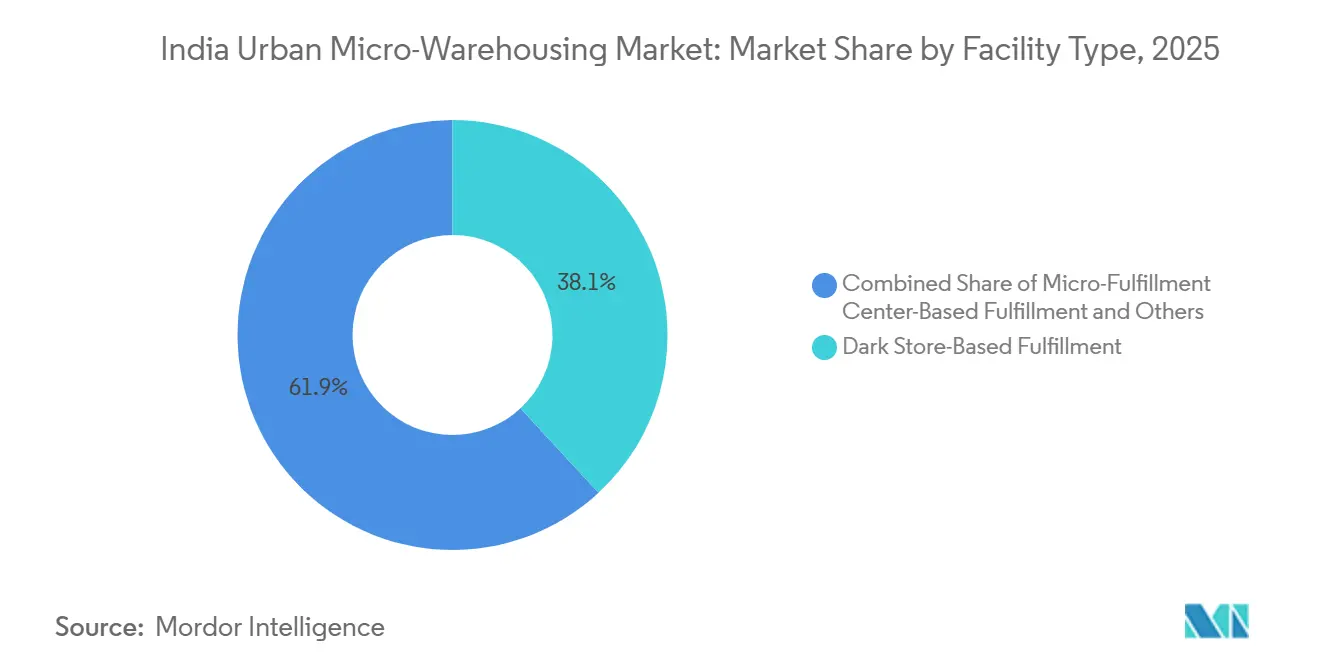
Dark-store-based fulfillment accounted for 38.11% of the India urban micro-warehousing market size in 2025, underscoring the format's alignment with the current shape of urban demand. These facilities were built for speed first, and they typically serve narrow delivery radii with dense daily order flow and high item turnover. In the Indian urban micro-warehousing market, dark stores became the leading facility type because they better meet the sub-30-minute promise than shared regional warehouses. Their single-purpose layout also helps operators run tighter picking routines and maintain closer control over service levels. Retail store-based fulfillment and hybrid models remain relevant, as existing store networks can double as local inventory points. Those formats help omnichannel retailers avoid a fully separate fulfillment footprint, although they are less specialized than dark stores.
MFC-based fulfillment is projected to grow at a 25.54% CAGR through 2031, making it the fastest-expanding facility type in the India urban micro-warehousing market. The appeal of MFCs is that they support a broader SKU mix and allow several brands or sellers to share fulfillment infrastructure within the same city cluster. Flipkart Minutes crossed 1,000 MFCs in June 2026 and said it was adding 75 to 100 more each month, which underlines how quickly this model is scaling. Amazon India also moved ahead with the rollout of urban fulfillment centers, showing that the Indian urban micro-warehousing industry is broadening beyond grocery-led formats alone. This shift matters because multi-client hubs can generate higher revenue per ft² than single-brand dark stores when throughput is well managed. It also gives 3PLs a stronger role in the Indian urban micro-warehousing market as brands seek capital-light ways to reach urban consumers faster.

By Temperature Type: Cold Chain as a Structural Differentiator
Non-temperature-controlled facilities accounted for 65.68% of the India urban micro-warehousing market share in 2025, reflecting the still-large role of ambient grocery and FMCG volumes. Most daily orders still sit in categories that do not need strict cold handling, which keeps ambient space dominant in the current mix. Even so, the Indian urban micro-warehousing market is changing, as fresh food, dairy, frozen products, and selected healthcare deliveries are taking a larger share of rapid-delivery baskets. That is why temperature-controlled facilities are forecast to grow at a 22.20% CAGR through 2031. Operators are no longer treating cold rooms as a premium feature used only in a few sites. They are increasingly being planned as a standard requirement in urban facilities that serve a broad range of quick commerce offerings.
The India urban micro-warehousing market size for temperature-controlled capacity is still smaller than ambient capacity, but its operational importance is rising much faster. India’s cold storage supply gap remains a structural constraint, which supports stronger demand for compliant urban cold rooms and last-mile cold hubs. Cold chain providers are also adding greater technical controls to urban delivery operations, indicating that fulfillment quality now extends beyond transport into the warehouse itself. In the India urban micro-warehousing market, this favors operators that can combine temperature integrity with small-footprint city operations. It also creates a clearer competitive gap between basic ambient facilities and higher-spec urban sites that can support fresh category growth. As quick commerce platforms expand their fresh offerings, cold chain capabilities are becoming a structural differentiator rather than a narrow niche.
By Automation Level: Manual Footprint Persists, Fully Automated Sets the Growth Ceiling
Manual operations accounted for 54.37% of the India urban micro-warehousing market size in 2025, indicating that labor-intensive facilities still align with the current cost structure of urban fulfillment in India. Many dark stores can still operate effectively with human picking because site sizes are compact and wage economics remain workable compared with the high upfront costs of automation. Semi-automated facilities sit at the midpoint of the spectrum, adding conveyor systems, digital guidance, and warehouse management tools without fully replacing labor. This gives operators a practical path to improve accuracy and speed without taking on the full capital burden of advanced robotics. As a result, the India urban micro-warehousing market still has a large manual base even while service standards are tightening. The current mix reflects an operating model that values fast rollout and flexible staffing.
Fully automated facilities are forecast to grow at a 27.50% CAGR through 2031, making them the fastest-moving automation segment in the India urban micro-warehousing market. Automated systems are improving the economics of compact MFCs by reducing packing time and making high-volume operations more repeatable. Unbox Robotics raised USD 28 million to scale warehouse automation solutions for Indian operators, underscoring that capital is backing the shift toward more automated urban fulfillment. The India urban micro-warehousing market share of fully automated sites is still smaller today. Still, their growth rate suggests that service reliability and throughput density are starting to justify the investment. This is especially relevant where 3PL contracts demand tighter SLAs and fewer picking errors. Over time, the India urban micro-warehousing market is likely to narrow the gap between manual and automated formats as order density continues to rise.
By End-Use Industry: Quick Commerce Anchors Demand, E-Commerce Leads Growth
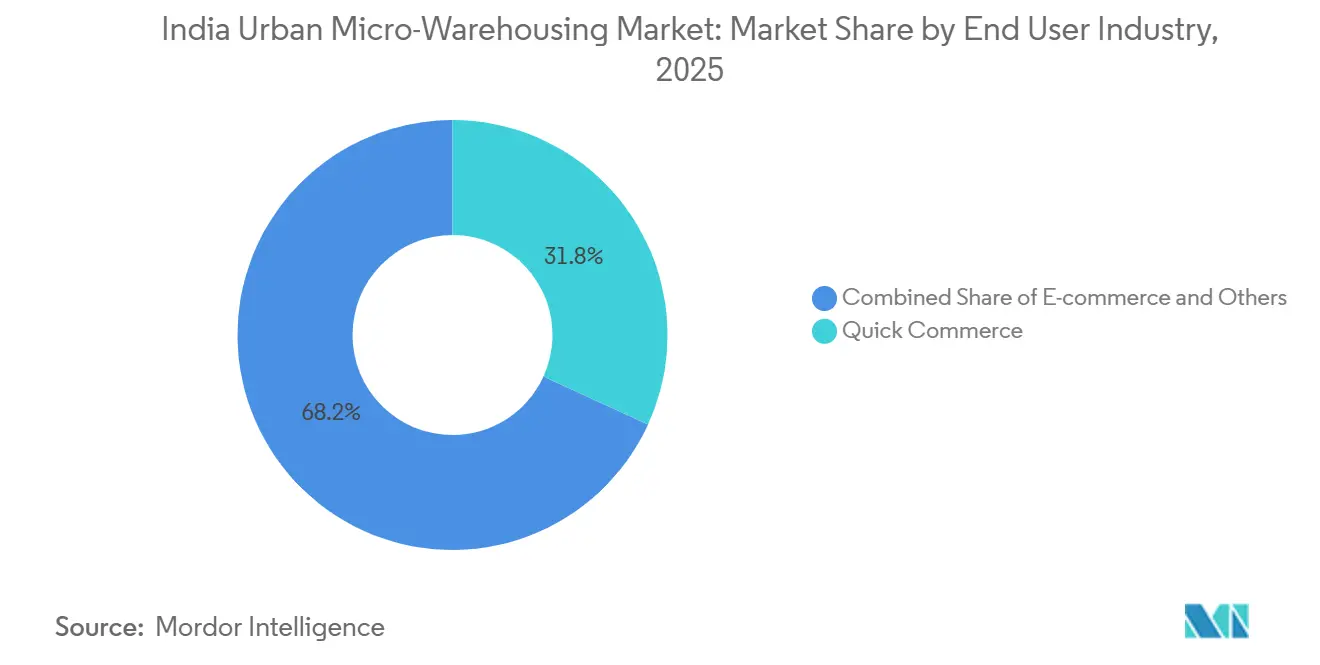
Quick commerce accounted for 31.83% of the India urban micro-warehousing market size in 2025, underscoring its position as the largest current demand base across end-use industries. Captive dark store expansion by Blinkit, Zepto, Swiggy Instamart, and similar operators has kept this segment at the center of network development. The India urban micro-warehousing market depends on quick commerce not only for space absorption, but also for setting service expectations that influence the wider logistics ecosystem. Grocery retail, FMCG, and food and beverage form a connected demand cluster because they share the same proximity model and high-frequency replenishment logic. Pharmaceuticals and healthcare products stand apart because they require tighter storage conditions and more disciplined handling. This creates a premium compliance tier in the India urban micro-warehousing market, especially in urban cold chain operations.
E-commerce is projected to grow at a 26.26% CAGR through 2031, making it the fastest-expanding end-use in the India urban micro-warehousing market. Large platforms are using more distributed urban nodes to meet same-day and next-day delivery commitments without relying solely on centralized warehouses. This is widening the role of the Indian urban micro-warehousing industry beyond food-led rapid delivery to include electronics, apparel, household goods, and selected B2B flows. Fashion and lifestyle brands are also testing urban nodes to deliver faster service and more convenient fulfillment options. Industrial and B2B distribution remains smaller, but it is increasingly using MFC infrastructure in dense commercial zones where response time matters. That gives the India urban micro-warehousing market a broader growth base than the current quick commerce headline alone might suggest.
Geography Analysis
The West region held 31.46% of the India urban micro-warehousing market share in 2025, making it the largest regional base. Mumbai remains the anchor because it combines dense consumption with established logistics support in Bhiwandi, Thane, and Pune. Scootsy Logistics, part of Swiggy, leased 580,000 ft² in Bhiwandi, near Mumbai, underscoring how major operators continue to deepen their urban logistics presence in the region[4]. The India urban micro-warehousing market in the West also benefits from a stronger institutional warehousing base than many other regions. That makes execution easier for organized operators, even though rent pressure stays high. Pune’s cost profile remains challenging for smaller players, pushing some activity toward satellite urban centers where occupancy costs are lower. This mix of strong demand and tighter economics keeps the West region important but selective.
The South region is projected to grow at a 22.68% CAGR through 2031, making it the fastest-growing geography in the India urban micro-warehousing market. Bengaluru is the clearest regional growth engine because quick commerce activity there has reached enough density to support continued facility additions. Hyderabad, Chennai, Kochi, and several Tier-2 southern cities are also seeing stronger dark-store and MFC rollouts. The India urban micro-warehousing market in the South benefits from a demand pattern that is no longer limited to one or two metro centers. This gives operators more room to spread networks across multiple city clusters while maintaining competitive service speeds. South India also fits well with the move toward broader category fulfillment, since shared urban hubs can serve groceries, FMCG, consumer goods, and selected healthcare flows from the same city footprint. That wider use case supports the South’s stronger growth rate.
The North remains a major logistics hub because Delhi-NCR still anchors a significant share of organized warehousing and urban delivery activity. The India urban micro-warehousing market in the North is more mature, which means growth is steadier and site competition is higher in established corridors. The East and Central regions are at an earlier stage, but they are becoming more strategically relevant as organized operators extend their reach into underserved city clusters. Mahindra Logistics added more than 400,000 ft² of warehousing capacity across Guwahati and Agartala, underscoring that the East and Northeast are attracting greater formal infrastructure investment. DP World’s January 2026 agreement with the Madhya Pradesh government for the Powarkheda hub points to rising institutional interest in Central India as an inland logistics node. Together, these shifts suggest that the India urban micro-warehousing market is still uneven by region. Still, its next phase of geographic expansion will increasingly depend on organized capacity being built outside the traditional metro-heavy core.
Competitive Landscape
The India urban micro-warehousing market remains moderately fragmented at the operator level, with no single company controlling a dominant share across facility types and regions. Organized 3PLs such as Delhivery, Mahindra Logistics, TVS Supply Chain Solutions, and Prozo operate alongside captive quick commerce networks run by Blinkit, Zepto, Swiggy Instamart, Flipkart Minutes, and Amazon Now. This creates a split structure within the Indian urban micro-warehousing market, where some players monetize shared infrastructure while others use warehousing mainly to improve retail service speed. Delhivery’s acquisition of Ecom Express in FY 2025 strengthened consolidation at the organized logistics layer, even as dark-store operations remained widely distributed across competing retail platforms. That means concentration is rising in selected 3PL functions without removing fragmentation from the broader operating landscape. The India urban micro-warehousing market, therefore, shows both consolidation and dispersion simultaneously, depending on the part of the value chain being observed.
Strategy in the India urban micro-warehousing market is increasingly shaped by technology depth, network flexibility, and asset discipline rather than simple warehouse count alone. Prozo deployed a hyperlocal delivery and dark store module within its warehouse management system in FY 2026, enabling brands to run quick commerce operations from shared fulfillment centers rather than building separate captive networks. Delhivery disclosed 7.5 million ft² of warehousing infrastructure and ongoing robotics and automation capability development in its FY 2026 filing, showing how listed operators are building deeper operating systems around warehousing scale. Flipkart Minutes continued its rapid MFC rollout in 2026, while Amazon India advanced its own urban fulfillment model, indicating that large platform-led networks still view micro-fulfillment as a core service asset rather than an experimental channel. These moves are raising the operating bar for the India urban micro-warehousing market by making speed, orchestration, and uptime central to competition. Players that cannot combine real estate access with technology support are likely to struggle in higher-density service environments.
White-space opportunities in the India urban micro-warehousing market remain strongest in automated MFCs, temperature-controlled urban hubs, and shared fulfillment models for brands that do not want captive networks. The need for compliance-ready sites also gives organized operators an advantage, as they can standardize processes across multiple cities. TVS Supply Chain Solutions expanded its South India footprint through the acquisition of Swamy & Sons 3PL Services, strengthening its position in consumption-heavy markets where urban fulfillment is scaling. Shadowfax commissioned its OneNCR automated sortation mega-hub in February 2026, showing that faster intra-city and regional throughput is becoming a more important competitive lever for logistics operators. The India urban micro-warehousing market is therefore moving toward a structure in which fragmentation remains high. Still, operating standards are becoming more demanding, and capital support matters more than before.
India Urban Micro-Warehousing Industry Leaders
-
Mahindra Logistics Ltd.
-
TVS Supply Chain Solutions Ltd.
-
Delhivery Ltd.
-
Allcargo Supply Chain Pvt. Ltd.
-
DHL Group
- *Disclaimer: Major Players sorted in no particular order
Recent Industry Developments
- February 2026: Shadowfax commissioned OneNCR, India's largest automated sortation mega-hub in the NCR region, at an investment of INR 50 crore (USD 5.9 million). The 210,000 ft² facility processes 48,000 shipments per hour and enables up to 1 million shipments per day through an 80% single-touch manifest model.
- January 2026: DP World Logistics India signed an agreement with the Government of Madhya Pradesh at the World Economic Forum in Davos to develop the Powarkheda Logistics Composite Hub, an inland logistics gateway integrating rail connectivity, warehousing, cold chain, and cargo management in Central India.
- February 2026: Allcargo Supply Chain Pvt. Ltd. completed the integration of its express and consultative logistics businesses and implemented Oracle Fusion ERP software across unified customer, warehousing, and transport operations, a key step toward enabling real-time multi-segment visibility.
- December 2025: Delhivery Ltd. launched Delhivery International, an economy air parcel service for SMEs and enterprise customers exporting to the United States, United Kingdom, Canada, and Australia, embedded within Delhivery's existing warehousing and transport network.
India Urban Micro-Warehousing Market Report Scope
| Dark Store-Based Fulfillment |
| Micro-Fulfillment Center (MFC)-Based Fulfillment |
| Retail Store-Based Fulfillment |
| Hybrid Facility and Others |
| Temperature Controlled |
| Non-Temperature Controlled |
| Manual Operations |
| Semi-Automated Facilities |
| Fully Automated Facilities |
| E-commerce |
| Quick Commerce |
| Grocery Retail |
| FMCG |
| Food and Beverage |
| Pharmaceuticals and Healthcare |
| Consumer Electronics and Household Appliances |
| Fashion and Lifestyle (Accessories, Apparel, Footwear) |
| Industrial and B2B Distribution |
| Others |
| North |
| Central |
| West |
| East |
| South |
| By Facility Type | Dark Store-Based Fulfillment |
| Micro-Fulfillment Center (MFC)-Based Fulfillment | |
| Retail Store-Based Fulfillment | |
| Hybrid Facility and Others | |
| By Temperature Type | Temperature Controlled |
| Non-Temperature Controlled | |
| By Automation Level | Manual Operations |
| Semi-Automated Facilities | |
| Fully Automated Facilities | |
| By End-Use Industry | E-commerce |
| Quick Commerce | |
| Grocery Retail | |
| FMCG | |
| Food and Beverage | |
| Pharmaceuticals and Healthcare | |
| Consumer Electronics and Household Appliances | |
| Fashion and Lifestyle (Accessories, Apparel, Footwear) | |
| Industrial and B2B Distribution | |
| Others | |
| By Region | North |
| Central | |
| West | |
| East | |
| South |
Key Questions Answered in the Report
What is driving growth in India's urban micro-warehousing through 2031
Growth is being driven by faster delivery expectations, rapid expansion of the quick commerce network, broader MFC adoption, and rising demand for proximity to urban inventory. The market is projected to reach USD 1.67 billion by 2031 at an 18.63% CAGR.
Which facility type leads today, and which one is growing fastest
Dark-store-based fulfillment led with a 38.11% share in 2025, while MFC-based fulfillment is expected to grow fastest at a 25.54% CAGR through 2031.
Why is the cold chain becoming more important in city fulfillment networks?
Fresh produce, dairy, frozen products, and selected healthcare deliveries are increasing the need for compliant cold rooms inside urban facilities. Temperature-controlled sites are forecast to grow at a 22.20% CAGR through 2031.
How important is automation for urban micro-warehousing operators in India
Manual operations still held the largest share at 54.37% in 2025, but fully automated facilities are projected to grow at a 27.50% CAGR as service levels and throughput density rise.
Which region offers the strongest current base, and which one offers the fastest growth
The West region held the largest share at 31.46% in 2025, while the South region is expected to post the fastest growth at a 22.68% CAGR through 2031.
What are the biggest operating risks for companies entering this space
The main risks are high urban land and rental costs, limited access to compliant small-format sites, and uneven local rules on zoning, fire safety, and operating approvals.